
Tulsa City Zoning Code
CHAPTER 67
- OUTDOOR LIGHTING
Section 67.010.- Purposes.
The outdoor lighting regulations of this chapter are intended to help ensure adequate lighting for motorized and nonmotorized travelers; provide for the efficient use of energy; and reduce the impacts of nuisance lighting and glare on nearby areas.
Section 67.020. - Applicability and exemptions.
The outdoor lighting regulations of this section apply to all outdoor lighting installed after the effective date specified in Section 1.030, except that they do not apply to any of the following:
A.
Outdoor lighting on lots occupied by residential buildings containing fewer than four (4) dwelling units;
B.
Public street lights;
C.
Airport runway and aviation safety lights required by the FAA (e.g., warning lights on radio, communication and navigation towers);
D.
Spotlighting of official government flags if the spotlighting is contained within the area of the flag;
E.
Outdoor lighting used exclusively for and during public recreational activities, sporting events at stadiums and ball fields or other outdoor public spaces or venues;
F.
Outdoor lighting used for emergency equipment and work conducted in the interest of law enforcement or for public health, safety or welfare;
G.
Outdoor lighting in association with special events approved by the city council;
H.
Outdoor lighting used for a temporary use lasting no more than ten (10) days;
I.
Lighting fixtures with a light output of no more than one thousand (1,000) lumens; and
J.
Temporary holiday light displays.
Section 67.030. - General standards.
All outdoor lighting must comply with the following general standards:
A.
Canopy-mounted lights. Recessed fixtures must be used in all under-canopy lighting. No lamps, reflectors, refractors or focusing or diffusing may extend below the underside of the canopy surface.
B.
Arrangement and shielding.
1.
Lighting must be installed to shield and direct light away from abutting lots that are not under common ownership or control with the lot on which the lights are located. Shielding must be designed and installed to ensure that the light-producing element of the fixture is not visible from on the abutting property, as measured five (5) feet above grade.
2.
Light-producing elements must be concealed or shielded with cutoffs so that no more than two and one-half (2.5) percent of the light emitted directly from the lamp or indirectly from the fixture is projected at an angle of more than ninety (90) degrees above nadir and no more than ten (10) percent of the light emitted directly from the lamp or indirectly from the fixture is projected at an angle of more than eighty (80) degrees above nadir.
Figure 67-1: Required Shielding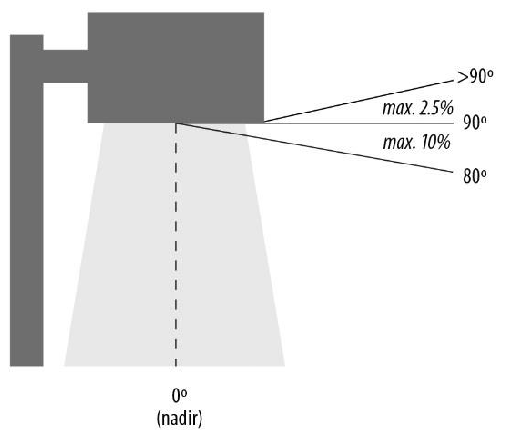
C.
Spillover light. Light trespass along the lot line of the subject property may not exceed 0.5 foot-candles when abutting an agricultural, agricultural-residential or residential zoning district and may not exceed 3.0 foot-candles when abutting any other zoning district or public right-of-way. Maximum illumination levels are measured three (3) feet above grade or from the top of any opaque screening fence or wall along the property line.
(Ord. No. 24382, § 15, 6-10-2020)
Section 67.040. - Lighting plans.
A.
General. Outdoor lighting plans demonstrating compliance with the standards of this section are required with the submittal of a site plan. If no outdoor lighting is proposed, a note must be placed on the face of the site plan indicating that no outdoor lighting will be provided. Applicants have two (2) options for the format of the required lighting plan:
1.
Submit a lighting plan that complies with the fixture height lighting plan requirements of Subsection 67.040B.; or
2.
Submit a photometric plan demonstrating that compliance will be achieved using taller fixture heights, in accordance with Subsection 67.040C.
B.
Option 1: Fixture Height Standard Lighting Plan. Option 1 (Fixture Height Standard Lighting Plans) establishes maximum light fixture heights but does not require submittal of a detailed photometric plan.
1.
Information required.
a.
Fixture height standard lighting plans must include at least the following: A scale drawing of the site with all outdoor lighting locations shown;
b.
Fixture specifications, including catalog cut-sheets or generic standards;
c.
Pole type and height of fixture;
d.
Lamp type and size; and
e.
Fixture mounting and orientation.
2.
Maximum Fixture Heights. Allowable heights of light fixtures must be measured from the light-emitting surface to finished grade at the base of the pole. Maximum allowed light fixture heights are based on the (ground-level) horizontal distance between the light fixture and any agricultural, agricultural-residential or residential zoning district or public right-of-way, as established in Table 67-1:
Table 67-1: Maximum Light Fixture Heights
C.
Option 2: Photometric Study. Under Option 2 (Photometric Study Lighting Plan) no maximum fixture heights are established, but applicants are required to submit a photometric study in enough detail to demonstrate that all applicable outdoor light standards will be met. The photometric study must include at least the following:
1.
A scale drawing of the site with all outdoor lighting locations shown;
2.
Fixture specifications, including catalog cut-sheets or generic standards;
3.
Lamp type and size;
4.
Fixture mounting heights, mounting orientation, and tilt angles if applicable; and
5.
A representative point-by-point illumination array for the site showing property lines and all off-site lighting impacts.
(Ord. No. 24382, § 16, 6-10-2020)
Section 67.050. - Measurement of illumination.
Light levels must be measured with a direct-reading, portable light meter, calibrated annually by an independent laboratory regularly engaged in the calibration of such instruments. The meter's sensor must be located at the top of the visual screening fence or wall along on the property line (or at a height of three (3) feet above finished grade at the property line if there is no fence or wall), aimed towards the subject property in horizontal position. Readings must be recorded after the value has stabilized. Measurements are made after establishment of darkness with the light sources to be measured illuminated, and then with those light sources extinguished. The difference between these two (2) readings must then be compared to the maximum allowed illumination at the property line. In this way, contributions to light levels by the moon and other ambient light sources are eliminated and the light intensity from the subject light sources can be accurately determined.

