
Tulsa City Zoning Code
CHAPTER 95
- DEFINITIONS
Section 95.010.- General.
Words and terms expressly defined in this zoning code have the specific meanings assigned unless the context clearly indicates another meaning. Words and terms that are not expressly defined in this zoning code have the meaning given in the latest edition of Merriam-Webster's Unabridged Dictionary.
Section 95.020. - Use definitions.
See Chapter 35 for an explanation of the use categorization system used in this zoning code and for use type definitions.
Section 95.030. - Measurement-related terms.
See Chapter 90 for an explanation of various lot and building regulation terms, such as "lot area," "building height," "setbacks" and "build-to-zone."
Section 95.040. - Terms beginning with "A".
Abut or abutting. To touch or share a contiguous boundary or border, except that in the context of hearing notice and screening or enclosure requirements, "abutting" includes properties that are contiguous or separated only by a non-arterial street, alley or railroad right-of-way.
Accessory use bar. A commercial establishment open to the public that sells and serves alcoholic beverages for consumption on the premises, but that is incidental and subordinate to and that occupies no more than twenty-five (25) percent of the floor area of a principal use restaurant or fraternal organization. In order to be classified as an accessory use bar, the bar must occupy the same principal building and contiguous tenant space as the principal use and not contain a separate exterior public entrance (i.e., it must be served solely by the customer entrance that serves the principal use restaurant, hotel/motel or fraternal organization).
Accessory dwelling unit. See Subsection 45.031A.
Accessory Use or Structure. A use or structure that meets the criteria established in Subsection 45.010B.
Adjacent. Lying near or in the immediate vicinity.
Agent. A person duly authorized to act on behalf of the owner of the subject property.
Alcoholic beverage. As defined in Title 37-A of Oklahoma Statutes.
Alley. A public right-of-way that affords a means of access to abutting property, generally secondary in nature.
All-weather surface (or material). A hard surface, dustless material capable, during ordinary use, of withstanding without substantial deterioration, normal weather conditions. Gravel, rock, or screenings, when treated with a road surface binder approved by the development administrator, meet the definition of an all-weather surface.
Applicant. The owner of the subject property or an agent authorized by the subject property owner to submit an application on the owner's behalf.
Arterial. A street designated on the major street and highway plan as an arterial, parkway or scenic drive.
Arts Commission. The Arts Commission of the City of Tulsa.
Average ground elevation. See Subsection 90.160A.1.a.
Awning. A roof-like structure typically made of cloth, metal or other material attached to a frame that extends from and is supported by a building. Awnings are typically erected over a window, doorway or building front and they may be raised or retracted to a position adjacent to the building.
(Ord. No. 24725, § 30, 11-17-2021; Ord. No. 25330, § 22, 6-5-2024)
Section 95.050. - Terms beginning with "B".
Base (zoning) district. Any zoning district that is not an overlay district.
Bioretention. The use of soil and plants to remove pollutants from stormwater runoff.
Block face. All lots abutting one side of a street between the two (2) nearest intersecting streets.
Board of Adjustment (BOA). The Board of Adjustment of the City of Tulsa.
Build-to-zone (or build-to line). See Section 90.110.
Building. A structure that is permanently affixed to the land; with or without a roof, or walls on all sides; and used or intended for supporting or sheltering any use or occupancy.
Building coverage. See Section 90.120.
Building height. See Section 90.160.
Section 95.060. - Terms beginning with "C".
Caliper. The diameter of the tree trunk measured at a point six (6) inches above the root ball or soil level.
Figure 95-1: Caliper (Tree) Measurement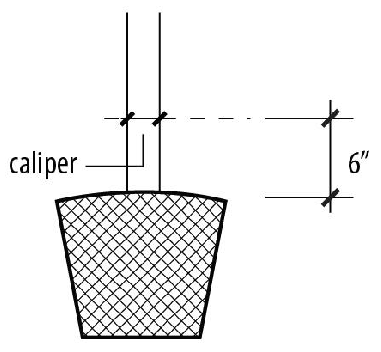
Carport. Any parking space or spaces having a roof, but not enclosed by walls, and accessory to a dwelling or dwellings. Parking garages and parking structures are not carports.
Car-share program. A system in which a fleet of cars (or other motor vehicles) is made available for use by members of the car-share program and that exhibit all of the following characteristics:
1.
Members are permitted to use vehicles from the car-share program fleet on an hourly basis;
2.
Car-share vehicles are generally available twenty-four (24) hours a day and seven (7) days a week to members in parking spaces at dispersed locations or facilities; and
3.
No separate written agreement is required each time a member reserves and uses a car-share vehicle.
Car-share vehicle. A motor vehicle from a car-share program fleet.
Character. Any letter of the alphabet or any numeral.
City. The City of Tulsa, Oklahoma.
City Council. The City Council of the City of Tulsa.
Coffee roasting. Applying heat to green coffee beans to produce darker roasted beans that can be used to brew coffee.
Cold frame. An unheated structure no more than four (4) feet in height used for protecting seedlings and plants from the cold.
Commercial message. Any sign, wording, logo, or other representation that directly or indirectly, names, advertises, or calls attention to a business, product, service or other commercial activity.
Comprehensive plan. The City of Tulsa's official comprehensive plan, as adopted by the planning commission and approved by the City Council.
Curb level. The average (mean) level of the established curb at the frontage of the subject lot. Where no curb has been established, the City Engineer is authorized to establish such curb level or its equivalent.
Section 95.070. - Terms beginning with "D".
Designated residential development area. An area specifically designated for residential development by conditions imposed in a PUD, MPD or CO district.
Design guidelines. The criteria used to guide the preservation commission in review of an application for an HP permit, unless the context clearly indicates another meaning.
Development. Any man-made change to improved or unimproved real estate, including but not limited to, buildings or other structures, mining, dredging, filling, grading, paving, excavation, or drilling operations.
Development Administrator. See Subsection 1.090I.8.
Development plan. See Section 70.040.
Diameter at breast height (DBH). The diameter of a tree trunk measured at a point four and one-half (4.5) feet above ground level at the base of the tree.
Figure 95-2: Diameter at Breast Height (DBH)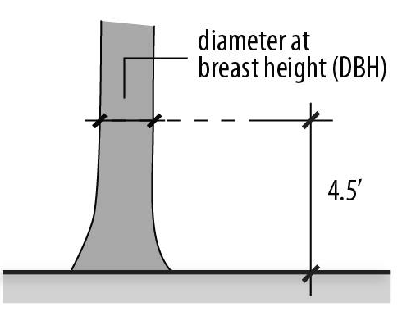
Donation bins. See "recyclable material bins/donation bins".
Dripline. The periphery of the area underneath a tree that would be encompassed by perpendicular lines extending from the exterior edges of the crown of the tree.
Figure 95-3: Dripline (of a Tree)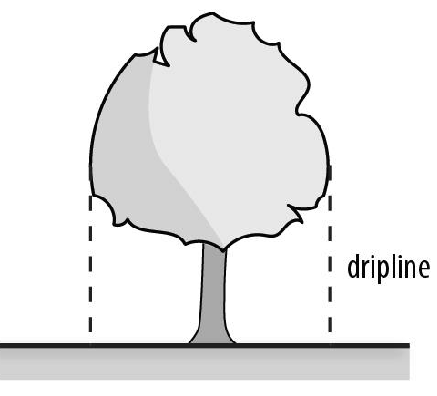
Dumpster. A container with a capacity of more than one and one-half (1.5) cubic yards or a height of more than four and one-half (4.5) feet that is designed for receiving, transporting, and depositing waste materials produced by uses that are on the subject site. Dumpsters are typically designed to be hoisted and emptied into a garbage truck. (See Section 45.050 for applicable regulations).
Dwelling unit. A room or group of rooms arranged, intended, or designed as a habitable unit, containing kitchen, bath and sleeping facilities, for not more than one household living independently of any other household.
(Ord. No. 24279, § 6, 12-11-2019; Ord. No. 25604, § 14, 6-18-2025)
Section 95.080. - Terms beginning with "E".
Electric vehicle. Any vehicle that is licensed and registered for operation on public and private highways, roads, and streets; either partially or exclusively, on electrical energy from the grid or an off-board source, that is stored on-board via a battery. "Electric vehicle" includes: (1) battery electric vehicles; and (2) plug-in hybrid electric vehicles.
Electric vehicle (EV) charging station. A public or private parking space that is served by battery charging station equipment.
Electric vehicle charging station, private (restricted-access)means an EV charging station that is not available for use by the general public. Examples include electric vehicle charging stations that serve residential homeowners or renters, executive parking areas, designated employee parking areas and fleet parking areas.
Electric vehicle charging station, public. An EV charging station that is accessible to and available for use by the general public.
Electric vehicle parking space. Any parking space that is clearly identified to be used exclusively for the parking of an electric vehicle.
Electrical fence charger system. A labeled circuit arrangement, whether energized by a battery or other electrical power source that is or is designed or intended to impart an electrical shock to any person or animal coming in contact with such un-insulated conductors.
Section 95.090. - Terms beginning with "F".
Floor area. See Section 90.040.
Floor area ratio. See Section 90.050.
Floor-to-ceiling height. See Section 90.130.
Foot-candle. A measure of illumination, the amount of light falling onto a surface. One lumen of light, shining evenly across one square foot of surface, illuminates that surface to one foot-candle.
Freeway. A street designated as a freeway on the major street and highway plan.
Section 95.100. - Terms beginning with "G".
Garage sale. The sale of tangible personal property at retail by a person who is not in the business or does not hold himself or herself out to be in the business of selling tangible personal property at retail, when such sale occurs on residentially-zoned property (including in a garage, on a driveway, patio or porch, in the yard or in the residential structure) and is open to the public. Also referred to as yard sale, estate sale, moving sale, occasional sale, etc.
Geothermal heat exchange system. Equipment that exchanges thermal energy between the ground (or a water source) and a building. This includes vertical closed loop, horizontal closed loop, water body closed loop system and open loop systems. Also known as ground source heat pumps and geothermal heat pumps.
Grade, finished. The vertical location of the ground or pavement surface after site grading work is completed in accordance with an approved plan.
Green roof. An extension of an above-grade building roof that includes at least a waterproof membrane, a root repellent system, a drainage system, a filtering layer, soil with a minimum depth of three (3) inches and native or naturalized plants. Also commonly referred to as a "vegetated roof."
Ground-floor level. The lowest level of a building that is at or above grade for at least fifty (50) percent of its interior floor-to-ceiling height.
Section 95.110. - Terms beginning with "H".
Height, building. See Section 90.160.
Height, sign. See Subsection 60.130B.
Historic preservation. The adaptive use, conservation, protection, reconstruction, rehabilitation, restoration, or stabilization of a historic resource.
Adaptive use. The restrained alteration of a historic resource to accommodate uses for which the resource was not originally constructed, but in such a way so as to maintain the general historical and architectural character.
Conservation. The sustained appearance of a historic resource essentially in its existing state.
Protection. The security of a historic resource as it exists through the establishment of the mechanisms of this zoning code.
Reconstruction. The process of recreating or reproducing by new construction all or part of the form and detail of a vanished historic resource as it appeared at a specific period in time.
Rehabilitation. The process of recreating a historic resource to a state of efficiency or soundness by repair or alteration designed to encourage its continued use, but without noticeably changing the exterior appearance of the historic resource.
Restoration. The process of accurately recovering all or part of the form and detail of a historic resource and its setting as it appeared at a particular period of time by means of the removal of later work and the replacement of missing earlier work.
Stabilization. The process of applying measures designated to halt deterioration and to establish the structural stability of an unsafe or deteriorated resource while maintaining the essential form as it presently exists and without noticeably changing the exterior appearance of the historic resource.
Historic preservation district. A supplemental zoning district consisting of a building, structure, or site or an area containing buildings, structures, or sites that is a historic resource.
(Historic preservation) work. Solely for purposes of administering and enforcing the historic preservation-related provisions of this zoning code, "work" means any changes to an existing building, structure, or lot, or any portion thereof, including but not limited to, the erection, construction, reconstruction, renovation, alteration, painting, removal, or demolition of a building, structure, or lot, irrespective of whether or not a building permit is required.
Historic resource. A building, structure, site or area containing a concentration, linkage, or continuity of buildings, structures, or sites that are generally fifty (50) years or older and that contain one or more of the following attributes:
1.
Significant characteristics, interest, or value as part of the historical development, history, or cultural heritage of the city, state, or nation;
2.
Significance as the site of a historic event in the past of the city, state, or nation;
3.
Associated with a person, or group of persons, who played a significant role in the historical development, history, and cultural heritage of the city, state, or nation;
4.
That is the embodiment of distinguishing characteristics, design, details, materials or craftsmanship which represent a historically significant architectural or engineering innovation, type, style or specimen;
5.
That portrays the environment in an era of history characterized by a distinctive architectural, engineering, or construction style;
6.
That represents a significant and distinguishable entity of historical importance whose components may lack individual distinction;
7.
Yielded and is likely to yield, information important in prehistory or history; or
8.
Meets the criteria for listing on the National Register of Historic Places.
Historic resource: Significant characteristics. Those characteristics that are important to the historic resource by design or location, and include, but are not limited to materials, detail, height, orientation, proportion, rhythm, scale, setback, setting, shape, and workmanship.
Materials. The physical elements of a building, structure, site, or area that create an aesthetic and structural appearance of the resource, including characteristics such as texture, form, composition, and style.
Detail. Aspects of a building, structure, site or area which, due to particular treatment, draw attention to certain parts or features of the building, structure, site, or area.
Orientation. The position of a building, structure, site, or area relative to a particular point in which it is viewed or in relation to other fixed elements in the environment.
Proportion. The visible relationship and order established between buildings, structures, sites or areas, their individual parts to one another, as well as between the parts and the whole.
Rhythm. The regular pattern or harmonious recurrence of lines, shapes, or forms, such elements occurring within or between buildings, structures, sites or areas; including, but not limited to, windows, doors, roofs, porches, driveways, sidewalks, setbacks and heights.
Scale. The size of the parts of a building, structure, site or area in relationship to one another and to the human figure.
Setback. The location of a building or structure as it relates to the street and other buildings and structures around it.
Setting. The surrounding buildings, structures, landscaping and familiar features which provide a visual aesthetic or perceptual quality to historic resources.
Shape. The physical configuration of a building, structure, site or area, established by its form, surfaces, edges, height, width, and depth.
Workmanship. A level of quality exhibited in the construction, detailing, or design of a historic resource.
Home occupation. An accessory use of a dwelling unit for business or commercial purposes. Home occupations are subject to the regulations of Section 45.100.
Hoop house. A temporary or permanent structure typically made of flexible pipe or other material covered with translucent plastic, constructed in a "half-round" or "hoop" shape, for the purposes of protecting and cultivating plants. A hoop house is considered more temporary than a greenhouse.
Household. One or more persons who inhabit a single dwelling unit, as a single housekeeping unit, that is: (1) traditionally characterized by matrimonial or parent-child relationship, provided that all such persons are related by blood, marriage, adoption, fosterage, or guardianship and no more than two (2) unrelated inhabitants are included in the housekeeping unit; or (2) predominantly characterized by voluntary associational, communal relationships, provided no more than eight (8) inhabitants are included in the housekeeping unit. The term "household" expressly includes community-based residential facilities licensed by or contracted with the Oklahoma Department of Human Services that provide care or supervision by a responsible adult for no more than eight (8) individuals with developmental or physical disabilities as a single housekeeping unit.
HP permit. The official document issued by the Preservation Commission authorizing work within an HP district.
Section 95.120. - Terms beginning with "I".
Inoperable vehicle. Any motor vehicle from which, for a period of seven (7) days, the engine, wheels, or other parts have been removed, or in which the engine, wheels, or other parts have been altered, damaged, or otherwise modified so that the vehicle is incapable of being driven under its own motor power. "Inoperable motor vehicle" does not include a motor vehicle that has been rendered temporarily incapable of being driven under its own motor power, solely to perform ordinary service or repair operations.
Intersection, signalized. The area where motor vehicle traffic is regulated by an official traffic control signal or light, which is also embraced within the prolongation or connection of the lateral curb lines, or if none, then the lateral boundary lines of the roadways of two (2) streets that join one another at or approximately at right angles, or the area within which vehicles travel upon different streets joining at any other angle that may conflict, whether or not one such street or roadway crosses the other.
Section 95.150. - Terms beginning with "L".
Landscaped area. The unpaved area of a lot that contains grass, shrubs, flowers, ground cover, trees or plant materials and that may include decorative fixtures such as rock, pools and planters. Areas of a lot containing artificial plants, artificial trees or other artificial vegetation are not considered landscaped area.
Land use administrator. See Subsection 1.090I.10.
Lawfully established. A use, structure, lot or sign (as the context indicates) that was established in conformance with all applicable zoning code regulations in effect at the time of its establishment.
Less intensive zoning district. A zoning district classification that is identified as being less intensive than another zoning district within the same grouping of districts, as indicated in Table 5-1, Table 10-1, Table 15-1. Overlay districts, special district and zoning districts that are expressly excluded from the relative intensity scales identified in these tables do not qualify as less intensive zoning districts.
Light trespass. Light that is emitted into an unintended area.
Liner building. A building or portion of a building that is specifically designed to mask a parking garage or structure from frontage on a public street and that consists of habitable or occupiable floor space.
Lot. A lot of record.
Lot area. See Section 90.020.
Lot area per unit. A measurement of allowed residential density. See Section 90.030.
Lot, corner. A lot abutting two (2) or more streets at their intersection or upon two (2) segments of the same street, when such segments form an interior angle of less than one hundred thirty-five (135) degrees. The point of intersection of street rights-of-way lines is the corner.
Lot, double-frontage. An interior lot with frontage on more than one street or a corner lot with frontage on more than two (2) streets.
Lot, interior. A lot other than a corner lot.
Lot of record. A lot that is part of a subdivision, the plat of which is recorded in the county clerk's office; a parcel of land, the conveyance of which is lawfully recorded in the county clerk's office; or the balance of a parcel of land where the conveyance of another portion of that parcel is lawfully recorded in the county clerk's office.
Lot line. Any boundary of a lot.
Figure 95-4: Lot Lines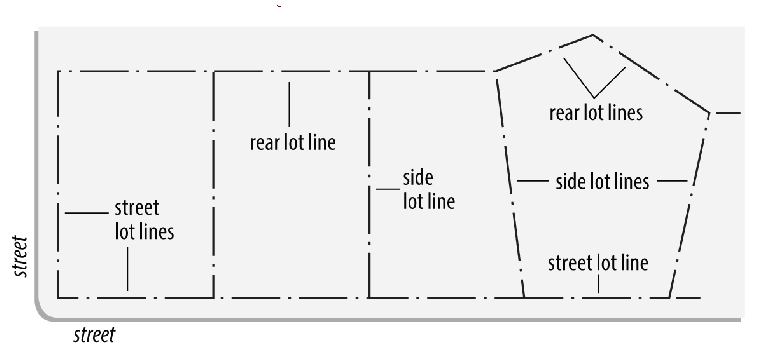
Lot line, front. The boundary of a lot that abuts the street. Unless otherwise expressly stated, the owner of the subject property may select which lot line is the front lot line on corner lots.
Lot line, rear. The boundary of a lot that is most distant from and most nearly parallel to the front lot line.
Figure 95-6: Rear Lot Line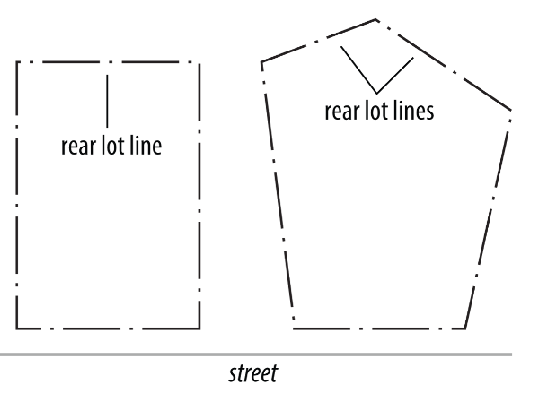
Lot line, side. Any boundary of a lot that is not a street lot line or a rear lot line.
Figue 95-7: Side Lot Lines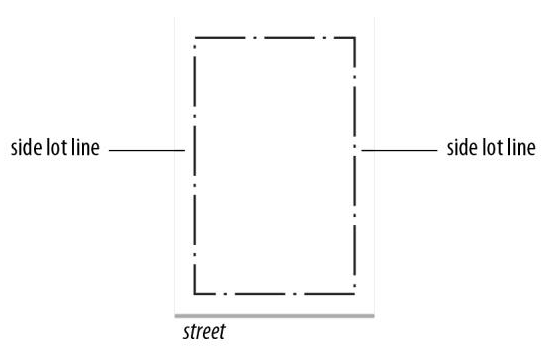
Lot line, street. The boundary of a lot that abuts a street. A lot may have more than one street lot line, and a street lot line may also be a front lot line.
Figue 95-5: Street Lot Line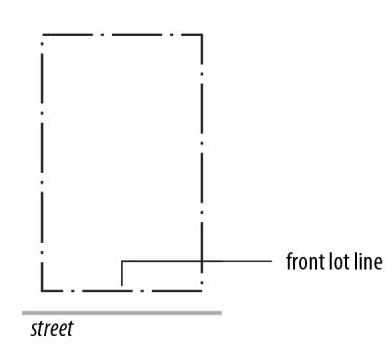
Lot width. See Section 90.060.
Low-impact development (LID). An approach to land development (or redevelopment) that works with nature to manage stormwater as close to its source as possible. LID employs principles such as preserving and recreating natural landscape features, minimizing impervious area to create functional and appealing site drainage features that treat stormwater as a resource rather than a waste product. Common LID practices include bioretention facilities, rain gardens, green roofs, rain barrels or cisterns, and permeable paving.
(Ord. No. 25055, § 12, 5-24-2023; Ord. No. 25330, §§ 23, 24, 6-5-2024)
Section 95.160. - Terms beginning with "M".
Major street and highway plan. The Tulsa Metropolitan Area Major Street and Highway Plan, which is adopted as a functional element of the comprehensive plan.
Massage therapy. The manipulation of soft or connective tissues of the human body to alleviate pain, enhance circulation, improve joint mobilization, relieve stress or muscle tension. This definition expressly excludes sexually oriented business establishments and any manipulation of the human body associated with a sexually oriented business establishment.
Mobile storage unit, temporary. A mobile, fully enclosed container that is specifically designed and used for the temporary storage of household goods, wares, and materials for the purpose of moving, relocation, or temporary storage during construction. This definition does not include a shipping or cargo container, modified or otherwise.
Multi-tenant development. A development typically under unified ownership and control consisting of two (2) or more business establishments, which may be on the same lot or on separate lots. The tenants of multi-tenant development typically share vehicle access and parking facilities.
Section 95.170. - Terms beginning with "N".
NA (or -). Not applicable or no requirement.
Neon. Gas-filled tubing made of glass or similar products which creates illumination when charged with electricity. Tubing may contain alternatives such as light-emitting diodes (LED) provided that any alternative must produce illumination that is a continuous, uninterrupted line similar to illumination produced by gaseous illumination technology.
NIT. A unit of illuminative brightness equal to one candela per square meter, measured perpendicular to the rays of the source.
Nonconforming development feature. See Subsection 80.070A.
Nonconforming lot. See Subsection 80.020A.
Nonconforming use. See Subsection 80.040A.
Nonconforming sign. See Subsection 80.060A.
Nonconforming structure. See Subsection 80.030A.
Nonconformity. A nonconforming lot, nonconforming use, nonconforming structure, nonconforming development feature or nonconforming sign.
Nonresidential building. Any principal building other than a residential building.
Nonresidential development area. An area designated for nonresidential development on an approved development plan, such as in a PUD, MPD or CO district.
Nonresidential district or nonresidential zoning district. Any zoning districts other an R (residential) district.
Section 95.180. - Terms beginning with "O".
Open-air uses. Uses of land that do not involve buildings or that involve buildings that are incidental and accessory to the open-air use of the lot. Typical examples include storage yards, vehicle impound yards, auto wrecking and junkyard uses.
Open space per unit. See Section 90.080.
Outdoor customer seating/dining area. The area of all unenclosed areas used or intended to be used for seating and dining by customers and guests, including standing table areas.
Overlay district. A zoning district that over-lays one or more base zoning districts and imposes requirements in addition to those of the base district or modifies the regulations otherwise applicable in the base zoning district.
Section 95.190. - Terms beginning with "P".
Package store. As defined in Title 37-A of Oklahoma Statutes.
Parapet or parapet wall. A wall-like barrier at the edge of a roof that acts as a vertical extension of an exterior building wall extending above the roof height of the building. Parapets may serve as a safety or architectural feature.
Parking area. The vehicular driving surfaces and parking area which includes the parking spaces, the maneuvering areas necessary to enter and exit the spaces and the drives providing access to the parking spaces and maneuvering areas from a public or private street or other parking areas.
Parking space, off-street. A space on a lot intended and reserved for the parking of an automobile.
Parking space, required off-street. A space on a lot reserved for parking required by this zoning code.
Permanent foundation. A foundation that meets the requirements established in Title 51 Tulsa Revised Ordinances.
Photovoltaic cell. A semiconductor device that converts solar energy into electricity.
Planned (street) right-of-way. The right-of-way designated in the Tulsa Metropolitan Area Major Street and Highway Plan.
Planning commission. See Subsection 1.090I.4.
Planning director. See Subsection 1.090I.4.
Preservation (historic). See "historic preservation."
Preservation commission. See Subsection 1.090I.7.
Preservation officer. See Subsection 1.090I.8.
Principal building. A building or combination of buildings of chief importance or function on a lot. In general, the principal use is carried out in the principal building.
Principal use. A use or activity or combination of which are of chief importance on the lot; one of the main purposes for which the land, buildings or structures are intended, designed or ordinarily used.
Proof gallon. One liquid gallon of beverage grade spirits that is fifty (50) percent alcohol by volume at sixty (60) degrees F. Note: Spirits bottled at eighty (80) proof (forty (40) percent alcohol) would be 0.8 proof gallons per gallon of liquid. At one hundred twenty-five (125) proof, a gallon of liquid would be 1.25 proof gallons.
Section 95.210. - Terms beginning with "R".
Rainwater harvesting equipment. A rain barrel, cistern or similar container that collects and stores rainwater or other water that would otherwise be lost as runoff.
Recreational vehicle (RV). A trailer, boat trailer, travel trailer, camping trailer, truck camper, camper shell, motor home, tent trailer, boat, houseboat, or similar vehicle or unit. Camper shells that are attached to a pickup truck are not considered a recreational vehicle.
Recyclable material bins/donation bins. A container or drop box with a capacity of more than one and one-half (1.5) cubic yards or a height of more than four and one-half (4.5) feet that is provided for receiving and temporary storing of recyclable materials or salvageable personal property such as paper, metal, glass, and plastic as well as clothing, shoes, books, and toys. Recyclable material bins/donation bins may receive items to be reused or resold for the purpose of charitable solicitation. Recyclable material bins/donation bins include both containers used by uses located on the subject site and those used by consumers who bring their recyclables from other (off-site) locations. (See Section 45.051 for applicable regulations.)
Residential building. A detached house, townhouse, duplex or apartment/condo building. (See also building types described in Section 35.010.)
Residential development area. An area designated for residential development on an approved development plan, such as in a PUD, MPD or CO district.
Retaining wall. A vertical structure built from stone or brick masonry, reinforced concrete, segmented block or other material approved by the development administrator and built to support earth of a higher level on one side than on the other.
Roomer. An occupant of a rooming unit who is not a member of the household occupying the principal residential building.
Rooming unit. Any habitable room or group of adjoining habitable rooms that is an accessory use to a household living use and forming a single unit with facilities that are used or intended to be used primarily for living and sleeping but not for cooking.
Route 66 Commission. The Route 66 Commission of the City of Tulsa.
(Ord. No. 24279, § 7, 12-11-2019; Ord. No. 25322, § 5, 5-22-24; Ord. No. 25330, § 25, 6-5-2024)
Section 95.220. - Terms beginning with "S".
Setback. An open, unobstructed area that is required to be provided by this zoning code. See Section 90.090.
Sexual conduct. Any and all of the following: (1) the fondling or other touching of human genitals, pubic region, buttocks, or female breasts; (2) ultimate sex acts, normal or perverted, actual or simulated, including intercourse, oral copulation, sodomy; (3) masturbation; and (4) excretory functions as part of or in connection with any of the activities set forth in (1) through (3) above.
Sign. Any object, device, structure or part thereof used to advertise, identify, display or attract attention to an object, person, institution, organization, business, product, service, event or location by any means, including words, letters, figures, designs, symbols, fixtures, colors, illumination or projected images. Signs as defined herein do not include temporary holiday decorations; or landscape features that display no words or symbols.
Sign, animation. The presentation of pictorials and graphics on signs displayed in a progression of frames that give the illusion of motion, including but not limited to the illusion of moving objects, moving patterns or bands of light, or expanding or contracting shapes.
Sign area. See Subsection 60.130A.
(Sign) banner. A sign composed of lightweight, flexible, non-rigid material that is mounted to a pole or a structure at one or more edges either vertically or horizontally. Flags are not considered banners.
Sign budget. Sign regulations governing the maximum aggregate number and/or maximum aggregate area of all or a defined group of signs on a lot.
Sign, campaign. A temporary sign displayed on a lot during an active local, state or federal campaign for public office or ballot issue or referenda.
(Sign) commercial message. See "commercial message."
Sign, construction. A temporary sign located on a lot upon which building or construction is actively occurring.
Sign corridor, freeway. An area four hundred (400) feet in width on each side of and adjacent to the publicly acquired right-of-way of a freeway.
Sign, development plan. A sign approved as part of a development plan (See Section 70.040) that directs attention to a business, commodity, service, or activity that is conducted, sold, or offered on property that lies within the boundaries of an approved development plan covering a contiguous area that includes both the subject sign and the subject business, commodity, service, or activity.
Sign, drive-through. A sign located on the site of an allowed drive-through use.
Sign, driveway. A sign located near a driveway entrance from a street or near an internal site driveway or drive aisle. (See also Subsection 60.030A.)
(Sign) dwell time. The duration or interval of time during that each individual advertisement or message is displayed on any sign with a dynamic display.
Sign, dynamic display. Any element of a sign or sign structure capable of displaying words, symbols, figures, images or messages that can be electronically or mechanically changed by remote or automatic means. This also includes any display that incorporates rotating panels, LED lights manipulated through digital input, "digital ink" or any other method or technology that allows a sign to present a series of images, messages or displays. This does not include electronic message center signs.
Sign, electronic message center. An electronic sign or portion thereof which displays alphanumeric characters only, which can be electronically changed or rearranged without altering the face or the surface of the sign.
(Sign) flag. A generally rectangular or triangular sign or part of a sign made of fabric or other pliant material attached to a flagpole only along one side and which predominately displays distinctive colors, images, shapes or designs rather than legible words, letters, numbers or other linguistic characters.
Sign, flashing (illumination). A light source or other image that in whole or in part physically changes in light intensity or gives the appearance of such change.
Sign, freestanding. A sign that is part of a self-supporting structure, other than a building or portion of a building. Sometimes referred to as a "ground sign."
Figure 95-8: Freestanding Sign
Sign, height of. See Subsection 60.130B.
Sign, illuminated. Any sign, other than a dynamic display, that is directly lighted by any constant light source, internal or external, except light sources specifically and clearly operated for the purpose of lighting the general area in which the sign is located rather than the sign itself.
Sign, illumination and luminance. See Subsection 60.130D.
Sign, monument. A freestanding sign where the base of the sign structure is on the ground or no more than twelve (12) inches above the ground adjacent to the sign. Typically constructed of brick, wood, stone, or metal, monument signs have a base that is at least seventy-five (75) percent of the width of the sign face.
(Sign) nameplate. A sign attached flush against a building.
Sign, off-premise business. A sign that directs attention to a business, commodity, service, or activity that is conducted, sold or offered within the development where the subject sign is located and that is expressly approved as part of a mandatory development plan.
Sign, off-premise outdoor advertising. See Subsection 35.100B.
Sign, on-premise. A sign that directs attention to a business, commodity, service, or activity that is conducted, sold or offered upon the lot where the subject sign is located.
Sign, projecting. A sign that is affixed to a building wall, canopy, awning or marquee and that extends horizontally more than fifteen (15) inches from the wall, canopy, awning or marquee.
Figure 95-9: Projecting Sign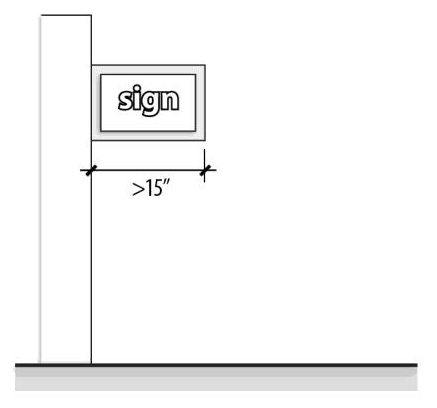
Sign, promotional. A temporary sign that is located on a lot on which a business promotion is actively occurring and that consists of tinsel, flags, balloons, banners, wind devices, or similar attention-getting devices, whether or not the same contain any words, numbers or characters.
Sign, real estate. A temporary sign located on a lot or portion of a lot that is actively being marketed for sale, rental or lease.
Sign, roof. A sign that is affixed to a roof, extended roof, pitched roof, or canopy, and that extends above the building wall or parapet wall.
(Sign) rules of measurement. See Section 60.130.
Sign, special event. A sign approved in connection with a special event permit approved by the city council. (See also Subsection 60.030E.6.)
(Sign) storyboarding. The consecutive display of advertisements or messages on a sign, used to provide a continuing or evolving message, theme or story.
(Sign) static message. An advertisement or message that, when displayed, contains no motion, flashing, changeable copy, running lights, variances in brightness, or animation.
Sign, wall. A sign affixed to a building wall, canopy, awning, marquee or parapet wall, or a sign displayed in or on a door that does not extend horizontally more than fifteen (15) inches from the wall, canopy, awning, marquee, parapet wall, or door, nor extend above the parapet wall.
(Sign) wind device. Any flag, banner, pennant, streamer or similar device that moves freely in the wind.
Sign, window. A sign attached to a window.
(Sign) word. Any and all of the following (otherwise, each separate character is considered to be a word):
1.
A word in any language found in any standard unabridged dictionary or dictionary of slang.
2.
A proper noun or any initial.
3.
A separate symbol or abbreviation, such as "&", "S", "%" and "INC".
4.
A telephone number, street number or commonly used combination of numerals and/or symbols such as "$5.00" or "50%".
5.
A symbol or logo that is a registered trademark, but that itself contains no word or character.
Figure 95-10: Wall Sign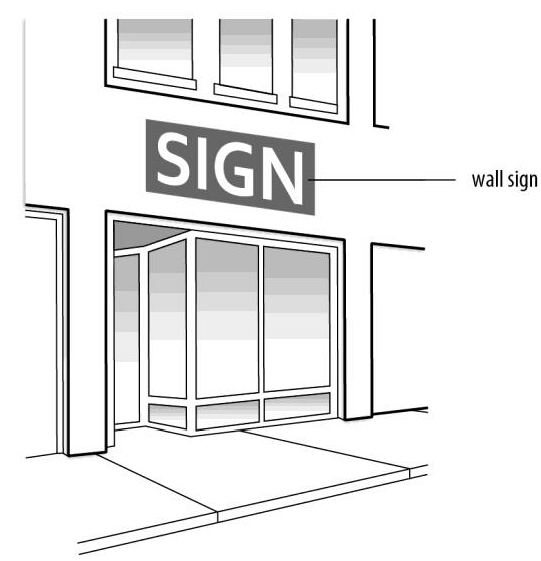
Site Plan. A detailed plan or set of plans depicting the arrangement of buildings, parking, landscaping, lighting, walls, grading, elevations, building materials, signs, dumpsters, and other information necessary to determine compliance with applicable regulations. (See also Section 70.050.)
Solar energy system. A system intended to convert solar energy into thermal, mechanical or electrical energy.
Solar energy system, building-integrated. A solar energy system that is an integral part of a principal or accessory building, rather than a separate mechanical device, replacing or substituting for an architectural or structural part of the building. Building-integrated systems include, but are not limited to, photovoltaic or hot water systems that are contained within roofing materials, windows, skylights, shading devices and similar architectural components.
Figure 95-11: Building-Integrated Solar Energy System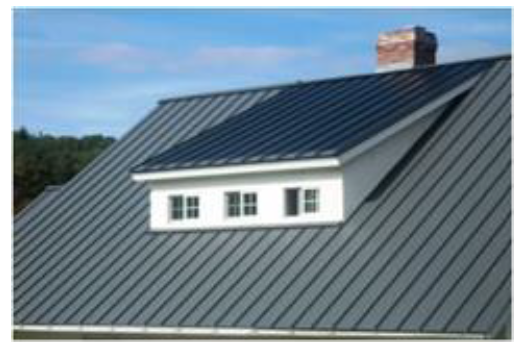
Solar energy system, structure-mounted. A solar energy system that is mounted on the façade or roof of either a principal or accessory structure.
Figure 95-12: Structure-mounted Solar Energy System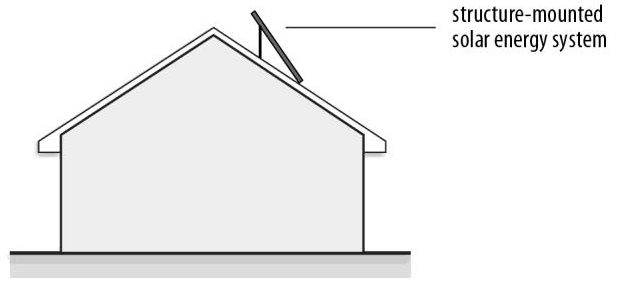
Solar energy system, flush-mounted. A solar energy system that is mounted flush with a finished building surface, at no more than six (6) inches in height above that surface.
Figure 95-13: Flush-Mounted Solar Energy System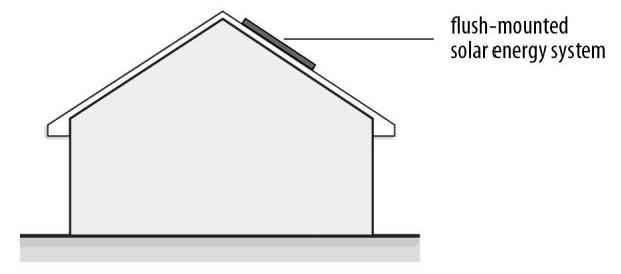
Solar energy system, ground-mounted. A solar energy system mounted on the ground and not attached to any other structure other than structural supports.
Figure 95-14: Ground mounted Solar Energy System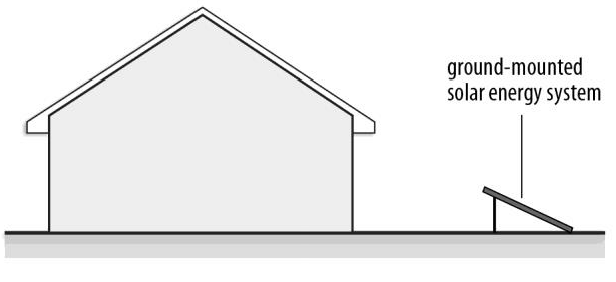
Solar panel. A group of photovoltaic cells assembled on a panel. Panels are assembled on-site into solar arrays.
Special event. An temporary event or group of related temporary events typically involving a mass gathering of people on public right-of-way or public property; or on private property in a manner that results in significant impacts on public property or right-of-way.
Special exception. A use or a design element or characteristic of a use or development that is not permitted by right because of potential adverse effect, but that if controlled in the particular instance as to its relationship to the neighborhood and to the general welfare, may be permitted by the board of adjustment. In order to be approved as a special exception, the special exception must be expressly authorized by this zoning code and reviewed in accordance with the substantive and procedural standards of this zoning code.
Specified anatomical areas. Any and all of the following: (1) human genitals, pubic region, buttocks, and female breasts below a point immediately above the top of the areola; and (2) human male genitals in a discernible turgid state, even if completely and opaquely covered.
Street-facing building entrance. See Section 90.150.
Street frontage. See Section 90.070.
Street, major. All classifications of streets shown on and defined by the major street and highway plan, except residential collector streets. Major streets include freeways and freeway service roads.
Street, minor. All classifications of public streets not defined as major streets.
Street, perimeter. A public street that abuts the exterior boundary of a residential or nonresidential development.
Street wall. The wall or part of the building nearest the abutting street.
Street yard. See "yard, street".
Structure. Anything constructed or erected with a fixed location on the ground, or attached to something having a fixed location on the ground, and includes buildings, parking areas, walks, fences canopies and signs.
(Ord. No. 24279, § 8, 12-11-2019; Ord. No. 24382, § 20, 6-10-2020; Ord. No. 25512, §§ 2, 3, 1-29-2025)
Section 95.230. - Terms beginning with "T".
Tasting room. A room that is ancillary to the production of beer at a microbrewery or large brewery where the public can purchase and /or consume only the beer produced on site.
Tent. Any structure, enclosure, or shelter constructed of fabric or other pliable material supported by any manner except by air or the contents protected by the material.
Top plate. The horizontal timber directly carrying the trusses of a roof or the rafters.
Figure 95-15: Top Plate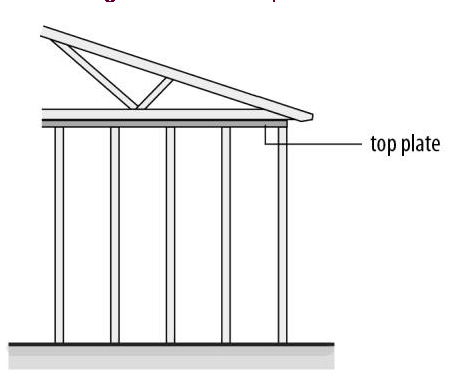
Transition time. The duration or interval of time between which each individual advertisement or message is displayed on any dynamic display.
Transparency. See Section 90.140.
Tree. A woody plant having one or more defined stems or trunks.
Tree, large. A tree that will attain a mature height of over sixty (60) feet and a spread or canopy that is at least thirty-five (35) feet in width.
Tree, medium. A tree that will attain a mature height of between thirty (30) and sixty (60) feet and a spread or canopy that is at least twenty-five (25) feet in width.
Tree, small. A tree that will attain a mature height of less than thirty (30) feet and a spread or canopy that is at least fifteen (15) feet in width.
Tulsa Metropolitan Area Planning Commission. See Subsection 1.090I.4.
Section 95.240. - Terms beginning with "U".
Utility-scale energy production. An energy production facility that produces electric energy for widespread distribution through the electric power grid.
Section 95.250. - Terms beginning with "V".
Variance. See Section 70.130.
Vehicle fuels, alternative. Electricity, CNG (compressed natural gas), LNG (liquefied natural gas), LPG (liquefied petroleum gas), and hydrogen.
Vehicle fuels, conventional. Gasoline and diesel fuel.
Section 95.260. - Terms beginning with "W".
Walkability. The extent to which the built environment is safe and inviting for pedestrians and for the presence of people living, shopping, visiting, enjoying or spending time in an area.
Walkway. A clearly defined path for non-motorized movement between buildings, structures, destinations, or other walkways on or adjacent to a site.
Wind energy conversion system. A device that directly converts wind energy into usable thermal, mechanical, or electrical energy, including such devices as windmills and wind turbines. The "system" includes towers and supporting structures and directly connected facilities such as generators, alternators, inverters, batteries, and associated control equipment.
Wind energy conversion system, small. A wind energy conversion system with a power-related capacity of no more than one hundred (100) kW that is primarily intended to produce power for on-site consumption, as a supplement to utility power or in lieu of utility power. Small wind energy systems are often connected to the electric utility for the purpose of "net metering."
Window area. See Subsection 60.130E.
Section 95.280. - Terms beginning with "Y".
Yard. An actual (as opposed to "required") open, unoccupied space that exists on a lot between a principal building and a lot line.
Figure 95-16: Yards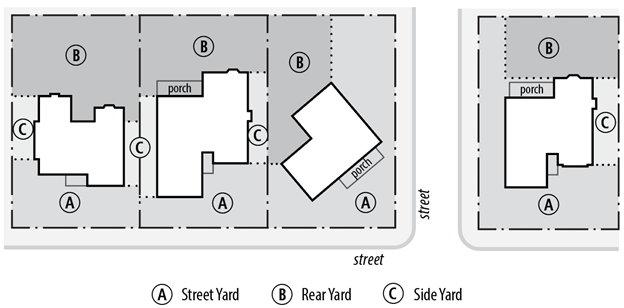
Yard, front. A yard extending along the full length of the front lot lines between the side lot lines.
Yard, rear. A yard extending along the full length of the rear lot line between the side lot lines.
Figure 95-17: Rear Yard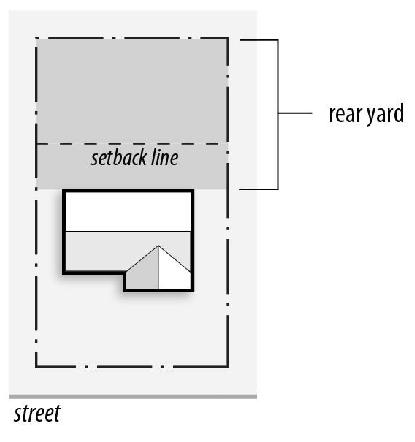
Yard, side. A yard extending along a side lot line between the front yard and the rear yard.
Figure 95-18: Side Yard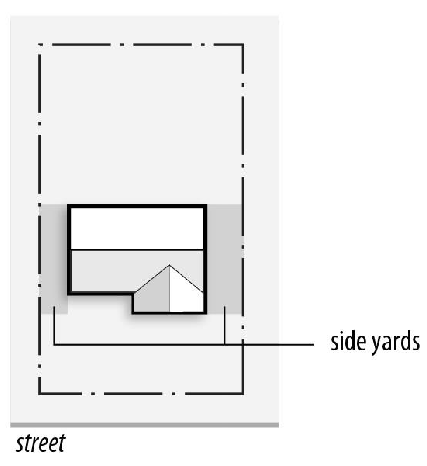
Yard, street. Any yard abutting a street.
Figure 95-19: Street Yard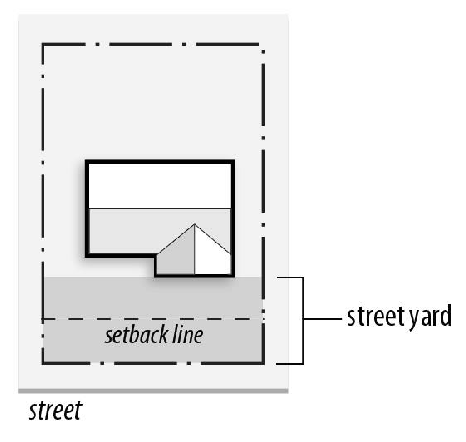
(Ord. No. 25656, § 35, 9-10-2025)

