
Tulsa City Zoning Code
CHAPTER 70
- REVIEW AND APPROVAL PROCEDURES
Section 70.010.- Common provisions.
A.
Applicability. The common provisions of this section apply to all of the procedures in this chapter unless otherwise expressly stated.
Table 70-1: Review and Decision-making Authority Summary Table
Table 70-1 Notes:
[1]
Unless alternative site plan review procedure/decision-maker is established by city council at time of development plan approval (see Subsection 70.050C.).
[2]
Preservation officer (staff) authorized to act on some applications (see Subsection 70.070K.).
[3]
Development administrator authorized to issue written interpretations.
[4]
Development Administrator authorized to verify spacing and separation distance requirements.
[5]
Special notice requirements for minor special exceptions (See Subsection 70.120E.).
[6]
Appeals of administrative decisions on site plans go to the planning commission.
[7]
Notice required for planning commission public hearing but not for city council public hearing.
B.
Review and decision-making authority (summary table). Table 70-1 provides a summary of the review and approval procedures of this chapter. In the event of conflict between this summary table and the detailed procedures contained elsewhere in this chapter, the detailed procedures govern.
C.
Applications and fees.
1.
Owner-initiated applications. Whenever the provisions of this zoning code allow the filing of an application by the owner of the subject property, that application must be filed by all record title owners of the real properties that are the subject of the application or the property owners' authorized agent.
2.
Pre-application meetings.
a.
Purpose. Pre-application meetings provide an early opportunity for staff and applicants to discuss the procedures, standards and regulations required for development approval under this zoning code.
b.
Applicability. Pre-application meetings are required whenever the provisions of this zoning code expressly state that they are required. They are encouraged in all cases.
c.
Scheduling. Pre-application meetings must be scheduled with the land use administrator.
d.
Guidelines. The land use administrator is authorized to establish guidelines for pre-application meetings, including information that should be provided and any available alternatives to face-to-face meetings, such as telephone conversations and email correspondence.
3.
Form of application.
a.
Applications required under this zoning code must be submitted in a form and in such numbers as required by the official responsible for accepting the application. Applications must include materials and information to assist authorized review and decision-making bodies in their consideration of the application, including at least the following:
(1)
A list of the names and addresses of all owners of record of the property that is the subject of the application; and
(2)
Maps, plats, surveys, dimensioned site plans, engineering documents, environmental reports, traffic studies, and other materials and information, as required by this zoning code or application checklists established by the official responsible for accepting the application. Application forms and submittal requirements must be made available to the general public.
4.
Application filing fees and notification costs. All applications must be accompanied by the application fee that has been established by the city council and by an amount to cover the costs of required public hearing notices and publication.
5.
Application completeness, accuracy and sufficiency.
a.
An application will be considered complete and ready for processing only if it is submitted in the required number and form, includes all required information and is accompanied by the required application filing and notification fees.
b.
The official responsible for accepting the application must make a determination of application completeness within ten (10) business days of application filing.
c.
If an application is determined to be incomplete, the official responsible for accepting the application must provide notice to the applicant along with an explanation of the application's deficiencies. Notice of an incomplete application may be provided by personal service, electronic mail or first-class mail.
d.
No further processing of incomplete applications will occur and incomplete applications will be pulled from the processing cycle. When the deficiencies are corrected, the application will be placed in the first available processing cycle. If the deficiencies are not corrected by the applicant within sixty (60) days, the application will be deemed to have been withdrawn.
e.
Applications deemed complete will be considered to be in the processing cycle and will be reviewed by staff and other review and decision-making bodies in accordance with applicable review and approval procedures of this zoning code.
f.
The official responsible for accepting the application may require that applications or plans be revised before being placed on an agenda for possible action if the land use administrator determines that:
(1)
The application or plan contains one or more significant inaccuracies or omissions that hinder timely or competent evaluation of the plan's/application's compliance with zoning code requirements or other regulations;
(2)
The application contains multiple minor inaccuracies or omissions that hinder timely or competent evaluation of the plan's/application's compliance with zoning code requirements or other regulations; or
(3)
The decision-making body does not have legal authority to approve the application.
D.
Application processing cycles. The land use administrator and other officials responsible for accepting applications, after consulting with review and decision-making bodies, is authorized to promulgate reasonable cycles and timelines for processing applications, including deadlines for receipt of complete applications.
E.
Neighbor communications.
1.
Neighbor communications are encouraged by the board of adjustment, planning commission and city council to help:
a.
Educate applicants and neighbors about one another's interests;
b.
Resolve issues in a manner that respects those interests; and
c.
Identify unresolved issues before initiation of formal public hearings.
2.
Applicants are encouraged to submit a summary of their neighbor communication activities at or before the first required public hearing. The recommended content of such summaries is as follows:
a.
Efforts to notify neighbors about the proposal (how and when notification occurred, and who was notified);
b.
How information about the proposal was shared with neighbors (mailings, work-shops, meetings, open houses, flyers, door-to-door handouts, etc.);
c.
Who was involved in the discussions;
d.
Suggestions and concerns raised by neighbors; and
e.
What specific changes (if any) were considered and/or made as a result of the neighbor communications.
F.
Public hearing notice.
1.
Newspaper notice. Whenever the procedures of this chapter require that newspaper notice be provided, the notice must be published in a newspaper of general circulation within the City of Tulsa.
2.
Mailed notice.
a.
Whenever the procedures of this chapter require that notices be mailed, the notices must be sent by United States Postal Service first class mail.
b.
Addresses must be based on property ownership information from the county assessor's office. When required notices have been properly addressed and deposited in the U.S. mail, alleged failure of a party to receive the mailed notice does not constitute grounds to invalidate any action taken.
3.
Posted notice.
a.
Except as expressly stated in Subsection 70.010F.3.b., when the procedures of this chapter require that posted notice be provided, at least one notice sign must be posted on each public street frontage abutting the subject property in locations plainly visible to passers-by. If the subject application includes an area with more than one thousand (1,000) feet of street frontage on a single street, at least one sign must be posted for each one thousand (1,000) feet of street frontage or fraction thereof on that street.
b.
When the city initiates a zoning map amendment in order to ensure consistency with its comprehensive plan or to implement land use and zoning policies in areas that require special attention due to topography, geography, or other distinguishing features, such as floodplain, drainage, historic preservation, or blight, the land use administrator is authorized to designate the number and location of posted notice signs. The locations must be within the area proposed for rezoning, be plainly visible to passers-by and provide reasonable posted notice.
4.
Content of notice. All required public hearing notices must:
a.
Indicate the date, time and place of the public hearing that is the subject of the notice;
b.
Describe any property involved in the application by map, street address or by legal description, provided that a map must be included in the newspaper notice for any zoning map amendment;
c.
Describe the action sought in the application or proposal;
d.
Identify who will conduct the hearing; and
e.
Indicate where additional information on the matter can be obtained.
5.
Constructive notice.
a.
Minor defects in required notices will not be deemed to impair the notice or invalidate proceedings pursuant to the notice. Minor defects in notice are limited to errors in a legal description or typographical or grammatical errors that do not impede communication of the notice to affected parties. If questions arise at the hearing regarding the adequacy of notice, the hearing body must make a formal finding about whether there was substantial compliance with the notice requirements of this zoning code.
b.
When the records of the city document the publication, mailing, and posting of notices as required by this chapter, required notice of the public hearing will be presumed to have been given.
6.
Courtesy notice.
a.
ln addition to otherwise required notices of public hearings, the land use administrator must endeavor to provide one or more of the following forms of additional courtesy notice of public hearings required under this zoning code:
(1)
Mailing notices to registered neighborhood and resident organizations whose boundaries include or are abutting the subject property;
(2)
Posting notices in city hall or in other government buildings; or
(3)
Publishing notice on the city or planning commission website.
b.
Failure to provide any form of courtesy notice that is not required under this zoning code or any defect in courtesy notice that is provided does not invalidate impair, or otherwise affect any application, public hearing or decision rendered in respect to the matter under consideration.
G.
Hearing procedures.
1.
At required public hearings, interested persons must be permitted to submit information and comments, verbally or in writing. The hearing body is authorized to establish reasonable rules and regulations governing the conduct of hearings and the presentation of information and comments. The required city council public hearing may be conducted under the council agenda classification "Authorities, Boards and Commissions" or under any other agenda classification deemed appropriate by the City Council.
2.
Once commenced, a public hearing may be continued by the hearing body. No re-notification is required if the continuance is set for specified date and time and that date and time is announced at the time of the continuance.
3.
If a public hearing requiring notice is continued or postponed for an indefinite period of time from the date of the originally scheduled public hearing, new public hearing notice must be given before the rescheduled public hearing. If the applicant requests and is granted a continuance or postponement requiring renotification, the applicant must pay any costs of renotification.
H.
Action by review bodies and decision-making bodies.
1.
In taking action under the procedures of this chapter, review and decision-making bodies must act by simple majority vote of a quorum, unless otherwise expressly stated. Unless otherwise expressly stated "simple majority vote" means a simple majority vote of a quorum.
2.
Review and decision-making bodies may take any action that is consistent with:
a.
The regulations of this zoning code;
b.
Any rules or by-laws that apply to the review or decision-making body; and
c.
The notice that was given.
3.
In acting on zoning map amendments, review and decision-making bodies are expressly authorized to recommend and approve a less intensive zoning district classification than the zoning district that was described in required public notices (see "less intensive zoning district" in Section 95.150).
4.
Review and decision-making bodies are authorized to continue a public hearing or defer action in order to receive additional information or further deliberate.
I.
Conditions of approval. When the procedures of this chapter authorize approval with conditions, review bodies, including staff, are authorized to recommend conditions and decision-making bodies are authorized to approve the subject application with conditions. Any conditions recommended or approved must relate to a situation likely to be created or aggravated by the proposed use or development and must be roughly proportional to the impacts of the use or development.
J.
Decision-making criteria; burden of proof or persuasion. Applications must address relevant review and decision-making criteria. In all cases, the burden is on the applicant to show that an application or proposal complies with all applicable review or approval criteria.
K.
Required time-frames for action. Any time limit specified in this zoning code for any decision or action on behalf of a review or decision-making body may be extended if the applicant agrees to an extension. Unless otherwise expressly stated, if a review or decision-making body does not render a decision or take action within any time period required under this zoning code and the applicant has not agreed to an extension of that time limit, the application is deemed denied.
(Ord. No. 24725, § 23, 11-17-2021; Ord. No. 25055, §§ 8—10, 5-24-2023)
Section 70.020. - Zoning code text amendments.
A.
Authority to file. Amendments to the text of this zoning code may be initiated only by the city council, planning commission or land use administrator.
Figure 70-1: Zoning Code Text Amendment Process (Generally)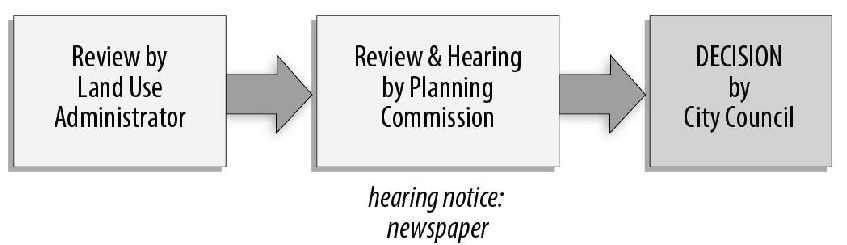
B.
Review and recommendation—Land use administrator. The land use administrator must prepare a report and recommendation on the proposed zoning code text amendment. The report must be transmitted to the planning commission before its public hearing on the proposed amendment.
C.
Notice of hearing. Notice of the planning commission's required public hearing on a zoning code text amendment must be published in the newspaper at least twenty (20) days before the scheduled public hearing (see Subsection 70.010F. for additional information on newspaper notices).
D.
Hearing and recommendation—Planning commission. The planning commission must hold a public hearing on the proposed zoning code text amendment. Following the close of the public hearing, the planning commission must act to recommend that the proposed text amendment be approved, approved with modifications, or denied and transmit its report and recommendations to the city council. Motions to approve, approve with modifications or deny zoning code text amendments may be approved by a simple majority vote. If the planning commission arrives at a tie vote, the application must be forwarded to the city council with the notation of the tie vote.
E.
Final action—City council. Following receipt of the planning commission's report and recommendation, the city council must hold a public hearing and act to approve the proposed zoning code text amendment, approve the proposed text amendment with modifications or deny the proposed text amendment. The city council is also authorized to remand the proposed text amendment back to the planning commission for further consideration. Zoning code text amendments may be approved by a simple majority vote.
F.
Review and approval criteria. The decision to amend the zoning code text is a matter of legislative discretion that is not controlled by any one standard. In making recommendations and decisions about zoning code text amendments, review and decision-making bodies must consider all relevant factors, including at least the following:
1.
Whether the proposed text amendment is in conformity with the policy and intent of the comprehensive plan; and
2.
Whether the proposed zoning code text amendment corrects an error or inconsistency or is necessary or desirable to meet the challenge of a changed or changing condition.
G.
Applicability.
1.
All amendments to the text of this Zoning Code must be processed in accordance with the provisions of this section, except as stated in Subsection 70.020G.2.
2.
The Land Use Administrator, in consultation with the city legal department, is authorized to correct typographical errors, reference errors, spelling errors, formatting errors, and errors in section, page, table, and figure numbering, without following the zoning code text amendment procedures of this section. The changes necessary to correct such errors may not change the meaning or regulations of the Zoning Code.
(Ord. No. 24725, § 24, 11-17-2021)
Section 70.030. - Zoning map amendments (rezonings).
A.
Authority to file. Amendments to the zoning map may be initiated only by the city council, the planning commission, the owner of the real property that is the subject of the proposed zoning map amendment or by the property owner's authorized agent.
Figure 70-2: Zoning Map Amendment Process (Generally)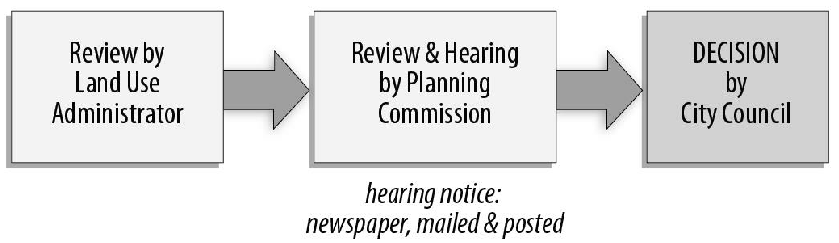
B.
Application filing. Property owner-initiated applications for zoning map amendments must be filed with the land use administrator. Property owners have the option of filing applications for zoning map amendments with or without a development plan. If the applicant elects to submit a development plan concurrently with a zoning map amendment application, the development plan procedures of Section 70.040 govern review and approval of the development plan.
C.
Review and recommendation—Land use administrator. Following receipt of a complete zoning map amendment application or initiation of zoning map amendment by the planning commission or the city council, the land use administrator must prepare a report and recommendation on the proposed zoning map amendment. The report must be transmitted to the planning commission before its public hearing on the proposed amendment.
D.
Notice of hearing. Notice of the planning commission's required public hearing on a zoning map amendment must be provided as follows (see Subsection 70.010F. for additional information on required newspaper, mail and posted notices):
1.
Newspaper notice. Notice must be published in the newspaper at least twenty (20) days before the scheduled public hearing.
2.
Mailed notice. Notice must be mailed to all owners of property included within the area that is the subject of the proposed zoning map amendment and all owners of property within three hundred (300) feet of the subject property at least twenty (20) days before the scheduled public hearing. Mailed notice is not required for city-initiated rezonings proposed as a means of revising the comprehensive plan or official map or designating areas that require specific land use development due to topography, geography or other distinguishing features, including but not limited to floodplain, drainage and blighted areas.
3.
Posted notice. Notice (signs) must be posted at least twenty (20) days before the scheduled public hearing.
E.
Hearing and recommendation—Planning commission.
1.
Following receipt of a complete application for a zoning map amendment or initiation of a zoning map amendment by the planning commission or city council, the planning commission must hold a public hearing on the proposed amendment. Following the close of the public hearing, the planning commission must act to recommend that the proposed amendment be approved, approved with modifications, or denied.
2.
All proposed zoning map amendments initiated by the city council or the planning commission must be transmitted to the city council within fifteen (15) days of the date of planning commission action.
3.
A property owner-initiated zoning map amendment recommended for approval or approval with modifications must be transmitted to the city council within fifteen (15) days of the date of planning commission action.
4.
A property owner-initiated application recommended for denial by the planning commission may not be considered further unless the applicant, within fifteen (15) days of the date of the planning commission's action, files a written request with the city clerk and the recording secretary of the planning commission for a public hearing by the city council. The request for hearing must be accompanied by the payment of the required filing fee. Upon notice of a request for a public hearing before the city council, the planning commission must transmit the application and its report and recommendations to the city council.
5.
Motions to approve, approve with modifications or deny zoning map amendments may be approved by a simple majority vote. If the planning commission arrives at a tie vote, the application must be forwarded to the city council with the notation of the tie vote.
F.
Final action—City council.
1.
Following receipt of the planning commission's recommendation, the city council must hold a public hearing on the application and act to approve the proposed zoning map amendment, approve the proposed amendment with modifications, including approval of a less intensive zoning district or an optional development plan, or deny the proposed amendment. The city council is also authorized to remand the proposed zoning map amendment back to the planning commission for further consideration.
2.
Zoning map amendments may be approved by a simple majority vote, except as stated in Subsection 70.030G.
G.
Protest petitions.
1.
If a valid protest petition is filed against any proposed zoning map amendment, passage of the zoning map amendment requires a favorable vote of three-fourths of the members of the entire city council.
2.
A protest petition will be deemed valid if it is signed by the owners of twenty (20) percent or more of the area of the lots included in the proposed zoning map amendment or by the owners of fifty (50) percent or more of the area of the lots within three hundred (300) feet of the area included in the proposed zoning map amendment and if it meets the other regulations of this Subsection 70.030G. Areas designated as right-of-way shall not be included in the calculation. The city council will determine sufficiency of a protest petition if its validity is challenged.
3.
A written protest petition opposing a zoning map amendment must be submitted to the land use administrator at least three (3) business days before the city council's vote.
4.
The protest petition must identify the zoning case number for which the protest is filed and must state that it is a formal protest of the proposed zoning map amendment.
5.
Persons signing the protest petition must be at least 18 years of age and must hold record title to their properties, as shown in the land records of the Tulsa County Clerk. If a lot is owned jointly by more than one owner, all owners must sign the protest petition. If a lot is owned by a trust, the trustee must sign, noting that he or she signs "as trustee". If there is more than one trustee, and no single trustee is authorized to sign, then all the trustees must sign. If a lot is owned by a corporation, the president or a vice-president or the chair or vice chair of the board of directors, must sign. If a lot is owned by a limited liability company, a manager must sign. If a lot is owned by any other legal entity, the person signing the protest petition must be someone authorized by that entity to convey title to land.
6.
Persons signing the protest petition must indicate the street address of the lot owned. If no street address is assigned, a legal description (lot and block of a subdivision, metes and bounds description of unplatted tracts) or a map must be provided.
7.
If a protest petition contains multiple signature pages, each page must contain the same protest language. Signatures must be the normal cursive signature of the person signing and should be accompanied by the legibly printed or typed name of the person signing. The name of the person signing must be the same as the name of that person as shown in the land records of the Tulsa County Clerk.
8.
A protest petition may not be amended, supplemented or corrected subsequent to the deadline for filing the petition.
H.
Review and approval criteria. The decision to amend the zoning map is a matter of legislative discretion that is not controlled by any single standard or criterion. In making recommendations and decisions on zoning map amendments, review and decision-making bodies must consider all relevant factors, including at least the following:
1.
Whether the proposed zoning map amendment is consistent with the policy and intent of comprehensive plan; and
2.
Whether the proposed zoning map amendment corrects an error or inconsistency or is necessary or desirable to meet the challenge of a changed or changing condition.
(Ord. No. 25656, § 27, 9-10-2025)
Section 70.040. - Development plans.
A.
Purpose. Development plans are required with some property owner-initiated rezonings and are optional with other property owner-initiated rezonings. Their purpose is to depict a property owner's generalized plan for the type, amount and character of development proposed on the subject property. By providing greater certainty about development proposals, development plans provide review and decision-making bodies with additional information on which to base rezoning decisions.
B.
Applicability.
1.
Mandatory. Development plans are required (mandatory) for Corridor (CO) district zoning map amendments and Master Planned Development (MPD) zoning map amendments. They are also required for major amendments to existing Planned Unit Developments (PUDs). In acting on mandatory development plans, the planning commission is authorized to recommend and the city council is authorized to approve use and development limitations that comply with, are more restrictive than or, as may be permitted by the respective CO, MPD, or PUD provisions of this code, are less restrictive than the base zoning district regulations and otherwise applicable standards of this zoning code.
2.
Optional. Property owners may elect to submit a development plan with any zoning map amendment application. The optional development plan process is also used to process proposals to provide access to lots via a private street. In acting on optional development plans, the planning commission is authorized to recommend and the city council is authorized to approve use and development limitations that are at least as restrictive or are more restrictive than the base zoning regulations. Optional development plans may not be used to obtain relief from otherwise applicable zoning code regulations. The city council is authorized to request an optional development plan from the applicant if they deem it appropriate at the time of their consideration of a proposed zoning map amendment.
C.
Application filing. Complete applications for development plan approval must be filed with the land use administrator concurrently with a zoning map amendment application.
D.
Review and recommendation—Land use administrator. Following receipt of a complete application, including the required development plan, the land use administrator must prepare a report and recommendation. The report must evaluate the proposed development plan in light of all applicable standards and approval criteria. The report must also include a description of any development plan modifications or conditions of approval that would help ensure the development plan complies with applicable standards and approval criteria. The land use administrator's report must be transmitted to the planning commission before the required public hearing.
E.
Notice of hearing. Notice of the planning commission's required public hearing must be provided as follows (see Subsection 70.010F. for additional information on required newspaper, mail and posted notices).
1.
Newspaper notice. Notice must be published in the newspaper at least twenty (20) days before the scheduled public hearing.
2.
Mailed notice. Notice must be mailed to the owner of the subject property and all owners of property within three hundred (300) feet of the subject property at least twenty (20) days before the scheduled public hearing. Notice for straight zoning constitutes notice for optional development plans.
3.
Posted notice. Notice (signs) must be posted at least twenty (20) days before the scheduled public hearing.
F.
Hearing and recommendation—Planning commission.
1.
Within sixty (60) days of the date of filing of a complete application for development plan approval, the planning commission must hold a public hearing to consider the proposed development plan. Following the close of the public hearing, the planning commission must act to recommend that the proposed development plan be approved, approved with modifications, or denied.
2.
A development plan application recommended for approval or approval with modifications must be transmitted, with the report and recommendation of the planning commission, to the city council within fifteen (15) days of the date of planning commission action.
3.
A development plan application recommended for denial by the planning commission, will be deemed denied and will not be considered further unless the applicant, within fifteen (15) days of the date of the planning commission's action, files a written request with the city clerk and with the recording secretary of the planning commission for a public hearing by the city council. The request for hearing must be accompanied by the payment of the required filing fee. Upon notice of a request for a public hearing before the city council, the planning commission must transmit the development plan application and its report and recommendations to the city council.
4.
If the planning commission arrives at a tie vote, the application must be forwarded to the city council with a notation of the tie vote.
G.
Final action—City council.
1.
Following receipt of the planning commission's recommendation, the city council must hold a public hearing on the development plan and act to approve the proposed development plan, approve the proposed development plan with modifications or deny the proposed development plan. The city council is also authorized to remand the proposed development plan back to the planning commission for further consideration. The city council may, but is not required to, consider and act upon an optional development plan submitted after the planning commission's public hearing on a proposed zoning map amendment.
2.
Development plans may be approved by a simple majority vote, except that any accompanying zoning map amendment may require a super-majority vote, as stated in Subsection 70.030G.
H.
Requirement for filing of site plan.
1.
Unless a longer time period or a phasing plan is approved at the time of approval of a mandatory development plan, a complete application for site plan approval must be filed within five (5) years of the date of mandatory development plan approval. If an application for site plan approval is not filed within the time required, no further site plans may be approved for the project until the subject property owner has filed the original or amended development plan for re-review and reconsideration by the planning commission and city council. Such re-review and reconsideration must follow the mandatory development plan review procedures of this zoning code. Following re-review and reconsideration, the planning commission is authorized to recommend and the city council is authorized to approve any of the following actions based on surrounding land use patterns and other relevant information presented at the time of reconsideration by the planning commission and city council:
a.
An extension of time for filing a site plan;
b.
An amendment to the approved mandatory development plan; or
c.
Rezoning to another zoning district in accordance with the zoning map amendment procedures of Section 70.030.
2.
The site plan filing deadline established in Subsection 70.040H.1. does not apply to optional development plans or to PUD or CO district development plans approved before the effective date specified in Section 1.030. The site plan filing deadline established in Subsection 70.040H.1. does apply to any major amendments to PUD or CO district development plans approved after the effective date specified in Section 1.030.
I.
Amendments to approved development plans.
1.
Minor amendments.
a.
The planning commission is authorized to approve amendments to approved development plans as minor amendments if the planning commission determines that substantial compliance is maintained with the approved development plan. The following is a non-exhaustive list of changes that may be considered as minor amendments:
(1)
Any deviation expressly authorized at the time of development plan approval;
(2)
The relocation or addition of customary accessory uses and structures;
(3)
Adjustment of internal development area boundaries, provided the allocation of land to particular uses and the relationship of uses within the project are not substantially altered;
(4)
Limitation or elimination of previously approved uses, provided the character of the development is not substantially altered;
(5)
Modification of the internal circulation system that would not increase points of access from adjacent streets, change access to another street or increase projected traffic volumes;
(6)
Lot splits that have been reviewed and approved in accordance with the subdivision and development regulations;
(7)
Modifications to approved signage, provided the size, location, number and type of signs is not substantially altered;
(8)
Modification to approved screening and landscaping plans, provided the modification is not a substantial deviation from the original approved plan;
(9)
Changes reducing the number of permitted dwelling units, the amount of nonresidential floor area or the area covered by buildings or paved areas; and
(10)
Reductions in off-street parking or loading by more than ten (10) percent or one space, whichever results in a greater reduction.
b.
In those cases when the city council has expressly imposed a condition more restrictive than recommended by the planning commission, any amendment of that city council-imposed condition must be reviewed and approved by the city council.
c.
Notice of the Planning Commission's public hearing on a development plan minor amendment request must be provided at least ten (10) days in advance of the hearing by mailing written notice to all owners of property within a three hundred-foot radius of the exterior boundary of the subject property.
d.
If the planning commission determines that the proposed development plan amendment, if approved, will result in a significant departure from the approved development plan or otherwise significantly change the character of the subject area or that the cumulative effect of a number of minor amendments substantially alters the approved development plan, then the amendment must be deemed a major amendment to the development plan and processed as a new development plan following the development plan approval procedure of Section 70.040, including all requirements for fees, notices and hearings.
2.
Appeal of development plan minor amendment decisions. An appeal from any development plan minor amendment decision by the planning commission may be taken by any person aggrieved, or any taxpayer or any officer, department, board or bureau of the city. Appeals are made to the city council by filing notice of appeal with the city clerk and with the recording secretary of the planning commission within ten (10) days of the date of the decision being appealed. The appeal must specify the grounds of the appeal. No bond or deposit for costs are required for an appeal. Upon filing of the notice of appeal, the planning commission must transmit to the city council, the original or certified copies of all the papers constituting the record in the case, together with the decision of the planning commission. The city council must notify the applicant and all interested parties, as recorded in the minutes of planning commission, of the appeal hearing location, date and time.
3.
Major amendments. Any amendment to an approved development plan that is not authorized as a minor amendment must be processed as a new development plan following the development plan approval procedure of Section 70.040, including all requirements for fees, notices and hearings.
(Ord. No. 24725, § 25, 11-17-2021; Ord. No. 25656, §§ 28, 29, 9-10-2025)
Section 70.050. - Site plans.
A.
Applicability. Site plan approval is required before the issuance of any permits for development or construction on any property included within the boundaries of any approved development plan and whenever a provision of this zoning code expressly states that site plan approval is required.
B.
Application filing. Complete applications for site plan approval must be filed with the land use administrator. At a minimum, the application must include a site plan, landscape plan and sign plan.
C.
Review and action by land use administrator; appeals.
1.
Unless otherwise required by the city council as a condition of approval of a development plan, the land use administrator is authorized to review and take action on site plans. The land use administrator must approve the site plan if it complies (as applicable) with an approved development plan, all conditions of development plan approval and all applicable regulations of this zoning code. If the submitted site plan does not comply with an approved development plan, any conditions imposed on that plan or applicable regulations of this zoning code, the land use administrator must disapprove the site plan and advise the landowner in writing of the specific reasons for disapproval.
2.
If the land use administrator does not approve the site plan, the landowner may either: (1) resubmit the site plan to correct the plan's inconsistencies and deficiencies, or (2) within sixty (60) days of the date of notice of disapproval, appeal the decision of the land use administrator by filing a notice of appeal with the recording secretary of the planning commission. If such an appeal is filed, the site plan must be reviewed by the planning commission following the hearing and notice requirements that apply to minor amendments of approved development plans (see Subsection 70.040I.1.c.). The planning commission's decision may be appealed following the procedures of Subsection 70.040I.2.
D.
Effect of approval. Approval of a site plan must occur before any building permits are issued. Site plan approval, in and of itself, does not constitute effective dedication of rights-of-way or any other public improvements. See also the zoning clearance permit provisions of Section 70.080.
Section 70.060 - Historic Preservation (HP) zoning map amendments.
A.
Scope. The HP zoning procedures of this section govern the establishment, amendment or repeal of any HP zoning district.
Figure 70-3: HP District Zoning Map Amendment Process (Generally)
B.
Authority to file. HP zoning map amendments may be initiated only by the city council, the planning commission, the preservation commission or the owner of the real property that is the subject of the proposed zoning map amendment or the property owner's authorized agent.
C.
Application filing. Complete applications for privately initiated HP zoning map amendments must be filed with the land use administrator.
D.
Notice of meeting and hearing. Notice of the preservation commission's meeting to consider an HP zoning map amendment must be given in accordance with the preservation commission's rules and regulations. Notice of the planning commission's required public hearing on an HP zoning map amendment must be provided as follows (see Subsection 70.010F. for additional information on required newspaper, mail and posted notices).
1.
Newspaper notice. Notice must be published in the newspaper at least twenty (20) days before the planning commission's public hearing.
2.
Mailed notice. Notice must be mailed to all owners of property included within the area that is the subject of the proposed HP zoning map amendment and all owners of property within three hundred (300) feet of the subject property at least twenty (20) days before the planning commission's public hearing. In addition to other information required in hearing notices (see Subsection 70.010F.), mailed notice for an HP zoning map amendment must include a statement indicating that upon approval of HP zoning, activities such as the erection, construction, reconstruction, renovation, alteration, painting, removal, or demolition of a building, structure or lot will trigger the need for the subject property owner to obtain an HP permit, regardless of whether a building permit is required for such work.
3.
Posted notice. Notice (signs) must be posted at least twenty (20) days before the planning commission's public hearing.
E.
Review and recommendation—Preservation commission. The preservation commission must hold a public meeting and receive public comments on the HP zoning map amendment. After the public meeting, the preservation commission must prepare a report and recommendation on the proposed HP zoning map amendment in accordance with the general overlay district procedure described in Subsection 20.010D. The report and recommendation must also include specific findings regarding the proposed map amendment's consistency with the HP zoning criteria of Subsection 70.060J. The preservation commission's report and all other pertinent information must be transmitted to the planning commission before the planning commission's public hearing on the proposed HP zoning map amendment.
F.
Hearing and recommendation—Planning commission.
1.
The planning commission must hold a public hearing on all proposed HP zoning amendments. Following the close of the public hearing, the planning commission must act to recommend that the proposed HP zoning map amendment be approved, approved with modifications, or denied.
2.
All proposed HP zoning map amendments initiated by the city council, the planning commission or the preservation commission must be transmitted to the city council within fifteen (15) days of the date of planning commission action.
3.
A property owner-initiated HP zoning map amendment recommended by the planning commission for approval or approval with modifications must be transmitted to the city council within fifteen (15) days of the date of planning commission action.
4.
A property owner-initiated HP application recommended for denial by the planning commission, may not be considered further unless the applicant, within fifteen (15) days of the date of the planning commission's action, files a written request with the city clerk for a public hearing by the city council. The request for hearing must be accompanied by the payment of the required filing fee. Upon notice of a request for a public hearing before the city council, the planning commission must transmit the application and its report and recommendations to the city council.
5.
If the planning commission arrives at a tie vote, the application must be forwarded to the city council with a notation of the tie vote.
G.
Final action—City council.
1.
Following receipt of the planning commission's recommendation, the city council must hold a public hearing on the application and act to approve the proposed HP zoning map amendment, approve the proposed amendment with modifications or deny the proposed amendment. The city council is also authorized to remand the proposed HP zoning map amendment back to the planning commission for further consideration.
2.
HP zoning map amendments may be approved by a simple majority vote, except as stated in Subsection 70.060H.
H.
Protest petitions.
1.
If a valid protest petition is filed against any proposed HP zoning map amendment, passage of the zoning map amendment requires a favorable vote of three-fourths of the members of the entire city council.
2.
A protest petition will be deemed valid if it is signed by the owners of twenty (20) percent or more of the area of the lots included in proposed HP zoning map amendment area or by the owners of fifty (50) percent or more of the area of the lots within three hundred (300) feet of the area included in the proposed HP zoning map amendment area and if it meets the other regulations of this Subsection 70.060H. Areas designated as right-of-way shall not be included in the calculation. The city council will determine sufficiency of a protest petition if its validity is challenged.
3.
A written protest petition opposing an HP zoning map amendment must be submitted to the land use administrator at least three (3) business days before the city council's vote.
4.
The protest petition must identify the zoning case number for which the protest is filed and must state that it is a formal protest of the proposed HP zoning map amendment.
5.
Persons signing the protest petition must be at least 18 years of age and must hold record title to their properties, as shown in the land records of the Tulsa County Clerk. If a lot is owned jointly by more than one owner, all owners must sign the protest petition. If a lot is owned by a trust, the trustee must sign, noting that he or she signs "as trustee". If there is more than one trustee, and no single trustee is authorized to sign, then all the trustees must sign. If a lot is owned by a corporation, the president or a vice-president or the chair or vice chair of the board of directors, must sign. If a lot is owned by a limited liability company, a manager must sign. If a lot is owned by any other legal entity, the person signing the protest petition must be someone authorized by that entity to convey title to land.
6.
Persons signing the protest petition must indicate the street address of the lot owned. If no street address is assigned, a legal description (lot and block of a subdivision, metes and bounds description of unplatted tracts) or a map must be provided.
7.
If a protest petition contains multiple signature pages, each page must contain the same protest language. Signatures must be the normal cursive signature of the person signing and should be accompanied by the legibly printed or typed name of the person signing. The name of the person signing must be the same as the name of that person as shown in the land records of the Tulsa County Clerk.
8.
A protest petition may not be amended, supplemented or corrected subsequent to the deadline for filing the petition.
I.
Recordation. The preservation officer must file a copy of the HP zoning map amendment ordinance and a map indicating the boundaries of the HP-zoned area in the county clerk's office of the county in which the property is located.
J.
HP zoning approval criteria. A building, structure, site or area containing buildings, structures or sites that are at least fifty (50) years old, or less with exceptional importance and possessing integrity, may be classified in an HP overlay district if the subject building, structure, site or area meets one or more of the following criteria:
1.
It has significant character, interest, or value as part of the historical development, history or cultural heritage of the city, state, or nation;
2.
It has significance as the site of a historic event in the past of the city, state or nation;
3.
It is associated with a person, or group of persons, who played a significant role in the historical development, history or cultural heritage of the city, state, or nation;
4.
It is the embodiment of distinguishing characteristics, design, details, materials or craftsmanship which represent a historically significant architectural or engineering innovation, type, style or specimen;
5.
It portrays the environment in an era of history characterized by a distinctive architectural, engineering, or construction style;
6.
It represents a significant and distinguishable entity of historical importance whose components may lack individual distinction;
7.
It has yielded, or is likely to yield, information important in prehistory or history; or
8.
It is listed or meets the criteria for being listed on the National Register of Historic Places.
Section 70.070. - HP permits.
A.
Applicability. Within any HP zoning district, an HP permit must be obtained in accordance with the procedures of this section before any work is performed on or changes are made to any existing building, structure or lot unless expressly exempted under Subsection 70.070B. Examples of changes and work that require an HP permit include the erection, construction, reconstruction, renovation, alteration, painting, removal, or demolition of a building, structure, or lot, regardless of whether or not a building permit is required.
Figure 70-4: HP Permits (Generally)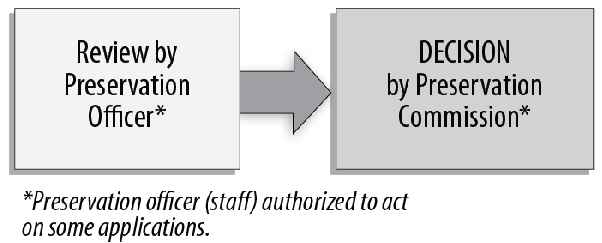
B.
Exemptions. The applicability provisions of Subsection 70.070A. notwithstanding, none of the following changes or work require an HP permit:
1.
Ordinary maintenance and repair including the removal, installation, or replacement of guttering; the removal or replacement of roof covering with like material; and the application of any paint color to non-masonry surfaces;
2.
The interior of buildings or structures;
3.
Portions of buildings, structures, or sites not visible from adjoining streets;
4.
Accessory structures or buildings, such as storage sheds, garages, decks, patios, fencing, swimming pools and pool houses that are not part of the primary structure, provided that the structures or buildings are not located in street yards;
5.
Installation of radio or television antennas that are not visible from abutting streets;
6.
General landscape maintenance and planting of new organic materials;
7.
Installation of temporary landscape features not affixed to the ground, such as bird baths, non-masonry landscape edging, raised planting beds not on permanent foundation, and lawn or patio furniture;
8.
Work required for temporary stabilization of a building or structure due to damage;
9.
Installation, removal, or alteration of park furnishings within City of Tulsa parks, such as benches, tables, bicycle racks, planters, statues, lighting, trash receptacles, and drinking fountains, provided they have not been identified as historic resources within the design guidelines governing the applicable HP zoning district;
10.
Installation, removal, or alteration of shade canopies or similar open-air shade structures within City of Tulsa parks, provided they are no more than ten (10) feet in height, and provided they have not been identified as historic resources within the design guidelines governing the applicable HP zoning district;
11.
Removal or replacement of existing fencing with equivalent materials within City of Tulsa parks, provided the fencing has not been identified as a historic resource within the design guidelines governing the applicable HP zoning district;
12.
Installation, removal, or alteration of sport courts, sport fields, swimming pools, and dog parks within City of Tulsa parks, inclusive of any fencing and lighting abutting the court, field, swimming pool, or dog park;
13.
Installation, removal, or alteration of playground equipment and other recreational equipment within City of Tulsa parks, provided they are no more than 16 feet in height; and
14.
Installation, removal, or alteration of signs within City of Tulsa parks that are erected and maintained pursuant to the discharge of governmental functions, or that are required by law, ordinance, or government regulation, or that are required to be posted in order to effectuate a legal right.
C.
Authority to file. Applications for an HP permit may be filed only by the owner of the subject property or by the property owner's authorized agent.
D.
Application filing. Complete HP permit applications must be filed with the preservation officer in a form established by the preservation commission. The application must be accompanied by plans of sufficient clarity and detail to show the nature of the work to be performed and the materials to be used. The plans must depict at least the following information:
1.
The location, orientation and placement of existing and proposed structures on the site;
2.
A floor plan, if applicable, identifying the location and limits of the proposed work;
3.
Facade elevations, if applicable, of the proposed work in sufficient detail to identify existing and proposed materials and the location of the proposed work; and
4.
Any other drawings, photographs, material brochures or samples, specifications, or information that may be necessary to determine compliance with HP district regulations and design guidelines.
E.
Meeting and Final Decision—Preservation Commission. Within thirty (30) business days of receipt of a complete HP permit application, the preservation commission must meet to consider the application and act to approve the HP permit, approve the HP permit with modifications and/or conditions, or deny the HP permit application based on the standards and review criteria of Subsection 70.070F. Failure of the preservation commission to take action within thirty (30) business days of receipt of a complete HP permit application is deemed to constitute approval of the HP permit, unless the applicant requests or agrees to an extension of the thirty-business-day period, or unless the applicant fails to attend the meeting in which the application is considered. If the applicant fails to attend the meeting, the preservation commission may defer action on the application, and the thirty-business-day period shall be extended until the preservation commission's next regular meeting.
F.
Standards and review criteria. In its review of HP permit applications, the preservation commission must use the adopted design guidelines to evaluate the proposed work and must, to the greatest extent possible, strive to affect a fair balance between the purposes and intent of HP district regulations and the desires and need of the property owner. In addition, the preservation commission must consider the following specific factors:
1.
The degree to which the proposed work is consistent with the applicable design guidelines;
2.
The degree to which the proposed work would destroy or alter all or part of the historic resource;
3.
The degree to which the proposed work would serve to isolate the historic resource from its surroundings, or introduce visual elements that are out of character with the historic resource and its setting, or that would adversely affect the physical integrity of the resource;
4.
The degree to which the proposed work is compatible with the significant characteristics of the historic resource; and
5.
The purposes and intent of the HP district regulations and this zoning code.
G.
Demolition requests.
1.
Any HP permit application for demolition, if not approved, is automatically stayed for a period of sixty (60) days, unless the preservation commission determines that the building or structure meets one of more of the following criteria:
a.
It is imminently dangerous to life and property;
b.
The building or structure does not contribute significantly to the district; or
c.
The building or structure cannot be preserved.
2.
During the sixty-day stay period, the preservation commission must consult with the property owner and other interested parties to find alternatives to demolition. Should alternatives acceptable to the property owner not be found, the HP permit for demolition will be deemed automatically approved and must be issued upon termination of the stay period.
3.
Prior to the expiration of the sixty-day stay period, the preservation commission may request that the city council extend the stay for a period not to exceed an additional sixty (60) days. The preservation commission must provide written notice to the property owner of such request and of the date of the public hearing to consider the request. At the hearing, the city council must consider whether:
a.
The preservation commission has presented reasonable alternatives that would preserve the structure;
b.
Suitable alternatives have been found and further time is required to finalize arrangements for achieving such alternatives; and
c.
The property owner desires further time to search for or continue action on available alternatives.
4.
After notice and public hearing, the city council must vote to approve, approve with conditions, or deny the request for an extension of the stay period. If the request is denied the HP permit for demolition will be deemed automatically approved and must be issued upon termination of the original stay period.
5.
During any period of the stay of demolition the property owner may use the property in question in any legal manner, except that no action may be taken that would place the property in danger of damage or destruction.
H.
Lapse of approval.
1.
An approved HP permit will lapse and become void two (2) years after it is approved by the preservation commission, unless a building permit for the work or improvements authorized has been issued and the project is commenced and thereafter diligently pursued to completion. If no building permit is required, the work that is the subject of the HP permit application must be completed within the two-year period.
2.
The preservation commission may extend the expiration period by up to one year at the time of approval of the HP permit or any time before expiration of the approval.
I.
Transferability. Approved HP permits run with the land and are not affected by changes of tenancy, ownership, or management.
J.
Amendments. A request for changes in the specific nature of the approved HP permit or changes to any conditions attached to an approved HP permit must be processed as a new application.
K.
Action by Preservation Officer.
1.
The preservation officer is authorized to approve HP permit applications for proposed work on existing structures involving the replacement of existing materials with equivalent materials if the work complies with the design guidelines of the subject HP district.
2.
The preservation officer is also authorized to approve HP permit applications for the following minor exterior alterations if the work complies with design guidelines of the subject HP district:
a.
Installation of storm windows and doors;
b.
Removal of non-historic materials, including but not limited to siding, storm windows and doors, awnings, shutters, retaining walls and fences; and
c.
Removal of paint from historic masonry surfaces.
3.
The preservation officer is authorized to approve HP permit applications for the replacement of trails or walkways within City of Tulsa parks with an alternative material if the work complies with the design guidelines of the subject HP district, provided that the location and size of the trail or walkway remain the same.
L.
Appeals. Any final decision of the preservation commission may be appealed to the board of adjustment in accordance with Section 70.140.
(Ord. No. 25212, §§ 2, 3, 12-20-2023; Ord. No. 25638, §§ 1, 2, 7-30-2025)
Section 70.080. - Zoning clearance and permits.
A.
Applicability. Property owners or their authorized agent must obtain a zoning clearance permit from the development administrator before constructing, moving, or structurally altering any building or structure or establishing or changing the use of any building or lot.
B.
Compliance with development regulations
1.
Purpose. The requirements of this section are intended to help ensure that rights-of-way, streets, sidewalks and other public improvements are in place and adequate to serve proposed developments in accordance with applicable regulations.
2.
Rezonings, special exceptions and residential uses. Except as expressly stated in Subsection 70.080B.3., no building permit or zoning clearance permit may be issued until the subject lot or parcel for which the permit is sought has been determined to be in compliance with all applicable design and improvement requirements of the Tulsa Metropolitan Area Subdivision and Development Regulations, as evidenced by submittal of a recorded subdivision plat or ALTA/ACSM survey and separately recorded legal instruments. This requirement applies to any property for which:
a.
A property owner-initiated zoning map amendment or development plan was approved after July 1, 1970;
b.
A special exception was approved for any of the following:
(1)
Group living use;
(2)
Public, civic or institutional use;
(3)
Outdoor assembly and entertainment use;
(4)
Household living involving three (3) or more households on a single lot;
(5)
Marina;
(6)
Gun club;
(7)
Crematory;
(8)
Mausoleum; or
c.
A building permit is requested for any of the following residential uses:
(1)
Cottage house development;
(2)
Patio house; or
(3)
Townhouse.
C.
Application.
1.
Zoning clearance permit applications must be accompanied by a legal description of the lot and plans in duplicate, drawn to scale, showing at least the following information:
a.
The actual shape and dimension of the lot;
b.
The location and dimensions of all easements;
c.
The location, size and height of any existing buildings or structures to be erected or altered;
d.
The existing and intended use of each building or structure and portion of the lot;
e.
The number of dwellings and buildings proposed; and
f.
Other information required by the development administrator to determine compliance with all applicable provisions this zoning code.
2.
If the zoning code requires that the use, structure, or other development feature must be separated or spaced a minimum distance from another use, structure, or development feature, the zoning clearance permit application must also be accompanied by the following information:
a.
An aerial photograph identifying the location of the proposed use, structure or development feature at the center of a circle drawn to scale, the radius of which is the required separation distance from another use, structure or development feature;
b.
The location of the nearest use, structure, or development feature from which the proposed use, structure or development feature must be separated; and
c.
Verification of having provided a copy of the zoning clearance permit application, concurrent with the submission of the application, to the City Councilor for the City Council District in which the subject property is located.
D.
Action. Following receipt of a complete application for a zoning clearance permit, the development administrator must review and take action on the permit. If the proposed development and construction complies with all applicable provisions of this zoning code, the permit must be issued. If the proposed development and construction does not comply with one or more provisions of this zoning code, the permit must be denied. The applicant must be notified of the action taken, and if the permit is denied, notified of the specific reasons for denial.
(Ord. No. 24382, §§ 17, 18, 6-10-2020; Ord. No. 24725, § 26, 11-17-2021)
Section 70.090. - Interpretations of zoning code, zoning map, and approved development plans and site plans.
A.
Purpose and applicability.
1.
Day-to-day responsibility for administering and interpreting the provisions of this zoning code, including the zoning map, rests with the development administrator and land use administrator, whose decisions may be appealed to the board of adjustment, in accordance with the procedures of Section 70.140.
2.
Occasionally, the zoning code may not sufficiently address an issue that arises in administering or interpreting the zoning code. In those cases, the development administrator may elect to issue, or a citizen may file an application for, a written zoning code interpretation to guide in future decision-making. The procedures of this section govern the issuance of such interpretations. The procedures also govern interpretations of the terms of approved development plans and site plans, such as those associated with PUDs, MPDs and CO zoning districts.
B.
Authority. The land use administrator, as to the zoning map and approved development plans and site plans, and the development administrator, as to the zoning code, are authorized to issue written interpretations pursuant to this section. The land use administrator and the development administrator are also authorized to refer the matter to the board of adjustment for an interpretation or for guidance in making an interpretation.
C.
Application. A complete application for a written interpretation request may be submitted either to the land use administrator or development administrator, as appropriate.
D.
Action. Within thirty (30) days of receipt of a complete application, the land use administrator or development administrator, as appropriate, must (1) review and evaluate the interpretation request in light of the provisions that are the subject of the interpretation request and any other relevant documents (2) consult with affected staff and (3) prepare a written interpretation.
E.
Form. The interpretation must be provided to the applicant in writing and filed in the official record of interpretations held by the development administrator.
F.
Official record. The development administrator must maintain an official record of written interpretations and provide copies to the land use administrator. The record of interpretations must be available for public inspection in the office of the land use administrator and development administrator during normal business hours.
G.
Appeal of decision. Appeals of written interpretations issued pursuant to this section may be taken to the board of adjustment in accordance with the appeal procedures of Section 70.140.
Section 70.100. - Administrative adjustments.
A.
Intent. Administrative adjustments are intended to provide a streamlined approval procedure for minor (de minimis) modifications of selected zoning code regulations. Administrative adjustments are further intended to:
1.
Allow development and construction that is in keeping with the general purpose and intent of zoning code regulations and the established character of the area in which the development or construction is located;
2.
Provide flexibility that will help promote rehabilitation and reuse of existing buildings when such flexibility will not adversely affect nearby properties or neighborhood character; and
3.
Provide flexibility for new construction when such flexibility is in keeping with the general purpose and intent of zoning code regulations and will not adversely affect nearby properties or surrounding neighborhood character.
B.
Authorized administrative adjustments.
1.
Administrative adjustments may be granted only as expressly identified in this section.
a.
The land use administrator is authorized to grant an administrative adjustment reducing minimum required street setbacks by up to five (5) feet.
b.
The land use administrator is authorized to grant an administrative adjustment reducing minimum required side and rear setbacks in any R district by up to twenty (20) percent.
c.
The land use administrator is authorized to grant an administrative adjustment reducing minimum required side setbacks to no less than five (5) feet in any RM district to allow construction of a detached house or two-unit house.
d.
The land use administrator is authorized to grant an administrative adjustment of build-to-zone regulations by up to twenty (20) percent.
e.
The land use administrator is authorized to approve an administrative adjustment reducing minimum transparency requirements by up to ten (10) square feet or twenty (20) percent, whichever is greater.
f.
The land use administrator is authorized to approve an administrative adjustment reducing minimum lot width and lot frontage requirements by up to ten (10) percent.
g.
The land use administrator is authorized to approve an administrative adjustment waiving or modifying the parking structure design requirement of Subsection 40.280B. when the land use administrator determines that compliance with that requirement would result in a reduction in the number of parking spaces within the parking structure or necessitate mechanical ventilation of the garage.
2.
The administrative adjustment procedures may not be used to vary, modify or otherwise override a condition of approval or requirement imposed by an authorized decision-making body.
C.
Authority to file. Administrative adjustment applications may be filed by the owner of the subject property or by the property owner's authorized agent.
D.
Application filing. Complete applications for administrative adjustments must be filed with the land use administrator. Applications must be accompanied by a letter of deficiency issued by the development administrator.
E.
Notice of filing/intent to approve. Written notice of application filing must be delivered to all owners of property abutting the subject lot. The written notice must describe the nature of the requested administrative adjustment. It must also indicate the date on which the land use administrator will take action on the application and that the application will be available for review and comment until that date. Any interested party may submit written comments concerning the application to the land use administrator.
F.
Action by land use administrator.
1.
The land use administrator must review each application for an administrative adjustment and act to approve the application, approve the application with conditions, deny the application or refer the application to the board of adjustment for consideration as a variance.
2.
The land use administrator may not take final action to approve or deny an administrative adjustment application until at least five (5) days after the required notices have been mailed.
3.
The land use administrator decision to approve or deny an administrative adjustment must be based on the approval criteria and standards of Subsection 70.100G. and accompanied by written findings of fact.
4.
At least once per calendar year, the land use administrator must provide to the board of adjustment a list of all administrative adjustment decisions.
G.
Standards and review criteria. Administrative adjustments may be approved only when the land use administrator determines that the following general approval criteria and any specific criteria associated with the authorized administrative adjustment have been met:
1.
The requested administrative adjustment is consistent with all relevant purpose and intent statements of this zoning code and with the general purpose and intent of the comprehensive plan;
2.
The requested administrative adjustment will not have a substantial or undue adverse effect upon adjacent property, the character of the area or the public health, safety and general welfare; and
3.
Any adverse impacts resulting from the administrative adjustment will be mitigated to the maximum extent feasible.
H.
Conditions of approval. In granting an administrative adjustment, the land use administrator is authorized to impose conditions upon the subject property that are necessary to reduce or minimize any potentially adverse impacts on other property in the surrounding area, and to carry out the stated purpose and intent of this zoning code.
I.
Lapse of approval. An approved administrative adjustment will lapse and become void three (3) years after it is granted by the land use administrator, unless a building permit for the work or improvements authorized has been issued and the project has commenced and is diligently pursued to completion. If no building permit is required, the improvement that is the subject of the administrative adjustment must be in place within the three-year period.
J.
Transferability. Approved administrative adjustments run with the land and are not affected by changes of tenancy, ownership, or management.
K.
Amendments. A request for changes in the specific nature of an approved administrative adjustment or changes to any conditions attached to an approved administrative adjustment must be processed as a new administrative adjustment application, including all requirements for fees and notices.
L.
Appeals. The applicant or any interested party may appeal the administrative adjustment decision of the land use administrator in accordance with Section 70.140.
Section 70.110. - Spacing and separation distance verification.
A.
Applicability. The spacing and separation distance verification procedure of this section applies whenever this zoning code requires that a use, structure or other development feature be separated or spaced a minimum distance from another use, structure or development feature. The procedure does not apply to a determination of compliance with building setback requirements that apply on individual lots.
B.
Action. The development administrator may rely upon the evidence provided by the applicant with an application for a zoning clearance permit to verify that the proposed use, structure or other development feature complies with the applicable spacing and separation distance requirements of this zoning code. Only other uses, structures, or development features that have been legally established by the issuance of a certificate of occupancy, an active building permit, active sign permit or active zoning clearance permit will be considered in determining compliance with the applicable spacing and separation distance requirements. It is the responsibility of the applicant to provide all information requested by the development administrator to aid in the determination. For purposes of determining whether spacing and separation distance requirements are met, a zoning-clearance-only permit for the use, structure or development feature from which the subject use, structure or development feature must be separated is valid for one hundred eighty (180) days after it is issued.
C.
Appeal of decision. Appeals of spacing and distance verification decisions of the development administrator may be appealed to the board of adjustment in accordance with Section 70.140.
(Ord. No. 24382, § 19, 6-10-2020)
Section 70.120. - Special exceptions.
A.
Authorized special exceptions. Only those special exceptions expressly authorized in this zoning code may be approved as special exceptions.
B.
Authority to file. Applications for special exception approval may be filed only by the owner of the subject property or by the property owner's authorized agent.
Figure 70-5: Special Exception Process (Generally)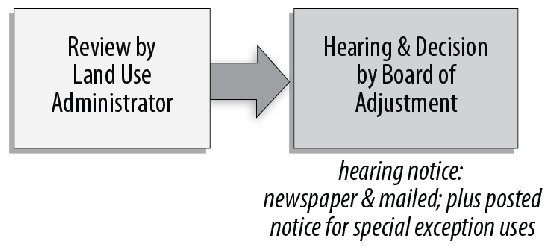
C.
Application filing. Complete applications for special exception approval must be filed with the land use administrator.
D.
Review and report—Land use administrator. Following receipt of a complete application, the land use administrator must prepare a report on the proposed special exception. The report must be transmitted to the board of adjustment before the required public hearing.
E.
Notice of hearing.
1.
Minor special exceptions. Notice of the board of adjustment's required public hearing on any minor special exception application must be mailed to all owners of property that abut the subject property at least ten (10) days before the scheduled public hearing. (See Subsection 70.010F. for additional information on required mailed notices). Minor special exceptions are limited to the following:
a.
A special exception to allow public or private schools at the primary, elementary, middle school or high school level to expand a principal building or construct an accessory building, structure or use or to permit a use that is an accessory use to an existing principal use, provided the improvement does not include new athletic stadiums or other outdoor athletic facilities that include spectator seating or high-intensity lighting;
b.
A special exception to allow recreational vehicles to be parked or stored in a street yard or required side setback if the conditions listed in Subsection 45.150A. cannot be met;
c.
Amendments to plot plans that were made condition of the granting of a special exception that involve an increase in building floor area of no greater than fifteen (15) percent and do not require the granting of any variances;
d.
A special exception to allow any of the following improvements in public parks:
(1)
Non-illuminated outdoor courts,
(2)
Non-illuminated athletic fields,
(3)
Playgrounds,
(4)
Picnic shelters,
(5)
Parking lots, and
(6)
Renovation or expansion of existing buildings.
2.
Other Special Exceptions. Except as expressly allowed for minor special exceptions under Subsection 70.120E.1., notice of the board of adjustment's required public hearing on a special exception application must be provided as follows (see Subsection 70.010F. for additional information on required newspaper, mail and posted notices).
a.
Newspaper notice. Notice must be published in the newspaper at least ten (10) days before the scheduled public hearing.
b.
Mailed notice. Notice must be mailed to the owner of the subject property and all owners of property within three hundred (300) feet of the subject property at least ten (10) days before the scheduled public hearing.
c.
Posted notice. For uses that require special exception approval, notice (signs) must be posted at least ten (10) days before the scheduled public hearing. Posting of signs is not required for non-use matters.
F.
Hearing and final decision—Board of adjustment.
1.
The board of adjustment must hold a public hearing on the special exception application. Following the close of the public hearing, the board of adjustment must act to approve the proposed special exception, approve the special exception with conditions and/or modifications or deny the special exception. Approval of a special exception requires an affirmative vote of at least three (3) members of the board of adjustment.
2.
In approving a special exception, the board of adjustment is authorized to impose such conditions and restrictions as the board of adjustment determines to be necessary to ensure compliance with the standards of Subsection 70.120G., to reduce or minimize the effect of the special exception upon other properties in the area, and to better carry out the general purpose and intent of this zoning code.
G.
Approval criteria. A special exception may be approved only if the board of adjustment makes each of the following findings:
1.
That the special exception will be in harmony with the spirit and intent of this zoning code; and
2.
That the special exception will not be injurious to the neighborhood or otherwise detrimental to the public welfare.
H.
Lapse of approval.
1.
An approved special exception will lapse and become void three (3) years after it is granted by the board of adjustment, unless a building permit has been issued and the project has commenced and is diligently pursued to completion. If no building permit is required, the use, improvement or activity that is the subject of the special exception must be in place within the three-year period.
2.
The board of adjustment may extend the expiration period by up to one year at the time of approval of the special exception or any time before expiration of the approval. Requests for extensions after the special exception is approved must be processed in accordance with the special exception procedures, including applicable fees, notices and public hearings.
I.
Transferability. Approved special exceptions run with the land and are not affected by changes of tenancy, ownership, or management.
J.
Amendments.
1.
Amendments to approved special exceptions must be processed as new special exception applications, including all requirements for fees, notices and public hearings, provided that the development administrator is authorized to approve the following:
a.
Any structures or uses authorized to be approved by the development administrator at the time of special exception approval; and
b.
The addition or relocation of customary accessory uses and structures.
2.
Applications for amendments to approved special exceptions must be filed in a form established by the land use administrator.
K.
Appeals. Board of adjustment decisions on special exceptions may be appealed to District Court in accordance with Subsection 75.010K.
Section 70.130. - Variances.
A.
Intent. A variance is a grant of relief to a property owner from strict compliance with the regulations of this zoning code. The intent of a variance is not to simply remove an inconvenience or financial burden that may result from compliance with applicable zoning requirements. Variances are intended to help alleviate an unnecessary hardship or practical difficulty that would be caused by strict enforcement of the subject zoning code requirements. They are intended to provide relief when the requirements of this zoning code render property very difficult or impossible to put to reasonable use because of some unique or special characteristics of the property itself.
Figure 70-6: Variance Process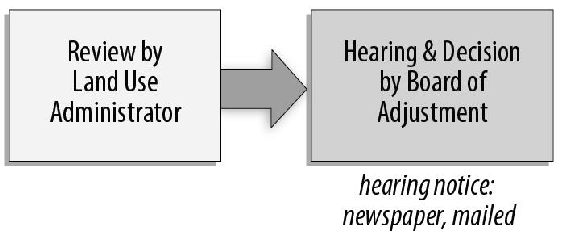
B.
Authorized variances. The board of adjustment is authorized to grant a variance to any regulation in this zoning code in accordance with the variance procedures of this section, except that the variance procedures may not be used to do any of the following:
1.
Allow a principal or an accessory use in a zoning district that is not otherwise allowed in that zoning district (i.e., "use variances" are prohibited);
2.
Allow an accessory use on a lot that is not occupied by the principal use that such accessory use serves;
3.
Waive, modify or amend any definition or use classification;
4.
Waive, modify or otherwise vary any of the review and approval procedures of this chapter;
5.
Waive, vary, modify or otherwise override a condition of approval or requirement imposed by an authorized decision-making body or the state or federal government; or
6.
Waive, vary or modify applicable residential density regulations, provided that this provision is not intended to prohibit variances to minimum lot area or width requirements that apply to lots occupied by a single dwelling unit.
C.
Authority to file. Variance applications may be filed only by the owner of the subject property or by the property owner's authorized agent.
D.
Application filing. Complete applications for variances must be filed with the land use administrator.
E.
Review and report—Land use administrator. Following receipt of a complete application, the land use administrator must prepare a report on the requested variance. The report must be transmitted to the board of adjustment before the required public hearing.
F.
Notice of hearing. Notice of the board of adjustment's required public hearing on a variance application must be provided as follows (see Subsection 70.010F. for additional information on required newspaper and mail notices).
1.
Newspaper notice. Notice must be published in the newspaper at least ten (10) days before the scheduled public hearing.
2.
Mailed notice. Notice must be mailed to the owner of the subject property and all owners of property within three hundred (300) feet of the subject property at least ten (10) days before the scheduled public hearing.
G.
Hearing and final decision—Board of adjustment.
1.
Following receipt of a complete variance application, the board of adjustment must hold a public hearing to consider the requested variance. Following the close of the public hearing, the board of adjustment must act to approve the requested variance, approve the variance with modifications and/or conditions, or deny the variance request based on the standards and review criteria of Subsection 70.130H. Approval of a variance requires an affirmative vote of at least three (3) members of the board of adjustment.
2.
In approving a variance, the board of adjustment is authorized to impose such conditions and restrictions as the board determines to be necessary to ensure compliance with the standards of Subsection 70.130H., to reduce or minimize the effect of the variance upon other properties in the area, and to better carry out the general purpose and intent of this zoning code.
H.
Standards and review criteria.
1.
No variance may be approved unless the board of adjustment determines that the following facts, favorable to the property owner, have been established:
a.
That the physical surroundings, shape, or topographical conditions of the subject property would result in unnecessary hardships or practical difficulties for the property owner, as distinguished from a mere inconvenience, if the strict letter of the regulations were carried out;
b.
That literal enforcement of the subject zoning code provision is not necessary to achieve the provision's intended purpose;
c.
That the conditions leading to the need of the requested variance are unique to the subject property and not applicable, generally, to other property within the same zoning classification;
d.
That the alleged practical difficulty or unnecessary hardship was not created or self-imposed by the current property owner;
e.
That the variance to be granted is the minimum variance that will afford relief;
f.
That the variance to be granted will not alter the essential character of the neighborhood in which the subject property is located, nor substantially or permanently impair use or development of adjacent property; and
g.
That the variance to be granted will not cause substantial detriment to the public good or impair the purposes, spirit, and intent of this zoning code or the comprehensive plan.
I.
Lapse of approval.
1.
An approved variance will lapse and become void three (3) years after it is granted by the board of adjustment, unless a building permit for the work or improvements authorized has been issued and the project has commenced and is diligently pursued to completion. If no building permit is required, the improvement that is the subject of the variance must be in place within the three-year period.
2.
The board of adjustment may extend the expiration period by up to one year at the time of approval of the variance or any time before expiration of the approval. Requests for extensions after the variance is approved must be processed in accordance with the variance procedures, including applicable fees, notices and public hearings.
J.
Transferability. Approved variances run with the land and are not affected by changes of tenancy, ownership, or management.
K.
Amendments. A request for changes in the specific nature of the approved variance or changes to any conditions attached to an approved variance must be processed as a new variance application, including all requirements for fees, notices and public hearings.
L.
Appeals. Board of adjustment decisions on variances may be appealed to District Court in accordance with Subsection 75.010K.
Section 70.140. - Appeals of administrative decisions.
A.
Authority. Appeals of administrative (staff-level) decisions on site plans go to the Planning Commission (See Subsection 70.050C.). The Board of Adjustment is authorized to hear and decide all other appeals where it is alleged there has been an error in any order, requirement, decision or determination made by the Land Use Administrator, the Development Administrator or any other Administrative Official in the administration, interpretation or enforcement of this Zoning Code. For the purpose of applying the procedures of Section 70.140 to appeal of any final decision of the Preservation Commission (See Subsection 70.070L.), the final decision of the Preservation Commission is deemed an administrative decision and the Preservation Commission is deemed an administrative official.
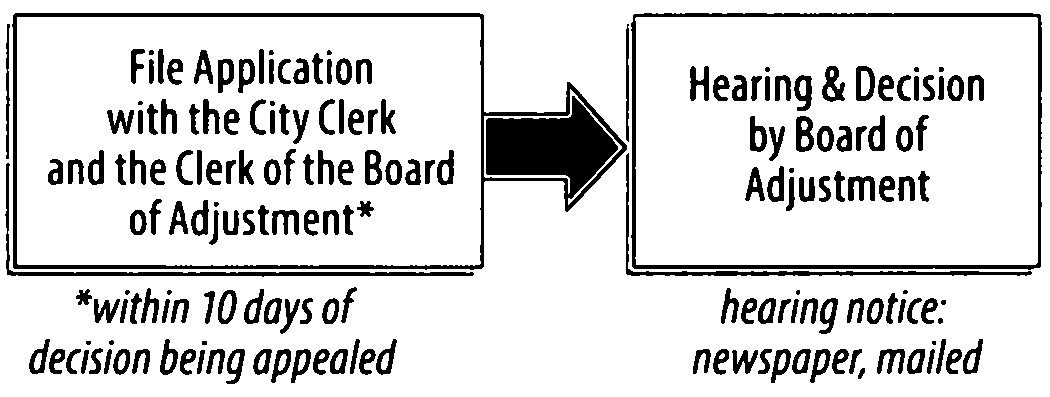
Figure 70-7: Appeals of Administrative Decisions (Generally)
B.
Right to appeal. Appeals of administrative decisions may be filed by any person aggrieved by the land use administrator's, the development administrator's or other administrative official's decision or action. The board of adjustment is authorized to make determinations about whether individuals filing appeals are "aggrieved" by the decision or action.
C.
Application filing.
1.
Complete applications for appeals of administrative decisions must be filed with the Clerk of the Board of Adjustment and the City Clerk, who will accept the appeal on behalf of the administrative official who made the decision being appealed and forward it to said official.
2.
Appeals of administrative decisions must be filed within ten (10) business days of the date of the decision being appealed.
D.
Effect of filing. The filing of a complete notice of appeal stays all proceedings in furtherance of the action appealed, unless the land use administrator or the administrative official who made the decision being appealed certifies to the board of adjustment, after the appeal is filed, that, because of facts stated in the certification, a stay would cause immediate peril to life or property, in which case the proceedings will not be stayed unless by a restraining order, which may be granted by the board of adjustment or by a court of record based on due cause shown.
E.
Record of decision. Upon receipt of a complete application of appeal, the land use administrator or other administrative official whose decision is being appealed must transmit to the board of adjustment all papers constituting the record related to decision being appealed
F.
Notice of hearing. Notice of the board of adjustment's required public hearing must be provided as follows (see Subsection 70.010F. for additional information on required newspaper and mail notices).
1.
Newspaper notice. Notice must be published in the newspaper at least ten (10) days before the scheduled public hearing.
2.
Mailed notice. When an appeal affects a specific property, notice must be mailed to the owner of the subject property and all owners of property within three hundred (300) feet of the subject property at least ten (10) days before the scheduled public hearing.
G.
Hearing and final decision.
1.
The board of adjustment must hold a public hearing on the appeal.
2.
Following the close of the public hearing, the board of adjustment must make its findings and take action on the appeal.
3.
In exercising the appeal power, the board of adjustment has all the powers of the administrative official from whom the appeal is taken. The board of adjustment may affirm or may, upon the concurring vote of at least three (3) members, reverse, wholly or in part, or modify the decision being appealed.
4.
In acting on the appeal, the board of adjustment must grant to the official's decision a presumption of correctness, placing the burden of persuasion of error on the appellant.
H.
Review criteria. The decision being appealed may be reversed or wholly or partly modified only if the board of adjustment finds that the land use administrator, the development administrator or other administrative official erred.
I.
Appeals. Board of adjustment decisions may be appealed to District Court in accordance with Subsection 75.010K.
(Ord. No. 24725, §§ 27—29, 11-17-2021; Ord. No. 25330, § 16, 6-5-2024)

