
Tulsa City Zoning Code
CHAPTER 10
- MIXED-USE DISTRICTS
Section 10.010.- General.
A.
List. The mixed-use zoning districts are listed in Table 10-1. When this zoning code refers to "mixed-use" zoning districts or to "MX" districts it is referring to all MX districts. (Note: IMX district regulations are found in Section 25.060.)
Table 10-1: Mixed-use (MX) Zoning Districts
B.
Purposes.
1.
MX1, Neighborhood Mixed-use. The MX1, Neighborhood Mixed-use district is intended to accommodate small-scale retail, service and dining uses that serve nearby residential neighborhoods. The district also allows a variety of residential uses and building types.
2.
MX2, Community Mixed-use. The MX2, Community Mixed-use district is intended to accommodate retail, service, entertainment, and employment uses that serve many surrounding neighborhoods. The district also allows a variety of residential uses and building types.
3.
MX3, Regional Mixed-use. The MX3, Regional Mixed-use district is intended to accommodate large-scale employment, retail, civic and institutional and entertainment uses that draw visitors and workers from around the region.
C.
Use, Character and Height Designations.
1.
Each MX district consists of a use designation (MX1, MX2 or MX3), a character designation (-P, -U, -V or -F) and a height designation (-35, -45, -55, -65 or -unlimited). This "modular" approach allows the creation of finely-tuned, context-sensitive zoning districts.
2.
MX districts and their respective use, character and height designations may be established or amended only through the zoning map amendment procedures of Section 70.030.
3.
On the zoning map, all the components of the applicable mixed-use zoning district will be identified as a single map symbol. MX1-P-45, for example, is the map symbol denoting a neighborhood-oriented mixed-use district (MX1) that requires a very pedestrian-oriented (-P) building pattern (character) and that allows buildings up to forty-five (45) feet in height (-45).
(Ord. No. 25656, § 3, 9-10-2025)
Section 10.020. - Use regulations.
Principal uses are allowed in mixed-use districts in accordance with Table 10-2.
A.
Use classification system. Uses are listed in the first column of Table 10-2. This zoning code classifies uses into categories and subcategories, which are defined in Chapter 35. In some cases, specific use types are listed in addition to the use categories and subcategories. Building types are also defined in Chapter 35.
B.
Permitted uses. Uses identified with a "P" are permitted as-of-right in the subject zoning district, subject to compliance with any supplemental regulations identified in the final column of Table 10-2 and with all other applicable regulations of this zoning code.
C.
Special exception uses. Uses identified with an "S" may be allowed if reviewed and approved in accordance with the special exception procedures of Section 70.120. Special exception uses are subject to compliance with any supplemental regulations identified in the final column of Table 10-2 and with all other applicable regulations of this zoning code.
D.
Prohibited uses. Uses identified with an "-" are expressly prohibited. Uses that are not listed in the table and that cannot be reasonably interpreted (as stated in Subsection 35.020E.) to fall within any defined use category are also prohibited.
E.
Supplemental regulations. The "supplemental regulations" column of Table 10-2 identifies additional regulations that apply to some uses. Unless otherwise expressly stated, compliance with these regulations is required regardless of whether the use is permitted as-of-right or requires special exception approval.
F.
Accessory uses. Accessory uses are not regulated by Table 10-2. Customary accessory uses are allowed in conjunction with principal uses permitted by right or by special exception, subject to compliance with all applicable accessory use regulations of Chapter 45.
Table 10-2: MX District Use Regulations
G.
Table notes. The following notes refer to the bracketed numbers (e.g.," [1]") in Table 10-2:
[1]
Proposed use requires special exception approval if selling or serving alcoholic beverages and located on a lot within 150 feet of any residential zoning district other than R-zoned street right-of-way (see Figure 10-1).
Figure 10-1: Special Exception Requirement within 150 feet of R zoning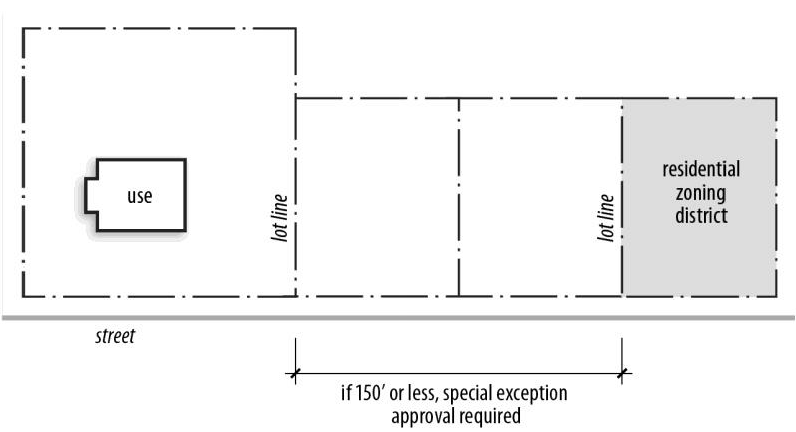
[2]
When located in the Healthy Neighborhoods Overlay (HNO) district the use is regulated as stated in Subsection 20.060D.
(Ord. No. 24328, § 2, 3-11-2020; Ord. No. 24725, § 2, 11-17-2021; Ord. No. 25192, § 2, 12-6-2023; Ord. No. 25604, § 2, 6-18-2025)
Section 10.030. - Character designations.
A.
List. There are four (4) character designations established for the MX districts, as identified in Table 10-3. These designations govern allowed building types as well as required building and development patterns.
Table 10-3: MX District Character Designations
B.
Pedestrian Character Designation.
1.
Intent. The -P, Pedestrian character designation is generally intended to be applied in locations where a high level of pedestrian orientation is present or desired, such as areas designated by the comprehensive plan as "main street" areas.
2.
Allowed Building Types. The following building types are permitted in -P character zones (see building type definitions in Section 35.010):
a.
Vertical mixed-use buildings.
b.
Commercial buildings.
c.
Civic/Institutional buildings.
d.
Open space sites.
3.
Lot and Building Regulations. The lot and building regulations of Table 10-4 apply to all new construction and building additions in -P character zones, except that civic/institutional buildings and open space sites are subject to -F character zone regulations (see Section 10.030-E). General exceptions to lot and building regulations and rules for measuring compliance can be found in Chapter 90. See Figure 10-3 for illustration of selected regulations. Existing buildings are exempt from compliance with build-to-zone (BTZ), ground floor ceiling height and transparency regulations.
Table 10-4: Lot and Building Regulations for -P Character Zones
See Figure 10-3 for illustration of selected regulations.
[1]
Parking spaces, not including drive aisles, are prohibited between building and street right-of-way (see Figure 10-2) Parking structures are subject to Section 40.280.
Figure 10-2: Parking Prohibited between Building and Street Right-of-Way (-P Character
Zones)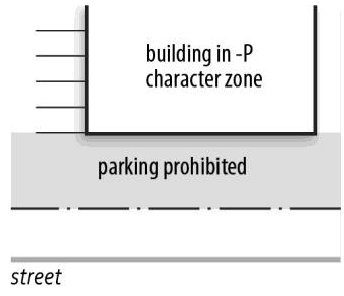
Figure 10-3: MX District Lot and Building Regulations (-P Character Zone)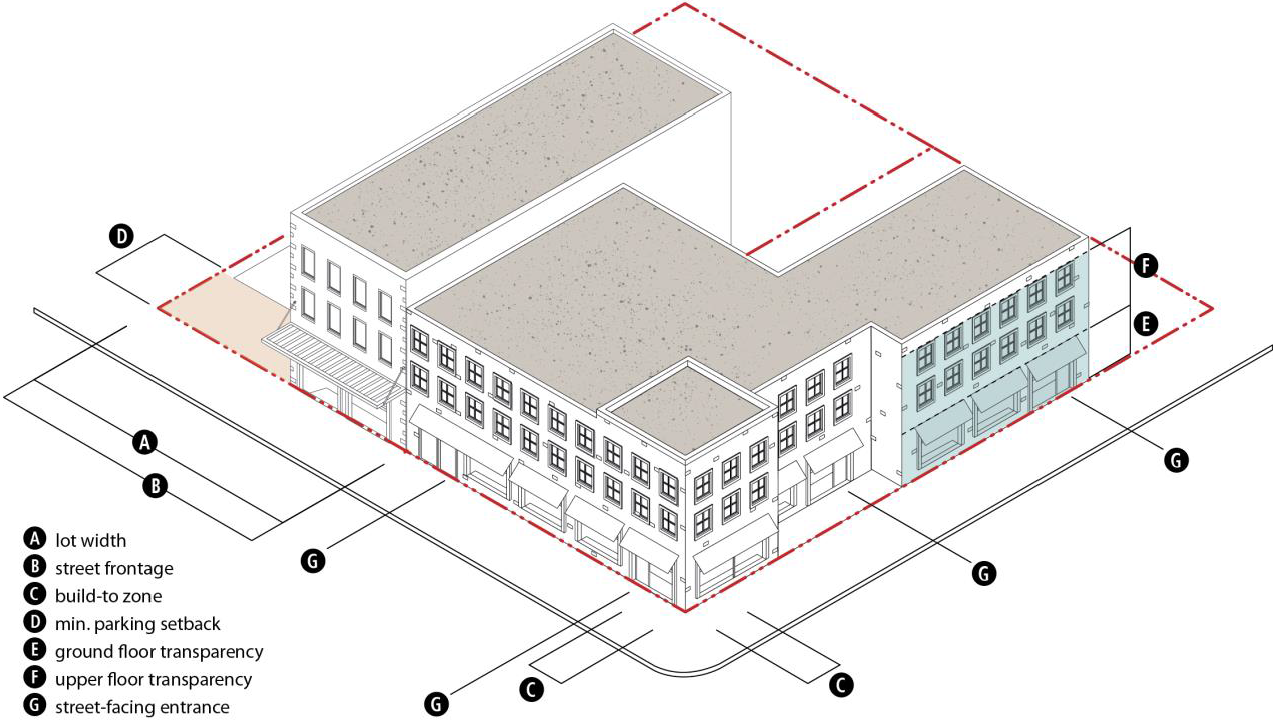
C.
Urban Character Designation.
1.
Intent. Like the -P character designation, the -U, Urban character designation is generally intended to be applied in areas with high levels of walkability, but where a greater variety of building types are present or desired, such as in areas designated by the comprehensive plan as neighborhood, town and regional centers and along some plan-designated mixed-use corridors.
2.
Allowed Building Types. The following building types are permitted in -U character zones (see building type definitions in Section 35.010):
a.
Vertical mixed-use and mixed-use buildings.
b.
Commercial buildings.
c.
Apartment/Condo.
d.
Townhouses.
e.
Civic/Institutional buildings.
f.
Open space sites.
3.
Lot and Building Regulations. The lot and building regulations of Table 10-5 apply to all new construction and building additions in -U character zones, except that civic/institutional buildings and open space sites are subject to -F character zone regulations (see Section 10.030-E). General exceptions to lot and building regulations and rules for measuring compliance can be found in Chapter 90. Existing buildings are exempt from compliance with build-to-zone (BTZ), ground floor ceiling height and transparency regulations.
Table 10-5: Lot and Building Regulations for -U Character Zones
[1]
Parking is prohibited between building and street right-of-way (see Figure 10-4). Parking structures are subject to Section 40.280.
Figure 10-4: Parking Prohibited between Building and Street Right-of-Way (-U Character
Zones)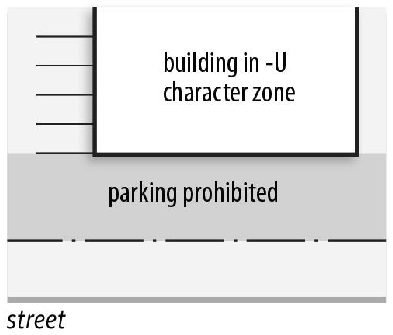
D.
Variable character designation.
1.
Intent. The -V, Variable character designation is generally intended to be applied in auto-oriented areas where a transition to greater levels of walkability are underway or desired. The regulations allow greater flexibility in the siting of buildings and parking areas by, for example, allowing more generous maximum building setbacks, which can be used for landscape and streetscape elements or limited amounts of parking.
2.
Allowed building types. The following building types are permitted in -V character zones (see building type definitions in Section 35.010):
a.
Vertical mixed-use buildings and mixed-use buildings.
b.
Commercial buildings.
c.
Apartment/Condo.
d.
Townhouses.
e.
Civic/Institutional buildings.
f.
Open space sites.
3.
Lot and Building Regulations. The lot and building regulations of Table 10-6 apply to all new construction and building additions in -V character zones, except that civic/institutional buildings and open space sites are subject to -F character zone regulations (see Section 10.030-E). General exceptions to lot and building regulations and rules for measuring compliance can be found in Chapter 90. See Figure 10-6 for illustration of selected regulations. Existing buildings are exempt from compliance with build-to-zone (BTZ), ground floor ceiling height and transparency regulations.
Table 10-6: Lot and Building Regulations for -V Character Zones
See Figure 10-6 for illustration of selected regulations.
[1]
A maximum of one double-loaded parking aisle (two (2) parking bays) is permitted between the building and street right-of-way (see Figure 10-5 and Figure 10-6). Parking structures are subject to Section 40.280.
Figure 10-5: Limited Parking between Building and Street Right-of-Way (-V Character
Zones)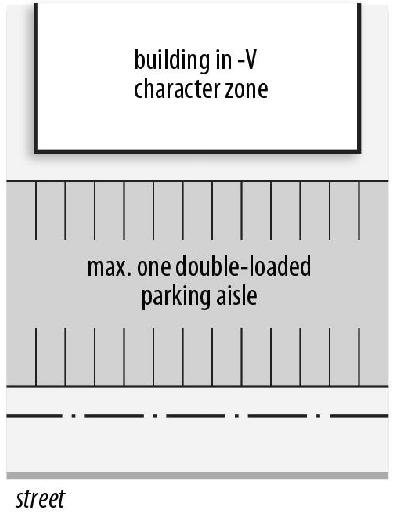
Figure 10-6: MX District Lot and Building Regulations (-V Character Zone)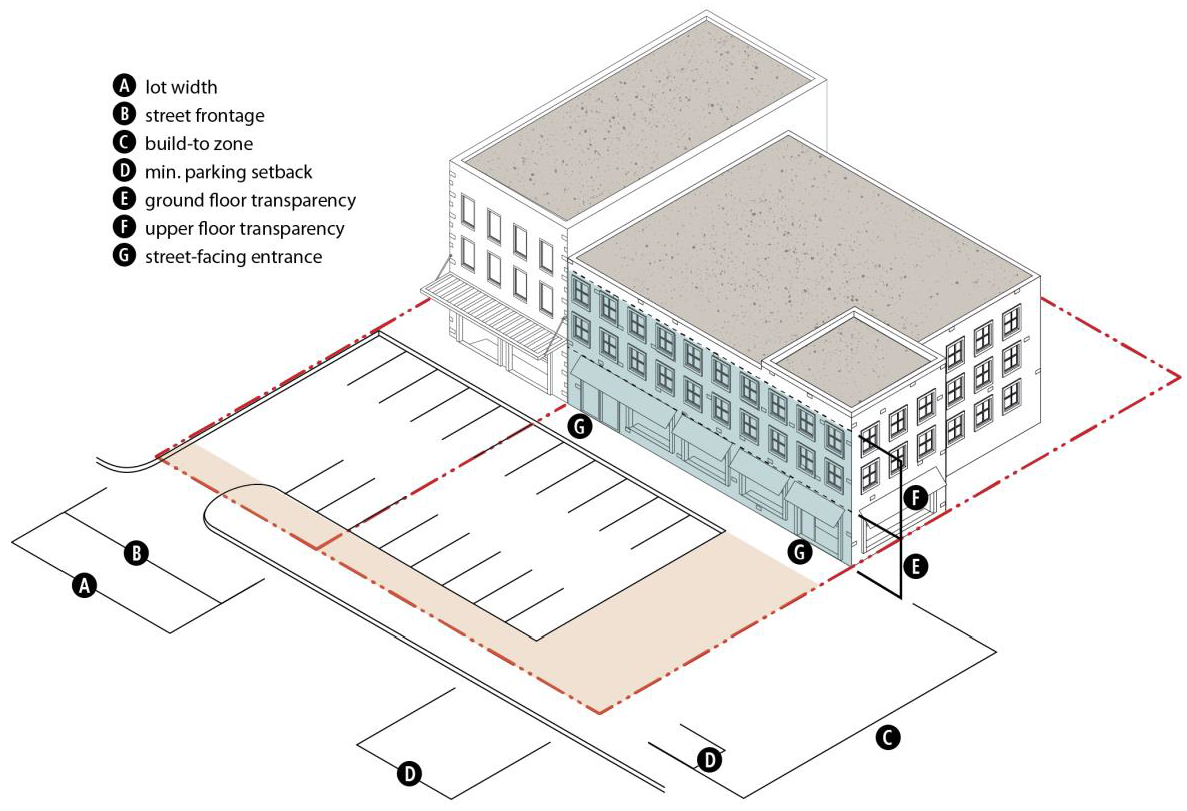
E.
Flexible Character Designation.
1.
Intent. The -F, Flexible character designation is generally intended to allow the highest levels of flexibility in terms of allowed building types and development patterns.
2.
Allowed Building Types. The following building types are permitted in -F character zones (see building type definitions in Section 35.010):
a.
Vertical mixed-use and mixed-use buildings.
b.
Commercial buildings.
c.
Apartment/Condo.
d.
Townhouses.
e.
Duplexes.
f.
Detached houses.
g.
Civic/Institutional buildings.
h.
Open space sites.
3.
Lot and building regulations. The lot and building regulations of Table 10-7 apply to all new construction and building additions in -F character zones. General exceptions to lot and building regulations and rules for measuring compliance can be found in Chapter 90. Existing buildings are exempt from ground floor ceiling height and transparency requirements.
Table 10-7: Lot and Building Regulations for -F Character Zones
[1]
Garage doors must be set back at least twenty (20) feet from back of sidewalk (see Figure 10-7).
[2]
For townhouses, side setback applies only to exterior wall of end units.
[3]
Parking structures are subject to Section 40.280.
Figure 10-7: Garage Door Setback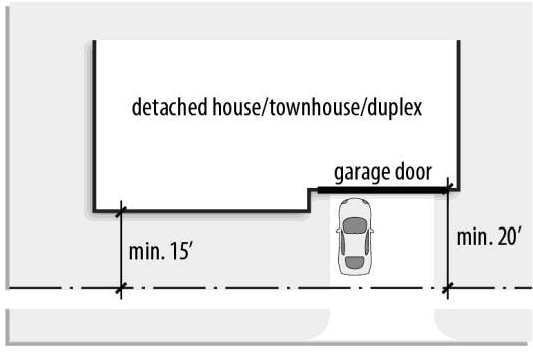
(Ord. No. 24725, §§ 3—6, 11-17-2021; Ord. No. 25055, § 4, 5-24-2023; Ord. No. 25656, §§ 4—9, 9-10-2025)
Section 10.040. - Height designations.
A.
Regulations. MX district height designations are indicated by a dash and number suffix at the end of an MX district map symbol. Except as stated by the transition standards of Subsection 10.040B., building heights in MX districts may not exceed the limits established in Table 10-8.
Table 10-8: MX District Height Designations
B.
Height transition. For MX-zoned lots that abut an R-zoned lot, the maximum building height limit at the point of the required minimum setback is forty (40) feet. Height may be increased above forty (40) feet by up to one foot (vertical) for each six (6) inches of additional building setback, up to the maximum height allowed in the district. The additional setback may be provided for the entire building or only the portion of the building above forty (40) feet in height (see Figure 10-8).
Figure 10-8: Transitional Height Standards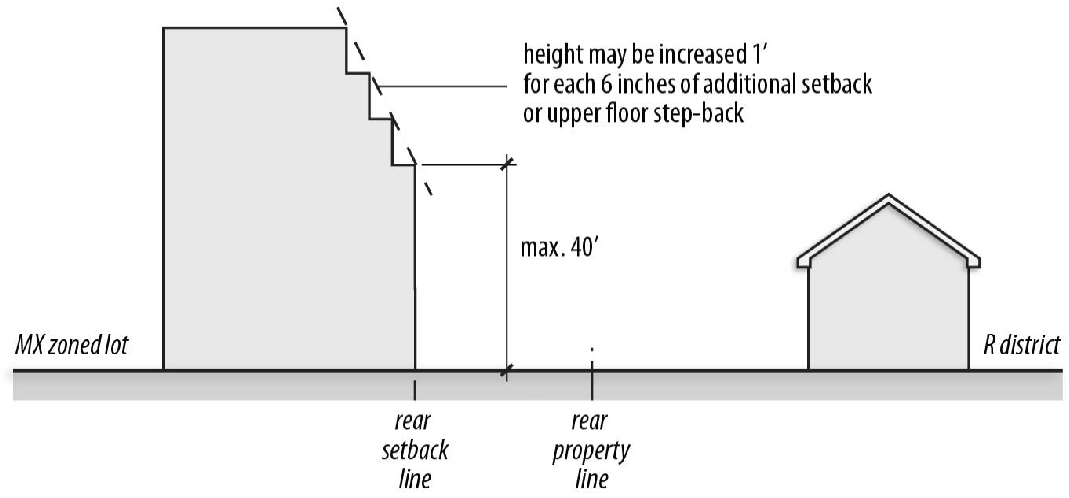
Section 10.050. - Other relevant regulations.
Uses and development in mixed-use zoning districts may be subject to other regulations and standards, including the following:
A.
Nonconformities. See Chapter 80.
B.
Accessory uses and structures. See Chapter 45.
C.
Parking. See Chapter 55.
D.
Signs. See Chapter 60.
E.
Landscaping and screening. See Chapter 65.
F.
Temporary uses. See Chapter 50.
G.
Outdoor lighting. See Chapter 67.

