
Tulsa City Zoning Code
CHAPTER 80
- NONCONFORMITIES
Section 80.010.- General.
A.
Intent. The adoption and amendment of the zoning code text and map, beginning with the adoption of the city's first zoning code in 1923, has resulted in some lots, uses and structures becoming nonconforming (i.e., established in compliance with regulations in effect at the time of their establishment, but which would be prohibited under subsequently adopted regulations). The nonconformity regulations of this chapter are intended to explain the effect of this nonconforming status and help differentiate nonconformities, which have legal status under this zoning code, from zoning violations, which are illegal and subject to penalties and enforcement action. The regulations of this chapter are also intended to:
1.
Recognize the interests of landowners in continuing to use their property for uses that were lawfully established;
2.
Promote maintenance, reuse and rehabilitation of existing buildings; and
3.
Place reasonable limits on nonconformities that have the potential to adversely affect surrounding properties.
B.
Authority to continue. Any nonconformity that existed on the effective date specified in Section 1.030 or any lot, structure use or situation that becomes nonconforming upon adoption of any amendment to this zoning code or any amendment of the zoning map subsequent to the effective date specified in Section 1.030 may be continued, subject to the regulations of this chapter.
C.
Determination of nonconforming status.
1.
The burden of proving that a nonconformity exists (as opposed to a zoning code violation) rests entirely with the subject owner.
2.
The development administrator is authorized to determine whether reliable evidence of nonconforming status has been provided by the subject owner.
3.
Building permits, zoning clearance reports, lawfully recorded plats, lawfully recorded instruments of conveyance, aerial photography owned by a governmental agency and other official government records that indicate lawful establishment of the use, lot or structure constitute conclusive evidence of nonconforming status. If such forms of conclusive evidence are not available, the development administrator is authorized to consider whether other forms of evidence provided by the owner are reliable and adequate to document nonconforming status. Common examples of evidence that may be determined to be reliable and adequate include:
a.
Professional registrations or business licenses;
b.
Utility billing records;
c.
Rent records;
d.
Advertisements in dated publications;
e.
Listings in telephone or business directories; and
f.
Notarized affidavits affirming the date of lawful establishment of the use or structure.
4.
The development administrator's determination of nonconforming status may be appealed in accordance with Section 70.140.
D.
Repairs and maintenance.
1.
Repairs and normal maintenance necessary to keep a nonconformity in sound condition are permitted unless the work increases the extent of the nonconformity or is otherwise expressly prohibited by this zoning code.
2.
If a nonconforming structure or a structure occupied by a nonconforming use becomes physically unsafe or unlawful due to lack of repairs and maintenance, and a final order of vacation or demolition is entered by any duly authorized official by reason of physical condition, it may not thereafter be used, restored, or repaired, or rebuilt except in conformity with the provisions of the zoning district in which it is located.
3.
Nothing in this chapter is intended to prevent nonconformities from being structurally strengthened or restored to a safe condition in accordance with an order from a duly authorized public official.
E.
Change of tenancy or ownership. Nonconforming status runs with the land and is not affected by changes of tenancy, ownership or management.
Section 80.020. - Nonconforming lots.
A.
Description. A nonconforming lot is a lot that does not comply with the applicable minimum lot area, minimum lot width, minimum street frontage or minimum open space requirements of the subject zoning district and that meets at least one of the following criteria:
1.
The lot was a lot of record on or before July 1, 1970;
2.
The lot is located within a subdivision approved by the planning commission; or
3.
The lot is a lot of record for which a recorded instrument of conveyance bears the endorsement of the planning commission.
B.
Nonconforming lots in residential zoning districts. In residential zoning districts, a single detached house may be erected on a nonconforming lot without complying with the minimum lot area, minimum lot area per unit, minimum lot width, minimum street frontage or minimum open space per unit requirements of the subject zoning district, provided that at least fifty (50) percent of the lot area remains as open space. All other lot and building regulations apply, except that detached houses may be erected on corner lots that are nonconforming with regard to lot width, subject to a reduced minimum street side building setback of five (5) feet. Garages that are accessed through a side yard abutting a street must be set back at least twenty (20) feet.
Figure 80-1: Detached House on Nonconforming Lot in R District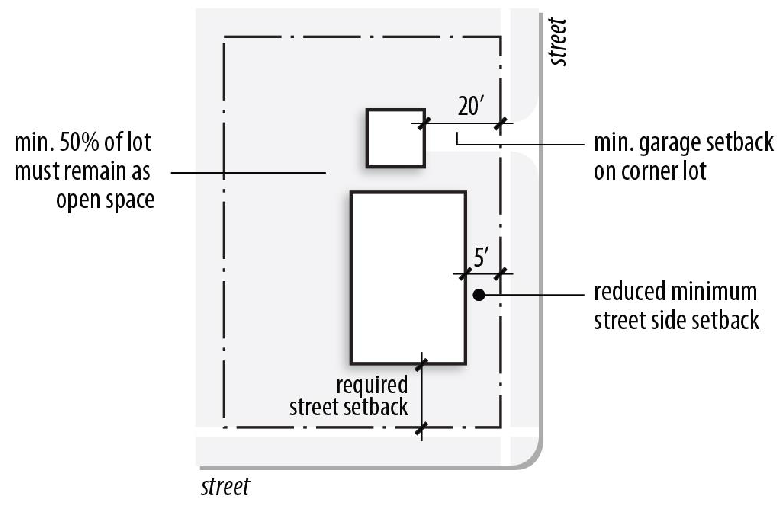
C.
Nonconforming lots in nonresidential zoning districts. In nonresidential districts, on any lot of record created on or before July 1, 1970, or on any lot within a subdivision having received approval of the planning commission, or any lot of record for which a recorded instrument of conveyance bears the endorsement of the planning commission a permitted use may be located on such lot irrespective of its street frontage. Such uses are subject to compliance with other lot and building regulations of the district and applicable use regulations.
Section 80.030. - Nonconforming structures.
A.
Description. A nonconforming structure is a structure, other than a sign, that was lawfully established but that no longer complies with applicable zoning regulations because of the adoption or amendment of zoning regulations after the structure was established.
B.
Use. A nonconforming structure may be used for any use allowed in the zoning district in which the structure is located, including a lawfully established nonconforming use.
C.
Movement. A nonconforming structure may be moved in whole or in part to another location on the same lot only if the movement or relocation does not create additional or new nonconformities. A nonconforming structure may be moved to another lot only if the structure would comply with the zoning regulations that apply to that (relocation) lot.
D.
Alterations, enlargements and expansions. Alterations, including enlargements and expansions, are permitted if the proposed alteration or expansion complies with all applicable lot and building regulations and does not increase the extent of the nonconformity. A building with a nonconforming street setback, for example, may be expanded to the rear as long as the rear expansion complies with applicable rear setback regulations and all other applicable lot and building regulations. Horizontal and vertical extensions of an exterior wall that is nonconforming with regard to applicable setbacks may be approved in accordance with the special exception procedures of Section 70.120, provided the extensions are not located closer to the lot line than the existing structure.
E.
Restoration or re-establishment of damaged or destroyed structures.
1.
Antenna-supporting structures, if damaged or destroyed by any means, may be reconstructed, provided the supporting structure is placed in the same location and has no greater height or area that the structure it replaces.
2.
If any other nonconforming structure is damaged or partially destroyed by any means to the extent of more than fifty (50) percent of its replacement cost at time of damage, it may be restored as a nonconforming structure only if approved in accordance with the special exception procedures of Section 70.120. In order to approve a special exception for re-establishment of a nonconforming structure, the board of adjustment must find that restoration as a conforming structure cannot reasonably be made in view of the nature and extent of the nonconformity and the nature and extent of the damages.
3.
If a nonconforming structure is damaged or partially destroyed by any means to the extent of fifty (50) percent or less of its replacement cost at time of damage it may be restored as a nonconforming structure.
4.
Re-establishment as a nonconforming structure may not increase the extent of nonconformity, except that the board of adjustment is authorized to approve a special exception for building additions that increase the extent of nonconformity if the board of adjustment determines that such additions:
a.
Do not increase the habitable or leasable floor area of the building; and
b.
Are required to be provided because of building or energy code amendments adopted after construction of the original building.
5.
In all cases, any permits required to restore the damaged structure must be obtained within two (2) years of the date of damage. If required permits are not obtained within two (2) years, the structure's nonconforming status is lost.
Section 80.040. - Nonconforming uses.
A.
Description. A nonconforming use is a use that was lawfully established in accordance with all zoning regulations in effect at the time of its establishment but that is no longer allowed by the use regulations of the zoning district in which the use is located. Lawfully established uses that do not comply with separation distance (spacing) requirements are also deemed to be nonconforming uses.
B.
Change of use.
1.
A nonconforming use in a residential zoning district may be changed only to a use that is allowed in the subject zoning district. Once changed to a conforming use, the nonconforming use may not be re-established.
2.
A nonconforming use located in a zoning district other than a residential zoning district, may be changed to a use that is allowed in the subject zoning district, in which case the nonconforming use may not be re-established. A nonconforming use located in a zoning district other than a residential zoning district, may be changed to another nonconforming use only if approved in accordance with the special exception procedures of Section 70.120. The change of a use to another use included within the same use category does not constitute a "change of use" within the meaning of this section. In order to approve a special exception for a nonconforming use substitution, the board of adjustment must find that the proposed use substitution will not result in any increase in adverse impacts on the surrounding area when compared to the previous nonconforming use of the property. In making such a determination, the board of adjustment must consider all of the following factors, as applicable:
a.
Traffic to and from the site;
b.
Hours of operation;
c.
Outdoor display, storage and work activities; and
d.
Other factors likely to have an effect on the surrounding area.
C.
Expansion of use. A nonconforming use of a portion of a building may be expanded or extended into the remaining portions of the building if the development administrator determines that the areas of the building in which the expansion is proposed were manifestly arranged and designed for the use. Nonconforming use may not be expanded or extended in any other way unless the expansion reduces or eliminates the nonconformity.
D.
Movement. A nonconforming use may be moved in whole or in part to another location on the same lot only if the movement or relocation does not create additional or new nonconformities. A nonconforming use may be moved to another lot only if the use would comply with the zoning regulations that apply to that (relocation) lot.
E.
Loss of nonconforming status.
1.
If a structure containing a nonconforming use is damaged or partially destroyed to the extent of more than fifty (50) percent of its replacement cost at time of damage, the nonconforming use may be re-established only if approved in accordance with the special exception procedures of Section 70.120. In order to approve a special exception for re-establishment of a nonconforming use, the board of adjustment must find that re-establishment will not result in any increase in adverse impacts on the surrounding area when compared to the previous nonconforming use of the structure. In making such a determination, the board of adjustment must consider all of the following factors, as applicable:
a.
Traffic to and from the site;
b.
Hours of operation;
c.
Outdoor display, storage and work activities; and
d.
Other factors likely to have an effect on the surrounding area.
2.
If a nonconforming use is changed to a conforming use, no matter how short the period of time, all nonconforming use rights are lost and re-establishment of the nonconforming use is prohibited.
3.
If a nonconforming use of a building is discontinued for thirty-six (36) consecutive months or for thirty-six (36) months during any four-year period, the nonconforming use may not be re-established. Periods of time when governmental action impedes access to or the use of the premises are not counted as periods of discontinuance.
F.
Nonconforming use of unimproved land. Nonconforming uses of unimproved land are land uses and activities that meet the definition of a nonconforming use but that include structures that are all accessory or incidental to the use and in the aggregate do not cover more than ten (10) percent of the lot area devoted to the nonconforming use. Common examples include storage yards, construction debris sites, used vehicle sales lots, vehicle impound yards, auto wrecking, junkyards, and similar open-air uses. Nonconforming uses of unimproved land are subject to the nonconforming use regulations of this section (Section 80.040), except as modified by the following specific regulations:
1.
No nonconforming use of unimproved land may be changed to another nonconforming use, nor enlarged, increased or moved to another portion of the lot, nor extended to occupy a greater area of land than was occupied at the time that the use became nonconforming.
2.
No additional structure (other than fences) may be erected in connection with a nonconforming use of unimproved land.
3.
If any nonconforming use of unimproved land ceases for any reason for a period of more than ninety (90) days, (except when government action impedes access to or use of the premises) any subsequent use of such land must conform in all respects to the regulations of the zoning district in which it is located.
Section 80.050. - Sexually oriented business establishment.
A sexually oriented business establishment lawfully existing on the effective date specified in Section 1.030, or any subsequent amendment, but that does not comply with any parking, loading, spacing or screening requirement of this zoning code, is deemed nonconforming. Such use may continue subject to the following provisions:
A.
No such use may be enlarged or extended.
B.
No such use may be changed to another use that does not comply with parking, loading, screening and spacing requirements, except that changes to an office or retail use are permitted, and the board of adjustment is authorized to approve a change to another use otherwise permitted by right or special exception within the subject zoning district, even though such use does not comply with applicable parking, loading, screening or spacing requirements.
C.
A change of a use from one type of sexually oriented business establishment to another type of sexually oriented business establishment is considered a change of use and is not permitted unless the new use complies with all applicable requirements of this zoning code.
D.
If the use of a nonconforming sexually oriented business establishment is discontinued for any reason whatsoever for a period of one hundred eighty (180) days or more, such use may not be reestablished unless it complies with all of the requirements of this zoning code.
E.
If two (2) or more existing sexually oriented business establishments are separated by a lesser distance than required by this zoning code, the first sexually oriented business establishment licensed and continually operating at a particular location will be deemed the conforming use with regard to required spacing and separation distances and all later established sexually oriented business establishments will be deemed the nonconforming use with regard to required spacing distance.
Section 80.060. - Nonconforming signs.
A.
Description. A nonconforming sign is a sign that was lawfully established but that no longer complies with applicable zoning code regulations because of the adoption or amendment of regulations after the sign was established.
B.
Off-premise outdoor advertising signs. Nonconforming off-premise outdoor advertising signs may continue subject to the following provisions:
1.
Nonconforming off-premise outdoor advertising signs must be maintained in good repair and safe condition, in accordance with Subsection 80.010D. No permits may be issued for upgrades or modifications of nonconforming signs. The conversion of a dynamic display component of a sign to a different dynamic display method or technology is considered a sign modification.
2.
If an off-premise outdoor advertising sign is nonconforming by reason of restrictions on its brightness or illumination or its use of strobe or beacon lights, the sign must be immediately removed or made to conform.
3.
If a nonconforming off-premise outdoor advertising sign is damaged or partially destroyed to the extent of more than fifty (50) percent of its replacement cost at the time of damage, the sign must be removed or made to conform to all applicable regulations within ninety (90) days of the date of the date of damage or destruction.
4.
If a nonconforming off-premise outdoor advertising sign is not used for advertising purposes for a period of one hundred eighty (180) consecutive days, the nonconforming off-premise outdoor advertising sign is deemed to have been abandoned and must be removed. A sign that directs attention to the sign owner's outdoor advertising business, commodity, or service is not considered "outdoor advertising" for purposes administering and enforcing the provisions of this paragraph.
C.
On-premise signs. Nonconforming on-premise signs may continue subject to the following provisions:
1.
Nonconforming on-premise signs must be maintained in good repair and safe condition, in accordance with Subsection 80.010D. No permits may be issued for upgrades or modifications of nonconforming signs.
2.
If an on-premise sign is nonconforming by reason of restrictions on its brightness or illumination or its use of strobe or beacon lights, the sign must be immediately removed or made to conform.
3.
A window sign that is nonconforming by reason of restrictions on its sign area must be immediately removed or made to conform.
4.
If a nonconforming on-premise sign is damaged or partially destroyed to the extent of more than fifty (50) percent of its replacement cost at the time of damage, the sign must be removed or made to conform to all applicable regulations within ninety (90) days of the date of the date of damage or destruction.
5.
If the on-premise sign is not used for advertising purposes for a period of one hundred eighty (180) consecutive days, the sign is deemed abandoned and must be removed.
D.
Strobe lights and beacons. Search lights, strobe lights and rotating beacon lights that are visible from public right-of-way are prohibited and must be removed immediately, except as otherwise required by law.
(Ord. No. 25330, § 17, 6-5-2024)
Section 80.070. - Nonconforming development features.
A.
Description. A nonconforming development feature is any aspect of a development—other than a nonconforming lot, nonconforming structure, nonconforming use or nonconforming sign—that was lawfully established in accordance with zoning regulations in effect at the time of its establishment but that no longer complies with one or more applicable zoning regulations. Common examples are off-street parking areas that contain fewer spaces than required by current regulations and sites that do not comply with current landscaping, screening or lighting regulations.
B.
General. Nonconforming development features may remain except as otherwise expressly stated in this zoning code, but the nature and extent of nonconforming development features may not be increased.

