
Tulsa City Zoning Code
CHAPTER 40
- SUPPLEMENTAL USE AND BUILDING REGULATIONS
Section 40.010.- General.
This chapter includes supplemental regulations that apply to some uses and building types. These regulations supplement the applicable zoning district regulations. The applicability of these supplemental use regulations is indicated in the individual sections of this chapter and in the use regulations of the respective zoning district.
Section 40.020. - Animal services.
Whenever an animal services use is located on a lot abutting an R- or AG-R-zoned lot, a screening wall or fence must be provided along the common lot line in accordance with the F1 screening fence or wall standards of Subsection 65.070C.
Section 40.030. - Apartments/condos.
Whenever an apartment/condo building is located on a lot abutting an RE, RS, or AG-R district, a screening wall or fence must be provided along the common lot line in accordance with the F1 screening fence or wall standards of Subsection 65.070-C.
(Ord. No. 24825, § 4, 5-18-2022)
Section 40.040. - Assembly and entertainment.
Whenever an assembly and entertainment use is located on a lot abutting an R or AG-R-zoned lot, a screening wall or fence must be provided along the common lot line in accordance with the F1 screening fence or wall standards of Subsection 65.070C.
Section 40.050. - Bars.
The supplemental use regulations of this section apply to all bars, except accessory use bars.
A.
Bars are subject to all of the following separation distance requirements:
1.
Public entrance doors of bars may not be located within fifty (50) feet of any R-zoned lot, as measured in a straight line from the nearest point on the R-zoned lot (not including R-zoned expressway right-of-way) to the nearest public entrance door of the bar or the nearest portion of any outdoor seating/dining area, whichever results in a greater setback.
2.
Bars may not be located within three hundred (300) feet of a public park, school or religious assembly use. The separation distance required by this paragraph must be measured from the nearest property line of such public park, school or religious assembly use to the nearest perimeter wall of the bar.
3.
Bars may not be located within three hundred (300) feet of any other bar or sexually oriented business establishment, except in the CBD district. The required separation distance must be measured in a straight line between the nearest perimeter walls of the portions of the buildings occupied by the bar or sexually oriented business establishment.
Figure 40-1: Separation Distance Requirements for Bars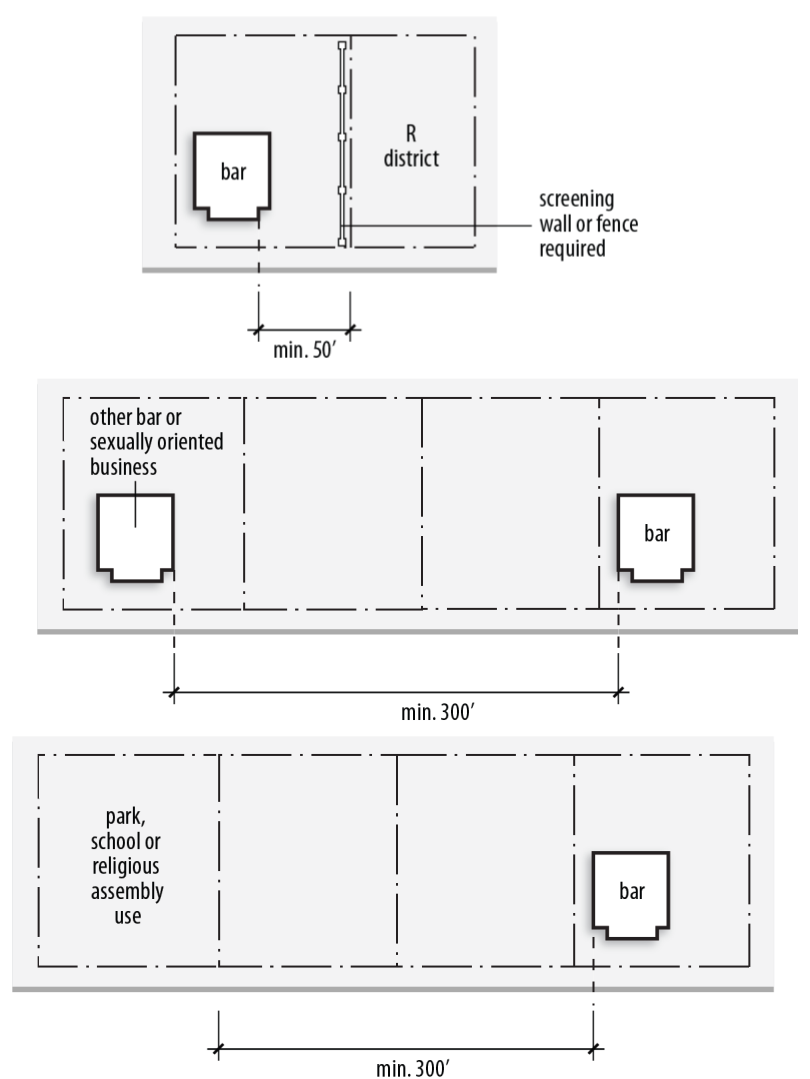
4.
Religious assembly uses include all contiguous property owned or leased by the religious organization upon which the principal religious assembly building is located, regardless of any interior lot lines.
5.
Schools include all contiguous property owned or leased by the school upon which the principal school building is located, regardless of any interior lot lines.
B.
Bars must be located within completely enclosed buildings, except that outdoor customer seating/dining areas, including rooftop seating, are allowed subject to the following regulations:
1.
Outdoor customer seating/dining areas are subject to all applicable building setback requirements and must abut the building wall or roof area of the principal building;
2.
Outdoor customer seating/dining areas may not occupy required parking spaces or parking area access aisles; and
3.
When a bar is located on a lot abutting an R-zoned lot, noise emanating from any on-site equipment or activity, including outdoor customer seating/dining areas may not exceed 65 db(A), as measured long the common lot line at the top of the required screening wall or fence.
C.
When a bar is located on a lot abutting an R-zoned lot, a screening wall or fence must be provided along the common lot line in accordance with the F1 screening fence or wall standards of Subsection 65.070C.
Figure 40-2: Screening of Bar Abutting R District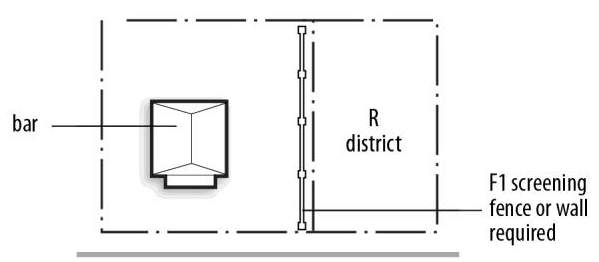
Section 40.060. - Bed and breakfasts.
The supplemental use regulations of this section apply to all bed and breakfast uses.
A.
Bed and breakfast are limited to a maximum of twelve (12) guest rooms unless a lower limit is established by the board of adjustment as a condition of an approved special exception.
B.
The maximum length of stay for any guest is limited to thirty (30) consecutive days.
C.
The owner/operator must maintain a register of bed and breakfast guests and on-site events for each calendar year and make the register available to city code enforcement upon request.
D.
Cooking facilities are prohibited in guest rooms.
E.
Signs are allowed in accordance with the sign regulations of the subject zoning district unless the board of adjustment establishes stricter conditions at the time of special exception approval.
F.
Public restaurants are prohibited. Meals may be served only to overnight guests and for on-site events expressly authorized by the board of adjustment at the time of special exception approval. The board of adjustment may authorize bed and breakfasts to be rented for events, such as weddings, receptions, anniversaries, private dinner parties, business seminars, etc. The use of bed and breakfasts for on-site events requires express authorization of the board of adjustment, in accordance with the special exception procedures of Section 70.120. As part of approval of the special exception, the board of adjustment is authorized to establish the maximum number of on-site events per year and the maximum number of guests per any single event, based on the availability of off-street parking and the facility's likely impacts on the area.
Section 40.070. - Colleges, universities and hospitals.
Colleges, universities and hospitals are all subject to a minimum site area requirement of one acre.
Section 40.080. - Commercial services.
Whenever a commercial services use is located on a lot abutting an R- or AG-R-zoned lot, a screening wall or fence must be provided along the common lot line in accordance with the F1 screening fence or wall standards of Subsection 65.070C.
Section 40.090. - Community garden and farm, market or community supported.
The supplemental use regulations of this section apply to all community garden uses, and to all farms, market or community supported, as may be allowed in a residentially zones district.
A.
Unless permitted by the underlying zoning district or approved as a special exception, on-site sale of products is prohibited.
B.
Lawn and garden equipment of the type customarily used by consumers for household lawn and garden care is the only type of motorized equipment allowed. The use of motorized equipment is restricted to hours beginning at 8:00 a.m. and ending at 8:00 p.m.
C.
The site must be designed and maintained to prevent any chemical pesticide, fertilizer or other garden waste from draining on to adjacent properties.
D.
An on-site trash storage container must be provided and located as close as practicable to the rear lot line. Compost bins or piles must also be located as close as practicable to the rear lot line. Trash must be removed from the site at least once a week. Dumpster style trash containers are prohibited.
E.
Only individuals and organizations authorized by the property owner may participate in the community garden.
F.
A sign must be posted on the property identifying the name and phone number of the property owner or the owner's agent name. The sign must be at least four (4) and no more than eight (8) square feet in area and be posted so that it is legible from the public right-of-way.
G.
The owner of any lot used for a community garden or a lot used for a farm, market or community supported, must give each abutting property owner and occupant written notice of the intent to establish a community garden or a farm, market or community supported, and the applicable use regulations of this zoning code at least thirty (30) days before the start of the operation.
H.
Measures must be taken to prevent cultivated areas from encroaching onto adjacent properties.
I.
The property must be maintained free of tall weeds and debris. Dead garden plants must be regularly removed and, in any instance, no later than October 31 of each year.
J.
Within an AG-R or residential zoning district, operating hours for community garden or farm-, market- or community-supported, activities are restricted to between 5:00 a.m. and 11:00 p.m. daily.
K.
Any use regulation of this section may be modified by special exception approval.
Section 40.100. - Community group homes.
The supplemental use regulations of this section apply to all community group homes.
A.
The occupancy of a community group home may not exceed fifteen (15) inhabitants. Consideration of special exception approval must, at least in part, be based upon a showing that, but for the economic need associated with the number of inhabitants requested to be permitted in the proposed group home, (1) the dwelling would otherwise be available to the applicant; and (2) the requested number of inhabitants is reasonably calculated to offset the increased economic costs associated with the group home use.
B.
Community group homes must have all licenses required by the state. A special exception granted for a community group home use will immediately become void upon final revocation of any required state license.
C.
To avoid over-concentration, community group homes in RE, RS or RD zoning districts may not be located within one thousand three hundred (1,300) feet of any other community group home. This separation requirement is established, not on the basis of any disability status, but on the basis of the non-family status of the groups. The required separation distance must be measured in a straight line from the nearest lot lines of the lots occupied by the community group home uses.
Figure 40-3: Required Separation of Community Group Homes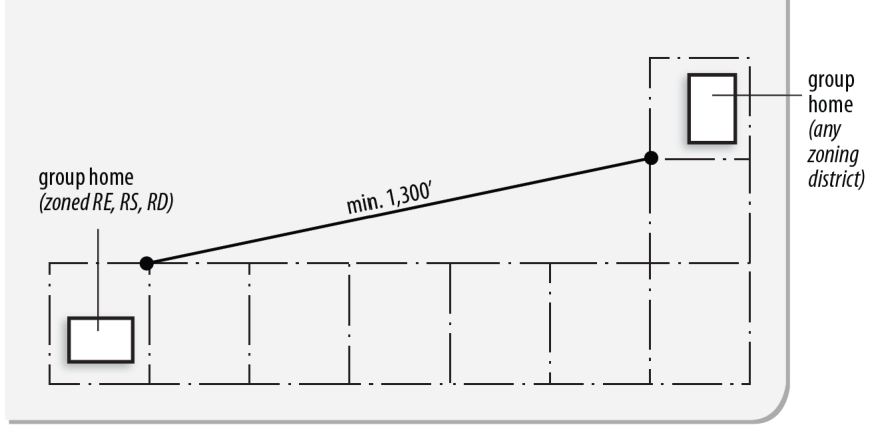
D.
In order to allow for special accommodations for inhabitants of community group homes, the board of adjustment is authorized, by special exception, to reduce or eliminate the separation distance requirement upon a finding that the federal Fair Housing Amendments Act, as amended, requires it, or that the grant of the special exception will not be injurious to the neighborhood or detrimental to the public welfare and will be in harmony with the spirit and intent of this zoning code. In consideration of granting this special exception, the board of adjustment must specifically consider the following factors:
1.
Traffic and parking congestion given the capacity of nearby streets;
2.
The likelihood that any other applicable group home use will impact traffic and parking congestion;
3.
Traffic hazards;
4.
Availability of off-street parking;
5.
Availability of public transit and the likelihood of its use;
6.
Feasibility of traffic mitigation measures; and
7.
Impacts on public utilities, including water and sanitary sewer capacities.
E.
When a community group home is located on a lot abutting an RE-, RS-, or AG-R-zoned lot, a screening wall or fence must be provided along the common lot line in accordance with the F1 screening fence or wall standards of Subsection 65.070C.
Figure 40-4: Screening of Community Group Home Abutting RE, RS, or AG-R Districts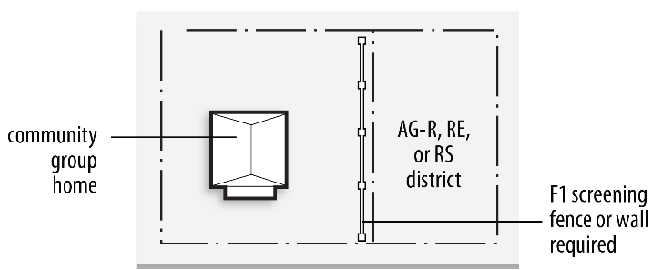
Section 40.110. - Cottage house developments.
Cottage house developments are subject to the lot and building regulations in Table 5-3, except as expressly modified by the regulations of this section.
A.
Purpose. The cottage house development regulations of this zoning code are intended to provide opportunities for individual ownership of small houses oriented around a courtyard or common open area.
B.
Development Size. On lots with one or more cottage house grouping(s), each grouping must contain at least three (3) and no more than ten (10) houses arranged around at least two (2) sides of a courtyard or common open space.
C.
Orientation of cottage houses.
1.
Cottage houses must be oriented to, and have a main entry onto a courtyard or common open space area that is accessible by all residents in the cottage house development, provided that cottage houses on lots abutting minor streets must have their front building elevation facing the street, including a building entrance, with a second entrance facing a courtyard or common open space area.
2.
Required courtyards and common open space areas must have cottage houses abutting on at least two (2) sides.
3.
All cottage houses must be located within seventy-five (75) feet walking distance of a required courtyard or common open space area.
Figure 40-5: Cottage House Developments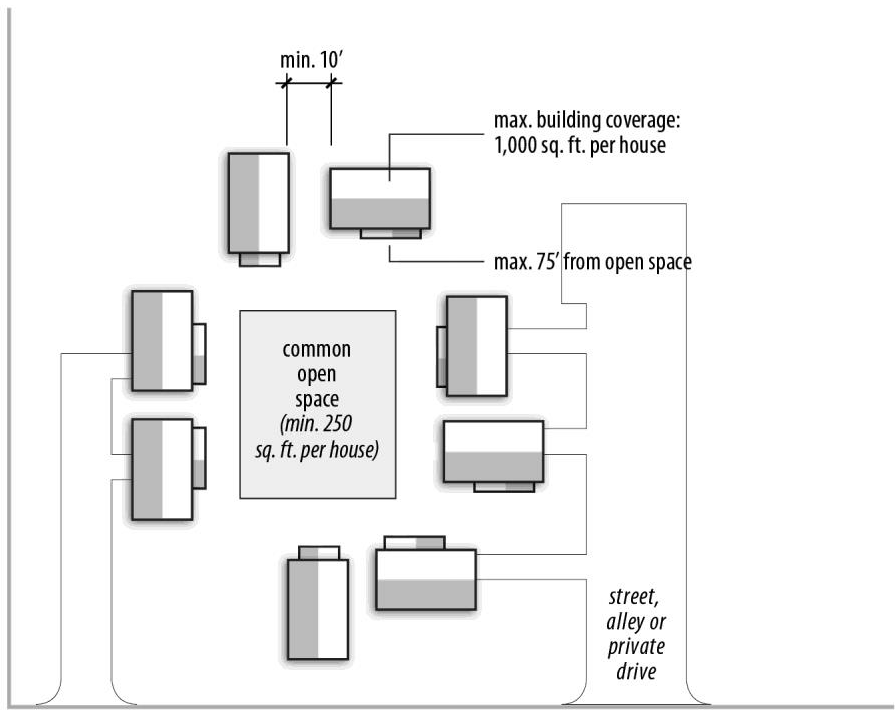
D.
Open space. A unified, contiguous courtyard or common open space must be provided as the focal point of the cottage house development. The courtyard or common open space area must contain at least two hundred fifty (250) square feet of common open space per cottage house.
E.
Building setbacks and separation. All buildings within a cottage house development must comply with the minimum building setbacks that apply to detached houses in the subject zoning district, except that no building setback is required from an alley. Buildings within a cottage house development must be separated by a minimum distance of ten (10) feet.
F.
Building coverage. Individual cottage houses are subject to a maximum first floor area of one thousand (1,000) square feet. Attached garages are counted in the calculation of first floor area, but covered porches and detached accessory buildings are not counted.
G.
Vehicular access and parking.
1.
Vehicular access to parking areas serving cottage houses within the development may come from the street, an alley or a private drive.
2.
Required parking may be provided on each cottage house lot or in a shared parking area located within commonly owned space or in a combination of the two. Common parking areas containing four (4) or more spaces must be screened from view of abutting R- or AG-R-zoned lots in accordance with the F1 screening fence or wall standards of Subsection 65.070C. Parking may not be located in street yards or in the required courtyard or common open space area.
H.
Restrictive covenants. A cottage house development is permitted only if a subdivision plat or other recorded legal instrument incorporating the provisions and requirements of this section (Section 40.110) is recorded in the county clerk's office.
(Ord. No. 25429, § 13, 10-30-2024)
Section 40.120. - Day cares.
A.
Child Care Centers. When a child care center is located inside an R or AG-R zoning district, outdoor child play equipment may not be located or stored in the street yard. See also the family child care home regulations of Section 40.120-B.
B.
Family Child Care Homes.
1.
When a family child care home is located inside an R or AG-R zoning district, outdoor child play equipment may not be located or stored in the street yard.
2.
Family child care homes must be licensed by the State of Oklahoma.
3.
Applicants for family child care homes must obtain a zoning clearance permit and a certificate of occupancy before commencing operation.
4.
Family child care homes may provide care and supervision for the number of children authorized under the state license, up to a maximum of twelve (12) children.
5.
When a family child care home is located in an AG, AG-R or R zoning district, signs advertising a Family Child Care home are prohibited.
6.
When a family child care home is located in an AG, AG-R or R zoning district, no exterior building alterations or site modifications may be made that would change the residential character of the premises.
(Ord. No. 25092, § 4, 7-26-2023; Ord. No. 25192, § 9, 12-6-2023)
Section 40.130. - Dispersal standards for specified land uses.
A.
The supplemental use regulations of this section apply to all detention and correctional facilities, emergency and protective shelters, homeless centers, residential treatment centers and transitional living center uses.
B.
To avoid over-concentration, all detention and correctional facilities, emergency and protective shelters, homeless centers, residential treatment centers and transitional living center uses must be separated from one another by a minimum distance of two thousand six hundred forty (2,640) feet, as measured in a straight line from the nearest point on the lot line of the property occupied by one of these uses to the nearest point on a lot line of the other property occupied by one of the subject uses (see Figure 40-6). The separation distance requirements of this subsection may be reduced if approved through the special exception approval process.
Figure 40-6: Dispersal Standards Measurement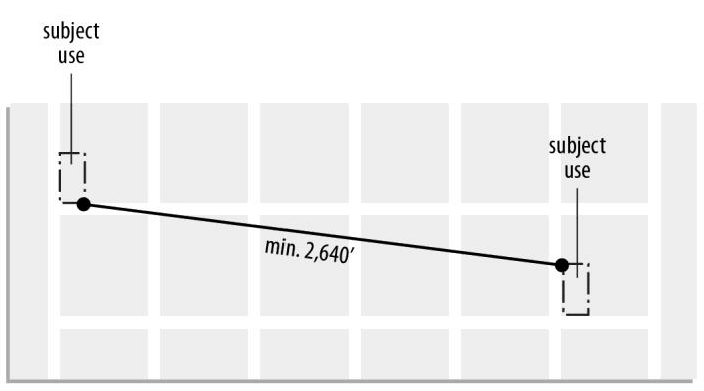
Section 40.140. - Fraternal organizations.
Fraternal organizations require a minimum lot area of one acre in AG, RE and RS zoning districts.
Section 40.150. - Funeral homes.
Funeral homes may be approved as a special exception in any cemetery with a land area of ten (10) acres or more, provided that special exception approval is not required for a funeral home use if the use is permitted as of right in the subject zoning district.
Section 40.160. - Group living uses.
Whenever any group living use is located on a lot abutting an RE-, RS-, or AG-R-zoned lot, a screening wall or fence must be provided along the common lot line in accordance with the F1 screening fence or wall standards of Subsection 65.070C.
Section 40.170. - Hotel or motel.
Whenever a hotel or motel use is located on a lot abutting an R- or AG-R-zoned lot, a screening wall or fence must be provided along the common lot line in accordance with the F1 screening fence or wall standards of Subsection 65.070C.
Section 40.180. - Industrial uses.
A.
Whenever any industrial use, other than a junk or salvage yard, is located on a lot abutting an R- or AG-R-zoned lot, a screening wall or fence must be provided along the common lot line in accordance with the F1 screening fence or wall standards of Subsection 65.070C. Junk and salvage yards are subject to the regulations of Section 40.190.
B.
Industrial uses located within three hundred (300) feet of an abutting R- or AG-R-zoned lot must be conducted within a completely enclosed building, except for storage, loading and off-loading areas.
Section 40.190. - Junk or salvage yards.
The supplemental use regulations of this section apply to all junk or salvage yards.
A.
Junk or salvage yards must be screened from view of abutting streets and all AG, AG-R, R, PK, O, C, CBD, SR, IL and CO zoning districts by the erection and maintenance of a screening wall or fence that is:
1.
At least eight (8) feet in height;
2.
Made of wood, metal, or masonry construction;
3.
Designed and arranged to provide opaque visual screening;
4.
Uniform in height, except in response to significant changes in topography;
5.
Constructed with all braces and supports on the interior of the fence or wall; and
6.
Erected before occupancy of the building or initiation of the junk or salvage yard use.
B.
Required screening walls and fences must be maintained by the owner of the lot containing the use requiring the screening.
C.
The piling of junk or salvage materials may not exceed the height of the required screening wall or fence within one hundred fifty (150) feet of the boundary required to be screened, except that storage racks designed for the stacking of automotive front-ends, hoods, doors, quarter panels, and similar parts that exceed the height of the screening wall or fence, must be set back at least twenty-five (25) feet from abutting R- or AG-R-zoned lot and street rights-of-way, plus two (2) additional feet of setback for every foot of rack height above fifteen (15) feet.
Figure 40-7: Screening and Setback Requirements for Junk and Salvage Material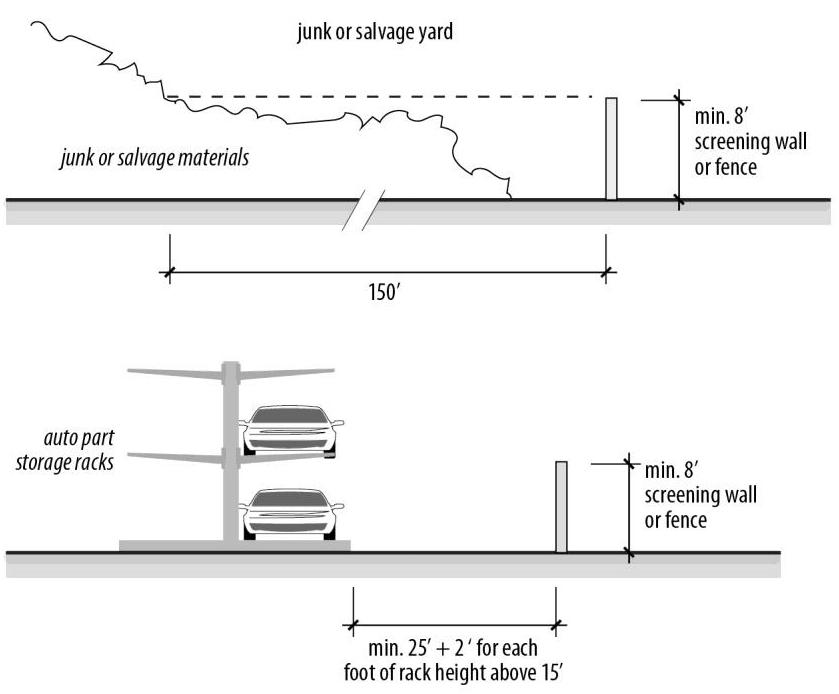
D.
The board of adjustment is authorized as a special exception to:
1.
Modify or eliminate the screening wall or fence requirements where existing physical features, such as trees and other plant materials, buildings, earthen berms or hills, provide equivalent visual screening;
2.
Modify the screening wall or fence requirements when alternative screening will provide equivalent visual screening, such as:
a.
Dense landscaping, or
b.
A six-foot privacy wall or fence;
3.
Grant an extension of time to erect a screening wall or fence when properties, other than streets, are undeveloped and no immediate plans for development are known or anticipated; or
4.
Eliminate the screening wall or fence requirements when the purpose of the screening requirement cannot be achieved, such as when a street is elevated, or when the required screening wall or fence is prohibited by other regulations, such as in floodplains.
Section 40.200. - Library or cultural exhibit.
Museums, planetariums, aquariums and other cultural exhibit uses require a minimum lot area of one acre in AG, AG-R, RE and RS zoning districts.
Section 40.210. - Manufactured housing units.
The supplemental regulations of this section apply only to manufactured housing units approved as special exception uses in R or AG-R zoning districts.
A.
No more than one manufactured housing unit may be located on a lot.
B.
Manufactured housing units are required to comply with the same lot and building regulations that apply to detached houses in the subject zoning district.
(Ord. No. 25429, § 14, 10-30-2024)
Section 40.220. - Manufactured housing subdivisions.
The supplemental use regulations of this section apply to all manufactured housing subdivisions.
A.
Manufactured housing subdivisions require a minimum contiguous land area of ten (10) acres.
B.
All manufactured housing units in manufactured housing subdivisions must be attached to a permanent foundation and comply with the same lot and building regulations that apply to detached houses in the subject zoning district.
Section 40.225. - Medical marijuana uses.
The supplemental use regulation of this section apply to medical marijuana uses.
A.
A medical marijuana grower operation must be located inside an enclosed building.
B.
A medical marijuana processing facility, whether low-impact or high-impact, must be located inside an enclosed building.
C.
A medical marijuana dispensary must be located inside an enclosed building.
D.
A medical marijuana dispensary may not be located within 1,000 feet of another medical marijuana dispensary.
E.
Drive-through windows and drive-through lanes are prohibited for medical marijuana grower operations, processing facilities, and research facilities.
F.
Medical marijuana grower operations, processing facilities, waste disposal facilities, and dispensaries must provide the following:
1.
A ventilation/air filtration system that prevents odor from being detectible at the boundaries of the lot within which the building housing the medical marijuana grower operation, processing facility or dispensary is located, except that if such use is located in multiple-tenant building, the ventilation/air filtration system must prevent odor from being detectible outside the tenant space housing the use.
2.
An electronic security system and surveillance camera.
G.
Medical marijuana grower operations, processing facilities, dispensaries, transportation facilities, education facilities, waste disposal facilities, testing laboratories, and research facilities must be conducted and maintained in compliance with the licenses issued by the Oklahoma Medical Marijuana Authority and in compliance with Oklahoma law, including but not limited to all applicable statutes, rules and regulations.
H.
No medical marijuana grower operation, processing facility, dispensary, transportation facility, education facility, waste disposal facility, testing laboratory, or research facility shall be permitted or maintained unless there exists a valid license, issued by the Oklahoma Medical Marijuana Authority for the particular use at the particular location.
I.
The separation distance required under Section 40.225D. must be measured in a straight line between the nearest perimeter walls of the buildings (or portion of the building, in the case of a multiple-tenant building) occupied by the dispensaries. The separation required under Section 40.225D. shall not be applied to limit the location of a medical marijuana dispensary for which a license was issued by the Oklahoma Medical Marijuana Authority prior to December 1, 2018, for the particular location.
J.
A medical marijuana waste disposal facility must be located inside an enclosed building.
(Ord. No. 24569, § 1, 2-24-2021; Ord. No. 25330, § 13, 6-5-2024)
Section 40.230. - Mining or mineral processing.
As part of the special exception review and approval process for any mining or mineral processing use, the board of adjustment must consider potential environmental impacts, such as noise, dust and vibration, and is authorized to establish conditions of approval (e.g., setbacks, screening, and methods of operation) to help control and mitigate any adverse land use or environmental impacts on surrounding areas.
Section 40.240. - Mobile home parks.
The supplemental regulations of this section apply to all mobile home parks.
A.
All mobile homes and manufactured housing units must be completely skirted.
B.
All mobile homes and manufactured housing units must be anchored in accordance with city regulations.
C.
All housing units must be certified and display applicable federal certifications.
D.
The lot and building regulations of Table 40-1 apply to the overall mobile home park site:
Table 40-1: Mobile Home Park Lot and Building Regulations
E.
The lot and building regulations of Table 40-2 apply to individual mobile home and manufactured housing unit spaces within a mobile home park:
Table 40-2: Mobile Home and Manufactured Housing Unit Space Regulations
Table 40-2 apply to individual mobile home and manufactured housing unit spaces within a mobile home park.
Table 40-2 Notes:
[1]
Minimum five (5) feet on one side, ten (10) feet on the other.
[2]
Includes dwellings, carports and all other accessory buildings.
[3]
May be covered by roof or awning. May be paved but may not include parking or driveway areas. Must have average dimensions of ten (10) feet per side.
F.
Accessory buildings must be set back at least ten (10) feet from manufactured housing units.
G.
Streets within the mobile home park must have a minimum paved width of twenty-four (24) feet.
H.
Common park/recreational open space and facilities (which may include trails, playgrounds, community buildings and tot-lots) must be provided for all mobile home parks equal to at least six (6) percent of the total gross area of the mobile home park, exclusive of outdoor living area provided on individual mobile home/manufactured unit spaces.
Section 40.250. - Multi-unit houses.
Multi-unit houses are subject to the lot and building regulations of the subject zoning district, except as expressly modified by the supplemental regulations of this section.
A.
The street-facing façade of a multi-unit house may have only one building entrance that is visible from the street. If the building is located on a corner lot, one building entrance may be visible from each street.
B.
Patio-style doors, such as sliding glass doors, may not be used for entrance doors on building façades that face a street.
C.
The front façade of new multi-unit houses established after the effective date established in Section 1.030 may not exceed sixty (60) feet in width.
D.
Outdoor (surface) parking areas may not be located between the principal building and the street or within any required side building setback.
Section 40.260. - Offices.
The supplemental use regulations of this section apply to office uses in the districts indicated.
A.
Office uses in the RM-1 district must comply with the lot and building regulations of the OL district.
B.
Office uses in the RM-2 district must comply with the lot and building regulations of the OM district, except that no building occupied by office uses may exceed thirty-five (35) feet in height.
C.
Office uses in the RM-3 district must comply with the lot and building regulations of the OMH district.
D.
Whenever an office use is located on a lot abutting an R- or AG-R- zoned lot, a screening wall or fence must be provided along the common lot line in accordance with the F1 screening fence or wall standards of Subsection 65.070C.
Section 40.270. - Oil or gas wells.
Oil and gas wells and oil and gas well drilling operations are subject to the regulations of Title 42A of the Tulsa Revised Ordinances.
Section 40.280. - Parking structures.
The supplemental use regulations of this section apply only to parking structures located in MX districts.
A.
The ground floor of parking structures must be screened from view of abutting public sidewalks by a liner building. The floor space within the liner building may be occupied by any principal use allowed in the district, except for parking.
B.
The street-facing facade of parking structures must be oriented horizontally (maintain a horizontal line) on all street-facing facades, so that the sloping nature of parking floors is not repeated on the exterior facade. This requirement does not apply to helix-shaped ramps leading to and from parking floors and may be waived or modified in accordance with the administrative adjustment provisions of Section 70.100 when compliance would result in a reduction in the number of parking spaces or necessitate mechanical ventilation of the garage.
Section 40.290. - Patio houses.
Patio houses are subject to the lot and building regulations of the subject zoning district, except as expressly modified by the supplemental patio house regulations of this section.
A.
A patio house development must consist of at least three (3) contiguous lots with frontage on the same street.
B.
The interior side building setback on one side of the lot containing a patio house may be reduced to as little as zero. The zero- or reduced setback side of a patio house may not abut a street and may not abut a lot that is not part of the patio house development. On the "non-zero" side, a side building setback must be provided equal to at least twice the minimum side building setback requirement of the subject zoning district.
Figure 40-8: Minimum Side Building Setbacks for Patio Houses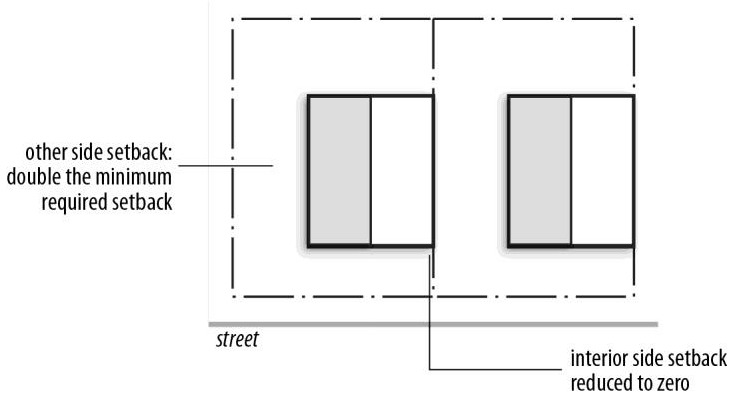
C.
When the patio house's exterior wall or eaves are within two (2) feet of the abutting property line, a perpetual maintenance easement at least five (5) feet in width must be provided on the lot abutting the zero patio property line, which, with the exception of walls and/or fences, must be kept clear of structures. The easement must be depicted on and established in a recorded plat or a separate legal instrument recorded in the county clerk's office. This provision is intended to ensure the ability to conduct maintenance on the patio house. Eaves on the side of a patio house with a zero or reduced setback may project over the side property line only if shown on the easement required under this paragraph.
D.
Windows, doors and other openings that allow for visibility into the side yard of the lot abutting the reduced or zero setback side of the patio house are prohibited. Windows that do not allow visibility into the side yard of the lot abutting the zero or reduced setback side, such as clerestory windows or translucent windows, are allowed, subject to compliance with the building code.
Figure 40-9: Patio House Maintenance
Easements and "Privacy" Requirements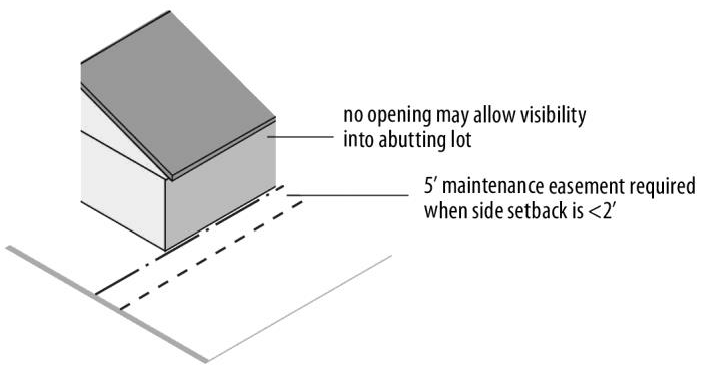
E.
A patio house development is permitted only if a subdivision plat or other recorded legal instrument incorporating the provisions and requirements of this section (Section 40.290) is recorded in the county clerk's office.
Section 40.300. - Plasma centers, day labor, package stores, bail bonds, pawn shops.
The supplemental use regulations of this section apply to all plasma centers, day labor hiring centers, package stores, bail bond offices and pawn shops.
A.
Plasma centers, day labor hiring centers, package stores, bail bond offices and pawn shops must be separated by a minimum distance of three hundred (300) feet, provided that bail bond offices located within the CBD district are not subject to this separation requirement.
B.
For uses established after July 1, 2001, the separation distance requirement of Subsection 40.300A. must be measured in a straight line from the nearest perimeter wall of the portion of the building occupied by one of the subject uses to the nearest perimeter wall of the portion of the building of any other subject use.
Figure 40-10: Measurement of Required Use Separation (Permits issued after 7/1/2001)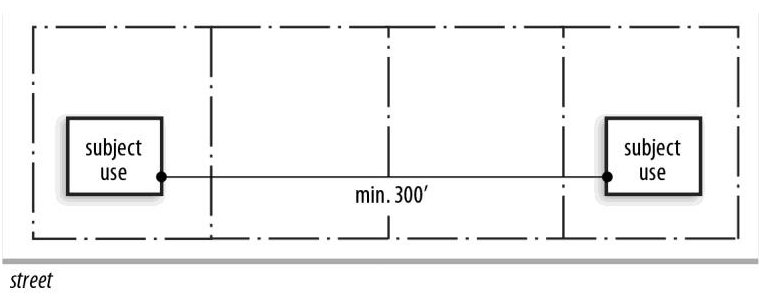
C.
For uses that were in operation or had been issued a building permit on or before July 1, 2001, the separation distance requirement of Subsection 40.300A. must be measured in a straight line from the nearest public entrance door of one of the subject uses to the nearest public entrance door of any other subject use.
Figure 40-11: Measurement of Required
Separation (Uses Established/Permits Issued
on or before 7/1/2001)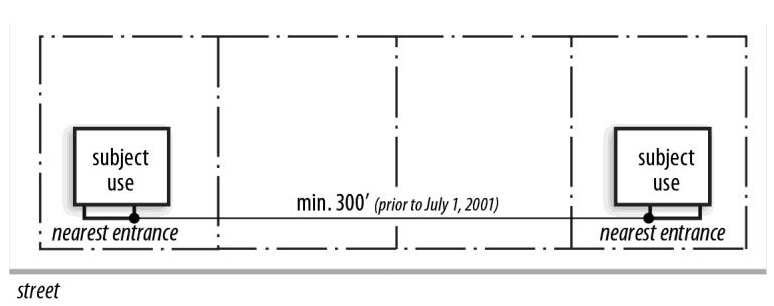
Section 40.310. - Recycling uses.
A.
Whenever any recycling use is located on a lot abutting an R- or AG-R-zoned lot, a screening wall or fence must be provided along the common lot line in accordance with the F1 screening fence or wall standards of Subsection 65.070C.
B.
Recycling uses located within three hundred (300) feet of an abutting R- or AG-R-zoned lot must be conducted within a completely enclosed building, except for storage, loading and off-loading areas.
Section 40.320. - Religious assembly.
The supplemental use regulations of this section apply to religious assembly uses in AG and R districts.
A.
In AG and R zoning districts, religious assembly uses must be located on lots with a minimum lot area of one acre and a minimum lot width of one hundred (100) feet.
B.
In AG and R zoning districts, off-street parking on the site of a religious assembly use is prohibited in street building setbacks.
Section 40.330. - Restaurants.
The supplemental use regulations of this section apply to all restaurant uses.
A.
Restaurants must occupy completely enclosed buildings, except outdoor customer seating/dining, including rooftop seating, is permitted subject to the following regulations:
1.
Outdoor customer seating/dining areas are subject to all applicable building setback requirements and must abut the building wall or roof area of the principal building;
2.
Outdoor customer seating/dining areas may not occupy required parking spaces or drive aisles or be located within fifty (50) feet of R- or AG-R-zoned lots;
3.
When a restaurant is located on a lot abutting an R- or AG-R-zoned lot, noise emanating from any onsite equipment or activity, including outdoor customer seating/dining areas may not exceed sixty-five (65) db(A), as measured along the common lot line at the top of the required screening wall or fence.
B.
Whenever a restaurant is located on a lot abutting an R- or AG-R-zoned lot, a screening wall or fence must be provided along the common lot line in accordance with the F1 screening fence or wall standards of Subsection 65.070C.
Figure 40-12: Screening of Restaurant Abutting R or AG-R Districts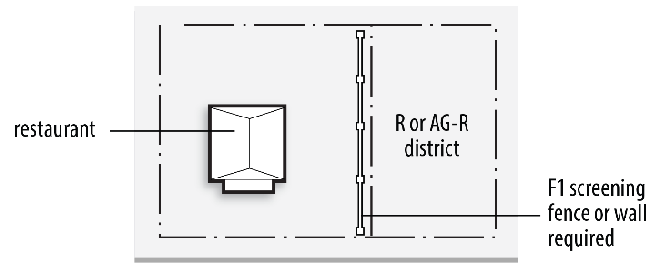
Section 40.340. - Retail sales.
A.
Whenever a retail sales use is located on a lot abutting an R- or AG-R-zoned lot, a screening wall or fence must be provided along the common lot line in accordance with the F1 screening fence or wall standards of Subsection 65.070C.
B.
Retail sales uses must take place within a completely enclosed building, except that accessory outdoor display of merchandise and accessory outdoor customer seating/dining areas are permitted, subject to the following supplemental regulations:
1.
Outdoor display areas must comply with the minimum street setback requirements of the subject zoning district;
2.
Outdoor display areas may not occupy or use required parking spaces or drive aisles;
3.
Outdoor display areas are considered floor area for the purposes of determining off-street parking requirements; and
4.
Outdoor customer seating/dining areas are subject to the same requirements that apply to restaurants, per Subsection 40.330A.
Section 40.350. - Schools.
A.
Schools Established Before January 1, 1998. Schools established before January 1, 1998 are subject to a maximum floor area ratio of 0.5 and to the following supplemental use regulations:
1.
Day care uses and community centers may be allowed as accessory uses to a school. Outdoor stadiums, lighted athletic fields, unlighted athletic fields that have bleachers for non-student spectators and buildings and structures accessory to these types of stadiums or fields may not be approved as accessory uses to a school.
2.
Buildings, parking areas and access drives must be set back at least twenty-five (25) feet from abutting RE- and RS-zoned properties, plus one foot of additional building setback for each one foot of building height above fifteen (15) feet. These setback and height requirements do not apply if the RE- or RS-zoned land is freeway or expressway right-of-way.
Figure 40-13: Required Building Setbacks from RE and RS Zoning Districts (Schools)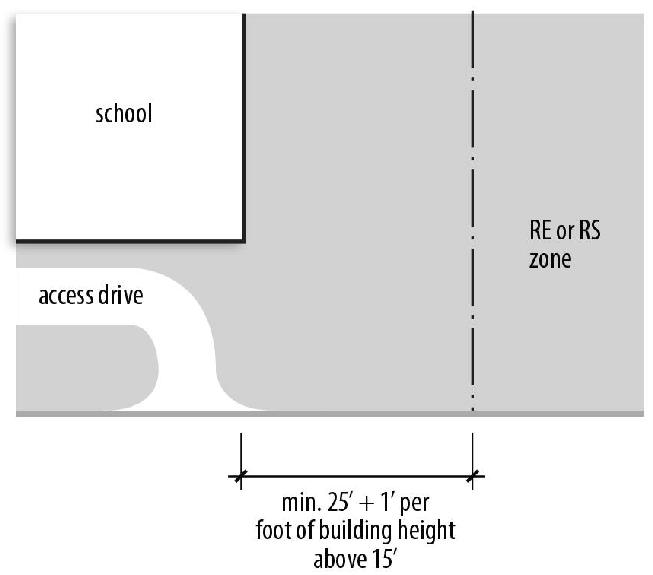
B.
Schools established on or after January 1, 1998. Schools established on or after January 1, 1998 require a minimum lot area of one acre, and lots to be occupied by senior high schools must have frontage on an arterial street.
Section 40.360. - Self-service storage facilities.
A.
General.
1.
The general provisions of this section apply to all self-service storage facilities.
2.
A screening fence or masonry wall is required along all lot lines that abut R- or AG-R-zoned lots. Required screening fences and walls must be at least eight (8) feet in height. If buildings are masonry, the building wall can serve as the screening wall, provided that any open spaces between perimeter buildings are screened with a masonry screening wall at least eight (8) feet in height. The screening fence/wall requirements of this section do not apply to climate-controlled self-storage buildings in which self-storage spaces are accessed only from within the building.
Figure 40-14: Screening of Drive-up Style
Self-Storage Facilities from Abutting
R or AG-R Districts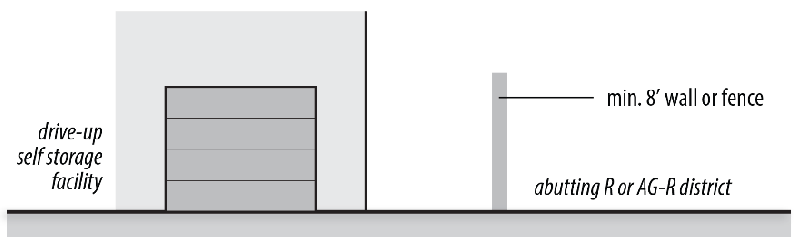
3.
A single dwelling unit may be integrated into the self-storage facility.
4.
No activities other than storage and pick-up and deposit of stored materials are allowed within the storage units.
B.
RM and O Districts. Self-service storage facilities located in RM or O zoning districts are subject to the following additional requirements:
1.
Exterior building walls visible from streets and abutting lots must be of masonry construction, using brick, stone, stucco or concrete tilt-up panels. Corrugated steel or standard (smooth) concrete block exterior walls are not permitted on these walls.
2.
The floor area ratio (FAR) may not exceed 0.5.
3.
Access doors to drive-up style storage units may not be visible at ground-level from abutting O-, R-, or AG-R-zoned lots or from abutting street rights-of-way.
4.
The storage of flammable liquids, highly combustible, explosive materials or hazardous chemicals is prohibited.
5.
In RM-1 and OL districts storage may only occur within completely enclosed buildings. All storage in RM-2, RM-3, OM, OMH or OH districts must also occur in completely enclosed buildings, except that outdoor (open-air) storage is allowed on the interior of the lot if the storage is not visible at ground level from abutting R, O, or AG-R districts or from any street rights-of-way.
C.
CS District. In the CS district, no outdoor (open-air) storage of any kind is allowed that is visible at ground level from abutting R, O, or AG-R districts or from any street rights-of-way.
Section 40.370. - Sexually oriented business establishments.
The supplemental use regulations of this section apply to all sexually oriented business establishments.
A.
Sexually oriented business establishments are allowed only in those districts and under those approval procedures expressly stated in this zoning code. In addition, no person may exercise supervisory control, manage, operate, cause the establishment or permit the establishment of any sexually oriented business establishment within one thousand (1,000) feet (the "minimum separation distance") of any of the following:
1.
Another sexually oriented business. The minimum separation distance must be measured in a straight line from the nearest point of the wall of the portion of the building occupied by a sexually oriented business establishment to the nearest point of the wall of the portion of the building occupied by another sexually oriented business establishment.
2.
A religious assembly use, including all contiguous property owned or leased by the religious organization upon which the principal religious assembly building is located, regardless of any interior lot lines. The minimum separation distance must be measured in a straight line from the nearest point of the wall of the portion of the building occupied by a sexually oriented business establishment to the nearest point of the building in which religious assembly activities occur.
3.
A school, including all contiguous property owned or leased by the school upon which the principal school building is located, regardless of any interior lot lines. The minimum separation distance must be measured in a straight line from the nearest point of the wall of the portion of the building occupied by a sexually oriented business establishment to the nearest point of the school.
4.
A public or private park. The minimum separation distance must be measured in a straight line from the nearest point of the wall of the portion of the building occupied by a sexually oriented business establishment to the nearest point on the property of the park.
5.
Residential zoning or a habitable dwelling unit in an AG or AG-R zoning district. The minimum separation distance must be measured in a straight line from the nearest point of the wall of the portion of the building occupied by a sexually oriented business establishment, to the nearest point on an R district boundary line (not including R-zoned expressway right-of-way) or to the nearest point of the exterior wall of a habitable dwelling located in an AG or AG-R zoning district.
6.
Any group living use or public, civic or institutional use that cares for or is typically frequented by persons under 18 years of age, including child day cares, children's preschools, children's nurseries, children's day camps, juvenile delinquency centers, children's campgrounds, children's group homes, libraries and cultural exhibits. The minimum separation distance must be measured in a straight line from the nearest point of the wall of the portion of the building occupied by a sexually oriented business establishment to the nearest point on the property occupied by the use that cares for or is typically frequented by persons under 18 years of age.
B.
The separation distance requirements of this section apply to new sexually oriented business establishments, the relocation of sexually oriented business establishments, the enlargement of sexually oriented business establishments in scope or area or the conversion of an existing business location to any sexually oriented business establishment.
C.
If a new religious assembly use, school, park or protected group living use or public, civic or institutional use is established within one thousand (1,000) feet of an existing lawful sexually oriented business establishment, the distance separation requirements from religious assembly uses, schools, parks or protected group living uses or public, civic or institutional uses do not apply.
D.
When a sexually oriented business establishment is located on a lot abutting an R- or AG-R-zoned lot, a screening wall or fence must be provided along the common lot line in accordance with the F1 screening fence or wall standards of Subsection 65.070C.
Figure 40-15: Screening of Sexually Oriented Business Establishments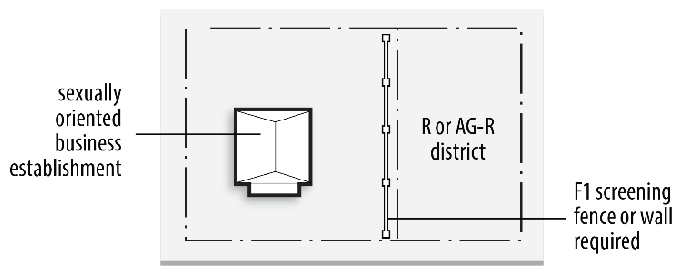
Section 40.375. - Short-term rental.
The supplemental use regulations of this section apply to all principal use short-term rentals.
A.
A short-term rental must comply with all licensing requirements of the City of Tulsa and an approved license number must be included with any material advertising the short-term rental.
B.
Events are not permitted in conjunction with a short-term rental use. Examples of events include, but are not limited to, weddings, receptions, anniversaries, private parties, banquets, and business seminars.
C.
A register of short-term rental guests must be maintained and made available to city code enforcement upon request.
D.
External structural alterations or site improvements that change the residential character of the lot upon which a short-term rental is located are prohibited. Examples of such prohibited alterations include, but are not limited to, the construction of a parking lot, the addition of commercial-like exterior lighting, and signage.
E.
No recreational vehicle, bus, or trailer shall be parked on a residential street in conjunction with a short-term rental use. A recreational vehicle, bus or trailer may be parked on the property if not visible from the street.
(Ord. No. 24328, § 6, 3-11-2020)
Section 40.380. - Studios, artist or instructional services.
Whenever an artist studio or an instructional services studio is located on a lot abutting an R- or AG-R-zoned lot, a screening wall or fence must be provided along the common lot line in accordance with the F1 screening fence or wall standards of Subsection 65.070C.
Section 40.390. - Townhouses.
A.
Applicability. Townhouses are subject to all applicable regulations of this zoning code and other city codes and ordinances except as modified or supplemented by the townhouse development and building regulations of this section.
B.
Side setbacks. No side building setback is required for common or abutting walls. Otherwise, the minimum side setback requirements of the subject zoning district apply.
C.
Design. Townhouses must be affixed to a permanent foundation.
D.
Open space. Required open space per dwelling unit for a townhouse project may be provided either on each townhouse lot or in common areas within the overall townhouse project, as designated on a recorded subdivision plat or in a separately recorded legal instrument.
Section 40.400. - Vehicle sales and service.
A.
Whenever a vehicle sales and service use is located on a lot abutting an R- or AG-R-zoned lot, a screening wall or fence must be provided along the common lot line in accordance with the F1 screening fence or wall standards of Subsection 65.070C.
B.
Whenever commercial or personal vehicle sales or rentals are within three hundred (300) feet of an R- or AG-R-zoned lot, off-street parking and vehicle display areas must comply with the parking area design standards of Section 55.090.
Section 40.410. - Wholesale, distribution and storage uses.
Whenever any wholesale, distribution and storage use is located on a lot abutting an R- or AG-R-zoned lot, a screening wall or fence must be provided along the common lot line in accordance with the F1 screening fence or wall standards of Subsection 65.070C.
Section 40.420. - Wireless communication facilities.
A.
Purpose. The wireless communication facility regulations of this section establish supplemental regulations governing wireless communications towers and antennas. These regulations are established to promote the following goals:
1.
Protecting residential areas and land uses from potentially adverse impacts of towers and antennas;
2.
Encouraging the location of towers in nonresidential areas;
3.
Minimizing the total number of towers;
4.
Encouraging co-location rather than the construction of additional single-use towers;
5.
Encouraging users of towers and antennas to locate them, to the extent possible, in areas where the adverse impact on the community is minimal;
6.
Encouraging users of towers and antennas to configure them in a way that minimizes the adverse visual impact of the towers and antennas through careful design, siting, landscape screening and innovative camouflaging techniques; and
7.
Helping to ensure the ability of telecommunications services providers to offer such services to the community quickly, effectively and efficiently.
B.
Exemptions. The following are exempt from these regulations:
1.
Amateur (Ham) radio antennas;
2.
Microwave reflectors and parabolic antennas;
3.
Antennas and equipment located completely inside of buildings; and
4.
Minor modifications of existing wireless communications facilities and attached wireless communications facilities, whether emergency or routine, provided there is little or no change in the visual appearance. Minor modifications are those modifications, including the addition of antennas, to conforming wireless and attached wireless communications facilities that comply with all applicable regulations of this section.
C.
Federal Law. The wireless communication facility regulations of this section must be applied within the constraints of the Telecommunications Act of 1996 and Section 6409 of the Middle Class Tax Relief and Job Creation Act of 2012.
D.
Special definitions. The following definitions are established solely for administering and interpreting the wireless communication facility regulations of this section:
1.
"Antenna" means any exterior transmitting or receiving device used in communications to radiate or capture electromagnetic waves, digital signals, analog signals, radio frequencies, wireless telecommunications signals or other communication signals.
2.
"FAA" means the Federal Aviation Administration.
3.
"FCC" means the Federal Communications Commission.
4.
"Height," when referring to a tower or wireless communication facility, means the distance from finished grade at the base of the tower or facility, including any base pad, to the highest point of the structure.
5.
"Monopole" means a single, freestanding pole structure without guy wires or external supporting braces.
6.
"Tower" means any structure more than twenty (20) feet tall that is designed and constructed primarily for the purpose of supporting one or more antennas for telephone, radio and similar communication purposes, including self-supporting lattice towers, guyed towers or monopole towers. The term includes radio and television transmission towers, microwave towers, common-carrier towers, cellular telephone towers and the like. The term includes the tower structure and any tower supports.
E.
General requirements. All towers and antennas are subject to the general requirements of this subsection unless otherwise expressly stated.
1.
Towers may be considered either principal or accessory uses. Another principal or accessory use on the same lot does not preclude the installation of a tower on that lot.
2.
Towers and antennas are subject to all of the following requirements:
a.
Towers and antennas must be designed to blend into the surrounding environment through the use of color, galvanizing, or camouflaging architectural treatment, except in instances where the color is dictated by federal or state authorities, such as the Federal Aviation Administration.
b.
Except in IM and IH zoning districts, communication towers must be of a monopole design unless the board of adjustment approves, by special exception, an alternative design that they determine would better blend into the surrounding environment or that the required antennas cannot be supported by a monopole.
c.
If an antenna is installed on a structure other than a tower, the antenna and supporting electrical and mechanical equipment must be of a color that closely matches or complements the color of the supporting structure, so as to make the antenna and related equipment as visually unobtrusive as possible.
3.
Towers may not be illuminated by artificial means and may not display strobe lights unless such lighting is expressly required by the Federal Aviation Administration or other federal or state authorities. When incorporated into the approved design of the tower, light fixtures used to illuminate ball fields, parking lots or similar areas may be attached to the tower.
4.
The use of any portion of a tower for advertising or signs other than warning or equipment information signs is expressly prohibited.
5.
All utility buildings and structures accessory to a tower must comply with all applicable requirements of the underlying zoning district. Exterior ground-mounted equipment occupying more than fifty (50) square feet, if visible from ground level, must be screened from view of abutting property used or zoned for residential purposes by a screening wall or fence in accordance with the F1 screening fence or wall standards of Subsection 65.070C.
6.
The following setback requirements apply to all towers unless otherwise expressly approved by the board of adjustment as part of the special exception approval:
a.
Towers must be set back a distance equal to at least one hundred ten (110) percent of the height of the tower from any adjoining lot line of an R-, O-, AG-, or AG-R-zoned lot, excluding R-zoned expressway rights-of-way.
b.
Accessory buildings are subject to applicable zoning district building setback requirements.
Figure 40-16: Tower Setback from R, O, AG, or AG-R districts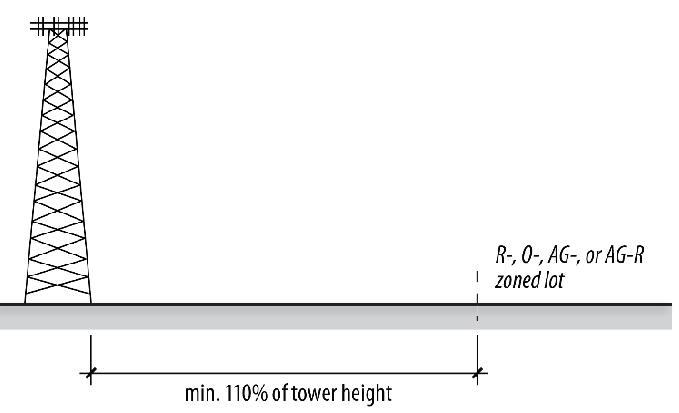
7.
Towers must be enclosed by security fencing that is at least 6 feet in height or be equipped with an appropriate anti-climbing device.
F.
Antennas and towers requiring special exception approval.
1.
Applicability. The regulations of this subsection (Subsection 40.420F.) apply to all antennas and towers that require special exception approval.
2.
Factors to be considered.
a.
In addition to any other applicable requirements, the following factors must be considered in a decision to approve or deny special exception approval for a tower:
(1)
Height of the proposed tower;
(2)
Proximity of the tower to residential structures, residential district boundaries and existing towers;
(3)
Nature of uses on adjacent and nearby properties;
(4)
Surrounding topography;
(5)
Surrounding tree coverage and foliage;
(6)
Design of the tower, with particular reference to design characteristics that have the effect of reducing or eliminating visual obtrusiveness;
(7)
The total number and size of antennas proposed and the ability of the proposed tower to accommodate co-location;
(8)
Architectural design of utility buildings and accessory structures to blend with the surrounding environment;
(9)
Proposed ingress and egress;
(10)
The need for a tower within the immediate geographic area to provide an acceptable level of communications service to the area;
(11)
The size of the tract and the most likely future development as indicated by the comprehensive plan, planned infrastructure, topography and other physical considerations.
b.
Findings. The findings of the board of adjustment as to each of these factors must be made on the record and included in the written minutes of the meeting.
3.
Co-location. Co-location of facilities is encouraged wherever practical by allowing reasonable extra height or tower diameter necessary to support multiple antennas.
4.
Landscaping. The following requirements govern landscaping surrounding towers that require special exception approval; provided that the board of adjustment may modify or waive such requirements by special exception.
a.
Tower facilities must be landscaped with a continuously maintained buffer of plant materials that effectively screens the view of the tower compound from property within three hundred (300) feet used or zoned for residential purposes. The standard buffer requirement consists of a landscaped strip with a minimum width of four (4) feet outside the perimeter of the compound.
b.
Existing mature tree growth and natural land forms on the site must be preserved to the maximum extent possible. In some cases, such as towers sited on large, wooded lots, natural growth around the property perimeter may provide sufficient buffer.
G.
Antennas and towers permitted as-of-right.
1.
Applicability. The regulations of this subsection (Subsection 40.420G.) apply to all antennas and towers that are permitted as-of-right.
2.
Permits. A permit must be obtained from the city before installation or construction of any antenna or tower.
3.
Standards. Antennas and towers that are permitted as-of-right are subject to the following supplemental regulations:
a.
Antennas attached to the roof or wall of buildings in commercial or industrial zoning districts, or to office or apartment/condo buildings, or to public, civic or institutional buildings (e.g., schools, places of worship, or hospitals) are subject to all of the following regulations:
(1)
An antenna may not extend more than twenty (20) feet above the highest point of the building, or, if located on an architectural feature such as a steeple or bell tower, may not protrude above that structure; provided, however, that the board of adjustment may modify such requirements by special exception; and
(2)
The antenna must comply with all applicable FCC and FAA regulations;
(3)
The antenna must comply with all applicable building codes.
b.
Antennas may be attached to existing towers and to city-owned buildings and structures. When an existing tower must be modified to accommodate the collocation of antennas, the tower must be of the same type as the existing tower or reconstructed as a monopole and the modification or reconstruction may not result in a height increase of more than thirty (30) feet above the height of the existing tower. Other modifications may be approved by special exception.
H.
Removal of abandoned antenna and towers. Any antenna or tower that is not operated for a continuous period of twelve (12) months will be considered abandoned, and the owner of the antenna or tower must remove it within ninety (90) days of receiving notice from the city. Failure to remove the abandoned antenna or tower within ninety (90) days constitutes grounds for the city to remove the antenna or tower at the owner's expense. Abandoned towers are subject to the nuisance abatement procedures set forth in Title 24 Tulsa Revised Ordinances, Chapter 2.
I.
Preexisting towers and antennas. Any tower or antenna that lawfully existed on or before April 19, 1997 including a tower or antenna for which a permit was issued on or before that date which was constructed within the time frame allowed under the permit, is allowed to remain in use. Routine maintenance, including antenna replacement, is permitted. All new construction, other than routine maintenance, requires compliance with all applicable regulations of this section.
Section 40.430. - Farmers markets.
The supplemental use regulations of this section apply to all farmers markets.
A.
All temporary tents, seating, equipment, materials and merchandise must be stored in a permanent building or off site when the farmers market is not operation.
B.
All tents placed on a temporary basis for the farmers market must follow all tent regulations within City of Tulsa ordinances and must be placed in a manner that complies with the building setback lines of the subject zoning district.
C.
All farmers markets and their vendors must comply with federal state and local laws and regulations relating to the operation and use of the market premises, including but not limited to any requirements to obtain health permits and licenses.
(Ord. No. 25604, § 9, 6-18-2025)

