
Wake County Unincorporated
City Zoning Code
City Zoning Code
ARTICLE 15
- Parking, Loading and Traffic
15-10 - Off-Street Parking.
15-10-1
Purpose. The regulations of this section are intended to ensure that the off-street parking demands of various land uses will be met without adversely affecting surrounding areas. The regulations are also intended to help maintain a safe and efficient transportation system and advance other planning goals related to land use, transportation and the environment. In recognition of the fact that different approaches may be appropriate in different settings, the regulations allow flexibility in addressing vehicle parking needs.
15-10-2
Applicability.
(A)
New Development. The off-street parking standards of this Article apply to all new buildings constructed and all new uses established in all zoning districts.
(B)
Expansion and Increased Intensity of Existing.
(1)
Whenever there is an increase in the number of dwelling units, the number of employees, the seating capacity, the floor area, or some other applicable unit of measurement for determining the number of parking spaces that a use, building, or structure should provide and the increase will result in a need for additional parking, such additional spaces as are necessary must be provided as a condition to obtaining any necessary permits.
(2)
If a use, building, or structure having inadequate parking spaces is increased by 50 percent or less, additional parking spaces must be provided as if the addition were a new development.
(3)
If a use, building, or structure having inadequate parking spaces is increased 51 percent or more, sufficient additional parking space must be provided to bring the total development into conformance with these regulations.
(4)
For purposes of this section, the expansion or increased intensity must be measured cumulatively from the initial permitting of the use, and may not be calculated independently for each separate expansion or intensification.
(5)
The Board of Adjustment may issue a Special Use Permit allowing an increase in the applicable unit of measurement without providing the additional number of parking spaces upon finding that:
(a)
The proposed use will primarily cater to pedestrian traffic; and
(b)
The character of the area within a radius of 600 feet prohibits the acquisition of land for additional parking spaces.
(C)
Change of Use. Additional off-street parking spaces will be required to accommodate a change of use of a structure or parcel of land only when the new use requires 25 percent or more parking spaces than the previous use or 25 or more additional spaces.
15-10-3
No Reduction Below Minimums. The number of parking spaces existing on a site may not be reduced below the minimum requirements of this Article.
15-10-4
Off-street Parking Schedule. Unless otherwise expressly stated in this Article, off-street parking spaces must be provided in accordance with the following schedule of minimum parking requirements.
Commentary: There are specific parking and loading standards in Research Applications Districts (RA) that take into account the unique land uses that may be seen. Please refer to section 3-51-4(C).
[Amended on 1/22/2008 by OA 04-07; Amended on 3/24/2008 by OA 01-08; Amended on 7/21/2008 by OA 02-08; Amended on 4/21/2014 by OA 05-12; Amended on 10/6/2014 by OA 03-14; Amended on 1/17/2017 by OA 02-16; Amended on 4/21/2025 by OA-02-25]
15-10-5
Calculations. The following rules apply when computing off-street parking requirements.
(A)
Multiple Uses. Unless otherwise approved, lots containing more than one use must provide parking and loading in an amount equal to the total of the requirements for all uses. (See the Shared Parking provisions of Sec. 15-10-8 for possible exceptions)
(B)
Fractions. When measurements of the number of required spaces result in a fractional number, any fraction of 0.5 or less is to be rounded down to the next lower whole number and any fraction of more than 0.5 is to be rounded up to the next higher whole number.
(C)
Area Measurements. Unless otherwise specifically noted, all area-based (square feet) parking and loading standards must be computed on the basis of gross floor area, which is to be measured as all of the floor area on each floor of the building, whether or not such area is enclosed by walls. Interior areas used for off-street parking or loading facilities are not counted in calculating the number of parking spaces required.
(D)
Outdoor Areas. For outdoor areas, calculations will be based on the portion of the lot actually being used for the specified purpose.
(E)
Occupancy- or Capacity-Based Standards. For the purpose of computing parking requirements based on employees, students, residents or occupants, calculations are to be based on the greatest number of persons working on any single shift, the maximum enrollment or the maximum fire-rated capacity, whichever is applicable and whichever results in the greater number of spaces.
(F)
Bench Seating. When seating consists of benches, pews or other similar seating facilities, each 20 linear inches of seating space counts as one seat.
(G)
Unlisted Uses. Upon receiving a development application for a use not specifically listed in the off-street parking schedule, the Planning Director must apply the off-street parking standard specified for the listed use that the Planning Director deems most similar to the proposed use or require the applicant to prepare and submit a parking study. The study must include estimates of parking demand based on recommendations of the Institute of Traffic Engineers (ITE), or other acceptable estimates as approved by the Planning Director and include other reliable data collected from uses or combinations of uses that are the same as or comparable with the proposed use. Comparability will be determined by density, scale, bulk, area, type of activity, and location. The study must document the source of data used to develop the recommendations.
15-10-6
Use of Required Parking Spaces. The off-street parking spaces required by this Article may not be used for any purpose other than parking.
15-10-7
Off-Site Parking.
(A)
Authorization. The Planning Director may approve the location of required off-street parking spaces on a separate lot from the lot on which the principal use is located, subject to the following standards.
(B)
Limitation on Amount of Off-Site Parking. No more than 50 percent of a uses' required off-street parking may be located off-site.
(C)
Ineligible Activities. Off-site parking may not be used to satisfy the off-street parking standards for residential units, restaurants, bars, convenience stores or other convenience-oriented uses. Required parking spaces reserved for persons with disabilities may not be located off-site.
(D)
Location. Off-site parking spaces for customers or visitors must be located within 600 feet of a primary entrance of the use served. Off-site parking for employees may be located up to 1,000 feet from the primary entrance.
(E)
Zoning Classification. Off-site parking areas require the same or a more intensive zoning classification than required for the use served.
(F)
Agreement. If the off-site parking area is under separate ownership from the use to be served, an attested lease agreement, executed by the parties involved, must be filed with the Planning Director, in a form approved by the County Attorney's office. A plat must also be recorded with the Wake County Register of Deeds showing an easement for the off-site parking area, and including a note that the installation of the parking area may impact the availability of suitable septic soils, and therefore may impact the future developability of the parcel upon which the off-site parking easement is located. Off-site parking privileges will continue in effect only as long as the lease agreement, binding on all parties, remains in force. If the agreement is no longer in force, then parking must be provided as otherwise required by this Article. The applicant must also agree in writing that all heirs, successors, and assigns must provide the required off-street parking on such remote lots or other equivalents so long as the principal use must continue and must further agree that the principal use must be discontinued if the required parking spaces are no longer provided on the lots or their equivalent. A violation of this provision constitutes an unauthorized and illegal occupancy of the principal use.
15-10-8
Shared Parking.
(A)
Description. Shared parking represents an arrangement in which two or more nonresidential uses with different peak parking demands (hours of operation) use the same off-street parking spaces to meet their off-street parking requirements.
(B)
Authorization and Criteria.
(1)
The Planning Director is authorized to approve shared parking arrangements for nonresidential uses with different hours of operation.
(2)
The Planning Director may permit up to 100 percent of the parking required for a daytime use to be supplied by the off-street parking spaces provided for a nighttime or Sunday use and vice-versa.
(3)
In order to approve a shared parking arrangement, the Planning Director must find, based on competent evidence provided by the applicant, that that there is no substantial conflict in the principal operating hours of the uses for which the sharing of parking is proposed.
(C)
Uses with Different Hours of Operation.
(1)
For the purposes of this section, the following uses are considered daytime uses:
(a)
Office uses;
(b)
Retail uses,
(c)
Lodging uses,
(d)
Industrial uses; and
(e)
Other similar primarily daytime uses, when authorized by the Planning Director.
(D)
For the purposes of this section, the following uses are considered nighttime or Sunday uses:
(a)
Auditoriums accessory to schools;
(b)
Places of worship;
(c)
Entertainment uses;
(d)
Eating and drinking establishments; and
(e)
Other similar primarily nighttime or Sunday uses, when authorized by the Planning Director.
(E)
Location of Shared Parking Facility. A use for which an application is being made for shared parking must be located within 600 feet walking distance of a primary entrance of the use served.
(F)
Agreement. If the shared parking area is under separate ownership from the use to be served, an attested lease agreement, executed by the parties involved, must be filed with the Planning Director, in a form approved by the County Attorney's office. Shared parking privileges will continue in effect only as long as the lease agreement, binding on all parties, remains in force. If the agreement is no longer in force, then parking must be provided as otherwise required by this Article.
15-10-9
Parking for Persons with Disabilities. A portion of the total number of required off-street parking spaces in each off-street parking area must be specifically designated, located and reserved for use by persons with physical disabilities, in accordance with all applicable county, state and federal standards.
15-10-10
Design Standards.
(A)
General. Off-street parking facilities must be designed and constructed to:
(1)
Allow unobstructed movement into and out of each parking space without interfering with fixed objects or vehicles;
(2)
Minimize delay and interference with traffic on streets and drives;
(3)
Maximize sight distances from parking lot exits and access drives;
(4)
Ensure that access to parking spaces is from parking lot driveways or private drives and not directly from public or private streets; and
(5)
Ensure that ingress and egress to parking spaces is by forward motion.
(B)
Required Plan and Standards. A plan showing all off-street parking areas must be submitted along with the property description form in the case of a permitted use and the application in the case of a special use. Such plan must show the location and width of all points of ingress and egress, the number, location, and dimensions of all parking spaces and drive aisles, and the location and width of the adjoining street right-of-way and the paved surface thereof. A general or special use may be disapproved for failure to comply with any applicable regulations of this section.
(C)
Surfacing. Required parking spaces and access drives must be paved and maintained with concrete, asphalt, or similar material of sufficient thickness and consistency to support anticipated traffic volumes and weights. Alternative paving materials and parking area surfaces may be approved by the Planning Director if such materials or surfaces are demonstrated to exhibit equivalent wear resistance and load bearing characteristics as concrete or asphalt. Paving is not required for:
(1)
Parking facilities used on an irregular basis for places of worship, private clubs, or other similar nonprofit organizations;
(2)
Parking facilities for residential uses when five or fewer spaces are required;
(D)
Markings. All parking spaces must be clearly identified with paint lines, bumper guards, curbs, or similar treatment.
(E)
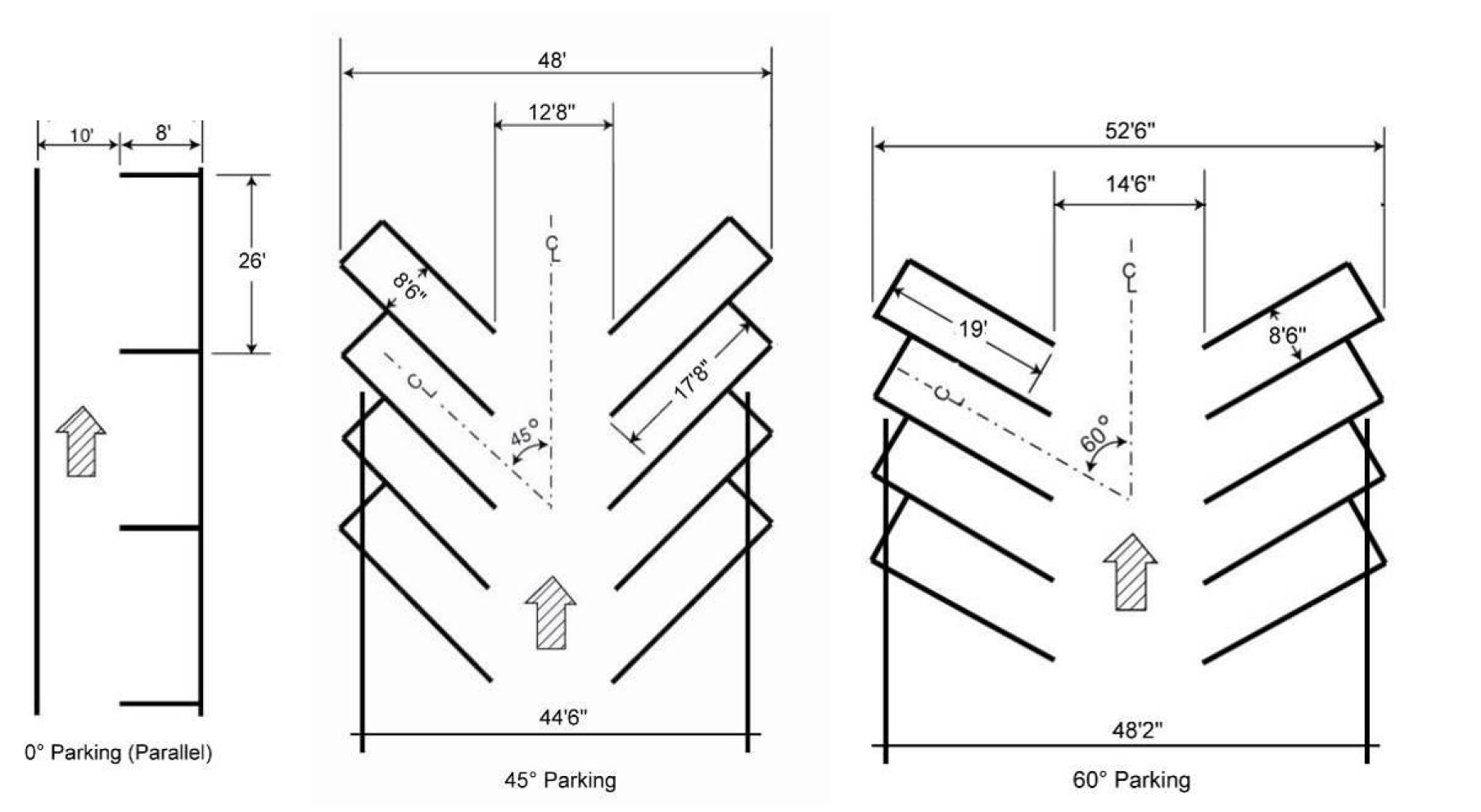
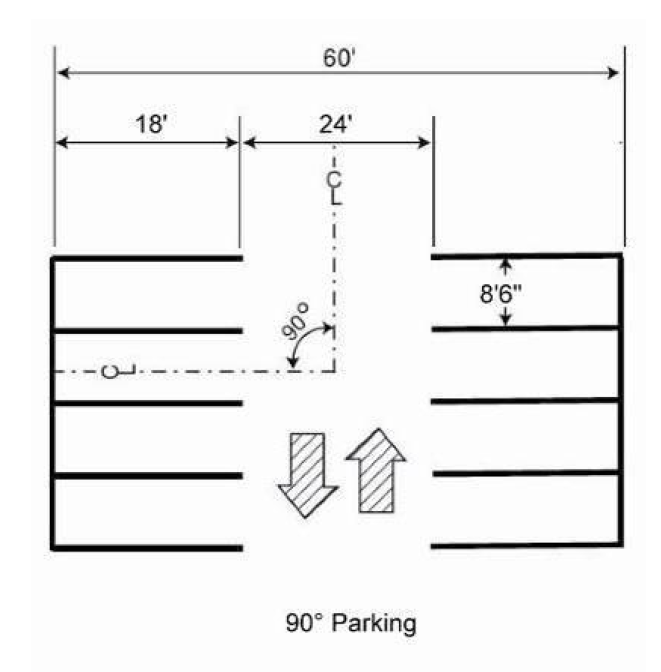
Dimensional Standards. Off-street parking facilities must be designed and constructed in accordance with the following dimensional standards:
(F)
Landscaping. Off-street parking areas must be landscaped in accordance with the standards of Sec. 16-10-1.
(G)
Loading Areas. Loading areas, except railroad loading areas, must be located, constructed, or landscaped so that they will not be visible from any other lot or public street right-of-way.
15-10-11
Motor Vehicles in Residential Districts.
(A)
Location of Vehicle Parking Spaces. Motor vehicles may be parked in enclosed garages or other buildings or upon clearly delineated driveways that lead to such garages or buildings. This standard applies to all parking spaces on a lot, whether required spaces or voluntarily provided spaces.
(B)
Commercial Vehicles.
(1)
No commercial motor vehicle or commercial trailer may be parked or stored in a residential district unless the vehicle or trailer:
(a)
Has a maximum load capacity of one ton or less; or
(b)
Is stored within a garage or other building that complies with all applicable standards of this ordinance.
(2)
Commercial motor vehicles and trailers that are making normal and reasonable service calls are exempt from this provision.
(C)
Sale of Vehicles. A resident of a dwelling unit may not have more than one motorized vehicle for sale on the site of such dwelling unit at any time. The vehicle must be titled to the current resident, properly licensed, and operable. In no instance may vehicles for sale be displayed in a required front setback or in the area between the front of the main building and the street, except that such vehicles may be displayed on an approved driveway. The sale of vehicles from a residential property may not exceed four vehicles per year.
15-10-12
Permit Required for Changes. All future changes in the parking for a use must only be allowed pursuant to a General Use Permit or a Special Use Permit if a Special Use Permit is necessary for some use, building, or structure which will accompany the change in the parking.
15-10-13
Loading Area Requirements. In addition to the preceding off-street parking requirements, all commercial uses must provide loading and unloading areas which are located and designed so that the normal flow of vehicles and pedestrians within the required off-street parking spaces may not be interfered with and vehicles may not be parked on or extend into any public right-of-way while being loaded or unloaded.
15-11 - Off-Street Loading.
15-11-1
No Use of Public Right-of-Way. At no time may goods be loaded or unloaded from the right-of-way of a collector or arterial street. No part of any vehicle may be allowed to extend into the right-of-way of a collector or arterial street while being loaded or unloaded.
15-11-2
Location. Plans for location, design and layout of all loading spaces must be indicated on all required site plans.
15-11-3
Design.
(A)
Space Size. Off-street loading spaces, excluding maneuvering areas, must be at least ten feet wide and 25 feet long unless off-street loading will involve the use of semi-tractor trailer combinations or other vehicles in excess of 25 feet in length, in which case the minimum size of a space must be 12 feet by 65 feet.
(B)
Surfacing and Maintenance. All off-street loading areas must be kept in a dust-free condition at all times.
15-12 - Traffic Impact Analyses.
15-12-1
Purpose. This Section is intended to help ensure that new development does not adversely affect the capacity of streets and intersections to safely and efficiently accommodate vehicular traffic. It seeks to do so by providing a standard set of analytic tools and format that can be used to identify a development's expected traffic impacts on the road system, any traffic problems associated with access to and from the development site, and any improvements or site design modifications needed to solve potential adverse traffic impacts and access problems.
15-12-2
When Required.
(A)
A traffic impact analysis is required at the time of application for approval of any zoning map amendment (rezoning), planned compliance permit, Special Use Permit, General Use Permit or preliminary subdivision plat if:
(1)
The proposed development, or phases of development, or contiguous tracts under the same ownership, would accommodate or could be expected to generate 100 or more added vehicle trips to or from the site during the peak traffic hour (based on the proposed development or the adjacent roads and intersections); or
(2)
The proposed development, or phases of development, or contiguous tracts under the same ownership, would accommodate or could be expected to generate 1,000 or more added vehicle trips to or from the site during a 24-hour period (based on the proposed development or the adjacent roads and intersections).
(B)
In calculating the number of added vehicle trips expected to be generated, trip generation rates must be obtained from the most recent editions of Trip Generation and Trip Generation Handbook, published by the Institute of Transportation Engineers (ITE). Only "new" vehicle trips will be counted; no pass-by or internal trip capture will be used in calculating "added vehicle trips."
(C)
The Planning Director may waive the requirement for a traffic impact analysis when the applicant shows that the proposed development's impact on adjacent roads and intersections will be minimal and insignificant, or will be no greater than those projected by a traffic impact analysis prepared and submitted within the past two (years) for the same site under the same or similar background conditions. The Planning Director must document the reasons for any waiver.
15-12-3
Level of Service Standards.
(A)
The traffic impact analysis must demonstrate that the proposed development would not cause build-out-year, peak-hour levels of service on any arterial or collector road or intersection within the study area to fall below Level of Service (LOS) "D," as defined by the latest edition of the highway capacity manual, or, where the existing level of service is already LOS "E" that the proposed development would not cause the LOS to fall to the next lower letter grade.
(B)
If the road segment or intersection is already LOS "F," the traffic impact analysis must demonstrate that the proposed development, with any proposed improvements, would not cause build-out year peak-hour operation to degrade more than five percent of the total delay on any intersection approach.
(C)
To the extent that application proposes specific access points, the analysis must also demonstrate that the proposed development would avoid unsafe conditions on adjacent roads.
(D)
Failure to meet these standards may serve as a basis for denying the application, or for conditioning approval of the application on provision of improvements or other mitigation measures needed to correct deficiencies due to the proposed development's impacts.
15-12-4
Study Area. The traffic impact analysis must address the proposed development's traffic impacts on at least:
(A)
Roads and intersections within the development site, as designated by county planning staff or review consultant;
(B)
Road segments and intersections abutting the development site as designated by county planning staff or review consultant; and
(C)
Off-site road segments and intersections where traffic from the proposed development is expected to account for at least ten percent of the road's or intersection approach leg's average daily traffic.
15-12-5
Qualifications. Traffic impact analyses must be prepared by a licensed professional engineer.
15-12-6
Study Contents.
(A)
Traffic impact analyses must include charts, graphics, and narrative presenting at least the following information:
(1)
A description of existing land uses and development intensities in the study area, the location and characteristics (functional classification, number of lanes, speed limit, signalization, etc.) of roads and intersections in the study area, and the existing traffic volumes and conditions (including levels of service) of those roads and intersections;
(2)
A description of the location and traffic-related characteristics (land use, intensity, expected date of full build-out and occupancy, vehicular access points and characteristics, etc.) of the proposed development and other developments in the study area that are under construction, approved, or pending approval, as well as roadway and other transportation facilities and improvements in the study area that are under construction, programmed, or planned (Transportation Plan, Collector Street Plan, etc.);
(3)
Projections of future background traffic (existing traffic volumes forecasted to build-out year levels based on agreed upon traffic growth rate) plus traffic generated by other development in the study area that is under construction, approved, or pending approval, future site traffic and total future traffic (the sum of future background traffic and future site traffic);
(4)
Future background and site traffic projections must be made for the peak hours (as identified by county planning staff or review consultant) of the adjacent road segments and intersections and for the development's expected full build-out and occupancy date, and must include trip generation, trip distribution (using pre-approved distribution by county planning staff or review consultant), and traffic assignment estimates;
(5)
Analyses of the proposed development's incremental impacts on:
(a)
Road capacity during peak hours at all site access points and at road segments and intersections in the study area (including determination of the level of service for the road segments and intersections, queuing vs. existing/proposed storage);
Commentary: when a rezoning is requested, a trip generation comparison must be prepared, comparing existing vs. proposed zoning)
(b)
The need for signalization of intersections in the study area; and
(c)
Existing or potential high accident areas (as referenced in the adopted transportation plan or determined by county planning staff);
(6)
A qualitative analysis/review of sight distance at access points, when required by county planning staff or the review consultant;
(7)
A description of the location, nature, and extent of site access and transportation improvements and other measures recommended to mitigate any failure to meet traffic operation standards due to the proposed development's traffic impacts, including the expected effectiveness of each mitigation measure in addressing deficiencies, the feasibility of implementing the measures, suggested allocation of responsibility for funding and implementing the measures, the measures' relationship to planned public transportation improvements, and a suggested time schedule for the implementation of the measures;
(8)
Resumes of the preparers of the analysis, demonstrating specific education, training, and professional experience in traffic-related analyses and, if the analysis involves roadway or traffic signal design, traffic engineering; and
(9)
Identification of all assumptions and data sources used in its projections, analyses, and recommendations.
(B)
When the traffic impact analysis accompanies a rezoning application, its description of the proposed development must indicate the full range of land uses and development intensities allowed by the proposed zoning and identification of the allowable land use/intensity that can be expected to have the greatest traffic impact on peak hour traffic on adjacent roads and intersections. This highest impact land use/intensity will constitute the "proposed development" for which traffic projections are made and traffic impacts are analyzed.
[OA 04/13 April 4, 2005]

