
Wake County Unincorporated
City Zoning Code
City Zoning Code
ARTICLE 4
- Use Regulations
4-10 - Explanation of use table.
4-10-1
Use Classification System. The first column of the use table lists the use groups, use categories and specific use types allowed in Residential, Commercial and Industrial zoning districts. This use classification system is further described in Sec. 4-11.
4-10-2
Permitted Uses. Uses identified with a "P" are permitted as of right in the subject zoning district, subject to compliance with all other applicable regulations of this ordinance.
4-10-3
Special Uses. Uses identified with an "S" are allowed only if reviewed and approved in accordance with the Special Use Permit procedures of Sec. 19-23. Uses identified with an "S*" must be located within a mixed-use district in accordance with the Wake County Comprehensive Plan and reviewed and approved in accordance with the Special Use Permit procedures of Sec. 19-23.
Commentary: Special Use Permits are required to meet the conclusions required for approval found in Sec. 19-23-8 including consistency with the Wake County Comprehensive Plan. To be consistent with the Comprehensive Plan, some special uses must be located within a designated multi-use district.
[Amended on 11/21/2022 by OA-02-22]
4-10-4
Uses Not Allowed. Uses identified with an "-" are not allowed in the respective zoning district, unless it is otherwise expressly allowed by other regulations of this ordinance.
4-10-5
Use Standards. The final column of the use table identifies use-specific standards and conditions that apply to some uses. Unless otherwise expressly stated in the text of the referenced use standard, these use-specific standards and conditions apply whether the use is allowed as a permitted (P) or special (S) use.
[Amended on 1/22/2008 by OA 04-07]
4-11 - Use Table.
Uses are allowed in zoning districts in accordance with the use table of this section (continues on the following page).
[Amended on 1/22/2008 by OA 04-07; Amended on 7/21/2008 by OA 02-08; Amended on 4/6/2009 by OA 01-09; Amended on 4/5/2010 by OA 03-09; Amended on 3/21/2011 by OA 01-10; Amended on 10/1/2012 by OA 04-12; Amended on 4/21/2014 by OA 05-12; Amended on 10/6/2014 by OA 03-14; Amended on 2/2/2015 by OA 04-14; Amended on 1/17/2017 by OA 02-16; Amended on 1/19/2021 by OA-03-20; Amended on 1/3/2022 by OA-03-21; Amended on 11/21/2022 by OA-02-22; Amended on 10/16/23 by OA-02-23; Amended on 11/18/2024 by OA-01-24; Amended on 4/21/2025 by OA-02-25; Amended on 6/16/2025 by OA-03-25; Amended on 10/20/2025 by OA-04-25]
4-20 - Use Classification System.
4-20-1
General.
(A)
Use Groups. For the purpose of interpreting the use table of Sec. 4-11, land uses are classified into five major groupings: "Residential," "Public and Civic," "Commercial," "Industrial," and "Other." These broad groupings are referred to as "use groups."
(B)
Use Categories. Each use group is further divided into more specific "use categories." Use categories classify land uses and activities based on common functional, product, or physical characteristics. Characteristics include the type and amount of activity, the type of customers or residents, how goods or services are sold or delivered and site conditions. The use categories are intended to provide a systematic basis for assigning present and future land uses into appropriate zoning districts. Principal uses are assigned to the use category that most closely describes the nature of the principal use. The "characteristics" subsection of each use category describes the common characteristics of each principal use.
(C)
Developments with Multiple Principal Uses. When all principal uses of a development fall within one use category, the entire development is assigned to that use category. A development that contains a coffee shop, bookstore and bakery, for example, would be classified in the retail sales and service category because all of the development's principal uses are in that category. When the principal uses of a development fall within different use categories, each principal use is classified in the applicable category and each use is subject to all applicable regulations for that category.
(1)
When there are two or more principal uses that require different types of permits (zoning, special use or planned compliance), then the development shall be reviewed using the most restrictive process from among the proposed uses.
If a proposed development includes a use that is permitted and a use that is a special use in the district then the entire development requires Special Use Permit review.
(2)
Multiple single-family dwellings as principal uses on a single parcel shall be prohibited, except in cases of mobile homes located in RMH District.
(D)
Business, Prima Facie. Any use or activity that functions as a traditional business or commercial use, whether or not such use or activity is performed for profit or financial gain, is a business. An individual who repairs vehicles owned by other people will, for example, be deemed to be operating a prima facie business regardless of whether payment is received for such services.
(E)
Use of Examples. The "examples" subsection of each use category lists typical uses included in the respective use category, but is not intended to represent an exhaustive list. The names of these typical uses are generic. They are based on common meanings and not on what a specific use may call itself. For example, a use that calls itself "wholesale warehouse" but that sells mostly to consumers is included in the retail sales and service category. This is because the actual activity on the site matches the description of the retail sales and service category.
(F)
Similar Use Interpretation Criteria. When a specific use type cannot be classified into a use category or appears to fit into two or more use categories, the Planning Director is authorized to determine the most appropriate Use Category. The following considerations may be used in making similar use interpretations:
(1)
The actual or projected characteristics of the activity in relationship to the stated characteristics of each use category;
(2)
The relative amount of site area or floor space and equipment devoted to the activity;
(3)
Relative amounts of sales from each activity;
(4)
The customer type for each activity (retail or wholesale);
(5)
The relative number of employees in each activity;
(6)
Hours of operation;
(7)
Building and site arrangement;
(8)
Vehicles used with the activity;
(9)
The manner in which such uses are classified by commonly used business classification reference sources, such as the American Planning Association's Land-Based Classification Standards;
(10)
The relative number of vehicle trips generated by the use; and
(11)
How the use advertises itself.
[Amended on 6/4/2012 by OA 02-12; Amended on 1/17/2017 by OA 03-16; Amended on 11/18/2024 by OA-01-24]
4-21 - Residential Use Group.
The "Residential" use group includes uses that provide living accommodations to one or more persons. The residential use group includes two use categories: group living and household living.
4-21-1
Household Living.
4-21-2
Group Living.
[Amended on 11/18/2024 by OA-01-24]
4-22 - Public and Civic Use Group.
The public and civic use group includes uses that provide public or semi-public services. The public and civic use group includes the following use categories:
4-22-1
Animal Shelter.
4-22-2
Colleges and Universities.
4-22-3
Cultural Exhibits and Libraries.
4-22-4
Daycare.
4-22-5
Detention and Correctional Facilities.
4-22-6
Hospitals.
4-22-7
Lodge or Private Club.
4-22-8
Parks and Recreation.
4-22-9
Religious Assembly.
4-22-10
Safety Service.
4-22-11
School.
4-22-12
Parking, Park and Ride.
[Added on 3/21/2011 by OA 01-10; Amended on 11/18/2024 by OA-01-24]
4-23 - Commercial Use Group.
The commercial use group includes uses that provide a business service or involve the selling, leasing or renting of merchandise to the general public.
4-23-1
Animal Service.
4-23-2
Eating and Drinking Establishment.
4-23-3
Event Venue
4-23-4
Financial Services.
4-23-5
Funeral and Interment Service.
4-23-6
Gasoline Station.
4-23-7
Lodging.
4-23-8
Office.
4-23-9
Parking, Commercial.
4-23-10
Recreation and Entertainment (Indoor and Outdoor).
4-23-11
Retail Sales and Service.
4-23-12
Sexually Oriented Business.
4-23-13
Vehicle Sales and Service.
[Amended 1/22/2008 by OA 04-07; Amended 3/21/2011 by OA 01-10; Amended on 11/18/2024 by OA-01-24]
4-24 - Industrial Use Group.
The industrial use group includes uses that produce goods from raw, recycled or previously prepared materials, and uses that store and distribute large quantities of these goods.
4-24-1
Junk/Salvage Yard.
4-24-2
Manufacturing, Production and Industrial Service.
4-24-3
Mining/Excavation.
4-24-4
Self-Service Storage.
4-24-5
Warehousing, Wholesaling and Freight Movement.
4-24-6
Waste-Related Use.
4-25 - Other Use Groups.
4-25-1
Agriculture, Horticulture, Forestry.
4-25-2
Airfields and Landing Strips.
4-25-3
Farm Serving Uses, Class I.
4-25-4
Farm Serving Uses, Class II.
4-25-5
Off-Premise Signs.
4-25-6
Telecommunication Facilities.
4-25-7
Special Events.
4-25-8
Solar Energy Systems.
4-25-9
Farmers Market.
4-25-10
Local Agricultural Market.
[Amended on 4/6/2009 by OA 01-09; Amended on 10/6/2014 by OA 03-14; Added on 1/17/2017 by OA 02-16; Amended on 11/18/2024 by OA-01-24]
4-30 - Bed and Breakfast Residences.
Bed and breakfast residences are subject to the following standards:
4-30-1
The dwelling originally was constructed as a single-family detached dwelling;
4-30-2
If a single-family dwelling is converted to a Bed and Breakfast, no substantial changes may be made to the exterior appearance of the structure or to the site that would alter the property's residential character;
4-30-3
No interior changes may be made that would prevent the structure's conversion back to an exclusively single-family residential use;
4-30-4
Guest stays are limited to 14 consecutive days;
4-30-5
The operator of the bed and breakfast residence may be the owner of the dwelling or a resident manager, but must occupy the dwelling as a principal residence;
4-30-6
Meals may be provided to overnight guests only, and no cooking facilities may be provided in guest rooms; and
4-30-7
Accessory facilities for meetings or recreation may be provided, but only for use by overnight guests (not open to the general public).
[Amended on 4/21/2025 by OA-02-25]
4-31 - Caretaker Residence.
4-31-1
A one-family dwelling, as a residence for security personnel, is permitted as a special use by the Board of Adjustment, after approval of plans subject to the following requirements:
(A)
Only one such use may be permitted in association with any one establishment; and
(B)
Any structural alterations of, or any change in the location, characteristics, use, or time and type of occupancy of, the unit must cause the permit to be voidable and require review and reapproval of the alterations or changes by the Board of Adjustment.
(C)
Dwellings in business districts must be provided with yard space as necessary to satisfy the living and health requirements in the dwelling units;
(D)
Where connections to public or community water and/or wastewater disposal systems are not available, the minimum lot area must be determined by the Board of Adjustment upon the recommendation of the Department of Health and Human Services. Other yard and space requirements must then be determined by the Board of Adjustment by reference to appropriate Residential district requirements as set forth in this ordinance;
(E)
Where connections to public or community water and wastewater systems are available, setback and space requirements must conform to provisions of R-12 Districts.
[Amended 6/7/2021 by OA-01-21; Amended on 11/18/2024 by OA-01-24].
4-32 - Cemeteries.
Cemeteries are subject to the following regulations:
(A)
Location and Plat Recordation. The location of existing and designated graves must be shown on the application plan. The applicant must record a plat with the Wake County Register of Deeds showing the location of all existing and designated graves and return a copy to the Planning Director.
(B)
Setbacks. Grave spaces must be located a minimum of 50 feet from adjacent property lines. This provision does not apply when adjacent property is commonly owned and used for cemetery purposes. Grave spaces (existing and/or designated) must be located a minimum of 20 feet from any road right-of-way or private road easement.
(C)
Proximity to wells and septic systems. The North Carolina Cemetery Commission regulates all perpetual care cemeteries. In addition, the Wake County Department of Health and Human Services regulates the location of water supply wells and septic systems relative to grave sites under rules of the NC Environmental Management Commission, NC Commission for Public Health, and Wake County Health and Human Services Board.
[Amended on 11/18/2024 by OA-01-24]
4-33 - Commercial Recreation Uses.
Uses subject to the use regulations of this section must comply with the following standards:
4-33-1
Parking. Paved or graveled parking areas of sufficient size to provide parking spaces on the premises for all persons using the premises must be provided. There may be no parking in any required setback. Parking areas must be designated and marked as such by curbs, borders, walls, or fences, and must be well drained and continuously maintained.
4-33-2
Storage. Outside storage is not permitted within any required setback. Storage areas must be screened or located where they will not be seen from any adjoining property.
4-33-3
Utilities. Approval of water supply and sewage disposal plans by the county or state agencies having jurisdiction is required before issuance of use or building permits.
[Amended on 9/6/2011 by OA 04-11]
4-34 - Day Camps.
Day camps and similar facilities must be located at least 300 feet from adjoining property lines. Rifle ranges or other shooting facilities are not permitted.
4-35 - Adult Day Care Facility.
Adult Day Care Facilities are subject to the following regulations:
4-35-1
The site plan must be an engineering drawing or a sketch plan drawn to scale, and must include the location, dimensions, and a rendering of the general appearance for each of the following:
(A)
The entire adult day care facility in relation to abutting properties and public thoroughfares;
(B)
Off-street parking areas and points of ingress and egress, in relation to abutting properties and connecting or adjoining streets;
(C)
The general landscape plan, including (but not limited to) the location of any proposed buildings, structures, recreation areas, parking facilities, fences, and vegetative screens;
(D)
Proposed utility designs, including (where applicable) water and wastewater lines and connectors, nitrification fields, water storage structures, etc.;
(E)
Projected day-time occupancy figures (including both staff and clientele); and
(F)
Vehicular movement and parking capacity projections for nearby streets.
4-35-2
No permit may be issued for development of any adult day care facility for the elderly unless:
(A)
There is a minimum of 1,300 square feet of total land area per each enrolled elderly person in R-40, R-80, R-40W, and R-80W districts, 800 square feet of total land area per each enrolled elderly person in R-30 districts, and 300 square feet of total land area per enrolled elderly person in any other Residential districts;
(B)
The building housing the facility is similar in appearance to nearby dwellings and buildings and compatible with the character of the neighborhood; and
(C)
Adequate off-street parking spaces and means of ingress to and egress from the facility are provided based upon projected enrollment and on-street parking capacity of the nearby streets.
[Amended on 1/22/2008 by OA 04-07]
4-36 - Duplex, Triplex and 4-plex Dwellings.
In all Residential districts, duplex, triplex and 4-plex dwellings must be located on a lot that contains at least two, three or four times respectively the land area required under the applicable minimum lot size standard in Article 5 of this ordinance.
4-37 - Family Burial Grounds.
4-37-1
Family Burial Grounds are permitted in all zoning districts but must meet the following standards.
(1)
Location and Plat Recordation. Family burial grounds are permitted provided the locations of all graves are shown on the application plan. The applicant must record a plat showing the location of all existing and designated graves for family burial grounds with the Register of Deeds and return a copy to the Planning Director.
(2)
Setbacks. All graves must be located a minimum of 50 feet from adjacent property lines and a minimum of 20 feet from any road right-of-way or private road easement.
(3)
Proximity to wells and septic systems. The North Carolina Cemetery Commission regulates all perpetual care cemeteries. In addition, the Wake County Department of Health and Human Services regulates the location of water supply wells and septic systems relative to grave sites under rules of the NC Environmental Management Commission, NC Commission for Public Health, and Wake County Health and Human Services Board.
[Amended on 11/18/2024 by OA-01-24]
4-38 - Family Care Homes.
Family care homes are permitted, provided no proposed family care home will be located within a one-half mile radius of an existing family care home, group home, youth care home, or other such care facility.
[Amended 10/20/2025 by OA-04-25]
4-39 - Farm Serving Uses—Class II.
4-39-1
Purpose.
(A)
These regulations are intended to ensure that Class II Farm Serving Uses are located in a manner consistent with the public health, safety, and welfare, and that surface waters, population centers, adjacent land uses, and Wake County in general will be protected from the potential injurious effects of a Class II use.
(B)
It is further intended to ensure that decisions pertaining to location of Class II uses are made according to objective criteria.
4-39-2
Special Uses.
(A)
Class II uses may be permitted as special uses within Residential districts, subject to the terms and conditions of this section and Sec. 19-23.
(B)
The following uses are prohibited in R-40W and R-80W districts:
(1)
Underground intermediary fuel storage facilities; and
(2)
Storage, in quantities of greater than 250 gallons, of any fuel which is a liquid at atmospheric pressure and 40 degrees Fahrenheit temperature.
4-39-3
Standards.
(A)
Ingress to and egress from Class II uses is not permitted by roads that principally provide access to residential properties within subdivisions.
(B)
A 100-foot bufferyard is required around all sides of a Class II use in accordance with Sec. 16-10-2, in order to conserve the value of buildings on adjacent properties, reduce or eliminate the effects of noise, odor, dust, and vibrations, and protect adjacent land uses from any adverse or detrimental effects due to the presence of a Class II use.
(C)
Storage tanks may not exceed a maximum of 18,000 gallons water capacity each. The minimum land area per 18,000 gallons is one acre.
(D)
A security fence at least six feet in height, designed to discourage unauthorized entry, must be installed around all portions of Class II uses directly involved in the storage and handling of non-radioactive fuel.
(E)
The Board of Adjustment may impose monitoring requirements as a condition to special use authorization.
(F)
Special use approval will not become effective until all applicable permits for a Class II use have been issued by the appropriate State and federal agencies, and will expire automatically if, at any time after the issuance, required State or federal permits are revoked or lapse.
4-39-4
Application Submittal Requirements. Permit applications must include four copies of all documents required by any State or federal agency for a permit to operate a non-radioactive intermediary fuel storage facility.
4-40 - Firearm Ranges and Clubs.
Ranges or clubs involving the use of firearms are subject to the following standards:
4-40-1
Ranges or clubs involving the use of firearms may not be interpreted to include the activity known as "turkey shoots;"
4-40-2
All shooting stations must be at least 1,000 feet distance from any adjacent property in different ownership, now or in the future. A 300 or more foot wooded buffer, consisting primarily of evergreens must exist or be planned and propagated between the firing area and all adjacent property and adequate fencing, warning signs, or other safety measures must be provided and maintained around any danger area; and
4-40-3
The minimum required distance of 1,000 feet between any shooting station and all lot lines may be reduced if actual firing tests conducted by the applicant demonstrates that a lesser distance will be adequate to protect the public safety and reduce noise at the property lines. The results of such tests and the request to lessen the required distance must be submitted in writing along with the application for a permit. Firearm ranges must be designed and constructed under the supervision of a design professional or certified by the National Rifle Association following construction and before the range is used.
4-41 - Golf Course.
4-41-1
Open Space Subdivisions. Golf courses within open space subdivisions must be located on an open space parcel reserved or dedicated for active recreation on a record plat for the open space subdivision, except in water supply watersheds. No direct glare from lights may be visible at any adjoining property lines.
[Amended on 11/21/2022 by OA-02-22]
4-41-2
Residential Watershed Districts. Golf course development and accessory activities in the R-80W and R-40W districts are subject to the following standards:
(A)
Golf course construction and operations may not be located in, and must avoid disturbance of, environmentally-sensitive natural areas including:
(1)
Wetlands as designated by the U.S. Army Corps of Engineers;
(2)
Slopes greater than 25 percent or soils with K values (erosion potential) of 0.3 or greater. K values for specific soils are located in Section 2 of the Soil Conservation Service Field Office Technical Guide;
(3)
Ecologically significant natural areas as identified by the North Carolina Natural Heritage Program; and
(4)
Floodways (See Article 14).
(B)
Golf course construction and operations must use and maintain watershed Best Management Practices (BMPs) including:
(1)
Undisturbed watershed and drainageway buffers along lakes, streams, and drainageways; and
(2)
Paired wet detention ponds designed to collect runoff from all golf course surfaces (fairways, tees, greens, roughs, and parking lots), eliminate direct discharge of pollutants into surface water, and serve as a source of irrigation water if desired. Detention ponds must be of adequate size to ensure that the peak discharge of stormwater runoff from the two and ten-year storm entering surface water does not exceed discharge at predevelopment conditions for the two year storm and does not exceed discharge at build out conditions, based on the zoning of the contributing watershed, for the ten-year storm. All detention ponds will provide spillways to adequately pass the 100-year storm peak.
(3)
Golf course operations must use integrated pest and turf grass management in order to minimize herbicide, fertilizer, and pesticide usage and the adverse impacts of their use on water quality and environmentally sensitive areas. Integrated management means that instead of using highly toxic chemicals and maintenance-intensive plants and practices, the operator uses a combination of less toxic and less environmentally degrading alternatives to achieve acceptable playing surfaces. The application for a Special Use Permit must include (a) an Integrated Pest Management (IPM) Plan specifying pest control strategies which will be employed, and (b) an Integrated Turf Grass Management (ITM) Plan specifying strategies that will be used during golf course construction and operations to establish and maintain the course's playing surfaces. Both of these plans must be designed to minimize herbicide, fertilizer, and pesticide usage and the adverse impacts of their use on water quality and environmentally sensitive areas. The plans must identify chemicals which will be used, specify effective frequency and concentrations at which they will be applied, and identify any potential environmental hazards that may arise from their proposed use. Approval of these plans by the Department of Environmental Services, Health and Human Services, and/or any other applicable state or federal agency is required before a Special Use Permit may be issued. In considering approval of these plans, the Department of Environmental Services, Health and Human Services, and/or any other applicable state or federal agency must consider if the plans minimize herbicide, fertilizer, and pesticide usage and the adverse impacts of their use on water quality and environmentally sensitive areas. Any changes to the approved plans must also be approved by the Department of Environmental Services, Health and Human Services, and/or any other applicable state or federal agency before the changes are implemented. Golf course construction and operation activities must conform to the approved ITM and IPM Plans, or to any subsequently revised plans that have been approved by the Department of Environmental Services, Health and Human Services, and/or any other applicable state or federal agency.
4-41-3
Golf course operations are required to include water quality monitoring necessary to ensure that downstream water quality is not degraded by golf course construction and operations, and that detention ponds continue to be effective in preventing the direct discharge of pollutants into downstream waters. Before any site preparation or construction, the golf course developer must: (a) arrange for an independent qualified testing establishment to sample downstream waters and determine baseline data for those parameters indicative of the water quality impacts of golf course construction and operations (including the management of turf grass and pests as proposed in the ITM and IPM Plans); (b) prepare a water quality monitoring program that specifies appropriate procedures and standards for quarterly sampling and analyses, by an independent qualified testing establishment, of detention pond waters and downstream waters in relation to the baseline data; and (c) obtain confirmation of the baseline data and the monitoring program from the Department of Environmental Services, Health and Human Services, and/or any other applicable state or federal agency. The results of the quarterly analyses must be submitted to the Wake County Department of Environmental Services, Health and Human Services, and/or any other applicable state or federal agency, which must compare the quarterly results to the baseline data and determine whether the requirements of the water quality monitoring provisions are met.
4-41-4
Outside of Open Space Subdivisions and Residential Watershed Districts.
Golf courses outside of open space subdivisions (with or without country clubs) are permitted where indicated in the use table, except that driving ranges and miniature golf courses are not permitted as part of golf courses. Country clubs may include driving ranges for daytime use of club members. Golf courses may be allowed in water supply watersheds only after review and approval of a Special Use Permit by the Board of Adjustment (See 19-23).
[Amended on 11/21/2022 by OA-02-22; Amended on 11/18/2024 by OA-01-24]
4-42 - Group Care Facilities.
Group care facilities are subject to the following standards:
4-42-1
Each facility must have a minimum uncovered land area of 5,000 or more square feet for the first 12 residents, and 700 square feet for each additional resident;
4-42-2
Each facility must have a minimum heated floor area of 2,000 square feet for the first 12 residents, and 110 square feet for each additional resident;
4-42-3
Off-street parking must be provided as required in Article 15;
4-42-4
No group care facility may be located within one-half mile of another such facility, measured by a straight line, and not street distances, in order to prevent the creation of a de facto social service district and to avoid affecting the surround neighborhood. "Affecting" means the point at which the number of group care facilities or residents therein might become so large that it may alter the character of a neighborhood. This subsection is also intended to protect existing group care facilities from the possibility that an over-concentration of such facilities might inadvertently create an institutional setting and hinder or negate the purposes of such facilities; and
[Amended on 1/22/2008 by OA 04-07; Amended on 4/21/2014 by OA 07-12]
4-43 - Group Homes.
The proposed Group Home is no less than one-half mile radius from an existing group home, family care home, youth care home, or other such care facility.
[Amended on 6/4/2012 by OA 02-12; Amended 10/20/2025 by OA-04-25]
4-44 - Hazardous and Low-Level Radioactive Waste Facilities.
4-44-1
Purpose. The purpose of these regulations is to:
(A)
Ensure that hazardous or low-level radioactive waste facilities are located in a manner consistent with the public health, safety, and welfare, and that surface waters, ground waters, population centers, adjacent land uses, and Wake County in general will be protected from the potential injurious effects of a hazardous or low-level radioactive waste facility;
(B)
Provide that decisions pertaining to location of hazardous or low-level radioactive waste facilities are made according to objective criteria;
(C)
Ensure that no hazardous or low-level radioactive waste facility will be located within Wake County's zoning jurisdiction unless a special use has been approved by the Board of Adjustment;
(D)
Ensure that all applicants requesting a hazardous or low-level radioactive waste permit must pay Wake County an application fee set by Wake County Commissioners; and
(E)
Provide that adequate money is available, through levy of a privilege license tax, to compensate Wake County for monitoring the effects of hazardous and low-level radioactive waste facilities in the county.
4-44-2
Special Use Permits.
(A)
Hazardous or low-level radioactive waste landfills may be permitted as a special use only in the Triassic Basin, subject to the terms and conditions of this section and Sec. 19-23.
(B)
Hazardous or low-level radioactive waste facilities other than hazardous or low-level radioactive waste landfills may be permitted as a special use only in Industrial districts and Airport districts subject to the terms and conditions of this section and Sec. 19-23.
(C)
Hazardous or low-level radioactive waste facilities are not permitted in those sections of the Triassic Basin or Industrial districts lying within a water supply watershed.
(D)
Hazardous or low-level radioactive waste facilities are not permitted in floodway, floodway fringe, or flood hazard soil areas.
(E)
Ingress to and egress from hazardous or low-level radioactive waste facilities must be permitted by roads to serve only the hazardous or low-level radioactive waste facilities. Such roads must be designed and constructed to North Carolina Secondary Road Standards, with roadway design to allow a weight limit of 19,000 pounds per axle, and must intersect directly with a State-maintained road. Approach and departure traffic routes for a hazardous or low-level radioactive waste facility are not permitted through a system of streets primarily intended to provide access to residences in a neighborhood.
(F)
A 300-foot bufferyard, in accordance with Article 16, is required around all sides of a hazardous or low-level radioactive waste facility to fulfill the following purposes:
(1)
To conserve the value of buildings on adjacent properties;
(2)
To reduce or eliminate the effects of noise, odor, dust, and vibrations; and
(3)
To protect adjacent land uses that would be particularly sensitive to the presence of hazardous or low-level radioactive waste facilities.
(G)
A security fence designed to severely discourage unauthorized entry and at least six feet in height must be installed around all portions of hazardous or low-level radioactive waste facilities directly involved in the storage, handling, and disposal of hazardous waste.
(H)
All storage, treatment, processing, recycling, collection, recovery, and disposal of hazardous or low-level radioactive waste must be located at least 500 feet from any exterior property line when such property line abuts a Residential district.
(I)
Issuance of a Special Use Permit for a hazardous or low-level radioactive waste facility must provide Wake County the opportunity to monitor the facility as a condition of the permit.
(J)
Special use approval will not become effective unless all applicable permits for hazardous or low-level radioactive waste facilities have been issued by the appropriate State and Federal agencies governing operation of the facility.
(K)
Special Use Permits will automatically expire if at any time after the issuance, State or Federal permits are revoked or terminated.
(L)
Wake County must be compensated for costs incurred as a result of the location of hazardous or low-level waste facilities by a privilege license tax, in accordance with the General Statues of North Carolina, Section 153A-151, as amended. The hazardous or low-level radioactive waste facility operator must be assessed in accordance with a privilege license tax schedule to offset costs incurred by the county attributable to the facility.
4-44-3
Application Submittal Requirements. Special Use Permit applications for hazardous or low-level radioactive waste facilities must be submitted in accordance with Sec. 19-23. The application must include four copies of all documents required by any State of North Carolina agency or any Federal agency for a permit to operate a hazardous or low-level radioactive waste facility.
[Amended 6/7/2021 by OA-01-21].
4-45 - Hospitals and Other Medical Institutions.
4-45-1
Hospitals, philanthropic or eleemosynary institutions are subject to the following standards:
(A)
All buildings must be set back at least 100 feet from any lot line or street line.
(B)
The exterior appearance of all buildings must be in harmony with the character of the area.
4-45-2
Veterinary clinics are subject to the following standards:
(A)
All buildings must be set back at least 100 feet from any lot line or street line.
(B)
The exterior appearance of all buildings must be in harmony with the character of the area.
(C)
No outside activity associated with the use shall be permitted.
(D)
Medical treatment or care shall be practiced only within an enclosed building or structure.
(E)
The building space shall be adequately soundproofed to assure that no noise will carry beyond the confines of the building or space that the use would occupy.
[Amended on 1/19/2021 by OA-03-20; Amended on 11/18/2024 by OA-01-24]
4-46 - Kennels.
4-46-1
Kennels. Kennels must comply with the following standards:
(A)
Purpose. These provisions are intended to recognize that although kennels provide a service for owners of animals, the noise, odor, insects, and traffic associated with kennels are not in keeping with what is ordinarily desirable in developed areas. However, within the zoning jurisdiction of the county, kennels might be appropriate and conveniently located therein provided that sites are carefully selected and establishments are built and operated in compliance with all applicable standards. It is further intended that the Board of Adjustment must consider each proposed site with reference to the character of the immediate neighborhood, topography, natural vegetation (and other purposes of zoning as set forth in Section 160D-701 of the General Statutes), and determine whether a kennel would be a suitable land use thereon.
(B)
Definition. Any building, structure, or land area that is licensed for the boarding, breeding, training, showing or raising of more than five dogs or five cats over the age of four months, where such animals are kept or maintained, whether or not for compensation and whether or not the dogs or cats are owned by the operator of the kennel.
(C)
Separation and Screening.
(1)
All building and structures related to the care of animals must be located at least 50 feet from any property line;
(2)
No outdoor kennel, exercise, training play area and/or run shall be located within 100 feet of any property line. All kennel areas are surrounded by an effective noise screen, in which case the setback requirement may be reduced to 50 feet. Where a noise screen is provided, it must comply with provisions of Article 16, and must consist of one of the following combinations:
(a)
An earth berm covered by a combination of dense evergreen shrubs and evergreen trees. The minimum height of the entire noise screen must be eight feet, but the earth berm itself must be no less than five feet. The minimum width of the entire noise screen must be 25 feet.
(b)
A masonry, stone, or block wall, augmented on one side by a combination of dense evergreen shrubs and evergreen trees. The minimum height of the entire noise screen must be eight feet, and the minimum width of the vegetation must be 25 feet.
(3)
A minimum of a six-foot-tall security fence must be installed and maintained between outdoor areas where animals are kept and any property line. Such fence may consist of a masonry wall, metal fence of solid appearance, or a chain link fence. The wall or fence must be screened in accordance with provisions of Section 16-10-3(C).
(4)
All fences must have a height of six or more feet, and all screens must have a height of six or more feet within four growing seasons.
(5)
Adequate parking facilities with safe and efficient pedestrian and vehicular access and egress must be provided; such parking facilities must be landscaped in accordance with provisions of Article 15.
[Amended on 4/21/2014 by OA 05-12; Amended 6/7/2021 by OA-01-21; Amended on 11/18/2024 by OA-01-24]
4-47 - Land-Clearing and Inert Debris Landfills, Construction and Demolition Landfills.
4-47-1
Application of Section. Land-clearing and inert debris landfills, and construction and demolition landfills, are permitted as special uses in any zoning district in compliance with the terms and conditions of this section, except in R-80-W and WSO-3CA districts, where they are prohibited.
4-47-2
Procedural Requirements. Land-clearing and inert debris landfills, and construction and demolition landfills, may only be established as special uses approved in accordance with the Special Use Permit review procedures set forth in Sec. 19-23, as modified by the following:
(A)
Landfill Franchise. Every operator of a land clearing and inert debris landfill or a construction and demolition landfill must obtain a franchise in accordance with the North Carolina General Statutes and Wake County's Solid Waste Ordinance.
(B)
Preliminary Site Plan. An application for a Special Use Permit for a land-clearing and inert debris landfill, or a construction and demolition landfill, must include a preliminary site plan that indicates the following: soils on the site according to the Wake County Soil Survey; location of water supplies within 1,000 feet of the site; drainage area upstream from the property; and proposed access to the site, including the intersection with a state maintained road. The application must also include a written report that includes the following: name of person or persons responsible for operation and maintenance of the site; proposed uses of the site after closing of the operations; population and area expected to be served by the site; anticipated type, quantity, and source of material to be disposed of at the site; anticipated lifetime of the project; and any other information pertinent to the proposed use.
(C)
Final Site Development Plan. If the Special Use Permit application is approved, the applicant must then submit a final site development plan to the Planning Director. The final site development plan must meet the requirements of paragraph 4-49-4 and indicates the methods by which the standards of paragraph 4-49-5 will be fulfilled, and must be consistent with the approval of the special use application and preliminary plan. It must be accompanied by evidence of approval of applicable plans and permits in accordance with State regulations. No Land Use Permit for the landfill may be issued, and no development of the landfill may begin, unless and until the Planning Director has approved the final site development plan as fully complying with the requirements of this section.
(D)
Special Use Permit. On request by the holder of a Special Use Permit for a land clearing and inert debris landfill or a construction and demolition landfill, the Planning Director may extend the date on which the Special Use Permit would otherwise expire under Sec. 19-23-14(B)(1)(a) and Sec. 19-23-14(B)(2)(b) by up to three years subject to the determinations set forth in Sec. 19-23-14(B)(2).
4-47-3
Site and Location Standards.
(A)
Traffic and Access. Land-clearing and inert debris landfills, and construction and demolition landfills, must be located where roads which will provide access to such landfills are constructed to NCDOT standards for the width and rated tonnage of the trucks that will be using the landfill. The additional truck traffic to the site may not cause roads providing access to the site to drop to a level of service below "D" as defined by NCDOT. Ingress to and egress from the landfill must be along a road or driveway that intersects directly with a state-maintained road. Landfill traffic routed to and from such intersection may not be through a residential neighborhood where the streets are primarily intended to provide access to adjacent residences.
(B)
Buffer Area. A buffer area of undisturbed land around all sides of the landfill must be established to fulfill the following purposes: conserving the value of buildings and protecting groundwater supplies on adjacent properties; minimizing such operational effects of the landfill, including, but not limited to, noise, odor, dust, and vibrations; and protecting adjacent land uses that are particularly sensitive to the presence of a land-clearing and inert debris landfill or a construction and demolition landfill. A standard buffer area of undisturbed land of 50 feet must be established around all sides of the landfill. The standard buffer area may be increased where it is necessary to fulfill the purposes of buffering. Where a proposed land-clearing and inert debris landfill or a construction and demolition landfill is adjacent to an existing landfill that has been officially closed in accordance with appropriate governmental regulations, the required buffer area on the side adjacent to the existing landfill must be 30 feet in width.
(C)
Locations in Noncritical Areas of Water Supply Watersheds. Land-clearing and inert debris landfills or construction and demolition landfills may be located in R-40W, WSO-2NC, WSO-3NC, and WSO-4P districts if the applicant can demonstrate, through information and plans submitted during the review process, that there will be no adverse effects from the landfill on public water supplies.
(D)
Visual Screen. A visual screen of at least 50 percent opacity must be established around that portion of the landfill that is excavated or being filled for current operations. Such screening is required only when the excavated or filled area is visible at eye level at ground elevation from State-maintained thoroughfares, residences, and buildings, but not including accessory buildings on properties adjacent to the landfill. When in the course of landfill operations, excavated or filled areas are stabilized in accordance with the standards and specifications of the Wake County Soil Erosion and Sedimentation Control Ordinance, required artificial screening may be removed.
(E)
Existing Vegetation. The Planning Director may exempt the applicant from all or part of the visual screening requirements of subparagraph 4-47-3(D) when existing vegetative cover will fulfill these requirements. Such natural screening may consist of existing vegetative cover including but not limited to trees and shrubs having opacity of not less than 50 percent at all seasons of the year. Screening may also consist of earthen berms or other artificial screens used individually or in combination with each other and existing vegetation to achieve a screening effect of at least 50 percent opacity during all seasons of the year. Screening materials and vegetation may be located in required buffer areas.
(F)
Waive Screen. Screening requirements may be waived along those sides or portions of the landfill not visible from state maintained roads where the adjacent property owner entitled to screening by this section indicates in writing to the Board of Adjustment that such screening is not necessary or desirable.
(G)
Storage Prohibited in Buffer Areas. Notwithstanding any other provision of this ordinance, no storage of vehicles or machinery and no accessory buildings are permitted within any buffer area.
(H)
Hours of Operation. The hours of operation must be limited from 7:00 a.m. to 7:00 p.m. except that the hours of operation may be extended when the Director of Wake County Department of Environmental Services certifies that sanitation conditions require an extension of operating hours.
(I)
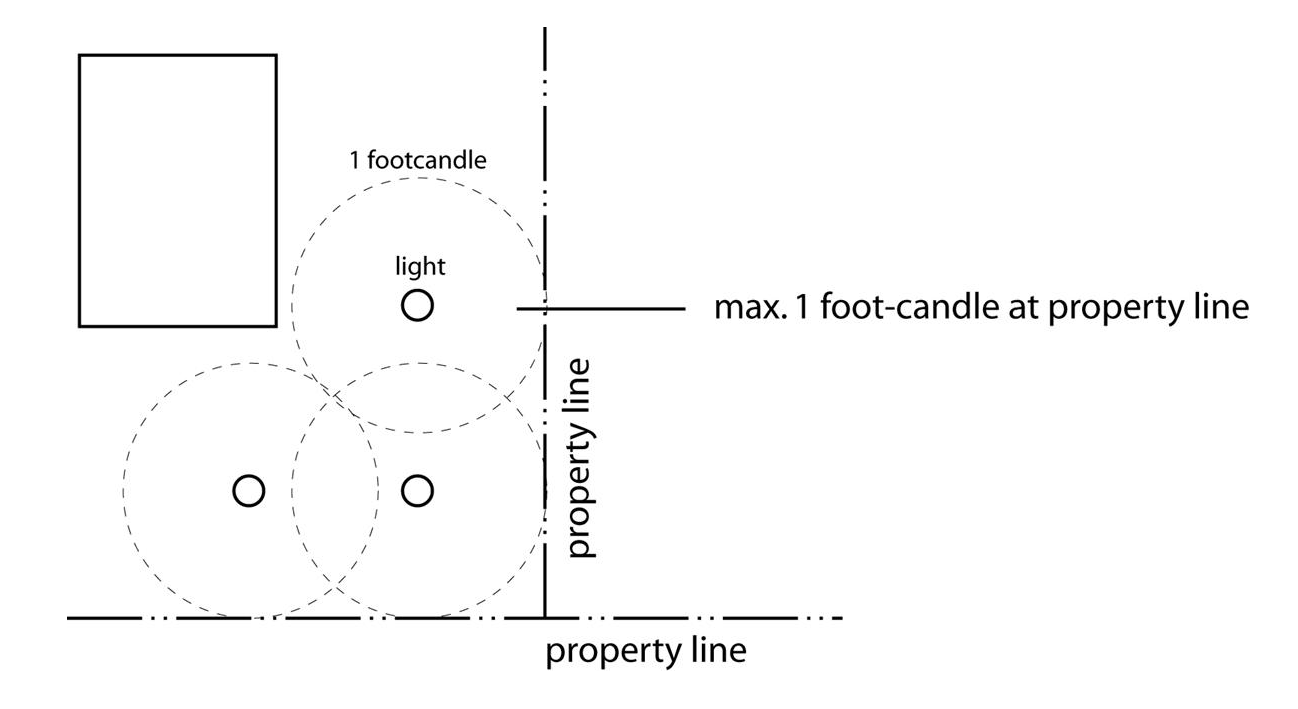
Exterior Lighting. Exterior lighting may not cause illumination in excess of one foot-candle at any property line; except that internally illuminated signs at the entrance to the landfill may exceed this standard where necessary.
(J)
Bufferyards. Bufferyards must be established and maintained in accordance with the standards of Sec. 16-10-2. Where width of the bufferyard required by Sec. 16-10-2 exceeds the setback depth required by Sec. 4-49, the bufferyard standards of Sec. 16-10-2 govern.
4-47-4
Site Development Plan Requirements. Site development plans must be at a scale appropriate to show and include the following information:
(A)
All of the information required by the "Solid Waste Management Rules" of the North Carolina Department of Human Resources, Division of Health Services, or successor agency;
(B)
Proposed access to the landfill including its location on the site, intersection with a state-maintained road, sight distances, and construction and maintenance standards;
(C)
Views from thoroughfares, residences, and other buildings enumerated in subparagraph 4-47-3(D) must be illustrated through graphics showing topographic sections in the affected areas and through photographs;
(D)
Proposed screening, where it is required in initial or subsequent phases, must be shown, and the plan must describe how these requirements will be fulfilled by specifically mentioning dimensions, varieties, timing, and other specifications;
(E)
Buffer areas must be indicated on site development plans;
(F)
Location of utilities, accessory buildings, and storage areas; and
(G)
Erosion control and final stabilization plans.
[Amended on 3/19/2012 by OA 01-12; Amended on 11/18/2024 by OA-01-24]
4-48 - Mining.
4-48-1
Findings. Extraction of mineral resources is a basic and essential industry which plays an important part in the county's economy. While mining of crushed stone is presently the most important mining activity in the county, other mineral products can become important to the economy of the county. Mining is a peculiar land use in that the location of mineral deposits will, in part, be determined only after exploration and discovery in the future. Consequently, the precise location of zoning districts wherein mining may take place cannot always be predetermined. Mineral extraction involves several methods—quarrying, open-pit, drilling, tunneling, etc.—each of which would affect a neighborhood environment differently. Therefore, the Board of Commissioners concludes that extraction of mineral resources should be encouraged; that the fundamental purposes and procedures of zoning would be served best by adoption of general regulations governing mining, which apply to all use-specific districts; that the Board of Adjustment should consider each location proposed to be mined to determine whether, and under what conditions or safeguards, they should authorize mining by the issuance of Special Use Permits.
4-48-2
General.
(A)
No mining may be commenced in the county's zoning jurisdictions until a Special Use Permit has been approved by the Board of Adjustment.
(B)
Special use approval granted by the Board of Adjustment will not become effective until a mining permit is issued by the North Carolina Department of Environment and Natural Resources, Division of Land Resources, Land Quality Section, or successor agency.
(C)
Mining may occur in any Wake County zoning district except R-80W, R-40W, WSO-2NC, WSO-3CA, WSO-3NC, and WSO-4P districts, where this use is prohibited, subject to the terms and conditions of this section and Sec. 19-23. This does not apply to the continuing operations and expansion of existing legally permitted facilities. Mining for special materials, however, may occur as a temporary special use in R-80W, R-40W, WSO-2NC, WSO-3CA, WSO-3NC, and WSO-4P districts subject to the terms and conditions of Sec. 19-23-8. To aid in the interpretation of the word "harmony" in Sec. 19-23-8(D), the following guidelines must be used:
(1)
The operation will not constitute a substantial physical hazard to a neighboring residence, school, place of religious assembly, hospital, commercial, or industrial building, public road, or public property;
(2)
The operation will not have a significantly adverse effect on the purposes of a publicly owned park, forest, or recreation area;
(3)
The operation will not have an adverse effect on public, community, or private water supplies, surface or ground waters, including, but not limited to, water supply watershed areas as designated in the Wake County Comprehensive Plan; and
(4)
A Special Use Permit will automatically expire if, at any time after its issuance, the State mining permit is revoked or terminated.
[Amended on 11/21/2022 by OA-02-22; Amended on 11/18/2024 by OA-01-24]
4-48-3
Definitions. Definitions as listed in Article 7, Section 74-49 of the General Statues of North Carolina, as amended, (North Carolina Mining Act of 1971), apply to this subsection.
4-48-4
Application Submittal Requirements. Special Use Permit applications must include two copies of all documents required by the State for a State mining permit. This must include, but not be limited to, the mining permit application, the reclamation plan, and any maps and charts accompanying these documents.
4-48-5
Traffic and Access. Mining operations must be located where roads which will provide access to such operations are constructed to NCDOT standards for the width and rated tonnage of the trucks that will be using the operation. The additional truck traffic to the site may not cause roads providing access to the site to drop to a level of service below "D" as defined by NCDOT. Ingress to and egress from the site must be along a road or driveway that intersects directly with a state-maintained road. Traffic routed to and from such intersection may not be through a residential neighborhood where the streets are primarily intended to provide access to adjacent residences.
4-48-6
Screening Standards.
(A)
Required Screening. A visual screen of at least 50 percent opacity must be established and maintained around that portion of the mining site that is being excavated or being used for the storage of minerals if required in writing by property owners adjacent to the mining site. A copy of said written request must be submitted to the permittee. Such screening is required only when such areas are visible at eye level at ground elevation, at the time of permit issuance, from State-maintained thoroughfares, publicly owned areas which have been maintained essentially in their natural state of vegetation, residences, and other buildings, but not including accessory buildings or properties adjacent to the mining site. When excavated areas have been reclaimed in accordance with the North Carolina Mining Act of 1971, as amended, and Chapter 5 of the North Carolina Administrative Code, Title 15, as amended, required artificial screening may be removed.
(B)
Exemptions. The visual screening requirements of subparagraph 4-48-6(A) may be exempted when:
(1)
The Planning Director determines that existing vegetative cover will fulfill these requirements. Such natural screening may consist of existing vegetative cover including, but not limited to, trees and shrubs having an opacity of not less than 50 percent at all seasons of the year. Screening may also consist of earthen berms or other artificial screens used individually or in combination with each other and existing vegetation to achieve a screening effect of at least 50 percent opacity during all seasons of the year. Screening materials and vegetation may be located in required buffer areas. All berms and other artificial screens requiring extensive land disturbance must comply with the Erosion and Sediment Control Ordinance; and
(2)
It is determined that, due to topographic or other circumstances where through no fault of the permittee, a 50 percent opacity cannot be provided.
4-48-7
Vibration Standards. All mining activities in the county must conform to the vibration policy adopted by the Land Quality Section of North Carolina Department of Environment and Natural Resources, or successor agency.
4-48-8
Temporary Special Uses. Temporary Special Use Permits for not more than two years may be approved subject to the requirements of this section and subsection 19-23-10 this ordinance.
4-48-9
Prior Mining Operations. Mining operations conducted in I-2 districts prior to November 17, 1980, will be allowed to continue as nonconforming uses after that date. "Mining operations," for purposes of this section, are defined as those in operation or for which an application for a mining permit has been made to the North Carolina Department of Environment and Natural Resources, or successor agency.
4-48-1
Bufferyards. Bufferyards must be established and maintained in accordance with the standards of Sec. 16-10-2. Where width of the bufferyard required by Sec. 16-10-2 exceeds the setback depth required by Sec. 4-47, the bufferyard standards of Sec. 16-10-2 govern.
[Amended on 4/20/2009 by OA 02a-09; Amended on 11/18/2024 by OA-01-24]
4-49 - Municipal Solid Waste Landfills.
4-49-1
Applicability. Municipal solid waste landfills are permitted as special uses in any zoning district in compliance with the terms and conditions of this section and the Wake County Code, except in R-80W, R-40W, WSO-2NC, WSO-3CA, WSO-3NC, and WSO-4P districts, where these uses are prohibited.
4-49-2
Approval Procedure. Municipal solid waste landfills may only be established as special uses approved in accordance with the Special Use Permit review procedures set forth in Sec. 19-23, as modified by the following:
(A)
Preliminary Site Plan. An application for a Special Use Permit for a municipal solid waste landfill must include a preliminary site plan that indicates the following: soils on the site according to the Wake County Soil Survey; location of community water supplies within 1,000 feet of the site; drainage area upstream from the property; and proposed access to the site, including the intersection with a state maintained road. The application must also include a written report that includes the following: name of person or persons responsible for operation and maintenance of the site; proposed uses of the site after closing of the operations; population and area expected to be served by the site; anticipated type, quantity, and source of material to be disposed of at the site; anticipated lifetime of the project; and any other information pertinent to the proposed use.
4-49-3
Final Site Development Plan. If the Special Use Permit application is approved, the applicant must then submit a final site development plan to the Planning Director. The final site development plan must meet the requirements of paragraph 4-49-4 and must indicate the methods by which the standards of paragraph 4-49-5 will be fulfilled, and must be consistent with the approval of the special use application and preliminary plan. It must be accompanied by evidence of approval of applicable plans and permits in accordance with State regulations. No Land Use Permit for the landfill may be issued, and no development of the landfill may begin, unless and until the Planning Director has approved the final site development plan as fully complying with the requirements of this section.
4-49-4
Site Development Plans. Site development plans must be at a scale appropriate to show and include the following information:
(A)
All of the information required by the "Solid Waste Management Rules" of the North Carolina Department of Human Resources, Division of Health Services, or successor agency;
(B)
Proposed access to the landfill including its location on the site, intersection with a State-maintained road, sight distances, and construction and maintenance standards;
(C)
Views from thoroughfares, residences, and other buildings enumerated in subparagraph 4-49-5(C) must be illustrated through graphics showing topographic sections in the affected areas and through photographs;
(D)
Proposed screening, where it is required in initial or subsequent phases, must be shown, and the plan must describe how these requirements must be fulfilled by specifically mentioning dimensions, varieties, timing, and other specifications;
(E)
Buffer areas must be indicated on site development plans;
(F)
Location of utilities, accessory buildings, and storage areas; and erosion control and final stabilization plans.
4-49-5
Siting and Location.
(A)
Traffic and Access. Ingress to and egress from the landfill must be along a road or driveway that is designed to serve only the landfill, and such road or driveway must intersect directly with a state-maintained road. Landfill traffic routed to and from such intersection may not be through a residential neighborhood where the streets are primarily intended to provide access to adjacent residences.
(B)
Buffer Area. A buffer area of undisturbed land around all sides of the landfill must be established to fulfill the following purposes: conserving the value of buildings and protecting groundwater supplies on adjacent properties; minimizing such operational effects of the landfill, including, but not limited to, noise, odor, dust, and vibrations; and protecting adjacent land uses that are particularly sensitive to the presence of a municipal solid waste landfill. A standard buffer area of undisturbed land of 50 feet must be established around all sides of the landfill. The standard buffer area may be increased where it is necessary to fulfill the purposes of buffering. Where a proposed municipal solid waste landfill is adjacent to an existing landfill that has been officially closed in accordance with appropriate governmental regulations, the required buffer area on the side adjacent to the existing landfill must be 30 feet in width.
(C)
Visual Screen. A visual screen of at least 50 percent opacity must be established around that portion of the landfill that is excavated or being filled for current operations. Such screening is required only when the excavated or filled area is visible at eye level at ground elevation from state-maintained thoroughfares, residences, and buildings, but not including accessory buildings on properties adjacent to the landfill. When in the course of landfill operations, excavated or filled areas are stabilized in accordance with the standards and specifications of the Wake County Soil Erosion and Sedimentation Control Ordinance, required artificial screening may be removed.
(D)
Existing Vegetation. Community Services may exempt the applicant from all or part of the visual screening requirements of subparagraph 4-49-5(C) when existing vegetative cover will fulfill these requirements. Such natural screening may consist of existing vegetative cover including but not limited to trees and shrubs having an opacity of not less than 50 percent at all seasons of the year. Screening may also consist of earthen berms or other artificial screens used individually or in combination with each other and existing vegetation to achieve a screening effect of at least 50 percent opacity during all seasons of the year. Screening materials and vegetation may be located in required buffer areas.
(E)
Modify Screen. The Board of Adjustment may waive or modify the screening requirements where, due to topographic conditions, screening cannot provide a 50 percent opacity screening effect.
(F)
Waive Screen. Screening requirements may be waived along those sides or portions thereof of the landfill not visible from state maintained roads where the adjacent property owner entitled to screening by this section indicates in writing to the Board of Adjustment that such screening is not necessary or desirable.
(G)
Storage Prohibited in Buffer Areas. Notwithstanding any other provision of this ordinance, no storage of vehicles or machinery and no accessory buildings are permitted within any buffer area.
(H)
Hours of Operation. The hours of operation must be limited from 7:00 a.m. to 7:00 p.m. except that the hours of operation may be extended when the Director of Wake County Department of Community Services certifies that sanitation conditions require an extension of operating hours.
(I)
Cover, Stabilize. Municipal solid waste landfills must be covered in accordance with the "Solid Waste Management Rules" of the North Carolina Department of Human Resources, Division of Health Services, or successor agency, 10 NCAC Subchapter 10G, as amended periodically. Municipal solid waste landfills must be stabilized in accordance with the standards and specifications of the Wake County Soil Erosion and Sedimentation Control Ordinance.
(J)
Exterior Lighting. Exterior lighting may not cause illumination in excess of one foot-candle at any property line; except that internally illuminated signs at the entrance to the landfill may exceed this standard where necessary.
(K)
Bufferyards. Bufferyards must be established and maintained in accordance with the standards of Sec. 16-10-2. Where width of the bufferyard required by Sec. 16-10-2 exceeds the setback depth required by Sec. 4-49, the bufferyard standards of Sec. 16-10-2 govern.
[Amended on 11/18/2024 by OA-01-24]
4-50 - Neighborhood/Convenience-Oriented Retail.
4-50-1
Intent. It is the intent of this subsection to permit within certain residential districts, other than R-80W districts, certain low-intensity retail trade, finance, and service establishments that are accessible by pedestrians from the surrounding neighborhoods, serve the daily convenience and personal service needs of the surrounding neighborhoods, and are of such a nature as to minimize conflicts with existing or potential residential uses.
4-50-2
Uses Allowed.
(A)
Retail convenience stores selling beverages, groceries, patent drugs, and gasoline, including automatic bank teller machines, and hardware stores, provided, however, that stores that sell gasoline are not allowed in R-40W districts.
(B)
Auto service and vehicular repair stations, except that they are not allowed in R-40W districts.
(C)
Neighborhood indoor retail and service trade establishments including: banks, cafes, book stores, antique shops, dry goods, and other similar indoor retail and service trade establishments, except that they are not allowed in R-40W districts.
(D)
Personal service establishments except dry cleaning operations are not allowed in R-40W districts.
4-50-3
Standards. All neighborhood/convenience-oriented retail uses, except personal service establishments, must comply with the following standards:
(A)
Floor Area. The gross floor area of any building may not exceed 15,000 square feet per building lot.
(B)
Road Access.
(1)
Access to the site must be designed and constructed in accordance with sound engineering principles and applicable standards of the North Carolina Department of Transportation.
(2)
All neighborhood/convenience-oriented retail uses, except personal service establishments, must be located on a lot that abuts a road that is included in one or more of the following classifications:
(a)
NC-numbered highways classified as "Major Collectors" on the Functional Classification System of Highways, as amended from time to time by the North Carolina Department of Transportation;
(b)
US-numbered highways classified as "Major Collectors," "Minor Arterials," or "Principal Arterials" (except "Freeways") on the Functional Classification System of Highways, as amended from time to time by the North Carolina Department of Transportation; or
(c)
State-maintained secondary roads (S.R.) that have a daily traffic volume of 1,000 vehicle trips per day according to the most recent traffic counts by North Carolina Department of Transportation, or are classified as "Major Collectors" on the Functional Classification System of Highways, as amended from time to time by the North Carolina Department of Transportation.
(3)
All personal service establishments must be located on a lot that abuts a public or private road, except that such uses may not be located on roads local access roads.
(C)
Hours of Operation. Hours of operation are limited to 7:00 a.m. to 9:00 p.m. The Board of Adjustment may permit an extension of operating hours after making a finding that such extension would not be injurious to the public health and safety of the surrounding area by reason of noise, congestion, lighting, or other aspects of the operation.
(D)
Parking. All parking associated with the proposed use must be on the premises, and all parking areas must be paved with an all-weather surface. All vehicles parked at any use must be officially registered and licensed for operation at all times.
(E)
Lot Area. The lot must have a minimum area equal to or greater than the largest minimum lot area required for a residence in any adjacent residential zoning district.
(F)
Setbacks.
(1)
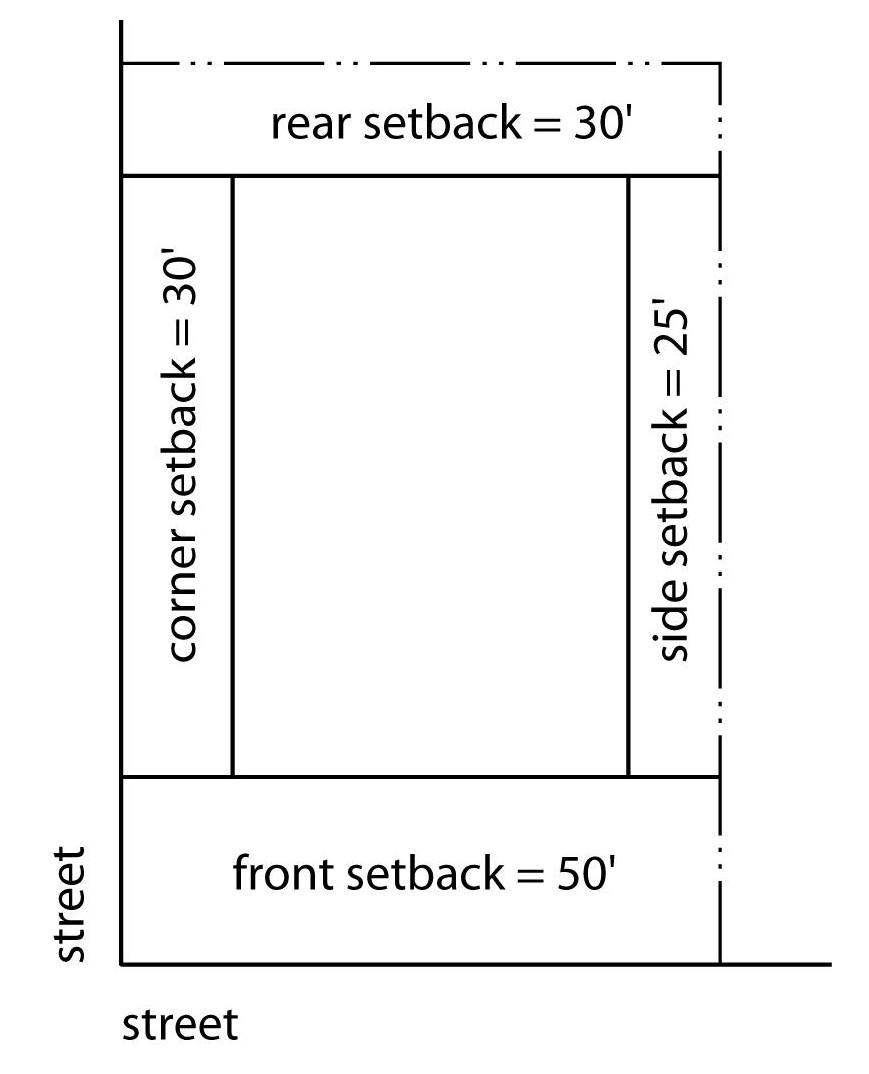
The minimum required building setbacks are as follows:
(a)
Front 50 feet;
(b)
Corner 30 feet;
(c)
Side 25 feet;
(d)
Rear 30 feet.
(2)
If the district within which the use is located requires larger yards, the use must conform to the larger lot requirements.
(3)
No required setback may be used for any use or parking.
(G)
Outside Storage. In addition to the primary facility, outside storage may be permitted subject to the following:
(1)
Type A screening/bufferyard (See 16-10-2) is established and maintained along the perimeter of the outside storage facility; and
(2)
Landscaping and bufferyards are provided in accordance with Sec. 16-10.
(3)
Refuse containers may be stored outside of the building, but they must be screened from view from any adjacent lot and maintained in a sanitary and litter-free condition.
(4)
Watershed and Watershed Overlay Districts are subject to the additional following standards:
(a)
Outdoor display shall be limited to seasonal products, including, but not limited to, live plants, pumpkins, and holiday trees, and shall be located under the main building canopy. The outdoor display area may include propane tanks.
(b)
The storage of landscaping and building products including, but not limited to, fertilizers, lime, grass seed, mulch, stone, and lumber shall be:
(i)
Inside the main building; AND/OR
(ii)
Under the main building canopy and located on an impervious surface to prevent runoff and enclosed with an opaque wall or fence in such a way that the stored materials are screened from any right-of-way, building, and adjacent lot.
(c)
The combined floor area of the main building and outdoor display/storage shall not exceed 15,000 S.F.
(H)
Exterior Lighting. All exterior lighting must be shielded or directed away from any adjacent use or lot or any adjacent public street. No exterior lighting may cause illumination in excess of one-foot candle at any lot line. After closing hours, all lighting, including signs, must be turned off except as necessary to illuminate the interior of the building for security purposes.
(I)
Landscaping and Buffers. Landscaping and bufferyards must be provided in accordance with Sec. 16-10. The Board of Adjustment is authorized to require additional landscaping and screening during the review and approval process if deemed necessary to ensure compatibility with surrounding uses and development.
(J)
Performance Standards. The use must comply with all applicable operational performance standards.
(K)
Site Maintenance. All parts of the site including parking area and setbacks must be kept free of trash and litter and maintained in good appearance and condition.
(L)
Certificates of Occupancy. No building may be occupied until a certificate of occupancy has been issued bearing the name of the chief building inspector certifying that all buildings and site improvements are in conformance with the approved site plan. In order to assure continued compliance with the terms of the Special Use Permit, the certificate must be reviewed and an inspection of the site must be made no less frequently than once every two years.
[Amended on 1/19/2021 by OA-03-20; Amended on 11/18/2024 by OA-01-24]
4-51 - Recreational Vehicle Parks.
Campgrounds and trailer parks may be for vacation or tourist use only. Trailers or campers may not be used for permanent occupancy.
[Amended on 11/18/2024 by OA-01-24]
4-52 - Security Sales and Service Businesses.
Security sales and service businesses must comply with the following standards:
4-52-1
Security sales and service businesses may not be located within a watershed area, but are permissible within multi-use districts as identified in the Wake County Comprehensive Plan, which are zoned R-80 or R-40.
[Amended on 11/21/2022 by OA-02-22]
4-52-2
The site must have a minimum size of 1.5 acres.
4-52-3
The structure cannot exceed 1,000 square feet in size and must have a residential appearance.
4-52-4
The use must comply with all relevant performance standards of Article 17.
4-52-5
The use must comply with all applicable building and fire codes.
4-52-6
The use must obtain any necessary well and/or wastewater permits from the Department of Health and Human Services.
4-52-7
Fifty-foot Type A buffers must be provided around the entire property perimeter; and
4-52-8
Buildings must comply with setback requirements of 50 feet along the front property line, 25 feet along the side property line, 30 feet along the corner and rear property lines.
[Amended on 11/18/2024 by OA-01-24}
4-53 - Sexually Oriented Businesses.
Sexually oriented businesses must comply with the following standards:
4-53-1
The site of the establishment must be located at least 2,000 feet—measured in a straight line from property line to property line—from the site of any other sexually oriented business that exists or has been permitted at the time notice of the hearing on the Special Use Permit application is provided;
4-53-2
The site of the establishment must be located at least 2,000 feet—as measured in a straight line from property line to property line—from the site of any place of religious assembly, elementary or secondary school, childcare home, childcare center, residence, other establishment with an on-premise North Carolina ABC license, or public park that exists or has been permitted at the time notice of the hearing on the Special Use Permit application is provided;
4-53-3
The site of the establishment must be located at least 1,000 feet—as measured in a straight line from property line to district boundary—from any Residential district or RMH district that exists or has been approved at the time notice of the hearing on the Special Use Permit application is provided;
4-53-4
No principal use other than the sexually oriented business may occupy the same building, structure, or property; and
4-53-5
Except for on-premise identification signs allowed under Article 15, no advertisements, displays or signs, or other promotional materials must be visible to the public from pedestrian sidewalks, walkways, driveways, or parking areas.
[Amended on 1/3/2022 by OA-03-21; Amended on 11/18/2024 by OA-01-24]
4-54 - Static Transformer Stations.
Static transformer stations, transmission lines and supporting towers, telephone exchanges, and radio and television towers and transmitting or relay stations (other than telecommunication towers) must comply with the following standards:
4-54-1
Service and storage yards are not permitted; and
4-54-2
The exterior appearance of any building or structure permitted under this section must be in keeping with the character of the neighborhood in which it is located.
4-55 - Swimming Pools and Tennis Clubs.
4-55-1
Swimming pools and tennis clubs within an open space subdivision must be located on an open space parcel reserved or dedicated for active recreation on a record plat for the open space subdivision. No direct glare from lights may be visible at any adjoining property lines.
[Amended on 11/21/2022 by OA-02-22]
4-55-2
Swimming pools and tennis clubs are allowed outside of open space subdivisions, provided no direct glare from any light source is visible at any adjacent property line.
Commentary: There may be additional regulations regarding pools in addition to zoning. The North Carolina Rules Governing Public Swimming Pools and/or the Wake County Pool Rules administered by Wake County Health and Human Services may apply when instruction or commercial activities are involved.
[Amended on 11/21/2022 by OA-02-22; Amended on 11/18/2024 by OA-01-24]
4-56 - Telecommunication Facilities.
4-56-1
General Requirements.
(A)
Collocated. Telecommunication antenna units that are attached to structures constructed for purposes other than supporting telecommunication equipment may be no taller than 30 feet or 30 percent of the structure's height. Collocated towers must comply with all relevant standards of this section.
(B)
Freestanding. Freestanding telecommunication towers must comply with the following standards:
(1)
The minimum distance between the tower and an adjoining parcel of land that is residentially developed or is vacant and zoned Residential, Residential Mobile Home or Highway District or from an adjoining local road separating the tower site from such a parcel, must be equal to the tower's height, but not less than 50 feet, nor less than the minimum setback depth applicable in the zoning district. This provision does not apply in relationship to any nonconforming residential use or the residence of a caretaker or watchman accessory to a permitted nonresidential use.
(2)
The Planning Director or the Board of Adjustment may reduce the minimum distance required above on finding that a lesser distance will not be injurious to properties or improvements in the affected area, but in no case may the minimum distance be reduced to less than that equal to 50 percent of the tower's height, or 50 feet, nor less than the minimum required setback depth applicable in the zoning district in which the tower is located. The Board of Adjustment is authorized to reduce the minimum setback distance required in this paragraph if a qualified structural engineer (licensed by the State of North Carolina) certifies in writing that any collapse of the pole will occur within a lesser distance under all foreseeable circumstances.
(3)
The minimum distance between the tower and any other adjoining parcel of land or road must be equal to the minimum setback depth applicable in the zoning district, plus any additional distance necessary to ensure that the tower, as designed, will fall within the tower site.
(4)
The distances referred to above must be measured from the outside dimensions of the tower, not from the guy anchors.
(5)
The minimum distance between two freestanding towers throughout all zoning districts shall be 1,500 feet; provided, however, that this separation requirement does not apply from a tower if the applicant submits sufficient evidence to demonstrate that a reasonable effort to co-locate on that tower has been made, or that collocation on that tower will not technically satisfy the applicant's specific needs.
(6)
If the tower is more than 100 feet high, but less than 180 feet high, it must be engineered and constructed to accommodate at least two additional telecommunication users. If the tower is 180 feet or greater in height, it must be engineered and constructed to accommodate at least three additional telecommunication users. Provision of collocation sites on other towers is encouraged wherever feasible.
(7)
The base of the tower and each guy anchor must be surrounded by a fence or wall at least eight feet high, unless the tower and all guy anchors are mounted entirely on a structure over eight feet high. Except for its entrances, the fence or wall must be screened with plant material so that no more than two-thirds of its surface is visible, within three years after its installation, from a public street or from any adjoining parcel of land that is residentially developed or is vacant and zoned Residential or Residential Mobile Homes.
(8)
A 40-foot-type C bufferyard is required along the inside perimeter of a leased lot or parcel for the utilization of telecommunication towers. Existing vegetation located inside the leased lot area may be used toward satisfying the bufferyard requirement provided that such vegetation is clearly indicated on the submitted site plan.
(9)
Radio, television, or other electromagnetic transmission or reception on other properties may not be disturbed or diminished.
(10)
The tower must meet the standards of the Federal Aviation Administration (FAA) for avoiding obstruction of navigable airspace and approaches to public airports (see Federal Aviation Regulations Part 77, as amended), and for marking and lighting structures to promote aviation safety (see FAA Advisory Circular 70/7460, as amended). Specifically, tower lighting must meet applicable FAA standards for either red obstruction lighting systems or dual lighting systems (red lighting for nighttime and medium-intensity flashing white lighting for daytime). If a tower is proposed to be located within 1,000 feet of a private use airport, the application must so indicate.
(11)
Output from the tower's antennas must meet the minimum standards of the Federal Communications Commission (FCC) relating to the environmental effects of radio frequency emissions.
4-56-2
Public Notification Process.
(A)
Purpose. Since new freestanding telecommunication towers may have impacts on nearby properties neighboring property owners should have the opportunity to learn about the proposed facility and to furnish information on the permit application.
(B)
Applicability of Notification. Any application to permit a new freestanding telecommunication facility less than 200 feet in height is subject to the following notification process. Telecommunication antenna units that are collocated on existing facilities are exempt from the notification requirement.
(C)
Notification Process.
(1)
The Planning Director shall mail a notice to all owners of property within 1,000 feet from the base of the tower.
(2)
Any permit applicant shall be responsible for supplying the Planning Director with the notification letter and postage paid envelopes addressed to property owners as noted above as part of the permit submittal process.
(3)
The Planning Director shall not render a decision on the application until 30 calendar days has elapsed following the date of the mailing of the notification letters. The 30-day notification period may be used by any interested party to discuss the proposed telecommunication facility with the permit applicant.
4-56-3
Standards for Specific Zoning Districts.
(A)
R Districts. Telecommunication towers in residential districts must comply with the following standards:
(1)
Buildings associated with the tower may not be used as an employment center for any worker (This provision does not prohibit the periodic maintenance or monitoring of equipment and instruments).
4-56-4
Decommissioning.
(A)
A decommissioning plan, signed by the party responsible for decommissioning and the landowner (if different), addressing the following items shall be submitted with initial permit application.
(1)
Defined conditions upon which decommissioning will be initiated (i.e. end of land lease, no signal being transmitted for 12 months);
(2)
Removal of all non-utility owned equipment, conduit, structures, fencing, roads and foundations;
(3)
Proper disposal of all materials from the site in accordance with local, state, and federal regulations.
(4)
Restoration of property to condition prior to development of the telecommunication facility including stabilization or re-vegetation of the site as necessary to minimize erosion;
(5)
The timeframe for completion of decommissioning activities;
(6)
Description of any agreement (i.e. lease) with landowner regarding decommissioning;
(7)
The party currently responsible for decommissioning; and
(8)
Plans for updating this decommissioning plan.
(B)
Before all required final inspections, provide evidence that the decommissioning plan has been recorded with the Register of Deeds.
[Added on 3/7/2016 by OA 07-15; Added on 2/2/2015 by OA 04-14; Amended on 3/7/2016 by OA 01-15; Amended on 1/22/2008 by OA 04-07; Amended on 4/20/2009 by OA 02b-09; Amended on 1/3/2022 by OA-03-21]
4-57 - Wildlife and Game Preserves.
Wildlife and game preserves must comply with the following standards:
4-57-1
No hunting is permitted within any required setback;
4-57-2
Fencing, warning signs, or other safety devices must be adequately provided and maintained; and
4-57-3
Hunting with rifles is prohibited.
4-58 - Special Events.
4-58-1
General Requirements:
(A)
Special Events are limited to no more than six events per calendar year per parcel. In no case may the cumulative total exceed 30 days per calendar year.
(B)
A Land Use Permit will be required prior to each special event.
(C)
The applicant must provide an original, signed letter from the landowner granting permission for the proposed event and acknowledging the landowner's liability for violations of this ordinance.
(D)
The applicant must provide a signed agreement or contract for provision of on-site sanitary facilities.
(E)
The applicant must provide a site plan showing: structures, adequate parking areas, lighting, speakers/amplified sound equipment, septic area, and noting the type of event(s) and duration of the event(s) and hours of operation.
(F)
The operator must obtain all other required permits applicable to the activity, such as septic permits.
(G)
No buildings, structures and parking associated with the special event shall be permitted in the building setback.
(H)
Parking and event-related activities must be located outside the public right-of-way and buffers.
(I)
Site must be restored to its previous condition within seven days after the conclusion of the special event.
(J)
Special use approval may authorize a Special Event for a period of no more than two years.
[Amended on 4/6/2009 by OA 01-09; Amended on 11/18/2024 by OA-01-24]
4-59 - Elimination and Redevelopment of Nonconforming Use.
4-59-1
Intent. It is the intent of this subsection to facilitate elimination and redevelopment of certain nonconforming uses (as defined in subsection 7-12-1 of this ordinance) and associated nonconforming development features within the R-40W Zoning District under conditions that result in conformity with the provisions of this UDO, reduce nutrients in runoff, and otherwise improve water quality.
4-59-2
Uses Allowed.
(A)
Those uses included in the Residential Use Group (as defined in subsection 4-21 et seq. of this ordinance) with the exception of Condominium or apartment, manufactured home subdivision/park, and Upper-story residence.
(B)
Those uses included in the Public and Civic Use Group (as defined in subsection 4-22 et seq. of this ordinance) with the exception of Colleges and Universities, Detention and Correctional Facilities, Hospitals, and Lodge or Private Club.
(C)
Those uses included in the Commercial Use Group (as defined in subsection 4-23 et seq. of this ordinance) with the exception of Bars and Nightclubs; Pawn Shop, payday loan; Kennel, commercial; Kennel, private; Funeral and Interment Service; Gas Station, or any other business engaged in the sale of gasoline; Hotel/motel; manufactured home sales; Sexually Oriented Business; and Vehicle Sales and Service. A use within the Commercial Use Group shall not be allowed, however, unless a use within the Commercial or Industrial Use Groups existed prior to redevelopment within the area subject to the Special Use Permit authorizing redevelopment.
4-59-3
Standards. All uses authorized under this Section 4-59 must comply with the following standards:
(A)
Location of Commercial Uses Limited. All uses included within the Commercial Use Group (as defined in subsection 4-23 et seq. of this ordinance) authorized under this 4-59 must be located within a multi-use district designated in the Wake County Comprehensive Plan. Subject to approval by the Board of Adjustment, open space, utility lines, wastewater systems, and stormwater detention, retention and treatment facilities associated with any such use may extend beyond the boundaries of a multi-use district.
(B)
Compliance with Watershed and Stormwater Regulations. Following redevelopment, the property subject to the Special Use Permit authorizing redevelopment under this Section shall meet or exceed the impervious surface and other standards of the Wake County Watershed and Stormwater Regulations applicable to the watershed in which such property is located.
Commentary: By way of example, redevelopment pursuant to this Section 4-59 in the Falls Lake Watershed must provide stormwater management devices if impervious surface exceeds 12 percent of the area subject to the Special Use Permit, and impervious surface cannot exceed 24 percent of such area.
(C)
Stormwater Management. Any nonresidential development under this Section shall provide stormwater controls that obtain a minimum of 60 percent reduction in post-construction nitrogen loading rate and 60 percent reduction in post-construction phosphorous loading rate on-site. This requirement shall remain effective until permanent rules adopted by the North Carolina Environmental Management Commission take effect that apply to the watershed in which development under this Section 4-59 occurs and impose an equivalent or more restrictive nutrient management strategy with respect to redevelopment.
Commentary: These requirements reflect the on-site standards for the reduction of nitrogen and phosphorous set forth in the Draft Rules for the Falls Lake Watershed issued on March 1, 2010 by the Division of Water Quality of the North Carolina Department of the Environment and Natural Resources. The nutrient reduction standards of this subsection (C) apply to the redevelopment of nonconforming uses pursuant to this Section 4-59 in R-40W Districts throughout the County. They remain in effect for each respective watershed until EMC approved rules for redevelopment that are equivalent or more restrictive take effect for that watershed.
(D)
Floor Area; Area Subject to Special Use Permit.
(1)
The gross floor area of any building or buildings and the area subject to the Special Use Permit authorizing redevelopment under this Section 4-59 shall be determined by the Board of Adjustment in its approval of the Special Use Permit. The gross floor area of the building or buildings approved in such Special Use Permit shall not exceed 85 percent of the gross floor area of all buildings existing prior to redevelopment upon the property subject to the Special Use Permit.
(2)
Elimination and redevelopment of a nonconforming use and associated nonconforming development features hereunder must result in a reduction of at least 20 percent in the area of impervious surface which existed prior to redevelopment.
(E)
Road Access.
(1)
Access to the site must be designated and constructed in accordance with sound engineering principles and applicable standards of the North Carolina Department of Transportation.
(2)
All buildings must be located on a lot that abuts a road that is included in one or more of the following classifications:
(a)
NC-numbered highways classified as "Major Collectors" on the Functional Classification System of Highways, as amended from time to time by the North Carolina Department of Transportation;
(b)
US-numbered highways classified as "Major Collectors," "Minor Arterials," or "Principal Arterials" (except "Freeways") on the Functional Classification System of Highways, as amended from time to time by the North Carolina Department of Transportation; or
(c)
State-maintained secondary roads (S.R.) that have a daily traffic volume of 1,000 vehicle trips per day according to the most recent traffic counts by North Carolina Department of Transportation, or are classified as "Major Collectors" on the Functional Classification System of Highways, as amended from time to time by the North Carolina Department of Transportation.
(F)
Parking. All parking associated with the proposed use must be on the parcel, and all parking areas must be paved with an all-weather surface. When approved by the Board of Adjustment as part of a development with commonly utilized parking areas, parking associated with the proposed use also may be on an adjacent parcel or lot. All vehicles parked at any use must be officially registered and licensed for operation at all times.
(G)
Setbacks. The minimum required building setbacks are as follows:
(a)
Front 30 feet;
(b)
Corner 30 feet;
(c)
Side 15 feet;
(d)
Rear 30 feet.
If approved by the Board of Adjustment, sidewalks and signage may be allowed in a setback.
(H)
Outside Storage. In addition to the primary facility, outside storage may be permitted on a lot when it is determined by the Board of Adjustment to be necessary to the use permitted, provided that:
(1)
Type A screening/bufferyard (See 16-10-2) is established and maintained along the perimeter of the outside storage facility;
(2)
Landscaping and bufferyards are provided in accordance with Sec. 16-10; and
(3)
Refuse containers may be stored outside of the building, but they must be screened from view from any adjacent lot as provided in Sec. 16-11 and maintained in a sanitary and litter-free condition.
(I)
Exterior Lighting. All exterior lighting must be shielded or directed away from any adjacent use or lot or any adjacent public street. No exterior lighting may cause illumination in excess of one-foot candle at any lot line. After closing hours, all lighting, including signs, must be turned off except as necessary to illuminate the premises for security purposes.
(J)
Landscaping and Buffers. Landscaping and bufferyards must be provided in accordance with Sec. 16-10. The Board of Adjustment is authorized to require additional landscaping and screening during the review and approval process if deemed necessary to ensure compatibility with surrounding uses and development.
(K)
Performance Standards; Regulations. The use must comply with all applicable operational performance standards. The regulations and standards provided in this Section 4-59 shall be applicable to redevelopments and uses subject thereto notwithstanding any other provision of this UDO, including, but not limited to, subsection 1-19-2.
(L)
Site Maintenance. All parts of the site including parking area and setbacks must be kept free of trash and litter and maintained in good appearance and condition.
(M)
Certificates of Occupancy. No building may be occupied until a certificate of occupancy has been issued bearing the name of the chief building inspector certifying that all buildings and site improvements are in conformance with the approved site plan. In order to assure continued compliance with the terms of the Special Use Permit, the certificate must be reviewed and an inspection of the site must be made no less frequently than once every two years.
(N)
Signs. The number, type, height, and size of signs upon a site redeveloped pursuant to this Section 4-59 shall be determined by the Board of Adjustment in its approval of the Special Use Permit authorizing redevelopment of the site.
(O)
Wastewater Treatment. Redevelopment pursuant to this Section 4-59 shall not utilize any system for the treatment of wastewater that involves the spray of effluent on the surface of the ground.
[Amended on 4/5/2010 by OA 03-09]; Amended on 11/21/2022 by OA-02-22; Amended on 11/18/2024 by OA-01-24]
4-60 - Parking, Park and Ride.
4-60-1
General Requirements. Parking spaces must be located outside of the public right-of-way and all required setbacks of the zoning district in which the use is located.
Commentary: It is the intent of these standards to minimize conflict in residential areas. Park and Ride lots should generally have frontage on and be accessed by thoroughfares as designated by the Wake County Transportation Plan. However, the Board of Adjustment may approve site-specific development plans subject to Section 19-23.
[Added on 3/21/2011 by OA 01-10]
4-61 - Alternative Energy Systems.
4-61-1
Solar Energy Systems.
(A)
Intent. It is the intent of this subsection to provide the opportunity for solar energy to serve as a viable form of energy generation while protecting public health, safety and general welfare. All regulations in this ordinance shall apply unless otherwise expressly stated in the standards below.
(B)
Standards for Solar Energy Systems. The following supplemental standards apply to Solar Energy Systems:
(1)
Aviation Notification: Solar energy systems (SES) of more than one-half acre in panel area, as measured around the perimeter of the panels, and which are located within five miles of a public use airport must provide notification to airport operations.
(a)
Before issuance of any permits, the applicant shall submit a copy of the FAA airspace determination letter confirming the proposal does not pose a hazard to flight navigation.
Commentary: The notification form for Obstruction Evaluation / Airport Airspace Analysis (OE/AAA) is available on the Federal Aviation Administration website.
(2)
Decommissioning.
(a)
A decommissioning plan, signed by the party responsible for decommissioning and the landowner (if different), addressing the following items shall be submitted with permit application.
i.
Defined conditions upon which decommissioning will be initiated (i.e. end of land lease, no power production for 12 months);
ii.
Removal of all non-utility owned equipment, conduit, structures, fencing, roads and foundations;
iii.
Proper disposal of all materials from the site in accordance with local, state, and federal regulations.
iv.
Restoration of property to condition prior to development of the SES including stabilization or re-vegetation of the site as necessary to minimize erosion;
v.
The timeframe for completion of decommissioning activities;
vi.
Description of any agreement (i.e. lease) with landowner regarding decommissioning;
vii.
The party currently responsible for decommissioning; and
viii.
Plans for updating this decommissioning plan.
(b)
Before all required final inspections, provide evidence that the decommissioning plan has been recorded with the Register of Deeds.
[Amended on 10/6/2014 by OA 03-14]
4-62 - Farmers Market.
4-62-1
Farmers Market.
(A)
Intent. It is the intent of this subsection to provide the opportunity for farmers markets to provide increased access to healthy, local food for all communities while protecting public health, safety and general welfare. All regulations in this ordinance shall apply unless otherwise expressly stated in the standards below.
(B)
Standards for Farmers Market. The following supplemental standards apply to Farmers Markets:
(1)
Accessory structures such as storage or utility buildings, trellises, greenhouses, and composting shall be permitted subject to compliance with the requirements of the zoning district.
(2)
Any structure shall be located at minimum ten feet from any property line.
(3)
Hours of Operation are limited to 7:00 a.m. to 9:00 p.m.
(4)
Farmers Markets need to meet all setbacks of the underlying zoning district.
(5)
Farmers Markets must have contact information including name and telephone of market operator or manager posted on site.
(6)
Parking and Loading notwithstanding any other provisions or standards contained in this ordinance, parking areas of sufficient size to provide parking for patrons, customers, suppliers, visitors, and employees shall be provided on the premise of each use. Loading areas for supplies and services shall be sufficient to meet requirements of each use. Documentation must be provided at each location even when using shared parking.
(7)
Farmers Markets shall be limited to no more than three days a week.
(8)
Road Access.
(a)
Must be located on a lot that abuts a private or public road that is included in one or more of the following classifications unless on a site with an existing permitted non-residential use:
i.
NC-numbered highways classified as "Major Collectors" on the Functional Classifications System of Highways, as amended from time to time by the North Carolina Department of Transportation;
ii.
US-numbered highways classified as "Major Collectors," "Minor Arterials," or "Principal Arterials" (except "Freeways") on the Functional Classification System of Highways, as amended from time to time by the North Carolina Department of Transportation; or
iii.
State-maintained secondary roads (S.R.) that have a daily traffic volume of 1,000 vehicle trips per day according to the most recent traffic counts by North Carolina Department of Transportation, or are classified as "Major Collectors" on the Functional Classification System of Highways, as amended from time to time by the North Carolina Department of Transportation.
4-62-2
Farmers Market as part of Public-Civic Use Group.
(A)
Intent. It is the intent of this subsection to provide the opportunity for farmers markets to provide Increase access to healthy, local food for all communities while protecting public health, safety and general welfare. All regulations in this ordinance shall apply unless otherwise expressly stated in the standards below.
(B)
Standards for Farmers Market as part of Public-Civic Use Group. The following supplemental standards apply to Farmers Markets as part of Public-Civic Use Group:
(1)
Accessory structures such as storage or utility buildings, trellises, greenhouses, and composting shall be permitted subject to compliance with the requirements of the zoning district.
(2)
Any structure shall be located at minimum ten feet from any property line.
(3)
Hours of Operation are limited to 7:00 a.m. to 9:00 p.m.
(4)
Farmers Markets need to meet all setbacks of the underlying zoning district.
(5)
Farmers Markets must have contact information including name and telephone of market operator or manager posted on site.
(6)
Parking and Loading notwithstanding any other provisions or standards contained in this ordinance, parking areas of sufficient size to provide parking for patrons, customers, suppliers, visitors, and employees shall be provided on the premise of each use. Loading areas for supplies and services shall be sufficient to meet requirements of each use. Documentation must be provided at each location even when using shared parking.
(7)
Farmers Markets shall be limited to no more than three days a week.
[Added on 1/17/2017 by OA 02-16]
4-63 - Local Agricultural Market.
4-63-1
Local Agricultural Market.
(A)
Intent. It is the intent of this subsection to provide the opportunity for individuals, group, businesses, and farmers to increase access to healthy, local food for all communities while protecting public health, safety and general welfare. All regulations in this ordinance shall apply unless otherwise expressly stated in the standards below.
(B)
Standards for Local Agricultural Market. The following supplemental standards apply to Local Agricultural Markets:
(1)
Any structure shall be located at minimum ten feet from any property line.
(2)
Sales of agricultural products not grown or produced on site should take up no more than 25 percent of the Local Agricultural Market retail area or not to exceed 500 sq. ft. Hours of Operation are limited to 7:00 a.m. to 9:00 p.m.
(3)
Local Agricultural Markets need to meet all setbacks of the underlying zoning district.
(4)
Road Access.
(a)
Must be located on a lot that abuts a private road or a public road that is included in one or more of the following classifications:
i.
NC-numbered highways classified as "Major Collectors" on the Functional Classifications System of Highways, as amended from time to time by the North Carolina Department of Transportation;
ii.
US-numbered highways classified as "Major Collectors," "Minor Arterials," or "Principal Arterials" (except "Freeways") on the Functional Classification System of Highways, as amended from time to time by the North Carolina Department of Transportation; or
iii.
State-maintained secondary roads (S.R.) that have a daily traffic volume of 1,000 vehicle trips per day according to the most recent traffic counts by North Carolina Department of Transportation, or are classified as "Major Collectors" on the Functional Classification System of Highways, as amended from time to time by the North Carolina Department of Transportation.
[Added on 1/17/2017 by OA 02-16]
4-64 - Tobacco and Hemp Retail.
4-64-1
Tobacco and Hemp Retail must comply with the following standards:
(A)
The site of the establishment must be located at least 1,000 feet—measured in a straight line from property line to property line—from the site of any other Tobacco and Hemp Retail establishment that exists or has been permitted.
(B)
The site of the establishment must be located at least 1,000 feet—as measured in a straight line from property line to property line—from any of the following use types: elementary, middle, or high school, public park, greenway, or residence.
(C)
There shall not be more than one use subject to these standards on the same property or in the same building, structure, or portion thereof.
[Added on 10/16/23 by OA-02-23; Amended on 11/18/2024 by OA-01-24]
4-65 - Event Venue.
4-65-1
Event Venue Standards.
(A)
Hours of Operation. Events may take place between the hours of 7:00 a.m. and 11:00 p.m. Set up or break down may take place outside of these hours.
(B)
Parking. Paved or graveled parking areas of sufficient size to provide parking spaces on the premises for all persons using the premises must be provided. There may be no parking in any required setback. Parking areas must be designated and marked as such by curbs, borders, walls, or fences, and must be well drained and continuously maintained.
(C)
Storage. Outside storage is not permitted within any required setback. Storage areas must be screened or located where they will not be seen from any adjoining property.
(D)
Utilities. Approval of water supply and sewage disposal plans by the county or state agencies having jurisdiction is required before issuance of use or building permits.
(E)
Lighting. All exterior lighting must be shielded or directed away from any adjacent use or lot or any adjacent public street. No exterior lighting may cause illumination in excess of one-foot candle at any lot line. After closing hours, all lighting, including signs, must be turned off except as necessary to illuminate the interior of the building for security purposes.
[Added on 11/18/2024 by OA-01-24]
4-66 - Youth Care Homes.
Youth Care Homes are permitted, provided no proposed youth care home will be located within a one-half mile radius of an existing family care home, group home, youth care home, or other such care facility.
[Adopted on 10/20/2025 by Res. No. OA-04-25]
4-70 - General.
4-70-1
Accessory Buildings and Structures. The accessory building and structures regulations of this subsection (4-70-1) apply to all accessory buildings and structures other than fences and signs. Accessory buildings are subject to the same standards as apply to main buildings except as expressly stated in this ordinance.
(A)
No accessory building or structure may be established on a lot prior to the issuance of all necessary permits and approvals for the main building on the lot.
(B)
No more than three accessory buildings may be located on a single lot in a residential district.
(C)
In all districts, the total floor area of all accessory buildings combined may not exceed the total floor area of the main building.
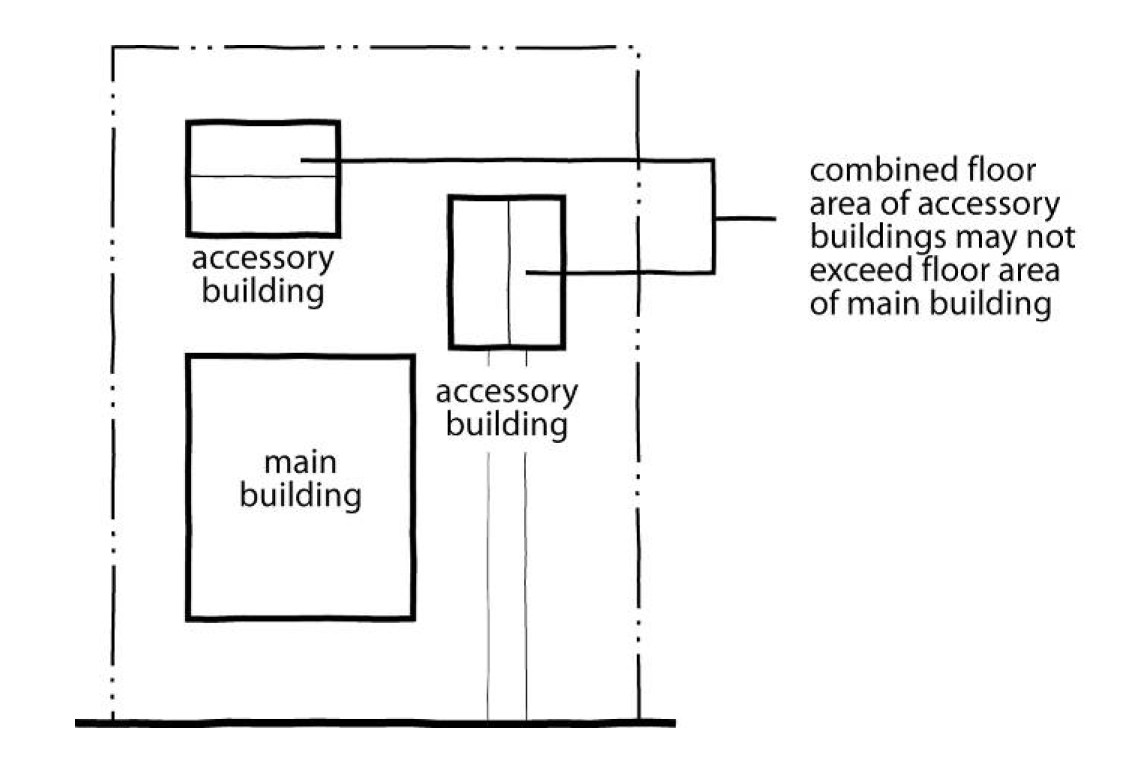
(D)
Accessory buildings and structures must be set back at least five feet from any side or rear lot line.
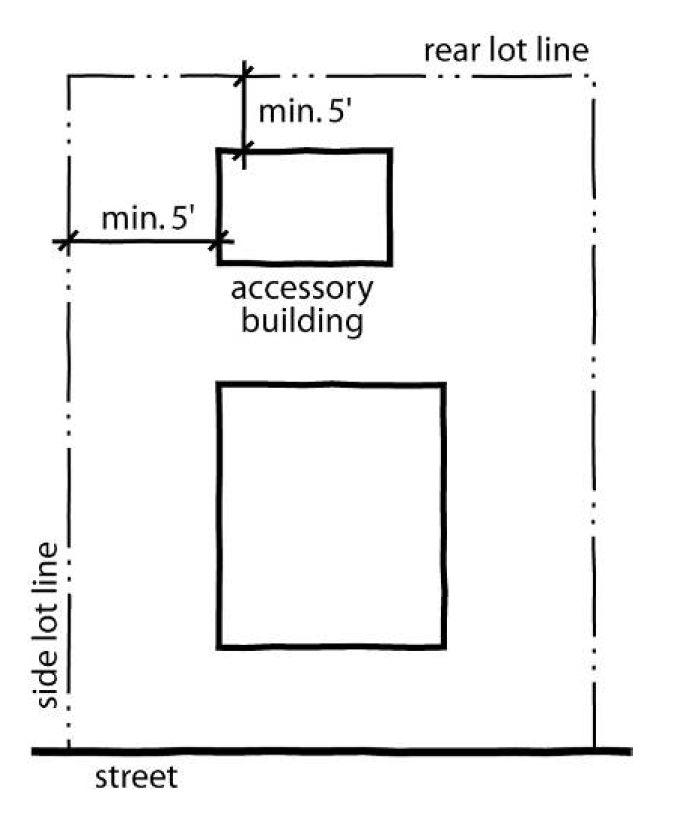
(E)
Accessory buildings and structures may not exceed the height of the main building or 24 feet in height, whichever is greater. Accessory buildings and structures located within ten feet of the lot line of property in a residential district may not exceed 15 feet or one story in height.
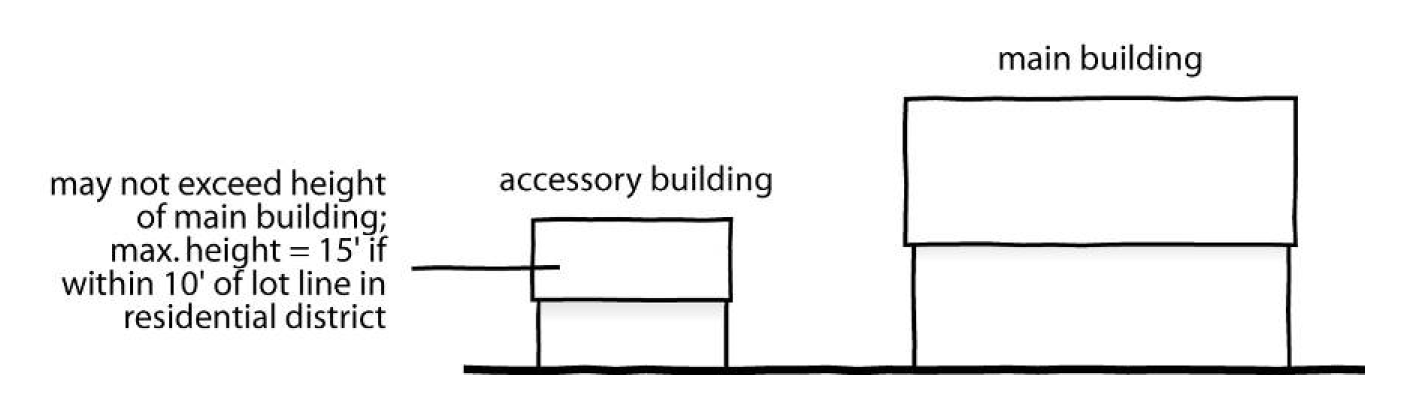
(F)
Accessory buildings and structures may not be located nearer the street than the main building or 50 feet whichever is less.
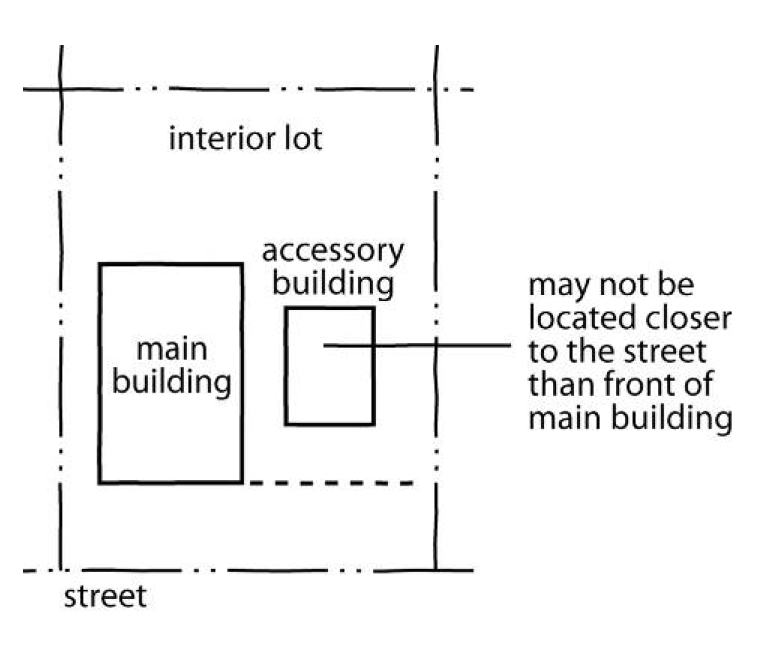
(G)
Accessory Buildings shall be considered a part of the principal building when the distance between buildings is covered solidly with a roof, using a breezeway, portico, or similar architectural device at least five feet in width and no longer than 15 feet.
(H)
Accessory solar energy systems shall be classified as:
(1)
Roof-mounted system on any code-compliant structure.
(2)
Building integrated solar (i.e. shingle, window).
(3)
Ground-mounted system or system covering permanent surface parking lot or other surface hardscape areas whose total panel area, as measured around the perimeter of the panel array, shall not exceed 30 percent of the footprint of the principal structure or one acre in panel area.
4-70-2
Accessory Dwelling Units. A second dwelling unit that is subordinate to the principal dwelling that is either (1) located within the principal dwelling, including an addition to the principal dwelling, or (2) is located in an accessory building on the same lot as the principal dwelling unit. An accessory dwelling unit is a complete, independent living facility equipped with a kitchen and with provisions for sanitation and sleeping. An accessory dwelling unit shall not exceed more than 50 percent of the gross floor area of the principal dwelling unit.
(A)
Only one accessory dwelling unit shall be permitted per lot.
(B)
A manufactured home is only permitted as an accessory dwelling unit on lots with a minimum of ten acres.
(C)
The accessory dwelling unit shall not be served by a separate driveway from that of the principal dwelling.
(D)
The accessory dwelling unit shall have at least one off-street parking space in addition to that required for the principal dwelling.
4-70-3
Accessory Uses. The accessory use regulations of this subsection (4-70-3) apply to all accessory uses.
(A)
Unless otherwise expressly stated, accessory uses are allowed in connection with any lawfully established general or special use.
(B)
Accessory uses may not be established on a lot prior to the issuance of all necessary permits and approvals for the general or special use on the lot. Accessory structures shall not be constructed prior to the main building.
[Amended on 6/4/2012 by OA 02-12; Amended on 10/6/2014 by OA 03-14; Amended on 9/15/2014 by OA 04-13]
4-71 - Standards for Specific Zoning Districts.
4-71-1
RA District. Notwithstanding the general provisions of Sec. Article 4, maintenance and support uses permitted in paragraph 3-51-2(C) are permitted on any portion of a lot except within any required setback areas, and those structures allowed within required setback areas by Sec. 3-51-4(D) are permitted on any portion of the lot.
4-71-2
GB District.
(A)
Buildings and uses customarily accessory to an authorized use, when located on the same lot, are permitted.
(B)
Manufacturing for sale at retail and repair facilities incidental to principal use, when conducted entirely within a building.
4-71-3
HC District.
(A)
Buildings and uses customarily accessory to an authorized use, when located on the same lot, are permitted.
(B)
Manufacturing for sale at retail and repair facilities incidental to a principal use.
4-71-4
I District. Within any Industrial district, buildings and uses of land customarily accessory to the principal land use are permitted. Accessory buildings and structures may not be located in any required front, side, or rear setback.
4-72 - Home Occupations.
4-72-1
General.
(A)
Home occupations must be clearly incidental and secondary to the use of the property for residential purposes.
(B)
Home occupations must be conducted without any significant adverse impact on the surrounding neighborhood.
(C)
Home occupations may not create any objectionable traffic, noise, fumes, odor, dust, or electrical interference.
(D)
For the purpose of this ordinance, remote work is not considered a home occupation.
(E)
The operator must obtain all other required permits applicable to the activity, such as septic permits.
Commentary: Many homeowner's associations impose private restrictions on home-based business activities. Individuals interested in starting a home occupation should contact their respective homeowner's association to inquire about additional limitations.
4-72-2
Allowed Uses. Allowed home occupations include, but are not limited to:
(A)
Dressmaking, sewing and tailoring;
(B)
Painting, sculpturing, photographer and writing;
(C)
Telephone answering service;
(D)
Home crafts, such as weaving, potting and canning;
(E)
Computer programming;
(F)
Teaching or tutoring of no more than four students at one time;
(G)
Barbershops and beauty parlors;
(H)
Tax consultant, real estate agent;
(I)
Lawyers, engineers, architects, accountants, bookkeepers, consultants or like professions; and
(J)
Catering.
4-72-3
Permits. A Land Use Permit, which is issued administratively by the Planning staff, is required prior to commencing any home occupation.
4-72-4
Standards. Home occupations are subject to all of the following standards and limitations:
(A)
No more than one person may be employed in the business who is not a permanent, full-time resident of the subject dwelling unit.
(B)
Outdoor storage is prohibited.
(C)
On-premise retail sales are prohibited. Customers are not permitted to come to the home to purchase goods.
(D)
Displays of goods, materials, equipment, or other commodities may not be visible from the street or from any abutting lot.
(E)
Home occupations may not exceed 50 percent of the floor area of the dwelling or 750 square feet, whichever is less.
Commentary: North Carolina building code may impose more stringent limits upon the allowable square footage of home-based business activities.
(F)
Vehicles used in conjunction with a home occupation may be no larger than a standard pick-up truck or sports utility vehicle (light duty class 3 size per FHWA truck classification). No more than two such vehicles may be parked at the site of a home occupation.
(G)
A maximum of one wall or ground sign is allowed. Such sign:
(1)
May not exceed four square feet in area per side;
(2)
May be no higher than eight feet above grade if wall-mounted or four feet above grade if ground-mounted or freestanding;
(3)
May not exceed ten feet in width;
(4)
May not be located in the right-of-way; and
(5)
May not be illuminated.
(H)
When home occupations are conducted in accessory buildings, a floor plan and site plan showing the dimensions and location of the accessory building in relation to the main building and property lines must be submitted with the application.
[Amended on 4/21/2014 by OA 06-12; Amended on 11/18/2024 by OA-01-24]
4-73 - Licensed Amateur Radio Antennas.
4-73-1
FCC License.
(A)
The applicant must be the holder of a valid FCC amateur operator's license.
(B)
Antennas must comply with all applicable federal regulations, including those governing height, location and RF emissions. In the event of a conflict between federal law and the provisions of this section, federal law will govern.
4-73-2
Number. Not more than one ground-mounted antenna support structure for a licensed amateur radio antenna are permitted on each site, except that a second ground-mounted antenna support structure for a licensed amateur radio antenna may be allowed on sites of more than one acre in area if approved as a special use.
4-73-3
Location Requirements. Except as otherwise specified herein, antenna support structures may be roof- or ground-mounted, free-standing or supported by guy wires, buildings or other structures. A support structure will be considered ground-mounted if its base is mounted directly in the ground, even if the structure is supported by or attached to the wall of a building. All antennas and support structures must be located on a site in accordance with the following standards:
(A)
No antenna or support structure may be located within any required setback, except that guy wires and antenna arrays may extend into a required side or rear setback but may not extend over property lines or street lines;
(B)
No antenna support structure may be located closer to any property line or street line than a distance equal to one-half of the height of the antenna support structure; and
(C)
Ground-mounted antenna support structures must be located to the rear of the main building on the site, unless otherwise approved by the County based upon a finding that the alternative location will more effectively reduce the visual impact of the antenna and its support structure upon adjacent properties and public rights-of-way.
4-73-4
Height. Antenna height means the overall vertical length of the antenna support structure and the antenna mounted thereon, including any length to which the antenna support structure is capable of being raised, as measured from the peak of the roof with respect to a roof-mounted antenna, or from the natural grade or finished grade, whichever is lower, with respect to a ground-mounted antenna. All antennas must comply with the following height restrictions:
(A)
Roof-mounted antennas may not exceed 15 feet in height above the peak of the roof, except that a single vertical pole or whip antenna which is not supported by guy wires may be erected to a height of 30 feet above the peak of the roof; and
(B)
Ground-mounted antennas may be erected to a maximum height of 65 feet.
4-73-5
Installation. Every antenna and its support structure must be constructed, installed and maintained in accordance with the manufacturer's specifications, in compliance with building and electrical codes and in accordance with the following additional requirements:
(A)
The antenna support structure must be of noncombustible and corrosive-resistant material;
(B)
Whenever it is necessary to install an antenna near exposed utility lines, or where any property damage would be caused by the falling of the antenna support structure, a separate guy wire must be attached to the antenna or the support structure and secured in a direction opposite the potential hazard. Exposed antenna transmission lines and guy wires must be kept at a distance of at least six feet from any exposed utility lines; and
(C)
The antenna must be adequately grounded for protection against a direct strike of lightning.
4-73-6
Mitigation of Visual Impact. Antennas and their support structures, including guy wires and accessory equipment, must be located on the site and screened as much as possible by architectural features, fences or landscaping to minimize the visual impact of the antenna and its support structures upon adjacent properties and public rights-of-way. The materials used in constructing the antenna and its support structures may not be unnecessarily bright, shiny or reflective. Conditions may be imposed upon the issuance of a building or use permit to mitigate the anticipated visual impact of the proposed antenna installation.
4-74 - Short-Term Rentals.
Short-term rentals are permitted subject to the following standards:
4-74-1
No substantial changes may be made to the exterior appearance of the structure or to the site that would alter the property's residential character;
4-74-2
Guest stays are limited to 30 consecutive days; and
4-74-3
Meals may be provided to overnight guests only, and no cooking facilities may be provided in guest rooms.
[Amended on 4/21/2025 by OA-02-25]
4-80 - Modular Sales Office.
A modular sales office is permitted as a temporary use in a subdivision, or an approved phase thereof, for four years beginning at the time of occupancy, and may be renewed every four years, provided that:
4-80-1
Underskirting is installed around the entire modular sales office;
4-80-2
The modular sales office is located on an approved lot, as shown on both preliminary and record plats, serving that subdivision only, and must conform to applicable setback requirements;
4-80-3
One off-street parking space is required for each employee plus two additional spaces for visitors, and all parking areas are paved with an all-weather surface and kept free of trash and litter and maintained in good appearance and condition;
4-80-4
Signs meet the requirements of Article 18; and
4-80-5
Landscaping is provided, meeting or exceeding the following requirements:
(A)
Existing vegetation will be retained whenever possible;
(B)
A minimum of two canopy trees and 12 shrubs, in accordance with the requirements of Sec. 16-10-3(B), must be planted;
(C)
Existing vegetation that remains on the lot must be included in the count of minimum lot landscaping; and
(D)
No less than 50 percent of the minimum landscaping must be visible from the front of the lot.
4-80-6
Approval is obtained from Department of Health and Human Services for any water and/or wastewater system.
4-80-7
The use of a temporary wastewater holding tank is allowed only when a lavatory and water closet are utilized and such use is conducted in accordance with the provisions of N.C.G.S. 130A-291.2.
[Amended on 6/4/2012 by OA 02-12; Amended on 11/18/2024 by OA-01-24]
4-81 - Temporary Contractors Office.
A temporary contractors' office and/or construction sheds are permitted as a temporary use during construction period only while building permits are valid, provided that:
4-81-1
The contractor's office and/or construction sheds are located on an approved lot, serving that development only, and must conform to applicable setback requirements;
4-81-2
Underskirting is installed around the entire temporary contractors' office;
4-81-3
One off-street parking space is required for each employee plus two additional spaces for visitors, and all parking areas are paved with an all-weather surface and kept free of trash and litter and maintained in good appearance and condition;
4-81-4
Signs meet the requirements of Article 18; and
4-81-5
Existing trees and vegetation will be retained whenever possible to buffer adjacent properties and rights-of-way.
4-81-6
Approval is obtained from Department of Health and Human Services for any water and/or wastewater system.
4-81-7
The use of a temporary wastewater holding tank is allowed only when a lavatory and water closet are utilized and such use is conducted in accordance with the provisions of N.C.G.S. 130A-291.2.
[Amended on 7/21/2008 by OA 05-08; Amended on 11/18/2024 by OA-01-24]
4-82 - Natural Disasters and Emergencies.
When an emergency or disaster affects the health, safety or welfare of the general public and compliance with otherwise applicable zoning regulations will delay remedial action, the County Manager is authorized to allow emergency or disaster response activities as a temporary use in any zoning district. In approving such temporary use, the County Manager may impose conditions deemed necessary to minimize any adverse impacts associated with the temporary use.
4-83 - Outdoor Seasonal Sales.
Outdoor seasonal sales are permitted in all zoning districts subject to the standards of the underlying zoning district and the following conditions:
4-83-1
Such sales may not operate more than a total of 90 days per calendar year, except as provided in 4-83-1 (A). The owner of the seasonal sales lot is required to maintain an account of the days of sales operations and must make such records available upon request of the Planning Director;
(A)
Christmas tree sales are allowed during the 46-day-period from November 15 through December 31. Christmas tree sales during this 46-day-period do not count against the aggregate per-calendar-year time limitation in 4-83-1 and are not included when calculating operating days per calendar year.
4-83-2
The use must abut a thoroughfare or collector road;
4-83-3
The use may not involve the construction of a building or permanent structure;
4-83-4
Any signage must be in accordance with the standards of the underlying zoning district;
4-83-5
Five off-street parking spaces must be provided for the use. Outdoor seasonal sales located on commercial properties may not utilize more than 20 percent of the required parking spaces on the site; and
4-83-6
All parking and sales must be located outside of the public right-of-way.
[Amended on 9/6/2011 by OA 03-11]
4-84 - Temporary Events.
Temporary events are permitted in any zoning district that allows the type of use, event or gathering proposed. Such events are subject to the following standards:
4-84-1
General Requirements:
(A)
Temporary events are limited to no more than two events per calendar year per parcel. In no case may the cumulative total exceed 14 days per calendar year.
(B)
A Land Use Permit will be required prior to each temporary event.
(C)
The applicant must provide an original, signed letter from the landowner granting permission for the proposed event and acknowledging the landowner's liability for violations of this ordinance;
(D)
The applicant must provide a signed agreement or contract for provision of on-site sanitary facilities;
(E)
The applicant must provide a site plan showing: structures, adequate parking areas, lighting, speakers/amplified sound equipment, septic area, and noting the type of event(s) and duration of the event(s) and hours of operation.
(F)
The operator must obtain all other required permits applicable to the activity, such as septic permits.
(G)
No buildings, structures and parking associated with the temporary event shall be permitted in the building setback.
(H)
Parking and event-related activities must be located outside the public right-of-way and buffers.
(I)
Site must be restored to its previous condition within seven days after the conclusion of the temporary event.
[Amended on 4/6/2009 by OA 01-09]
4-85 - Roadside Stands.
Roadside stands offering the sales of agricultural products produced on the premises are permitted in Residential districts and in the Highway District on the site of a bona fide farm.
[Amended on 1/3/2022 by OA-03-21]
4-86 - Temporary Second Dwellings.
4-86-1
In all zoning districts that allow residences as a permitted use, the Board of Adjustment may issue a temporary Special Use Permit for a second nonpermanent dwelling on a lot when the landowner or occupant, or a family member of the landowner or occupant, requires at-home custodial care because of advanced age or medical condition.
4-86-2
No temporary second dwelling may be established unless the Board of Adjustment has approved a Special Use Permit for such temporary use in accordance with Sec. 19-23. Special Use Permits may authorize the use of temporary second dwellings for a period of no more than two years. If the need for custodial care still exists after two years, the Planning Director may renew the Special Use Permit if the applicant demonstrates that the requirements of Sec. 4-86-3(A) and Sec. 4-86-3(B) continue to be met.
4-86-3
The following must be submitted as part of the application for the temporary Special Use Permit:
(A)
A recommendation from the Director of the Wake County Department of Human Services that the Special Use Permit must be considered based on the attending physician's written statement certifying medical need for custodial care because of advanced age or medical condition;
(B)
An improvements permit from the Department of Health and Human Services for a septic system for the second dwelling;
(C)
A floor plan showing that the existing dwelling is insufficient to provide independent private living space for both the needy individual and the custodian; and
(D)
An affidavit signed by the applicant declaring and acknowledging that the applicant will remove the second dwelling within 60 days after the medical necessity ceases to exist or after the temporary Special Use Permit expires, whichever occurs first.
4-86-4
If the (temporary) Special Use Permit is approved by the Board of Adjustment, adjacent property owners must be notified that the (temporary) Special Use Permit is for purposes of custodial care and is not permission to allow a permanent second dwelling unit on the property.
[Amended on 11/18/2024 by OA-01-24]
4-87 - Temporary Development-Related Activities.
4-87-1
In all zoning districts except R-80W and R-40W Districts, the Board of Adjustment may issue a temporary Special Use Permit for the following development-related activities:
(A)
Asphalt plants;
(B)
Quarries;
(C)
Saw mills; and
(D)
Other types of uses which are necessary for development or redevelopment of the area, and which will not have an unduly injurious effect upon adjoining or nearby areas which are already developed.
4-87-2
No temporary development-related activity may be established unless the Board of Adjustment has approved a Special Use Permit for such temporary use in accordance with Sec. 19-23. Special Use Permits may authorize temporary development-related activities for a period of no more than two years. Special Use Permits for temporary development-related activities may not be renewed unless the Board of Adjustment determines that the applicant has demonstrated a compelling need for such renewal.
4-88 - Temporary Quarries in Watershed Districts.
4-88-1
In R-80 Watershed and R-40 Watershed Districts, the Board of Adjustment may issue a temporary Special Use Permit for temporary quarries for special materials not practicably available in other areas of the County.
4-88-2
No temporary quarries may be established unless the Board of Adjustment has approved a Special Use Permit for such temporary use in accordance with Sec. 19-23. Special Use Permits may authorize temporary quarries for a period of no more than two years. Special Use Permits for temporary quarries may not be renewed unless the Board of Adjustment determines that the applicant has demonstrated a compelling need for such renewal.

