
Wake County Unincorporated
City Zoning Code
City Zoning Code
ARTICLE 16
- Landscaping and Tree Protection
16-10 - Landscaping and Bufferyards.
16-10-1
Off-Street Parking Area Landscaping.
(A)
Perimeter Landscaping.
(1)
The parking lot perimeter landscaping requirements of this section apply to all off-street parking lots and vehicular use areas containing ten or more parking spaces or an area of 3,000 square feet or more. "Vehicular use areas" include drive-through lanes, travel lanes, and other areas upon which vehicles traverse the lot as a function of the primary use.
(2)
The parking lot perimeter landscaping standards of this section do not apply where a lot to be used for the erection of a place of worship was purchased by a religious organization for that purpose and the purchase thereof is evidenced by a deed to the religious organization or the trustee or other proper officers thereof in their representative capacity and filed for registration in the Office of the Register of Deeds of Wake County on or prior to August 15, 1950.
(3)
Parking and vehicular use areas must be screened from view of adjacent properties and public rights-of-way by a solid evergreen hedge a minimum of three feet in height. At least one canopy tree must be planted for each 40 linear feet of parking lot perimeter.
(B)
Interior Landscaping.
(1)
The interior parking lot landscaping requirements of this section apply to all off-street parking lots containing ten or more parking spaces except those expressly exempted under Sec. 16-10-1(A)(2), above. Interior landscaping must consist of the following:
(a)
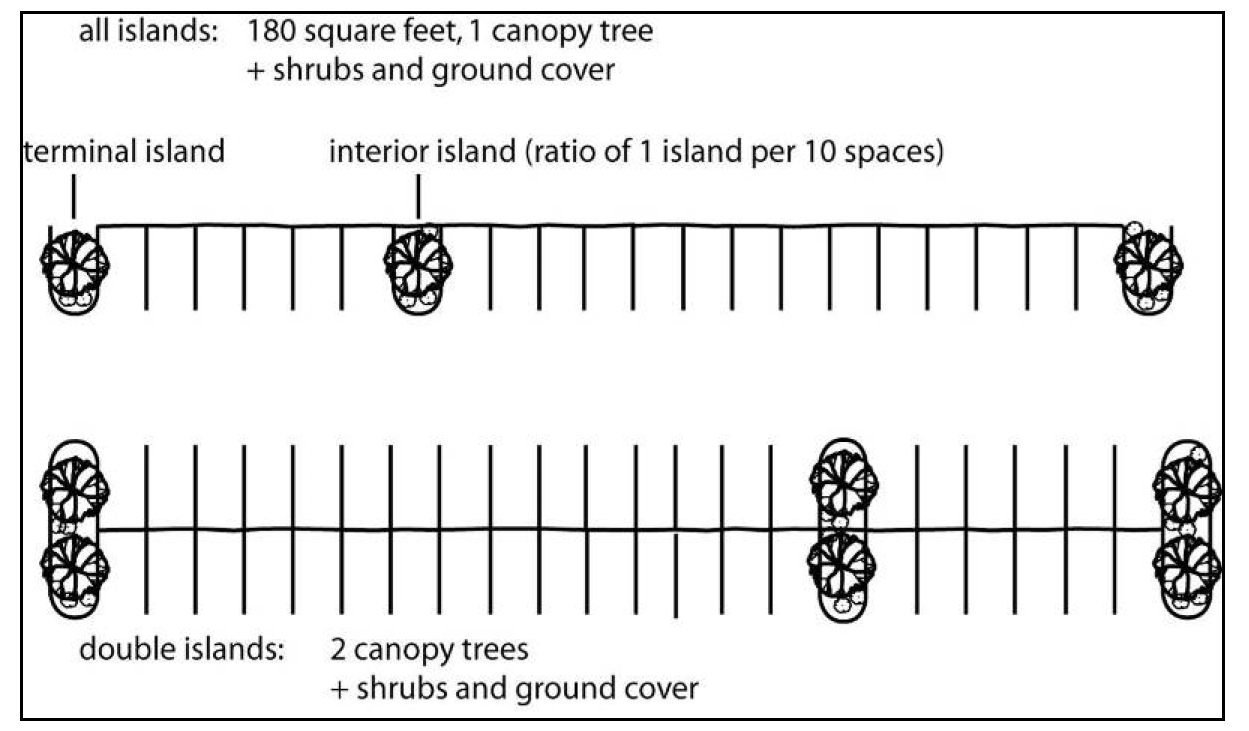
Terminal landscape islands at the end of each row of parking spaces, and either;
i.
Interior landscape islands within each row of parking; or
ii.
A landscape divider median between abutting rows of parking spaces. Each terminal and interior landscape island must be at least 180 square feet in size and be planted with a minimum of one canopy tree, as well as shrubs, and ground cover. Double islands within a double row of parking (typically the area of two abutting parking spaces combined into a single parking lot island) must be planted with two canopy trees, shrubs, and ground cover.
(2)
Each landscape island must have a horizontal dimension of at least nine feet, as measured back-of-curb to back-of-curb.
(3)
Where interior parking lot islands are provided, ratio of one landscape island must be provided for every ten parking spaces, but in no case may any parking space be located more than 50 feet from the trunk of a tree in a single landscape island, or 75 feet from the trunk of a tree in a double landscape island or landscape median.
(4)
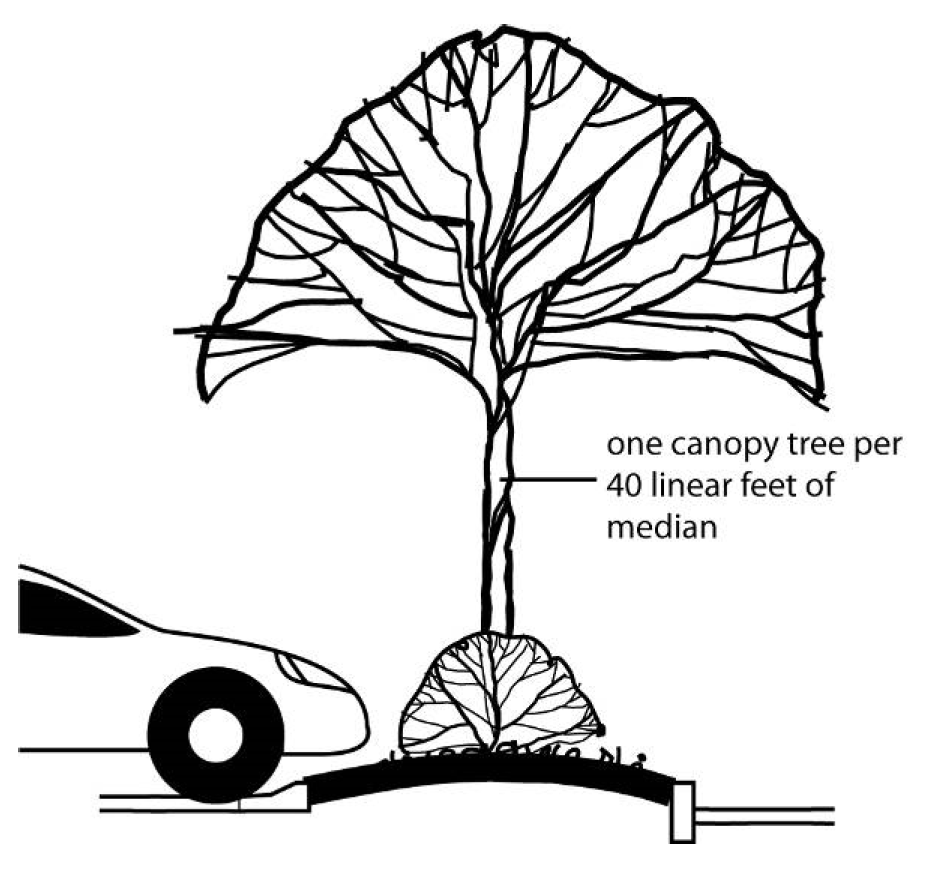
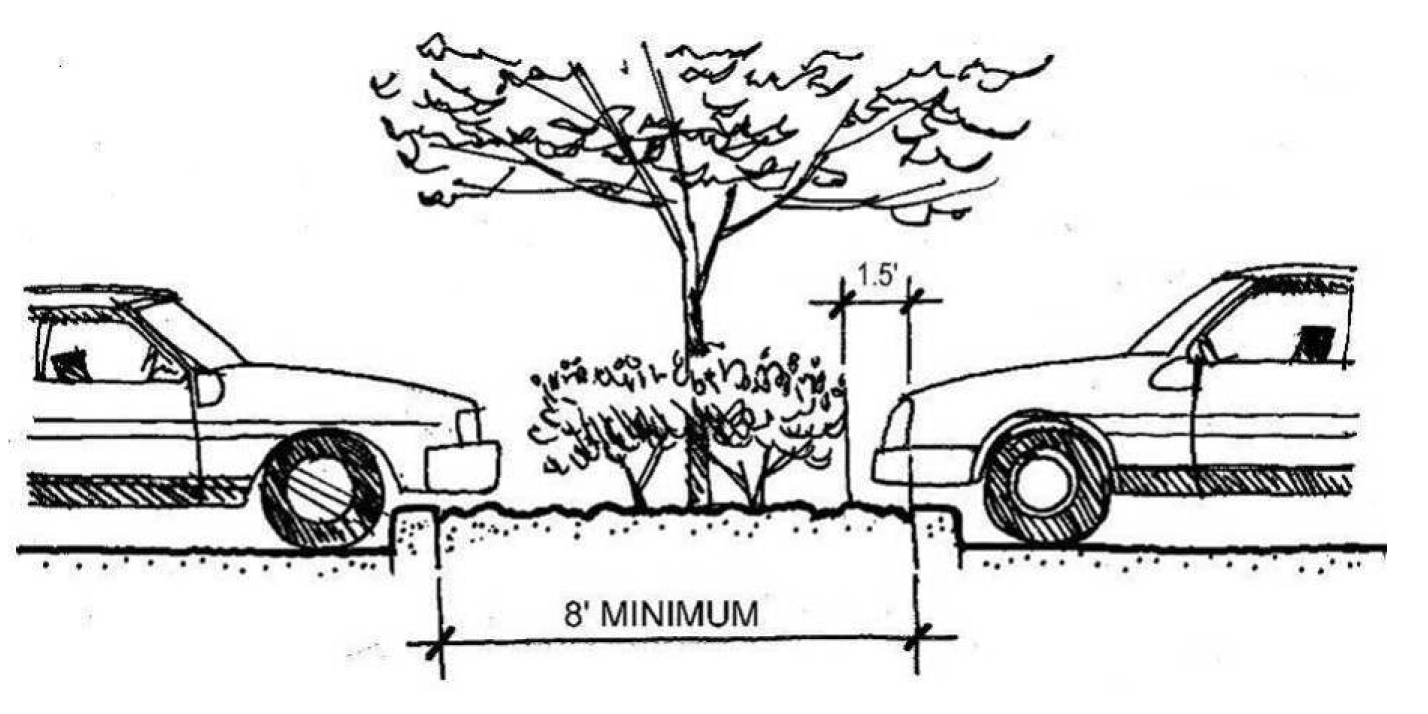
Where landscape divider medians are provided to meet the minimum landscaped area, they must be a minimum of eight feet in width (measured back-of-curb to back-of-curb), and be planted with a minimum of one canopy tree for every 40 feet of linear median, as well as shrubs and ground cover. Divider medians that are at least 15 feet in width may include a pedestrian walkway, in addition to the required landscape plantings. Landscape divider medians may serve as the first one and one-half feet of required parking stall depth for parking spaces that are designated for non-compact vehicles only. A maximum of 25 percent of the total required number of parking spaces may be designated for compact vehicles.
(5)
All parking spaces must be blocked or curbed to prevent vehicles from damaging adjacent fences or overhanging planting islands or landscaped yards by an average of more than two feet.
(C)
Plans. Whenever a parking area is required to be landscaped, the information included in the approved landscaping plan must be submitted to the Planning Director as part of the plan for a parking lot or site or development plan.
16-10-2
Bufferyards.
(A)
Purpose. The bufferyard regulations of this section are intended to:
(1)
Utilize spacing and screening to buffer lower density and intensity uses from higher density or intensity uses and reduce adverse visual effects and the impacts of traffic, noise, dust, and odor;
(2)
Tailor bufferyard requirements to suit the varying intensities of use; and
(3)
Require adequate screening of commercial and industrial uses along thoroughfares to preserve building values and to enhance the visual appearance of road corridors.
(B)
Applicability.
(1)
Any new nonresidential use or high-density residential use must provide bufferyards and screening in accordance with the requirements of this section.
(2)
Any change in a nonresidential use to a more intensive class of use, or expansion of an existing nonresidential or high-density residential use by 25 percent or more of the floor area and/or impervious surface associated with the use as of August 15, 1996 must provide bufferyards and screening in accordance with the requirements of this section.
(3)
In the case of an expansion of a lawful existing use, when the degree of expansion does not exceed 50 percent, such expansion need only provide a bufferyard and screening that meets the requirements of this section to a degree proportional to the degree of expansion. For example, a 30 percent expansion of an existing use must provide a bufferyard meeting 30 percent of required bufferyard depth and plant density (screen) requirements. For purposes of this section, existing uses include proposed uses for which a Land Use Permit has been issued and remains valid, and the class of a use and zoning of vacant land must be determined from the bufferyard table in Sec. 16-10-2(D). These bufferyard regulations apply whether or not the adjoining lot is in the same zoning district. (See Sec. 16-10-2(I) for other instances in which bufferyards are required).
(4)
No landscaping material will be allowed within a minimum radius of three feet around any fire hydrant. Additionally, each fire hydrant must be provided with a minimum three-foot wide access, from the adjacent parking lot, driveway, or street, that is unobstructed by any landscaping material (other than grass). Access roads must be maintained so as to remain clear of all vegetation for a width of 20 feet and a height of 13 feet six inches to allow for emergency vehicle access.
(5)
The buffers required by this section do not apply to temporary uses.
(C)
Location of Bufferyards. Bufferyards must be located:
(1)
Along the perimeter of a lot or parcel, but not within any portion of an existing or planned road right-of-way; or
(2)
In instances where the area represented by a site plan is significantly less than the total area of the lot of record, the Planning Director may permit the screening required between the proposed use and adjacent lots to be located in a bufferyard surrounding the smaller area provided that:
(a)
The depth of the bufferyard and type of screening provided for the smaller area is equal to or greater than required by the bufferyard table of Sec. 16-10-2(D);
(b)
The bufferyards required in Sec. 16-10-2(D) are also provided around the perimeter of the lot of record; and
(c)
The total area of the lot of record, less the smaller area represented by the subject site plan, could meet the minimum requirements within the applicable zoning district, if considered as if it were an independent lot of record.
(3)
Around the perimeter of a leased lot or parcel utilized for telecommunication towers. A 40-foot, type C bufferyard is required.
(D)
Bufferyard Table. The following table establishes minimum bufferyard depth and screen (landscape planting) standards. To determine the applicable requirements, first identify the class of the proposed (new, changed, or expanded) use. Then identify the class of each adjacent existing use and the zoning of each adjacent vacant lot. The intersection of the row associated with the proposed use and the column associated with the adjacent use shows the minimum depth and screening requirement; the number indicates the bufferyard depth (in feet) and the letter indicates the type of screen required.
Bufferyard Depth and Screening (feet/screen type)
NA—no bufferyard required
[1] A low-density residential use is a residential use with a density less than three dwelling units per acre.
[2] A medium-density residential use is a residential use with a density between three and six dwelling units per acre.
[3] A high-density residential use is a residential use with a density of more than six dwelling units per acre.
[4] A low-intensity nonresidential use is a nonresidential use with a floor area ratio (gross floor area/site area) no greater than 0.15 and an impervious surface coverage no greater than 30 percent.
[5] A medium-intensity nonresidential use is a nonresidential use with a floor area ratio (floor area/site area) greater than 0.15 but no greater than 0.30, or an impervious surface coverage greater than 30 percent, but no greater than 60 percent.
[6] A high-intensity nonresidential use is a nonresidential use with a floor area ratio (floor area/site area) greater than 0.30 or an impervious surface coverage greater than 60 percent.
[7] The buffers listed in the table above may not be reduced except as expressly authorized by Sec. 16-10-2(G) or Sec. 16-10-2(H) or by the granting of a variance in accordance with Sec. 19-26.
(E)
Overlap with Required Setbacks. In the event that bufferyard depth requirements conflict with zoning district setback requirements, the stricter standard governs.
(F)
Screen Types.
(1)
Landscape Plan Variations.
(a)
The quantities of plant materials noted below represent the number of deciduous canopy trees, full size evergreen trees, deciduous understory trees, evergreen understory trees, and shrubs that are necessary to create the type of screen specified. These stated quantities represent the number of each plant type (e.g. deciduous canopy tree or shrub) that is necessary to achieve the specified type of screen.
(b)
The Planning Director has the authority to allow variations in the mix of plants required, up to a maximum of 25 percent of the total required number of each type of tree (i.e. deciduous canopy tree, evergreen tree, deciduous understory tree, or evergreen understory tree) and up to a maximum of 35 percent of the shrubs (depending upon species), in order to encourage creativity in landscape design, to more effectively create a buffer or screen, to address site issues such as topography or geological features, or to allow for more efficient irrigation or water use practices so long as the intent of this Sec. 16-10-2(A) is still met. In evaluating the allowance of plant variations, the Planning Director must also give due consideration to the use of fences, walls, or berms.
(c)
The following options are examples of the plantings needed to meet the required screening, however, the applicant can propose an alternative design, prepared by a licensed landscape architect that meets the same screening standard.
(2)
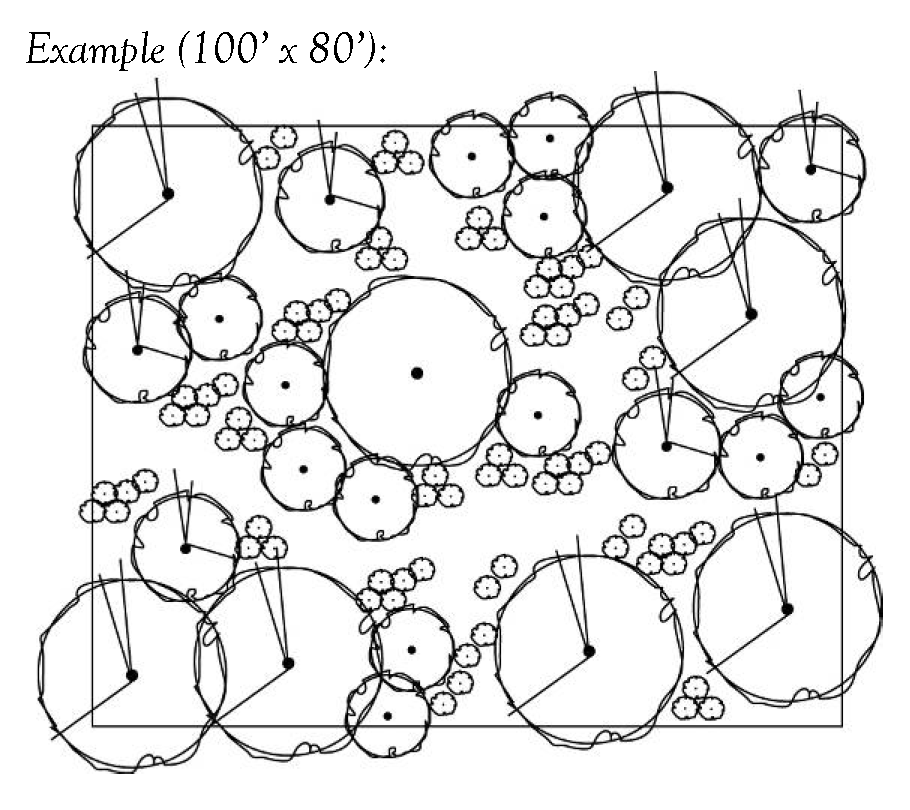
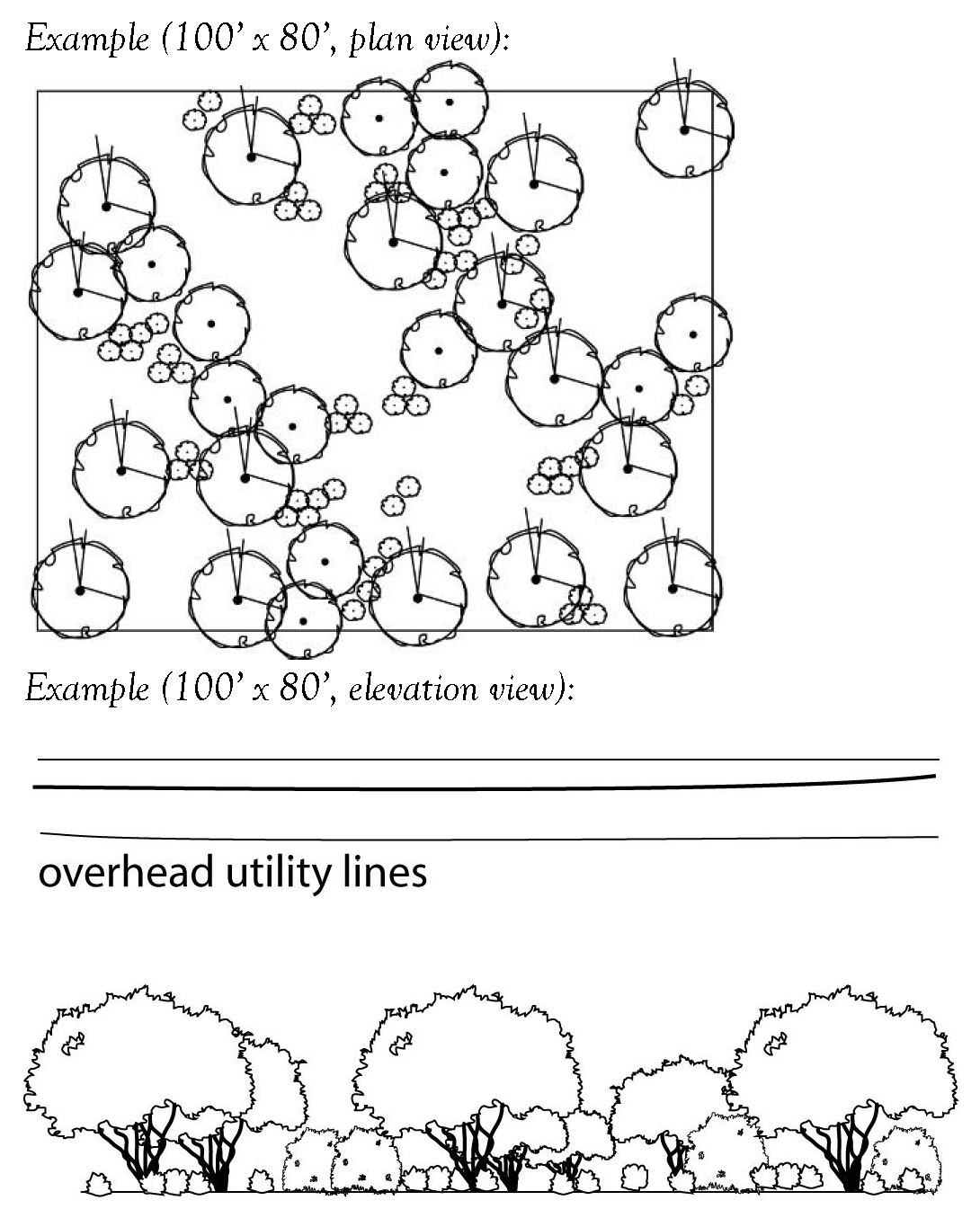
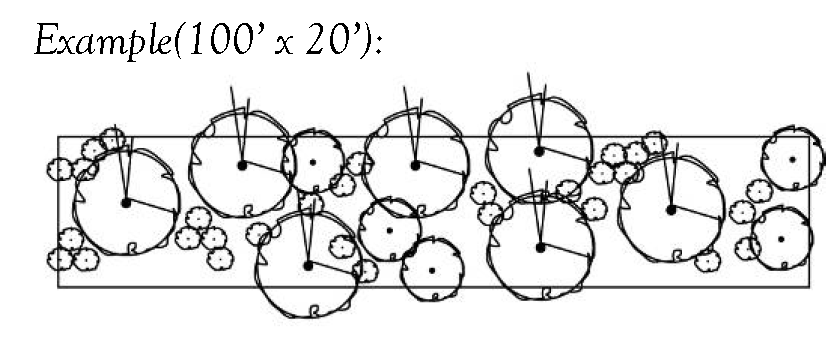
Type A Opaque Screen. Whenever a Type A screen is required, the applicant may choose to provide any of the following screen options. The examples below are expressed in terms of the number of plants required per 100 feet of bufferyard length, and an 80-foot width.
(a)
Example 1—Evergreen Screen:
i.
Zero deciduous canopy trees;
ii.
Ten evergreen trees;
iii.
Zero deciduous understory trees;
iv.
Twenty evergreen understory trees;
v.
Eighty shrubs.
(b)
Example 2—Deciduous Screen:
i.
Ten deciduous canopy trees;
ii.
Zero evergreen trees;
iii.
Twelve deciduous understory trees;
iv.
Zero evergreen understory trees;
v.
Eighty shrubs.
(c)
Example 3—Mixed (Evergreen-Deciduous) Screen:
i.
Seven deciduous canopy trees;
ii.
One evergreen tree;
iii.
Five deciduous understory trees;
iv.
Twelve evergreen understory trees;
v.
Eighty-five shrubs.
(d)
Example 4—Overhead Utility Screen
i.
Zero deciduous canopy trees;
ii.
Zero evergreen trees;
iii.
Sixteen deciduous understory trees;
iv.
Twelve evergreen understory trees;
v.
Sixty-five shrubs.
(3)
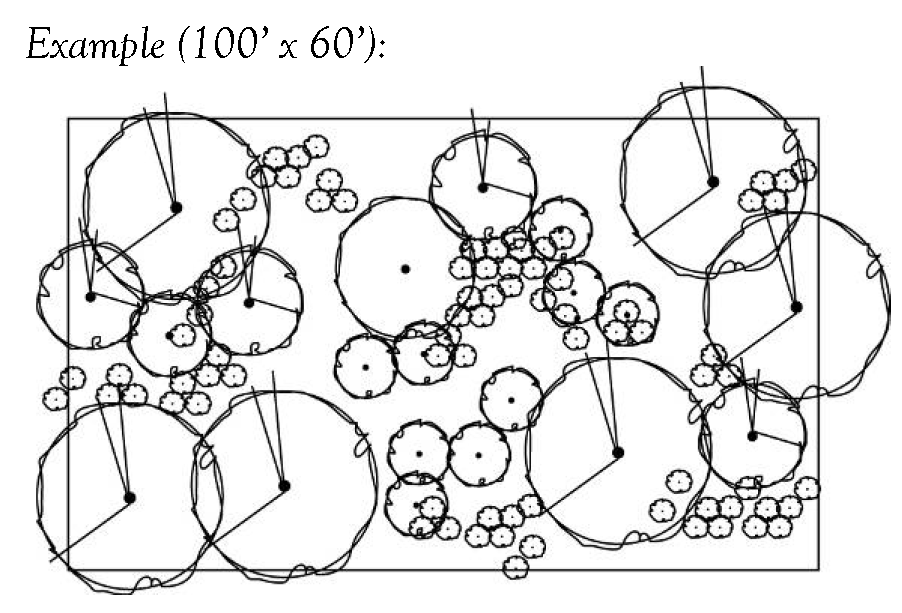
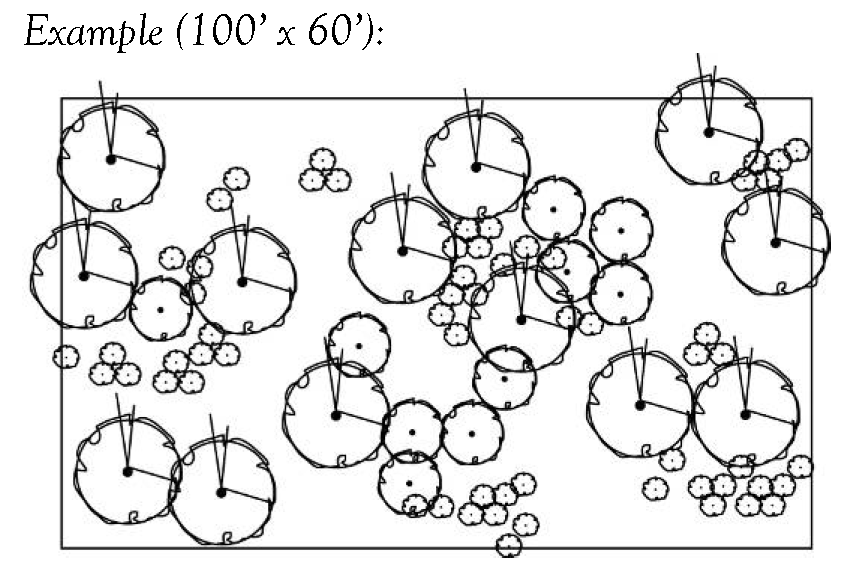
Type B Intermittent-1 Screen. Whenever a Type B screen is required, the applicant may choose to provide any of the following screen options. The examples below are expressed in terms of the number of plants required per 100 feet of bufferyard length, and a 60-foot width.
(a)
Example 1—Evergreen Screen:
i.
Zero deciduous canopy trees;
ii.
Eight evergreen trees;
iii.
Zero deciduous understory trees;
iv.
Seventeen evergreen understory trees;
v.
Seventy-five shrubs.
(b)
Example 2—Deciduous Screen:
i.
Eight deciduous canopy trees;
ii.
Zero evergreen trees;
iii.
Eleven deciduous understory trees;
iv.
Zero evergreen understory trees;
v.
Seventy-five shrubs.
(c)
Example 3—Mixed (Evergreen-Deciduous) Screen:
i.
Six deciduous canopy trees;
ii.
One evergreen tree;
iii.
Four deciduous understory trees;
iv.
Ten evergreen understory trees;
v.
Eighty shrubs.
(d)
Example 4—Overhead Utility Screen:
i.
Zero deciduous canopy trees;
ii.
Zero evergreen trees;
iii.
Thirteen deciduous understory trees;
iv.
Ten evergreen understory trees;
v.
Sixty shrubs.
(4)
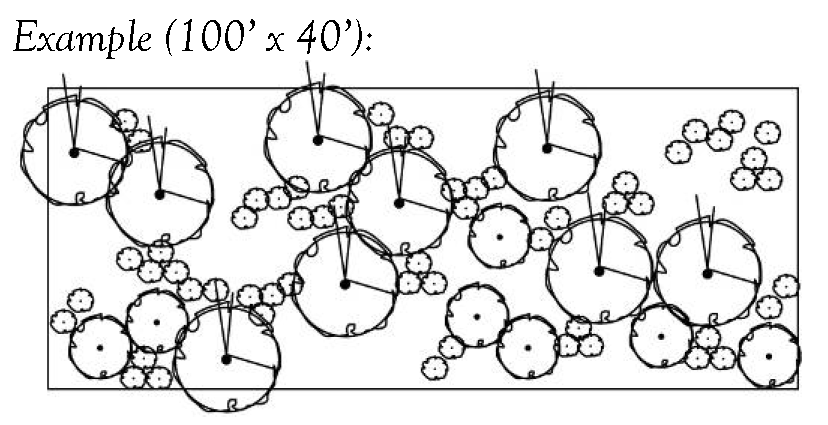
Type C Intermittent—2 Screen.
(a)
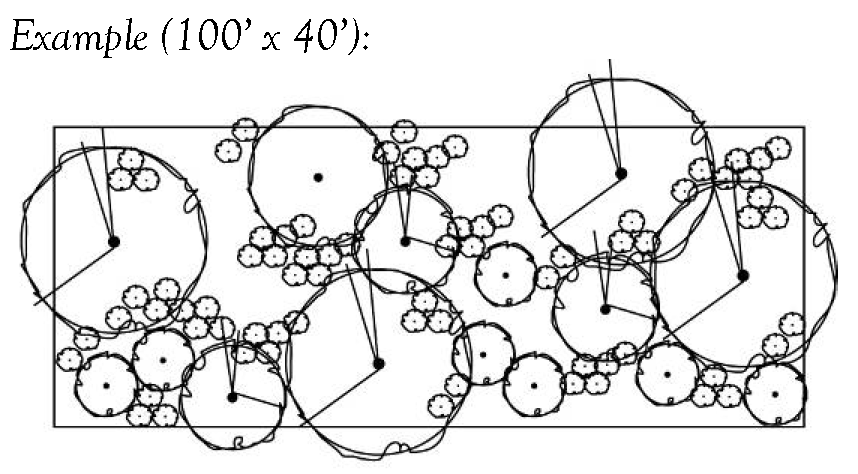
Whenever a Type C screen is required, the applicant may choose to provide any of the following screen options. The examples below are expressed in terms of the number of plants required per 100 feet of bufferyard length, and a 40-foot width. Example 1—Evergreen Screen
i.
Zero deciduous canopy trees;
ii.
Five evergreen trees;
iii.
Zero deciduous understory trees;
iv.
Twelve evergreen understory trees;
v.
Seventy-two shrubs.
(b)
Example 2—Deciduous Screen:
i.
Five deciduous canopy trees;
ii.
Zero evergreen trees;
iii.
Eight deciduous understory trees;
iv.
Zero evergreen understory trees;
v.
Seventy-one shrubs.
(c)
Example 3—Mixed (Evergreen-Deciduous) Screen:
i.
Four deciduous canopy trees;
ii.
One evergreen tree;
iii.
Three deciduous understory trees;
iv.
Seven evergreen understory trees;
v.
Seventy-five shrubs.
(d)
Example 4—Overhead Utility Screen:
i.
Zero deciduous canopy trees;
ii.
Zero evergreen trees;
iii.
Nine deciduous understory trees;
iv.
Seven evergreen understory trees;
v.
Fifty-seven shrubs.
(5)
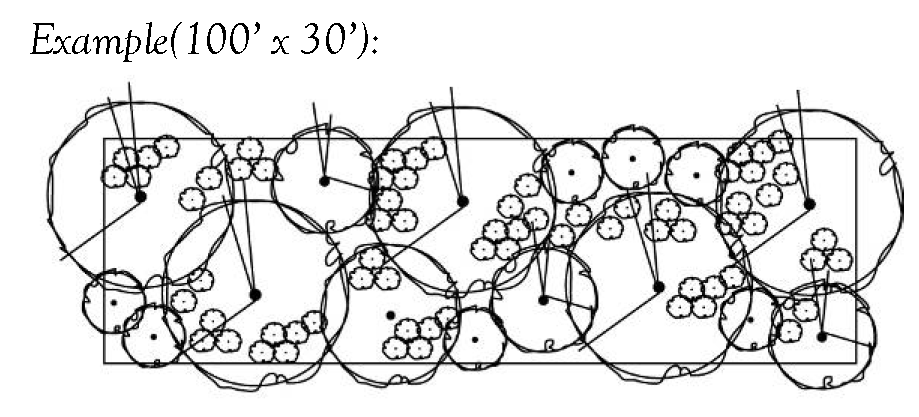
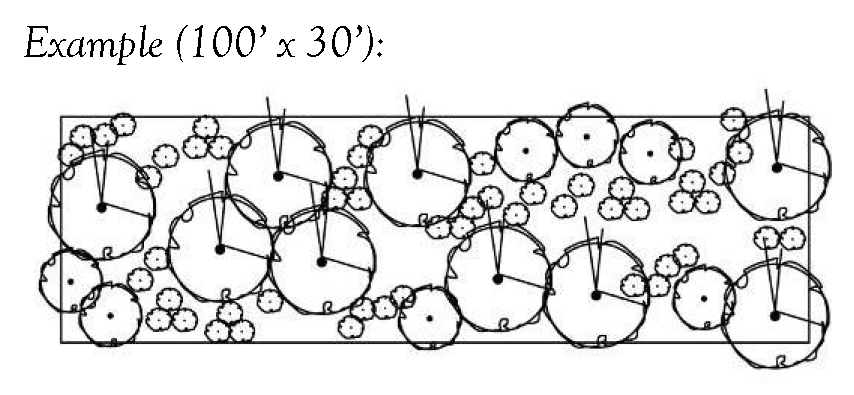
Type D Intermittent-3 Screen. Whenever a Type D screen is required, the applicant may choose to provide any of the following screen options. The examples below are expressed in terms of the number of plants required per 100 feet of bufferyard length, and a 30 -foot width
(a)
Example 1—Evergreen Screen:
i.
Zero deciduous canopy trees;
ii.
Five evergreen trees;
iii.
Zero deciduous understory trees;
iv.
Twelve evergreen understory trees;
v.
Sixty-nine shrubs.
(b)
Example 2—Deciduous Screen:
i.
Five deciduous canopy trees;
ii.
Zero evergreen trees;
iii.
Eight deciduous understory trees;
iv.
Zero evergreen understory trees;
v.
Sixty-seven shrubs.
(c)
Example 3—Mixed (Evergreen-Deciduous) Screen:
i.
Five deciduous canopy trees;
ii.
One evergreen tree;
iii.
Three deciduous understory trees;
iv.
Seven evergreen understory trees;
v.
Seventy shrubs.
(d)
Example 4—Overhead Utility Screen:
i.
Zero deciduous canopy trees;
ii.
Zero evergreen trees;
iii.
Nine deciduous understory trees;
iv.
Seven evergreen understory trees;
v.
Five-three shrubs.
(6)
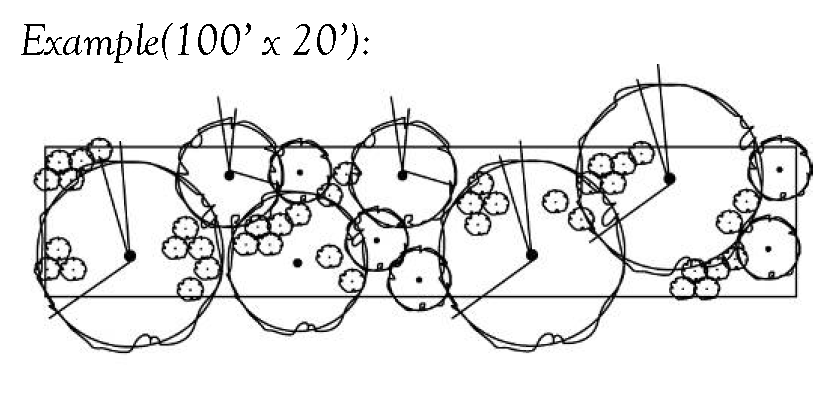
Type E Intermittent-4 Screen.
(a)
Whenever a Type E screen is required, the applicant may choose to provide any of the following screen options. The examples below are expressed in terms of the number of plants required per 100 feet of bufferyard length, and a 20-foot width. Example 1—Evergreen Screen:
i.
Zero deciduous canopy trees;
ii.
Four evergreen trees;
iii.
Zero deciduous understory trees;
iv.
Nine evergreen understory trees;
v.
Forty shrubs.
(b)
Example 2—Deciduous Screen:
i.
Four deciduous canopy trees;
ii.
Zero evergreen trees;
iii.
Six deciduous understory trees;
iv.
Zero evergreen understory trees;
v.
Forty shrubs.
(c)
Example 3—Mixed (Evergreen-Deciduous) Screen:
i.
Three deciduous canopy trees;
ii.
One evergreen tree;
iii.
Two deciduous understory trees;
iv.
Five evergreen understory trees;
v.
Forty shrubs.
(d)
Example 4—Overhead Utility Screen:
i.
Zero deciduous canopy trees;
ii.
Zero evergreen trees;
iii.
Seven deciduous understory trees;
iv.
Five evergreen understory trees;
v.
Thirty shrubs.
(7)
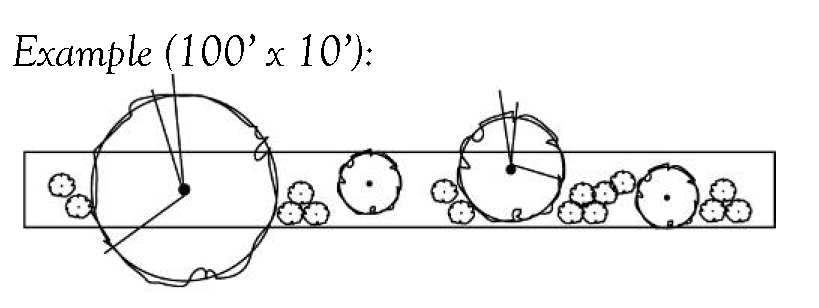
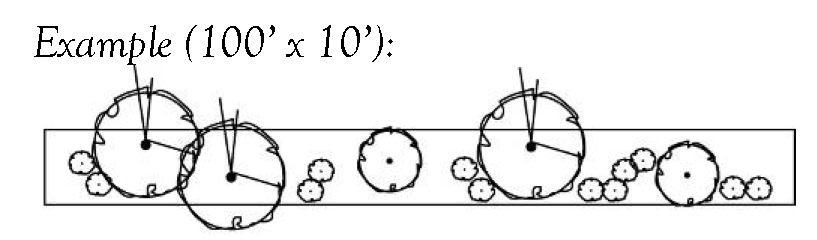
Type F Streetfront Screen. Whenever a Type F screen is required, the applicant may choose to provide any of the following screen options. The examples below are expressed in terms of the number of plants required per 100 feet of bufferyard length, and a 10-foot width.
(a)
Example 1—Evergreen Screen:
i.
Zero deciduous canopy trees;
ii.
Two evergreen trees;
iii.
Zero deciduous understory trees;
iv.
Three evergreen understory trees;
v.
Fifteen shrubs.
(b)
Example 2—Deciduous Screen:
i.
Two deciduous canopy trees;
ii.
Zero evergreen trees;
iii.
Two deciduous understory trees;
iv.
Zero evergreen understory trees;
v.
Fourteen shrubs.
(c)
Example 3—Mixed (Evergreen-Deciduous) Screen:
i.
One deciduous canopy tree;
ii.
Zero evergreen trees;
iii.
One deciduous understory tree;
iv.
Two evergreen understory trees;
v.
Fifteen shrubs.
(d)
Example 4—Overhead Utility Screen:
i.
Zero deciduous canopy trees;
ii.
Zero evergreen trees;
iii.
Three deciduous understory trees;
iv.
Two evergreen understory trees;
v.
Twelve shrubs.
(G)
Depth Reductions for Walls, Fences or Berms. The Planning Director may allow a reduction in bufferyard depth by up to 25 percent if a solid wall, solid fence, or berm is provided within the interior portion of the bufferyard. For purposes of this section a solid wall or fence will be considered any completely opaque wall or fence without any openings, including shadowbox fences. Walls and fences provided pursuant to this provision must have a minimum height of six feet and berms must have a minimum height of four feet. Any such fencing must have the dress side facing outward toward the right-of-way or adjacent properties. When a bufferyard depth reduction is taken pursuant to this provision, the number of shrubs required within the bufferyard may also be reduced to 50 percent. In order to approve such reduction, the Planning Director must determine that the proposed bufferyard plan is at least as effective in achieving the purposes of this section, as is strict compliance with the bufferyard standards.
(H)
Plant Density Reductions. The Planning Director may allow a reduction in a bufferyard screening (plant) density by up to 25 percent if the bufferyard's depth is increased to effectively mitigate the density reduction. In order to approve a reduction in plant density, the Planning Director must determine that the proposed bufferyard plan is at least as effective in achieving the purposes of this section as is strict compliance with bufferyard standards.
(I)
Additional Bufferyards and Screening.
(1)
Any outside storage of junk, refuse, salvage, or discarded materials must be screened from adjacent rights-of-way and adjacent properties by means of a Type A screen.
(2)
Whenever a nonresidential use is proposed along a thoroughfare, a 10-foot deep bufferyard and Type F screening must be provided adjacent to the thoroughfare right-of-way.
(3)
Whenever a nonresidential use is proposed next to a residential use and is separated from the residential use by a public road, a 10-feet-deep bufferyard and Type F screening must be provided adjacent to the public road right-of-way.
(4)
Any outside storage existing on August 21, 1989, must be screened from adjacent properties and rights-of-way on or before December 31, 1992, by means of Type A screening or its equivalent as determined by the Planning Director.
(J)
Features Allowed within Bufferyards.
(1)
A bufferyard may be traversed by utility lines, water supply and wastewater lines, septic systems (if a qualified soil scientist determines that such location is the only feasible alternative), sidewalks, driveways, roads and other similar improvements, provided that:
(a)
The proposed locations of such uses are necessary for their proper functioning, and such uses cross the bufferyard where feasible, rather than lie along the length of the bufferyard;
(b)
The total width of the bufferyard is maintained; and
(c)
No screen required by this ordinance is reduced or eliminated.
(2)
The required undisturbed radius around a well may lie within the bufferyard, but the well head itself may not encroach within the bufferyard.
(3)
Signs are permitted within bufferyards provided that:
(a)
They are completely screened from view from any point on adjacent residential properties; and
(b)
Placement of such signs will not violate other provisions of this ordinance.
(4)
Bufferyards may not be used for parking, loading, storage, or any activity that is either part of or accessory to the proposed use.
16-10-3
Plant Material, Installation and Maintenance.
Editor's note— [Section 16-10-3 "Landscaping of Freestanding Signs" was moved to Section 18-10-2 (P) on 1/22/2008 by OA 04-07. Section 16-10-4 "Plant Material, Installation and Maintenance" became the new Section 16-10-3]
(A)
Time of Installation.
(1)
All landscaping, bufferyards and screening materials must be in place prior to final inspection by the Wake County Zoning Inspector.
(2)
When weather conditions do not permit planting, installation of plant material may be delayed until the start of the next growing season (for the particular species), provided that adequate financial guarantees are posted to ensure compliance. This performance guarantee must provide for the cost of the plant material, the labor costs of installation, and a 25 percent contingency. The process for providing such performance guarantee must parallel that described in Sec. 8-22 and is required before the issuance of a Certificate of Occupancy, or the approval of the final plat, whichever may be applicable.
(B)
Plant Materials.
(1)
Existing Vegetation. Existing vegetation that meets or exceeds applicable screening requirements may be used to satisfy the requirements of this section, provided the bufferyard contains sufficient area surrounding the vegetation to ensure its protection from encroachments that may threaten its continued healthy growth. Due to their effectiveness in immediately providing a more effective screen, the retention and protection of existing vegetation must be given preference over the installation of new plant materials in the achievement of the required screening. Existing vegetation that is in a healthy condition, meets the minimum planting size requirements, and will meet the required mature plant size must be given credit toward meeting the required screening. Existing vegetation must be noninvasive in nature. If nonnative invasive plants are found within the buffer, they must be permanently removed through mechanical or herbicidal means. No disposal of these plants (whole plants, clippings, root masses, etc…) may occur within buffers, easements, open space areas, or along rights-of-way. Invasive species are those identified on the most current lists published by the North Carolina Department of Agriculture & Consumer Services and NC Invasive Plant Council.
(2)
Location and Spacing. Plants must be staggered or clustered as necessary to maximize screening objectives and to meet the needs of the particular species of plants for root space, water, light, and circulation.
(3)
General Standards. All required landscape plant materials, inclusive of trees, shrubs and groundcovers, must comply with the American Nurseryman's Standards. Neither nonnative nor invasive plant species may be used for planting in landscaping and bufferyards. The designer is responsible for researching proposed species utilized in the plantings and indicate on the plans that the material being used is native to our geographical area.
(4)
Trees.
(a)
Deciduous canopy trees must have a minimum size of two-inch caliper and a minimum height of ten feet at the time of planting and be planted at least 18 feet apart.
(b)
Deciduous understory trees must have a minimum height of eight feet at the time of planting and be planted at least 12 feet apart.
(c)
Evergreen trees must have a minimum height of eight feet at the time of planting (unless mixed with deciduous trees in which case a minimum height of four feet is required).
(d)
Evergreen understory trees must have a minimum height of six feet at the time of planting.
(5)
Shrubs.
(a)
All shrubs must be cold hardy and heat tolerant.
(b)
Upright shrubs must have a minimum height of 15 inches at the time of planting.
(c)
Shrubs may not be planted closer than three feet on-center or closer than three feet to planted trees.
(6)
Minimum Height at Maturity. Trees and shrubs must be of a variety that has a minimum mature height that will meet the minimum screening requirements for which they were chosen. Deciduous canopy trees must be of a species that will reach a minimum height of 35 feet at maturity. Deciduous understory trees must be of a species that will reach a minimum height of 15 feet at maturity. Evergreen trees must be of a species that will reach a minimum height of 35 feet at maturity. Evergreen understory trees must be of a species that will reach a minimum height of 20 feet at maturity. Shrubs must be of a species that will grow to a minimum height of 36 inches at maturity.
(C)
Fences, Walls and Berms.
(1)
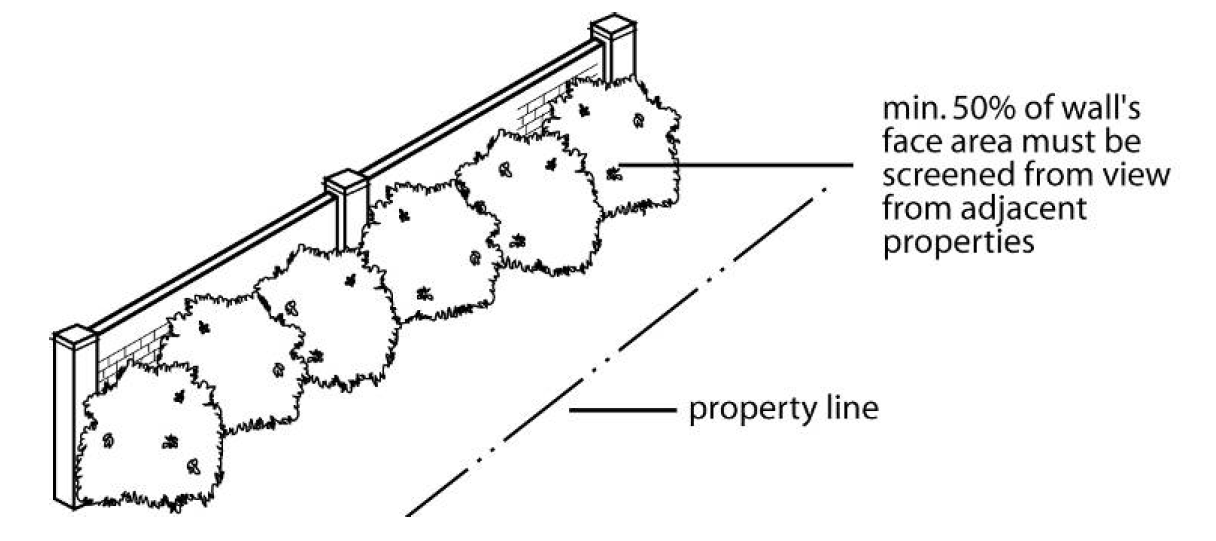
Fences and Walls. Fences and walls must be screened over at least 50 percent of their exterior face area by plantings that provide year round screening to obstruct the view of the fence or wall from adjacent properties. This may be achieved with a tight evergreen hedge that is one-half the height of the fence or wall; or by using plants other than the evergreen hedge meeting the above requirement, provided that figures on the average mature height and spread of each species to be planted are submitted with the site plan for approval by the Planning Director. The plantings required by this section may be included in the totals listed in the various options that are established in Sec. 16-10-2(F). In evaluating the allowance of plant variations, the Planning Director must also give due consideration to the use of fences, walls, or berms.
(2)
Berms. Berms must be planted with trees, shrubs, vines, grasses, or other groundcover. Part of a berm may be devoted to a nonliving screen such as a fence or wall.
(3)
Location of Required Planting Materials. Whenever a wall, fence or berm is proposed, the placement of the required plant materials (other than that required by 16-10-3(C)), in relation to the wall, fence or berm, must take into consideration such factors as the intensity level of the proposed use, the degree of dissimilarity of the proposed use to the adjacent use, the site topography, the road curvature and other factors. The applicant may propose the location of the wall, fence or berm and the amount of the landscaping material that will be placed on each side of the wall, fence or berm. The Planning Director must consider these factors noted above in determining whether the proposal complies with the intent of Sec. 16-10-2(A).
(D)
Maintenance. All required landscaping and screening must be maintained. If necessary to ensure the continued effectiveness and intended purpose of the screen, plantings that deteriorate or dies must be repaired or replaced during the next planting season, or within six months. Failure to maintain required landscaping and buffers is a violation of this ordinance (including the limbing of growing trees and the pruning of shrubs to encourage compact new growth). Plant materials must be located and maintained by the property owner, or property owner association, in such a manner that they do not overhang into utility easements or the fire hydrant access ways that are required by Sec. 16-10-2(B)(4). Access roads must be maintained so as to remain clear of all vegetation for a width of 20 feet and a height of 13 feet six inches to allow for emergency vehicle access.
(E)
Clear View of Intersections. Bufferyards and visual screens may not interfere with sight lines at intersections.
[OA 05/03 September 19, 2005; Amended on 1/22/2008 by OA 04-07; Amended on 7/21/2008 by OA 04-08; Amended of 1/22/2019 by OA 02-18; Amended on 1/3/2022 by OA-03-21; Amended on 11/18/2024 by OA-01-24]
16-11 - Trash Storage Area Screening.
16-11-1
Screening Methods.
(A)
Required trash storage area screening may be achieved by designating an enclosed space for trash facilities within a principal building or within an accessory building such as a garage.
(B)
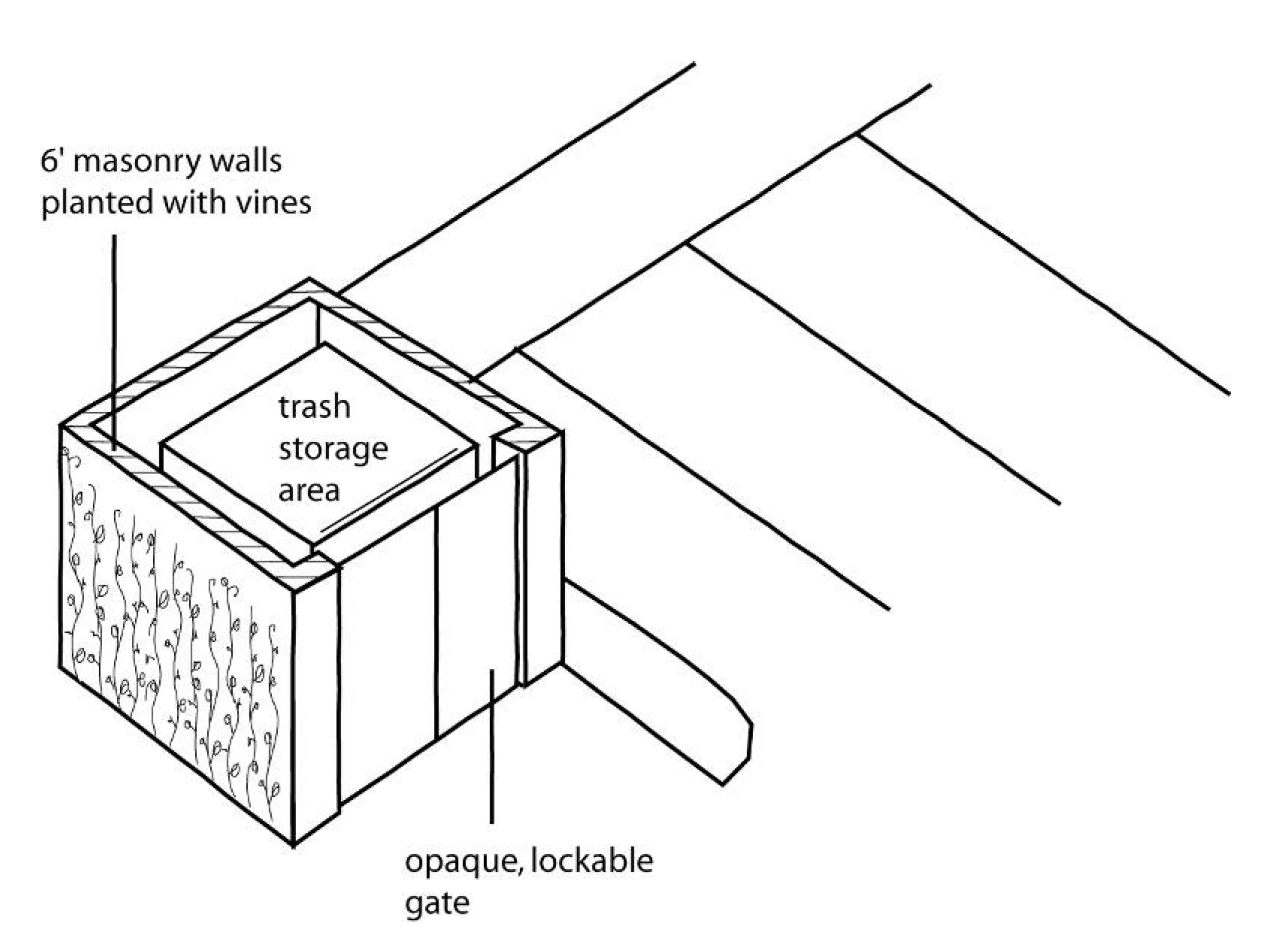
When trash storage areas are not enclosed within a principal building or accessory building, they must be screened from off-site view on all sides by masonry walls with a minimum height of six feet. One side of the storage area must be furnished with an opaque, latchable gate.
(C)
The screening walls required by this section must be planted with vines or surrounded with other landscape material.
16-12 - Tree and Vegetation Protection.
16-12-1
General Intent. The regulations of this section are intended to preserve trees and other significant vegetation along the outer perimeter of development sites. Such regulations will help to ensure that trees and vegetation along the perimeter of a site are not removed or disturbed to preserve and enhance the visual character of the County, control surface water runoff, and moderate temperatures. Tree and vegetation protection will also help conserve water because of increased absorption ability of retained plants.
16-12-2
Applicability; Effect.
(A)
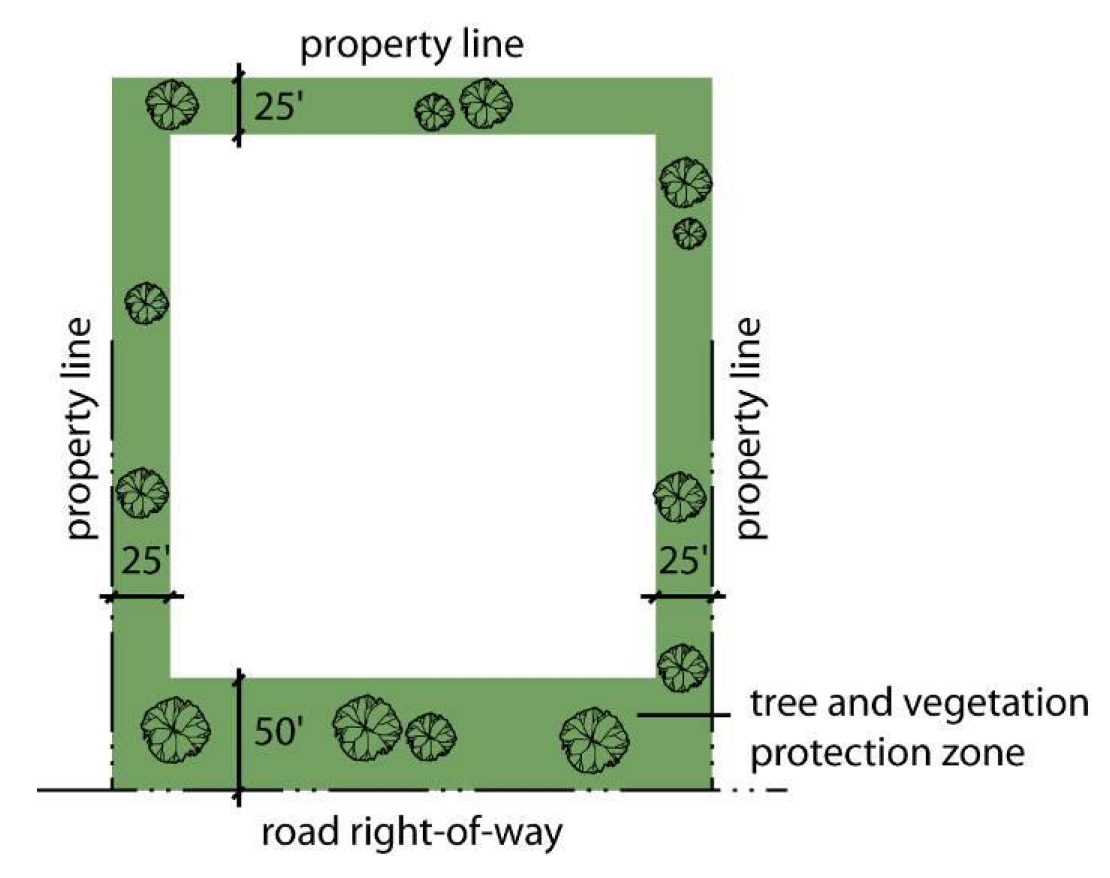
The tree and vegetation protection standards of this section apply to the outer perimeter of parcels proposed to be graded, disturbed or subdivided—an area known as the "tree and vegetation protection zone." The boundaries of the tree and vegetation protection zone shall extend the following distances from the outer perimeter of a parent parcel's property lines:
(1)
Fifty feet from all public road rights-of-way; and
(2)
Twenty-five feet from all other property lines.
(B)
The standards of this section generally require that the tree and vegetation protection zone remain undisturbed and that trees and vegetation within the zone be preserved, except that the Planning Director may permit land disturbance and tree and vegetation removal within the protection zone when deemed necessary to allow for reasonable use and development of the property in accordance with Sec. 16-12-6.
(C)
A permanent tree and vegetation protection zone is required on the outer perimeter of lands included in the initial approved preliminary plan of a parent tract of land. Subsequent subdivisions of lots within the parent tract are not required to provide additional tree and vegetation protection zones.
16-12-3
Exemptions. The following activities are exempt from the tree and vegetation protection standards of this section:
(A)
The removal of dead or naturally fallen or severely damaged trees or vegetation, or the removal, by an approved method, of trees or vegetation that are a threat to the public health, safety, or welfare;
(B)
The removal, by hand, of diseased or insect-infected trees or vegetation that pose a risk to adjoining trees as determined by the North Carolina Division of Forest Resources or by a certified arborist (International Society of Arboriculture);
(C)
The selective and limited removal of trees or vegetation necessary to obtain clear visibility at driveways, intersections, or within required sight triangles;
(D)
The removal of trees or vegetation on parent tracts of two acres or less in area located within a single-family residential zoning district. Land within public rights-of-way is excluded from the area calculation.
Commentary: Since tracts of two acres or less are exempt from compliance with tree and vegetation protection standards, it is intended that development and building on such lots will be subject only to the building setback standards of the underlying zoning district. The "tree and vegetation zone" definition is not to be interpreted as additional building setback requirements in those instances in which tree and vegetation preservation is not required.
(E)
The removal of trees as part of normal forestry activities on property taxed under the present-use value standard or conducted pursuant to a forestry management plan prepared or approved by a forester registered pursuant to NCGS Chapter 89B. However, for such properties, the County may deny a building permit or refuse to approve a site plan or subdivision plan for a period of three years following completion of the harvest if all or substantially all of the trees that should have been protected within the tree and vegetation protection zone were removed from the tract of land for which the permit or plan is sought. The County may deny a permit or refuse to approve a site plan or subdivision plan for a period of two years if the owner replants the protection zone within 120 days of harvest with plant material that is consistent with buffer areas required under the County buffer area standards;
Commentary: As its name implies, the "tree and vegetation protection zone" is intended as an area in which tree and vegetation removal is prohibited or otherwise strictly limited. It is not intended as an additional building setback requirement in those instances in which tree and vegetation preservation is not required.
(F)
The removal of damaged or dead trees or vegetation during or after emergencies or inclement weather such as wind storms, ice storms, fire, or other disasters.
16-12-4
Maximum Size of Tree and Vegetation Protection Zone. The total area of a tree and vegetation protection zone shall not exceed 20 percent of the total area of the parcel, excluding any land area located within public road rights-of-way and any required conservation easements. (Note: Conservation easements located within tree and vegetation protection zones will be credited toward compliance with the tree and vegetation protection standards of this section)
16-12-5
Delineation of Tree and Vegetation Protection Zone. Subdivision and all site plans submitted for development must indicate the limits of the tree and vegetation protection zone.
16-12-6
Allowed Encroachments.
(A)
It is the intent of this section to permit reasonable predevelopment activity on lands that are subject to the tree and vegetation protection standards of this section. It is recognized that encroachment into the tree and vegetation protection zone may be necessary to allow for reasonable use and development of the subject parcel. The Planning Director may approve encroachments deemed necessary to permit reasonable use and development. Examples of encroachments that may be permitted include utility lines (electric, gas or public water/sewer lines), driveways, sidewalks, entrances and entrance features, supplemental landscaping, as well as access routes for construction vehicles or equipment where no alternative means of access exists on the site.
(B)
Septic fields must be allowed to encroach into the tree and vegetation protection zone if a qualified soil scientist determines that such location is the only feasible and safe alternative. The qualified soil scientist must submit sealed documentation indicating encroachment is the only feasible and safe alternative and identify the limits of disturbance within the tree and vegetation zone.
(C)
At the time of consideration of a site plan or other authorized development plan for the subject site, review and decision-making bodies are authorized to approve land disturbance, development activity and tree and vegetation removal in accordance with applicable zoning and site development regulations.
(D)
When encroachment is deemed necessary by the Planning Director, care must be taken to remove and/or disturb the minimum amount of trees and vegetation possible.
16-12-7
Replacement of Trees and Vegetation. Any trees and vegetation that are removed from the tree and vegetation protection zone without Planning Director approval must comply with Sec. 16-12-7(A).
(A)
Any trees and vegetation that are removed from the tree and vegetation protection zone without the Planning Director's approval must be replaced as a Type C Intermittent-2 Screen as described in Sec. 16-10-2(F)(4).
(B)
The Planning Director may allow replacement trees and vegetation to be placed outside the tree and vegetation protection zone when adequate area does not exist within the tree and vegetation protection zone.
16-12-8
Tree Protection During Construction.
(A)
Owner's Responsibility. During development of the property, the owner is responsible for the erection and maintenance of any and all barriers necessary to ensure protection of trees and vegetation within the tree and vegetation protection zone from damage during construction.
(B)
Protective Fencing.
(1)
Where Required. The tree and vegetation protection zone must be surrounded by a clearly visible fence before grading begins. Required fencing must extend as far as practical from the tree and vegetation protection zone. No construction, grading, equipment or material storage, or any other activity is allowed within the tree and vegetation protection zone, unless approved by the Planning Director in accordance with Sec. 16-12-6.
(2)
Plans. The location and a detail of the proposed protective fencing or other means of demarcation must be clearly shown on subdivision plans.
(3)
Type of Fencing. All fencing required by this section must be a minimum four feet in height and of durable construction. Orange polyethylene laminar fencing is acceptable. Passive forms of tree and vegetation protection may be utilized to delineate tree and vegetation protection zones that are not located near areas of land disturbance. These must be surrounded by fencing, continuous rope, or durable taping that is a minimum of four inches wide.
(4)
Signs. Signs must be installed on the protective fence so that they are visible on all sides of the area to be protected. At least one sign must be placed on each side, with signs spaced no more than 150 linear feet apart. The size of each sign must be a minimum of two feet by two feet and must contain the following language: "KEEP OUT, TREE AND VEGETATION PROTECTION ZONE," both in Spanish and in English.
[OA 04/10 January 18, 2005; Amended on 1/22/2008 by OA 04-07; Amended on 9/8/2020 by OA-01-20]

