
Wake County Unincorporated
City Zoning Code
City Zoning Code
ARTICLE 17
- General Site Design and Performance Standards
17-10 - General Site Design.
17-10-1
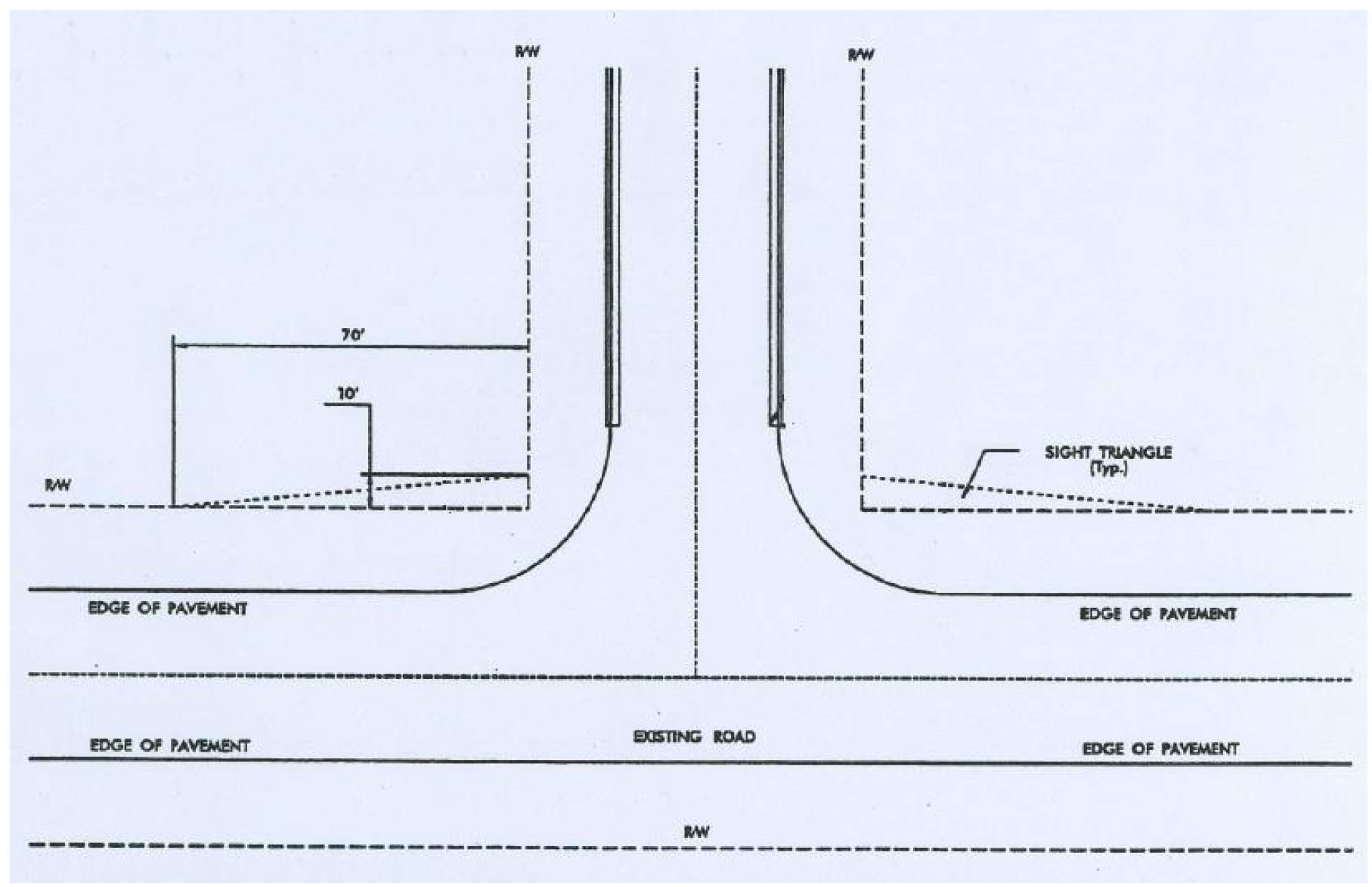
Sight Visibility. To minimize traffic hazards at street or driveway intersections. See the following graphic from the North Carolina Department of Transportation's Policy on Street and Driveway Access to North Carolina Highways manual.
17-10-2
Sight Triangles Required. No sight obstructing or partially obstructing wall, fence, foliage, berming, parked vehicles or sign between the heights of 24) inches and eight feet above the curb line elevation, or the nearest traveled way if no curbing exists, shall be placed within a sight triangle of a public street, private street or driveway contained either on the property or on an adjoining property, as set forth by the North Carolina Department of Transportation's Policy on Street and Driveway Access to North Carolina Highways manual, and all subsequent amendments thereto.
17-10-3
Size of Required Sight Triangles. A sight triangle is that triangle as set forth by the North Carolina Department of Transportation's Policy on Street and Driveway Access to North Carolina Highways manual, and all subsequent amendments thereto.
17-10-4
If the provisions of any other law, ordinance or regulation of the county or of the state shall be in conflict with this section, the more stringent provision shall control.
[Amended 7/21/2008 by OA 02-08]
17-11 - Operational Performance Standards.
17-11-1
Applicability. Whenever the uses in a zoning district are subject to the operational performance standards of this Article, all of the uses in that district except those that are allowed without a permit must comply with all of the applicable standards of this Article. At the time a permit is issued, it will not always be possible to determine whether a use will comply with all of these standards when construction is completed and operation is begun. Therefore, permittees are hereby put on notice that a Use Permit is issued on the condition that all applicable operational performance standards—just as with the other regulations in this ordinance—must be complied with continually and that any violation of this condition is a violation of this ordinance.
17-11-2
Effect of Two or More Uses. The sum total of the effects of two or more uses whether located on the same lot or different lots may not exceed the standards of this section. Compliance with the standards of this section by single or mutual changes in operational levels, scheduling of operations, or other appropriate means is permitted.
17-11-3
Noise.
(A)
Measurement. Noise must be measured with a sound level meter at the lines of the property from which the noise is being emitted. The instrument must be set to the A-weighted response scale, and the meter to slow response. Measurements must be conducted with the "American Standard Method for the Physical Measurements of Sound," American National Standard Institute (ANSI S1. 2-1962). When more than one sound level applies the more stringent one govern.
(B)
Standards. Except as provided in subsection (C) immediately below, noise may not exceed the following levels:
* When adjacent to any Residential district, the weighted sound level may not exceed 55 dba during the hours of 7:00 a.m. to 9:00 p.m. and 45 dba during the hours of 9:00 p.m. to 7:00 a.m.
(C)
Exceptions to Standards. The maximum sound levels in subsection (B) above may be exceeded if one of the following correction factors is applicable:
* Apply only one of these correction factors
(D)
Exclusion from Standards. Noises which are not under the direct control of an industrial use, such as from independent transportation facilities, are excluded from the standards established by this subsection.
17-11-4
Odor.
(A)
The applicable federal and State regulations over discharge (liquid), emissions (air), and disposal (solid waste) must take precedence over the standards in this subsection, and violation of those regulations will be a violation of this ordinance.
(B)
In those instances where the above federal and State regulations are not applicable, the standards in this subsection must be complied with. No use may emit any continuous, frequent, or repetitive odor or odor causing substance which is detectable at or beyond the lot lines of the property on which the use is located. An odor which is emitted no more than 15 minutes in any one day nor more than two days out of the calendar month may not be deemed to be continuous, frequent, or repetitive under this subsection. The existence of an odor must be presumed when the concentration of the odor causing substance in the air at or beyond a lot line exceeds the lowest concentration listed as the odor threshold for such a substance in Table III, "Odor Thresholds," appearing in Chapter 5, "Physiological Effects," The Air Pollution Abatement Manual, Manufacturing Chemists' Association (1952), or any subsequent amendments or revisions thereto. Substances which are not listed in that table will not be deemed odorous unless analysis by a competent chemist demonstrates that a discernible odor is being emitted.
(C)
In any district other than Industrial or Airport districts, no emission of an odor or odor causing substance is permitted.
17-11-5
Glare. No glare, whether direct or reflected, such as from sunlight, floodlights, or operational processes, must be visible at or beyond the lot line of the property from which it is being emitted.
17-11-6
Heat.
(A)
The applicable federal and State regulations over discharges (liquid) and emissions (air) take precedence over the standards in this subsection, and a violation of those regulations will be a violation of this ordinance.
(B)
Where the above federal and State regulations are not applicable, the standards in this subsection must be complied with. No continuous, frequent, or repetitive discharge or emission of heat is allowed if it increases the general temperature by one degree Celsius or more at or beyond the lot line of the property from which it is being emitted.
17-11-7
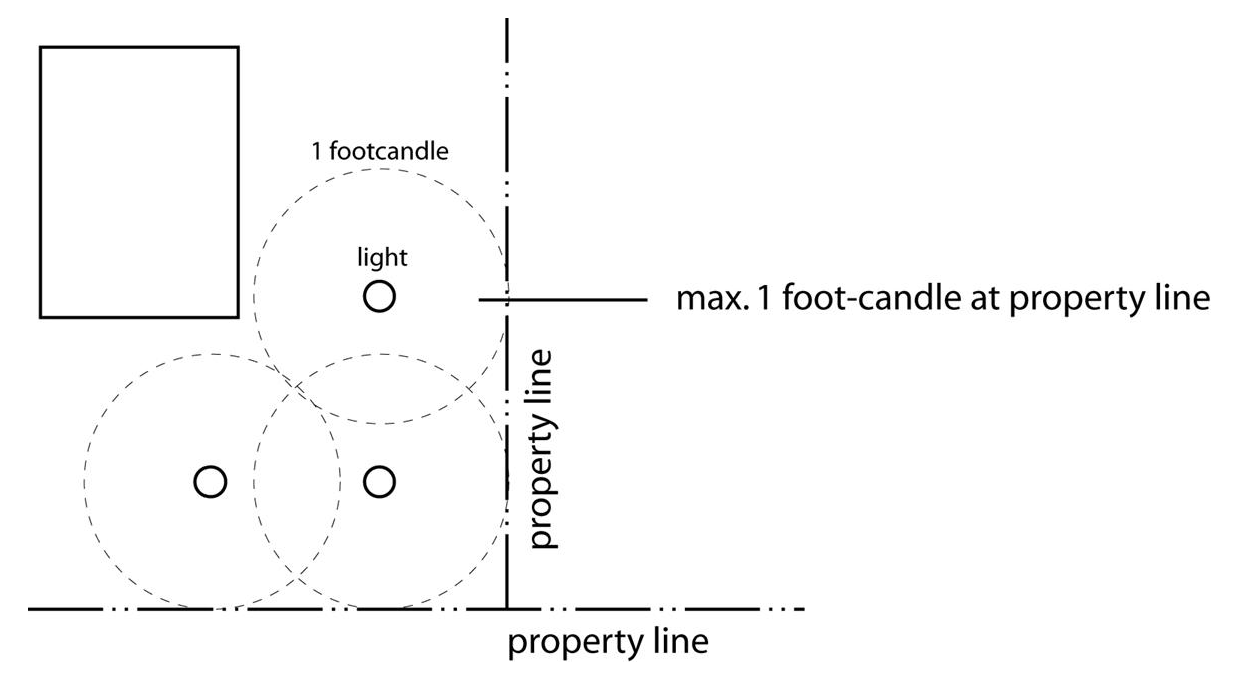
Exterior Lighting. All exterior lighting must be shielded or directed away from any adjacent use or lot or any adjacent public street. No exterior lighting may cause illumination in excess of one foot candle at the lot line of any use.
17-11-8
Vibration.
(A)
Measurement. Ground transmitted vibration must be measured at the lot line of the property from which the vibration is being emitted using a seismograph or complement of instruments capable of recording vibration displacement and frequency, particle velocity, or acceleration simultaneously in three mutually perpendicular directions. When more than one vibration level applies, the more stringent one govern.
(B)
Standards.
(1)
Vibration may not exceed the following levels:
* When adjacent to any Residential district, the peak particle velocity may not exceed 0.02 inches per second during the hours of 7:00 a.m. to 9:00 p.m. and 0.01 inches per second during the hours of 9:00 p.m. to 7:00 a.m.
(2)
The maximum particle velocity must be the maximum vector of three mutually perpendicular components recorded simultaneously. Particle velocity may also be expressed as 6.28 times the displacement in inches multiplied by frequency in cycles per second. Steady state vibrations are ones which are continuous or in discrete impulses of more than 60 per minute. Discrete impulses which do not exceed 60 per minute must be considered impact vibrations. Impact vibrations are limited to values which are not greater than twice those specified above.
17-11-9
Airborne Emissions.
(A)
Smoke.
(1)
The applicable federal and State regulations over emissions (air) take precedence over the standards in this subsection, and a violation of those regulations will be a violation of this ordinance.
(2)
When the above federal and State regulations are not applicable, the standards in this subsection must be complied with. Smoke must be measured at the point of emission using the Ringelmann Smoke Chart published by the U. S. Bureau of Mines. Smoke which is not darker or more opaque than No. 1 on the Ringelmann Chart may be emitted, except that smoke which is not darker or more opaque than No. 2 on such chart may be emitted for periods not longer than four minutes out of any 30 minutes. These standards are applicable to visible grey smoke but also apply to visible smoke with a different color but an equivalent apparent opacity.
(B)
Particulate Matter.
(1)
The applicable federal and State regulations over emissions (air) take precedence over the standards in this subsection, and violation of those regulations will be a violation of this ordinance.
(2)
When the above federal and State regulations are not applicable, solid particles may not be emitted at any point in concentration exceeding one-tenth grain of particulates per standard cubic foot being emitted.
(C)
Steam. The emission of visible steam with an equivalent opacity of 60 percent or higher is prohibited within 500 feet of a Residential use or district. In all other situations, no steam may be emitted which is perceptible to the senses at any lot line of the property.
(D)
Gases.
(1)
The applicable federal and State regulations over emissions (air) take precedence over the standards in this subsection, and a violation of those regulations will be a violation of this ordinance.
(2)
When the above federal and State regulations are not applicable, fumes or gases may not be emitted at any point in concentrations or amounts which are noxious, toxic or corrosive. The values given in Table I, "Industrial Hygiene Standards—Maximum Allowance Concentration for Eight Hour Day, Five Days per Week," Table II, "Odor Thresholds," Table IV, "Concentrations of Substances Causing Pain in the Eyes," and Table V, "Exposures to Substances Causing Injury to Vegetation," in Chapter 5 of the Air Pollution Abatement Manual, Manufacturing Chemists' Association, Inc., Washington, D.C., and any amendments or revisions thereto, are hereby established as guides for determining the permissible concentrations or amounts of fumes or gases.
17-11-10
Toxic Matter. The applicable federal and State regulations over discharges (liquid) or disposal (solid matter) must be complied with, and a violation of those regulations will be a violation of this ordinance.
17-11-11
Fire and Explosion. The manufacture, storage, or utilization of flammable liquids, gases or explosive materials are allowed only in accordance with the North Carolina Fire Code and other applicable federal and state regulations.
17-11-12
Radiation. No use may cause any dangerous radiation at any lot line in violation of the regulations of the U. S. Nuclear Regulatory Commission.
17-11-13
Radioactivity. No use may cause any radioactivity at any lot line in violation of the "Standards for Protection Against Radiation," Title 10, Chapter 1, Part 20, Code of Federal Regulations (January 16, 1957), and any subsequent amendments or revisions thereto, and "The Use of Ionizing Radiation, Radiation Machines, and Radioactive Materials, and Atomic Energy," NCGS §104C-1-5, and any subsequent amendments or revisions thereto.
17-11-14
Electrical Radiation. No electrical radiation may adversely affect any operations or equipment other than those of the creator of the radiation.
17-11-15
Waste.
(A)
The applicable federal and State regulations over discharges (liquid industrial wastes or sewage) and disposal (solid industrial wastes) take precedence over the standards in this subsection, and a violation of those regulations will be a violation of this ordinance.
(B)
When the above regulations are not applicable, the disposal or discharge of all solid or liquid industrial wastes, including sewage, must be approved by the Department of Health and Human Services.
[Amended on 11/18/2024 by OA-01-24]
17-12 - Trash Storage Area Requirements.
17-12-1
Applicability. All of the following must provide for the enclosure and screening of dumpsters and trash collection bins:
(A)
Multi-unit buildings containing more than five dwelling unit; and
(B)
Business, commercial, industrial or manufacturing uses.

