
Wake County Unincorporated
City Zoning Code
City Zoning Code
ARTICLE 19
- Review and Approval Procedures
19-10 - Preapplication Conferences.
Individuals intending to submit applications for review and approval should confer with the Planning Director before submitting an application. At such conference, the Planning Director will explain applicable procedures and standards, including the traffic impact analysis requirements of Sec. 15-12, and identify potential problems, conflicts and available processing options.
19-11 - Form of Application and Filing Fees.
19-11-1
All applications required under this ordinance must be submitted in a form and in such numbers as required by the official responsible for accepting the application. Application forms, detailing the specific requirements for each specific type of application, are available in the Planning Department office.
19-11-2
Officials responsible for accepting applications must maintain a list specifying the materials and information to be submitted with each application filed. The list must be made available to all applicants and to any other person who requests a copy.
19-11-3
Applications must be accompanied by the fee amount that has been established by Board of Commissioners. Application fees are nonrefundable.
19-11-4
Site plans submitted with applications to be heard by the Board of Adjustment and site plans for proposed development in water supply watersheds must be prepared by a licensed professional engineer, surveyor, architect, landscape architect, or planner authorized by the North Carolina General Statutes to perform such work.
19-12 - Application Completeness.
19-12-1
An application will be considered complete and ready for processing only if it is submitted in the required number and form, includes all required information and is accompanied by the required filing fee.
19-12-2
The Planning Director must review all submitted applications to determine whether the application complies with all submittal requirements.
19-12-3
The Planning Director must notify the applicant of any deficiencies in the application and invite the applicant to revise the application to correct identified deficiencies. If or when the application complies with all submittal requirements, the Planning Director must accept the application as complete and notify the applicant of its acceptance.
19-12-4
No further processing of incomplete applications will occur until the deficiencies are corrected.
19-13 - Withdrawal of Applications.
Applicants may withdraw applications at any time by submitting written notice of the withdrawal to the Planning Director.
19-14 - Timely Processing of Applications.
The Planning Director, Planning Board, Board of Adjustment, Board of Commissioners and all other authorized review and decision-making bodies must make every reasonable effort to process, review, and act on applications in a timely manner, consistent with the need to fully consider the application's proposed impact and ensure that it is consistent with the spirit and intent of the Wake County Comprehensive Plan and otherwise advances the public health, safety, and general welfare.
[Amended on 11/21/2022 by OA-02-22]
19-15 - Burden of Proof.
The burden of demonstrating that an application complies with applicable review and approval criteria is on the applicant.
19-16 - Review and Decision-making Summary.
The following table provides a summary of the review and decision-making authority granted under this ordinance.
R = Review and/or Recommendation DM = Decision Making Authority <> = Public Hearing
[Amended on 2/5/2018 by OA 01-17; Amended on 3/19/18 by OA 02-17]
19-20 - Unified Development Ordinance Text Amendments.

19-20-1
Purpose. The text amendment procedures of this section are intended to accommodate substantive changes to this ordinance's text that are consistent with the Wake County Comprehensive Plan and otherwise advance the public health, safety, and general welfare.
[Amended on 11/21/2022 by OA-02-22]
19-20-2
Applicability.
(A)
All substantive amendments to the text of this ordinance must be processed in accordance with the provisions of this section.
(B)
The Planning Director is authorized to correct typographical errors, numerical reference errors, spelling errors, and errors in section or page numbering, and to make other non-substantive editorial changes to the text of this ordinance without formal adoption by the Board of Commissioners, provided that the changes necessary to correct such errors do not change the meaning of the ordinance.
19-20-3
Authority to File.
(A)
A proposal to amend the text of this ordinance may be initiated by:
(1)
The Board of Commissioners, by passing a motion directing county staff to consider the proposal;
(2)
The Planning Board, the Board of Adjustment, any resident of Wake County, or any owner of real property in Wake County, by submitting a request for consideration of the proposal to the Board of Commissioners; or
(3)
The Planning Director, on preparing an application for the amendment.
(B)
If a request for consideration of an amendment proposal is submitted to the Board of Commissioners, the Board of Commissioners may decline to consider the request or may refer the amendment proposal to the Planning Director for preparation of an amendment application.
19-20-4
Staff Review. After accepting an application as complete, the Planning Director must review the application and analyze the proposed amendment's consistency with the Comprehensive Plan and the county's other development-related policies. The Planning Director must notify the applicant of all findings and, on determining that revisions to the application could constructively address the staff findings, invite the applicant to revise the application to address those findings. If a revised application is submitted, the Planning Director must review and analyze it in the same manner as the original application. The Planning Director must prepare a staff report that summarizes the analysis and recommends approval or denial of the proposed amendment.
[Amended on 11/21/2022 by OA-02-22]
19-20-5
Planning Board Review.
(A)
Submittal of Application to Board. After completing the staff report, the Planning Director must schedule the amendment application for review by the Planning Board and send Planning Board members copies of the amendment application and the staff report. The Planning Director must also notify the applicant of the time and place of the Planning Board meeting and send the applicant a copy of the staff report.
(B)
Board Hearing of Presentations. At its meeting, the Planning Board must receive the amendment application and staff report, and hear presentations of additional comments, exhibits, and arguments pertaining to the application by the Planning Director and the applicant. The Planning Board may also hear presentations by any other interested party. To avoid unnecessary delay, the Planning Board's presiding officer may impose reasonable limits on the number of persons heard and on the nature and length of their presentation.
(C)
Board Review and Action. After hearing presentations, the Planning Board must review the amendment application, the staff report, and additional information and comments submitted or presented to the Planning Board, and must recommend approval or denial of the proposed amendment in writing and within 30 days of the public hearing. Before completing its review and making its recommendation, the Planning Board may refer the application to a committee for further consideration. In deciding whether to recommend approval or denial of an amendment application, the Planning Board must consider whether the proposed amendment is consistent with the Wake County Comprehensive Plan and otherwise advances the public health, safety, and general welfare. When a recommendation is not made within the time periods established in this section, the Board of County Commissioners may process the request without a Planning Board recommendation.
(D)
Opportunity to Revise Application. After the Planning Board has heard presentations and completed its discussion of the application, but before the Planning Board recommends action on the application, the applicant may ask the Planning Board for permission to revise the application to address concerns raised by the presentations and Planning Board discussion. If the Planning Board grants the request, the revised application must be submitted to the Planning Director, and must be reviewed in the same manner as an original application.
(E)
Conflicts of Interest. Planning Board members may not vote on any matter that is reasonably likely to have a direct, substantial and readily identifiable financial impact on the member.
[Amended on 11/21/2022 by OA-02-22]
19-20-6
Board of Commissioners Public Hearing and Review.
(A)
Public Hearing Required. After the Planning Board has completed its review, the Board of Commissioners must hold a public hearing on the amendment application at its next available regularly scheduled public hearing. Once a public hearing on the application has been scheduled and advertised for a particular meeting, it must be held at that meeting unless some emergency or special circumstance requires cancellation or early recess of the meeting.
(B)
Notice of Public Hearing. The Planning Director must provide notice of the public hearing in accordance with the provisions of Section 160D-601 of the North Carolina General Statutes. The notice must state the time and place of the public hearing, briefly summarize the nature of the proposed amendment, and invite interested persons to review the application at the Planning Department and to submit written or oral comments on the application to the Board of Commissioners at the hearing.
(C)
Submittal of Application to Board. Before the public hearing, the County Manager must send members of the Board of Commissioners copies of the amendment application, the recommendations of the Planning Director and Planning Board, and any written comments submitted by the public (or an accurate summary of those comments). The Planning Director must send the applicant a copy of the Planning Director's and Planning Board's recommendations.
(D)
Public Hearing. At the public hearing, the Board of Commissioners must receive the amendment application and recommendations of the Planning Director and Planning Board, and hear presentations of additional comments, exhibits, and arguments pertaining to the application by the Planning Director, applicant, representatives of the Planning Board, and any other interested party. To avoid unnecessary delay, the Board of Commissioners' presiding officer may impose reasonable limitations on the number of persons heard and on the nature and length of their presentation. The Board of Commissioners may continue the hearing to a later meeting to accommodate additional comments, information, or speakers. If the Board of Commissioners continues the hearing to a named date, no further notice of the continued hearing is required.
(E)
Board Review and Action. Following the public hearing, the Board of Commissioners must review the amendment application, recommendations of the Planning Director and Planning Board, and other information and comments submitted or presented at the hearing, and must approve the proposed amendment, deny the amendment application, or approve a modified amendment that is within the scope of matters considered at the public hearing. Before completing its review and making its final decision, the Board of Commissioners may postpone its discussion and/or action to a later meeting, or refer the application to a committee or back to the Planning Director and Planning Board for further consideration. In deciding whether to approve or deny an amendment application, the Board of Commissioners must adopt a statement describing whether the proposed amendment is consistent with the Wake County Comprehensive Plan and otherwise advances the public health, safety, and general welfare. The Board of Commissioners may adopt the statement furnished by staff or agencies or it may formulate its own statement.
[Amended on 11/21/2022 by OA-02-22]
19-20-7
Actions Following Final Decision. The Planning Director must send the applicant written notice of the Board of Commissioners' final decision on the amendment application, and must file a copy of the decision in the Planning Department. If the Board of Commissioners approved the application, the Planning Director must record the changes into this ordinance's text.
[Amended 6/7/2021 by OA-01-21].
19-21 - Zoning Map Amendments (Rezonings).

19-21-1
Purpose. The zoning map amendment (rezoning) procedures of this section set forth the required review and approval procedures for changes to the zoning map that are consistent with the Wake County Comprehensive Plan and otherwise advance the public health, safety, and general welfare. They are not intended to relieve particular hardships or to confer special rights or privileges.
[Amended on 11/21/2022 by OA-02-22]
19-21-2
Authority to File.
(A)
A proposal to amend the zoning map to rezone land to a general use district may be initiated by:
(1)
The Board of Commissioners, by passing a motion directing county staff to consider the proposal;
(2)
The Planning Board, the Board of Adjustment, any resident of Wake County, or any owner of real property in Wake County, by submitting a request for consideration of the proposal to the Board of Commissioners;
(3)
The Planning Director, on preparing an application for the amendment; or
(4)
Any resident of Wake County, or any owner of real property in Wake County, on submitting an application for the amendment to the Planning Director.
(B)
If a request for consideration of an amendment proposal is submitted to the Board of Commissioners, the Board may decline to consider the request or may refer the amendment proposal to the Planning Director for preparation of an application in accordance with the provisions of this section.
(C)
A request to amend the zoning map to rezone land to a Conditional Zoning district may be initiated only by the owner of the subject property, on submitting an application for the amendment to the Planning Director.
19-21-3
Contents of Application.
(A)
All Applications. An application to amend the zoning map must include those forms, maps, plans, and other documents prescribed by the Planning Director as necessary to identify the applicant, to describe the nature of the requested amendment, and to state justifications for the amendment. The application must also include those forms, maps, plans and other materials prescribed by the Planning Director as necessary to identify and describe the land proposed to be rezoned, to identify its owners, and to identify and notify the owners of properties adjacent to it. If required pursuant to Sec. 15-12, such applications must also include a traffic impact analysis.
(B)
Applications for Conditional Zoning District Rezonings.
(1)
Signed by Property Owners. An application to rezone land to a Conditional Zoning district must be signed by all owners of the land proposed to be rezoned, or by their authorized agents. Applications signed by a landowner's agent rather than the landowner must also include documentation of the agent's authorization to sign on behalf of the owner.
(2)
Proposed Rezoning Conditions.
(a)
A landowner requesting to rezone land to a Conditional Zoning district may propose conditions to be placed on the requested rezoning. The application must specify any proposed conditions, either in writing or with maps, plans, or drawings. Conditions and site-specific standards imposed in a Conditional Zoning district are limited to those that address conformance of the development to county ordinance standards and the Comprehensive Plan and those that address the impacts reasonably expected to be generated by the development or use of the site.
(b)
Any proposed conditions must impose requirements that are more restrictive than those generally applicable in the proposed Conditional Zoning district. Conditions might limit the amount of floor area, the location and size of structures, the location and extent of access ways and parking areas, the location and extent of buffer areas, the hours of business operation, or the timing of development.
(c)
No condition, however, may restrict the race, religion, ownership status, or character of residents or occupants of the property, or contain any other exclusionary restrictions. Nor may any condition purport to abridge or affect any other applicable federal, state, or local law.
(3)
Site-Specific Development Plans. If an application to rezone land to a Conditional Zoning district includes a plan that shows at least the information specified by the definition of "site-specific development plan" in Section 160D-102 of the North Carolina General Statutes, such plan constitutes a "site-specific development plan," the approval of which establishes a vested right pursuant to Section 160D-108 of the North Carolina General Statutes.
[Amended on 11/21/2022 by OA-02-22]
19-21-4
Notice of Acceptance. If the amendment application proposes amending the zoning map, the Planning Director must provide notice of the application's acceptance in accordance with the provisions of Section 160D-601 of the North Carolina General Statutes and Chapter 252 of the North Carolina Session Laws, 1989. The notice must briefly summarize the nature of the proposed amendment and invite interested persons to review the application at the Planning Department and to submit written or oral comments on the application.
19-21-5
Staff Review. After accepting an application as complete, the Planning Director must review the application and analyze the proposed amendment's consistency with the Comprehensive Plan and the county's other development-related policies. The Planning Director must notify the applicant of all findings and, on determining that revisions to the application could constructively address the staff findings, invite the applicant to revise the application to address those findings. If a revised application is submitted, the Planning Director must review and analyze it in the same manner as the original application. The Planning Director must prepare a staff report that summarizes the analysis and recommends approval or denial of the proposed amendment.
[Amended on 11/21/2022 by OA-02-22]
19-21-6
Planning Board Review.
(A)
Submittal of Application to Board. After completing the staff report, the Planning Director must schedule the amendment application for review by the Planning Board and send Planning Board members copies of the amendment application and the staff report. The Planning Director must also notify the applicant of the time and place of the Planning Board meeting and send the applicant a copy of the staff report.
(B)
Board Hearing of Presentations. At its meeting, the Planning Board must receive the amendment application and staff report, and hear presentations of additional comments, exhibits, and arguments pertaining to the application by the Planning Director and the applicant. The Planning Board may also hear presentations by any other interested party. To avoid unnecessary delay, the Planning Board's presiding officer may impose reasonable limits on the number of persons heard and on the nature and length of their presentation.
(C)
Board Review and Action. After hearing presentations, the Planning Board must review the amendment application, the staff report, and additional information and comments submitted or presented to the Planning Board, and must recommend approval or denial of the proposed amendment in writing and within 30 days of the public hearing. Before completing its review and making its recommendation, the Planning Board may refer the application to a committee for further consideration. In deciding whether to recommend approval or denial of an amendment application, the Planning Board must consider whether the proposed amendment is consistent with the Wake County Comprehensive Plan and otherwise advances the public health, safety, and general welfare. When a recommendation is not made within the time periods established in this section, the Board of County Commissioners may process the request without a Planning Board recommendation.
(D)
Opportunity to Revise Application. After the Planning Board has heard presentations and completed its discussion of the application, but before the Planning Board recommends action on the application, the applicant may ask the Planning Board for permission to revise the application to address concerns raised by the presentations and Planning Board discussion. If the Planning Board grants the request, the revised application must be submitted to the Planning Director, and must be reviewed in the same manner as an original application.
(E)
Conflicts of Interest. Planning Board members may not vote on any matter that is reasonably likely to have a direct, substantial and readily identifiable financial impact on the member.
[Amended on 11/21/2022 by OA-02-22]
19-21-7
Board of Commissioners Public Hearing and Review.
(A)
Public Hearing Required. After the Planning Board has completed its review, the Board of Commissioners must hold a public hearing on the amendment application at its next available regularly scheduled public hearing. Once a public hearing on the application has been scheduled and advertised for a particular meeting, it must be held at that meeting unless some emergency or special circumstance requires cancellation or early recess of the meeting itself.
(B)
Notice of Public Hearing.
(1)
The Planning Director must provide notice of the public hearing in accordance with the provisions of Section 160D-601 of the North Carolina General Statutes. The notice must state the time and place of the public hearing, briefly summarize the nature of the proposed amendment, and invite interested persons to review the application at the Planning Department and to submit written or oral comments on the application to the Board of Commissioners at the hearing.
(2)
For zoning map amendments directly affecting more than 50 properties owned by at least 50 different property owners, the county may elect to provide mailed notice or publish notice of the hearing as allowed by state statute, provided that each advertisement must be at least one-half of a newspaper page in size. The advertisement is only effective for property owners who reside in the area of general circulation of the newspaper which publishes the notice. Property owners who reside outside of the newspaper circulation area, according to the address listed on the most recent property tax listing for the affected property, must be provided with mailed notice.
(3)
Signs must be posted by the Planning Director in accordance with Section 160D-602 of the North Carolina Statutes.
(C)
Submittal of Application to Board. Before the public hearing, the County Manager must send members of the Board of Commissioners copies of the amendment application, the recommendations of the Planning Director and Planning Board, and any written comments submitted by the public (or an accurate summary of those comments). The Planning Director must send the applicant a copy of the Planning Director's and Planning Board's recommendations.
(D)
Public Hearing. At the public hearing, the Board of Commissioners must receive the amendment application and recommendations of the Planning Director and Planning Board, and hear presentations of additional comments, exhibits, and arguments pertaining to the application by the Planning Director, applicant, representatives of the Planning Board, and any other interested party. To avoid unnecessary delay, the Board of Commissioners' presiding officer may impose reasonable limitations on the number of persons heard and on the nature and length of their presentation. The Board of Commissioners may continue the hearing to a later meeting to accommodate additional comments, information, or speakers. If the Board of Commissioners continues the hearing to a named date, no further notice of the continued hearing is required.
(E)
Board Review and Action. Following the public hearing, the Board of Commissioners must review the amendment application, recommendations of the Planning Director and Planning Board, and other information and comments submitted or presented at the hearing, and must approve the proposed amendment, deny the amendment application, or approve a modified amendment that is within the scope of matters considered at the public hearing. Before completing its review and making its final decision, the Board of Commissioners may postpone its discussion and/or action to a later meeting, or refer the application to a committee or back to the Planning Director and Planning Board for further consideration. In deciding whether to approve or deny an amendment application, the Board of Commissioners must adopt a statement describing whether the proposed amendment is consistent with the Wake County Comprehensive Plan and otherwise advances the public health, safety, and general welfare. The Board of Commissioners may adopt the statement furnished by staff or agencies or it may formulate its own statement.
(F)
Opportunity to Revise Application. After the Board of Commissioners has heard presentations and completed its discussion of the application, but before the Board of Commissioners takes action on the application, the applicant may ask the Board of Commissioners for permission to revise the application to address concerns raised by the presentations and Board discussion. If the Board of Commissioners grants the request, the revised application must be submitted to the Planning Director, and must be reviewed in the same manner as an original application.
(G)
Site-Specific Development Plans. If the Board of Commissioners approves an application for rezoning to a Conditional Zoning district that includes a plan qualifying as a site specific development plan, the Board of Commissioners must identify the approved plan as a site specific development plan that triggers a vested right pursuant to Section 160D-108 of the North Carolina General Statutes.
[Amended on 11/21/2022 by OA-02-22]
19-21-8
Revised Applications. To revise an amendment proposal at any time other than expressly allowed under this section, the applicant must first withdraw the original amendment application in accordance with Sec. 19-13 then resubmit a new amendment application in accordance with Sec. 19-21-10.
19-21-9
Actions Following Final Decision. The Planning Director must send the applicant written notice of the Board of Commissioners' final decision on the amendment application, and must file a copy of the decision in the Planning Department. If the Board of Commissioners approved the application, the Planning Director must record the changes onto official copies of the zoning map.
19-21-10
Waiting Period for Resubmittal of Application.
(A)
If the Board of Commissioners denies an amendment application or if the applicant withdraws the application after the hearing notice required in Sec. 19-21-7(B), the Planning Director may not accept another application for the same or similar amendment for at least one year after the denial or withdrawal, unless the Board of Commissioners first approves the applicant's request for an exception to this provision.
(B)
An application for a rehearing may be considered by the Board of Commissioners within 12 months after the date of denial or withdrawal. The application for rehearing must be accompanied by an affidavit setting forth evidence that significant physical, economic or land use changes have taken place on the subject tract or within the immediate vicinity, or newly discovered evidence that was not available at the initial hearing, or a significant ordinance amendment has been adopted.
19-21-11
Changes to Conditional Zoning Conditions. Any proposed change to the conditions approved as part of an amendment rezoning land to a Conditional Zoning district must be considered a proposed amendment to the zoning map and must be processed as a new amendment application.
19-21-12
Amendments of Provisions and District Boundaries Related to Water Supply Watershed Protection.
(A)
Compliance with State Watershed Rules. Those provisions of this ordinance relating to the protection of water supply watersheds, as well as those zoning district boundaries reflecting the boundaries of any water supply watershed or its critical or protected area, may not be amended except in compliance with the watershed rules adopted by the State Environmental Management Commission (Title 15A, Subchapter 2B, of the North Carolina Administrative Code).
(B)
Filing of Amendments with State. The Planning Director must submit copies of any amendment relating to the protection of water supply watersheds to the State Division of Water Quality, or its successor agency.
[Amended 6/7/2021 by OA-01-21].
19-22 - Reserved for future use.
[OA 04/03 January 18, 2005; Amended on 2/5/2018 by OA 01-17]
19-23 - Special Use.

19-23-1
General.
(A)
Any use or development designated by applicable zoning district regulations as a special use, or as allowed only pursuant to a Special Use Permit, may be established in that district only after the use or development is authorized by a validly issued and recorded Special Use Permit.
(B)
This section sets forth required review and approval procedures for submitting, reviewing, and approving applications for Special Use Permit.
(C)
A Special Use Permit authorizes its holder to use or develop a particular parcel of land in a particular way, as specified by the Special Use Permit's terms and conditions.
(D)
A Special Use Permit imposes on its holder the responsibility of ensuring that the authorized use or development continues to comply with the terms and conditions of approval.
(E)
Issuance of a Special Use Permit does not relieve the holder of the Special Use Permit of the additional responsibility of obtaining a building permit or any other permit or approval required by any other applicable law.
19-23-2
Purpose. Regulations for the various zoning districts recognize and permit certain uses and developments that, because of their inherent nature, extent, and external effects, require special consideration of their location, design, and methods of operation to ensure that their location in the particular district is appropriate and the public health, safety, and general welfare is protected. Such uses and developments are designated as Special Uses or as uses allowed only pursuant to a Special Use Permit.
19-23-3
Applications. A person proposing uses or development requiring a Special Use Permit must submit a Special Use Permit application to the Planning Director.
(A)
The application must:
(1)
Include, with sufficient copies for necessary referrals and records, those forms, maps, plans, and other documents prescribed by the Planning Director as necessary to identify the applicant and owner of the property on which development is proposed;
(2)
Describe the development site;
(3)
Identify and notify the owners of properties adjacent to the site;
(4)
Depict the nature and scope of the proposed development, and show how the development would allow each of the required conclusions to be reached; and
(5)
Be accompanied by a traffic impact analyses if required pursuant to Sec. 15-12;
(B)
The Planning Director may waive submittal requirements by certifying in writing that information is unnecessary in the particular case to determine compliance with applicable regulations or address the required conclusions.
(C)
Plans must be prepared by a licensed designed professional authorized by the North Carolina General Statutes to perform such work.
19-23-4
Process Generally.
(A)
Review of Special Use Permit applications is a quasi-judicial process, where the Board of Adjustment acts much like a panel of judges. It hears factual evidence presented to it at an evidentiary hearing, then makes findings of fact supported by competent, substantial, and material evidence. Based on those findings, the Board of Adjustment decides whether or not it can reach each of the required conclusions specified in 19-23-8 below.
(B)
Although Special Use Permit review procedures need not be as formal as those used by the courts, the same constitutional due process requirements apply. Thus, interested parties have the right to offer evidence, cross-examine adverse witnesses, inspect documents, have sworn testimony, have the decision based only on evidence that is properly in the hearing record, and have written findings of fact supported by competent, substantial, and material evidence.
(C)
All interested parties have a right to know all the evidence being considered as part of the Board of Adjustment's decision. Hence the Board of Adjustment may consider only evidence presented at the evidentiary hearing on the application, and it is improper for the applicant or any other interested party to communicate with Board of Adjustment members about the application outside of the hearing.
19-23-5
Staff Review.
(A)
After accepting an application as complete, the Planning Director must refer it to appropriate staff for review.
(B)
The review staff must determine whether the proposed development complies with all applicable regulations and standards, and identify any other significant concerns about whether the required conclusions can be reached.
(C)
The Planning Director must notify the applicant of the staff findings and concerns, and, on determining that revisions to the application could constructively address the staff findings, invite the applicant to revise the application to address those findings.
(D)
If a revised application is submitted, the Planning Director must cause it to be reviewed in the same manner as the original application.
(E)
The Planning Director must then prepare a staff report that summarizes the analysis.
(F)
At a reasonable time before the hearing, the Planning Director must send members of the Board of Adjustment copies of the application and the staff report. The Planning Director must also send the applicant a copy of the staff report.
19-23-6
Public Hearings.
(A)
Timing.
(1)
After the staff has completed its review, the Board of Adjustment must hold a hearing on the application at its next available regularly scheduled meeting.
(2)
Once a hearing on the application has been scheduled and advertised for a particular meeting, it must be held at that meeting unless some emergency or special circumstance requires cancellation or early recess of the meeting itself.
(B)
Notice.
(1)
At least ten days before the hearing, the Planning Director post notice of the hearing on the proposed development site and send written notice of the hearing to the applicant and the owner of the property on which development is proposed, and to the owners of all real property adjoining and across the street from the property on which development is proposed (as identified in County tax listings current when the application is filed).
(2)
On determining that the proposed development would likely have significant impacts on other properties in the neighborhood, the Planning Director must also send written notices to the owners of those properties (as identified in current County tax listings), and may require the applicant to submit the additional materials necessary to provide such notices.
(3)
Notices to the applicant and owner of the property on which the development is proposed must be sent via certified mail, return receipt requested. All other mailed notices must be sent via first-class mail.
(4)
On determining that the proposed development would likely have significant impacts on properties beyond the neighborhood of the proposed development site, the Planning Director must cause notice of the hearing to be published in a newspaper of general circulation in the County or area of the proposed development site. The notice must be published in each of two successive calendar weeks, with the first notice being published between ten and 25 days before the hearing date.
(C)
Hearing.
(1)
At the hearing, the Board of Adjustment must receive the application and staff report as evidence, and must allow the applicant and other interested parties the opportunity to offer evidence, cross-examine adverse witnesses, inspect documents, and offer evidence in explanation and rebuttal. Board of Adjustment members may question any interested party with respect to testimony or evidence. Any Board of Adjustment member who has prior or specialized knowledge relevant to the application (such as that gathered from a visit to the proposed development site) must disclose such evidence at the hearing.
(2)
Witnesses presenting evidence during the hearing must do so under oath (sworn or affirmed). The Board of Adjustment's presiding officer, and the clerk to the board, may administer oaths to witnesses. The presiding officer may also take whatever action is necessary to limit testimony to the presentation of new factual evidence that is material to the application, to ensure fair and orderly proceedings, and to otherwise promote the efficient and effective gathering of evidence. Such actions may include barring the presentation of obvious hearsay evidence (e.g., another person's statement supporting or opposing the proposal), barring the presentation of non-expert opinion (i.e., an opinion from a person lacking sufficient experience or knowledge to form a basis for the opinion), interrupting digressions into immaterial testimony, interrupting repetitive testimony, reasonably limiting the time allotted each witness or cross-examination, providing for the selection of spokespersons to represent groups of persons with common interests, interrupting personal attacks, and ordering an end to disorderly conduct.
(3)
The Board of Adjustment may continue the hearing to a later meeting to accommodate additional witnesses or the presentation of additional testimony or evidence. If the time and place of the continued hearing is announced in open session during the hearing, no further notice need be given for the continued hearing.
19-23-7
Review and Decision.
(A)
Following the hearing, the Board of Adjustment must review and discuss the evidence presented at the hearing, make specific findings of fact supported by that evidence, and determine whether or not such findings allow it to reasonably reach each of the required conclusions. In making findings of fact and reaching conclusions, the Board of Adjustment may consider only competent, substantial, and material evidence presented at the hearing.
(B)
The applicant bears the burden of presenting sufficient evidence in support of the application to allow the Board of Adjustment, after weighing such evidence against that presented in opposition to the application, to make findings of fact that reasonably support each of the required conclusions. If that burden is met, the Board of Adjustment must approve the application. If that burden is not met, the Board of Adjustment must deny the application, provided that if the Board of Adjustment determines that specific minor changes or additions to, or restrictions on, the proposed development are necessary and sufficient to overcome impediments to its reaching the required conclusions, it may approve the application subject to reasonable conditions requiring such changes or additions or imposing such restrictions. Such conditions may include time limits for completion of development or for the start or end of certain uses or activities.
(C)
A resolution or motion to approve the application must state the required conclusions and include findings of fact on which the conclusions are based, plus any proposed conditions of approval. The favorable vote of at least three members of the Board of Adjustment is necessary to adopt such a resolution or pass such a motion. A resolution or motion to deny the application must state which of the required conclusions cannot be reached and include findings of fact on which the inability to reach the conclusions is based. The favorable vote of a majority of Board of Adjustment members present is necessary to adopt such a resolution or pass such a motion. If a resolution or motion to approve the application fails, the application is deemed denied, and those members voting against the resolution or motion must state which of the required conclusions they could not reach as well as findings of fact on which their inability to reach the conclusions is based.
(D)
If the Board of Adjustment approves an application that includes one or more plans qualifying as a site-specific development plan under Section 160D-102 of the North Carolina General Statutes, it must identify the approved plan as a site specific development plan that triggers a vested right pursuant to Section 160D-108 of the North Carolina General Statutes.
19-23-8
Conclusions Required for Approval. The Board of Adjustment may not approve an application for a Special Use Permit unless it first reaches each of the following conclusions based on findings of fact supported by competent, substantial, and material evidence presented at the hearing. The considerations listed below each required conclusion are intended to suggest some of the primary concerns pertinent to reaching the conclusion, but are not intended to be all-inclusive.
(A)
The proposed development will not materially endanger the public health or safety. Considerations:
(1)
Traffic conditions in the vicinity, including the effect of additional traffic on streets and street intersections, and sight lines at street intersection and curb cuts;
(2)
Provision of services and utilities, including sewer, water, electrical, garbage collections, fire protection;
(3)
Soil erosion and sedimentation; and
(4)
Protection of public, community, or private water supplies, including possible adverse effects on surface waters or groundwater.
(B)
The proposed development will comply with all regulations and standards generally applicable within the zoning district and specifically applicable to the particular type of Special Use or class of Special Uses. Special Use Permits for nonconformities are required to meet the provisions of Article 7.
(C)
The proposed development will not substantially injure the value of adjoining property, or is a public necessity. Considerations:
(1)
The relationship of the proposed use and the character of development to surrounding uses and development, including possible conflicts between them and how these conflicts will be resolved; and
(2)
Whether the proposed development is so necessary to the public health, safety, and general welfare of the community or County as a whole as to justify it regardless of its impact on the value of adjoining property.
(D)
The proposed development will be in harmony with the area in which it is located. Considerations:
(1)
The relationship of the proposed use and the character of development to surrounding uses and development, including possible conflicts between them and how these conflicts will be resolved; and
(2)
A Special Use Permit for a nonconformity will have equal or less of an adverse impact on those most affected by it or will be more compatible with the surrounding neighborhood than the use in operation at the time the permit is applied for.
(E)
The proposed development will be consistent with the Wake County Comprehensive Plan.
Considerations:
(1)
Consistency with the Plan's goals, objectives for the various planning areas, its definitions of the various land use classifications and multi-use districts, and its locational standards; and
(2)
Consistency with the municipal and joint land use plans incorporated in the Plan.
[Amended on 11/21/2022 by OA-02-22]
19-23-9
Revised Applications. After the Board of Adjustment has held the hearing and fully discussed the application, but before it takes action on the application, the applicant may ask the Board of Adjustment for permission to revise the application to address concerns raised during the hearing and Board of Adjustment discussion. If the Board of Adjustment grants the request, the revised application must be submitted to the Planning Director, and must be reviewed in the same manner as an original application, following the posted Board of Adjustment schedule.
19-23-10
Notice of Decision and Issuance of Special Use Permit.
(A)
The Planning Director must send the applicant written notice of the Board of Adjustment's final decision on the application, and must file a copy of the decision in the Planning Department office. If the application is denied, the notice must state the Board of Adjustment's reasons for its decision. This required notice must be sent via certified mail, return receipt requested.
(B)
If the application is approved, the Planning Director must issue the applicant a Special Use Permit identifying the property to which it applies, the development plans on which it is based, and any conditions to which it is subject. The applicant must record the Special Use Permit in the office of the Wake County Register of Deeds.
19-23-11
Appeal of Decision. Any person aggrieved by the Board of Adjustment's decision to approve or deny an application for a Special Use Permit may appeal the decision to Superior Court by an action in the nature of certiorari, provided the appeal is made within 30 days after written notice of the decision is delivered to the applicant, or a copy of the decision is filed in the Planning Director's office, whichever is later.
19-23-12
Waiting Period for Resubmittal of Application.
(A)
If the Board of Adjustment denies a Special Use Permit application, or if the applicant withdraws the application after the hearing notice required in Sec. 19-23-6(B), the Planning Director may not accept another application for the same or similar use or development until at least one year after the denial or withdrawal, unless the Board of Adjustment first approves the applicant's request for an exemption from this provision.
(B)
An application for a rehearing may be considered by the Board of Adjustment within 12 months after the date of denial or withdrawal. The application for rehearing must be accompanied by an affidavit setting forth evidence that significant physical, economic or land use changes have taken place on the subject tract or within the immediate vicinity, or newly discovered evidence that was not available at the initial hearing, or a significant ordinance amendment has been adopted.
19-23-13
Final Plans.
(A)
Final Plan Approval Required. No use or development authorized by approval of a Special Use Permit application may be established until the Special Use Permit has been recorded and the Planning Director has approved, or certified others' approval of, final plans for the authorized development, or for an approved phase thereof, as conforming to the plans, terms, and conditions of the Special Use Permit application approval and as complying with all applicable requirements of this ordinance.
(B)
Plan Modifications.
(1)
The Planning Director may approve, or certify approval of, final plans that reflect minor modifications of the plans approved as part of the Special Use Permit application on determining that the modifications continue to be consistent with the Board of Adjustment's approval of the Special Use Permit application (i.e., that the modifications are necessary to comply with conditions of approval or would not significantly change the development's general function, form, intensity, character, appearance, demand on public facilities, relationship to adjacent properties, impact on adjacent properties, or other characteristic from that indicated by the plans and materials approved as part of the Special Use Permit application).
(2)
Before making such a determination, the Planning Director must review the record of the proceedings on the Special Use Permit application and consider whether any proposed modification would require evidentiary support in addition to that on which the Board of Adjustment based its approval of the Special Use Permit application.
19-23-14
Validity of Permit.
(A)
Special Use Permit Binding on Land. A Special Use Permit runs with the land covered by the Special Use Permit and is binding on the original applicant as well as any subsequent successor, heir, or assign of the property to which it applies. Once the Special Use Permit is recorded with the Register of Deeds, no use or development other than that authorized by the Special Use Permit must be approved on that land unless the Special Use Permit is first voided or revoked in accordance with this subsection.
(B)
Time Limits and Extensions.
(1)
Starting Time Limits.
(a)
Approval of a Special Use permit will automatically expire within three years after the date of the Special Use Approval, and any associated permits or approvals granted pursuant to that Special Use approval, will automatically become void, if the applicable land use and/or building permits has not been obtained and completed for the entire development or the first phase of a phased development. All remaining phases of a phased development must be completed within seven years of the approved Special Use permit approval.
(2)
Extension of Starting and Completion Time Limits.
(a)
On request by the holder of a Special Use Permit, the Planning Director may extend the date on which the Special Use Permit would otherwise expire under Section 19-23-14(B)(1)(a) by up to 12 months on determining that:
i.
The Special Use Permit has not yet expired;
ii.
The holder of the Special Use Permit has proceeded with due diligence and good faith to start or continue the authorized use or development; and
iii.
Conditions or applicable regulations have not changed so substantially as to warrant reconsideration of the proposed use or development with respect to the public health, safety, and general welfare.
iv.
No previous extension of approval has been granted for the Special Use Permit.
(C)
Abandonment of Permit.
(1)
On request of the holder of a Special Use Permit, the Planning Director must approve the abandonment of the Special Use Permit on determining that the starting time limit established in Sec. 19-23-14(B) has not expired, or that the use or development authorized by the Special Use Permit no longer requires a Special Use Permit.
(2)
On approving the abandonment of a Special Use Permit, the Planning Director must issue the holder of the Special Use Permit a certification of Special Use Permit abandonment. The abandonment will not become effective until the holder of the Special Use Permit records that certification in the office of the Register of Deeds.
(D)
Cessation of Use. If the use authorized by a Special Use Permit is started, but ceases for a continuous period of 12 months, the Special Use Permit will automatically become void. The Planning Director must then record an instrument noting the voiding of the Special Use Permit in the office of Wake County Register of Deeds.
(E)
Revocation of Permit.
(1)
In accordance with Sec. 19-42-1(E) the Planning Director may revoke a Special Use Permit for failure to comply with the requirements of this section or the terms and conditions of the Special Use Permit. The Planning Director may also revoke a Special Use Permit in response to a request by the holder of the Special Use Permit on determining that:
(a)
The Special Use Permit is still valid and any completion time limit has not yet expired;
(b)
The request is made in conjunction with an application for approval of development other than that authorized by the Special Use Permit; and
(c)
The proposed design of the new development incorporates adequate consideration of the site's already-disturbed land area and previous commitments made as part of the Special Use Permit review process.
(2)
On revoking a Special Use Permit, the Planning Director must record an instrument noting the voiding of the Special Use Permit in the office of Wake County Register of Deeds.
[Amended by OA 06-13 on 3/17/2014; Amended on 9/15/2014 by OA 02-14; Amended by OA 01-18 on 7/23/2018; Amended 6/7/2021 by OA-01-21; Amended on 10/20/2025 by OA-04-25]
19-24 - Planned Developments.

19-24-1
Procedure.
(A)
Preliminary. The establishment of a PD district is in the nature of an amendment to the official zoning map and requires a development plan, regulatory standards and other documents, and certain showings of proof. For that reason, it is recommended, though not required, that the proposed PD District be discussed in a preliminary manner on one or more occasions with the Planning Director and the Planning Board before being made the subject of a formal application. It should be the function of those preliminary discussions to determine the particulars of the development plan, regulatory standards and other documents, and showings of proof which the Planning Board will require in order to give a favorable recommendation to the Board of Commissioners regarding the proposed PD District.
(B)
Formal Application and Filing. The PD District is a zoning district and the establishment thereof requires an amendment to the official zoning map. Such an amendment must be proposed by formal application pursuant to the general requirements of this ordinance pertaining to all such applications and to the additional requirements of this section pertaining specially to applications for the establishment of PD District. But, in the event of a conflict, the requirements of this section govern. An application for the establishment of a PD District must be filed by delivering it to the Planning Director. Upon receipt of such an application, the Planning Director must schedule it to come before the Planning Board in due course as prescribed by the rules of the Planning Board, but in any event within 60 days from the date on which it was filed; provided that the Planning Director is afforded at least 30 days prior to the date of the applicant is scheduled to come before the Planning Board within which to prepare the recommendations required by 19-24-1(C) immediately below.
(C)
Planning Director Recommendation. Before the time the application for the proposed PD District comes before the Planning Board, the Planning Director must inspect the development, general plan, regulatory standards and other documents, and the evidence submitted in support of the application, and must prepare a recommendation for the delivery to the Planning Board as to:
(1)
The technical sufficiency of the plans and the documents;
(2)
Whether or not the proposed PD District is in accordance with the general comprehensive plan;
(3)
Whether or not the proposed PD District is in keeping with the purpose and intent of the Board of Commissioners for creating such Districts as set out herein; and
(4)
The conditions, if any, which should be imposed in order to accomplish the purposes set out in 19-24-4(D), should the District be established.
(D)
Planning Board Recommendation; Notice to Applicant. Following receipt of the recommendations of the Planning Director, the Planning Board must inspect the plans, documents and other evidence, and may undertake any other activities within its power which it deems to be appropriate, and, after which, must certify its findings and recommendations regarding the application for the proposed PD District to the Board of Commissioners as to:
(1)
The technical sufficiency of the plans and documents;
(2)
Whether or not the proposed PD District is in accordance with the general comprehensive plan;
(3)
Whether or not the proposed PD District is in keeping with the purpose and intent of the Board of Commissioners for creating such Districts as set out herein; and
(4)
The conditions, if any, which should be imposed in order to accomplish the purposes set out in 19-24-4(D), should the district be established. The Planning Board must notify applicant by first class mail when its findings and recommendations regarding the application are prepared, and must make them available to applicant for copying, should that be desired.
(E)
Timing and Sequence of Events; Notice. Upon receipt of a formal application to establish a PD District, the Planning Director must schedule the application to come before the Planning Board within 60 days after the date on which it is filed. The Planning Director must give notice of such scheduling to the applicant at the time the application is filed or by first class mail, but in any event not later than 14 days prior to the date on which the application is scheduled to come before the Planning Board. The Planning Director must make a recommendation to the Planning Board when the matter of the proposed PD District is brought before it. The Planning Board must certify its findings and recommendations to the Board of Commissioners within 90 days after the date on which the application was filed, which time may be extended by the Board of Commissioners upon request by the Planning Board for good cause shown.
(F)
Public Hearing. No amendment establishing a PD District may be adopted without a public hearing in accordance with Sec. 19-20-6.
(G)
Permits. Upon amending this ordinance to allow the PD District to be established, the Board of Commissioners will order the Planning Director to issue a special or planned compliance permit, as appropriate, in the name of the Board of Commissioners for the establishment of any and all uses which are consistent with the development plan for the District and such standards and conditions as the Board of Commissioners may have prescribed therefor. Uses which are subject to any conditions specially prescribed for the PD District will be permitted by Special Use permit; those subject to conditions will be permitted by planned compliance permit.
19-24-2
Requirements for Application. The application for establishment of a PD District must be accompanied by:
(A)
A proposed development plan for the District, accompanied by regulatory standards (the land use regulations which are proposed for the District - see particularly 19-24-6);
(B)
A general plan in the nature of a future land use map of the kind found in general comprehensive plan documents for governmental jurisdictions, showing existing and proposed (to the extent that it can be readily determined at the time) development within the proposed District and beyond its borders for at least one mile;
(C)
Proposed conditions, including special administrative provisions for regulating land use and development within the PD District (see particularly 19-24-4(D)); and
(D)
Other documents and evidence sufficient to allow the Planning Board to make the findings and recommendations required in 19-24-4;
(E)
Plans must be prepared by a licensed designed professional authorized by the State of North Carolina to perform such work.
19-24-3
Development Plan and Regulatory Standards.
(A)
General. The development plan and regulatory standards proposed for a PD District must be designed to accomplish the purposes of zoning, as more particularly set out in Section 160D-604 of the General Statutes of North Carolina, and in keeping with the purposes and intent of the Board of Commissioners as set out in this section, and particularly in 3-52-1.
(B)
Nature of the Development Plan and Regulatory Standards. It is recognized that the precise nature of the development plan and the regulatory standards will be governed largely by the nature of the development itself, and it is intended that applicants should be afforded as much latitude as may be had, consistent with the public interest, in the way development plans are rendered and regulatory standards set out.
(C)
Examples. Where appropriate, the development plan might be a map showing the proposed PD District as an aggregation of smaller areas in which the regulatory standards could be stated as being the same as those now prescribed by this ordinance for one or more other zoning districts, with or without specified modifications. Or, the development plan might be a precise site plan with all, or nearly all, essential regulatory standards shown on its face. Or some combination of the foregoing might be used. Or some entirely different and innovative method of setting out regulatory standards might be proposed.
(D)
Minimum Specifications. Regardless of how a given applicant may decide to render the development plan and set out the regulatory standards, the plan and standards must:
(1)
Be consistent with all requirements pertaining thereto appearing in applicable state law or ordinances of the Board of Commissioners, or in rules of the Planning Board which have been approved by the Board of Commissioners; and
(2)
Specify, as a minimum, the following regulatory standards: the maximum height, number of stories, and size of buildings and other structures; the maximum percentage of lots which may be covered; the minimum size and dimensions of setbacks, courts, and open spaces; the maximum density of population; and the location and use of buildings, structures, and land for trade, industry, residence, and other purposes.
19-24-4
Planning Board Recommendation. The Planning Board must examine the application for establishment of a PD District and must certify its findings and recommendations regarding it to the Board of Commissioners as prescribed in 19-24-4(D)(6) and this subsection.
(A)
Areas of Consideration. In the course of such examination, the Planning Board must, as a minimum, consider the following matters regarding the application for the proposed PD District, and must certify its findings regarding each of them to the Board of Commissioners as to whether or not the development plan and regulatory standards proposed adequately treat the matter when measured against the purposes of zoning as set out in Section 160D-604 of the General Statutes of North Carolina.
(1)
Ingress and egress to property and proposed structures thereon, with particular reference to automotive and pedestrian safety and convenience, traffic flow and control, access in case of fire or catastrophe, and street names approved by the Planning Director;
(2)
Off-street parking and loading areas, with particular attention to the items in (a) above and the economic, noise, glare, or odor effects of the proposed uses on adjacent and neighboring properties, and properties in the general area;
(3)
Refuse and service areas, with particular reference to the items in (a) and (b) above;
(4)
Utilities, water and sewerage systems, and other essential services, whether public or private, with reference to location, availability, sufficiency, compatibility, and provisions for continuing maintenance;
(5)
Bufferyards and screening with reference to type, dimensions, and character;
(6)
Signs, if any, and proposed exterior lighting with reference to glare, traffic safety, economic effects, and compatibility and harmony with properties in the area;
(7)
Required setbacks and other open spaces with reference to adequacy and suitability for the purposes intended;
(8)
Changes in surface drainage characteristics with reference to erosion, siltation, pollution, flooding, or other detrimental effects, both on the site and on other properties;
(9)
General compatibility with, and effect upon, the general environment, adjacent properties and other property in the general area;
(10)
Substantial consistency with the general comprehensive plan: Are the predominate uses proposed for the PD District substantially the same as those permitted by the current zoning classification of the area; or has the applicant adequately demonstrated that the changes proposed should be made in the public interest in the manner prescribed in (B) immediately below.
(B)
Substantial Departure from the Comprehensive Plan. In order to justify a substantial departure from the general comprehensive plan in the establishment of a PD District, a two-part demonstration will be required:
(1)
First, it must be demonstrated that a change is necessary in the public interest because a mistake was made when the property was last classified for zoning purposes, or because a material change in relevant circumstances has occurred since the property was last zoned, or because of some other legally recognized justification or combination of justifications.
(2)
Second, after sufficiently demonstrating that the zoning classification of the property should be substantially different from that currently existing, it must be demonstrated that the proposed PD District represents uses of the land involved which are at least as appropriate in the public interest as any other use or combination of uses permitted under the zoning classifications currently established by this ordinance.
(C)
Findings to be upon Substantial Basis. The Planning Board must make its findings and recommendations regarding an application for a PD District upon the basis of competent, material, and substantial evidence. (Substantial evidence is more than a mere scintilla. It means such relevant evidence as a reasonable mind might accept as adequate to support a conclusion. It must do more than create the suspicion of the existence of the fact to be established.) The findings and recommendations certified by the Planning Board to the Board of Commissioners regarding the application must indicate, by reference or otherwise, the substantial evidence upon which findings and recommendation is based.
(D)
Conditions.
(1)
The Planning Board must certify, as part of its recommendations to the Board of Commissioners regarding the proposed PD District, the conditions which it has determined should be imposed upon the establishment of the district in order to accomplish one or more of the purposes set out below. In order to ensure that conditions which are necessary in the public interest are as nearly compatible as may be with proposed development, it will be the duty of the applicant to prepare, either as part of the original application or subsequently, and propose such conditions as are determined to be necessary by the Planning Board. It is the policy of the Board of Commissioners that conditions proposed by the applicant will be acceptable without alteration if they may reasonably be found to adequately serve the necessary purposes intended.
(2)
To provide assurances that structures and improvements which are essential to the carrying out of the development plan will be constructed in a satisfactory and timely manner, to protect the public against fraud or misrepresentation regarding the development, or to provide safeguards against unforeseen occurrences which would jeopardize the development, or similar purposes.
(3)
To provide assurances that actions or facilities which are necessary in the public interest will be obtained in a timely and sufficient manner (such as maintenance of sewerage systems; the reservation of school or other sites for public purchase; the protection or preservation of existing public buildings, historic sites, or other structures in the area in which the public has an interest; and similar purposes).
(4)
To overcome difficulties or deficiencies in physical or functional design (such as the development of rules and procedures for the regulation of commonly held areas; limitations on the direction or intensity of exterior lighting; maintenance of development of buffer areas; conditions involving the timing or phasing of the development of certain portions of the plan; and similar purposes).
(5)
To overcome hazardous or limiting characteristics of, or to protect, the land or natural formations or growths upon the land (such as limited ground water supply or soil permeability; areas of flood and other hazards; excessive slopes or depressions; protection from pollution and siltation; protection of critical areas of natural growths or mineral deposits; and similar purposes).
(6)
To overcome uncertainties or difficulties in administering the land use regulations which are to be applied by this ordinance with the district.
(E)
Dedications. Where appropriate, such conditions may include requirements that street and utility rights-of-way be dedicated to the public and that recreational space be provided.
19-24-5
Sizes of PD District. A PD District must be of sufficient size to reasonably accomplish the objectives of the development plan. The following sizes of PD Districts for the predominate uses shown must be presumed to be of sufficient size. Smaller sizes may be approved upon adequate proof and demonstration by the applicant, and certified finding and recommendation by the Planning Board.
(A)
PD Districts of predominately residential development: Ten acres.
(B)
PD Districts of predominately commercial, or office and institutional development: Ten acres.
(C)
PD Districts of predominately industrial development: 20 acres.
(D)
PD Districts of predominately agricultural or conservation use: 640 acres.
(1)
Enlarging or Internally Changing PD Districts.
(a)
General policy. It is anticipated that PD Districts may from time to time need to be changed internally or enlarged. It is in the public interest to permit such internal changes or expansions where it will:
i.
Facilitate development by overcoming difficulties without compromising the plan;
ii.
Obtain improvements in the development of the area through further refinement or expansion of the plan; or
iii.
Permit the phased execution of a well designed plan for a larger area.
(b)
Policy regarding enlargements. It is the policy of the Board of Commissioners to allow enlargement and expansion unless just and sufficient cause is shown why that should not be done when the proposed expansion is:
i.
Substantially consistent with the general plan for the surrounding area presented in connection with the application for establishment of the PD District or a previous expansion thereof; and
ii.
Appears, upon the basis of the evidence presented, to be a reasonable and well designed addition to the existing development plan for the District which could have been approved as part of the original District had it been included at the time.
(c)
Procedure. An internal change to, or an enlargement of, an established PD District (including the conditions and regulatory standards appertaining thereto) is an amendment to this ordinance and must be applied for in the same manner and subject to the same requirements as for the establishment of a PD District except that:
i.
Any owner or owners of any property included in the proposed internal change or expansion may join in and file the application, but applicant must notify all other owners of included property (as they appear of record for tax purposes) by first class mail of the fact that the application has been filed, the general nature of the application, the fact that it affects property of which the addressee is an owner of record, and of the fact that a copy of the application may be seen at the office of record, and of the fact that a copy of the application may be seen at the office of the Planning Director. In order to permit its being viewed by the other property owners, applicant must file at leave five additional complete copies of the application and all attachments thereto with the Planning Director.
ii.
Plans and documentary and other evidence presented, and demonstrations made, in connections with the application for establishment and any previous amendments to the PD District may be incorporated by reference into the application and into the Planning Board's certified findings and recommendations to the extent they are relevant and remain accurate.
(d)
Preliminary discussions recommended. It is strongly recommended, though not required, that prospective applicants for internal changes or expansions of PD Districts discuss the matter with the Planning Director and the Planning Board to determine the nature of the plans and the proof which will be required.
19-24-6
Preservation of Evidence. The Planning Director must maintain, in the nature of a public record, all plans, documents, exhibits and other such evidence submitted in support of all approved PD Districts and any changes thereto.
[Amended 6/7/2021 by OA-01-21].
19-25 - Mobile Home Parks.
19-25-1
Zoning, Plans, Building Permits.
(A)
Rezoning. Mobile home parks may be developed only within the RMH zoning district. Property owners may apply to have land rezoned to the RMH district by submitting a zoning application to the Planning Department. The application should be accompanied by a map showing the location of the tract in relation to the surrounding areas and public thoroughfares. All zoning applications must be processed in accordance with provisions of Sec. 19-21.
(B)
Preliminary Site Plan Review.
(1)
Any party intending to locate a mobile home park within a Residential Mobile Homes district must submit an application for a Land Use Permit, accompanied by a preliminary site plan (pursuant to 19-25-2) to the Planning Director for review and preliminary approval.
(2)
The purpose of the preliminary review is to provide counsel to the applicant with respect to the procedures and requirements of this ordinance, and to advise the applicant of any changes or additions that may be necessary to bring the proposed park into compliance with this ordinance or with regulations of other County or State agencies having jurisdiction over the site.
(3)
Upon preliminary approval by the Planning Director, a letter indicating preliminary approval must be sent to the applicant, indicating suggested modifications of the proposed park.
(C)
Final Site Development Plan Submittal.
(1)
The applicant for a mobile home park must then submit a final site development plan (as described in 19-25-2) to the Planning Department and the Department of Health and Human Services or State agency having jurisdiction over the site.
(2)
The purpose of the site development plan is to provide to the Planning Board all information necessary to determine whether the proposed park is in compliance with the provisions of this ordinance.
(D)
Final Site Development Plan Review. The Planning Department must make written recommendations to the Planning Board; and where connections to existing public water or sewer systems are not available, the applicant must submit a statement from the Department of Health and Human Services or the North Carolina Department of Environment and Natural Resources (or any successor agencies). Such statement must address the appropriateness and regulatory conformance of the proposed systems of water supply and sewage disposal. If sewage disposal is proposed to be provided by on-site sewage disposal system(s), certification in accordance with Sec. 12-11-4 is required.
(E)
Issuance of Land Use Permit. If the Planning Board finds the site development plan in compliance with all of the requirements of this ordinance, and if statements from the appropriate State or County agencies (listed in (D) above) are in order, the Planning Board must authorize the Planning Director to issue a Land Use Permit.
(F)
Construction to Conform to Approved Plan. Construction must conform to the approved development plan.
(G)
Certificate of Occupancy Required. A certificate of occupancy must be authorized and issued prior to occupancy of a mobile home park.
(H)
Staged Development.
(1)
When the Planning Board approves a plan that specifies development of a mobile home park in increments or stages, the initial Land Use Permit will apply only to the first development stage.
(2)
Additional permits and certification of occupancy for subsequent stages must be authorized by the Planning Board, provided that such stages meet all requirements of the approved plan.
(3)
Where additional utilities and sanitary facilities are required for subsequent stages, Land Use Permits for subsequent stages may not be issued until the Department of Health and Human Services or State agency with jurisdiction (or successor agencies) certifies approval of the additional facilities.
(I)
Additions. Land Use Permits are required for any additional buildings not shown in the plan and for additions to homes or other buildings within the park where additions constitute a "building." Such buildings and additions must comply with setback and space requirements of this subsection, and with the existing building, plumbing, or electrical codes of the County or State.
(J)
Vested Rights with Final Site Development Plan.
(1)
A final site development plan for a mobile home park constitutes a "site specific development plan," the approval of which establishes a vested right pursuant to Section 160D-108 of the North Carolina General Statutes if:
(a)
The submitted final site development plan shows at least the information specified by the definition of "site specific development plan" in Section 160D-102 of the North Carolina General Statutes; and
(b)
The application includes the applicant's written request that the Planning Board hold a public hearing as part of its review of the application.
(2)
On receiving a final site development plan qualifying as a site specific development plan, the Planning Board must hold a public hearing on the application.
(3)
If the Planning Board approves a final site development plan qualifying as a site specific development plan, the Board must identify the approved plan as a site specific development plan that triggers a vested right pursuant to Section 160D-108 of the North Carolina General Statutes.
19-25-2
Preliminary and Final Site Development Plan Requirements for Mobile Home Parks.
(A)
Preliminary Site Plan Requirements. The preliminary plan must be an engineering drawing or a sketch plan, drawn at a scale appropriate to indicate the location and dimensions of the following:
(1)
The relationship of the parcel to abutting properties and public thoroughfares.
(2)
Proposed location of mobile home spaces.
(3)
Recreation areas and facilities, accessory buildings and associated land uses, garbage disposal facilities, and storage areas.
(4)
The approximate location, width, and length of existing and proposed public or private streets, utilities, or other major improvements, and the point at which any such street, utility, or improvement of an adjoining parcel intersects the proposed park. Proposed streets must be identified by street names approved by the Planning Director.
(5)
The location of any natural or man-made features that may affect the suitability of the land for mobile home park development (such as watercourses and drainageways, flood hazard areas, rock outcrops, railroads, electrical transmission lines, oil and gas pipelines, and drainage ditches).
(6)
Location of open space, grassed areas, natural areas, and any proposed buffers, screens, or fences.
(7)
Existing topographic contours with vertical intervals of ten feet or less.
(B)
Final Site Development Plan Requirements. The final site development plan must be an engineering drawing or a sketch plan, drawn at a scale appropriate to indicate the location and dimensions of the following:
(1)
All of the requirements of the preliminary plan.
(2)
Existing and proposed topographic contours, with vertical intervals of ten feet or less and elevations of existing streets, roads, drives, walls, and curbs. (The Planning Director may require intervals of less than ten feet where topography of the site so requires.)
(3)
Plans for proposed utility layouts (water and sewer lines, treatment plants, septic tanks, and drainfields) showing provisions for connections to public or private utility systems where feasible or anticipated.
(4)
The proposed mobile home park must conform to Wake County Department of Health and Human Services regulations governing such parks and all applicable provisions of Sec. 8-34.
(5)
If a mobile home park is proposed to be provided by a semi-public water system or a community water system, the following conditions must be met:
(a)
For community and semi-public water systems, the applicant must have engineered plans approved by either the North Carolina Department of Environmental and Natural Resources or the Wake County Department of Health and Human Services, respectively.
(b)
For community water systems the applicant must have well locations approved and permitted by the North Carolina Department of Environmental and Natural Resources.
[Amended 6/7/2021 by OA-01-21; Amended on 11/18/2024 by OA-01-24]
19-26 - Variances.
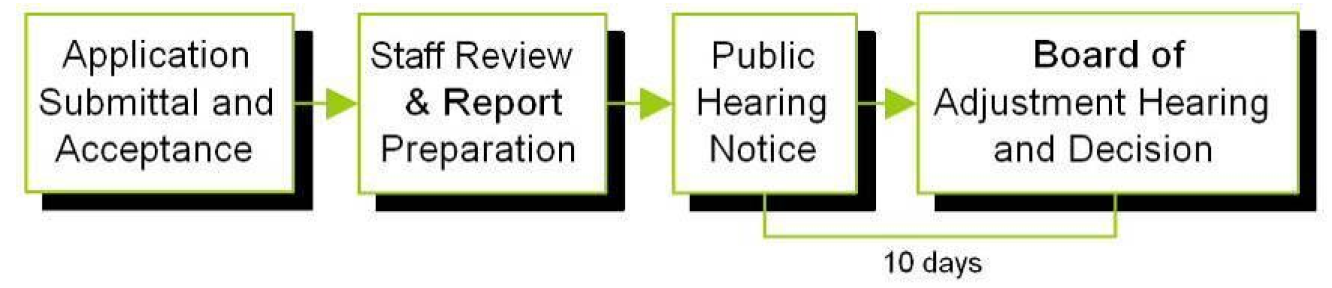
19-26-1
Purpose. The variance procedures of this section authorize the Board of Adjustment to modify or vary regulations of this ordinance when strict compliance with the regulation or standard would result in practical difficulties or unnecessary hardships upon the subject property.
19-26-2
Authorized Variances.
(A)
The Board of Adjustment is not authorized to grant variances to any of the standards of Article ten (Erosion and Sedimentation Control).
(B)
The Board of Adjustment is not authorized to grant use variances (i.e., variances that have the effect of allowing a type of land use that is not otherwise allowed in the subject zoning district).
19-26-3
Applications. A person requesting a variance must submit a variance application to the Planning Director.
19-26-4
Process Generally.
(A)
Quasi-Judicial Proceedings. Although the Board of Adjustment acts in a quasi-judicial capacity, it is not intended that proceedings before it be conducted as formally as those before courts. Nevertheless, it is necessary that the rules of procedure and evidence set forth in this ordinance be followed to protect the interests of the parties and of the public. To this end, the presiding officer may administer oaths to any witnesses and may make any rulings as are necessary to preserve fairness, order, or proper decorum in any matter before the Board of Adjustment. The clerk to the board may administer oaths to witnesses. In addition, any member of the Board of Adjustment or any interested party may object to, and the presiding officer may exclude, any evidence or testimony or statement which is so incompetent, irrelevant, immaterial, or unduly repetitious as to fail to reasonably address the issues before the Board of Adjustment.
(B)
Evidence and Testimony. Any interested party may be given the opportunity to present evidence or testimony, to cross-examine witnesses, to inspect documents, and to offer evidence or testimony in explanation or rebuttal. The presiding officer may determine whether testimony, oral argument, or cross-examination must be limited in duration. Any member of the Board of Adjustment may question any interested party.
19-26-5
Public Hearing.
(A)
The Board of Adjustment must hold a public hearing before taking action on a variance application.
(B)
At least ten days before a hearing on a variance, the Planning Director must post notice of the hearing on the affected property and send written notice of the hearing to the applicant, the owner of the affected property, and the owners of all real property adjoining the affected property (as shown on County tax listings current when the application is filed).
(C)
If a requested variance would result in the relaxation of any of the State Environmental Management Commission's minimum watershed management requirements for the low-density option (see 15A NCAC 2B), the Planning Director must, at the same time, send written notice of the hearing to all other local governments having jurisdiction within the same water supply watershed.
(1)
If the Board of Adjustment grants a variance that would result in the relaxation, by a factor greater than ten percent), of any of the State Environmental Management Commission's minimum watershed management requirements for the low-density option (see 15A NCAC 2B), the Board of Adjustment's decision is subject to review and approval by the State Environmental Management Commission before it becomes final. In such cases, the Planning Director must prepare a preliminary record of the variance application, the evidence submitted to the Board of Adjustment, and the Board of Adjustment's findings and decision, and submit it to the State Environmental Management Commission.
(2)
If the State Environmental Management Commission approves the variance as granted by the Board of Adjustment, the Board of Adjustment's decision will then be considered final and the variance granted.
(3)
If the State Environmental Management Commission approves the variance with conditions varying from, or in addition to, those imposed by the Board of Adjustment, the Board of Adjustment must revise its decision to include the varied or added conditions.
(4)
If the State Environmental Management Commission denies the variance, the Board of Adjustment must reverse its decision and deny variance. The Planning Director must, by January 1, submit to the State Division of Water Quality, or its successor agency, a report of any variances granted within water supply watersheds during the previous calendar year that would result in a variation from the State Environmental Management Commission's minimum watershed management requirements (see 15A NCAC 2B). The report must describe each project receiving a variance and the reason for granting the variance.
(D)
On determining that the application would impact non-adjoining properties in the vicinity of the affected site, the Planning Director may also send written notices to the owners of those properties, and may require the applicant to submit the additional materials necessary to provide such notices.
(E)
Notices to the applicant and the owner of the affected site must be sent via certified mail, return receipt requested. All other mailed notices must be sent via first-class mail.
(F)
If the Planning Director determines that an application for a variance would have significant impacts on properties beyond the vicinity of the affected site, the Planning Director must cause notice of the hearing to be published in a newspaper of general circulation in the county or the area of the affected site. The notice must be published in each of two successive calendar weeks, with the first notice being published between ten and 25 days before the hearing date.
(G)
The Planning Director must make every reasonable effort to comply with these notice requirements. However, where the Planning Director has made a reasonable and good-faith attempt to comply with the requirements for notice to owners of adjoining properties, no failure to comply with those requirements must render any decision on the application invalid.
19-26-6
Review and Decision.
(A)
General. The decision of the Board of Adjustment must include findings of fact and conclusions of law and must be based upon substantial evidence or testimony that is competent, relevant, and material. The concurring vote of four-fifths of the board shall be necessary to grant a variance. Every decision of the Board of Adjustment must also include the vote, abstention from voting, or absence of each member.
(B)
Additional Evidence. Notwithstanding any other provision of this ordinance, the Board of Adjustment may require additional evidence or memoranda of authority to be submitted, and may reserve its decision until such evidence or memoranda have been submitted and considered.
19-26-7
Required Findings of Fact.
(A)
When unnecessary hardships would result from carrying out the strict letter of the UDO, the Board of Adjustment shall vary any of the provisions of the ordinance upon a showing of all of the following:
(1)
Unnecessary hardship would result from the strict application of the ordinance. It shall not be necessary to demonstrate that, in the absence of the variance, no reasonable use can be made of the property.
(2)
The hardship results from conditions that are peculiar to the property, such as location, size, or topography. Hardships resulting from personal circumstances, as well as hardships resulting from conditions that are common to the neighborhood or the general public, may not be the basis for granting a variance.
(3)
The hardship did not result from actions taken by the applicant or the property owner. The act of purchasing property with knowledge that circumstances exist that may justify the granting of a variance shall not be regarded as a self-created hardship.
(4)
The requested variance is consistent with the spirit, purpose, and intent of the ordinance, such that public safety is secured, and substantial justice is achieved.
(B)
In areas of special flood hazard to which Article 14 applies, the Board of Adjustment must additionally conclude that:
(1)
No increase in flood levels will result within any designated floodway during the base flood discharge as a result of granting the variance;
(2)
A more limited or narrower variance would not provide relief;
(3)
Failure to grant the variance would result in exceptional hardship to the property-owner;
(C)
Moreover, the Board of Adjustment must make specific findings of fact, based on evidence introduced, on the following issues, and these findings of fact may not be inconsistent with the conclusions concerning variances in areas of special flood hazard:
(1)
The danger that materials may be swept onto other lands to the injury of others;
(2)
The danger to life and property due to flooding damage;
(3)
The susceptibility of the proposed use and its contents to flood damage and the effect of such damage on the individual owner;
(4)
The importance of the services provided by the proposed use to the community;
(5)
The necessity for the use of a waterfront location, where applicable;
(6)
The availability of alternative locations on the same parcel, not subject to flooding damage, for the proposed use;
(7)
The compatibility of the proposed use with existing and anticipated development;
(8)
The safety of access to the property in times of flood for ordinary and emergency vehicles;
(9)
The expected heights, velocity, duration, rate of rise, and sediment transport of the flood waters, and the effects of wave action, if applicable, expected at the site; and
(10)
The cost of providing governmental services during and after flood conditions, including maintenance and repair of public utilities and facilities such as wastewater, gas, electrical, and water systems, and streets and bridges.
19-26-8
Conditions of Approval. In granting variances, the Board of Adjustment is authorized to impose conditions that secure substantially the objectives of the regulations or provisions being varied or modified.
19-26-9
Variations from State Watershed Management Requirements. If the Board of Adjustment grants a variance that would result in the relaxation, by a factor greater than ten percent), of any of the State Environmental Management Commission's minimum watershed management requirements for the low-density option (see 15A NCAC 2B), the Board of Adjustment's decision is subject to review and approval by the State Environmental Management Commission before it becomes final. In such cases, the Planning Director must prepare a preliminary record of the variance application, the evidence submitted to the Board of Adjustment, and the Board of Adjustment's findings and decision, and submit it to the State Environmental Management Commission. If the State Environmental Management Commission approves the variance as granted by the Board of Adjustment, the Board of Adjustment's decision must then be considered final and the variance granted. If the State Environmental Management Commission approves the variance with conditions varying from, or in addition to, those imposed by the Board of Adjustment, the Board of Adjustment must revise its decision to include the varied or added conditions. If the State Environmental Management Commission denies the variance, the Board of Adjustment must reverse its decision and deny the variance.
19-26-10
Appeal to Superior Court. Any interested party may seek review of the decision of the Board of Adjustment in Superior Court by proceedings in the nature of certiorari. Any appeal to the Superior Court must be taken within 30 days after decision of the Board of Adjustment is filed with the zoning enforcement officer, or after a written copy thereof is delivered to the person taking the appeal by personal service or registered mail, whichever is later.
[Amended by OA 06-13 on 3/17/2014; Amended on 2/5/2018 by OA 01-17]
19-27 - Exceptions.
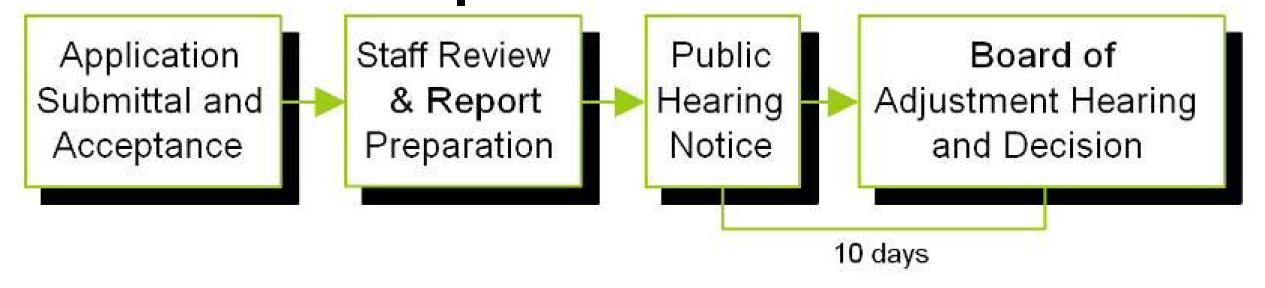
19-27-1
Authorized. The Board of Adjustment is specifically authorized to grant the following exceptions to the application of the regulations herein established, without changing the boundaries of the respective zones:
(A)
Where a zone boundary line divides a lot in a single ownership at the time this ordinance became applicable to the land at issue, permit a use authorized on either portion of such lot to extend to the entire lot, but not more than 25 feet beyond the boundary line of the zone in which such use is authorized.
(B)
Permit the erection of an additional building upon a lot occupied by a business or industrial establishment at the time this ordinance became applicable to the land at issue, but only when the additional building is a part of such establishment.
(C)
Exempt a proposed building, either in whole or in part, from the minimum front setback requirement. This relief may, however, be granted only in cases where the proposed building adjoins, on both sides, buildings that do not conform to the minimum front setback requirements, or where compliance with the minimum setback standard would cause unnecessary hardship to the owner without any compensating benefit to the community.
(D)
Permit the reconstruction, rehabilitation, or restoration of structures listed on the National Register of Historic Places or the State Inventory of Historic Places.
19-27-2
Public Hearing.
(A)
The Board of Adjustment must hold a public hearing before taking action on an authorized exception.
(B)
At least ten days before a hearing, the Planning Director must post notice of the hearing on the affected property and send written notice of the hearing to the applicant, the owner of the affected property, and the owners of all real property adjoining the affected property (as shown on county tax listings current when the application is filed).
(C)
If a requested exception result in the relaxation of any of the State Environmental Management Commission's minimum watershed management requirements for the low-density option (see 15A NCAC 2B), the Planning Director must, at the same time, send written notice of the hearing to all other local governments having jurisdiction within the same water supply watershed.
(D)
On determining that the application would impact non-adjoining properties in the neighborhood of the affected site, the Planning Director may also send written notices to the owners of those properties, and may require the applicant to submit the additional materials necessary to provide such notices.
(E)
Notices to the applicant and the owner of the affected site must be sent via certified mail, return receipt requested. All other mailed notices must be sent via first-class mail.
(F)
If the Planning Director determines that an application for an exception would have significant impacts on properties beyond the neighborhood of the affected site, the Planning Director must cause notice of the hearing to be published in a newspaper of general circulation in the county or the area of the affected site. The notice must be published in each of two successive calendar weeks, with the first notice being published between ten and 25 days before the hearing date.
(G)
The Planning Director must make every reasonable effort to comply with these notice requirements. However, where the Planning Director has made a reasonable and good-faith attempt to comply with the requirements for notice to owners of adjoining properties, no failure to comply with those requirements must render any decision on the application invalid.
19-27-3
Review and Decision.
(A)
General. The decision of the Board of Adjustment must include findings of fact and conclusions of law and must be based upon substantial evidence or testimony that is competent, relevant, and material. Findings concerning the existence or nonexistence of crucial facts must be based upon sworn evidence or testimony unless the party or parties before the Board of Adjustment stipulate the facts or waive this requirement. Every decision of the Board of Adjustment must also include the vote, abstention from voting, or absence of each member.
(B)
Additional Evidence. Notwithstanding any other provision of this ordinance, the Board of Adjustment may require additional evidence or memoranda of authority to be submitted, and may reserve its decision until such evidence or memoranda have been submitted and considered.
19-27-4
Appeal to Superior Court. Any interested party may seek review of the decision of the Board of Adjustment in Superior Court by proceedings in the nature of certiorari. Any appeal to the Superior Court must be taken within 30 days after decision of the Board of Adjustment is filed with the zoning enforcement officer, or after a written copy thereof is delivered to the person taking the appeal by personal service or registered mail, whichever is later.
19-30 - Exempt Subdivisions.

19-30-1
Generally. Persons proposing divisions of land that do not constitute a subdivision must file an application for determination of exempt subdivision status with the Planning Director.
19-30-2
Applicability. The exempt subdivision determination procedures of this section apply to those activities that do not constitute a subdivision, as identified below:
(A)
The division of a tract of land in single ownership into no more than three lots if:
(1)
The tract to be divided is no greater than two acres in area;
(2)
No road right-of-way is dedicated; and
(3)
The resulting lots meet or exceed the minimum standards of this ordinance (such as, but not limited to minimum lot size and minimum road frontage).
(B)
The division of land resulting in the creation of parcels that are each more than ten acres in area, provided that no right-of-way is dedicated;
(C)
The combination or recombination of portions of previously subdivided and recorded lots if:
(1)
The total number of lots is not increased; and
(2)
The resulting lots comply with the subdivision design and improvements standards of this Article; and
(3)
No nonconformities are created.
(D)
The public acquisition of land for the establishment (or widening) of roads, rail corridors, parks, open space, trails, greenway corridors, conservation areas, or public water reservoir projects;
(E)
The creation of Reserved Conservation Parcels under the requirements of Article 11, Part 2 (Water Supply Watershed Buffers) and Sec. 8-43, Special Requirements in Water Supply Watersheds;
(F)
The division of land into cemetery plots;
(G)
The division of land solely for the purpose of creating lots to be occupied by electrical substations, water towers, community water and wastewater systems, cell towers and similar structures used for public or quasi-public utility purposes, provided no road right-of-way is dedicated;
(H)
The division of a tract of land resulting solely from public acquisition of land to be used for public road right-of-way; and
(I)
The division of a tract into parcels in accordance with the terms of a probated will or in accordance with intestate succession under Chapter 29 of the NC General Statutes.
19-30-3
Application Submittal and Acceptance.
(A)
The application must include copies of recorded instruments showing the name of the current owner, a complete legal description and plat of the property (including control corners) for which an exemption is requested and all other information deemed necessary by the Planning Director to make a competent determination of the exempt or non-exempt status of the proposed subdivision.
(B)
Following receipt of a complete application for determination of exempt subdivision status, the Planning Director must make a determination of the land division's exempt or non-exempt status.
(C)
Plans must be prepared by a licensed designed professional authorized by the North Carolina General Statutes to perform such work.
(D)
Any application for an exempt subdivision must comply with all applicable provisions of this ordinance that are in effect at the time that final approval is sought. In the event that an applicant withholds resubmittal of the revised application for more than two years from the date of the original application, then that submittal must be processed in the same manner as a new submittal, including the payment of a new application fee in accordance with the fee schedule in effect at the time of filing.
19-30-4
Staff Review and Action. If the Planning Director determines that the proposed land division does not constitute a subdivision, in accordance with Sec. 8-11 and Sec. 8-12, the Planning Director must certify the proposed land division as exempt and affix the following certificate to the plat:
I, ________________________, Planning Director and Review Officer of Wake County,
certify that this plat does not constitute a subdivision and that it meets all statutory
requirements for recording. Because of its "exempt" status, the county has not reviewed
this plat for compliance with applicable lot standards and other subdivision regulations
(e.g., road standards). Prospective purchasers should be aware that plans for building
and development may be denied for lots that do not meet applicable county standards.
This approval expires if not recorded before _______________________.
_________ __________________________________________
Date Planning Director/Review Officer
19-31 - Minor-Limited Subdivisions.

19-31-1
Generally. The minor-limited subdivision approval process requires the Planning Director's review and approval of a record plat, which, upon recordation with the Register of Deeds, actually creates the proposed lots and easements. No lot proposed to be created through the minor-limited subdivision of a parcel may be sold or offered for sale until a record plat showing the subdivision has been approved by the Planning Director as complying with Section 19-31-2, and has been recorded with the Wake County Register of Deeds.
19-31-2
Applicability. The minor-limited subdivision determination procedures of this section apply to the division of a tract or parcel of land in single ownership if all of the following criteria are met:
(A)
The tract or parcel to be divided is not exempted under 19-30-2(B).
(B)
No part of the tract or parcel to be divided has been divided under this subsection 19-31 in the ten years prior to division.
(C)
The entire area of the tract or parcel to be divided is greater than five acres.
(D)
After division, no more than three lots result from the division.
(E)
After division, all resultant lots comply with all of the following:
(1)
Any lot size requirements of the applicable land-use regulations, if any.
(2)
The use of the lots is in conformity with the applicable zoning requirements, if any.
(3)
A permanent means of ingress and egress is recorded for each lot
19-31-3
Application Submittal and Acceptance.
(A)
Submittal. A person seeking approval of a record plat for a minor-limited subdivision must submit an application for a minor-limited subdivision record plat approval to the Planning Director.
(B)
Application Contents.
(1)
The application must:
(a)
Include copies of recorded instruments showing the name of the current owner, a complete legal description and plat of the property (including control corners) for which a minor-limited is requested and all other information deemed necessary by the Planning Director to make a competent determination of the minor-limited determination status of the proposed subdivision.
(b)
Include the property owner's signed authorization for submittal of the application;
(c)
Indicate the site's relationship to adjacent development and improvements;
(d)
Depict the nature and scope of the proposed subdivision and any associated development;
(e)
Identify and depict the boundaries and area of all proposed lots and other parcels;
(f)
Identify and depict the boundaries of all existing and proposed rights-of-way and easements;
(g)
Indicate significant topographical, environmental physical and built features of the subdivision site and surrounding area;
(h)
Show how the subdivision complies with all applicable provisions of this ordinance and all applicable requirements for recording set forth in the North Carolina General Statutes.
(2)
The Planning Director may waive one or more application submittal requirements by certifying in writing that such information is unnecessary in the particular case to determine compliance with applicable regulations.
(3)
Plans must be prepared by a licensed designed professional authorized by the North Carolina General Statutes to perform such work.
(C)
Fee. The applicant must also submit the fee prescribed for the type of application by the Board of Commissioners.
(D)
Acceptance.
(1)
The Planning Director must review a submitted application to determine whether it includes all of the information required by paragraph 19-31-3(B).
(2)
If the application does not include all of the information required by paragraph 19-31-3(B) the Planning Director must notify the applicant of the submittal deficiencies and invite the applicant to revise the application to correct the deficiencies.
(3)
If the application includes all of the information required by paragraph 19-31-3(B) the Planning Director must accept the application as complete.
19-31-4
Withdrawal of Application. An applicant may withdraw an application for minor-limited subdivision record plat approval at any time by submitting written notice of withdrawal to the Planning Director.
19-31-5
Staff Review and Action.
(A)
After accepting an application as complete, the Planning Director must refer it to appropriate staff for review.
(B)
The review staff must review the application, determine whether the record plat complies with all applicable regulations, identify any noncompliant features of the plat, and, whenever feasible, suggest modifications to correct the noncompliant features.
(C)
The Planning Director must notify the applicant of the identified noncompliant features and suggested modifications, and invite the applicant to discuss the review staff comments.
(D)
The Planning Director must make every reasonable effort to process, review, and decide applications for minor-limited subdivision record plat approval in a timely manner, consistent with the need to fully consider the proposed plat's compliance with applicable regulations.
19-31-6
Opportunity to Revise Application.
(A)
Following receipt of the review staff comments and any discussions thereof with the Planning Director, the applicant must either:
(1)
Request that the Planning Director take action on the application as submitted; or
(2)
Notify the Planning Director of an intent to revise the application to address staff comments and submit a revised application to the Planning Director.
(B)
If the applicant submits a revised application, the Planning Director must determine whether it continues to comply with submittal requirements. After accepting a revised application as complete, the Planning Director must refer it to appropriate staff, who must review it for correction of previously identified noncompliant features.
(C)
Any application for a minor-limited subdivision must comply with all applicable provisions of this ordinance that are in effect at the time that final approval is sought. In the event that an applicant withholds resubmittal of the revised application for more than two years from the date of the original application, then that submittal must be processed in the same manner as a new submittal, including the payment of a new application fee in accordance with the fee schedule in effect at the time of filing.
19-31-7
Plat Certification.
(A)
Approval. Upon approval of the application, the Planning Director must enter the following certification on the approved record plat;
I, ________________________, Planning Director and Review Officer of Wake County,
certify that this plat constitutes a minor-limited subdivision and has been reviewed
only to determine compliance with GS 160D-802 and that it meets all statutory requirements
for recording. Because of its "minor limited" status, the county has not reviewed
this plat for compliance with all applicable development standards and other subdivision
regulations (including, but not limited to, road standards). Prospective purchasers
should be aware that plans and/or permits for building and development shall be denied
for lots that do not meet all applicable county standards. This approval expires if
not recorded before _______________________.
_________ __________________________________________
Date Planning Director/Review Officer
(Amended on 3/19/2018 by OA 02-17; Amended 6/7/2021 by OA-01-21)
19-32 - Minor Subdivisions.

19-32-1
Generally. The minor subdivision approval process requires the Planning Director's review and approval of a record plat, which, upon recordation with the Register of Deeds, actually creates the proposed lots and easements. No lot proposed to be created through the minor subdivision of a parcel may be sold or offered for sale until a record plat showing the subdivision has been approved by the Planning Director as complying with all applicable provisions of this ordinance, and has been recorded with the Wake County Register of Deeds.
19-32-2
Applicability. The minor subdivision procedures of this section may be used only for land divisions that cannot meet the criteria of Section 19-31 minor-limited subdivision and comply with all of the following criteria:
(A)
Creates no more than three lots with direct access to a new, existing or extended private road or to an existing public road;
(B)
Does not involve any new public road;
(C)
Does not involve the extension of public wastewater or water lines;
(D)
Does not land-lock or prevent development of the remainder of the parcel or abutting property;
(E)
Does not create any new or residual parcels that do not comply with the requirements of this ordinance or other applicable state or local regulations;
(F)
Is not located, wholly or substantially, in a flood hazard area; and
(G)
A total of no more than five lots being created with the combination of two minors or a combination of one minor and/or one minor-limited of a parent tract within five years.
19-32-3
Application Submittal and Acceptance.
(A)
Submittal. A person seeking approval of a record plat for a minor subdivision must submit an application for minor subdivision record plat approval to the Planning Director.
(B)
Application Contents.
(1)
The application must:
(a)
Include, with sufficient copies for necessary referrals and records, those application forms, maps, plans, and other documents prescribed by the Planning Director;
(b)
Include the property owner's signed authorization for submittal of the application;
(c)
Indicate the site's relationship to adjacent development and improvements;
(d)
Depict the nature and scope of the proposed subdivision and any associated development;
(e)
Identify and depict the boundaries and area of all proposed lots and other parcels;
(f)
Identify and depict the boundaries of all existing and proposed rights-of-way and easements;
(g)
Indicate significant topographical, environmental physical and built features of the subdivision site and surrounding area;
(h)
Be accompanied by an environmental assessment describing plans for any proposed community or wastewater systems;
(i)
Be accompanied by a traffic impact analyses if required pursuant to Sec. 15-12;
(j)
Affect proposed dedications and restrictions; and
(k)
Show how the subdivision complies with all applicable provisions of this ordinance and all applicable requirements for recording set forth in the North Carolina General Statutes.
(2)
The Planning Director may waive one or more application submittal requirements by certifying in writing that such information is unnecessary in the particular case to determine compliance with applicable regulations.
(3)
Plans must be prepared by a licensed designed professional authorized by the North Carolina General Statutes to perform such work.
(C)
Fee. The applicant must also submit the fee prescribed for the type of application by the Board of Commissioners.
(D)
Acceptance.
(1)
The Planning Director must review a submitted application to determine whether it includes all of the information required by paragraph 19-32-3(B).
(2)
If the application does not include all of the information required by paragraph 19-32-3(B), the Planning Director must notify the applicant of the submittal deficiencies and invite the applicant to revise the application to correct the deficiencies.
(3)
If the application includes all of the information required by paragraph 19-32-3(B), the Planning Director must accept the application as complete.
19-32-4
Withdrawal of Application. An applicant may withdraw an application for minor subdivision record plat approval at any time by submitting written notice of withdrawal to the Planning Director.
19-32-5
Staff Review.
(1)
After accepting an application as complete, the Planning Director must refer it to appropriate staff for review.
(2)
The review staff must review the application, determine whether the record plat complies with all applicable regulations, identify any noncompliant features of the plat, and, whenever feasible, suggest modifications to correct the noncompliant features.
(3)
The Planning Director must notify the applicant of the identified noncompliant features and suggested modifications, and invite the applicant to discuss the review staff comments.
(4)
The Planning Director must make every reasonable effort to process, review, and decide applications for minor subdivision record plat approval in a timely manner, consistent with the need to fully consider the proposed plat's compliance with applicable regulations.
19-32-6
Opportunity to Revise Application.
(A)
Following receipt of the review staff comments and any discussions thereof with the Planning Director, the applicant must either:
(1)
Request that the Planning Director take action on the application as submitted; or
(2)
Notify the Planning Director of an intent to revise the application to address staff comments and submit a revised application to the Planning Director.
(B)
If the applicant submits a revised application, the Planning Director must determine whether it continues to comply with submittal requirements. After accepting a revised application as complete, the Planning Director must refer it to appropriate staff, who must review it for correction of previously identified noncompliant features.
(C)
Any application for a minor subdivision must comply with all applicable provisions of this ordinance that are in effect at the time that final approval is sought. In the event that an applicant withholds resubmittal of the revised application for more than two years from the date of the original application, then that submittal must be processed in the same manner as a new submittal, including the payment of a new application fee in accordance with the fee schedule in effect at the time of filing.
19-32-7
Staff Action. Following the applicant's request for staff action on the original application, or staff review of a revised application, the Planning Director must review staff comments, and, based on findings regarding the application's compliance with all applicable provisions of this ordinance, approve the application as submitted or deny the application.
19-32-8
Notice of Decision. The Planning Director must provide the applicant notice of the final decision on the application, and must file a copy of the decision in the Planning Department office. If the application is denied, the notice must include the reasons for the denial.
19-32-9
Appeal of Decision. Any person aggrieved by the Planning Director's decision to approve or deny an application for minor subdivision record plat approval may appeal the decision in accordance with Sec. 19-41.
19-32-10
Plat Certifications.
(A)
Approval. Upon approval of the application, the Planning Director must enter the following certification on the approved record plat:
I, __________________________, Planning Director and Review Officer of Wake County,
certify that this plat creates a subdivision subject to and approved in accordance
with the Wake County Unified Development Ordinance, and that it meets all statutory
requirements for recording. This approval expires if not recorded before _______________________.
_________ __________________________________________
Date Planning Director/Review Officer
(B)
Dedications. If the approved record plat shows or otherwise includes offers to dedicate to the public any rights-of-way, easement, open space, or recreation area for roads, utilities, recreation facilities, or other public improvements, the Planning Director must also enter the following certification on the approved record plat:
Wake County hereby accepts, for the use and benefit of the general public, the rights-of-way,
easements, open spaces, and recreation areas shown or otherwise provided for on this
plat as dedicated for public roads, public utilities, public recreation facilities,
and other public improvements. This acceptance does not include the county's acceptance
of any responsibility to construct, install, or maintain the roadway, utility line,
recreation facility, or other public improvement intended to be constructed or installed
within the right-of-way, easement, open space, or recreation area.
_________ __________________________________________
Date Planning Director/Review Officer
(C)
Acceptance. Recordation of an approved plat with the above signed certification constitutes public acceptance of the public dedication, authorizing the use of the dedicated right-of-way, easement, open space, or recreation area for public road access and associated public purposes, utility service, or open space or recreation use (as appropriate), including the construction or installation thereon, in accordance with County and State regulations, of roadways, associated stormwater management improvements and erosion and sedimentation control devices, utility lines and facilities, recreation facilities, and other public improvements appropriate to the public purposes to which the right-of-way, easement, open space, or recreation area is dedicated.
19-32-11
Plat Recordation. The Planning Director's approval of a minor subdivision record plat is contingent on recordation of the plat by the Wake County Register of Deeds within 15 days after the approval date and submittal of an authorized copy of the recorded plat to the Planning Director.
19-32-12
Improvements. If an approved minor subdivision involves any associated improvements (such as a private road, public road widening, water supply or sewage disposal system other than individual wells and septic systems, stormwater management facilities or easements, erosion and sedimentation control devices, or any other improvements required as part of the minor subdivision approval), the construction or installation and maintenance of such improvements are subject to the provisions of Sec. 8-20, Sec. 8-21, and, as applicable, Sec. 8-22.
[OA 04/14 May 2, 2005 (Amended on 3/19/2018 by OA 02-17; Amended on 9/18/2023 by OA-01-23)
19-33 - Regular Subdivisions—Generally.
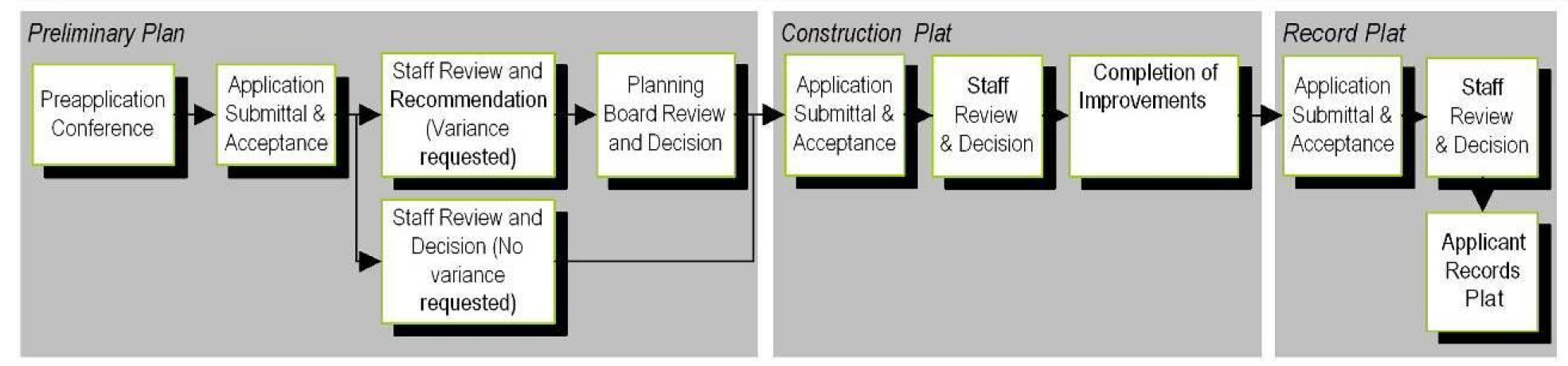
Any subdivision that does not meet the criteria for processing as a minor subdivision (See subsection 19-32-2) is a regular subdivision. A regular subdivision of land and authorization for development associated with the subdivision, requires a three-step review and approval process. First, a preliminary plan must be reviewed and approved in accordance with Sec. 19-34. If the preliminary plan is approved, the applicant may then apply for approval of a construction plan in accordance with Sec. 19-35 and for approval of a record plat for the subdivision or approved phase thereof in accordance with Sec. 19-36.
19-34 - Regular Subdivision—Preliminary Plan.
19-34-1
Application Submittal and Acceptance.
(A)
Submittal. Any person proposing a regular subdivision must submit an application for preliminary subdivision plan approval to the Planning Director.
(B)
Contents.
(1)
The application must:
(a)
Include, with sufficient copies for necessary referrals and records, those application forms, maps, plans, and other documents prescribed by the Planning Director;
(b)
Include the property owner's signed authorization for submittal of the application;
(c)
Indicate the site's relationship to adjacent development and improvements;
(d)
Depict the nature and scope of the proposed subdivision and any associated development;
(e)
Identify and depict the boundaries and area of all proposed lots and other parcels;
(f)
Identify and depict the boundaries of all existing and proposed rights-of-way and easements;
(g)
Indicate significant topographical, environmental and physical features of the subdivision site and surrounding area;
(h)
Be accompanied by an environmental assessment describing plans for any proposed wastewater systems;
(i)
Be accompanied by a traffic impact analyses if required pursuant to Sec. 15-12; and
(j)
Show how the subdivision complies with all applicable provisions of this ordinance and all applicable requirements for recording set forth in the North Carolina General Statutes.
(2)
The Planning Director may waive one or more application submittal requirements by certifying in writing that such information is unnecessary in the particular case to determine compliance with applicable regulations.
(3)
Plans must be prepared by a licensed designed professional authorized by the North Carolina General Statutes to perform such work.
(C)
Acceptance.
(1)
The Planning Director must review the application to determine whether it complies with submittal requirements.
(2)
If the application does not comply with submittal requirements, the Planning Director must notify the applicant of the submittal deficiencies and invite the applicant to revise the application to correct the deficiencies.
(3)
If or when the application complies with all submittal requirements, the Planning Director must accept the application as complete.
19-34-2
Withdrawal of Application. An applicant may withdraw an application for preliminary subdivision plan approval at any time by submitting written notice of the withdrawal to the Planning Director.
19-34-3
Staff Review.
(A)
After accepting an application as complete, the Planning Director must refer it to appropriate staff for review.
(B)
Staff must review the application, determine whether the proposed subdivision complies with all applicable regulations, identify any noncompliant features of the proposal, and, whenever feasible, suggest modifications to correct the noncompliant features.
(C)
The Planning Director must notify the applicant of the identified noncompliant features and suggested modifications, and invite the applicant to discuss the staff comments.
(D)
The Planning Director must make every reasonable effort to process, review, and decide applications for preliminary subdivision plan in a timely manner, consistent with the need to fully consider the proposed subdivision's impact with respect to applicable regulations.
19-34-4
Opportunity to Revise Application.
(A)
Following receipt of the staff review comments and any discussions with the Planning Director, the applicant must either:
(1)
Request that the Planning Director prepare a staff report on the application as submitted; or
(2)
Notify the Planning Director of their intent to revise the application to address staff comments and submit a revised application to the Planning Director.
(B)
If the applicant submits a revised application, the Planning Director must determine whether it continues to comply with submittal requirements. On accepting a revised application as complete, the Planning Director must refer it to appropriate staff, who must review it for correction of previously identified noncompliant features.
19-34-5
Staff Action.
(A)
If No Variance Requested.
(1)
Following the applicant's request for staff action on the original application, or staff review of a revised application, the Planning Director must review staff comments, and make findings regarding the proposed subdivision's compliance with all applicable provisions of this ordinance.
(2)
Based on those findings, the Planning Director must approve the application as submitted, or approve the application subject to conditions, or deny the application. The decision must be issued in writing. If the Planning Director determines that the proposed subdivision is particularly controversial or problematic, the Planning Director may forward the application to the Planning Board for action. The Planning Board may approve the application as submitted, or approve the application subject to conditions, or deny the application.
(3)
If the application is denied or approved subject to conditions, the decision must state the reasons for the denial or conditions. Any conditions of approval must be limited to requiring specific actions and/or minor changes or additions to, or restrictions on, the proposed subdivision that are deemed reasonably necessary to ensure compliance with applicable provisions of this ordinance. Such conditions may include time limits for completion of development or for the start or end of certain activities.
(4)
The Planning Director must file the decision in the Planning Department office and send a copy to the applicant, along with a written notice that the decision becomes final unless the applicant submits to the Planning Director, within seven days after receiving a copy of the Planning Director's Decision, a written request that the application be forwarded to the Planning Board. If the applicant submits such a request within the prescribed time period, the Planning Director must forward the application to the Planning Board for further review and a final decision, and the Planning Director's decision must represent the staff report and recommendation for the Planning Board action on the application. Otherwise, the Planning Director's decision becomes the final decision on the application.
(B)
If Variance Requested.
(1)
The applicant must apply for a variance in accordance with Sec. 19-26.
(2)
If a variance is granted the applicant may proceed with the preliminary subdivision noting the variance. If the variance request is denied the applicant may proceed with the preliminary subdivision meeting the terms of this ordinance.
19-34-6
Effect of Preliminary Plan Approval; Lapse of Approval.
(A)
Approval of a preliminary plan does not authorize any development, but rather authorizes the applicant to apply for approval of construction plans and record plats for the subdivision or for an approved phase of the subdivision.
(B)
A valid, approved preliminary plan confers upon an applicant the right to have the construction plan and record plat for the subject subdivision reviewed in accordance with the standards in effect at the time of approval and insulates development of the subdivision from any subsequent changes to this ordinance or other county regulations incorporated by provisions of this ordinance.
(C)
Within three years of the date of preliminary plan approval, applications for construction plan and record plat approval must be submitted and recorded for the entire subdivision or the first phase of a phased subdivision. Construction plans and record plats must be submitted and approved for all remaining phases of a phased subdivision within seven years of the date of preliminary plan approval.
(D)
On request by the applicant or owner of the parcel proposed to be subdivided, the Planning Director may grant an extension up to 12 months of the preliminary plan approval if the Planning Director determines that:
(1)
The preliminary plan approval has not yet expired;
(2)
The applicant or owner of the parcel proposed to be subdivided has proceeded with due diligence and good faith to prepare a construction plan and record plat for the subdivision, or approved phases thereof; and
(3)
Conditions or applicable regulations have not changed so substantially as to warrant reconsideration of the proposed subdivision with respect to the public health, safety, and general welfare.
(4)
No previous extension of approval has been granted on the preliminary plan approval.
(E)
Preliminary plan approval will lapse and become void if complete applications for both construction plan approval and the recordation of the record plat approval for the subdivision have not been submitted to the Planning Director within the time period required by this subsection (19-34-6). If applications for construction plan approval and record plat approval are submitted for only part of the approved subdivision within the required time period, preliminary plan approval for remaining parts of the subdivision will automatically lapse and become void and applications for construction plan approval or record plat approval for development of the remaining parts of the subdivision site may be submitted only pursuant to a new preliminary plan approval granted in accordance with this section.
19-34-7
Public Notice. Upon approval of the preliminary plan application, the applicant must post the subject property with a sign providing public notice of preliminary plan approval.
(A)
Provision of Signs. The notification sign must be provided by the Planning Director to the applicant. It must be the applicant's responsibility to obtain the sign from the Planning Director and to post the sign on the subject property as prescribed herein. The applicant must submit the fee prescribed for the sign by the Board of Commissioners.
(B)
Timing of Notice. Required signs must be posted on the subject property within ten days after the date of preliminary plan approval and must remain posted for at least 25 days after the date of preliminary plan.
(C)
Placement of Sign. Signs must be posted along each public road that is adjacent to or runs through the subject property in a manner that makes the sign clearly visible to neighboring residents and the general public. The sign must be set back no more than 25 feet from the public road so that the lettering is visible from the road. Where the subject property does not have frontage on a public road, signs must be erected on the nearest public road with attached notation indicating generally the direction and distance to the subject property. It is the applicant's responsibility to ensure that signs remains on the property and visible from the public road for the required period of time.
[Amended on 2/5/2018 by OA 01-17; Admin. edit of 7-1-2025; Amended on 10/20/0225 by OA-04-25]
19-35 - Regular Subdivision—Construction Plan Review.
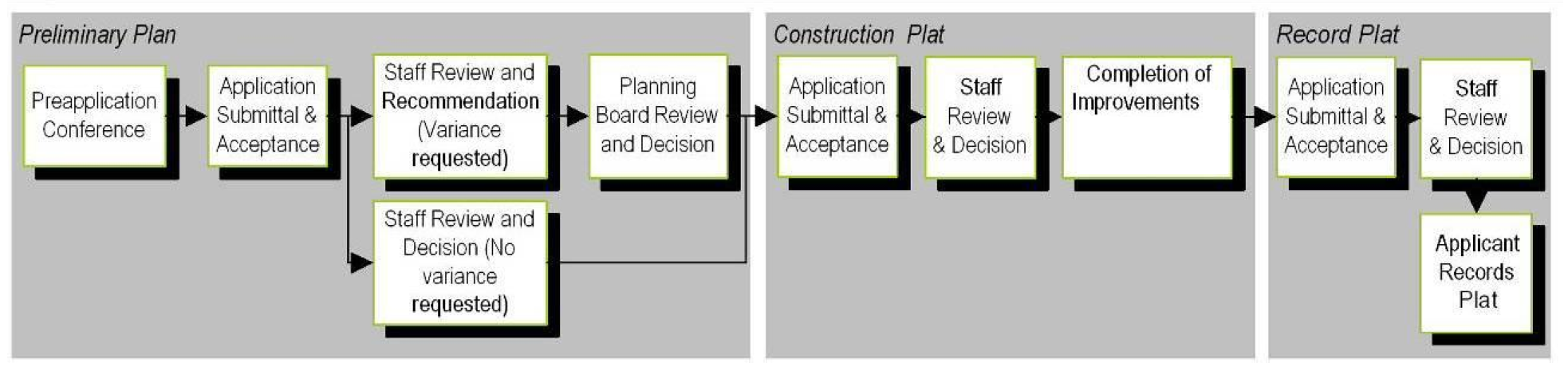
19-35-1
Generally. Construction plan approval authorizes development of roads, utilities, stormwater management facilities, erosion and sedimentation control devices, and other improvements consistent with the preliminary plan approval. No development associated with the construction or installation of improvements proposed or needed to serve the subdivision (roads, utilities, stormwater management measures, erosion and sedimentation control devices, etc.) may occur except in accordance with a construction plan that has been approved by the Planning Director.
19-35-2
Application Submittal and Acceptance.
(A)
Submittal. A person seeking final approval of development associated with a regular subdivision, or approved phase thereof, must submit an application for construction plan approval to the Planning Director.
(B)
Contents.
(1)
The application must:
(a)
Include, with sufficient copies for necessary referrals and records, those application forms, maps, plans, and other documents prescribed by the Planning Director;
(b)
Include the property owner's signed authorization for submittal of the application;
(c)
Indicate the site's relationship to adjacent development and improvements;
(d)
Indicate the arrangement, layout and pattern of lots;
(e)
Indicate significant topographical, environmental and physical features of the subdivision site and surrounding area; and
(f)
Show how development associated with the subdivision complies with the preliminary plan approval and all applicable provisions of this ordinance.
(2)
The Planning Director may waive one or more application submittal requirements by certifying in writing that such information is unnecessary in the particular case to determine compliance with applicable regulations.
(3)
Plans must be prepared by a licensed designed professional authorized by the North Carolina General Statutes to perform such work.
(C)
Acceptance.
(1)
The Planning Director must review a submitted application and determine whether it complies with submittal requirements.
(2)
If the application does not comply with submittal requirements, the Planning Director must notify the applicant of the submittal deficiencies and invite the applicant to revise the application to correct the deficiencies.
(3)
If or when the application complies with all submittal requirements, the Planning Director must accept the application as complete.
19-35-3
Withdrawal of Application. An applicant may withdraw an application for construction plan approval at any time by submitting written notice of the withdrawal to the Planning Director.
19-35-4
Staff Review.
(A)
After accepting an application as complete, the Planning Director must refer it to appropriate staff for review.
(B)
The review staff must review the application, determine whether the proposed development is consistent with the approved preliminary plan and complies with all applicable regulations, identify any noncompliant features of the proposed development, and, whenever feasible, suggest modifications to correct the noncompliant features.
(C)
The Planning Director must notify the applicant of the identified noncompliant features and suggested modifications, and invite the applicant to discuss the review staff comments.
(D)
The Planning Director must make every reasonable effort to process, review, and decide applications for construction plan approval in a timely manner, consistent with the need to fully consider the proposed development's impact with respect to applicable regulations.
19-35-5
Opportunity to Revise Application.
(A)
Following receipt of the review staff comments and any discussions thereof with the Planning Director, the applicant must either:
(1)
Ask the Planning Director to take action on the application as submitted; or
(2)
Notify the Planning Director of an intent to revise the application to address staff comments and submit a revised application to the Planning Director.
(B)
If the applicant submits a revised application, the Planning Director must determine whether it continues to comply with submittal requirements. On accepting a revised application as complete, the Planning Director must refer it to appropriate staff, who must review it for correction of previously identified noncompliant features.
19-35-6
Staff Action.
(A)
Following the applicant's request for staff action on the original application, or staff review of a revised application, the Planning Director must review staff comments, and make findings as to the application's consistency with the preliminary plan approval and compliance with all applicable provisions of this ordinance.
(B)
Based on those findings, the Planning Director must approve the application as submitted, or approve the application subject to conditions, or deny the application. The decision must be issued in writing.
(C)
If the application is denied or approved subject to conditions, the decision must state the reasons for the denial or conditions. Any conditions of approval must be limited to requiring specific actions and/or minor changes or additions to, or restrictions on, the proposed development that are deemed reasonably necessary to ensure consistency with the preliminary plan approval or compliance with applicable provisions of this ordinance. Such conditions may include time limits for completion of development or for the start or end of certain activities.
19-35-7
Approval Criterion. The Planning Director must approve a construction plan application only if the Planning Director determines that the proposed construction plan is consistent with the preliminary plan approval and complies with all applicable provisions of this ordinance.
19-35-8
Minor Modifications.
(A)
The Planning Director may approve construction plans that reflect minor modifications to the approved preliminary plan upon determining that the modifications continue to be consistent with the preliminary plan approval. Examples of such modifications include those that are necessary to comply with conditions of approval or would not significantly change the subdivision's general function, form, intensity, character, demand on public facilities, relationship to a local road network, relationship to adjacent properties, or other characteristic from that indicated by the preliminary plan approval.
(B)
Before making such a determination, the Planning Director must review the record of the proceedings on the application for preliminary plan approval and consider whether any proposed modification would raise compliance issues in addition to those considered in approving the preliminary plan.
19-35-9
Notice of Decision and Permit Issuance. The Planning Director must send the applicant written notice of the final decision on the application, and must file a copy of the decision in the Planning Department office. If the application is approved subject to conditions, the notice must state the reasons for the conditions. If the application is denied, the notice must state the reasons for the denial. Upon approval of the application, with or without conditions, the Planning Director must issue to the applicant the appropriate Land Use Permit for the approved development.
19-35-10
Appeal of Decision. Any person aggrieved by the Planning Director's decision to approve or deny an application for construction plan approval may appeal the decision in accordance with Sec. 19-41.
19-35-11
Effect of Construction Plan Approval; Lapse of Approval.
(A)
Construction plan approval will be valid for two years as authorizing the start of construction or installation of roads, utilities, stormwater management devices, erosion and sedimentation control devices, and other improvements approved as part of the construction plan approval, and as insulating the approved development from any subsequent changes to this ordinance or other County regulations incorporated by provisions of this ordinance.
(B)
Construction plan approval will automatically become void if the approved development has not been substantially started while the approval is still valid.
(C)
On request by the applicant or owner of the parcel proposed to be subdivided, the Planning Director may extend the date on which construction plan approval would otherwise expire by up to 12 months if the Planning Director determines that:
(1)
The applicant or owner of the parcel proposed to be subdivided has proceeded with due diligence and good faith to prepare a record plat for the subdivision, or approved phases thereof; and
(2)
Conditions or applicable regulations have not changed so substantially as to warrant reconsideration of the proposed subdivision with respect to the public health, safety, and general welfare.
19-36 - Regular Subdivision—Record Plat Review.
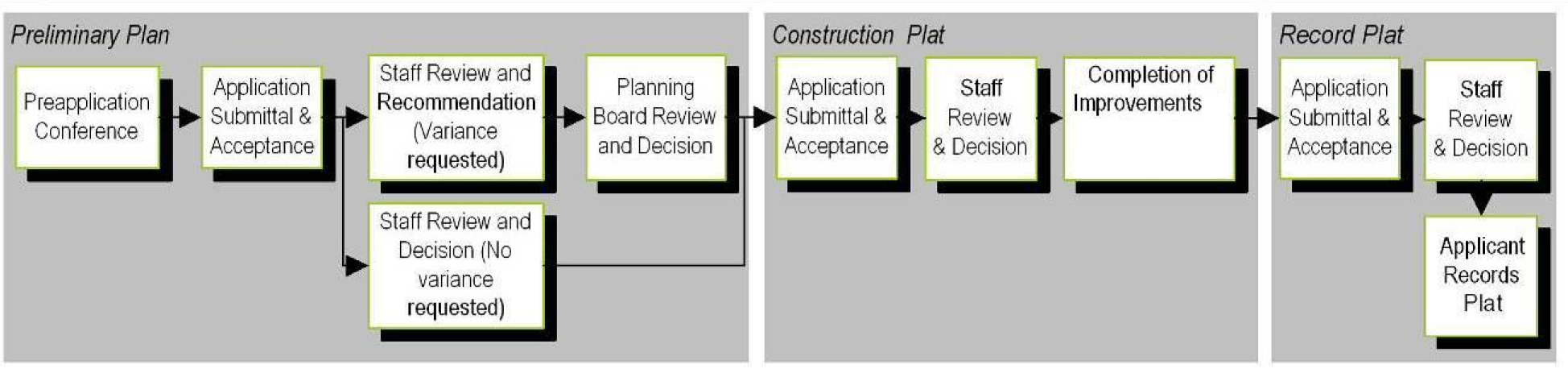
19-36-1
Generally. Record plat approval authorizes recording of the record plat with the Register of Deeds, an action that effectuates the creation of lots and parcels, the reservation or dedication of rights-of-way, easements, and open space, and other conditions or requirements consistent with the preliminary plan approval.
19-36-2
Public Improvement Completion as Prerequisite to Record Plat. The Planning Director may not accept or approve a record plat until all required improvements have been completed in accordance with Sec. 8-21.
19-36-3
Application Submittal and Acceptance.
(A)
Submittal. A person seeking approval of a record plat for a regular subdivision, or approved phase thereof, must submit an application for record plat approval to the Planning Director.
(B)
Contents.
(1)
The application must:
(a)
Include, with sufficient copies for necessary referrals and records, those application forms, maps, plans, and other documents prescribed by the Planning Director;
(b)
Include the property owner's signed authorization for submittal of the application;
(c)
Identify and depict the boundaries and area of all proposed lots and other parcels;
(d)
Identify and depict the boundaries of all proposed rights-of-way and easements, effect proposed dedications and restrictions; and
(e)
Show how the subdivision complies with the preliminary plan approval, all applicable provisions of this ordinance, and all applicable requirements for recording set forth in the North Carolina General Statutes.
(2)
The Planning Director may waive one or more application submittal requirements by certifying in writing that such information is unnecessary in the particular case to determine compliance with applicable regulations.
(3)
Plans must be prepared by a licensed designed professional authorized by the North Carolina General Statutes to perform such work.
(C)
Acceptance.
(1)
The Planning Director must review a submitted application and determine whether it complies with submittal requirements.
(2)
If the application does not comply with submittal requirements, the Planning Director must notify the applicant of the submittal deficiencies and invite the applicant to revise the application to correct the deficiencies.
(3)
If or when the application complies with all submittal requirements, the Planning Director must accept the application as complete.
19-36-4
Withdrawal of Application. An applicant may withdraw an application for record plat approval at any time by submitting written notice of the withdrawal to the Planning Director.
19-36-5
Staff Review.
(A)
Initial Staff Review:
(1)
After accepting an application as complete, the Planning Director must refer it to appropriate staff for review.
(2)
Staff must review the application, determine whether the record plat is consistent with the preliminary plan approval and complies with all applicable regulations, identify any noncompliant features of the plat, and, whenever feasible, suggest modifications to correct the noncompliant features.
(3)
The Planning Director must notify the applicant of the identified noncompliant features and suggested modifications, and invite the applicant to discuss the review staff comments.
(4)
The Planning Director must make every reasonable effort to process, review, and decide applications for record plat approval in a timely manner, consistent with the need to fully consider the proposed plat's compliance with applicable regulations.
19-36-6
Opportunity to Revise Application.
(A)
Following receipt of the review staff comments and any discussions thereof with the Planning Director, the applicant must either:
(1)
Ask the Planning Director to take action on the application as submitted; or
(2)
Notify the Planning Director of an intent to revise the application to address staff comments and submit a revised application to the Planning Director.
(B)
If the applicant submits a revised application, the Planning Director must determine whether it continues to comply with submittal requirements. On accepting a revised application as complete, the Planning Director must refer it to appropriate staff, who must review it for correction of previously identified noncompliant features.
19-36-7
Staff Action.
(A)
Following a request for staff action on the original application, or staff review of a revised application, the Planning Director must review staff comments and make findings regarding the application's compliance with the approved preliminary plan and all other applicable provisions of this ordinance.
(B)
Based on those findings, the Planning Director must decide to approve the application as submitted or deny the application.
19-36-8
Approval Criterion. The Planning Director must approve a record plat application only if the Planning Director determines that the proposed record plat is consistent with the preliminary plan approval and complies with all applicable provisions of this ordinance.
19-36-9
Minor Modifications.
(A)
The Planning Director may approve record plats that reflect minor modifications of the approved preliminary plan on determining that the modifications continue to be consistent with the preliminary plan approval, i.e., that the modifications are necessary to comply with conditions of approval or would not significantly change the subdivision's general function, form, intensity, character, demand on public facilities, relationship to a local road network, relationship to adjacent properties, or other characteristic from that indicated by the preliminary plan approval.
(B)
Before making such a determination, the Planning Director must review a record of the proceedings on the preliminary plan approval and consider whether any proposed modification would raise compliance issues in addition to those considered in approving the preliminary plan.
19-36-10
Notice of Decision. The Planning Director must send the applicant written notice of the final decision on the application, and must file a copy of the decision in the Planning Department office. If the application is denied, the notice must state the reasons for the denial.
19-36-11
Appeal of Decision. Any person aggrieved by the Planning Director's decision to approve or deny an application for construction plan approval may appeal the decision in accordance with Sec. 19-41.
19-36-12
Plat Certifications.
(A)
Approval.
Upon approval of the application, the Planning Director must enter the following certification
on the approved record plat: I, _______________, Planning Director and Review Officer
of Wake County, certify that this plat creates a subdivision subject to and approved
in accordance with the Wake County Unified Development Ordinance, and that it meets
all statutory requirements for recording. I also certify that copies of all necessary
approvals of other state and local agencies having jurisdiction over the roads, utilities,
and other improvements have been submitted to me and are on file in my office. This
approval expires if not recorded before_______________________.
_________ __________________________________________
Date Planning Director/Review Officer
(B)
Dedications. If the approved record plat shows or otherwise includes offers to dedicate to the public any rights-of-way, easement, open space, or recreation area for roads, utilities, recreation facilities, or other public improvements, the Planning Director must also enter the following certification on the approved record plat:
Wake County hereby accepts, for the use and benefit of the general public, the rights-of-way,
easements, open spaces, and recreation areas shown or otherwise provided for on this
plat as dedicated for public roads, public utilities, public recreation facilities,
and other public improvements. This acceptance does not include the county's acceptance
of any responsibility to construct, install, or maintain the roadway, utility line,
recreation facility, or other public improvement intended to be constructed or installed
within the right-of-way, easement, open space, or recreation area.
_________ __________________________________________
Date Planning Director/Review Officer
(C)
Acceptance. Recordation of an approved plat with the above signed certification constitutes public acceptance of the public dedication, authorizing the use of the dedicated right-of-way, easement, open space, or recreation area for public road access and associated public purposes, utility service, or open space or recreation use (as appropriate), including the construction or installation thereon, in accordance with County and State regulations, of roadways, associated stormwater management improvements and erosion and sedimentation control devices, utility lines and facilities, recreation facilities, and other public improvements appropriate to the public purposes to which the right-of-way, easement, open space, or recreation area is dedicated.
19-36-13
Plat Recordation. The Planning Director's approval of any record plat is contingent on recordation of the plat by the Wake County Register of Deeds within 15 days after the approval date and submittal of an authorized copy of the recorded plat to the Planning Director.
19-36-14
Sale of Lots.
(A)
No lot proposed to be created through the regular subdivision of a parcel may be sold or offered for sale until a record plat showing the subdivision has been approved by the Planning Director and has been recorded with the Wake County Register of Deeds.
(B)
The provisions of Section 19-36-14(A) are not to be construed to prohibit any property owner from entering into contracts to sell or lease by reference to an approved preliminary plan for which a record plat has not yet been properly approved or recorded with the register of deeds, provided that:
(1)
The buyer or lessee has contracted to acquire or lease the land for the purpose of engaging in the business of construction of residential, commercial, or industrial buildings on the land, or for the purpose of resale or lease of the land to persons engaged in that kind of business, provided that no conveyance of that land may occur and no contract to lease it may become effective until after the record plat has been properly approved and recorded; or
(2)
The contract does all of the following:
(a)
Incorporates a copy of the preliminary plan as an attachment and requires the property owner to deliver a copy of the recorded plat to the buyer prior to closing and conveyance;
(b)
Plainly and conspicuously notifies the prospective buyer or lessee that a record plat has not been approved or recorded at the time of the contract, that no governmental body will incur any obligation to the prospective buyer or lessee with respect to the approval of the record plat, that changes between the preliminary plan and record plat are possible, and that the contract or lease may be terminated without breach by the buyer or lessee if the record plat differs in any material respect from the preliminary plan;
(c)
Provides that if the approved and recorded record plat does not differ in any material respect from the plan referred to in the contract, the buyer or lessee may not be required by the seller or lessor to close any earlier than five days after the delivery of a copy of the recorded plat; and
(d)
Provides that if the approved and recorded plat differs in any material respect from the preliminary plan referred to in the contract, the buyer or lessee may not be required by the seller or lessor to close any earlier than 15 days after the delivery of the recorded plat, during which 15-day period the buyer or lessee may terminate the contract without breach or any further obligation and may receive a refund of all earnest money or prepaid purchase price.
[Amended by OA 06-15 on 2/15/2016]
19-37 - Subdivision Plat Vacations.
19-37-1
Authority.
(A)
The owner of a subdivision may seek to vacate the plat or part thereof at any time before the sale of any lot by submitting an instrument of vacation and a copy of such plat for approval under this section.
(B)
If a lot or lots have already been sold, all of the owners of any lots to be vacated must join the owner of the subdivision in executing the instrument of vacation and in petitioning the county to close roads offered for dedication within the subdivision.
19-37-2
Recording. The instrument of vacation must be recorded with the Wake County Register of Deeds within 15 days after the approval date. When duly recorded, the instrument of vacation will destroy the force and effect of the prior recorded plat which has been vacated and will extinguish any offer or dedication to any grounds, improvements, roads, or alleys.
19-38 - Reserved for future use.
[Amended on 2/5/2018 by OA 01-17]
19-40 - Interpretations of Flood Boundaries.
19-40-1
Authorization. The Board of Adjustment is authorized to resolve disputes concerning the location of floodways, floodway fringes, and flood hazard soils areas with respect to various lots.
19-40-2
Decision-making Criteria.
(A)
The boundaries of floodway and floodway fringe areas must be determined from the Flood Insurance Study;
(B)
In areas between official cross sections, floodway and floodway fringe boundaries must be determined by scaling distances on Flood Insurance Study maps;
(C)
Where interpretation of the lateral location of scaled distances is needed to determine the actual field location of these boundaries, the Department of Environmental Services is directed to make the necessary interpretation and corrections of the maps;
(D)
The regulatory flood protection elevation must in all cases be the controlling factor in locating the outer limits of a floodway fringe boundary; and
(E)
Interpretations of floodway boundaries on the maps must be based on the following standards:
(1)
The main stream must always lie within the floodway boundaries;
(2)
The unobstructed cross sectional area of the floodway must lie below the regulatory floodway protection elevation specified in the FIA study, without exceeding the scaled top width of the floodway as determined from the FIA study and Corps of Engineers data;
(3)
Each side of the floodway contains a flood fringe width of at least five feet;
(4)
The angle of deflection of the centerline of the floodway at any bend created by interpretation may not exceed 45 degrees;
(5)
The ratio of the radius of the centerline of the floodway to the top width of the floodway in any bend created by interpretation may not be less than three;
(6)
The variance of total floodplain cross sectional area below the regulatory flood protection elevation between official sections, as determined from field topographic data, may not exceed plus or minus ten percent of the closest official cross section;
(7)
The average retardance (value of "n," a coefficient in Manning's equation) between cross sections and on both sides of the stream centerline are equal; and
(8)
The floodway boundaries must be located laterally such that the flood fringe areas on either side of the floodway satisfy the following equation:
(left) A5/3 = A5/3 (right)
P2/3 P2/3
where A equals the cross sectional area of the floodway, and P equals wetted perimeter of the floodway.
(F)
Interpretation of the flood hazard soils boundaries must be based upon hydraulic analysis and hydraulic routing methods used by the U.S. Corps of Engineers to establish Flood Insurance Study maps. These methods are contained in Flood Insurance Study for Wake County, dated May 1978. Approved interpretations of flood hazard soils' boundaries may be described by bearings and distances and drawn with elevation in mean sea level datum given for each cross section used in the routing computations.
19-40-3
Procedure.
(A)
All interpretation requests must be accompanied by a list of the names, mailing addresses, and County tax parcel numbers of the owners of any property (as such names and address are listed with the Tax Supervisor) affected by the requested interpretation.
(B)
The Planning Director must give notice by certified or registered mail, return receipt requested, or by personal service to such property owners at the address listed with the Tax Supervisor.
(C)
The notice must inform affected property owners that they can direct the Board of Adjustment to conduct a public hearing on the matter within 14 days of the date of the letter.
(D)
All requests for a public hearing must be directed to the Board of Adjustment.
(E)
The establishment and documentation of field conditions used in interpretations must be based on sworn testimony or certified information supplied by a licensed professional land surveyor, and all calculations must be made and certified by a registered and qualified professional.
19-40-4
Review and Decision.
(A)
General.
(1)
The Board of Adjustment is the final decision-making body on interpretations
(2)
The decision of the Board of Adjustment must include findings of fact and conclusions of law and must be based upon substantial evidence or testimony that is competent, relevant, and material. Findings concerning the existence or nonexistence of crucial facts must be based upon sworn evidence or testimony unless the party or parties before the Board of Adjustment stipulate the facts or waive this requirement. Every decision of the Board of Adjustment must also include the vote, abstention from voting, or absence of each member.
(B)
Additional Evidence. Notwithstanding any other provision of this ordinance, the Board of Adjustment may require additional evidence or memoranda of authority to be submitted, and may reserve its decision until such evidence or memoranda have been submitted and considered.
19-41 - Appeals of Administrative Decisions.
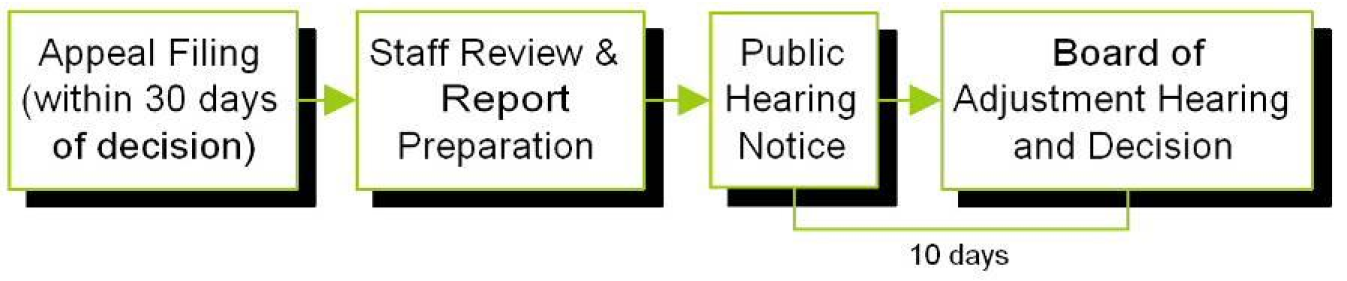
19-41-1
Authority. The Board of Adjustment is authorized to hear and decide appeals when it is alleged that there is an error in any order, requirement, decision or determination made by the Planning Director or other county staff in the administration or enforcement of this ordinance.
19-41-2
Right to Appeal. Appeals authorized by this section may be taken to the Board of Adjustment by any interested party aggrieved by an administrative decision.
19-41-3
Application. Appeals must be filed within 30 days of the order or decision complained of by filing with the officer from whom the appeal is taken, and with the Board of Adjustment, a notice of appeal that specifies the grounds for appeal.
19-41-4
Effect of Filing. The filing of a complete application for appeal stays all proceedings in furtherance of the action appealed, unless the official from whom the appeal is taken certifies to the Board of Adjustment, after the notice of appeal is filed, that, because of facts stated in the certification, a stay would cause imminent peril to life or property, or that, because the violation charged is transitory in nature, a stay would seriously interfere with enforcement of this ordinance. In that case, proceedings may not be stayed except by a restraining order, which may be granted by the Board of Adjustment or by a court of record on petition, on notice to the officer from whom the appeal is taken, and on due cause shown. The appellant may file with the official a request for an expedited hearing of the appeal, which must be heard by the Board of Adjustment within 15 days after such a request is filed. The filing of an appeal does not stop the accruing of assessed civil penalties.
19-41-5
Record of Decision. Upon receipt of a notice of appeal, the official whose decision is being appealed must transmit to the Board of Adjustment all papers constituting the record upon which the action appealed is taken.
19-41-6
Public Hearing.
(A)
The Board of Adjustment must hold a public hearing before taking action on an appeal. The Board of Adjustment must fix a reasonable time for the hearing of the appeal and decide the appeal within a reasonable time.
(B)
At least ten days before a hearing on an appeal affecting a particular site, the Planning Director must send written notice of the hearing to the applicant, and the owner of the affected property.
(C)
Notices to the appellant and the owner of the affected site must be delivered by personal delivery, electronic mail, or by first-class mail.
(D)
The official making the decision that is appealed shall be present at the hearing as a witness.
19-41-7
Decision.
(A)
General.
(1)
The Board of Adjustment is the final decision-making body on appeals in Wake County. The Board of Adjustment may reverse or affirm, in whole or in part, or may modify the order, requirement, decision, or determination appealed from, and may make any order, requirement, decision, or determination that in its opinion ought to be made in the circumstances.
(2)
Under this section, the Board of Adjustment has all of the powers of the officer from whom the appeal is taken.
(3)
The burden of proof is on the appellant by submittal of competent evidence.
(4)
An appeal may be affirmed only if the Board of Adjustment finds that the administrative official erred.
(5)
The decision of the Board of Adjustment must include findings of fact and conclusions of law and must be based upon substantial evidence or testimony that is competent, relevant, and material. Findings concerning the existence or nonexistence of crucial facts must be based upon sworn evidence or testimony unless the party or parties before the Board of Adjustment stipulate the facts or waive this requirement. Every decision of the Board of Adjustment must also include the vote, abstention from voting, or absence of each member.
(B)
Additional Evidence. Notwithstanding any other provision of this ordinance, the Board of Adjustment may require additional evidence or memoranda of authority to be submitted, and may reserve its decision until such evidence or memoranda have been submitted and considered.
19-42 - Permits.
19-42-1
Permits.
(A)
Permit Required. No excavation may be commenced, no wall, structure, premises, or land used, building or part thereof may be built, constructed or altered, nor may any building be moved, nor may any sign be erected or structurally altered (unless exempted), until application has been made and the proper permit has been obtained. This permit requirement includes prima facie businesses or activities. When the Planning Director, with the technical assistance of other County departments or upon direction by the Planning Board or Board of Adjustment, has determined that the proposed land use is permitted under the provisions of this ordinance, a permit for the proposed use will be issued.
(B)
Applications.
(1)
All applications for Land Use Permits must be accompanied by:
(a)
Accurate plot plans, drawn to scale, showing the actual shape and dimensions of the lot to be built upon;
(b)
The legal description of the lot to be built upon or used or the location of the plan as recorded by the Wake County Register of Deeds;
(c)
The exact sizes and location on the lot of all existing buildings and accessory buildings; the lines within which the proposed building or structure will be erected or altered;
(d)
The existing and intended use of each building or part of building, the number of families or housekeeping units the building is designed to accommodate;
(e)
The location, dimensions, and arrangements of all bufferyards required by this ordinance, including a landscape plan showing the design and specifications for any required plant materials earth berms, fences, or walls;
(f)
Location, dimensions and use of all existing and proposed impervious surface areas on the site;
(g)
Any other data deemed necessary by the Planning Director to determine compliance of a proposed development with the terms of this ordinance.
(2)
Non-residential plans must be prepared by a licensed design professional authorized by the North Carolina General Statutes to perform such work. The Planning Director may waive this requirement by certifying in writing that such information is unnecessary in the particular case to determine compliance with applicable regulations. Residential uses may require a professionally-prepared site plan based on the scale and scope of the project.
(3)
No certificate of occupancy or compliance may be issued by the Planning Director or Building Inspector until:
(a)
Applicable standards of this ordinance have been met; or
(b)
Written assurances are provided to the Building Inspector that applicable standards of this ordinance will be met within a reasonable period of time. Assurances must include posting of a surety bond or submission of a notarized letter of credit for the value of the incomplete improvements required.
(4)
The Planning Director is responsible for determining compliance with any applicable standard of this ordinance not under the purview of the Building Inspector.
(5)
In addition to the above, the following information must accompany applications for nonresidential uses:
(a)
Location of parking areas including the layout of spaces (on paved lots only), and ingress and egress from a public right-of-way;
(b)
Driveway entrance permit from North Carolina Division of Highways, District Engineer;
(c)
Location of signs, if any, including ownership and type (identification, commercial, or those not requiring a permit); and
(d)
Whether excavation, clearing of ground, or moving of earth other than that actually required for the building, is expected to occur.
(C)
Exemptions. Unless the property at issue is located in an area of special flood hazard, the following land uses will be exempt from the permit requirements as stated in (A) and (B) above:
(1)
The use of property for a bona fide farm purpose, except that application must be made for a determination of whether the use or proposed use is a bona fide farm purpose, and a farm exempt permit shall be issued upon a determination that the property is being used for a bona fide farm purpose;
(2)
Forestry;
(3)
Excavation for installation of septic tank systems under the control of Department of Health and Human Services or grading permits issued by Wake County Natural Resources Department or excavation and grading permits issued by North Carolina Department of Natural Resources and Community Development, or successor agency;
(4)
Fences designed primarily to enclose the perimeter, wholly or partially, of a lot;
(5)
Utility structures covering a well or pump, provided structure is used only for a covering well and pump; utility poles or structures supporting utility lines; excavation for installation of underground utilities; transformer enclosures or pad-mounted transformers; sewage treatment plants under the control of the North Carolina Department of Natural Resources and Community Development.
(6)
Governmental land uses that do not involve the construction or use of buildings by state agencies, counties, cities, or utility districts.
(D)
Permits in Flood Hazard Areas. See Article 14 for further requirements regarding Land Use Permits where the property at issue is located within an area of special flood hazard.
(E)
Validity of Permit. Development approval issued pursuant to this section shall expire one year after the date of issuance if the work authorized by the permit has not been substantially commenced. If work or activity is discontinued for a period of 12 months after commencement, the development approval shall immediately expire.
(F)
Permit Revocation.
(1)
The Planning Director may revoke any permit or other authorization granted under this ordinance for failure to comply with the provisions of this ordinance or the terms and conditions of the permit or authorization, or for false statements or misrepresentations made in securing the permit or authorization, or if the permit or authorization was mistakenly granted in violation of applicable State or local law.
(2)
Before revoking a permit or other authorization, the Planning Director must give the holder of the permit or authorization ten days written notice of intent to revoke the permit or authorization. The notice must state the reasons for the intended revocation and state that the holder may have an informal hearing on the intended revocation before the Planning Director. On revoking a permit or other authorization, the Planning Director shall follow the same development review and approval process required for issuance of the development approval, including any required notice or hearing, in the review and approval of any revocation of that approval. The revocation of a development or permit approval by the Planning Director may be appealed pursuant to Section 19-41 of this Ordinance. The holder of a revoked permit or authorization may, within 90 days after the revocation, submit to the Planning Director a written request to reinstate the revoked permit or authorization. On determining that the conditions justifying the revocation have been eliminated and that the development fully complies with all applicable requirements of this ordinance, the Planning Director may reinstate the permit or authorization.
(3)
No certificate of occupancy or compliance may be issued until:
(a)
Applicable standards of this ordinance have been met; or
(b)
Written assurance that applicable standards of this ordinance will be met, within a reasonable period of time, is provided to the Planning Director. Assurance must include posting of a surety bond or submission of a notarized letter of credit for the value of the incomplete improvements required.
(c)
The Planning Director will be responsible for determining compliance with any applicable standard of this ordinance not under the purview of the Building Inspector.
[Amended 12/7/2015 by OA-05-15; Amended on 9/8/2020 by OA-02-20; Amended 6/7/2021 by OA-01-21].

