
Wake County Unincorporated
City Zoning Code
City Zoning Code
ARTICLE 18
- Signs
18-10 - General Regulations.
18-10-1
Purpose.
(A)
The sign regulations of this Article are intended to prevent over-concentration, improper placement and excessive height, bulk, and area of outdoor signs. The regulations are also intended to encourage the positive economic development of the county by preserving the natural beauty of the area and protecting existing property values in both residential and nonresidential areas.
(B)
It is recognized that, unlike on-premise identification signs which are in actuality a part of a business, off-premise signs are a separate and distinct use and should be regulated differently from on-premise signs. It is intended that off-premise signs be located away from residential areas, that such signs be regulated to protect the character of the area where off-premise signs are located, and that property values in these areas be conserved.
(C)
It is further intended that these regulations neither favor signs displaying commercial speech over those displaying noncommercial speech nor favor signs displaying one type of noncommercial speech over those displaying another.
18-10-2
General Regulations. The following regulations apply to all signs in all districts except when in conflict with the provisions of Sec. 18-12, in which case the provisions of Sec. 18-12 govern.
(A)
Compliance. No outdoor sign of any type may be constructed, erected, painted, repainted, posted, reposted, placed, replaced, or hung in any district except in compliance with this ordinance. The location and size of each proposed sign must be included in plans submitted for approval.
(B)
Plan Approval and Sign Permit Required. A sign permit issued by the Wake County Planning Director is required for all outdoor signs.
(C)
Name of Owner. All signs with a copy area greater than two square feet must display the name of the owner of the sign in letters no less than one and one-half inches high.
(D)
Construction and Maintenance. All outdoor signs must be constructed and maintained in accordance with the North Carolina State Building Code.
(E)
Unlawful, Unsafe, or Improperly Maintained Signs. If the Planning Director has reason to believe that a sign is or may be in violation of any provision of the North Carolina State Building Code, the Planning Director must refer the matter to the Wake County building inspector, who must immediately investigate the possible violation and take appropriate action under the provisions of the State Building Code. Such referral will not preclude other methods of enforcement of this ordinance.
(F)
Removal of Obsolete Signs. Signs advertising events such as shows, displays, festivals, circuses, fairs, athletic contests, fund drives, election, contests, exhibits, meetings, sales, performances, dances, and the like must be removed within 30 days after the date of termination of such events. All other obsolete signs must be removed from the premises within 180 days after the first date of obsolescence.
(G)
Construction Signs. Construction signs are allowed without the issuance of a permit, subject to the following standards:
(1)
Construction signs may not be illuminated.
(2)
Construction signs may contain only the identification of the project, its owner and/or developer, architect, engineer, land planner, landscape architect, contractor and subcontractors.
(3)
A single construction site identification sign is permitted.
(4)
Construction signs may not exceed 32 square feet in area and must be set back at least ten feet from all property lines.
(5)
Construction signs may not be erected prior to issuance of a building permit, and must be removed within 15 days of the final inspection.
(H)
Temporary Signs. Temporary signs are allowed in accordance with the regulations of this subsection.
(1)
General Standards. Electric signs or permanently mounted signs may not be used as temporary signs.
(2)
Grand Openings and Special Events. Temporary signs or fixed banners (i.e. cannot move with the wind) erected for not more than 14 days announcing openings, closings, management changes or special events will be allowed, subject to issuance of a temporary sign permit and compliance with the following standards:
(a)
Such signs must be attached in total to a building wall or canopy.
(b)
No more than six such signs may be erected by any establishment within a calendar year.
(c)
The permit for such signs must be on display at the establishment.
(3)
Not-for-Profit Events. Temporary signs or fixed banners announcing a noncommercial and civic or philanthropic event are allowed, subject to issuance of a temporary sign permit and compliance with the following standards:
(a)
Such signs are allowed in any zoning district for not more than 14 days.
(b)
Such signs or banners are limited to one per lot with the written permission of the owner.
(c)
Such signs may be located in required setbacks.
(4)
Off-Premise Directional Signs. Two temporary off premise directional signs are allowed, subject to issuance of a temporary sign permit and compliance with the following standards:
(a)
Such signs are limited to a maximum of 16 square feet in area and eight feet in height.
(b)
Such signs are allowed for any new business for a period of 30 days following issuance of a certificate of occupancy.
(c)
Such signs are limited to one per lot with the written permission of the property owner.
(d)
Such signs are not allowed in any residential district.
(e)
Such signs may be located in required setbacks.
(5)
Signs for Temporary Sales and Seasonal Events. Signs for the sale of produce, crafts, seasonal, seafood or similar items sold on a seasonal or temporary basis are allowed, subject to issuance of a temporary sign permit and compliance with the following standards:
(a)
Such signs may not exceed 32 square feet in area or eight feet in height.
(b)
Only one such sign per temporary business may be erected and must be safely affixed to the ground or a permanent structure on the lot.
(c)
Such signs must be removed within seven days of the termination of sale activities.
(I)
Real Estate Signs. Real estate signs are allowed without the issuance of a permit, subject to the following standards:
(1)
Real estate signs may not be illuminated.
(2)
Real estate signs may only contain the message that the property is for sale, lease or rent and the name, address and phone number of the agent or owner.
(3)
Real estate signs must be removed immediately upon the sale or lease of the property.
(4)
A single real estate sign may be erected on each street frontage of the property.
(5)
Real estate signs are subject to the same size and height restrictions as any other on-premise sign allowed in the subject zoning district.
(6)
Real estate signs do not require a permit if they:
i.
Have an area of 32 square feet or less;
ii.
Are located on premises for sale or for rent;
iii.
Are in compliance with all zoning regulations; and
iv.
Are set back at least 12 feet from all street right-of-way lines.
(J)
Political Campaign Signs. Political campaign signs are allowed, on private property and in the right-of-way of state-maintained roads, in all districts subject to the following standards:
(1)
Signs may be located on private property with prior permission of the owner;
(2)
Signs may be erected within specified proximity of polling places, under rules established by the Wake County Board of Elections;
(3)
Signs may only be erected during the period 30 days before the beginning date of "one-stop" early voting;
(4)
Signs shall be removed within ten calendar days following election;
(5)
No sign shall be permitted in the right-of-way of a fully controlled access highway (a highway with no at-grade crossings and access only at limited public roads. Examples include US264, I-440 and I-540);
(6)
No sign located within the right-of-way shall be higher than 42 inches above the edge of the pavement of the road;
(7)
Signs within the right-of-way may not obscure motorist visibility at any intersection;
(8)
No sign shall be larger than six square feet if it is within the right-of-way. When a political campaign sign is erected in place of another sign permitted at that location and outside of the right-of-way then it may be the same size and is subject to the same conditions as the sign it is replacing;
(9)
Signs must be at least three feet from the edge of pavement;
(10)
No sign shall obscure or replace another sign;
(11)
Signs are not allowed in the medians of any roadways;
(12)
The candidate must obtain the prior permission of any property owner of a residence, business or religious institution fronting the right-of-way where a sign would be erected.
(K)
Prohibited Signs. Flashing signs, illuminated tubing or strings of lights outlining roof or building lines of structures, roof signs, portable signs, windblown signs, and suspended signs are prohibited in all zoning districts.
(L)
Illumination and Movement. Permitted signs may not be illuminated as to cast direct light on adjoining properties or roads. No moving or flashing signs are permitted except as authorized per Section 18-13.
(M)
Signs for Which No Permit is Required. The following signs may be erected or displayed in any district without a permit, provided the uses of the premises upon which such signs are erected or displayed are in compliance with all other zoning regulations:
(1)
Any sign with an area of less than two square feet.
(2)
Bulletin boards with an area of no more than 32 square feet located upon the premises of public, charitable, or religious institutions. Temporary signs announcing activities of such institutions may be displayed, without a permit, for a maximum of 30 days.
(3)
Signs advertising the sale of farm, florist, or horticultural products to be sold at the farm or nursery where they are produced, provided that there will not be more than two separate signs with an area not exceeding 32 square feet each.
(4)
Signs indicating the name of an active farm or nursery, provided that there will not be more than two separate signs with an area not exceeding 32 square feet each.
(5)
Temporary signs identifying the name of architects or contractors for projects under construction.
(6)
Official traffic and warning signs, including private signs pertaining to hunting, fishing, trespassing, or dumping of refuse.
(7)
Memorial signs or tablets, names of buildings, date of erection, and the like, when cut into masonry or permanently affixed to the surface of a building.
(8)
Incidental signs, provided that the number and location of such signs are approved on plans submitted to the Wake County Planning Director and that the number of signs is no greater than reasonably necessary.
(9)
Official governmental flags, provided that the county has authority to regulate the size, number, location and pole height of official government flags.
(10)
Signs on water towers and Doppler radar towers. No more than two signs (other than governmental signs that are exempt) may be located on any water tower or Doppler radar tower. Signs on water towers and Doppler radar towers may not exceed a maximum of 20 percent of the total surface area of the actual water tank or Doppler radar unit. No supporting columns or other structural supporting elements may be included in the calculation of allowable surface area. Height limits do not apply to signs on water towers or signs on Doppler radar towers.
(11)
One address sign of no more than two square feet of total sign face area for each parcel of land used for residential purposes and no more than three square feet of total sign face area for each parcel of land used for commercial purposes.
(12)
Fixed Banner Signs of no more than 32 square feet on parcels used for non-residential purposes. Fixed banners signs may not exceed eight square feet per sign face.
(N)
Location and Number of Signs.
(1)
Not Allowed in Right-of-Way. No sign may be located in or overhang any public right-of-way except as permitted by the North Carolina Department of Transportation. No sign may be located in such manner that creates a visual obstruction for traffic or otherwise create a traffic hazard, or create adverse visual impact on the landscape. Any such sign may be removed by county staff and disposed of without any requirement for such signs to be stored or retained.
(2)
On-Premise Identification Signs.
(a)
On-premise signs may be located in required front or side setbacks.
(b)
A maximum of two on-premise signs are permitted per use. Double-sided and V-type signs may be considered as a single sign for purposes of this section.
(c)
Non-residential on-premise ground and pole signs are required to display the address of the property on the sign or sign structure. The address sign for each parcel of land used for non-residential purposes shall be no more than three square feet of total sign face area. The square footage for the address sign shall be allowed in addition to the total signage square footage allowed.
(3)
Off-Premise Signs.
(a)
All off-premise signs must conform with the minimum setback requirements of the district in which they are located.
(b)
No off-premise sign may be located within a radius of 2,500 feet from any other off-premise sign. Double-sided and V-type signs may be considered as a single sign for purposes of this section.
(c)
The landscaping requirements of the district in which the structure is located apply to off-premise sign structures.
(d)
No off-premise sign may be located closer than 750 feet from a residence, when built.
(4)
Incidental Signs.
(a)
The possible number of incidental signs permitted for a proposed use must be determined by the need for such signs.
(b)
Incidental signs may be located in all required setbacks.
(c)
Double-sided signs may be considered a single sign for purposes of this section.
(O)
Construction Standards.
(1)
Permitted Signs by Structural Type.
(a)
On-premise signs: Ground signs and pole signs (including V-type and double-faced signs), marquee signs, projection signs, wall signs, and awning signs in districts where authorized.
(b)
Off-premise signs: Ground signs and pole signs (including V-type and double-faced signs) or wall signs may be permitted as off-premise signs in districts where allowed.
(c)
Incidental signs: Ground signs, projection signs, wall signs, marquee signs, and awning signs may be permitted as incidental signs.
(2)
Maximum Sign Area.
(a)
On-premise signs: 100 square feet per sign face.
(b)
Off-premise signs: 300 square feet per sign face.
(c)
Incidental signs: Four square feet.
(3)
Maximum Height of Signs.
(a)
On-premise signs.
i.
Pole signs, marquee signs, wall signs, and awning signs: 30 feet.
ii.
Ground signs: 12 feet.
iii.
Projection signs: 12 feet.
(b)
Off-premise signs.
i.
Pole signs and wall signs: 30 feet.
ii.
Ground signs: 12 feet.
(c)
Incidental signs.
i.
Ground signs: eight feet.
ii.
Projection signs, wall signs, marquee signs and awning signs: 12 feet.
(P)
Landscaping of Freestanding Signs. The base of all freestanding signs must be landscaped as follows:
(1)
Residential Development Signs.
(a)
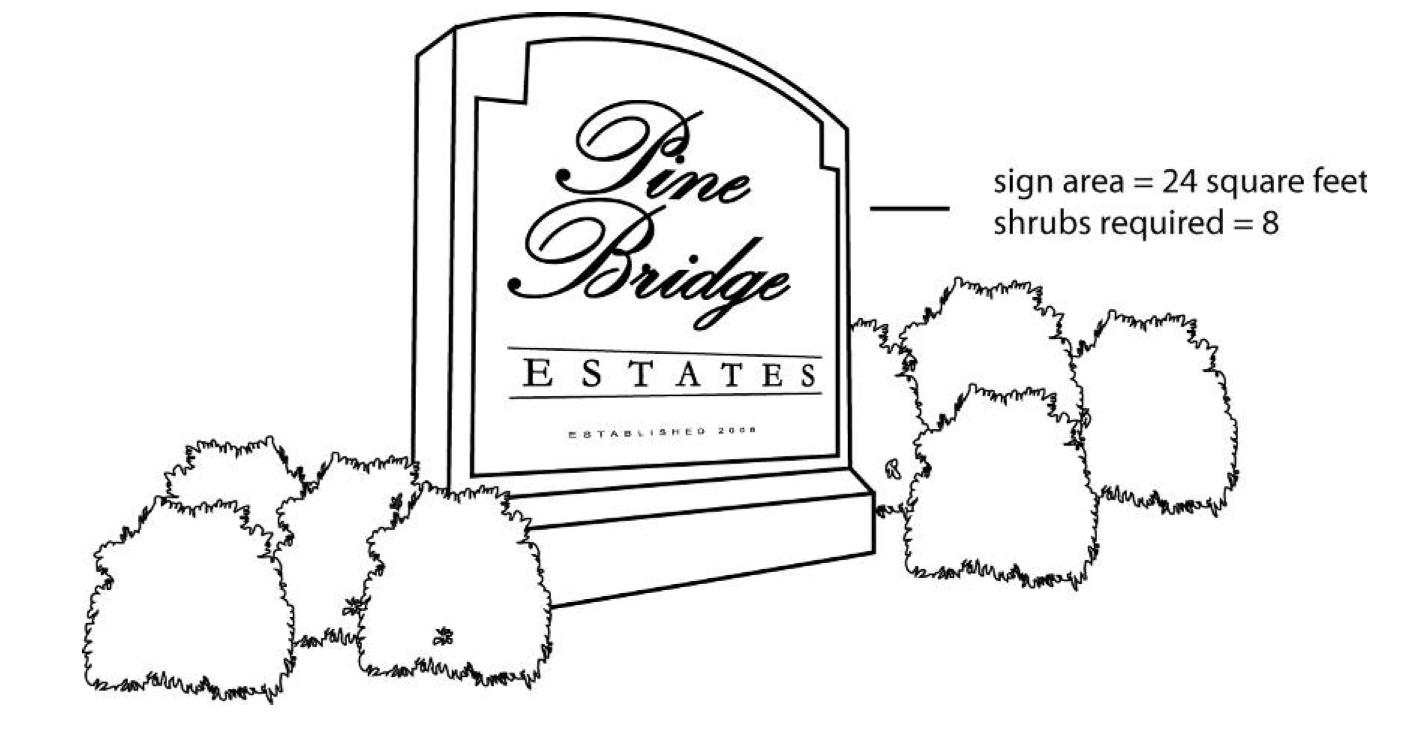
The area around the base of all freestanding or wall mounted residential identification signs at the entrances to subdivisions or multi-family development projects must be planted with shrubs, at a rate of one shrub for every three square feet of sign area (or portion thereof). This calculation is based upon the actual sign area as defined in Sec. 21-11 and does not include the supporting monument or wall. Additional landscaping is encouraged in the form of trees, flowers, and ground cover.
(b)
The required landscaping must be placed around the perimeter of the sign base, or below the sign area for wall mounted signs, and must be located in such a manner to ensure that the mature plantings will not obscure the sign area. In no case may the required landscaping be located further than 25 feet from the sign area.
(c)
Plantings must be evenly distributed around the sign base but may be grouped and located so as to maintain visibility of the sign and the site.
(2)
Freestanding Signs for Nonresidential Uses.
(a)
The area around the base of all freestanding signs on the site of nonresidential uses must be planted with shrubs, at a rate of one shrub for every four square feet of sign area (or portion thereof). Additional landscaping is encouraged in the form of trees, flowers, and ground cover.
(b)
The required landscaping must be placed around the perimeter of the sign base, or below the sign area for wall mounted signs, and must be located in such a manner to ensure that the mature plantings will not obscure the sign area. In no case may the required landscaping be located further than 25 feet from the sign area.
(c)
Plantings should be evenly distributed around the sign base but may be grouped and located so as to maintain sign visibility. If the area around the base of the sign is insufficient in size to accommodate the required plantings, the Planning Director may permit installation of a portion of them at an alternate location on the site.
(d)
The following signs are exempt from sign base landscaping requirements:
i.
Those located more than 100 feet from road rights-of-way,
ii.
Permitted temporary signs,
iii.
Directional and incidental signs containing no commercial message.
[Amended on 1/22/2008 by OA 04-07; Amended on 7/21/2008 by OA 02-08; Amended on 9/3/2013 by OA 02-13; Amended on 2/2/2015 by OA 05-14]
18-11 - Permitted Signs.
Sign types are allowed as shown in the following table (p = allowed/permitted; blank = not allowed)
[1] For permitted uses only.
[2] For special uses only.
* Additional standards apply. See Sec. 18-12
** For Electronic Changeable Message Signs (ECMS), see section 18-13.
[Amended on 10/1/2012 by OA 04-12; Amended on 9/3/2013 by OA 02-13; Amended on 1/3/2022 by OA-03-21]
18-12 - Sign Regulations for Specific Zoning Districts.
Sign regulations applicable within specific zoning districts are described in this section. Except whereas otherwise provided for in this ordinance, these regulations shall apply.
18-12-1
Research Applications Districts.
(A)
A maximum of one sign per vehicular access point and one additional sign per tenant is allowed.
(B)
Maximum sign height of on-premise marquee and wall signs: The parapet or eave line of the building to which the sign is attached.
18-12-2
Residential Districts.
(A)
Permitted Signs.
(1)
On-premise signs must identify the name and use in letters constructed of wood, plastic, or metal, or in letters painted onto or carved into a wooden sign. Wood, plastic, or metal letters may be displayed upon a building wall or framed or mounted on a concrete or masonry ground sign.
(2)
On-premise signs may not exceed four square feet per side in sign area.
(3)
One on-premise sign for churches, colleges, schools, public libraries, public museums, and art galleries not exceeding 32 square feet per side in sign area.
(4)
On-premise signs for residential subdivisions and multi-family dwelling developments may be as large as 32 square feet per side in sign area, and may have two on-premise identification signs per subdivision or development entrance.
(5)
On-premise signs may not exceed eight feet in height or ten feet in width.
(6)
Except as otherwise specified herein, a maximum of one on-premise sign per nonresidential permitted use may be erected on a lot.
(B)
Special Uses.
(1)
A maximum of one on-premise identification sign per special use may be erected on a lot.
(2)
On-premise identification signs for bed and breakfast homestays and bed and breakfast residences may not exceed four square feet in area; all other signs may not exceed 32 square feet per side in area. No ground sign may exceed eight feet in height.
18-12-3
Business Districts (GB and HC Districts).
(A)
No on-premise sign may be located within 50 feet of a residence and, if illuminated, may not be closer than 100 feet to a residence.
(B)
Neither on-premise nor off-premise signs may be located in any required side setback adjacent to a Residential district.
18-12-4
Industrial Districts.
(A)
No on-premise sign may be located within 50 feet of a residence and, if illuminated, may not be closer than 100 feet to a residence.
(B)
Neither on-premise nor off-premise signs may be located in any required side setback adjacent to a Residential district.
18-12-5
Residential Mobile Home Districts. On-premise signs may not be located less than five feet from any property line. Such signs are limited to 32 square feet per sign face in area, and eight feet in height. Only one double-sided or V-type sign, or two single-sided on-premise signs, is permitted per park entrance.
18-12-6
Airport Districts. All illuminated signs must be shielded in such a manner that no direct glare from the light source can be seen from above.
18-12-7
O&I Districts. No on-premise sign is located within 20 feet of an adjacent Residential district.
18-12-8
SHOD Overlay Districts.
(1)
Relation to Underlying District Sign Regulations. Where the sign regulations of the overlay district and the underlying zoning district differ, the more restrictive sign regulation applies.
(2)
Additional Standards for Permitted Signs.
(a)
On-premise signs must be located along, or facing, the road from which direct or principal vehicular access to the premises is obtained.
(b)
Incidental signs may be no more than eight feet in height.
(3)
Shielding of Illuminated Signs. All illuminated signs must be shielded in such a manner that no direct glare from the light source can be seen from the highway or thoroughfare or from above.
[Amended on 1/22/2008 by OA 04-07; Amended on 10/1/2012 by OA 04-12]
18-13 - Electronic Changeable Message Signs (ECMS).
All electronic changeable message signs (ECMS) are subject to the regulations of this section.
18-13-1
Standards for ECMS Signs. Standards governing maximum area, minimum message hold time, and hours of operation vary by zoning district. ECMS signs shall be permitted as on-premises signs subject to the following limitations and requirements as shown in the table below. ECMS signs shall not be permitted in the RA district.
Standards for Electronic Changeable Message Signs
[1] Maximum sign area allowed for ECMS per use per district. ECMS only allowed for non-residential land uses within residential zoning districts.
[2] Minimum hold time for message or image.
[3] Hours that ECMS must be turned off. Automatic timers are required.
* If a restriction in Hours of Operation is regulated under Article 4 (Use Standards), the standards of that section shall also apply to ECMS.
18-13-2
Maximum Light Levels of ECMS Signs. Maximum sign luminance shall not exceed 0.3 (three-tenths) foot-candles above ambient light levels based upon the size of the ECMS sign (in square feet) and distance measured perpendicular to the sign face in accordance with the following table.
Maximum Light Levels of Electronic Changeable Message Signs
| Maximum Allowed Above Ambient Light Level | Area of ECMS (Sq. Ft)[1] | Measurement Distance (Ft)[2] |
|---|---|---|
| 0.3 foot-candles | 10 | 32 |
| 0.3 foot-candles | 15 | 39 |
| 0.3 foot-candles | 20 | 45 |
| 0.3 foot-candles | 25 | 50 |
| 0.3 foot-candles | 30 | 55 |
| 0.3 foot-candles | 35 | 59 |
| [1] For signs with an area in square feet other than those specifically listed in the table (i.e., 12 sq ft, 38 sq ft, etc.), the measurement distance may be calculated with the following formula: | ||
 | ||
| [2] Measured in feet, perpendicular to the face of the sign. Measurement must occur on same property where on-premise sign is located. Maximum light level shall not exceed 0.3 foot-candles at pre-set measurement distance or at adjoining property lines. | ||
18-13-3
Certification Required. Prior to the issuance of a sign permit, certification must be provided to the County demonstrating that the sign has been preset to automatically adjust brightness to these levels or lower. Re-inspection and recalibration may be periodically required by the County in its reasonable discretion, at the permit holder's expense, to ensure that the specified brightness levels are maintained at all times.
18-13-4
Brightness.
(A)
Measurement. Brightness of electronic changeable message signs shall be measured as follows:
(1)
At least 30 minutes following sunset, a foot-candle meter shall be used to obtain an ambient light reading for the location. This is done while the sign is off or displaying black copy. The reading shall be made with the meter aimed directly at the sign area at the pre-set distance.
(2)
The sign shall then be turned on to full white copy to take another reading with the meter at the same location.
(3)
The difference between the readings must be 0.3 foot-candles or less.
18-13-5
Movement of ECMS Prohibited. Blinking, flashing, flickering, oscillating, rotating, or scrolling of the changeable area shall be prohibited.
[Added on 9/3/2013 by OA 02-13; Amended on 1/3/2022 by OA-03-21; Amended on 6/16/2025 by OA-03-25]

