
Whittier City Zoning Code
CHAPTER 18
30 - C-2 GENERAL COMMERCIAL ZONE
Sections:
18.30.010 - Purpose.
In order to provide for the development of general commercial areas and to maintain the integrity of existing general commercial areas within the city, zone C-2, entitled "General Commercial," is created.
(Prior code § 9200)
18.30.020 - Permitted uses.
No person shall use or permit the use of any property zoned C-2, except for the following principal and accessory uses:
A.
Principal Uses.
1.
Any use permitted in the C-1 zone, except that residences may only be established within that portion of a building located above the ground floor over commercial uses. Such dwelling units shall observe the same yard requirements as applicable to the C-2 zone;
2.
Those uses which are expressly permitted pursuant to Section 18.52.030, for which a conditional use permit is required;
3.
The following uses:
— Ambulance services
— Appliance sales and service, household
— Art supply stores
— Automobile rental agencies
— Automobile sales (new) agencies
— Automobile supply stores (not including installation)
— Bookbinderies
— Bookstores
— Ceramics and pottery shops
— Cleaning and dyeing establishments
— Communication equipment buildings
— Computer sales and service
— Costume rental and sales shops
— Department stores
— Dry goods stores
— Food markets (not including convenience markets)
— Fortunetelling
— Furniture stores
— Hardware stores
— Health centers/fitness clubs
— Ice vending machines
— Interior decorating shops
— Lawnmower, edger sales and service
— Leather goods stores
— Lighting fixtures
— Mail-order houses, with floor samples only, but not including warehousing or other direct sales
— Music stores
— Newspaper publishers
— Paint and wallpaper stores
— Parking lots and parking structures
— Pawn shops
— Pet shops, including tropical fish
— Pet supply and grooming
— Photoengraving
— Power-tool sales and service
— Print shops
— Plumbing shops
— Radio and television stores
— Radio and television broadcasting studios
— Recycling, small collection facility, unless prohibited pursuant to Section 66787.6 of the Government Code
— Reverse vending machines, unless prohibited pursuant to Section 66787.6 of the Government Code
— Residential facility (former drug abusers)
— Restaurants and cafes (including dancing and entertainment)
— Rubber stamp stores
— Schools, business and professional
— Secondhand stores
— Sickroom supplies, rental and sales
— Sign painting and repairing
— Sporting goods stores
— Swimming pool supply sales
— Tile sales, ornamental, but not including a kiln or manufacture of same
— Tobacco shops
— Toy shops
— Any use which is found, pursuant to Section 18.50.030, to be similar to and compatible with the uses listed in this section;
B.
Accessory Uses. Those uses which are directly related, but clearly subordinate to permitted principal uses.
(Ord. 2740 § 4, 1998; Ord. 2712 § 1 (G), 1997; Ord. 2553 § 8, 1991; Ord. 2423 § 9, 1987; Ord. 2382 § 1, 1986; Ord. 2371 § 2, 1986; prior code § 9201)
18.30.030 - Development standards.
Buildings, structures and uses located on lots classified in zone C-2 shall be developed and maintained in accordance with the regulations contained in Chapter 18.24.
(Prior code § 9202)
18.30.040 - C-2 with housing overlay.
A.
Purpose. To provide for the development of general commercial uses integrated with housing.
B.
Permitted Uses. No person shall use or permit the use of any property zoned C-2-HO, except for the following principal and accessory uses:
1.
Principal Uses. Table 18.30.040 - B lists the land uses for C-2-HO zoned lots indicating the type of approval required subject to compliance with all provisions of this title. Descriptions and definitions of the land uses can be found in Chapter 18.07. The specific use regulations and notes column in the table indicates a chapter or section where additional regulations may apply; and/or provides additional information specific to that use type.
2.
Accessory Uses. Accessory uses are those uses which are directly related, but clearly subordinate to a permitted or conditionally permitted principal use; where such use is already established, or the principal and accessory uses are established jointly.
3.
Stand-alone Residential. Stand-alone residential is not allowed in C-2-HO zoned lots.
4.
Use Not Listed. Any use that is not listed or has not been determined by the director of community development to be similar to a listed use, is prohibited in C-2-HO zoned lots.
C.
Development Standards. Buildings, structures and uses located on lots classified in zone C-2-HO shall be developed and maintained in accordance with the regulations contained in Chapter 18.24; unless modified by Table 18.30.040 - C standards as outlined within this title, and objective design standards contained in Chapter 18.93:
1.
Maximum Density. The maximum density standard is only applicable to mixed-use developments that include both residential and non-residential uses.
2.
Accessory Structures. Includes parking structures, trash enclosures and similar supporting or separate structures from the primary structure. The standards do not apply to accessory dwelling units regulated by Section 18.10.020.I.
3.
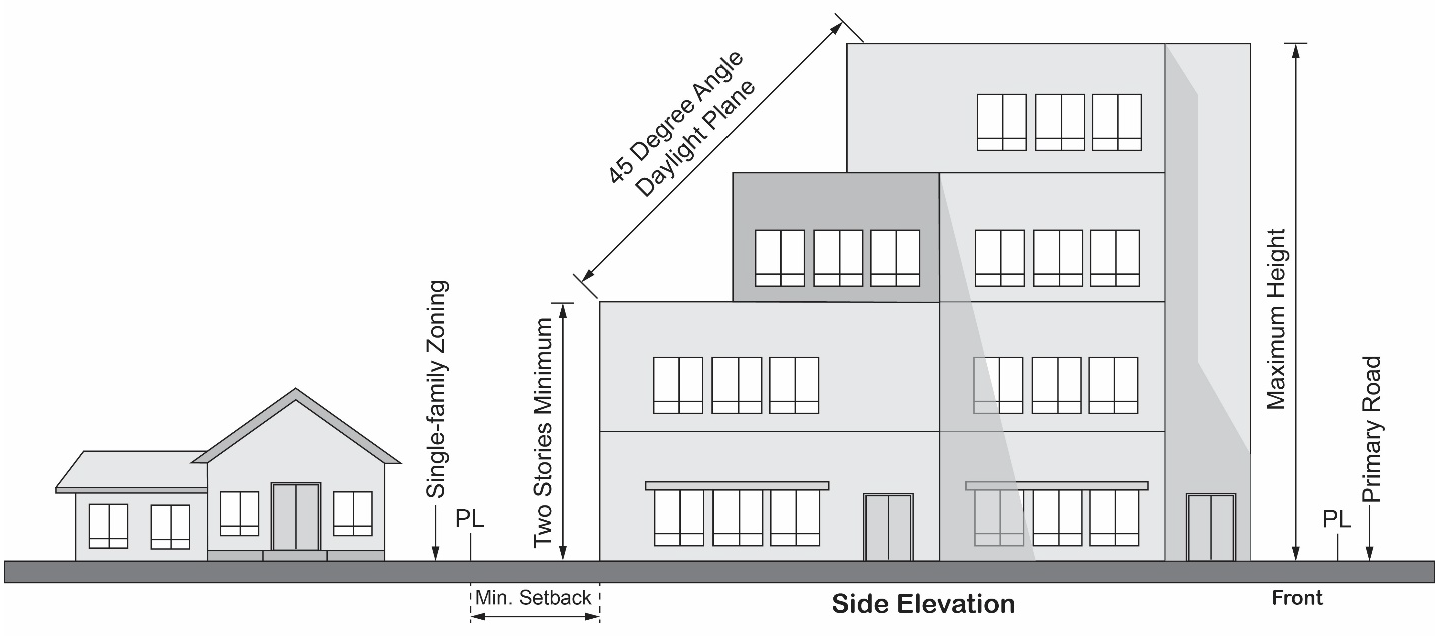
Building Step Back Requirements. Buildings located on C-2-HO zoned parcels shall provide transition, a stepping back of the building at the third story and above, that is in addition to the minimum side and rear setback line. Taller elements of the building shall increasingly step back from adjacent single-family zones. No portion of the building, excluding parapets, shall extend above an imaginary plane drawn at the property line that is adjacent to the single-family zone, and extended at an angle of 45 degrees toward the center of the C2-HO zoned parcel as shown in Figure 18.30.040-B.
Figure 18.30.040-B: Building Step Back
4.
Building Frontage. New buildings are to be located in close proximity to the street for improved relationship to the street and an enhanced experience for pedestrians. For parcels less than fifteen acres in size, at least fifty percent of the lot width shall be occupied by primary building frontage and/or pedestrian features located between zero and thirty feet from the front property line. For parcels fifteen acres and greater in size, at least fifty percent of the lot width is occupied by primary building frontage and/or pedestrian features located between zero and eighty feet from the front property line. Additional criteria may apply and includes:
a.
Proportion and form of buildings should contribute to the visual effect of "grand buildings on display." Individual units should work together to create a more substantial building mass punctuated by strong building elements or portions of greater height.
b.
New buildings should be designed to present a strong, formal presence along the thoroughfare.
c.
The height of a major building mass should be roughly two-thirds its width.
d.
The primary visual presence along the major street frontage should be the building, not a drive-through lane or parking area.
5.
Open Space. The residential component of an integrated development shall provide open space areas subject to the following standards in addition to the requirements of Table 18.30.040 - C.
a.
Private Open Space. Private open space shall be provided at each unit in the form of a patio, yard, balcony, immediately adjacent deck, or combination thereof and shall be directly adjacent to and accessible from each unit. Private open space shall have a minimum area of sixty square feet, minimum dimension of six feet in any direction, and a minimum vertical clearance of eight feet.
b.
Active Common Open Space/Recreation Areas. Common open space/recreation areas shall be designed to provide specific amenities as outlined below based on the number of units proposed in the development. The list of amenities is both cumulative and additive, requiring that the base amenity type and minimum size be satisfied for the applicable number of units threshold, plus all preceding amenities, plus any additional increase in number or size of the amenity based upon the additive amenity ratio over the base.
As an example, a development consisting of twenty units shall provide a business center with at least two work stations OR a two hundred fifty square foot gym; plus, an outdoor active use area or facility a minimum of six hundred fifty square feet (400 sf + 250 sf); plus, forty-eight square feet of community garden area (32 sf + 16 sf); and, two barbeque areas each with table seating for twelve adults.
c.
Common Open Space Dimensions. Common open spaces shall have a minimum horizontal dimension in any direction of twenty feet on the ground floor level. Upper story decks shall be no less than ten by ten feet in horizontal dimension. Roof decks shall be no less than fifteen by fifteen feet in horizontal dimension. The minimum vertical dimension shall be fifteen feet.
d.
Common Open Space Location. Active common open spaces shall not be located in any required setback area. Active common open spaces may be located at ground level, on upper story decks, on roof decks, indoors, or outdoors. Areas located at upper story decks or on roof decks may contribute one hundred percent towards the required common open space area. Areas located indoors shall not contribute more than fifty percent of the required common open space area.
6.
Parking. The number of parking spaces provided for the allowed uses contained in Table 18.30.040 - B, and the design of such parking areas shall satisfy the applicable requirements of Chapters 18.48 and 18.99. Shared parking shall be permitted, subject to review and approval of a parking study prepared in accordance with Section 18.48.030 for mixed occupancy requirements and Section 18.48.040 joint use authorization.
(Ord. No. 3159, § 3(Exh. A), 11-12-24)

