
Whittier City Zoning Code
CHAPTER 18
34 - M MANUFACTURING ZONE
Sections:
18.34.010 - Purpose.
In order to provide for the development of manufacturing areas and to maintain the integrity of existing manufacturing areas within the city, the regulations set out in this chapter shall be applicable to all properties classified in zone M.
(Prior code § 9220)
(Ord. No. 3159, § 3(Exh. A), 11-12-24)
18.34.020 - Permitted uses.
No person shall use, or permit the use of any lot zoned M, except for the following principal and accessory uses:
A.
Principal Uses.
1.
Any use permitted in the C-3 zone, except for the following:
a.
Educational institutions,
b.
Lodging facilities;
2.
Those uses which are expressly permitted pursuant to Section 18.52.030, for which a conditional use permit is required;
3.
The following uses:
—
Automobile assembly plants, including body and fender repair
—
Bakeries
—
Bottling plants
—
Building material sales
—
Contractors' equipment yards, storage, sales or service
—
Cleaning and dyeing establishments, wholesale and retail
—
Emergency shelters (See Section 18.34.060 for provisions
—
Engraving, machine-metal engraving
—
Fabricating, or other process used in bending or shaping metal
—
Feed and fuel sales
—
Flour mills
—
Gases. Storage of the following gases is permitted, provided that the same is conducted in accordance with the provisions of all applicable laws, including, but not limited to, this code: acetylene, butane and oxygen
—
Ice and cold-storage plants
—
Knitting mills
—
Laundries
—
Lumberyards
—
Machine shops
—
Machine storage yards
—
Manufacturing, compounding, assembling, processing, packaging or treatment which creates any of the following products, with associated distribution occupying no more than forty-nine percent of building area:
—
Batteries
—
Brushes
—
Candles
—
Canvas
—
Casein, the manufacture of casein products, except glue
—
Cigars
—
Cigarettes
—
Clocks
—
Coffins
—
Cosmetics
—
Cutlery
—
Drugs
—
Dry goods
—
Electric or neon signs
—
Engines, internal combustion or steam, which shall not include foundries
—
Food products, except lards, pickles, sauerkraut or vinegar
—
Furs
—
Furniture
—
Gloves
—
Hearing equipment
—
Ink
—
Mattresses and bedsprings
—
Motors, electric
—
Musical instruments
—
Phonograph records
—
Prefabricated buildings
—
Rugs
—
Shoes
—
Soap, cold-mix only
—
Statuary
—
Store and other commercial fixtures
—
Toys
—
Type, printers
—
Venetian blinds
—
Wearing apparel and garments
—
Manufacturing, compounding, assembly, packaging or treatment of articles or merchandise from any of the following materials, with associated distribution occupying no more than forty-nine percent of building area:
—
Bone products
—
Cellophane
—
Cork
—
Corrugated cardboard
—
Feathers
—
Fiber, including fiberglass
—
Glass
—
Hair
—
Horn
—
Iron, not including foundries
—
Metal, products of precious metals: steel and brass stamp, including hand and machine engraving, metal fabricating, spinning and storage
—
Paper, not including the manufacture of paper itself
—
Plastics and synthetics
—
Pottery
—
Rope
—
Rubber, fabrication of products made from finished rubber
—
Textiles
—
Wire
—
Wood, including a planing mill
—
Yarn
—
Paints, paint-mixing, providing a boiling process is not employed, no tank farm is permitted and above-surface thinner storage is limited to two hundred gallons
—
Poultry and rabbit slaughter
—
Public utility service yards and pumping plants
—
Sheet-metal shop
—
Solid-fuel operation
—
Tile, wall and floor, and related small tile products
—
Tinsmiths
—
Tire rebuilding, recapping and retreading
—
Trade schools
—
Truck-washing and cleaning
—
Welding shops
—
Wine storage and manufacture
—
Any similar enterprises or businesses which the commission finds, by clarification of ambiguity, are similar to and compatible with the uses enumerated in this section.
(Ord. 2553 § 10, 1991; Ord. 2423 § 10, 1987; Ord. 2375 § 1(c), 1986; prior code § 9221)
(Ord. No. 2948, § 1, 2-23-10; Ord. No. 3159, § 3(Exh. A), 11-12-24)
18.34.030 - Accessory uses.
On the site of an active construction project, the storage of building materials necessary for the construction of the approved project will be permitted as an accessory use. Upon completion of the approved project, the property owner shall have ten calendar days in which to remove all building materials associated with the construction of the approved project and to render the surrounding off-site area clean and free of all trash and debris that was associated with the construction of the approved project.
(Ord. 2515 § 6, 1990)
18.34.040 - Limitations on permitted uses.
Every use permitted in the M zone shall comply with the following:
A.
Uses in Buildings. All uses shall be conducted totally within a completely enclosed building, except for those uses which are customarily conducted in the open, as determined pursuant to Section 18.50.040.
B.
Outdoor Storage. No outdoor storage shall be allowed unless the same is enclosed within a view-obscuring wall not less than eight feet in height, having a closable access gate.
C.
Sales, Display and Storage Areas and Surfacing. Outdoor sales, display and storage areas, when permitted, shall be surfaced and improved in accordance with subsections E and H of Section 18.48.070.
D.
Discharge of Material. No person shall permit or allow the discharge of, across the boundaries of the lot whereon the use is located, toxic, noxious or odorous matter in such concentrations as may be detrimental to the public health, safety, comfort or welfare, or cause injury or damage to or unreasonably interfere with the use of adjacent lots.
E.
Burning Operations. The manufacture of materials, goods or products which includes, as a part of such process, burning, ranging from free or active to intense burning, as determined by the fire chief, shall not be allowed unless enclosed within a building and such buildings are set back at least forty feet from any lot line or, in lieu thereof, all such buildings or structures are protected throughout by an automatic sprinkler system of a type approved by the fire chief.
F.
Public Nuisance. Any operation producing intense glare or heat shall be performed in such a manner so as not to create a public nuisance or hazard to the adjacent or abutting properties.
(Prior code § 9222)
18.34.050 - Development standards.
Prior to the issuance of a building permit, a development review, in accordance with Chapter 18.56, shall be approved.
The adopted manufactured design guidelines and the following development standards shall be applicable to each use, building or structure located in the M zone, except for developments within which more than fifty percent of the floor area of the structures are devoted to commercial uses, as listed in Sections 18.26.020, 18.28.020, 18.30.020 and 18.32.020, for which the commercial design guidelines shall be applicable; and, except as set forth in this title.
A.
Lots. Lots created after the effective date of the ordinance codified in this chapter shall conform to the following:
1.
Area. The minimum required lot area of each lot in the M zone shall be seven thousand square feet.
2.
Minimum Width. The minimum width of each lot in the M zone shall be sixty-five feet.
B.
Yards. The following yard areas shall be required and observed on all M-zoned lots:
1.
Front Yards.
a.
All M-zoned lots fifty feet or less in width and/or one hundred forty feet or less in depth, shall have a front yard of not less than fifteen feet. All m-zoned lots with widths of greater than fifty feet and depths greater than one hundred forty feet shall have and maintain a front yard of a depth of not less than twenty feet. An additional five foot setback is required for each story of the building above the second story except as permitted in paragraph c of this subsection; and
b.
Front yards may be reduced to the average of the adjacent existing front yards, but in not case less than ten feet on M-zoned lots less than one hundred feet wide, located between existing buildings with front yard areas less than twenty feet in depth. For corner lots the adjacent front yard shall be averaged with a ten foot front yard setback; and
c.
On corner lots of eight thousand square feet or less in net area, the front yard shall be no less than fifteen feet and the street side yard no less than ten feet; and
b.
Where a permitted driveway enters the front wall of a building, facing a street, located on an M-zoned lot, that portion of such front wall shall be located not less than twenty-five feet from the front lot line.
2.
Side Yards.
a.
Each lot classified in zone M which has a side lot line abutting any lot located in any of the R zones shall have and maintain a side yard area of not less than ten feet in width on the side adjoining such residentially zoned lot; and
b.
Where a permitted driveway enters the side wall of a building, facing the street, located as an M-zoned lot, that portion of such side wall shall be located not less than twenty-five feet from the side lot line of the lot upon which located.
c.
All M-zoned corner lots fifty feet or less in width and/or one hundred forty feet or less in depth shall have a street side yard of not less than fifteen feet. All M-zoned corner lots with widths of greater than fifty feet and depths grater than one hundred forty feet shall have and maintain a street side yard of not less than fifteen feet except as permitted in paragraph d of this subsection.
d.
Each M-zoned lot which has a side lot line abutting an alley shall have and maintain a side yard on the alley side of not less than five feet.
3.
Rear Yards.
a.
Each lot in the M zone, the rear lot line of which separates the same from any lot located in an R zone, shall have and maintain a rear yard not less than twenty-five feet in depth; and
b.
Each M-zoned lot, the rear lot line of which abuts public alley, shall have and maintain a rear yard not less than five feet in depth.
4.
Exceptions. The yards required in paragraphs 2 and 3 of this subsection, may be decreased to the minimum allowed under the California Building Code when approved pursuant to Section 18.56.045(B) of this title, provided:
a.
Such yards may only be approved when necessary to allow the construction of a sound attenuating structure or enclosure to protect adjacent property from stationary noise sources legally established, prior to the effective date of this paragraph, on the property from which such noise emanates.
b.
Such structure or enclosure may only be approved when all reasonable efforts to reduce such noise at the source have been made, as determined by a qualified acoustical engineer after appropriate technical studies.
c.
The maximum height of such a structure or enclosure shall not exceed the minimum necessary to achieve compliance with the city's noise ordinance, Chapter 8.32 of the Whittier Municipal Code as determined by a qualified acoustical engineer.
d.
Such structure or enclosure shall be constructed of sound absorbing materials and designed to include architectural treatment appropriate to and compatible with the adjacent properties.
C.
Buildings.
1.
Height. No building or structure in the M zone shall exceed a height of one hundred feet, provided that where a lot in the M zone has one or more common lot lines with a lot classified in any R zone, or is separated from such R-zoned property by an alley, no building or structure on such M-zoned lot, located within fifty feet of such R-zoned property, shall exceed the maximum height permitted for buildings or structures on such R-zoned lot.
2.
Building Bulk. Buildings, including accessory buildings and structures, may cover all of the area of any lot in the M zone, except for required yard areas.
D.
Off-street Parking.
1.
Each lot in the M zone shall have and maintain off-street parking facilities, as may be required by Chapter 18.48.
2.
Where any service-type vehicles are maintained in conjunction with any use located in the M zone, off-street parking spaces therefor shall be provided in addition to the off-street parking spaces required pursuant to Chapter 18.48.
E.
Loading. Each lot classified in the M zone shall have and maintain such loading facilities as may be required by Section 18.48.060.
F.
Walls and Fences. Any wall or fence over forty-two inches high shall maintain at least a five-foot front yard setback and a three-foot setback from all street side yard property line(s) of a corner or reverse corner lot. In addition, the following provisions shall apply:
1.
Each lot in any of the M zones which has a common side or rear lot line with any R-zoned property, the Greenway Trail, or a railroad right-of-way shall have and maintain a view obscuring wall not less than six feet or more than twelve feet, in height along all such side and rear lot lines. Any such required wall which is adjacent to the side of a front yard area on the adjoining R-zoned property shall conform to the height regulations applicable to front yard areas in such R-zoned property.
2.
When it can be demonstrated to the approval authority that a wall or fence over forty-two inches in height within the front yard setback and/or over six feet in height along an adjoining street side yard property line is appropriate for security and/or screening purposes, it may be constructed up to eight feet in height at least five feet from the front yard property line and three feet from an abutting street side yard property line with the approval of a minor conditional use permit. Walls and fences in excess of eight feet, but not greater than twelve feet in height (except as provided in Section 18.34.050(F)(5) for noise attenuation), may be approved with a conditional use permit subject to the same setback requirements. In addition, no pilaster, gate, or light fixture designed in conjunction with a wall or fence may exceed twelve inches above the maximum wall or fence height.
3.
All new walls and fences shall be subject to the provisions contained within Section 18.98.040(l) (Manufacturing Design Guidelines) of the Whittier Municipal Code in addition to the following provisions:
a.
Smooth-faced precision blocks may be used only when integrated within a wall design to create a decorative wall pattern or when plaster or stucco is to be applied to the blocks as a finishing material.
b.
A decorative finishing wall course cap shall be applied to all new walls and pilasters.
c.
Combination walls or fences may be constructed consisting of a variety of different building materials, subject to the review and approval of the approval authority.
d.
All landscaping planted in front of any wall or fence shall be maintained in healthy condition at all times and supported with an operable irrigation system that complies with the city's water conservation ordinance.
e.
All street-facing walls and fences shall be treated with an anti-graffiti laminate coating or any other anti-graffiti method deemed acceptable by the approval authority. Alternatively, healthy landscaping (i.e., vines) may be planted to provide sufficient coverage of the wall face, if deemed acceptable by the approval authority.
f.
All fencing shall comply with Section 18.64.070 (Barbed wire, razor wire, concertina wire and similar material(s)) of the Whittier Municipal Code.
4.
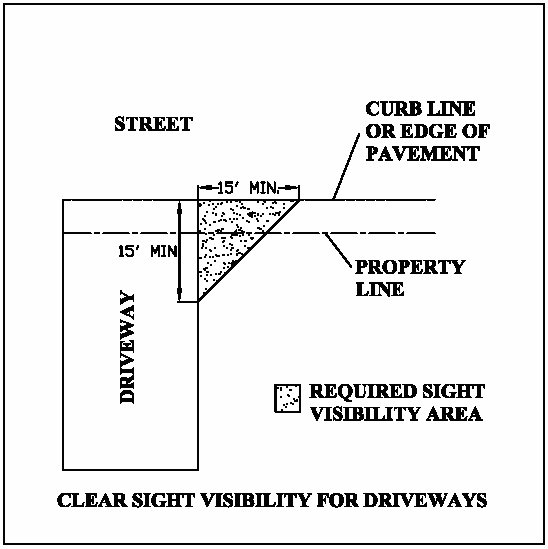
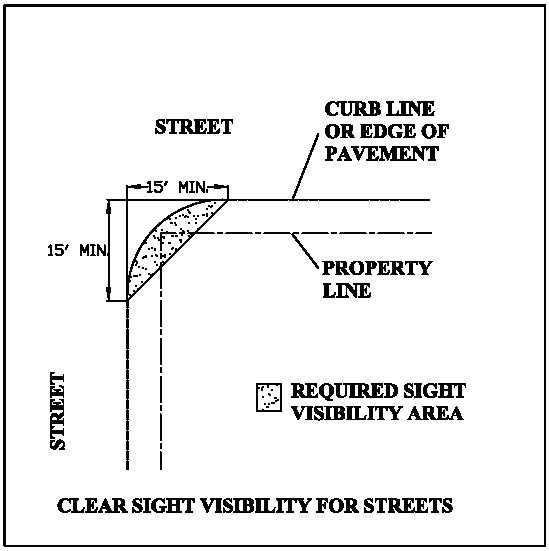
All new walls and fences shall be subject to the provisions contained within Section 18.64.050 (Open corner area on certain lots). These provisions shall also apply to all driveways too, as illustrated in Diagram "A".
DIAGRAM "A"
a.
Deviation(s) from Diagram "A", as well as from the design requirements noted within this section, may be approved by the director of community development and the city traffic engineer, if necessary, for the purpose of ensuring public safety.
5.
The maximum wall and fence height described within paragraph 2 of this subsection may be increased in height to a maximum of sixteen feet for noise attenuation purposes when approved with a conditional use permit, provided:
a.
Such walls may only be approved when necessary to protect adjacent property from stationary noise sources legally established, prior to the effective date of this paragraph, on the property from which such noise emanates, or to protect adjacent property from unavoidable nuisance noise resulting from permitted uses of the commercial property.
b.
Such walls may only be approved when all reasonable efforts to reduce such noise at the source have been made, as determined by a qualified acoustical engineer after appropriate technical studies.
c.
The maximum height of such a wall shall not exceed the minimum necessary to achieve compliance with the city's noise ordinance, Chapter 8.32 of the municipal code as determined by a qualified acoustical engineer.
d.
Such walls shall be constructed of sound absorbing materials and designed to include architectural treatment appropriate to and compatible with the adjacent properties.
G.
Refuse Storage Areas.
1.
Each lot in the M zone shall be provided with facilities for the storage of refuse containers, as follows:
a.
Location. A refuse storage area shall be placed on the same lot as the use it serves. Such area may be located on any portion of a lot where a building or accessory building may be placed; provided that, on properties served by an alley the refuse storage area shall be located within a distance not to exceed five feet of the right-of-way line of the alley. The director of public works or his/her designated representative, may waive the requirement for an on-site refuse storage area when a property is located in an automated refuse collection area and is served by off-site containers.
b.
Size. Refuse storage areas shall have a minimum area of thirty square feet, with minimum interior dimensions of five feet by six feet. Depending on the proposed use and anticipated generation of refuse, the public works director or his/her designated representative, may require greater or lesser dimensions to increase the efficiency of solid waste disposal operations.
c.
Design. Refuse storage areas shall be completely enclosed by a view-obscuring wall, not less than six feet in height. The enclosure shall include a closeable, view-obscuring gate, with a minimum five-foot wide unobstructed access point. On properties served by an alley, the gate shall be located adjacent to the alley to accommodate refuse collection. The walled enclosure shall be designed so that the contents thereof are not visible from any public street or adjacent property. Such walled enclosure shall be finished to match the color and facade material of the building it serves and shall incorporate landscape screening when possible.
i.
Businesses that utilize a roll-off box are not required to provide a walled enclosure; provided that, the refuse storage area is located within an area that is not visible from the public street or from any adjacent residential or commercially zoned property.
d.
Compactors. A roll-off trash compactor unit and enclosure may be required, as determined necessary by the director of public works or his/her designated representative, for any use anticipated to generate a large amount of refuse.
e.
Maintenance. The property owner shall ensure that all refuse storage areas are regularly cleaned and maintained in a safe and sanitary condition.
f.
Director. The public works director or his/her designated representative shall approve the specific location of refuse storage areas to ensure convenient vehicular access for pickup and disposal. When located in an automated refuse collection area, the director of public works or his/her designated representative, may allow or require the removal or relocation of existing refuse storage areas that do not meet the minimum location, size and/or design requirements necessary for automated service.
H.
Lighting. All outdoor lighting located on a lot classified in zone M shall be so located and shielded as to prevent the spill of light onto adjacent lots.
I.
Compressors, Motors, etc.
1.
Each use on a lot which utilizes compressors, air-conditioning units or other machinery including but not limited to vents, ducts and conduits, but excluding window-mounted or wall-mounted air conditioners (hereafter, "equipment"), located outside of the exterior walls of any building, shall comply with the following:
a.
All such equipment shall be enclosed within a permanent, noncombustible enclosure, which shall be subject to the approval of the director of building and safety to insure that the same will not be observable, or emit noise to a degree which interferes with the peaceful use and enjoyment of adjacent lots.
b.
All such mechanical equipment shall be maintained in a clean and proper condition to prevent a collection of litter and filth and to avoid the emission of unnecessary noise, dust or fumes.
2.
Notwithstanding any other provisions of this title, or this chapter, all existing uses, buildings and structures which do not conform with the provisions of this subsection as of the effective date of the ordinance codified in this section shall comply within twenty-four months after such effective date.
J.
Landscaping and Yard Areas. All required front and street side yard setbacks shall be landscaped and appropriately irrigated to city commercial landscape guidelines and standards. All plant materials shall be maintained in a healthy and thriving condition, clear of weeds and debris. Plans shall meet all city requirements for submittal, including but not limited to the city landscape guidelines. The city shall maintain the option to require plans to be prepared by a landscape professional, including, but not limited to, a landscape contractor, landscape architect or landscape designer.
(Ord. 2839 § 14, 2004: Ord. 2838 § 14, 2004: Ord. 2787 §§ 6, 7, 12, 19, 20 and Exh. A, (part), 2001; Ord 2786 § 6 (part), 2001; Ord. 2765 § 2 (part), 2000; Ord. 2755 § 2 (part), 1999; Ord. 2738 § 3, 1998; Ord. 2632 § 1 (F), 1994; Ord. 2515 § 2, 1990; Ord. 2411 § 3, 1987; Ord. 2304 § 1(b), 1983; prior code § 9223)
(Ord. No. 2923, § 1, 3-24-09; Ord. No. 3121, § 5, 8-25-20)
18.34.060 - Emergency shelters.
A.
"Emergency shelter" means housing with minimal supportive services for the homeless and occupancy limited to six months or less by a homeless person.
B.
Provisions listed herein for emergency shelters shall not apply to cold weather and domestic violence shelters.
C.
An emergency shelter is allowed by right in the "M" (Manufacturing) zone, provided that all of the requirements and development standards set forth below are satisfied. A conditional use permit shall only be required if an emergency shelter will not meet all of the provisions contained herein.
D.
Location Requirements. Emergency shelters shall meet the following location requirements:
(1)
Emergency shelters serving single adults or families shall be situated a minimum of five hundred feet from away any another emergency shelter as well as two hundred fifty feet away from a public park and public or private school (not including trade or technology schools), as measured from property line to property line.
(2)
Emergency shelters shall be located within one-quarter-mile of a designated public transportation stop.
E.
Development Standards. Emergency shelters shall meet the following development standards:
(1)
Maximum Stay. No homeless person shall stay within an emergency shelter for more than six months from the date of their acceptance into the shelter. In addition, no homeless person shall be re-admitted to the same homeless shelter within five days of being discharged.
(2)
Waiting Area. If the intake of homeless clients occurs on-site, an enclosed or screened waiting area shall be provided between the intake area and the public right-of-way. There shall be no queuing within the public right-of-way or within any parking lot.
(3)
Hours of Operation. Each emergency shelter shall establish and maintain set hours of operation for client intake and discharge. These hours shall be clearly displayed at the entrance to the shelter at all times. In the event an emergency shelter client is socially disruptive, a threat to the safety of others or in violation of the emergency shelter facility rules during non-business hours of operation, the emergency shelter manager may proceed with discharging that client immediately.
(4)
On-site Personnel. On-site personnel shall be provided during all hours of operation when clients are present. A designated area for on-site personnel shall be located near the main entry to the facility for the purpose of controlling admittance into the facility and providing security.
(5)
Client Restrictions. The emergency shelter operator shall not intake any person as a client of the shelter that the operator knows is wanted by the police or knows has been convicted of committing any violent offense. The emergency shelter operator shall also conduct a background check on all prospective clients using the Megan's Law database and restrict client intake in accordance with state and local registered sex offender residency restrictions.
(6)
Maximum Number of Beds. No more than a total of forty-five beds shall be provided on the entire property where the emergency shelter is located. Beds shall be provided for men and women in separate and secured areas.
(7)
Personal Storage. A private storage area or closet shall be provided with each on-site bed. At no time shall any client of an emergency shelter be allowed to keep on-site any alcoholic beverages or store any type of illegal substances, drugs, and/or weapons of any kind. The manager of the emergency shelter shall conduct routine inspections of each on-site client's personal space to verify compliance and report to the Whittier police department any client that is found in possession of illegal substances, drugs, and/or weapons of any kind.
(8)
Personal Space. A minimum of thirty square feet of personal space shall be allocated for each client bed.
(9)
Restroom and Shower Facilities. A communal restroom facility with at least two toilets, one shower, and one sink shall be provided for every twenty clients residing at an emergency shelter. The emergency shelter manager shall be responsible for ensuring that all restroom and shower facilities comply with the city of Whittier's building code requirements. Separate and secured restroom and shower facilities shall be provided for men and women.
(10)
Common Space. Interior and/or exterior common space for the on-site clients to congregate shall be provided on the property at a ratio of not less than fifteen square feet per occupant or a minimum overall area of four hundred square feet, whichever is greater.
(11)
Telephones. Each emergency shelter shall provide telephone(s) for the use of the on-site clients.
(12)
Food Service Areas. The emergency shelter operator shall be responsible for ensuring that any food service or on-site meal preparation areas comply with all applicable requirements of the city of Whittier and the Los Angeles County Health Department.
(13)
Outdoor storage. Emergency shelters shall screen all outdoor storage areas from all public rights-of-way and on-site parking lots. The emergency shelter manager shall ensure that all outside storage areas be maintained in a neat, clean, and orderly manner at all times.
(14)
Parking. Off-street parking shall be provided at the ratio of one on-site parking space for every eight adult beds, plus one additional space designated exclusively for the on-site manager. No client shall sleep or live within a motor vehicle on the property of an emergency shelter at any time.
(15)
Bicycle Racks. Bicycle racks that allow for the secure storage of bicycles shall be provided. Bicycle racks shall accommodate at least one bicycle storage space for every eight adult beds. All bicycle racks are required to be on-site and located in an area that is not visible from the public right-of-way.
(16)
Lighting. Each emergency shelter shall provide exterior lighting on pedestrian pathways and parking lot areas on the property for safety. Lighting shall be shielded and/or reflected away from all residential areas and public streets. All on-site lighting shall be subject to the review and approval of the Whittier police department prior to operation.
(17)
Security. The emergency shelter operator shall be required to submit an on-site security plan to the community development department for review and approval by the director of community development and the Whittier chief of police. The emergency shelter operator shall be responsible for ensuring that the approved security plan is implemented at the emergency shelter at all times.
(18)
Health and Safety. Each emergency shelter shall comply with all applicable local and state health and safety codes such as, but not limited to, the California Building Code, California Fire Code, California Health and Safety Code and applicable zoning standards for the development and use of the property on which the emergency shelter is located.
(19)
Existing emergency shelters that were established by a conditional use permit with adopted conditions of approval for its operation shall continue to operate under those adopted conditions of approval and be supplemented by the provisions of this ordinance. Should any conflict(s) arise with any operational requirement, the operational requirement(s) in the adopted conditions of approval shall prevail.
(Ord. No. 2948, § 1, 2-23-10)

