
Whittier City Zoning Code
CHAPTER 18
39 - PQP PUBLIC AND QUASI-PUBLIC ZONE
18.39.010 - Purpose.
This chapter provides regulations applicable to development and land uses in the public and quasi-public (PQP) zone, as established by 18.08.010. The PQP zone is intended to provide regulations for uses in appropriate locations that are maintained by private institutions, public, or publicly controlled agencies such as municipal and/or county agencies, school districts, or utility companies.
The zone regulations encourage and support the adaptive reuse of historic and industrial buildings, with new construction echoing the scale and design aesthetic of long-established character buildings.
(Ord. No. 3159, § 3(Exh. A), 11-12-24)
18.39.020 - Permitted uses.
A.
Principal Uses. Table 18.39.020 lists the allowed land uses for the PQP zoned lots, indicating the type of approval required subject to compliance with all provisions of this title. Descriptions and definitions of the land uses are established in Chapter 18.07. The specific use regulations and notes column in the table provides any chapter or section where additional regulations may apply or additional information for that use type.
B.
Accessory Uses. Accessory uses are those uses which are directly related but clearly subordinate to a permitted or conditionally permitted principal use.
C.
Limitations on Use. Uses shall comply with the applicable use regulations specified in Chapter 18.24.
D.
Symbols Used. Use regulations in the table are shown with a representative symbol by use classification listing: "P" symbolizes uses allowed by right, "C" symbolizes uses that require approval of a conditional use permit, "A" symbolizes uses that are accessory to an established principal use, and "—" symbolizes that the use is not permitted. Any use that is not listed or has not been determined by the director to be similar to a listed use is specifically prohibited.
(Ord. No. 3159, § 3(Exh. A), 11-12-24)
18.39.030 - Development standards.
A.
General. New land uses, structures, and alterations to existing uses or structures shall be designed, constructed, and/or established in compliance with all development standards requirements in Table 18.39.030, in addition to building design standards in Section 18.39.040 and applicable standards in Chapter 18.48, Chapter 18.64, and other applicable provisions of this title.
B.
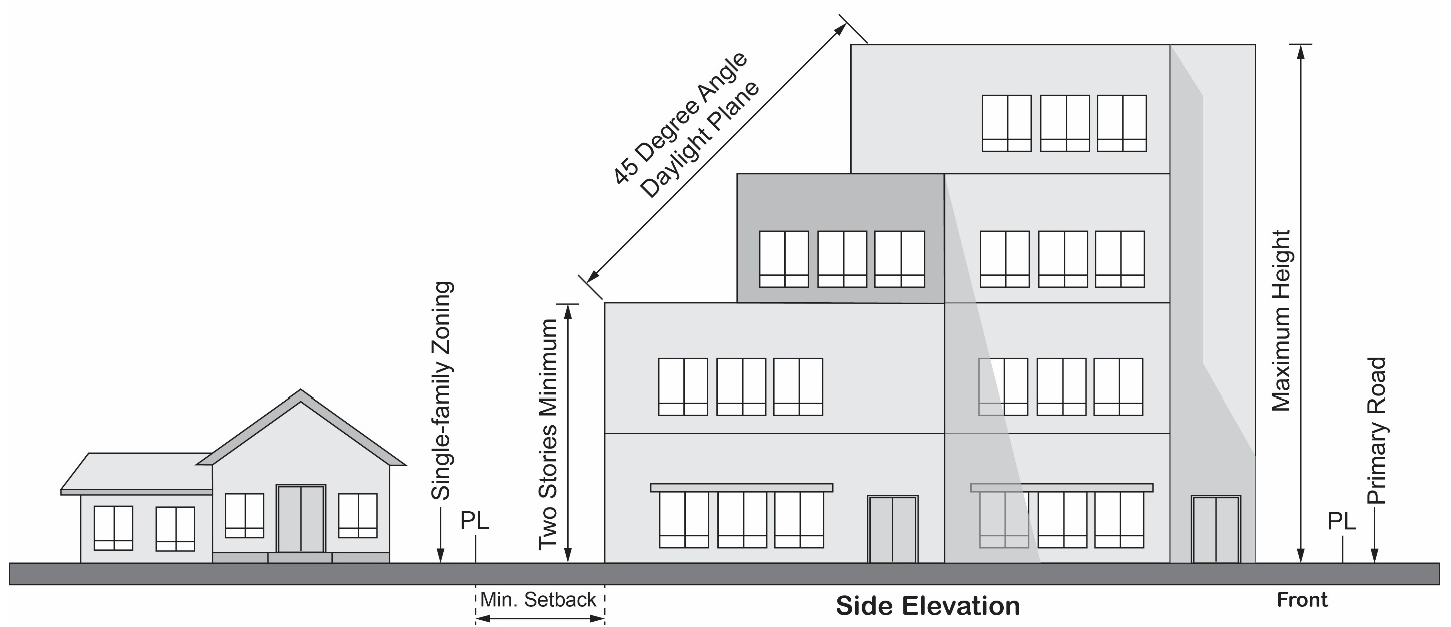
Building Step Back Requirements. Buildings located on PQP zoned parcels shall provide transition, a stepping back of the building at the third story and above, that is in addition to the minimum side and rear setback line. Taller elements of the building shall increasingly step back from adjacent single-family zones. No portion of the building, excluding parapets, shall extend above an imaginary plane drawn at the property line that is adjacent to the single-family zone, and extended at an angle of forty-five degrees toward the center of the PQP zoned parcel as shown in Figure 18.39.030-B.
Figure 18.39.030-B: Building Step Back
C.
Walls and Fences. All new walls and fences shall be subject to the following provisions:
1.
Smooth-faced precision blocks may be used only when integrated within a wall design to create a decorative wall pattern or when plaster or stucco is to be applied to the blocks as a finishing material.
2.
A decorative finishing wall course cap shall be applied to all new walls and pilasters.
3.
Combination walls or fences may be constructed consisting of a variety of different building materials, subject to the review and approval of the approval authority.
4.
All landscaping planted in front of any wall or fence shall be maintained in healthy condition at all times and supported with an operable irrigation system that complies with the city's water conservation ordinance.
5.
All street-facing walls and fences shall be treated with an anti-graffiti laminate coating, or any other anti-graffiti method deemed acceptable by the approval authority. Alternatively, healthy landscaping (i.e., vines) may be planted to provide sufficient coverage of the wall face, if deemed acceptable by the approval authority.
6.
All fencing shall comply with Section 18.24.040 F and all materials subject to the limitations of 18.64.070.
7.
All new walls and fences shall be subject to the provisions contained in Section 18.64.050. These provisions shall also apply to all driveways.
8.
The maximum wall and fence height described within paragraph two of this subsection may be increased in height as determined by staff but not higher than sixteen feet for noise attenuation purposes when approved with a conditional use permit, provided:
a.
Such walls may only be approved when necessary to protect adjacent property from stationary noise sources legally established, prior to the effective date of this paragraph, on the property from which such noise emanates, or to protect adjacent property from unavoidable nuisance noise resulting from permitted uses of the commercial property.
b.
Such walls may only be approved when all reasonable efforts to reduce such noise at the source have been made, as determined by a qualified acoustical engineer after appropriate technical studies.
c.
The maximum height of such a wall shall not exceed the minimum necessary to achieve compliance with the city's noise ordinance, Chapter 8.32 of the municipal code, as determined by a qualified acoustical engineer.
d.
Such walls shall be constructed of sound-absorbing materials and designed to include architectural treatment consistent with the style of the buildings on the subject property.
E.
Refuse Storage Areas. All development and uses in the PQP zone shall be provided with facilities for the storage of refuse containers as set forth in Section 18.24.040.G.
F.
Compressors, Motors, etc. Each use on such a lot which utilizes compressors, air conditioning units, or other machinery which is located outside of the exterior walls of any building, including but not limited to, vents, ducts and conduits, but excluding window-mounted or wall-mounted air conditioners, shall comply with the standards contained in Section 18.24.040 H.
G.
Lighting. All outdoor lighting shall be located, directed downward, and shielded to prevent light from shining onto adjacent lots.
H.
Landscaping. All required front yard and street side yard setbacks shall be landscaped and appropriately irrigated to city commercial landscape guidelines and standards. All plant material shall be maintained in a healthy and thriving condition, clear of weeds and debris. Plans shall meet all city requirements for submittal, including but not limited to the city landscape guidelines. The city shall maintain the option to require plans to be prepared by a landscape professional, including but not limited to a landscape contractor, landscape architect or landscape designer.
(Ord. No. 3159, § 3(Exh. A), 11-12-24)
18.39.040 - Design standards.
A.
All new development in the PQP zone shall comply with the design guidelines set forth in Chapter 18.96.
B.
The following additional design standards shall apply.
1.
Primary building entries should be well defined, provide a "sense of entry" for the building, and use architectural features such as columns and awnings.
2.
New buildings over ten thousand square feet in size shall include a one thousand square foot minimum shaded outdoor seating area.
3.
Loading areas, access and circulation driveways, trash enclosures, and mechanical equipment should be located as far as practical from any adjacent residences.
4.
When adjoining uses can mutually benefit from connection rather than separation, appropriate connective elements (e.g., walkways, common landscape areas, building orientation, and unfenced property lines) should be provided between the uses.
5.
Window orientation in nonresidential buildings should preclude a direct line of sight into adjacent residential units. Methods of precluding such line of sight include opaque windows, clerestory windows, and tall evergreen trees that block the line of sight.
6.
Uses that involve outdoor storage and/or staging materials or activities outdoors must be screened from view from public streets, parks, and/or residential areas.
(Ord. No. 3159, § 3(Exh. A), 11-12-24)

