
Whittier City Zoning Code
CHAPTER 18
64 - YARDS AND LOTS
18.64.010 - Yard requirements generally.
Except as expressly permitted in this title, every required yard shall be open and unobstructed from the ground to the sky. No yard required for one lot shall be considered as providing a required yard for another lot.
(Prior code § 9360)
18.64.020 - Intrusions permitted in required yards.
The following intrusions and no others may project into any required yard area, but in no case shall such intrusion extend more than forty percent of the width of the required yard or four feet whichever is the lesser and except as provided in this title:
A.
Cornices, eaves, belt courses, sills, buttresses or other similar architectural features;
B.
Fireplace structures;
C.
Stairways, balconies, and fire escapes;
D.
Uncovered porches and platforms;
E.
Planter boxes or masonry planters;
F.
Guard railings for safety protection around ramps;
G.
Bay windows;
H.
Mechanical equipment including air conditioning units when adjacent to solid, view obscuring walls;
I.
Water heater enclosures;
J.
Pool equipment when placed within a fully enclosed structure.
(Ord. 2746 § 3, 1999: Ord. 2610 § 1(Q), 1993: prior code § 9363)
(Ord. No. 3159, § 3(Exh. A), 11-12-24)
18.64.030 - Front yard depth.
The depth of the required front yard on lots facing directly upon the arc of a cul-de-sac shall be measured on an arc parallel to the front property line comprising the arc of the cul-de-sac and being a distance therefrom of the required front-yard depth as prescribed for each zone.
(Prior code § 9364)
18.64.040 - Side yards on combined lots.
When the common boundary line separating two contiguous lots is covered by a building or permitted group of buildings, such lots shall be deemed to be a single lot and the yard area requirements in this title shall apply accordingly.
(Prior code § 9361)
18.64.050 - Open corner area on certain lots.
Corner and reversed corner lots shall maintain, for safety vision purposes, a triangular area within which no building, structure, tree, fence, shrub or other object higher than forty-two inches above the established grade of the lot shall be permitted or maintained. The triangular area shall be formed by the prolongation of the front and side lot lines separating the lot from the streets; the third side of the triangle shall be a straight line connecting the last two mentioned points which are distant fifteen feet from the intersection of the front and side lot lines.
(Prior code § 9362)
18.64.060 - Through lots—Front lot line determination.
The director shall determine, with regard to through lots, which lot line of the lot shall be deemed for all purposes the front lot line, in the manner set forth in Section 18.50.040.
(Prior code § 9365)
18.64.070 - Barbed wire, razor wire, concertina wire and other similar materials.
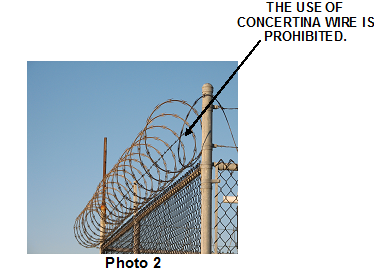
Notwithstanding any other section of this code, walls and fences shall not be constructed or maintained in a manner or materials which create a hazard to life, health or safety. Fences and walls made of razor wire, barbed wire, concertina wire, nails, glass and similar materials, including electrified fences, are prohibited and shall not be erected, constructed or maintained. However, fences and walls incorporating barbed wire or razor wire may be permitted based on the circumstances outlined under Sections 18.64.070(F), 18.64.070(G), 18.64.070(H) and 18.64.070(I).
A.
A nonconforming use shall not be relocated, expanded, enlarged, or increased in intensity in any manner whatsoever unless such activity is approved through the issuance of a conditional use permit as provided by this title.
B.
The use of barbed wire, razor wire, electrified fencing material or similar material in or on fences and walls is strictly prohibited within the city except as noted below.
C.
Any fencing which is a nonconforming use on the date the ordinance codified in this section becomes effective shall be subject to an amortization period of three years commencing on the date the use becomes nonconforming. Any fence and wall which does not meet the standard of this section but which was legally established prior to the adoption of these standards may be maintained provided such fence or wall upon which barbed wire sits is not less than six feet above the ground and is not expanded nor its nonconformance with these standards otherwise increased. Any fence or wall which is destroyed or damaged to the extent of more than fifty percent of its total replacement value shall not be repaired, rebuilt, or reconstructed except in conformance with these standards.
D.
Upon the conclusion of the amortization period, the owner of the property upon which the nonconforming use is located shall be required to remove the fencing within thirty days thereafter.
E.
All walls and fences shall be continuously maintained in good repair. The property owner shall be provided thirty days after receiving notice from the city to repair a wall or fence.
F.
The director of community development, notwithstanding the prohibitions cited within this section and with recognition that no exemption shall be given for the use of concertina wire, nails, glass, or similar materials, including electrified fencing material of any type, may approve through a development review application the construction and maintenance of barbed wire fencing within non-residential zoning classifications in the city, where there is outdoor storage and/or an outdoor display, if the applicant demonstrates and documents that all of the following conditions exist or can be met:
1.
The fence or wall upon which the barbed wire or razor is placed shall be located at least three feet from any property line abutting the public right-of-way.
2.
That the barbed wire fencing will be out of plain view from public streets and properties.
3.
That the fence or wall upon which the barbed or razor wire is placed is no less than six feet above the ground level and the barbed or razor wire does not exceed two feet above the maximum fence and/or wall height permitted for the property.
4.
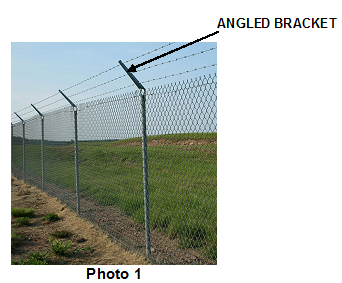
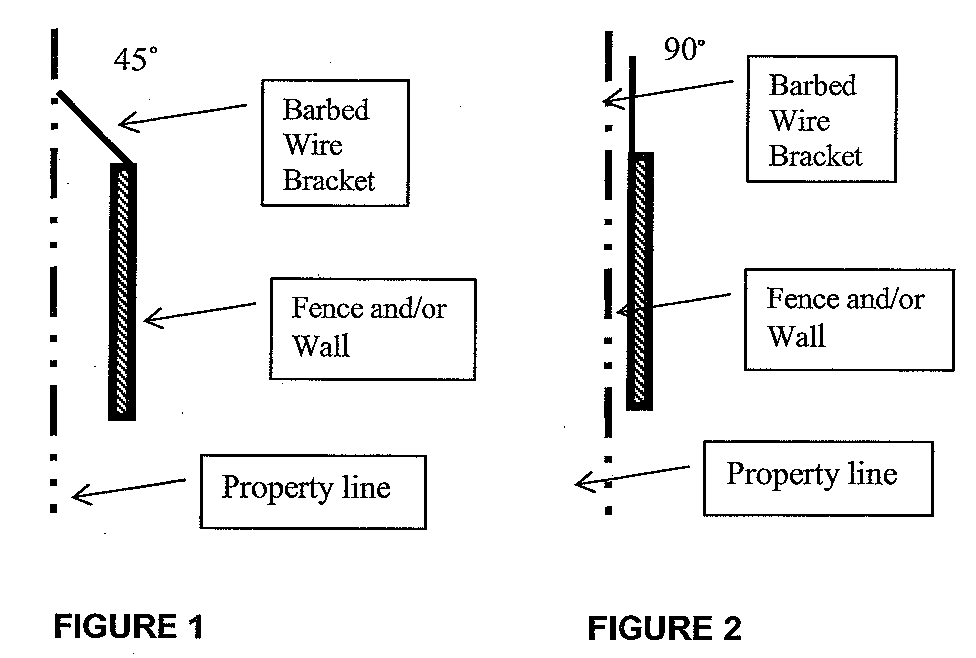
The barbed or razor wire shall be supported by brackets attached at a 45 to 90 degree angle to the face of the wall or fence it is placed on (See Figure Nos. 1 and 2).
5.
If the fence or wall that is topped with barbed or razor wire is located within the front yard, rear yard, or street side, side yard, which is adjacent to the public right-of-way, the property owner shall provide one of the following:
A.
A minimum three-foot wide (irrigated) landscape planter shall be provided between the property line and the fence or wall.
B.
An irrigated landscape trellis shall be installed for the purpose of allowing vines or similar plant material to cover the face of the fence or wall topped with barbed or razor wire.
C.
A wrought iron, ornamental tubular steel fence, or decorative wall shall be installed in lieu of using chain link fencing material to support the barbed or razor wire.
D.
An alternative fence and/or wall design provided by the property owner may be used with the approval of a minor conditional use permit. However, the property owner must develop an alternative design that is acceptable to the approval authority and demonstrates that there is compelling reason why the development standards listed above cannot be met.
6.
The property owner can demonstrate that their lot is at a high risk for criminal activity and substantiate the need for barbed or razor wire on their lot by submitting copies of a formal evaluation with recommendation(s) prepared by a professional security consultant.
G.
Barbed wire or razor wire fencing may be used in any zoning classification within the city for providing security to unmanned public infrastructure facilities, public utility sites, hazardous material storage, and other similar facilities and sites that are subject to homeland security concerns and/or public safety needs (as deemed necessary (in writing) by the chief of police or any federal law enforcement agency) including, but not limited to other storage facilities that may require a greater level of public safety, subject to the following conditions:
1.
That reasonable efforts shall be taken to minimize the plain view of such barbed wire or razor wire fencing from streets adjacent and other public views to the property;
2.
That the fence or wall upon which the barbed wire or razor wire is placed is no less than six feet above the ground level;
3.
Approval of barbed wire or razor wire fencing shall be subject to the prior review and approval of the director of community development through a development review application.
H.
Barbed wire or razor wire may be used in any nonresidential zoning classification when it is set back a minimum of three feet from any property line and is completely screened by a solid fence along the property line.
(Ord. 2881 § 2, 2006)
(Ord. No. 2975, § 1, 9-13-11)

