
Whittier City Zoning Code
CHAPTER 18
37 - MED MEDICAL ZONE
18.37.010 - Purpose.
This chapter provides regulations applicable to development and land uses in the medical (MED) zone, as established by 18.08.010. The MED zone implements the general plan medical land use category, the intent of which is to accommodate pedestrian-oriented master-planned medical facility complexes such as hospitals and nearby complementary medical office and medical research uses. Allowed supportive commercial uses are limited in scope to businesses that sell and/or rent products; provide services that support and/or encourage the further expansion of the medical uses within the zone; uses that serve the medical facilities, their employees, and their customers/visitors/clients; and uses and site design that promote overall health and well-being. Specifically prohibited uses include automotive and auto-oriented uses, manufacturing, warehousing/storage uses, including personal storage, and big-box retail businesses.
The zone regulations encourage and support the architectural design that is distinctive and memorable, building design and landscaping that minimizes the public views or presence of parking lots and parking structure, and site planning that allows for and encourages pedestrian circulation between buildings and uses.
(Ord. No. 3159, § 3(Exh. A), 11-12-24)
18.37.020 - Permitted uses.
A.
Principal Uses. Table 18.37.020 lists the allowed land uses for MED zoned lots, indicating the type of approval required subject to compliance with all provisions of this title. Descriptions and definitions of the land uses are established in Chapters 18.06 and 18.07. The specific use regulations and notes column in the table provides any chapter or section where additional regulations may apply or additional information for that use type.
B.
Accessory Uses. Accessory uses are those uses which are directly related but clearly subordinate to a permitted or conditionally permitted principal use.
C.
Limitations on Use. Uses shall comply with the applicable use regulations specified in Chapter 18.24.
D.
Symbols Used. Use regulations in the table are shown with a representative symbol by use classification listing: "P" symbolizes uses allowed by right, "C" symbolizes uses that require approval of a conditional use permit, "A" symbolizes uses that are accessory to an established principal use, and "—" symbolizes that the use is not permitted. Any use that is not listed or has not been determined by the director of community development to be similar to a listed use is specifically prohibited.
(Ord. No. 3159, § 3(Exh. A), 11-12-24)
18.37.030 - Development standards.
Prior to the issuance of a building permit, a development review, in accordance with Chapter 18.56 shall be approved. In addition to the special development standards set forth in Chapters 18.24 through 18.32, compliance with Division VI, Community Design, as applicable, is required, and the following development standards shall apply to each MED-zoned lot, except as otherwise expressly provided in this chapter.
A.
General. New land uses, structures, and alterations to existing uses or structures shall be designed, constructed, and/or established in compliance with all development standards requirements in Table 18.37.030, in addition to building design standards in Section 18.37.040 and applicable standards in Chapter 18.48, Chapter 18.64, and other applicable provisions of this title.
B.
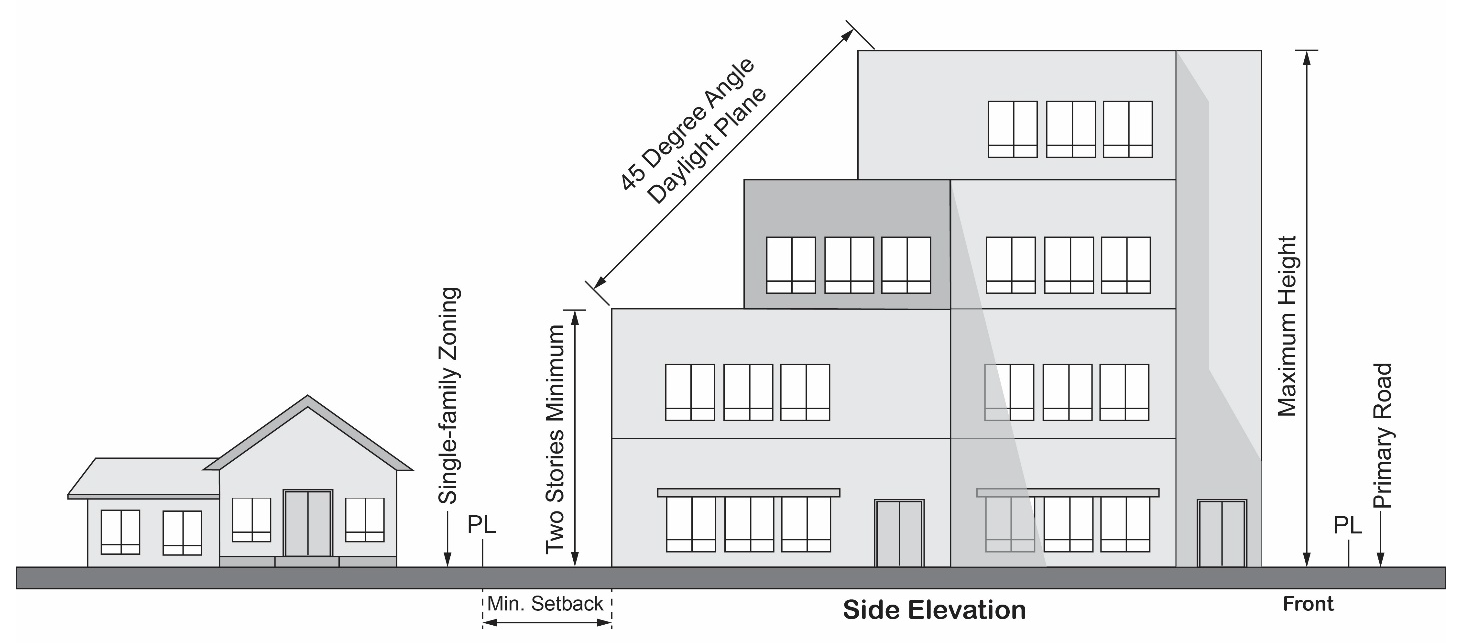
Building Step Back Requirement. Buildings located on MED zoned parcels shall provide transition, a stepping back of the building at the third story and above, that is in addition to the minimum side and rear setback line. Taller elements of the building shall increasingly step back from adjacent single-family zones. No portion of the building, excluding parapets, shall extend above an imaginary plane drawn at the property line that is adjacent to the single-family zone, and extended at an angle of forty-five degrees toward the center of the MED zoned parcel as shown in Figure 18.37.030-B.
Figure 18.37.030-B: Building Step Back
(Ord. No. 3159, § 3(Exh. A), 11-12-24)
18.37.040 - Design standards.
A.
All new development in the MED zone shall comply with the design guidelines set forth in Chapter 18.96.
B.
All new parking structures in the MED zone shall comply with the standards and design guidelines set forth in Chapter 18.99.
C.
The following additional design standards shall apply.
1.
Higher-rise buildings of four stories or more must clearly distinguish the base, middle and upper stories.
2.
The base of all buildings must visually establish a human-scale for pedestrians and passers-by.
3.
Two-story buildings shall provide a scale base treatment between nine inches and six feet in height.
a.
Three- to five-story buildings should provide a scale base treatment from one to two stories in height, relating proportionally to the total building height.
b.
Buildings greater than five stories must provide a building base of approximately one-eighth of the building's height.
c.
Design Base treatment should extend around all sides of the building.
4.
The "top" of buildings must be approximately one-twentieth of the building's height or twelve inches, whichever is greater.
5.
New and renovated buildings should be treated architecturally on all sides.
6.
Buildings located at the Five Points intersection, along the intersecting streets of Whittier Boulevard, Santa Fe Springs Road, and Washington Boulevard, must include special treatment, such as a prominent entry at the corner, special architectural "turning" of the corner with a major facade change, symmetrical designs at the two flanking facades, or special attention at building facades, including fenestration over at least twenty-five percent of the facade's surface.
7.
Front facades facing other public streets should have a highly visible main entrance, with a substantial presence and scale.
8.
Primary building entries should be well defined, provide a "sense of entry" for the building, and use architectural features such as columns and awnings.
9.
New buildings over ten thousand square feet in size shall include a shaded outdoor employee seating area with a one-thousand square foot minimum.
10.
Parking lots and parking structures must be designed as follows:
a.
Parking lots and parking structures shall follow standards identified in Chapter 18.48 (Off-Street Parking).
b.
Parking areas should be located behind or along the side of structures.
c.
Parking lots and structures located along the side of structures must be screened with landscaping of fifteen feet or more in width.
d.
Driveways and internal circulation must be safe, efficient, and convenient and must result in minimal conflict between vehicles and pedestrians.
11.
Equipment, loading and storage areas, circulation, and trash enclosures must be designed as follows:
a.
Roof mounted equipment such as cooling and heating equipment, antennae and receiving dishes must be screened from view of parking lots, connecting walkways and street right-of-way.
b.
Mechanical equipment screening should be integrated as part of a project's site and building design.
c.
Loading areas, overhead doors, and storage areas must not face street right-of-way and must be located behind or to the side of buildings.
d.
Loading areas, access and circulation driveways, trash enclosures, and mechanical equipment should be located as far as possible from any adjacent residences.
12.
When adjoining uses can mutually benefit from connection rather than separation, appropriate connective elements (e.g., walkways, common landscape areas, building orientation, and unfenced property lines) should be provided between the uses.
13.
Landscaping. All required front yard and street side yard setbacks shall be landscaped and appropriately irrigated to city commercial landscape guidelines and standards. All plant material shall be maintained in a healthy and thriving condition, clear of weeds and debris. Plans shall meet all city requirements for submittal, including but not limited to the city landscape guidelines. The city shall maintain the option to require plans to be prepared by a landscape professional, including but not limited to a landscape contractor, landscape architect or landscape designer.
14.
Landscaping and outdoor pedestrian-oriented areas must be distinctive and should dominate the streetscape.
a.
Landscaping shall be an integral part of the overall site plan, enhance building design, public views and spaces, and provide buffers, transitions, and screening.
b.
Distinct planting and/or landscape features must be provided through focal points at project entries, plaza areas, and other areas of interest.
c.
Development should provide outdoor pedestrian activity and gathering areas such as courtyards and plazas which are accessible to the public.
15.
Medical drive-through facilities must be located to the side or rear of the structure. The overall height of landscaped berms and/or low walls shall be between thirty-six and forty-two inches high and must screen the parking lot and drive-through aisle.
(Ord. No. 3159, § 3(Exh. A), 11-12-24)

