
Whittier City Zoning Code
CHAPTER 18
06 - DEFINITIONS1
Editor's note— Ord. No. 3159, § 3(Exh. A), adopted Nov. 12, 2024, repealed the former Ch. 18.06 in its entirety and enacted a new chapter as set out herein. The former Ch. 18.06 pertained to similar subject matter. Refer to Code Comparative Table and Disposition List for a detailed history of derivation.
18.06.010 - "A" land uses.
Abandon.
"Abandon" and "abandoned" with respect to any individual structure, site, leased area or use means the discontinuance of its use or occupancy, as evidenced by, but not limited to, any of the following: (1) its vacancy or cessation of use for more than one hundred eighty days; (2) disconnection of necessary public utilities to the structure, site, leased area or use for more than one hundred eighty days; or (3) removal of improvements, equipment, parts, or components necessary for the use of buildings or structures on the site or property or for the operation of a business or other activity or specific use of property. As to any proposed development, structure, alteration, addition, expansion or new use, allowing permits or approved development review applications specific to the nonconformity to expire, shall be deemed an abandonment. (Ord. 2806 § 1, 2002)
Abut, adjoining or contiguous.
"Abut, adjoining or contiguous" means, in reference to real property, two or more lots sharing a common lot line. With reference to two or more objects, the same means in immediate contact with each other. (Prior code § 9111(A)(1))
Access.
"Access" means the place or way by which pedestrians and/or vehicles shall have safe, adequate and usable ingress and egress to a lot from a public or private street or alley. (Prior code § 9111(A)(2))
Accessory dwelling unit.
"Accessory dwelling unit" shall have the same meaning as stated in Government Code 65852.2 as that section may be amended from time to time. For the sake of convenience only, currently Government Code 65852.2 defines "accessory dwelling unit as, "an attached or a detached residential dwelling unit that provides complete independent living facilities for one or more persons and is located on a lot with a proposed or existing primary residence. It shall include permanent provisions for living, sleeping, eating, cooking, and sanitation on the same parcel as the single-family or multifamily dwelling is or will be situated. An accessory dwelling unit also includes the following: (A) An efficiency unit. (B) A manufactured home, as defined in Section 18007 of the Health and Safety Code. (Ord. No. 3068 , § 2, 6-13-17; Ord. No. 3116 , § 2, 5-26-20)
Accessory living area.
"Accessory living area" means habitable space within an accessory building limited to not more than three rooms, including a bathroom, with facilities for living, sleeping, or recreation, but excluding facilities for preparation of food, for use by guests of the occupants of the dwelling located upon such lot or domestic help employed by the occupants of the dwelling, and may not be rented, leased, or otherwise used as a permanent residence or separate dwelling unit. Accessory living areas include, but are not limited to, cabanas, recreation rooms, rumpus rooms, enclosed covered patios, guesthouses, and hobby rooms. Guest rooms with an outside entrance but which have access from within a dwelling unit through a common wall is considered attached and not defined as accessory living area. A separate shower and/or bathroom of less than fifty square feet of floor area used in conjunction with a swimming pool is not considered accessory living area. (Ord. 2619 § 1 (part), 1994: Ord. 2539 § 1, 1991)
Accessory use.
"Accessory use" means a use which is directly related, but clearly subordinate, to a permitted principal use. All accessory uses shall be established and maintained on the same lot as the principal use which they serve, except as otherwise expressly provided in this title. (Prior code § 9111(A)(3))
Accessory building.
"Accessory building" means any building or structure which is detached from, but related to, the building containing the permitted principal use of the property on which said accessory building is located. (Ord. 2619 § 1 (part), 1994)
Adjacent.
"Adjacent" means two or more objects which are located in close proximity to each other. (Prior code § 9111(A)(4))
Adult day care center.
"Adult day care center" means any facility where service is rendered, by trained and experienced personnel, to adults who require care during a portion of the day, as provided by Section 80001 of Title 22 of the Administrative Code of the state. (Ord. 2869 § 53, 2006: prior code § 9111(A)(13))
Alley.
"Alley" means a public or private way designated as an alley by the city, other than a street, permanently reserved as a means of secondary vehicular access to adjoining properties. (Prior code § 9111(A)(6))
Antique mall.
"Antique mall" means a building or buildings wherein the interior thereof has been partitioned into individual spaces or stalls leased or rented to individuals for the sale and display of antiques, replicas, collectibles and new or secondhand goods, and wherein the management provides sales staff and security. (Ord. 2553 § 5 (part), 1991)
Apartment.
"Apartment" means the same as "dwelling unit." (Prior code § 9111(A)(7))
Arcade games.
"Arcade games" means any establishment where five or more amusement machines, defined as such in this code, or any combination of five or more such machines and/or billiard or pool tables, are located. (Prior code § 9111(A)(12))
Assessed value.
"Assessed value" means the then-assessed value of the land, building or structure, as is shown on the current assessment roll, in effect as of the time of the making of the determination of such assessed value. (Prior code § 9111(A)(10))
Assessor.
"Assessor" means the tax assessor of the county of Los Angeles. (Prior code § 9111(A)(10))
Automobile repair and service garage.
"Automobile repair and service garage" means a facility which provides for the repair and maintenance of motor vehicles, including but not limited to the repair and/or installation of tail pipes, mufflers, brakes, radiators and electrical systems; provided, that such facilities shall not include the painting of motor vehicles, nor body and fender repair. (Prior code § 9111(A)(11))
(Ord. No. 3159, § 3(Exh. A), 11-12-24)
18.06.020 - "B" land uses.
Basement.
"Basement" means a portion of a building which is totally or partially below the level of the finished grade of the lot upon which it is located. (Prior code § 9111(B)(1))
Bedroom/Sleeping area.
A habitable space that is a minimum of seventy square feet and includes an egress window or door to the exterior for the purpose of developing a room in which people sleep. (Ord. No. 2940, § 1, 12-8-09)
Billiard or pool hall.
"Billiard or pool hall" means any establishment where five or more tables for the playing of billiards, pool, snooker, or similar games, or any combination of five or more such tables and amusement machines as defined in this code are located. (Prior code § 9111(B)(7))
Building.
"Building" means any structure having a roof supported by columns or walls, or combination thereof, and intended for the shelter, housing or enclosure of persons or property of any kind. (Ord. 2806 § 2, 2002)
Building, accessory.
"Accessory building" means a separate detached building, housing a permitted accessory use, located on the same lot as the main building or principal use, and clearly subordinate to said building or use. (Ord. 2787 § 11, 2001: prior code § 9111(B)(4))
Building height.
See "height." (Prior code § 9111(B)(5))
Building, main.
"Main building" means a building in which is conducted one or more principal uses permitted upon the lot which it is situated. (Prior code § 9111(A)(6))
(Ord. No. 3159, § 3(Exh. A), 11-12-24)
18.06.030 - "C" land uses.
Carport.
"Carport" means a permanently roofed structure with not more than two enclosed sides, used or intended to be used for automobile shelter and storage. (Prior code § 9111(c)(1))
Cellar.
"Cellar" means the same as "basement." (Prior code § 9111(c)(2))
Centerline.
"Centerline" means the centerline, as determined by the city engineer, on any street, highway or alley. (Prior code § 9111(C)(3))
Child day care facility.
"Child day care facility" means a state-licensed facility which provides nonmedical care, protection, and supervision to children under eighteen years of age in need of personal services, supervision, or assistance essential for sustaining the activities of daily living or for the protection of the individual on less than a twenty-four-hour basis. Child day care facility includes day care centers and family day care homes. (Ord. 2573 § 2(b) (part), 1992: prior code § 9111(C)(4))
City.
"City" means the city of Whittier. (Prior code § 9111(C)(6))
City manager.
"City manager" means the city manager of the city. (Prior code § 9111(C)(8))
Clerk.
"Clerk" means the city clerk of the city. (Prior code § 9111(C)(7))
Club, private.
"Private club" means any building or premises used by an association of persons, whether incorporated or unincorporated, organized for some common purpose, but not including a group organized primarily to render a service customarily carried on as a commercial enterprise. (Prior code § 9111(C)(9))
Code.
"Code" means the Whittier Municipal Code. (Prior code § 9111(C)(10))
Collection facility.
A collection facility is a center for the acceptance, by donation, redemption or purchase, of recyclable materials from the public. Such a facility does not use power-driven processing equipment except a trash compactor. A collection facility may include any or all of the following:
A.
Reverse vending machine(s);
B.
A small collection facility which occupies an area of not more than five hundred square feet, and may include:
1.
A mobile unit, and/or
2.
Bulk reverse vending machines or a grouping of reverse vending machines occupying more than fifty square feet, and/or
3.
Kiosk type units, which may include permanent structures, and/or
4.
Unattended container placed for the donation of recyclable materials;
C.
A large collection facility which may occupy an area of more than five hundred square feet and may include permanent structures. (Ord. 2423 § 1, 1987) (Ord. No. 3103 , § 4, 6-11-19)
Commercial recreation facility.
"Commercial recreation facility" means a privately owned and operated establishment open to the public, with or without charge, where the public may participate in games of chance or skill, or a sport or other recreation activity. "Commercial recreation facilities" includes but is not limited to parks, playgrounds, pool or billiard halls, game arcades, skating rinks, bowling alleys, swimming pools and miniature golf courses. (Prior code § 9111(C)(17))
Commission.
"Commission" means the planning commission of the city. (Prior code § 9111(C)(11))
Communications equipment buildings.
"Communications equipment buildings" means buildings housing operating electrical and mechanical equipment utilized in conducting a public utility communications operation. (Prior code § 9111(c)(12))
Condominium.
"Condominium" means an individually owned dwelling unit in an attached or detached structure with an undivided interest in common shared area. (Prior code § 9111(C)(13))
Convalescent home.
"Convalescent home" means the same as "nursing and convalescent hospital." (Prior code § 9111(C)(14))
Convenience market.
"Convenience market" means a market with a limited line of grocery, notion and beverage items in a building not exceeding six thousand square feet in gross floor area. (Prior code § 9111(C)(18))
Council.
"Council" means the city council of the city. (Prior code § 9111(C)(15))
Court.
"Court" means an area which is open and unoccupied by any building or structure, bounded on three or more sides by the exterior walls of a building. An inner court is a court entirely enclosed within the exterior walls of a building. All other courts are outer courts. (Prior code § 9111(C)(16))
18.06.040 - "D" land uses.
Dairy.
"Dairy" means any premises where one or more cows or goats, or any combination thereof, are kept or maintained for the purpose of producing milk. (Prior code § 9111(D)(1))
Day care center.
"Day care center" means an establishment providing non-medical care for persons on a less than twenty-four-hour basis other than family day care, including nursery schools, preschools, and day care facilities for children or adults, and any other day care facility licensed by the state of California. (Ord. 2573 § 2(b) (part), 1992)
Destroyed.
"Destroyed" means demolished or damaged structures or other improvements to property, by any cause, to an extent of greater than fifty percent of the total cost estimate to reconstruct, repair, or rehabilitate the damaged structure or other improvements on the property, as determined in accordance with Section 18.62.160 of this Title. (Ord. 2806 § 3, 2002)
Director.
"Director" means the director of community development for the city. (Ord. 2897 § 4, 2008)
Driveway.
"Driveway" means the vehicular access from the street or alley to a legal parking space, which serves the lot upon which the parking space is located. A driveway shall not lose its status as a "driveway" if the parking space that it was serving was removed in conjunction with the creation of an accessory dwelling unit. (Ord. 2610 § 1(A)(1), 1993) (Ord. No. 3116, § 3, 5-26-20)
Dump, inert-solid.
"Inert-solid dump" means an area devoted to the disposal of non-water soluble, non-decomposable inert solids such as natural earth, rock, sand and gravel, paving fragments, concrete brick, plaster and plaster products, steel mill slag, glass, asbestos fiber and products therefrom. (Prior code § 9111(D)(12))
Dump, rubbish and refuse.
"Rubbish and refuse dump" means an area devoted to the disposal of inert solid and/or decomposable organic refuse and scrap metal. (Prior code § 9111(D)(13))
Duplex.
"Duplex" means the same as "two-family dwelling." (Prior code § 9111(D)(7))
Dwelling, single-family.
"Single-family dwelling" means a building containing one dwelling unit. (Prior code § 9111(D)(8))
Dwelling, two-family.
"Two-family dwelling" means a building containing two dwelling units. (Prior code § 9111(D)(9))
Dwelling unit.
"Dwelling unit" means one or more habitable rooms in a building which are designed to be occupied by any one person or one family, with facilities for living, sleeping, cooking, eating and sanitation. (Prior code § 9111(D)(11))
(Ord. No. 3159, § 3(Exh. A), 11-12-24)
18.06.050 - "E" land uses.
Educational institution.
"Educational institution" means any public, private or parochial, elementary, junior high, high school, university or other school giving general academic instruction in the several branches of learning. (Prior code § 9111(E)(1))
Engineer.
"Engineer" means the city engineer of the city. (Prior code § 9111(E)(2))
Explosives.
"Explosives" mean any explosive substance as defined in Section 12000 of the Health and Safety Code of the state.(Prior code § 9111(E)(3))
(Ord. No. 3159, § 3(Exh. A), 11-12-24)
18.06.060 - "F" land uses.
Family.
"Family" means two or more persons living together in a single dwelling unit , with common use of all living and eating areas and all areas and facilities for the preparation and storage of food. A family includes, for example, residents of residential care facilities and group homes for people with disabilities. A family does not include larger institutional group living situations such as dormitories, fraternities, sororities, monasteries, or nunneries.
Family day care home.
"Family day care home" means a day care facility licensed by the state of California, located in a residential unit where the resident of the dwelling provides care and supervision for children under the age of 18 for periods of less than 24 hours a day. (Ord. 2864 §§ 1—2, 2005: Ord. 2573 § 2 (b) (part), 1992)
Fence.
"Fence" means a structure made of wood, metal (i.e., iron, steel, or other similar alloy), or other pre-manufactured material, like vinyl, or other composite that mimics the look of a wood fence, with substantially wider columns set at regular intervals and comprised of concrete block, masonry, wood, metal or pre-manufactured material, like vinyl, or other composite that mimics the look of wood; fence can include a base comprised of block, masonry, wood, metal or pre-manufactured material, like vinyl, or other composite that mimics the look of wood; built to industry standards. (Ord. 2839 § 3, 2004)
Floor area, net.
"Net floor area" means the total horizontal floor area of all the floors of a building included within the surrounding walls, exclusive of vents, shafts, courts, elevators, stairways and similar facilities. (Prior code § 9111(F)(6))
Fortunetelling.
"Fortunetelling" means the telling of fortunes, forecasting of future events or furnishing of any information not otherwise obtainable by the ordinary process of knowledge, by means of any occult or psychic power, faculty or force, including, but not limited to, clairvoyance, clairaudience, cartomancy, psychology, psychometry, spirits, tea leaves or other such reading, mediumship, seership, prophecy, augury, astrology, palmistry, necromancy, mind-reading, telepathy, or other craft, art, science, cards, talisman, charm, potion, magnetism, magnetized article or substance, crystal gazing, oriental mysteries or magic of any kind or nature. (Ord. 2371 § 1, 1986)
Fraternity.
"Fraternity" means the same as "private club." (Prior code § 9111(F)(7))
Frontage, street.
"Street frontage" means the length of a lot line of a lot which abuts a street. (Prior code § 9111(F)(8))
(Ord. No. 3159, § 3(Exh. A), 11-12-24)
18.06.070 - "G" land uses.
Garage.
"Garage" means any building with three enclosed sides, provided with a closeable access door or doors, which is used or intended to be used for automobile shelter or storage. (Prior code § 9111(G)(1))
Gender.
When consistent with context, words in the masculine gender include the feminine and neuter genders. (Prior code § 9111(G)(2))
(Ord. No. 3159, § 3(Exh. A), 11-12-24)
18.06.080 - "H" land uses.
Habitable space.
"Habitable space", as used in this title means space within a structure for living, sleeping, recreation, eating or cooking, bathing and sanitation, halls, closets, storage and utility space. Storage and utility space located within a garage is not considered habitable space. (Ord. 2619 § 1 (part), 1994)
Height.
"Height" means the vertical distance measured from the grade of the lot immediately beneath the portion of the building or structure being measured, to the highest point of such building or structure, based on a topographic survey. (Ord. 2610 § 1 (A)(2), 1993: prior code § 9111(H)(1))
Highway.
"Highway" means the same as "street." (Prior code § 9111(H)(2))
Hillside area.
"Hillside area" means those properties included within the area described in Section 18.14.020. (Prior code § 9111(H)(3))
Hillside plan.
"Hillside plan" means a plan described in Chapter 18.14. (Prior code § 9111(H)(4))
Historic resource.
"Historic resource" means a building, structure or collection of buildings or structures, and their associated sites deemed of importance to the history, architecture, or culture of an area by an appropriate local, state or federal agency or organization. This shall include designated structures on official inventories such as the National Register of Historic Places, State Historical Landmarks, State Points of Historical Interest, the Whittier Local Official Register of Historic Resources and resources eligible for listing on such inventories by reason of their age, association with people or events important to the history of the area, or unique design or architecture. (Ord. 2489 § 2, 1990)
Home based business.
"Home based business" means an occupation, calling or profession carried on by a resident of a building located on an R-zoned lot, as an accessory use. The home-based business shall not change the integrity and residential character of a neighborhood. (Ord. 2707 § 2(B), 1997: prior code § 9111(H)(6))
Hospitality houses/low barrier navigation center.
"Hospitality houses/low barrier navigation center" means any buildings used to provide housing-first, low-barrier, service-enriched emergency housing on a temporary basis focused on moving people into permanent housing that provides living facilities where case managers connect individuals experiencing homelessness to income, public benefit, health services, shelter and housing. Low barrier includes best practices to entry such as allowing partners, pets, storage of personal items and privacy (Prior code § 9111(H)(7)(a))
Hotel.
"Hotel" means any building or portion of any building with access provided through a common entrance, lobby or hallway, to one or more guestrooms, which have no cooking facilities and which are designed and intended to be used or are used, rented or hired out as temporary or overnight accommodations for guests. (Prior code § 9111(H)(8))
Household pets.
"Household pets" means and is limited to the following pets, maintained principally within a dwelling unit:
A.
Domesticated cats;
B.
Domesticated dogs;
C.
Fish, without a limit on number;
D.
1.
Any bird which is:
a.
Customarily kept in residence of people;
b.
Kept, at all times, within a dwelling unit;
2.
Specifically, "bird" shall not include, among others, for the purpose of these regulations, chickens, hens, roosters, geese or ducks. (Prior code § 9111(H)(9))
Housing, senior citizen.
"Senior citizen housing" means a housing development that can be authorized on property within the C-O zone subject to approval of a development plan as described in Chapter 18.42,which consists of individual dwelling units designed for and/or restricted to occupancy by one person or a group of two or more persons who will live regularly together in the same dwelling unit, whose head, spouse, or sole member is:
A.
Sixty-two years of age or older;
B.
Under a disability as defined in Section 223 of the Social Security Act; or
C.
Handicapped within the meaning of the Housing Act of 1959. (Ord. 2343 § 1 (part), 1985: prior code § 9111(H)(10))
(Ord. No. 3159, § 3(Exh. A), 11-12-24)
18.06.090 - "I" land uses.
Internet cafe.
"Internet cafe" means an establishment with five or more computers or gaming devices, wherein computers, having online capabilities, are available to customers to rent for a fee. (Ord. 2808 § 1 (part); 2002)
(Ord. No. 3159, § 3(Exh. A), 11-12-24)
18.06.100 - "J" land uses.
Reserved.
(Ord. No. 3159, § 3(Exh. A), 11-12-24)
18.06.110 - "K" land uses.
Kennel.
"Kennel" means a place where four or more adult dogs and/or cats are kept, whether by the owner of such dogs and cats or by other persons, providing facilities and care, whether or not for compensation. An "adult" dog or cat, for the purpose of these regulations, is one that has reached the age of four months. (Prior code § 9111(K)(1))
Kitchen.
"Kitchen" means any room or space within a building designed and intended to be used for the storage and preparation or cooking of food, and which includes or provides space for full-size refrigerators, stoves and sinks. An undercounter refrigerator of not more than three cubic feet and/or a wet bar do not constitute a kitchen. (Ord. 2539 § 2, 1991: prior code § 9111(K)(2))
(Ord. No. 3159, § 3(Exh. A), 11-12-24)
18.06.120 - "L" land uses.
Landscaping and landscaped areas.
A.
"Landscaping" means the planting and maintenance of natural and/or artificial trees, shrubs, vines, ground covers, flowers and lawns. In addition, the same may include natural features such as rock and stone; and structural features, including, but not limited to, fountains, reflecting pools, art works, screens, walls, fences and benches.
B.
"Landscaped area" means an area upon which landscaping is required, by these regulations, to be continuously maintained. (Prior code § 9111(L)(1))
Landscaping, appropriate.
"Appropriate landscaping" means maintaining a variety of plants, including a variety of species and a mixture of sizes (i.e. trees, hedges, vines), within a yard, planter, or other "landscaping area" that is consistent with the type of planting found onsite and compatible with the neighborhood, with a priority placed on drought tolerant, native plants. (Ord. 2839 § 4, 2004: Ord. 2838 § 4, 2004)
Livestock.
"Livestock" means a use involving the grazing, care and maintenance of cattle and/or horses for commercial or noncommercial purposes. (Prior code § 9111(L)(2))
Lot or parcel of land.
"Lot or parcel of land" means:
A.
A parcel of real property which is shown as a single lot in a lawfully recorded subdivision, approved pursuant to the provisions of the Subdivision Map Act (Government Code Section 66410 et seq.); or
B.
A parcel of real property, the dimensions and boundaries of which are designated as a single lot by a lawfully recorded record of survey map; or
C.
A parcel of real property shown on a parcel map as a single lot, lawfully recorded pursuant to the provisions of the Subdivision Map Act; or
D.
Any parcel of real property otherwise lawfully created and dimensioned prior to the adoption of these regulations; or
E.
Two or more lots which are combined, by an appropriate recorded written instrument, or two or more lots which are combined by a common usage, shall be deemed, for all purposes, a single lot. (Prior code § 9111(L)(4)) (Ord. No. 3121, § 1, 8-25-20)
Lot area.
"Lot area" means the total area, measured by a horizontal plane, included within the lot lines of a lot. (Prior code § 9111(L)(5))
Lot, standard corner.
"Standard corner lot" means a lot situated at the intersection of two or more streets. (See figure below.)
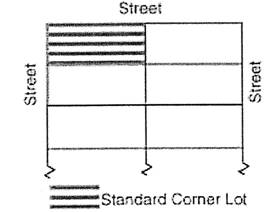
(Ord. 2839 § 5, 2004)
Lot depth.
"Lot depth" means the horizontal distance measured between the midpoints of the front and rear lot lines. (Prior code § 9111(L)(7))
Lot, interior.
"Interior lot" means a lot, other than a corner or reversed corner, or through lot. (Prior code § 9111(L)(8))
Lot, key.
"Key lot" means a lot which has a side lot line which is a common lot line with the rear lot line of a reversed corner lot. (See figure below.)
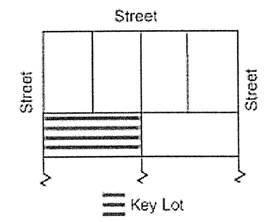
(Ord. 2839 § 6, 2004)
Lot line, front.
"Front lot line" means a lot line separating an interior lot from a street; in the case of a corner or reversed corner, the lot line separating the narrowest street frontage of the same shall mean the narrowest lot line parallel and closest to the nearest street or highway, as determined by the director. (Prior code § 9111(L)(10))
Lot line, rear.
"Rear lot line" means the lot line which is approximately parallel to, and most distant from, the front lot line. (Prior code § 9111(L)(11))
Lot line, side.
"Side lot line" means any lot line which is not a front or rear lot line. (Prior code § 9111(L)(12))
Lot, minimum width.
"Minimum-width lot" means the horizontal distance between the side lot lines measured along the line constituting the rear of the required front yard area, or between two points each located on the side lot lines at a distance midway between the front and rear lot lines, whichever is lesser. (Prior code § 9111(L)(15))
Lot, reversed corner.
"Reversed corner lot" means a corner lot, the side lot line of which is substantially a continuation of the front lot line of an adjacent key lot. (See figure below.)
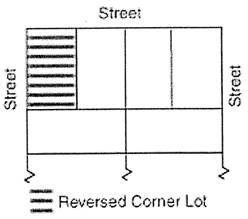
(Ord. 2839 § 7, 2004)
Lot, through.
"Through lot" means a lot having frontage on two approximately parallel streets. (Prior code § 9111(L)(14))
Low impact recreational use.
Nonconsumptive uses which have little or no adverse effect on native habitat and wildlands. (Ord. 2694 § 2 (part), 1996)
(Ord. No. 3159, § 3(Exh. A), 11-12-24)
18.06.130 - "M" land uses.
Manufacturing.
"Manufacturing" means the creation of finished parts or products either from raw materials or previously prepared materials. Includes processing, fabrication, assembly, treatment, testing (e.g., laboratories), and incidental office storage, sales, and distribution. (Prior code § 9111(M)(3))
Map.
"Map" means the zoning map of the city, referred to in Section 18.08.020. (Prior code § 9111(M)(2))
May.
"May" is permissive. (Prior code § 9111(M)(1))
Medical and/or dental clinic.
"Medical and/or dental clinic" means any facility providing health service, or medical, surgical or dental care of the sick or injured, but does not include inpatient or overnight accommodations. "Medical and/or dental clinic" includes health centers, health clinics, doctors' and dentists' offices. (Prior code § 9111(M)(4))
Mobilehome.
"Mobilehome" means a building which is transportable in one or more sections, built on a permanent chassis and designed and equipped to contain not more than one dwelling unit, to be used without a foundation. (Prior code § 9111(M)(5))
Mobilehome, foundational.
"Foundational mobilehome" means a mobilehome home which is:
A.
Installed on a permanent foundation system; and
B.
Manufactured and certified under the National Mobilehome Construction and Safety Standards Act of 1974. (Prior code § 9111(M)(5.1))
Mobilehome park.
"Mobilehome park" means a lot where two or more mobilehomes and/or mobilehome sites are rented or leased or held out for rent or lease. (Prior code § 9111(M)(6))
Mobilehome site.
"Mobilehome site" means that portion of a mobilehome park designated for use or occupancy of one mobilehome and including all appurtenant facilities thereon. (Prior code § 9111(M)(7))
Mobile recycling unit.
A mobile recycling unit means a motor vehicle, as defined in the Vehicle Code, which is used for the collection of recyclable materials. A mobile recycling unit includes the bins, boxes or containers located on a motor vehicle and used for the collection of recyclable materials. Mobile recycling units shall provide an area clearly marked to prohibit other vehicular parking during hours when the mobile unit is scheduled to be present. (Ord. 2423 § 2, 1987)
Motel.
"Motel" means one or more buildings containing rooms without kitchen facilities, each having a separate entrance leading directly from the outside of the building or from an inner court, which rooms are designed for rental for temporary or overnight accommodations for guests, and are offered primarily to automobile tourists or transients by signs or other advertising media. One unit, for use by a resident manager, may have kitchen facilities. "Motel" includes auto courts, motor lodges and tourists' courts. (Prior code § 9111(M)(8))
Moving and storage.
"Moving and storage" means the business of transferring household and business goods from one location to another and including the temporary storage of such goods while in transit and awaiting delivery. (Ord. 2375 § 1(a), 1986)
(Ord. No. 3159, § 3(Exh. A), 11-12-24)
18.06.140 - "N" land uses.
Nonconforming site.
"Nonconforming site" means a lot or parcel of land which was lawfully developed in accordance with zoning regulations in effect at the time of development but which does not comply with current regulations with respect to, but not limited to: density; coverage; yards; setbacks; parking layout and paving; site orientation; fencing and walls; landscaping; refuse storage; outdoor storage, or any other provision specific to site development, regardless of whether or not the site was previously deemed conforming. (Ord. 2806 § 4, 2002)
Nonconforming structure.
"Nonconforming structure" means a structure, or portion thereof, which was lawfully constructed or altered in accordance with zoning regulations in effect at the time of the construction or alteration but which does not comply with current regulations with respect to, but not limited to: size; height; width; materials; massing; equipment screening, or any other provision specific to the structure's physical form, regardless of whether or not the structure was previously deemed conforming. (Ord. 2806 § 5, 2002)
Nonconforming use.
"Nonconforming use" means the use of any lot, structures or any combination thereof, which use conformed to the zoning regulations in effect at the time use was established, but which does not comply with current zoning regulations. Nonconforming use shall also include uses established prior to the establishment of zoning on such lots or uses that were granted as exceptions to applicable zoning regulations in effect at such time as said exception was granted, regardless of whether or not the use was previously deemed a conforming use. (Ord. 2806 § 6, 2002)
Non-view obscuring.
"Non-view obscuring" relative to fences, means that at least fifty percent of the fence area between the columns is open with no visual barriers. (Ord. 2839 § 8, 2004: Ord. 2838 § 8, 2004)
Notice.
Whenever written notice is required to be given under this title, the same shall be given by personal service thereof upon the person or persons to be notified, or by United States mail, postage prepaid, addressed to such person or persons, at his/her last known address; such notice shall be conclusively deemed to have been given as of the time of personal service, or as of the time the same is deposited in the course of postal transmission. (Prior code § 9111(N)(2))
Nursery school.
"Nursery school" means the same as "child care center." (Prior code § 9111(N)(4))
Nursing and convalescent hospital. (Convalescent homes/facilities)
"Nursing and convalescent hospital" means any place or institution which provides bed accommodations for one or more chronic or convalescent patients who, by reason of illness or physical infirmity, are unable to properly care for themselves. (Prior code § 9111(N)(5))
(Ord. No. 3159, § 3(Exh. A), 11-12-24)
18.06.150 - "O" land uses.
Oath.
"Oath" means and includes affirmation. (Prior code § 9111(O)(1))
Open space.
"Open space" means an area, other than a required yard area, driveway or off-street parking facility, which has no building or structure located therein except for those used exclusively for recreational purposes. To meet the requirement of open space, such area, referred to as usable open space, shall meet the following:
A.
If the same is located upon the ground, or upon the roof of a subterranean garage, such contiguous area shall not be less than five hundred square feet in area; and
B.
If the roof of such subterranean garage is utilized for such open space, all such roof areas may be utilized provided that the same is not in excess of two feet above the grade of the lot immediately adjacent thereto; and
C.
That where such open space is located on any roof area, other than a subterranean garage, not to exceed twenty-five percent of such roof area may be utilized to meet the open space requirement; and
D.
Notwithstanding subsection A, any partially or totally enclosed patio or balcony located immediately adjacent to a dwelling unit may be utilized to meet the open space requirement. (Prior code § 9111(O)(2)(a—d))
Open space, private.
"Private open space" means open space on a residential lot which is enclosed by a fence or wall, or consists of a balcony which is designed and intended for the exclusive use of the occupant of the immediately adjacent dwelling unit, located on the lot, having direct access to such area. (Ord. 9111(O)(2)(e))
Owner.
"Owner" means any or all of the following:
A.
The owner or owners of the fee interest in real property;
B.
The owner or owners of any beneficial interest under a trust deed relating to real property;
C.
The purchaser and vendor under a land-sale contract relating to such property; or
A tenant under a written and recorded lease, easement, or other legal document as such interests are shown by a title search conducted by a qualified title company. (Ord. 2806 § 7, 2002)
(Ord. No. 3159, § 3(Exh. A), 11-12-24)
18.06.160 - "P" land uses.
Parking space, off-street.
"Off-street parking space" means a readily accessible area on a lot not including driveways, ramps, loading or work areas, maintained exclusively for the parking of one automobile. (Prior code § 9111(P)(1))
Parolee.
"Parolee" means an individual who has been released from a prison term prior to its expiration and who is subject to regular monitoring by a law enforcement officer for a set period of time, during such monitoring time period. This term shall include all of the following:
A.
An individual who was convicted of a federal crime, was sentenced to a United States federal prison, and received conditional and revocable release in the community under the supervision of a federal parole officer;
B.
An individual who is serving a period of supervised community custody, as defined in California Penal Code Section 3000, following a term of imprisonment in a state prison, and is under the jurisdiction of the California Department of Correction, Parole and Community Services Division;
C.
An adult or juvenile individual who was sentenced to a term in the California Youth Authority and received conditional and revocable release in the community under the supervision of a youth authority parole officer; and
D.
An individual who meets the above equivalent criteria in another state.
This term shall only include those individuals who are subject to parole relating to a serious felony, as that term defined in California Penal Code Section 1192.7(c) or any successor provision thereto. (Ord. 2897 § 7, 2008)
Person.
"Person" means any individual, firm, co-partnership, joint venture, association, social club, fraternal organization, corporation, estate, trust, business trust, receiver, syndicate, district, public agency, public utility, or any group or combination acting as a unit. "Person" does not include the city. (Prior code § 9111(P)(2))
Plural.
When consistent with the context, words in plural include the singular. (Prior code § 9111(P)(3))
Precision engine rebuilding.
"Precision engine rebuilding" means the disassembly, cleaning, inspection, machining and reassembly of engines or engine parts, but shall not include the removal of engines from vehicles or the running or bench testing of reassembled engines. (Prior code § 9111(P)(4)(2))
Principal use.
"Principal use" means a use specifically allowed of right, in any one or more of the zones set forth in this chapter. (Prior code § 9111(P)(4))
Processing.
"Processing" means, when used in reference to commercial or industrial use, one or more acts or operations which have the effect of changing the form of a product or material, so as to render the same more salable or usable. (Prior code § 9111(P)(5))
(Ord. No. 3159, § 3(Exh. A), 11-12-24)
18.06.170 - "Q" land uses.
Quarry.
"Quarry" means any place on a lot where dirt, soil and gravel, rock or other similar material is removed by excavation or otherwise. "Quarry" does not include the excavation and removal of materials from a lot preparatory to construction of a building for which a building permit has been issued, and remains in full force and effect, provided that such excavation is confined to that necessary for such building construction. (Prior code § 9111(Q)(1))
(Ord. No. 3159, § 3(Exh. A), 11-12-24)
18.06.180 - "R" land uses.
Real estate subdivision sales office, temporary.
"Temporary real estate subdivision sales office" means a temporary structure or building, including a foundational mobile home, intended to be used for the sale of lots within a recorded residential subdivision. (Ord. 2296 § 1(c), 1983; prior code § 9111(T))
Recorder.
"Recorder" means the county recorder of the county of Los Angeles. (Prior code § 9111(R)(1))
Recyclable material.
Recyclable material is reusable material, including, but not limited to metals, glass, plastic and paper, which are intended for reuse, remanufacture, or reconstitution for the purpose of using the altered form. Recyclable material does not include refuse as defined in this code, nor hazardous materials. Recyclable material may include used motor oil collected and transported in accordance with Section 25250.11 of the California Health and Safety Code. (Ord. 2423 § 4, 1987) (Ord. No. 3121, § 2, 8-25-20)
Recycling facility.
A recycling facility is a center for the collection and/or processing of recyclable materials. A certified recycling facility or certified processor means a recycling facility certified by the California Department of Conservation as meeting the requirements of the California Beverage Container Recycling and Litter Reduction Act of 1986 (Public Resources Code Section 14500 et seq.). A recycling facility does not include storage containers or processing activity located on the premises of a residential, commercial or manufacturing use and used solely for the recycling of material generated by that residential property, business or manufacturer. Recycling facilities may include collection facilities and processing facilities. (Ord. 2423 § 5, 1987) (Ord. No. 3121, § 3, 8-25-20)
Refuse storage area.
"Refuse storage area" means an exterior area, not including a driveway, ramp, loading area, parking space or required open space, that is permanently reserved and exclusively used for the storage of refuse containers. (Ord. 2755 § 2 (part), 1999)
Regulations.
"Regulations" means the provisions of this title. (Prior code § 9111(R)(2))
Residential care facility.
"Residential care facility" means facilities that are licensed by the State pursuant to the provisions of the California Community Care Facilities Act, (Health and Safety Code Section 1500-1518) to provide permanent living accommodations and 24-hour primarily non-medical care and supervision for persons in need of personal services, protection, or assistance for sustaining the activities of daily living. Living accommodations are shared living quarters with or without separate kitchen or bathroom facilities for each room or unit. This classification includes facilities that are operated for profit as well as those operated by public or not-for-profit institutions, including hospices, nursing homes, convalescent facilities, and group homes for minors and persons with disabilities, including alcoholism or drug abuse recovery or treatment facilities that are licensed pursuant to Health and Safety Code section 11834.01.
Residential development.
"Residential development" means the construction of, addition to, or exterior remodeling of, a single-family dwelling, foundational mobilehome, or multiple-family development which requires the issuance of a building permit, and including accessory structures, reroofing, changing of windows, or changing of exterior siding materials. (Ord. 2580 § 4, 1992)
Reverse vending machine.
A.
A reverse vending machine is an automated mechanical device which accepts at least one or more types of empty beverage containers including, but not limited to aluminum cans, glass and plastic bottles, and issues a cash refund or a redeemable credit slip with a value not less than the container's redemption value as determined by the state. A reverse vending machine sorts and processes containers mechanically provided that the entire process is enclosed within the machine. In order to accept and temporarily store all three container types in a proportion commensurate with their relative redemption rates, and to meet the requirements of certification as a recycling facility, multiple grouping of reverse vending machines may be permitted.
B.
A bulk reverse vending machine is a reverse vending machine that is larger than fifty square feet; is designed to accept more than one container at a time; and will pay by weight instead of by container. (Ord. 2423 § 6, 1987)
(Ord. No. 3159, § 3(Exh. A), 11-12-24)
18.06.190 - "S" land uses.
Secretary.
"Secretary" means the secretary of the commission. (Prior code § 9111(S)(1))
Self-storage.
"Self-storage" means a controlled-access building or group of buildings which contain varying sizes of individual, compartmentalized, and user-securable stalls or lockers for the storage of the user's goods, wares or records. (Ord. 2375 § 1(b), 1986)
Service station.
A.
"Service station" means a retail place of business engaged primarily in the sale of motor fuels, but also engaged in supplying goods and services generally required in the operation and maintenance of motor vehicles. Such goods and services include:
1.
Sale of petroleum products;
2.
Sale and servicing of tires, batteries and automotive accessories;
3.
Washing and lubrication services;
4.
The performance of minor automotive maintenance and repair; and
5.
The supplying of other incidental customer services and products.
B.
Major automotive repairs, painting, body and fender work, and automobile or truck rental or storage shall not be deemed permitted as a part of such service station usage. (Prior code § 9111(S)(3))
Setback.
"Setback" means the area which defines the depth of the required yard. Said setbacks are to be measured from the ultimate right-of-way of a street or a distance perpendicular from the property line for the required yard. (Ord. 2515 § 8, 1990)
Shall.
"Shall" is mandatory. (Prior code § 9111(S)(2))
Single room occupancy (SRO) development.
"Single room occupancy development" mean a dwelling unit or portion thereof, other than a hotel, which is used to accommodate with or without individual or group cooking facilities, for compensation, three or more individuals under separate rental, lease, or sublease agreements, either written or oral, whether or not the owner resides therein. The word "compensation" includes compensation in money, services or other things of value. This term shall not include a residential care facility, as defined in this chapter; shall not include a "family," as defined in this chapter, regardless of any number of rental agreements between members of a "family"; and shall not include dormitories owned and operated by colleges or private schools for student housing or shelters and transitional housing intended to and actually serving the homeless or other stranded or dislocated person(s).
Singular.
When consistent with the context, words in the singular number shall include the plural. (Prior code § 9111(S)(4))
Solid fill.
"Solid fill" means any noncombustible materials insoluble in water, such as soil, rock, sand or gravel, that can be used for grading land or filling depressions. (Prior code § 9111(S)(5))
Solid-fill project.
"Solid-fill project" means any operation which involves the importation and deposit of one thousand or more cubic yards of solid fill material on a lot, for the purpose of reclaiming such lot or portion thereof. (Prior code § 9111(S)(6))
Sorority.
"Sorority" means the same as "club, private." (Prior code § 9111(S)(7))
State.
"State" means the state of California. (Prior code § 9111(S)(8))
Story.
"Story" means that portion of building included between the upper surface of any floor and the upper surface of the floor next above, except that the topmost story shall be that portion of a building included between the upper surface of the topmost floor and the ceiling or roof above. "Story" includes a basement. (Prior code § 9111(S)(9))
Street.
"Street" means a public or private way permanently reserved as a primary means of vehicular access to adjoining property. "Street" does not include an alley. (Prior code § 9111(S)(10))
Street frontage.
"Street frontage," see "frontage, street." (Prior code § 9111(S)(11))
Structure.
"Structure" means a building or anything constructed or erected which has a fixed location on the ground or is attached to a building or other object having a fixed location on the ground. A fixed location shall include, but not be limited to, the following: a concrete foundation, footing, foundation system, concrete floor; or elements buried in, or adhered to, the ground. (Ord. 2806 § 8, 2002)
Substance use recovery facility.
"Substance use recovery facility" means an institution intended solely for the admission, diagnostic and intensive short-term treatment of patients addicted to excessive use of substances, and related conditions.
Swap meet.
"Swap meet" means a building or open area in which stalls or sales areas are set aside, and rented or otherwise provided, and which are intended for use by unrelated individuals to sell, trade, exchange or swap articles that are either new, homemade, homegrown, old, obsolete or antique and includes the selling of goods and or services at retail by business or individuals who are generally engaged in retail trade. (Ord. 2553 § 5 (part), 1991)
(Ord. No. 3159, § 3(Exh. A), 11-12-24)
18.06.200 - "T" land uses.
Tenses.
When consistent with the context, words used in the present tense include the past and future tenses and words in the future tense include the present tense. (Prior code § 9111(T)(1))
Theater.
"Theater" means indoor facilities for group entertainment, other than sporting events. Examples include civic theaters, facilities for "live" theater and concerts, exhibition and convention halls, motion picture theaters, and auditoriums. "Theater" excludes outdoor amphitheaters, outdoor concert facilities and similar entertainment facilities. "Theater" excludes Adult Entertainment Establishments as defined in Chapter 18.44.
Temporary.
"Temporary," unless otherwise specified, shall mean not to exceed thirty days. (Ord. 2619 § 1 (part), 1994)
Transfer station.
"Transfer station" means an area, including any necessary buildings or structures, for the temporary storage and salvage of rubbish, garbage or industrial waste. (Prior code § 9111(T)(2))
Triplex.
"Triplex" means the same as "dwelling, three-family." (Prior code § 9111(T)(3))
Tattoo shop/business.
Any establishment where principal activity is the indelible marking or coloring of the skin with a needle injecting ink, dye or other coloring material upon or under the skin so as to leave permanent marks or designs on the skin. Tattoo parlor does not include tattooing performed by a licensed dermatologist on premises licensed as a dermatology office, hospital, or similarly state-licensed institution. (Ord. 2691 § 3 (part), 1996)
(Ord. No. 3159, § 3(Exh. A), 11-12-24)
18.06.210 - "U" land uses.
Unclassified use permit.
"Unclassified use permit" means the same as "conditional use permit." (Prior code § 9111(U)(3))
Underlying zone classification.
"Underlying zone classification" means, when used in reference to an overlay zone, the zone classification of the lot or lots established as such by Section 18.08.010 of this code. (Prior code § 9111(U)(1))
Use.
"Use" means the utilization of a lot, building, structure or any combination thereof. (Prior code § 9111(U)(2))
(Ord. No. 3159, § 3(Exh. A), 11-12-24)
18.06.220 - "V" land uses.
View-obscuring.
"View-obscuring," relative to fences and walls, means constructed in such a manner as to substantially obstruct a person's ability to see through the fence or wall. (Ord. 2632 § 1 (G), 1994)
(Ord. No. 3159, § 3(Exh. A), 11-12-24)
18.06.230 - "W" land uses.
Wall.
"Wall" means a view-obscuring structure comprised of concrete block, cement or masonry; with a footing, columns set at regular intervals and a trim cap or other similar treatment denoting the top of the wall; which is built to industry standards. (Ord. 2839 § 9, 2004)
Wall, crib.
A "crib wall" is a retaining wall system that does not exceed a three to one slope and that provides for landscape pockets with a minimum dimension of four inches wide by four inches tall. (Ord. 2839 § 10, 2004: Ord. 2838 § 10, 2004)
Writing.
"Writing" means and includes any form of message recorded in English and capable of visual comprehension. (Prior code § 9111(W)(2))
(Ord. No. 3159, § 3(Exh. A), 11-12-24)
18.06.240 - "X" land uses.
Reserved.
(Ord. No. 3159, § 3(Exh. A), 11-12-24)
18.06.250 - "Y" land uses.
Yard.
"Yard" means an area upon a lot, other than a court or open space, required as a front, side or rear yard, which shall be maintained unoccupied and unobstructed from the ground upward without any encroachments therein, except as expressly authorized in this title. (Prior code § 9111(Y)(1))
Yard, above grade.
"Yard above grade" means a lot, which has a yard setback that slopes up away from the street or alley a minimum slope of ten percent. (Ord. 2839 § 11, 2004: Ord. 2838 § 11, 2004)
Yard, below grade.
"Yard below grade" means a lot, which has a yard setback that slopes down away from the street or alley with a minimum slope of ten percent. (Ord. 2839 § 12, 2004: Ord. 2838 § 12, 2004)
Yard, front.
"Front yard" means a yard extending across the full width of a lot, immediately adjacent to the front lot line thereof. The depth of a required front yard shall be the specified horizontal distance measured between the front lot line and a line parallel thereto on the lot. (Prior code § 9111(Y)(2))
Yard, rear.
"Rear yard" means a yard extending across the full width of a lot, immediately adjacent to the rear lot line thereof. The depth of a required rear yard shall be the specified horizontal distance measured between the rear lot line and a line parallel thereto on the lot. (Prior code § 9111(Y)(3))
Yard, side.
"Side yard" means a yard extending from the rear line of a required front yard, or the front lot line where no front yard is required, to the front line of the required rear yard, or the rear lot line where no rear yard is required. The width of the required side yard shall be the specified horizontal distance measured between each side lot line and the line parallel thereto on the lot. (Prior code § 9111(Y)(4))
(Ord. No. 3159, § 3(Exh. A), 11-12-24)
18.06.260 - "Z" land uses.
Zones.
"Zones" means those zones established pursuant to Chapter 18.08 of this code. (Ord. 2694 § 2 (part), 1996: prior code § 9111(Z)(1))
Zoning map; map.
"Zoning map or map" means the official zoning map of the city, referred to in Chapter 18.08 of this code. (Prior code § 9111(Z)(2))
(Ord. No. 3159, § 3(Exh. A), 11-12-24)

