
Whittier City Zoning Code
CHAPTER 18
10 - RESIDENTIAL ZONES GENERALLY
Sections:
18.10.010 - Generally.
The provisions of this chapter shall be applicable to each lot classified in any R zone, hereafter "such lots."
(Prior code § 9120)
18.10.020 - Accessory uses.
Except as otherwise stated, for all zones where the municipal code allows residential uses, the following are the only accessory uses which are allowed based upon the residential use on l such lot:
A.
Household Pets.
1.
R-E, H-R and R-1 zones: dogs and/or cats, not to exceed three per lot,
2.
All other zones which allow for residential uses: dogs and/or cats, not to exceed two per dwelling unit, and
3.
All zones which allow for residential uses: any number of fish or birds, if allowed by, and subject to, the provisions of Section 18.06.228;
B.
Building Materials. The outdoor storage of building materials is permitted during the construction of any building or structure on that lot, and for a period of thirty days after such construction is completed;
C.
Home Based Business. Home based businesses, other than cottage food operations governed by Subsection (L) below, are permitted, provided that:
1.
No display or storage of goods, materials or products connected with a home occupation shall be allowed in a garage or carport, attached or detached, except that such storage may be kept in cabinets, shelves or as specified in this section. Such cabinets or shelves must not obstruct the required parking area. Trailers used in conjunction with the home-based business must comply with the following:
a.
That such trailers shall not exceed twelve feet in length, nor six feet in height, and
b.
That such trailers shall not be parked or stored within required front or side yards, including driveways, and
c.
That such trailers shall be parked or stored only in a legal parking space or vehicle storage area, and
d.
That no part of the required parking shall be used to store such trailers, and
e.
That parking or storage of such trailers shall be screened from view of the public street by a six-foot-high fence or wall.
2.
No one other than persons residing on the lot where the home occupation is located is regularly employed in such occupation,
3.
No equipment is used in conjunction with such occupation which emits dust, fumes, noise or odor, which would or could interfere with the peaceful use and enjoyment of adjacent properties,
4.
The area to be used for business may encompass not more than one room of the main dwelling or accessory structure, and not exceed twenty-five percent of the floor area or two hundred square feet, whichever is the lesser. No portion of the required parking may be used for the conduct of the business,
5.
No appreciable increase of traffic, pedestrian or vehicular, results from such occupation,
6.
There is no structural alteration of any building or structure,
7.
There is no use of any sign not otherwise permitted in the zone in which the occupation is located; and
8.
That green waste resulting from gardening business shall not be stored at the residence.
D.
Parking. Off-street parking facilities;
E.
Open Space. Open spaces;
F.
Customary Accessory Uses. Those uses found to be customarily utilized as accessory uses pursuant to Section 18.50.030;
G.
Garage Sales. Garage sales involving only the sale of personal property owned by the owner or occupant of the lot upon which conducted shall be permitted if conducted in accordance with the following:
1.
That not more than one such sale shall be permitted on a lot during any three-month period, and permitted on a lot during any three-month period, and
2.
That no portion of any required front or side yard area shall be utilized for such purposes, and
3.
That such sales shall be conducted only during the hours of nine a.m. and six p.m. of any day, and
4.
That no such sale period shall exceed two days.
H.
Accessory Living Area. One accessory living area may be permitted on lots in the H-R, R-E, and R-1 zones with not more than one dwelling unit, located on any portion of a lot where a main building can be placed provided the lot will not have an accessory dwelling unit, subject to the following:
1.
Each lot, for which an application for an accessory living area in excess of four hundred square feet is submitted, shall have a lot area equal to the minimum lot area plus twenty square feet of lot area for each one square foot of floor area in excess of four hundred square feet, provided that in the R-1 zones with minimum-lot-area of twelve thousand square feet or larger, an accessory living area in excess of six hundred square feet shall have a lot area equal to the minimum lot area plus twenty square feet of lot area for each one square foot of floor area in excess of six hundred square feet,
2.
No accessory living area shall have a floor area in excess of one thousand square feet, unless a conditional use permit has first been approved therefor,
3.
Accessory living areas shall have no kitchen facilities,
4.
No accessory living area shall be in excess of one story in height and shall be prohibited on the second floor, unless a minor conditional use permit has first been approved therefor,
5.
An accessory living area may have no more than four plumbing fixtures, including one bar sink,
6.
The applicant for approval of a permit for an accessory living area shall record a restrictive covenant approved as to form and content by the city attorney, which clearly states the restrictions (not to be used as a rental and/or permanent residence) on the use of the structure. The covenant shall require that the planning director be notified prior to removing the deed restriction,
7.
Accessory living areas shall be designed in the same style and of the similar materials, where appropriate, as the main structure.
I.
Accessory Dwelling Units. Accessory dwelling units shall be permitted in the single-family residential, multi-family residential and mixed-use zones in accordance with the following regulations:
1.
Intent and Findings.
a.
Intent. The intent of this subsection (I) is to ensure that accessory dwelling units and junior accessory dwelling units remain as an accessory use to the residence(s) on site, that structures on parcels are organized to accommodate an accessory dwelling unit and/or junior accessory dwelling unit, and that such dwelling units will not adversely impact surrounding residents or the community. Notwithstanding any wording within this subsection (I), this subsection (I) should be interpreted to affect the requirements of Government Code sections 66310 through 66342, but to not authorize more than is legally required.
b.
General Plan Consistency. In adopting these standards, the city recognizes that the approval of dwelling units may, in some instances, result in dwelling densities exceeding the maximum densities prescribed by the general plan. The city finds that this occurrence is consistent with the general plan, as allowed under state planning and zoning law applicable to accessory dwelling units and junior accessory dwelling units, and that the amendment furthers the goals, objectives, and policies of the general plan housing element.
c.
Denial. If the city denies an application for an accessory dwelling unit or junior accessory dwelling unit, the city shall, within sixty days from the date the city receives a complete application, return in writing a full set of comments to the applicant with a list of items that are defective or deficient and a description of how the application can be remedied by the applicant.
d.
Any additional changes to a primary dwelling unit (single-family, multi-family or mixed-use) that do not relate to the creation of an accessory dwelling unit or junior accessory dwelling unit must comply with the requirements of Title 18, as applicable.
2.
Occupancy and Rental. Except as otherwise authorized by law, accessory dwelling units and junior accessory dwelling units may be rented separate from the primary residence but may not be sold or otherwise conveyed separate from the primary residence. Rental periods shall not be less than thirty-one days.
3.
Definitions. For purposes of this subsection (I) only:
a.
The terms "accessory dwelling unit", "passageway", "public transit", and "tandem parking" each have the same meaning as that stated in Government Code section 66313 as that section may be amended time to time. For the sake of convenience only, currently Government Code 66313 defines these terms as follows:
i.
"Accessory dwelling unit" means an attached or a detached residential dwelling unit that provides complete independent living facilities for one or more persons and is located on a lot with a proposed or existing primary residence. It shall include permanent provisions for living, sleeping, eating, cooking, and sanitation on the same parcel as the single-family or multifamily dwelling is or will be situated. An accessory dwelling unit also includes the following: (A) An efficiency unit, as defined in Section 17958.1 of the Health and Safety Code, and (B) A manufactured home, as defined in Section 18007 of the Health and Safety Code.
ii.
"Passageway" means a pathway that is unobstructed clear to the sky and extends from a street to one entrance of the accessory dwelling unit.
iii.
"Public transit" means a location, including, but not limited to, a bus stop or train station, where the public may access buses, trains, subways, and other forms of transportation that charge set fares, run on fixed routes, and are available to the public.
iv.
"Tandem parking" means that two or more automobiles are parked on a driveway or in any other location on a lot, lined up behind one another.
b.
"Junior accessory dwelling unit" shall have same meaning as that stated in Government Code section 66313 as that section may be amended from time to time, and developed pursuant to Government Code sections 66333 through 66339. For the sake of convenience only, currently Government Code 65852.22(h)(1) provides:
i.
"Junior accessory dwelling unit" means a unit that is no more than five hundred square feet in size and contained entirely within a single-family residence. A junior accessory dwelling unit may include separate sanitation facilities or may share sanitation facilities with the existing structure."
ii.
"Efficiency kitchen" means a kitchen that includes a cooking facility with appliances and a food preparation counter and storage cabinets that are of reasonable size in relation to the size of a junior accessory dwelling unit.
c.
"Existing structure" shall mean a structure (primary residence, multi-family residence or accessory structure) that has proper permits issued and finalized for at least one year or the structure has been in existence at least fifty years prior to the submittal of the application.
4.
Accessory dwelling units—Development standards. Except for dwelling units approved pursuant to subsection 6 of this subsection (I), below, all accessory dwelling units shall comply with the requirements of this subsection 4. Except as otherwise provided in this subsection 4 or subsection 6, accessory dwelling units shall conform to the development standards of the underlying zone. Accessory dwelling units are only allowed in zones which allow residential uses.
a.
Legal residence. An accessory dwelling unit shall only be allowed on a lot within the city that contains or will be developed with a legal, single-family or multiple-family residence.
b.
Setback requirements.
i.
Consistent with subsection 6.A.ii, below, no setbacks are required for:
a.
Those portions of accessory dwelling units that are created by converting existing living area or existing accessory buildings to new accessory dwelling units; or
b.
Construction of a new accessory dwelling unit in the same location and to the same dimensions as an existing lawful structure.
ii.
For all other accessory dwelling units (including accessory dwelling units listed in subsections 6.a.ii, 6.b.i, 6.b.ii. below), there must be a minimum four feet setbacks from interior side and rear lot lines and the accessory dwelling unit must comply with all applicable front and street side yard setbacks, unless doing so would prohibit the construction of at least an eight hundred square foot accessory dwelling unit. The first priority placement shall be in the rear of a property, developed in compliance with the above required setbacks. If proposed at the front of a property, the front setback shall be maximized to the extent allowed within these requirements. Distance. The distance between any detached accessory dwelling unit and the primary dwelling unit shall not be less than five feet, unless it would prohibit the construction of an up to eight hundred square foot accessory dwelling unit. The distance separation does not apply to existing structures converted to an accessory dwelling unit.
c.
Maximum Number of Dwelling Units.
i.
Single-Family. For lots with a proposed or existing single-family residence, no more than one detached and one attached accessory dwelling unit and no more than one junior accessory dwelling unit may be on the lot
ii.
Multi-family. For lots with existing multi-family residential dwellings:
a.
Accessory dwelling units may be constructed within enclosed/attached portions of multifamily "dwellings" structures that are not used as livable space (i.e., storage rooms, boiler rooms, passageways, attics, basements, or garages), provided the spaces meet state building standards for dwellings. The number of interior accessory dwelling units permitted on the lot shall not exceed twenty-five percent of the current number of units of the multi-family complex on the lot and at least one such unit shall be allowed.
b.
If the existing multifamily dwelling has a rear or side setback of less than four feet, the city shall not require any modification of the existing multifamily dwelling as a condition of approving the application to construct an accessory dwelling unit that satisfies the requirements of this subparagraph.
c.
For lots with existing or proposed multi-family residential dwellings, accessory dwelling units that are detached from that multifamily dwelling, are subject to a height limitation set forth in subsection H below, as applicable, and rear yard and side setbacks of no more than four feet and limited as follows:
(i)
On a lot with an existing multifamily dwelling, not more than eight detached accessory dwelling units. The total number of detached accessory dwelling units shall not exceed the number of existing units on the lot.
(ii)
On a lot with a proposed multifamily dwelling, not more than two detached accessory dwelling units.
iii.
Notwithstanding anything else in this section to the contrary, if the lot was previously involved in a subdivision pursuant to municipal code Section 17.06.100 et seq. (Urban Lot Split — Approval Process), then an ADU or JADU is allowed if, after construction, there would be no more than two housing units on the lot, including, but not limited to units otherwise allowed pursuant to density bonus provisions, ADUs, and JADUs.
d.
Floor Area. Accessory dwelling units shall not exceed the size standards listed below:
i.
Attached accessory dwelling units: The maximum floor area of an attached accessory dwelling unit shall be the greater of:
a.
For new construction of a primary dwelling, eight hundred fifty square feet for an accessory dwelling unit with zero to one bedroom or one thousand square feet for an accessory dwelling unit with two or more bedrooms; or
b.
If there is an existing primary dwelling, fifty percent of the square footage of the existing primary dwelling.
ii.
Detached accessory dwelling units: For new construction, the size shall be limited to one thousand two hundred square feet. On lots of twenty thousand square feet and greater, the maximum floor area of the accessory dwelling unit shall not exceed one thousand five hundred square feet. Notwithstanding the above, if a detached accessory dwelling unit is constructed in an existing accessory structure, the new detached accessory structure shall be constructed in the same footprint as the existing detached structure. If the existing detached accessory structure is less than one thousand two hundred square feet, the accessory dwelling unit may be increased up to one thousand two hundred square feet. If existing detached accessory structure is over one thousand two hundred square feet, it may only be expanded by one hundred and fifty square feet to accommodate ingress and egress.
e.
Zones of Insufficient Sewer or Water. New accessory dwelling units are prohibited if the director determines the area has insufficient water or sewer service. The director shall maintain a map showing the known areas in the city with insufficient water or sewer service; such map shall be promptly made available to the public upon request. The director shall update the map periodically and shall do so only after consulting with the relevant water or sewer service provider if such service is not provided by the city.
f.
Parking.
i.
One parking space shall be provided for the accessory dwelling unit. The required parking space may be provided as:
a.
Tandem parking on an existing driveway in a manner that does not encroach onto a public sidewalk and otherwise complies with city parking requirements; or
b.
Within a setback area or as tandem parking in locations determined feasible by the city for such use. Locations will be determined infeasible based upon specific site or regional topographical or fire and life safety conditions, or that it is not permitted anywhere else in the city.
ii.
Notwithstanding the foregoing, no parking space shall be required for an accessory dwelling unit if:
a.
It is located within one-half mile of public transit (purposes of this subsection, "public transit" has the same meaning as in Government Code 66313 as it may be amended from time to time);
b.
It is located within an architecturally and historically significant district;
c.
It is part of a proposed or existing primary residence or accessory building;
d.
When on-street parking permits are required but not offered to the occupant of the accessory dwelling unit;
e.
Where there is a car share vehicle located within one block of the accessory dwelling unit; or
f.
When a permit application for an accessory dwelling unit is submitted with a permit application to create a new single-family dwelling or a new multifamily dwelling on the same lot, provided that the accessory dwelling unit or the parcel satisfies any other criteria listed in this section.
iii.
When a garage, carport, covered parking structure or uncovered parking space is demolished in conjunction with the construction of an accessory dwelling unit or converted to an accessory dwelling unit, the off-street parking spaces do not have to be replaced. However, all portions of any existing driveway should remain except to the extent that the driveway becomes blocked by a new habitable structure. Any subsequent additional development in the primary dwelling shall comply with the single-family, multi-family, or mixed-use as applicable, parking standards set forth in this code.
g.
Conversion of existing primary unit. An existing single-family dwelling may be converted to an accessory dwelling unit if it complies with all applicable requirements of this chapter when a new primary residence is proposed to be constructed.
h.
Creation of an accessory dwelling unit. The accessory dwelling unit is either attached to, or located within, the proposed or existing primary dwelling, including attached garages, storage areas or similar uses, or an accessory structure or detached from the proposed or existing primary dwelling and located on the same lot as the proposed or existing primary dwelling, including detached garages, carports, covered parking or uncovered parking spaces.
i.
Demolition. A demolition permit for a detached garage that is to be replaced with an accessory dwelling unit shall be reviewed with the application for the accessory dwelling unit and issued at the same time. If the property is located within a historic district or is a designated historic landmark subject to the certificate of appropriateness provisions of Chapter 18.84, the requirements of Chapter 18.84 must be followed.
5.
Accessory dwelling and junior accessory units—Universal Standards. All accessory dwelling units shall comply with the requirements of this subsection 5, plus either the requirements of subsection 4 or 6. Junior accessory dwelling units shall comply with the requirements of this subsection 5 in addition all other applicable requirements, including those listed in subsection 7.
a.
Building Code Compliance. All new accessory dwelling units must comply with Title 15 of the municipal code ("Buildings and Construction") and any other applicable provisions of the California Building Standards Code, including all applicable sewer, utility, and water connection requirements, unless the requirements of the California State Historic Building Code apply, in which case those requirements shall apply. (See municipal code Chapter 18.84, Historic Resources). Notwithstanding the foregoing, in either instance, fire sprinklers shall not be required if sprinklers would not be required if the accessory dwelling unit or junior accessory dwelling unit were instead an addition to the primary residence, are not required for the primary unit, nor shall fire sprinklers be required in an existing multi-family dwelling.
b.
Easements. No accessory dwelling unit or junior accessory dwelling unit may be constructed in a location that would violate any easement unless approved in writing by the holder of the easement.
c.
Separate Utility Connections. In general, the city may require a new or separate utility connection between the utility on the one hand and any accessory dwelling unit(s) or junior accessory dwelling unit on the other. If, however, the accessory dwelling unit is constructed pursuant to subsection 6.A.i of this subsection (I) (i.e., constructed within an existing single-family structure), then the city cannot require a separate utility connection unless the accessory dwelling unit is constructed with a new single-family home.
d.
Architectural Standards. The accessory dwelling unit shall be compatible with or compliment the exterior appearance of the primary unit, and the existing dwellings in the vicinity of the lot or parcel on which it is proposed to be constructed, in accordance with code design standards and guidelines applicable to the zone, and as determined by the director. Junior accessory dwelling units may only be allowed in a primary dwelling and attached garages that meets all requirements applicable to the primary dwelling.
Notwithstanding the above, if the applicant may use a plan for an accessory dwelling unit that has been preapproved by the city or a plan that is identical to a plan used in an application for a detached accessory dwelling unit approved by the city within the current triennial California Building Standards Code cycle.
e.
Historic Preservation. A proposed accessory dwelling or junior accessory dwelling unit shall comply with any applicable requirements of Chapter 18.84 ("Historic Resources"). For example, if an accessory dwelling unit is to be constructed on a parcel identified on any federal, state or local list of historic or eligible historic resources, the accessory dwelling unit shall not adversely impact the property's integrity to convey its historic significance through the seven aspects of integrity consisting of: setting, location, design, materials, workmanship, feeling and association, as described in National Register Bulletin 15. Likewise, the dwelling unit shall not be placed or constructed so as to result in a modification to any existing historic resource on the parcel or to a designated historic district, unless alterations to the existing historic resource(s) on the property or within a designated historic district conform to the United States Secretary of Interior's Standards for Treatment of Historic Properties with Guidelines for Preserving, Rehabilitating Restoring and Reconstructing historic buildings. In addition, any detached garages and structures that contribute to the historic significance of an on-site resource shall retain its exterior integrity and comply with the United States Secretary of the Interior's Standards with Guidelines for Preserving, Rehabilitating, Restoring and Reconstructing Historic Buildings. Certain accessory dwelling units and junior accessory dwelling units may be eligible for a waiver pursuant to the procedures of Chapter 18.84.
f.
Height. In general, except as set forth below, an accessory dwelling unit shall not exceed one level and shall comply with the height requirements set forth herein; the height shall be measured from the top of the first-floor top plate.
i.
A height of sixteen feet for a detached accessory dwelling unit on a lot with an existing or proposed single-family or multifamily dwelling unit.
ii.
A height of eighteen feet for a detached accessory dwelling unit on a lot with an existing or proposed single-family or multifamily dwelling unit that is within one-half of one mile walking distance of a major transit stop or a high-quality transit corridor, as those terms are defined in Section 21155 of the Public Resources Code. An additional two feet in height to accommodate a roof pitch on the accessory dwelling unit that is aligned with the roof pitch of the primary dwelling unit shall be allowed.
iii.
A height of eighteen feet for a detached accessory dwelling unit on a lot with an existing or proposed multifamily, multistory dwelling.
iv.
A height of twenty-five feet or the height limitation in the local zoning ordinance that applies to the primary dwelling, whichever is lower, for an accessory dwelling unit that is attached to a primary dwelling. If the existing primary dwelling is a two-story structure, the attached accessory dwelling unit may also be two-stories, subject to the height limitations herein.
g.
An accessory dwelling unit may be built on a second floor if the accessory dwelling unit is solely to be above a garage, the primary dwelling, or accessory building, and the following requirements are met:
i.
Accessory buildings with "habitable space", as defined by the California Building Code, or which have bathing facilities, are considered accessory area and therefore must comply with the requirements of Section 18.10.030(H).
ii.
If an accessory dwelling unit will be within an existing accessory building which is two stories, then the enclosed floor area of the second floor shall not exceed the footprint of the existing second floor.
iii.
If an accessory dwelling unit will be constructed above an accessory structure or primary dwelling, a stairwell of not more than one hundred fifty square feet may be constructed to provide ingress and egress.
iv.
The stairway access to a second floor shall be interior, unless demonstrated to be infeasible. Exterior stairway access to the second floor may be permitted when it is not readily visible from the street or public right-of-way. The location and the design of the stairway shall be architecturally integrated into the design of the accessory dwelling unit.
h.
Conversion of existing primary unit. An existing single-family dwelling may be converted to an accessory dwelling unit when all requirements of this section are met and a new single-family dwelling will be constructed in compliance with all requirements of this code.
i.
Passageway. No passageway shall be required in conjunction with the construction of an accessory dwelling unit.
j.
Nonconforming.
i.
Accessory dwelling units and junior accessory dwelling units shall not be required to correct legal nonconforming zoning conditions (e.g., physical development upon the property) as a pre-condition to obtaining authorization to construct an accessory dwelling unit or junior accessory dwelling unit. However, this authorization shall not be interpreted as allowing non-conforming use on a property (e.g., a single-family dwelling in a commercial zone) to be expanded or intensified by allowing either a new accessory dwelling unit or new junior accessory dwelling unit on the property.
ii.
No application or permit shall be denied for an accessory dwelling unit or junior accessory dwelling unit that was constructed prior to January 1, 2020, based on either of the following:
a.
The ADU is in violation of building standards pursuant to Article 1 of Chapter 5 of Part 1.5 of Division 13 of the Health and Safety Code (commencing with Section 17960); or
b.
The ADU does not comply with state law or the provisions of this chapter.
iii.
The provisions of subsection ii shall not apply if the city makes a finding that correcting the violation is necessary to comply with the standards specified in Health and Safety Code Section 17920.3 or if the building is deemed substandard pursuant to Health and Safety Code Section 17920.3.
iv.
Before submitting an application for a permit, the homeowner may obtain a confidential third-party code inspection from a licensed contractor to determine the unit's existing condition or potential scope of building improvements before submitting an application for a permit.
v.
Upon receiving an application to permit a previously unpermitted accessory dwelling unit or junior accessory dwelling unit constructed before January 1, 2020, an inspector from the city may inspect the unit for compliance with health and safety standards and provide recommendations to comply with such standards in order to obtain a permit. The city shall not penalize an applicant for having the unpermitted junior or accessory dwelling unit and shall approve necessary permits to correct noncompliance with health and safety standards.
vi.
No impact fees or connection or capacity charges shall be imposed on a homeowner applying for a permit for a previously unpermitted junior or accessory dwelling unit built before January 1, 2020, except when the utility infrastructure is required to comply with Health and Safety Code Section 17920.3 and authorized by Government Code Section 66324(e).
k.
Driveway Maintenance/Removal. If an existing garage for a single-family dwelling is demolished or converted to allow an accessory dwelling unit, after creation of the accessory dwelling unit, either (1) the driveway must continue to operate in a manner that one or more cars can lawfully park on the driveway; or (2) at the applicant's sole cost, the driveway shall be removed, the curb cut and driveway apron removed, a replacement curb and gutter installed, and a parkway installed in a manner consistent with the immediate surroundings.
l.
Applications for junior and accessory dwelling units shall be ministerially processed within sixty days of receipt of a complete application and approved if they meet the requirements of this section.
i.
The city shall grant a delay if requested by the applicant.
ii.
If the application is submitted in conjunction with an application for a new single-family or multi-family residential dwelling, the application for the junior or accessory dwelling unit shall not be acted upon until the application for the new single-family or multi-family residential dwelling is approved, but thereafter it shall be ministerially approved within sixty days if it meets all requirements of this section.
iii.
If the application is denied, the city shall return a full set of comments in writing to the applicant with a list of items that are defective or deficient with a description of how the application can be remedied by the applicant. These comments shall be provided to the applicant within sixty days of a complete application.
iv.
Notwithstanding the above, if the applicant uses a plan for an accessory dwelling unit that has been preapproved by the city or a plan that is identical to a plan used in an application for a detached accessory dwelling unit approved by the city within the current triennial California Building Standards Code cycle, the application shall be approved or denied within 30 days from the date of a complete application.
6.
Accessory Dwelling Unit and Junior Accessory Dwelling Unit Exceptions. The following types of accessory dwelling units shall be approved regardless of whether the proposed accessory dwelling unit meet the requirements of subsection 4. However, accessory dwelling units approved via this subsection 6 must meet all other applicable requirements of this code, including those listed in subsection 5 above.
a.
On lot with a proposed or existing single-family dwelling within a zone that allows residential uses, either:
i.
One accessory dwelling unit and/or one junior accessory dwelling unit per lot may be constructed within an existing or proposed single-family or attached accessory building, including the construction of up to a one hundred fifty square foot expansion beyond the same physical dimensions as the existing accessory building to accommodate ingress and egress. Any accessory dwelling unit and any junior accessory dwelling unit must have exterior access and side and rear setbacks sufficient for fire safety. If the unit is a junior accessory dwelling unit, it must also comply with the requirements of subsection 7 below ("Junior Accessory Dwelling Units"); or
ii.
One detached, new construction, accessory dwelling unit with setbacks of at least four feet from side and rear yards, no more than eight hundred square feet floor area, with a height as set forth in (5)(f) above. A junior accessory dwelling unit may also be built within the existing or proposed single-family dwelling of such residence in connection with the accessory dwelling unit.
b.
On a lot with an existing or proposed multifamily dwelling within a zone that allows residential uses, the following shall apply:
i.
In an existing multifamily dwelling, accessory dwelling units may be constructed within enclosed/attached portions of multifamily dwellings structures that are not used as livable space (i.e., storage rooms, boiler rooms, passageways, attics, basements, or garages), provided the spaces meet state building standards for dwellings. The number of interior accessory dwelling units permitted on the lot shall not exceed twenty-five percent of the current number of units of the multifamily complex on the lot and at least one such unit shall be allowed.
ii.
Detached accessory dwelling units may be newly constructed, or converted from an existing accessory structure, provided they comply with the height requirements under (5)(H), and they have at least four feet of side and rear yard setbacks not to exceed eight hundred square feet in floor area as follows:
a.
On a lot with an existing multifamily dwelling, not more than eight detached accessory dwelling units. The total number of detached accessory dwelling units shall not exceed the number of existing units on the lot.
b.
On a lot with a proposed multifamily dwelling, not more than two detached accessory dwelling units.
c.
If the lot is entirely within a multifamily zone, the detached accessory dwelling unit(s) may be two stories, (if located on top of each other), provided that the height does not exceed twenty-five feet.
7.
Junior Accessory Dwelling Units.
a.
Purposes: This section provides standards for the establishment of junior accessory dwelling units. Junior accessory dwelling units will typically be smaller than an accessory dwelling unit and will be constructed within the walls of an existing or proposed single-family residence.
b.
Size: A junior accessory dwelling unit shall not exceed five hundred square feet in size.
c.
Owner Occupancy: The owner of a parcel proposed for a junior accessory dwelling unit shall occupy as a primary residence either the primary dwelling or the junior accessory dwelling. Owner-occupancy is not required if the owner is a governmental agency, land trust, or "housing organization" as that term is defined in Government Code Section 65589.5(k)(2), as that section may be amended from time to time.
d.
Sale Prohibited: A junior accessory dwelling unit shall not be sold independent of the primary dwelling on the parcel.
e.
Short-term rentals: The junior accessory dwelling unit shall not be rented for periods of less than thirty-one days.
f.
Location of Junior Accessory Dwelling Unit: A junior accessory dwelling unit shall be entirely within a legally established single-family residence, including an attached garage. As such, the structure in which the junior accessory dwelling unit is located (i.e., the primary dwelling) must be in a zone that allows single-family dwellings, and must comply with all development requirements (e.g., architectural, historic preservation) otherwise applicable to the primary dwelling.
g.
Kitchen Requirements: The junior accessory dwelling unit shall include an efficiency kitchen as defined in this section.
h.
Parking. No additional parking is required beyond that already required for the primary dwelling.
i.
Fire Protection; Utility Service. For the purposes of any fire or life protection ordinance or regulation or for the purposes of providing service for water, sewer, or power, a junior accessory dwelling unit shall not be considered a separate or new unit, unless the junior accessory dwelling unit was constructed in conjunction with a new single-family dwelling. No separate connection between the junior accessory dwelling unit and the utility shall be required for units created within a single-family dwelling, unless the junior accessory dwelling unit is being constructed in connection with a new single-family dwelling.
j.
Deed Restriction. Prior to the finalization of the building permit for a junior accessory dwelling unit, the owner shall record a deed restriction in a form approved by the city that includes a prohibition on the sale of the junior accessory dwelling unit separate from the sale of the single-family residence and restricts the size and attributes of the junior dwelling unit to those that conform with this section.
J.
Antennas and Flagpoles. Flagpoles, satellite television receiving antennas, and amateur radio receiving and transmitting antenna, utilized for the private noncommercial use by the occupant of a residence located upon the lot, subject to the provisions of Section 18.10.030 (I).
K.
Family Day Care Facilities. Family day care facilities shall be permitted in all zones where required by and in accordance with state law and shall be licensed as required by law and shall be operated according to all applicable state and local regulations.
L.
Cottage Food Operation. A "cottage food operation," as that term is defined in California Health & Safety Code 113758(a), as may be amended from time to time, is permitted provided that:
1.
Permit Required. An application for a permit to engage in a cottage food operation shall be filed with the director of community development on a form prescribed by the city and shall include the following:
a.
The name and address of the applicant. The applicant must be the "cottage food operator," as that term is defined in California Health & Safety Code 113758(b) as may be amended from time to time;
b.
A statement of whether the applicant is the owner or a tenant of the property on which the use is proposed to be located; and if a tenant, the name and contact information for the property owner, landlord, or management company; as well as the signature of the property owner, landlord or management company consenting to the use;
c.
The address or legal description of the property on which the cottage food operation is proposed to be located;
d.
A copy of the permit issued by or the application submitted or to be submitted to the Los Angeles County Department of Public Health Environmental Health Division for the proposed use;
e.
Identification of the name of each individual involved and/or employed in the proposed use and whether they are a family member or household member of the cottage food operator;
f.
A statement of whether the proposed use will involve "direct sales" or "indirect sales" of cottage food products at the subject residence as those terms are defined in California Health and Safety Code 113758(b) as may be amended;
g.
A description, explanation, and amount of projected impacts on traffic, including but not limited to the number of deliveries to be received or sent from the subject residence, frequency of loading of products for sale elsewhere, and anticipated consumer or third party retailer visits to the subject residence;
h.
An accurate floor plan drawing(s) of the subject residence showing:
i.
Areas proposed to be registered and/or permitted by or areas shown on application submitted to the Los Angeles County Department of Public Health Environmental Health Division for cottage food preparation, packaging and related exclusive storage;
ii.
All doors and exits;
iii.
All vehicle parking spaces;
iv.
All delivery and/or loading areas; and,
v.
The location(s) of streets, property lines, uses, structures, driveways, pedestrian walks.
i.
Any additional information, plans, or drawings the director may require to determine whether the proposed use will comply with all of the applicable provisions of this Subsection (L). The director may authorize omission of any or all of the plans and drawings required by this section if they are not necessary.
j.
An Application Processing Fee for a cottage food operation permit as established by resolution of the city council. The applicant has the right to request a fee verification for any fee paid pursuant to this chapter.
2.
Action of Director. After submittal of a complete application and fee as required by this section the director shall approve, approve in modified form, or deny the application in compliance with the authority and requirements set forth in California Government Code § 51035, as may be amended from time to time. The director shall grant the permit if the proposed cottage food operation, as applied for or as modified, complies with the standards set forth in this section. Notwithstanding the foregoing, the director, in his/her discretion may condition approval of the use upon the cottage food operations compliance with any additional reasonable standards related to spacing and concentration, traffic control, or noise which the director, in his/her sole discretion, deems necessary to mitigate the impact of the proposed use on the surrounding residential neighborhood. any action of the director may be appealed to the planning commission pursuant to Section 18.58.050.
3.
Standards. Cottage food operations must meet the following requirements:
a.
Traffic Control.
i.
Parking.
(a)
On-site parking for the residential unit in which the cottage food operation is located shall be maintained free and clear and available for parking and/or deliveries at all times to the extent such parking is necessary to mitigate the cottage food operations impact upon the traffic circulation; and,
(b)
The cottage food operation shall not result in any appreciable increase in traffic, pedestrian or vehicular.
b.
Deliveries and Loading. The cottage food operator shall only allow vehicular delivery or loading related to the cottage food operation between the hours of eight a.m. and seven p.m., Monday through Saturday.
c.
The cottage food operator shall not allow any vehicle making a delivery, being loaded, or being used by consumers or third-party retailers in relation to the cottage food operation to block or impede the public right-of-way, a vehicular drive aisle, encroach into any required on-site parking space, or idle at any time.
d.
Sales at the Subject Residence. Cottage food operations engaging in sales to consumers or third-party retailers at the residence containing the cottage food operation shall also be subject to the following traffic control standards:
i.
Visitation to the residence containing the cottage food operation for the purpose of direct or indirect sales is limited to the hours of eight a.m. to five p.m., Monday through Saturday.
ii.
Visitors shall not be allowed to queue outside of the residence containing the cottage food operation at any time, either on foot or in vehicles.
iii.
There shall be no outdoor sales at any time at the residence containing the cottage food operation.
iv.
Noise Control. Cottage food operations shall not create noise levels in excess of those allowed in the applicable residential areas in the noise element of the general plan or in excess of those allowed in residential property pursuant to Chapter 8.32 of the Whittier Municipal Code.
v.
Zoning Standards. The cottage food operation shall conform to all applicable federal, state, and municipal laws and regulations applicable to the residential area in which the cottage food operation is located, including but not limited to setbacks, signage, etc.
4.
Permit Revocable. A permit to operate a cottage food operation obtained under this section is revocable at any time by the final approving authority if the business is found to be in non-compliance with any condition of approval or applicable local or state law or regulation governing cottage food operations.
5.
Appeals. Any final action of the director made under this section may be appealed pursuant to Chapter 18.56 of the Whittier Municipal Code.
6.
Penalty. Any violation of the provisions of this section shall be enforced pursuant to Chapter 1.08 and Chapter 1.09 of the Whittier Municipal Code.
(Ord. 2887 §§ 1, 2, 2007; Ord. 2864 § 3, 2005; Ord. 2824 §§ 1, 3—6, 8—18 (part), 2003; Ord. 2619 § 1 (part), 1994; Ord. 2539 § 3, 1991; Ord. 2345 § 1, 1985; Ord. 2318 § 1(b), 1983; prior code § 9121)
(Ord. No. 2938, § 1, 10-27-09; Ord. No. 2950, § 1, 2-23-10; Ord. No. 2998, §§ 1, 2, 4-23-13; Ord. No. 3018, § 2, 3-25-14; Ord. No. 3068, §§ 3, 4, 6-13-17; Ord. No. 3116, §§ 8, 9, 5-26-20; Ord. No. 3117, § 5, 6-23-20; Ord. No. 3132, § 1, 12-14-21; Ord. No. 3147, § 2(Exh. A), 4-11-23; Ord. No. 3159, § 3(Exh. A), 11-12-24; Ord. No. 3167, § 3(Exh. A), 9-23-25)
18.10.030 - Limitations on use.
The regulations set out in this section shall be limitations on, and be applicable to, all uses on R-zoned lots.
A.
Dismantling or Storage of Vehicles. The dismantling or storage of vehicles is prohibited.
1.
Definitions. The following words, for the purpose of this section, shall be defined as follows:
a.
"Disabled vehicle" means a vehicle which is not operable, by reason of the removal of or damage to integral component parts.
b.
"Disassemble" means the same as dismantle.
c.
"Dismantle" means the removal or stripping of one or more component parts from a vehicle.
d.
"Park" means the standing of a motor vehicle, other than for the purpose of loading or unloading merchandise or passengers.
e.
"Repair" means the work necessary to restore a vehicle to a usable condition.
f.
"Store" means to keep or locate for future use.
g.
"Vehicle" means and includes motorcycle, motor-driven cycle, motor truck, passenger vehicle, station wagon, truck tractor and vehicle, as these phrases are defined in the State Vehicle Code, and all similar types of vehicles.
2.
Parking of Vehicles. No person shall park any vehicle or any component thereof, for any purpose, in any front or side yard area on any R-zoned lot, except in a permitted driveway or in a parking facility.
3.
Repair, Dismantling or Storage of Vehicles. No person shall assemble, repair, dismantle or store any vehicle on any part of an R-zoned lot, other than as provided in this section, unless such work is done:
a.
Within an enclosed building; or
b.
In an area which is completely enclosed by view-obscuring walls not less than six feet in height, or by the exterior walls of a building or buildings, or combination thereof.
4.
Exception. The prohibition imposed by subsection (A)(3) of this section shall not apply to the occasional and incidental repair of vehicles owned or leased by the person in possession of the lot on which such takes place, provided that a disabled vehicle which is being repaired or assembled shall not be stored except as provided in subsection (A)(3) of this section for a period longer than seven consecutive days within any thirty-day period.
B.
Storage of Boats and/or Trailers. No person shall store or park any boat or trailer in any required front or side yard area on any R-zoned lot.
C.
Location of Buildings. Location of buildings or structures on any R-zoned lots shall conform to the following:
1.
No building or structure may be located on any portion of a required yard area, except as expressly provided in this section; and
2.
The distance between buildings shall not be less than five feet.
3.
Detached non-dwelling accessory buildings, not including accessory living areas, when located entirely in the rear one-third of the lot, may be constructed as follows provided that the eaves of any structure do not project over any property line and there is no roof drainage to adjacent property:
a.
On interior lots, to each side lot line and to the rear lot line,
b.
On corner lots, to the interior side line and the rear line,
c.
On reversed corner lots, to the interior side lot line only,
d.
On any lot served by an alley, no such building shall be located within five feet of the rear lot line, nor within five feet of one side lot line,
e.
Except, along property lines abutting a less restrictive zone, notwithstanding the provisions of paragraphs (3)(a) through (c) of this subsection, on R-E-zoned lots, non-dwelling accessory buildings in the rear one-third of the lot shall not be placed closer than five feet to a side lot line, nor closer than ten feet to a rear lot line.
f.
Structures less than one hundred twenty square feet (i.e., storage sheds) shall not exceed twelve feet in height.
4.
Dwelling units constructed above garages shall observe all yard requirements;
5.
Nonconforming Yards. Additions to main dwellings with nonconforming setbacks may be permitted only as follows:
a.
The length of the addition shall be limited to seventy-five percent of the length of the existing encroachment dwelling wall,
b.
Additions to main dwellings, resulting in the attachment to non-dwelling accessory structure having existing nonconforming yards, only in compliance with the following:
i.
A minimum side yard of five feet must be maintained on one side of the structure,
ii.
The architectural changes necessary to meet the building code must be found consistent with the architectural character of the existing residence.
D.
Walls, Fences and Retaining Walls. Walls, fences or retaining walls may be built on any part of a lot provided that the structure, within the front yard, street side yard, interior side yard and rear yard, complies with the provisions listed below, including Table 18.10.030(D) and Section 18.64.050.
Table 18.10.030(D)
Wall, Fences and Retaining Walls in Residential Zones
Footnotes:
a.
Gates and decorative pilasters may exceed maximum height by up to 6" if in scale with fence/wall design.
b.
The maximum height of fence/wall or retaining wall restrictions may be increased to provide a required five-foot pool safety enclosure.
c.
The Director may waive compliance with the requirements of Table 18.10.030(D) (including footnotes a and b, above) if the Director determines compliance will create a significant inconsistency with abutting properties.
1.
Development Review Required. Walls, fences and retaining walls in residential zone front or street side, side yards require submittal of a development review application, in conformance with Chapter 18.56, and the information submitted shall be subject to Section 18.56.030(1 and 10). Any other fence or wall that requires a variance, including a minor variance, shall also be subject to development review. These fences, walls and retaining wall within the front yard setback, street side, side yard setback shall be consistent with the city council approved fence palette. Fence or wall design exceptions to the approved fence palette shall be reviewed and approved by the design review board.
2.
Front Yard Setback. The front yard setback is provided under "front yards" in the underlying zone classification as described in Sections 18.64.120, 18.64.140, 18.64.160, 18.64.180, 18.64.200, 18.64.220.
a.
Non-View Obscuring Walls or Fences in Front Yard Setback. Except for permitted retaining walls, all other walls and fences in the front yard setback shall be non-view obscuring.
b.
Maximum Fence Height. The maximum height of a non-view obscuring fence in the front yard setback of residential properties sixty feet or less in width is thirty-six inches. The maximum height of a non-view obscuring fence in the front yard setback of residential properties on lots sixty feet to one hundred feet in width is forty-two inches. The maximum height of a non-view obscuring fence in the front yard setback of residential properties on lots one hundred and one feet or larger is five feet six inches.
c.
Fences Between Driveways. Non-view obscuring fences should not be permitted between the driveways, when adjacent driveways within the front yard are less than ten feet in width for a single-family residence, or less than twelve feet in width for two units, or less than eighteen feet in width for three or more units, or less than fifteen feet in width when the driveway is over one hundred feet in length, or construction of a fence would create a nonconforming driveway width.
d.
Retaining Wall.
i.
Lot Above Street Grade.
(A)
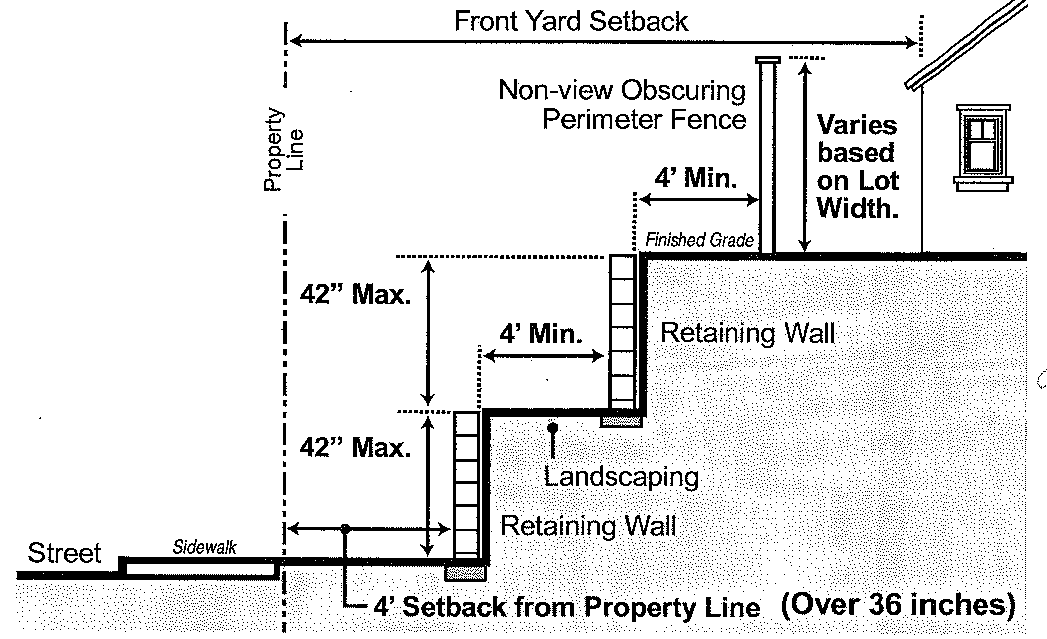
Maximum Height. The maximum height of a retaining wall on an above grade lot is forty-two inches within the front yard setback; however, retaining walls over three feet in height within the front yard setback shall be set back from the right-of-way line a minimum of four feet and the setback space appropriately landscaped.
(B)
Additional Retaining Walls. If more than one retaining wall is necessary within the required front yard setback, then additional retaining walls (up to forty-two inches) may be constructed above the lower retaining wall when set back a minimum of four feet from the preceding (lower) retaining wall, with appropriate landscaping planted between each retaining wall (see Figure 1).
(C)
Fence Set Above a Retaining Wall. A non-view obscuring fence (as permitted under Section 18.10.030(D)(2)(b)) may be built above a retaining wall on an above street grade lot, if the fence is setback four feet from the lower retaining wall and that setback is appropriately landscaped (see Figure No. 1).
Figure 1. Front Yard Fence Height on Above Street Grade Lots
ii.
Lot Below Street Grade.
(A)
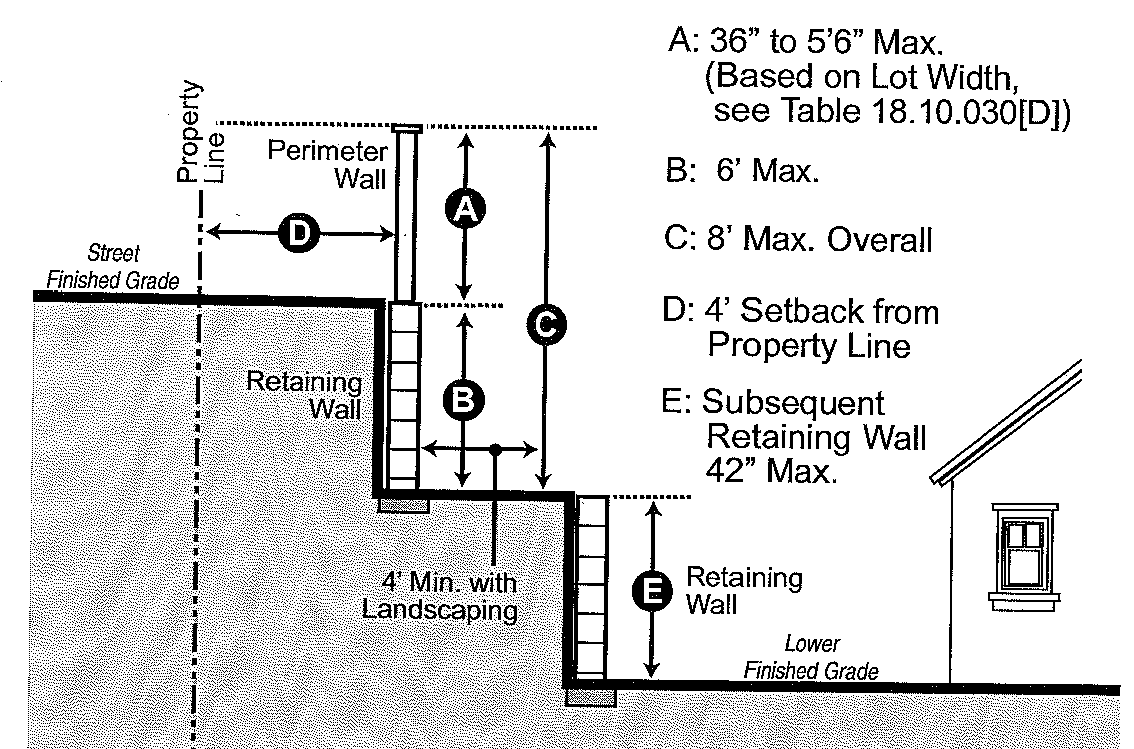
Maximum Height. Retaining walls, or crib type retaining wall systems, within the front yard setback on below street grade lots may be constructed up to six feet in height when not visible from the street, and setback a minimum of four feet from the front property line with a (non-view obscuring) safety fence at a minimum height determined by the California Building Code constructed on top of the retaining wall. In no case shall the overall height of the combination fence and retaining wall exceed eight feet high, as measured from the lowest contiguous finished grade of the wall. Likewise, the non-view obscuring fence on top of the retaining wall may not exceed the maximum height permitted within the front yard setback, as specified under Section 18.10.030(D)(2)(b). The non-view obscuring fence shall be measured from the highest finished grade it is contiguous to, to the top of the fence (see Figure 2).
(B)
Fence or Wall. The maximum height of a fence or wall along the street side, side yard right-of-way line is forty-two inches.
Figure 2. Front Yard Combination Walls/Fence Heights on Below Street Grade Lots
3.
Street Side, Side Yard Setback. The street side, side yard setback is provided under "side yards" in the underlying zone classification as described in Sections 18.64.120, 18.64.140, 18.64.160, 18.64.180, 18.64.200, [and] 18.64.220.
Figure 3. Illustration of Various Lot Configurations
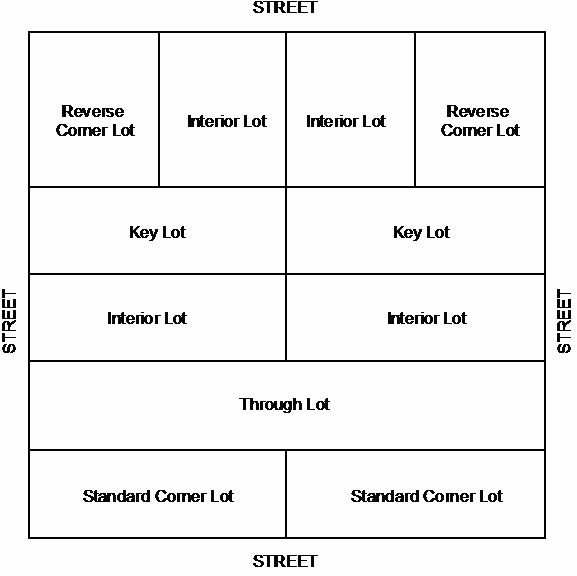
Figure 4. Standard Corner Lot
Standard Corner Lot. A six-foot fence or wall, within the street side, side yard setback on standard corner (see Figure 4) lots may be built if a landscaped setback consisting of a minimum of four feet in width between the right-of-way and the wall is maintained along the entire length of the wall (see Figure 4).
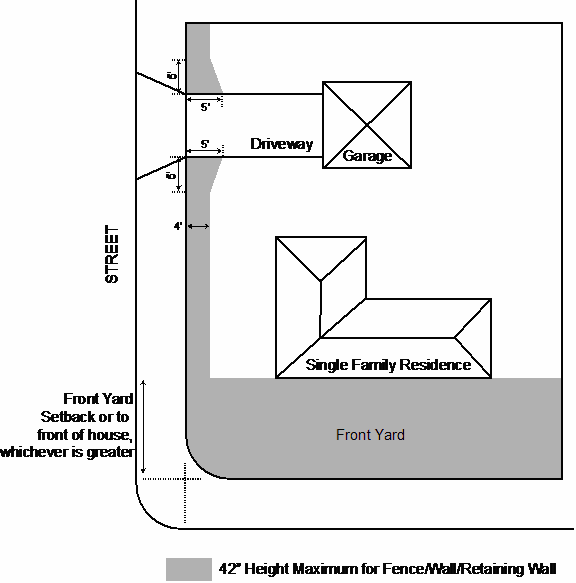
Figure 5. Reversed Corner Lots
Reversed Corner Lots. A six-foot fence or wall within the street side, side yard setback on a reversed corner (see Figure 5) lot may be constructed, if such fence or wall is set back at least five feet from the right-of-way and the five-foot setback is appropriately landscaped.
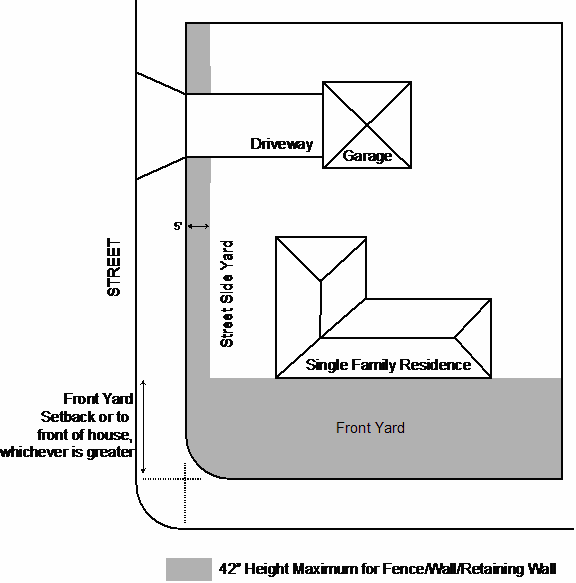
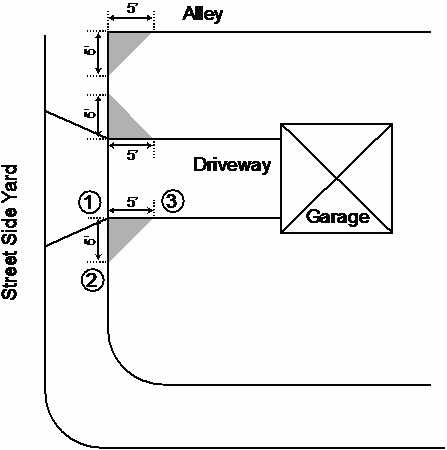
Figure 6. Driveway Cut-off Vision Clearance
Driveway View Clearance. No fence, wall, retaining wall, other structure, or landscaping shall exceed forty-two inches in height within the cut-off area along the driveway and the street right-of-way line. The cut-off area is a triangular area beginning at the intersection of a driveway and the street right-of-way (Point 1), five feet from that point along the street right-of-way (Point 2) and the other point five feet up the driveway (Point 3) (see Figure 6).
Alley View Clearance. No fence, wall, retaining wall, landscaping or other structure shall exceed forty-two inches in height within the cut-off area along the driveway and the alley. The cut-off area is a triangular area beginning at the intersection of a driveway and the alley, five from that point along the alley (see Figure 6).
e.
Retaining Wall.
i.
Maximum Height.
ii.
Lot Above Street Grade. The maximum height of a retaining wall within the street side, side yard on standard corner lots or reversed corner lots is forty-two inches.
iii.
Lot Below Grade. Retaining walls in the street side, side yard, setback may be constructed up to six feet in height when not visible from the street.
iv.
Number of Retaining Walls. Additional retaining walls are permitted in the street side, side yard setback on standard and reversed corner lots. If additional retaining walls are necessary in the street side, side yard setback, then additional retaining walls may be constructed above the retaining wall below it, if it is set back a minimum of four feet from the lower retaining wall, with appropriate landscaping in between each retaining wall.
v.
Fence or Wall Set Above a Retaining Wall.
(A)
Lot Above Street Grade. A fence or wall in the street side, side yard, setback above a retaining wall may be up to forty-two inches in height, if the fence or wall is setback four feet from the wall below and the setback is appropriately landscaped.
(B)
Lot Below Street Grade Combination Wall. Any combination of a retaining wall with a perimeter fence on top within the street side, side yard, setback on below street grade lots may be constructed if setback four feet from the street side property line and the overall combination retaining wall and fence does not exceed eight feet high when measured from the lowest finished grade on the property on which the wall is built and no more than six feet high, as measured from the highest finished grade for the perimeter fencing on top of the retaining wall. (see Figure 7)
Figure 7. Combination Wall Below Adjacent Street Grade
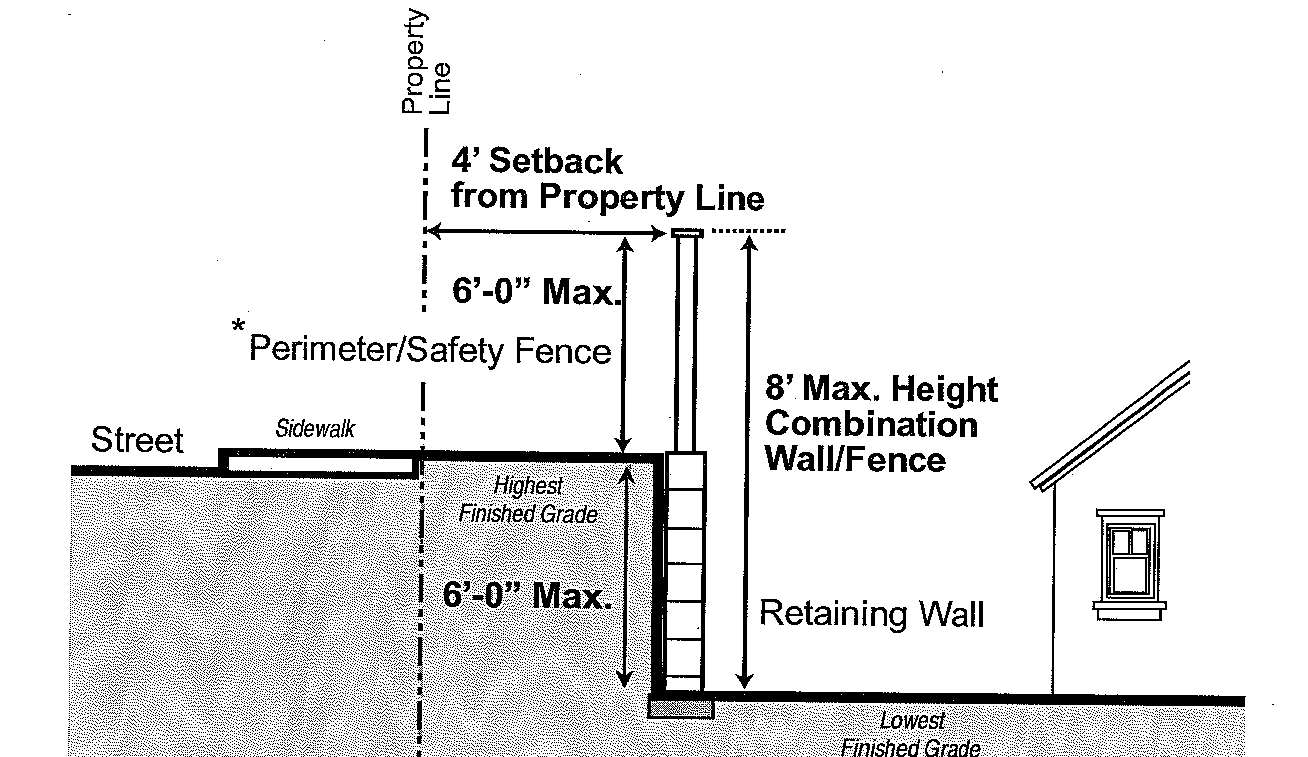
* If a swimming pool is located on the below grade property, refer to Building Code for safety fence minimum height requirement.
4.
Interior Side Yards.
a.
Wall, Fence and Retaining Wall. The maximum height of any freestanding wall, fence or retaining wall within the interior side yard setback is six feet, except as provided below for combination walls. In addition, no setback shall be required between walls on different lots that share a common property line.
b.
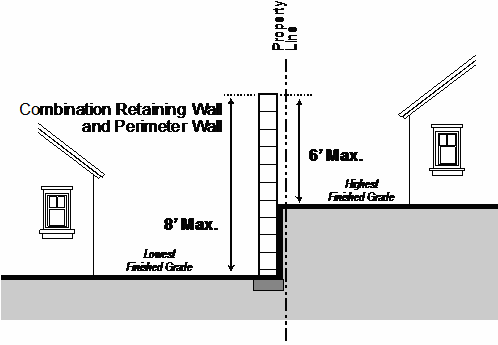
Below Grade Combination Walls. When the finished grade of a lot is situated below the finished grade of a contiguous parcel at a higher elevation (and both lots share the same common interior property line), the property owner of the lot with the lower finished grade may construct a single retaining wall or combination retaining and perimeter wall/fence up to a maximum of eight-foot high adjacent to the property line (as measured from the lowest finished grade) if:
i.
The area of work is located behind the required front yard setback;
ii.
Any perimeter wall or fence located on top of the retaining wall does not exceed six feet high, as measured from the finished grade of the contiguous lot located at the higher finished grade (see Figure 8).
Figure 8. Construction of Below Grade Combination Walls
c.
Above Grade Combination Walls. When the finished grade of a lot is situated above the finished grade of a contiguous parcel at a lower elevation and both lots share the same common interior property line, the property owner of the lot with the higher finished grade may construct a maximum six-foot high retaining wall facing the adjoining property at the lower finished grade, as measured from the pad elevation of the lower adjoining property grade. However, the retaining wall shall be constructed with a decorative material consistent with the city-approved retaining wall palette or any other building material(s) deemed acceptable by the director of community development or other applicable approval authority. If desired, a maximum six-foot high perimeter wall or fence may also be constructed immediately behind the retaining wall (at the higher finished grade), without setbacks from the retaining wall (see Figure 9), subject to the other applicable provisions contained within this ordinance.
d.
Where a perimeter wall/fence is within four feet of a property line where a proposed or existing retaining wall is also placed on the same property, and both walls/fences exceed a combined vertical height of eight feet from the lowest finished grade, the walls/fences shall require design review approval by the approval authority to mitigate any adverse impacts to the lower adjacent property owner related to aesthetics, massing and height.
Figure 9. Construction of Above Grade Combination Walls
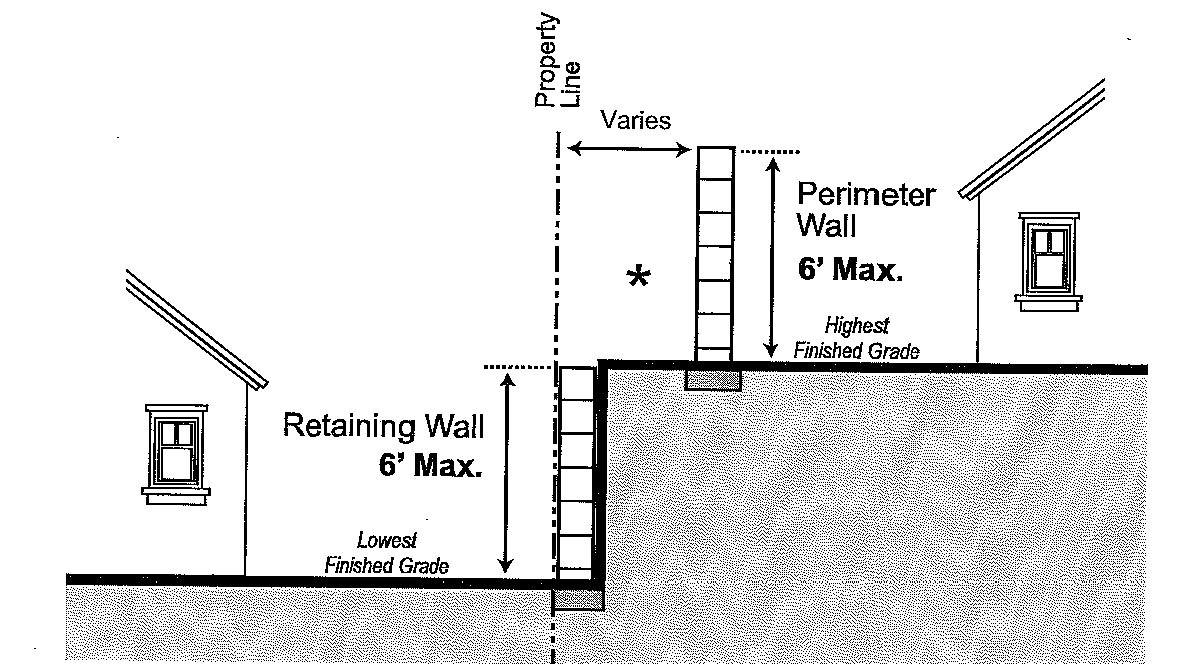
* No separation/setback required between walls on separate parcels. However, if a freestanding perimeter wall/fence is within four feet of the property line that includes an intervening retaining wall built on the same parcel as the freestanding wall and the combined vertical height (face) of the retaining wall and freestanding fence on the same parcel is over eight feet in height as measured from the lowest finished grade or the adjacent parcel, design review approval is required and appropriate mitigation measures applied, as deemed necessary by the approval authority.
e.
Fences and Walls between Driveways. When adjacent driveways are less than ten feet in width for a single-family residence, or less than twelve feet in width for two units, or less than eighteen feet in width for three or more units, or less than fifteen feet in width when the driveway is over one hundred feet in length or construction of a wall or fence would create a nonconforming driveway width, then fences and walls are not permitted between the driveways, except when located behind the back side of the house where a driveway can be expanded to a conforming width. A six-foot fence or wall between adjacent driveways is permitted, only if the area between each driveway and the interior property line is a minimum of three feet wide, from the front yard setback line to the back wall plane of the house, and those areas between the driveway and the interior property line are appropriately landscaped.
5.
Rear Yard Setback.
a.
Wall and Fence.
i.
Maximum Height. The maximum height of a wall or fence in the rear yard setback is six feet, except as provided below for combination walls.
ii.
Exception. The maximum height of a wall or fence in the rear yard setback is eight feet, when the adjacent property to the rear is a commercial zone, manufacturing zone, an alley or the Greenway Trail.
iii.
Minimum Height. Rear yard walls and fences along the Greenway Trail must be a minimum of six feet in height.
iv.
Setbacks. No setback shall be required between walls on different lots that share a common property line.
b.
Retaining Wall.
i.
Maximum Height. The maximum height of a retaining wall within the rear yard setback is six feet, except as provided below for combination walls.
ii.
Exception. The maximum height of a retaining wall in the rear yard setback is eight feet, when the adjacent property is a commercial zone, manufacturing zone, or the Greenway Trail.
c.
Combination Walls.
i.
Except as provided elsewhere within this chapter, above and below grade combination walls may be constructed in the rear yard setback as described above (in Section 18.10.030(D)(4)) for above and below grade combination walls located along interior side yards (see Figure 8 and 9).
6.
Outside of Yard Setbacks. A fence, wall or retaining wall may be built outside of yard setbacks within the interior of a lot up to six feet in height. If greater than six feet, the approval of a minor conditional use permit shall be required.
7.
Other.
a.
Swimming pool fences. Where a fence above a retaining wall is required per building code in order to comply with a fence enclosure for a swimming pool, a non-view obscuring fence may be placed on top of the retaining wall at such a height as to comply with pool enclosure requirements, as long as, that portion of retaining wall and fence that exceeds six feet is non-view obscuring.
b.
Prohibitions. Except as provided for under the city's vacant lot ordinance, chain-link fences are not permitted within the front or street side, side yard on any residentially zoned lot, provided that educational institutions, churches, and other similar non-profit uses, which have outdoor athletic facilities in such zones may be exempt from such prohibitions and from required height limits provided a conditional use permit is first obtained. The exemption pertains to those areas immediately around the outdoor athletic facility and does not include single-family or multi-family residences with outdoor athletic facilities.
c.
Exceptions:
i.
Fences, walls or retaining walls may vary from the sections listed above when a minor variance or variance has been granted in compliance with Sections 18.58.060(D) and 18.52.020, respectively.
ii.
Landscape planters constructed up to eighteen inches in height are exempt from this section.
iii.
When a residential parcel is contiguous to any arterial or collector street, the abutting rear and/or street side yard property line may have a wall constructed on it up to of six feet high. A maximum height of eight feet may be permitted if the wall is setback two feet from the property line and the setback space is appropriately landscaped and irrigated, subject to design review approval. Based on the lot grade and wall location, the approval authority shall consider the physical and visual impact of the wall along the street and its compatibility with the neighborhood. The street facing side of the wall shall be constructed with a decorative material consistent with the city council approved fence palette or any other building material(s) deemed acceptable by the director of community development or other applicable approval authority.
d.
Temporary fences constructed on vacant lots. Refer to Section 8.08.026 (Vacant lots) for applicable vacant lot fencing regulations.
E.
Refuse Storage Areas. Each R-zoned lot shall be provided with facilities for the storage of refuse containers, as follows:
1.
Location. A refuse storage area shall be provided on the same lot as the dwelling unit(s) it serves. Such area may be located on any portion of a lot where a building or accessory building may be placed; provided that, on properties served by an alley the refuse storage area shall be located within a distance not to exceed five feet of the right-of-way line of the alley. The director of public works or his/her designated representative, may waive the requirement for an on-site refuse storage area when a property is located in an automated refuse collection area and is served by off-site containers.
2.
Size. Refuse storage areas shall comply with the following size requirements:
a.
For R-E, H-R and R-1 lots: Refuse storage areas shall be of adequate size for the temporary storage of refuse originating on the lot.
b.
For all other zones which permit residential uses: Refuse storage areas shall have a minimum area of thirty square feet, with minimum interior dimensions of five feet by six feet. The public works director or his/her designated representative, may require greater or lesser dimensions, where it is determined that such adjustments will increase the efficiency of solid waste disposal operations.
3.
Design. Refuse storage areas shall be completely enclosed by a view-obscuring wall, not less than six feet in height. The enclosure shall include a closeable, view-obscuring gate, with a minimum five-foot wide unobstructed access point. On properties served by an alley, the gate shall be located adjacent to the alley to accommodate refuse collection. Such walled enclosure shall be finished to match the color and facade material of the building it serves and shall incorporate landscape screening when possible.
4.
Maintenance. The property owner shall ensure that all refuse storage areas are regularly cleaned and maintained in a safe and sanitary condition.
5.
Director. The locations of refuse storage areas shall be conveniently adjacent to the units served and placed to facilitate efficient collection of refuse. When located in an automated refuse collection area, removal, modification or relocation of existing refuse storage areas that do not meet the minimum location, size, and/or design requirements may be necessary for automated service.
F.
Use of Dwellings. No single-family dwelling nor any dwelling unit shall be used or occupied except by a family, and not to exceed:
1.
Two domestic workers, employed as such in dwelling units; or
2.
Two paying boarders; however boarding or rooming houses shall not be permitted in residential zones, except as may be permitted and provided for in Chapter 18.52 of this code.
G.
Design Standards. In order to preserve the architectural integrity of the city's residential neighborhoods and the integrity of individual structures, prevent deterioration of older neighborhoods, ensure that residential design is based on the general architectural character of the neighborhood, and to accomplish the city's objectives of quality development; each residential development shall comply with the design standards set forth in this subsection, the community design ordinance and any applicable guidelines.
1.
General. To accomplish the city's objective of quality development, each development project must be of a good project design and the following factors must be considered in the context of the neighborhood character:
—
Height
—
Mass
—
Architectural style
—
Setbacks
—
Site and setting
—
Density and intensity
—
Roof shapes
—
Scale
—
Material
—
Landscaping
—
Proportion of openings
—
Location of parking
—
Porches and entryways
—
Accessory structures
a.
The following standards shall apply to all residential development:
i.
Exterior Siding. Each residential development and additions thereto shall have exterior sidings of wood, stucco, masonry, or other approved materials which are formed and finished to give the appearance of such materials, provided;
(A)
Metal siding shall be prohibited unless incorporated as part of a defined architectural style; and
(B)
New Construction. New residential developments shall have an architectural style and siding material which is appropriate to and compatible with the character of the structures on the street which make up the block within which such dwellings are proposed to be constructed.
(C)
Accessory Structures. Exterior siding on accessory structures shall be the same or complimentary to the siding used on the structure to which the accessory structure is related.
(D)
Additions and Exterior Remodeling. Siding on additions and remodeling shall be the same as the siding material used on the structure proposed to be added to or remodeled or be a combination of materials appropriate to the architectural style of the building and the character of the neighborhood.
(E)
Replacement of Existing Siding. If the existing siding is in need of replacement or the original material has been removed, replacement material shall be the same material, or have a similar appearance to the original siding on structures of the same or similar architectural style of the building and the character of the neighborhood.
(F)
Architectural treatments utilized on the front and street side elevations shall be continued on to interior property line side elevations.
ii.
Roofing Material. Each residential development shall have a roof constructed of wood shake, shingle, asphalt composition, fiberglass shingle, crushed rock, tile or other approved materials appropriate to the architectural style of the building, provided:
(A)
Metal roofing shall be prohibited, except that which is formed and finished to represent wood shake or tile, or architecturally integrated into the design of the building, and excepting metal patio covers, when located on the rear of the building and more than fifty feet from the street.
(B)
New built-up composition roofs are prohibited unless screened from view of the public street by a parapet wall or other approved feature and excepting additions to existing structures with built-up composition roofs.
(C)
The roof on accessory structures shall have the same or a complimentary roof design and materials as used on the structure to which the accessory structure is related.
iii.
Eave Overhang. The roof of each residential development shall have an eave overhang appropriate to the architectural style of the buildings, or shall have a parapet extending above roof level a minimum of one foot, provided:
(A)
Additions to existing buildings shall maintain the same eave overhang as the existing structure; and
(B)
Detached accessory structures shall maintain the same overhang as the principal structure.
iv.
Mechanical Equipment. All heating, ventilation and air-conditioning equipment, including but not limited to condensers, compressors, vents, ducts and conduits and water holding tanks associated with solar panels, shall comply with the following:
(A)
All such equipment shall be completely enclosed and/or architecturally screened from view from adjacent properties and the public right-of-way.
(B)
All such equipment shall be screened by an enclosure designed as an integral part of the building, which is consistent with the architecture of the building or by appropriate landscaping.
(C)
Heating, ventilation and air-conditioning equipment shall not be located on the roof of a building, except in new developments wherein such equipment is recessed into the roof structure or placed behind parapet walls of adequate height to meet the requirement of subsection (G)(a)(iv)(B) of this section.
v.
Utilities. Electrical service panels, conduits, transformers, gas meters, backflow prevention valves, fire sprinkler valves, water control valves and landscape irrigation equipment shall be screened, to the greatest extent possible, from view from streets or common areas consistent with the requirements of utility companies and the fire department, for access to the facilities for service and reading of the meters, provided:
(A)
New construction must utilize flush mounted electrical service panels, set into the wall between the studs, painted to match the adjacent surface and located on side or rear walls, unless approved on the front as part of the overall design of the project and if the front is the only location where the meter can be located.
(B)
Replacement of existing electrical service panels which utilize surface mounted panels attached to the outer surface of the wall, must be painted, including the conduit, to match the adjacent surface.
2.
R-E and R-1 Zones. In addition to the standards set forth in subsection 1, above, each residential development in the R-E and R-1 zones shall comply with the following standards:
a.
Floor Area.
i.
Minimum. Each single-family dwelling and foundational mobile home, , shall have a gross floor area exclusive of garages, decks, patios and breezeways of not less than fifteen percent of the area of the lot area upon which it is or is proposed to be located or eleven hundred square feet, whichever is greater, provided that no dwelling shall be required to have a floor area in excess of three thousand square feet; and
ii.
Maximum. The total floor area of all enclosed useable space, including accessory buildings other than accessory dwelling units, and enclosed patios, other than the area required, designed, and used for parking of vehicles, shall not exceed forty percent of the area of the lot upon which such buildings are or are proposed to be located; and
b.
Minimum Width. Each single-family dwelling and foundational mobile home shall have a minimum width of not less than sixty percent of the lot width, provided that no such building shall be required to have a width in excess of fifty-five feet.
c.
Window Treatments. Window treatments which are architecturally compatible with the project shall be incorporated into the project design. Window treatments should include but not be limited to: architectural window trim, such as: lintels, sills, arches, molds, brackets, bay windows, recessed windows, mullions, and multi-paned windows. Exceptions may be given through the development review process, when the particular architectural style excludes the above requirements. Bare aluminum window casements are prohibited unless consistent with an identified architectural style. Aluminum window casements must be either anodized or painted to complement the trim and colors of the structure.
d.
Landscaping. Not less than sixty percent of the required front yard area shall be planted and maintained with plant material and appropriately irrigated; provided, that the planning director may waive this requirement in order to comply with minimum driveway requirements set forth in Section 18.48.070(D).
3.
R-2, R-3 and R-4 Zones. In addition to the standards set forth in subsection 1, above, each residential development in the R-2, R-3 and R-4 zones shall comply with the following standards:
a.
Window Treatments. Window treatments which are architecturally compatible with the project shall be incorporated into the project design. Window treatments should include but not be limited to: architectural window trim, such as: lintels, sills, arches, molds, brackets, bay windows, recessed windows, mullions, and multi-paned windows. Exceptions may be given through the development review process, when the particular architectural style excludes the above requirements. Bare aluminum window casements are prohibited unless consistent with an identified architectural style. Aluminum window casements must be either anodized or painted to complement the trim and colors of the structure.
b.
Entry Door Treatment. Entry doors can be simple or decorated but should balance the entryway to each unit. Doors should have paneled recesses, unless inconsistent with an identified architectural style, and decorative trim treatment around the door. The entry to each unit shall incorporate a cover over the door to protect residents from inclement weather. Such covers must be integrated into the design of the building and not appear as add-ons.
c.
Garage Door Treatment. Garage doors shall be decorative and designed to match and complement the principal structure. Garage doors shall be framed by the trim treatment utilized on the principal structure. If metal doors are used, they shall be painted to match, contrast or complement the exterior wall color.
d.
Utilities. Electrical boxes, gas meters, landscape irrigation equipment, and other utilities visible from public or private streets or common areas shall be appropriately screened architecturally or with landscaping.
e.
Pavement Treatment. Enriched or decorative pavement, including but not limited to: colored concrete, concrete brick, brick and appropriately located turf block, shall be incorporated into the overall design theme. Pavement treatment shall include, but not be limited to, driveways and walkways. Credit toward the landscaping requirements may be given for exceptional use of treated pavement.
f.
Stairways. Stairway entrances, including the safety railing, shall be designed as an integral part of the building and designed to screen the view of the stair treads from the street.
H.
Development Review. Prior to the issuance of a building permit for a residential development, a development review application shall be submitted, reviewed, and approved in accordance with Chapter 18.56 hereof. In the review of the applications for development review, the approving authority shall consider the following:
1.
No development review application shall be approved for a residential development unless the approving authority, based upon the evidence presented, finds that the factors set forth in subsection (G)(1) of this section have been considered in the design of the project; and the improvements proposed will be compatible as to size, location on the lot, elevations and appearances with existing structures located upon lots within the immediate vicinity of the lot which is the subject of such application; and
2.
The design of the residential development will be consistent with the purpose and intent of the provisions of this title, the general plan, and applicable city development guidelines.
I.
Antennas and Flagpoles. Flagpoles and antennas, as permitted pursuant to Section 18.10.020(J), shall be permitted to be constructed and maintained only in compliance with the following:
1.
Location. Except as expressly hereinafter permitted, no flagpole or antenna may be located in a required yard area nor in an area of a lot between a front lot line of that lot and a dwelling unit located thereon; a flagpole, not in excess of twenty-five feet in height, nor a dimension of more than four inches, may be located in a required front yard area; provided, that the same shall not be placed closer than ten feet of any lot line; and
2.
Height. No flagpole or antenna shall have a height in excess of that permitted by the underlying zone classification for buildings and structures; and
3.
Bulk. No antenna shall have a horizontal dimension in excess of twelve feet; and
4.
Bracing. All flagpoles and antennas shall be self-supporting and shall have no external guys or braces.
5.
Federal Law. Notwithstanding any other provisions of this code to the contrary, the Director may allow antennas to the extent required by state or federal law. See Chapter 18.47 (Wireless Telecommunications Facilities on Public and Private Property).
J.
Accessory Structures. Accessory structures shall be subject to the following:
1.
Accessory structures with habitable space, as defined by the California Building Standards Codes, or which have bathing facilities, are considered accessory living area and subject to the requirements of subsection (H) of this section; and
2.
Accessory structures in excess of one story in height are prohibited unless a minor conditional use permit has first been approved therefor; and
3.
The second-floor area of a two-story accessory building shall not exceed seventy-five percent of the ground floor area of the accessory structure; and
4.
Stairway access to the second floor shall be interior.
(Ord. 2897 § 8, 2008; Ord. 2901 § 1, 2007; Ord. 2839 § 13, 2004: Ord. 2838 § 13, 2004: Ord. 2824 § 7 (part), 2003; Ord. 2792 § 2, 2001; Ord. 2765 § 2 (part), 2000; Ord. 2755 § 2 (part), 1999; Ord. 2746 § 2, 1999; Ord. 2738 § 4, 1998; Ord. 2712 § 1 (H), (I), (L)—(N), 1997; Ord. 2690 § 2, 1996; Ord. 2632 § 1(A), 1994; Ord. 2610 § 1(B—F), 1993; Ord. 2580 §§ 2, 3, 1992; Ord. 2577 § 33, 1992; Ord. 2518 § 2, 1990; Ord. 2441 § 1, 1988; Ord. 2416 § 2, 1987: Ord. 2392 § 2(a), 1986; Ord. 2345 § 2, 1985; Ord. 2337 § 1, 1984; Ord. 2318 § 1(c), 1983; prior code § 9122)
(Ord. No. 2932, § 1, 8-11-09; Ord. No. 2967, § 1, 4-12-11; Ord. No. 3054, § 2, 8-9-16; Ord. No. 3159, § 3(Exh. A), 11-12-24)
18.10.040 - Alternative development standards.
Alternative development standards, when allowed in this chapter, are intended to provide better quality of design than could be achieved through the use of the basic development standards and design guidelines indicated in Sections 18.20.020, 18.20.030, 18.22.020, 18.22.030, 18.48.070(C), 18.48.070(D), 18.48.070(M) and 18.76.030(A) and Division VI. Alternative development standards allow the use of more creative design, while maintaining the quality of development and the character of the adjacent and surrounding neighborhood. This section is not to be construed as a substitute for the variance procedure detailed in Chapter 18.52. The following findings must be made to allow for the use of the alternative development standards:
A.
A development review application may be approved, utilizing alternative development standards, notwithstanding any provision of this title to the contrary, and to the exclusion of the zoning regulations applicable to the lot by reason of its underlying zone classification, provided:
1.
That the approval is consistent with the public peace, health, safety and general welfare; and
2.
That the development proposed is consistent with the city's general plan and any applicable specific plan relating to the areas included within such plan; and
3.
That the development will be in substantial compliance with the purpose and intent of the zoning regulations; and
4.
The approving body or zoning administrator shall make a specific finding as a condition of approval that the alternative standards being approved shall increase the quality of the project by achieving greater than minimum standard requirements provided by this code.
(Ord. No. 3159, § 3(Exh. A), 11-12-24)
Editor's note— Ord. No. 3159, § 3(Exh. A), adopted Nov. 12, 2024, amended § 18.10.040 in its entirety to read as herein set out. Former § 18.10.040 pertained to optional development standards and derived from Ord. 2518 § 3, adopted in 1990.
18.10.050 - Minimum residential density.
The provisions within the general plan pertaining to minimum density may be waived or modified by the director of community development when it can be demonstrated that the minimum density requirements cannot be provided because of unusual circumstances associated with the property due to one or more of the following conditions:
A.
The topography of the property cannot be altered in a practical manner to accommodate the minimum density requirement.
B.
The minimum density cannot be physically developed on the project site without the approval of a variance because the existing property does not comply with the city's minimum required lot size, depth and/or width requirements.
C.
The new construction would necessitate the removal or significant alteration of existing on-site structures and/or cannot be physically integrated onto the existing property without the approval of a variance or deviation from Health and Safety Codes.
D.
The property is eligible for or listed on a local, state or national historic register or is a contributing resource within an historic district and the minimum density requirements would adversely impact the historic setting, structure(s) or feature(s) of the property in such a manner as to adversely diminish the site's historic significance or value.
E.
The property has one or more significant easement(s) on the property that cannot be relocated, modified or abandoned and therefore reduces the functional building area on the property to develop residential dwelling units.
F.
Evidence is presented to the satisfaction of the director of community development that a waiver or modification to the minimum density requirement is appropriate in consideration of project site physical constraints and existing economic market conditions.
(Ord. 2873 § 1, 2006)
(Ord. No. 3159, § 3(Exh. A), 11-12-24)
18.10.060 - Minimum dwelling unit square footage.
Residential dwelling units located in any "R" (residential) referenced zoning classification or specific plan (unless identified otherwise within the development standards of an adopted specific plan) shall comply with the following standards:
A.
All detached, single-family, dwelling units shall consist of a minimum of one thousand one hundred square feet.
1.
The minimum required square footage shall not include porches, balconies/decks, garages, storage rooms or other such accessory structures or architectural features that are attached or detached from the dwelling unit.
B.
All attached or semi-detached residential dwelling unit(s) located in an apartment, townhome, condominium or other multi-family residential or mixed-use development shall consist of the following minimum square footage:
Minimum Dwelling Unit
Square Footage Schedule
1.
The minimum required dwelling square footage shall not include porches, balconies/decks, garages, storage rooms, or other such accessory structures or architectural features attached or detached from an individual dwelling unit.
C.
Any accessory dwelling unit and any junior accessory dwelling unit shall be subject to the standards in Section 18.10.020 (I), Accessory Dwelling Units.
D.
No existing residential dwelling unit that was legally constructed prior to the enactment of this ordinance [Ordinance No. 2940] shall be deemed nonconforming solely because it fails to comply with the minimum dwelling unit square footage provisions contained in this chapter. If an existing residential dwelling is partially or totally destroyed by fire or other natural disaster, it may be reconstructed to its original square footage, even if it does not meet the minimum dwelling unit square footage provisions contained in this chapter.
(Ord. No. 2940, § 1, 12-8-09; Ord. No. 3068, § 5, 6-13-17; Ord. No. 3116, § 10, 5-26-20; Ord. No. 3159, § 3(Exh. A), 11-12-24)

