Zoneomics Logo
search icon

Whittier City Zoning Code

CHAPTER 18

35 - MU MIXED-USE ZONES

18.35.010 - Purpose.

In order to provide for the development of mixed-use areas within the city, the regulations set forth in this chapter shall be applicable to all properties classified in zones MU-1, MU-2 or MU-3. These zones are established to support a healthy, active area with a mixture of uses that support a full-service community along corridors and at activity nodes. The zones support multi-modal mixed-use corridors that provide daily needs, goods, and services in walkable proximity to established residential neighborhoods. These zones permit a mixture of residential and non-residential uses in a wide variety of configurations. The purpose of each zone is as follows:

A.

Mixed-Use 1 (MU-1) zone provides for medium-scale, mixed-use development as a transition between residential and mixed-use nodes.

B.

Mixed-Use 2 (MU-2) zone provides for neighborhood activity centers in proximity to bus routes and multi-modal corridors. This zone permits horizontal and vertical mixed-use appropriately scaled for adjacent neighborhoods.

C.

Mixed-Use 3 (MU-3) zone provides for the highest intensity neighborhood activity centers in proximity to bus routes and multi-modal corridors. This zone permits horizontal and vertical mixed-use developments scaled for the highest intensity uses that benefit from transit proximity and pedestrian activity. A two-tiered development system allowing for specific increased intensity, densities and building height is established for the MU-3 zones to promote development with added benefit to the community as outlined under Section 18.35.040.

(Ord. No. 3159, § 3(Exh. A), 11-12-24)

18.35.020 - Permitted uses.

A.

Principal Uses. Table 18.35.020 lists the permitted and conditionally permitted land uses for MU-1, MU-2, and MU-3 zoned lots indicating the type of approval required subject to compliance with all provisions of this title. Descriptions and definitions of the land uses can be found in Chapters 18.06 and 18.07. The specific use regulations and notes column in the table indicates a chapter or section where additional regulations may apply; and/or provides additional information specific to that use type.

B.

Accessory Uses. Accessory uses are those uses which are directly related, but clearly subordinate to a permitted or conditionally permitted principal use; where such use is already established, or the principal and accessory uses are established jointly.

C.

Stand-alone Residential. Stand-alone residential is allowed in any MU zone and not subject to floor area ratio (FAR) restrictions; however, all density limits for each MU zone are applicable regardless of the type of residential use as identified in Table 18.35.030.

D.

Use Not Listed. Any use that is not listed or has not been determined by the director of community development to be similar to a listed use, is prohibited in any mixed-use zone.

Table 18.35.020: Allowable Uses and Approval Requirements for Mixed-Use Zones
Allowable Uses Approval Required By Zone
"P" Permitted
"A" Accessory
"C" Conditional Use Permit
"—" Use Not Allowed in Zone
Specific Use Regulations and Notes
MU-1 MU-2 MU-3
Residential Uses
Dwelling Unit, Accessory A A A Section 18.10.020 I
Dwelling Unit, Multi-Family P P P
Dwelling Unit, Single-Family
Employee Housing P P P
Home Based Business A A A Section 18.10.020 C
Live-Work Units P P P
Mixed-Use Development P P P Vertical - Residential over Nonresidential or Horizontal - Residential adjacent to Non-residential.
Senior Residential Project P P P As defined in Section 18.07
Care Uses
Day Care, Adult A A A
Day Care, Family A A A Section 18.10.020 K
Emergency Shelter Section 18.34.060
Low Barrier Navigation Center P P P
Residential Care Facility P/C P/C P/C CUP for 7 or > persons
Supportive Housing P P P
Transitional Housing P P P
Retail, Service and Office Uses
Alcoholic Beverage Sales C C C Not allowed as a stand-alone use. Sale and/or service of alcoholic beverages require CUP approval.
Animal Sales and Grooming P P P Not including kennels
Art, Antique, Collectible P P P
Artisan Shops P P P
Artisanal and Specialty Manufacture, Display, and Sales P P P
Banks and Financial Services P P P
Bars, Taverns, Nightclubs
Brew Pub C C C Shall be located at least 250 feet from any existing Adult Entertainment Establishment as regulated under Chapter 18.44.
Brewery, Winery, Distillery C C Limited to a maximum of 20,000 square feet and in conjunction with food services.
Business Support Services P P P Limited to a maximum of 5,000 square feet.
Child Day Care Facility P C C
Convenience Stores
Drive-Through Facilities A/C A/C A/C Limited to Pharmacies, banks, and similar uses. Must be located to the rear of a building, or within parking area.
Furniture, Furnishings, and Appliance Stores P P
Garden Center/Plant Nursery C C
Grocery Stores/Supermarkets P P Limited to a maximum of 55,000 square feet.
Health Facilities C C
Home Improvement Sales/Services P P
Lodging Facilities C C Includes all on-site guest services subject to any specific regulations of this Title or as required by State law.
Maintenance and Repair, Small Equipment C P P
Neighborhood Market P/C P/C P/C Sale of alcoholic beverages requires CUP approval.
Offices, Business and Professional P P P 10,000 sf max - street level
Offices, Medical and Dental P P P 10,000 sf max - street level
Offices, Research and Development
Personal Services P P P
Restaurants, Eating and Drinking Establishments P/C P/C P/C Sale and/or service of alcoholic beverages require CUP approval.
Restaurant with Drive-through C C C
Retail, Accessory A A A
Retail, Bulk Merchandise P P
Retail, General P P
Retail, Limited P P P
Retail, Regional Anchor P P
Retail, Specialty/Quality P P P
Tasting Area A A A Shall be located at least 250 feet from any existing Adult Entertainment Establishment as regulated under Chapter 18.44.
Veterinary Services A/C C C Specific regulations, including kennels as defined in the WMC
Recreation, Education and Public Assembly Uses
Assembly/Meeting Facilities, Public or Private C C C
Community Garden C C C
Government Facilities P P P
Indoor Amusement/Entertainment Facility P/C P/C P/C Includes all on-site guest services subject to any specific regulations of this Title or as required by State law.
Indoor Fitness and Sports Facility C C C Includes all on-site guest services subject to any specific regulations of this Title or as required by State law.
Libraries and Museums P P P Includes all on-site guest services subject to any specific regulations of this Title or as required by State law.
Indoor/ Outdoor Commercial Recreation C C C Includes all on-site guest services subject to any specific regulations of this Title or as required by State law.
Parks and Public Plazas P P P
Public Safety Facility P P P
Studio-Art, dance, martial arts, music, yoga, etc. P P P
Theater and Auditoriums C C C Includes all on-site guest services subject to any specific regulations of this Title or as required by State law.
Utility, Transportation, and Communication Uses
Park and Ride Facility P P P
Transit Stations and Terminals P P P
Utility Facility C C C
Utility Infrastructure P P P
Wireless Telecommunication Facility P/C P/C P/C Chapter 18.47


(Ord. No. 3159, § 3(Exh. A), 11-12-24)

18.35.030 - Development standards.

Table 18.35.030 contains the development standards applicable to the MU-1, MU-2 or MU-3 zones. These standards, along with other development standards as outlined within this Title, including objective design standards contained in Chapter 18.93, are intended to assist property owners and project designers in understanding the city's minimum requirements and expectations for high quality development. The following applies to the requirements of Table 18.35.030:

A.

Minimum and Maximum Density. The minimum and maximum density standards are only applicable to mixed use developments that include residential uses.

B.

Density, Floor Area Ratio, and Height. Increase to any of these standards in Table 18.35.030 is exclusive to the MU-3 zone subject to the requirements of the community benefits program outlined in Section 18.35.040.

C.

Predominant Use. Predominant uses are intended to establish the primary focus for development maximizing the land use intent and square footage for those uses in Table 18.35.020 identified as primary uses. Mixed-use zones allow some standalone uses that are not traditional mixed-use (e.g., medical services/hospitals, banks/financial institutions, lodging facilities, recreation, education, and public assembly uses).

D.

Accessory Structures. Includes parking structures, trash enclosures and similar supporting or separate structures from the primary structure.

E.

Development Standards. In addition to the standards outline in Table 18.35.030, mixed-use development shall comply with applicable requirements of Chapter 18.93.

Table 18.35.030: Development Standards for Mixed Use Zones
Development Standard MU-1 MU-2 MU-3
Density
Minimum 20 du/ac 25 du/ac 25 du/ac
Maximum 30 du/ac 40 du/ac 40 du/ac
Tier 1 - 50 du/ac
Tier 2 - 60 du/ac
(see Section 18.35.050 for Tiers)
Floor Area Ratio
Minimum 0.25 FAR 0.30 FAR 0.45 FAR
Maximum 1.00 FAR 1.00 FAR 1.00 FAR
Tier 1 - 2.00 FAR
Tier 2 - 3.00 FAR
(see Section 18.35.050 for Tiers)
Predominant Use Standard
Use Type Stand-alone residential Neighborhood serving retail with residential
Horizontal or vertical development
Commercial and/or entertainment retail with residential
Vertical development
Standard ≥ 50% total combined building square footage ≥ 50% of combined building square footage ≥ 50% of ground floor building square footage
Maximum Height
Primary Structures 40 feet 50 feet 50 feet
Tier 1 - 60 feet
Tier 2 - 75 feet
Accessory Structures 25 feet, excluding parking structures
Setbacks (build to line)
Front 15 feet minimum
20 feet maximum
0 feet minimum
15 feet maximum
0 feet minimum
Street Side 0 feet minimum
10 feet maximum
0 feet minimum
5 feet maximum
0 feet minimum
0 feet maximum
Rear 10 feet minimum 10 feet minimum 10 feet minimum
Building step back requirement applies where adjacent to residential uses (see Section F)
Interior Side 0 feet minimum
5 feet maximum
0 feet minimum
5 feet maximum
0 feet minimum
0 feet maximum
Building step back requirement applies where adjacent to residential uses (see Section F)
Accessory Structures Front: 15 feet
Side/Rear: 10 feet
Front: 10 feet
Side/Rear: 5 feet
Front: 10 feet
Side/Rear: 0 feet
Building Frontage None Frontage percentage dependent upon parcel size
Open Space
Private and Common 300 sf/du minimum combined total, private open space shall have a minimum of 60 sf (interior dimensions)
Parking
Stand-Alone Uses Off-street parking shall be provided as required by Section 18.48.020
Residential Mixed-Use Off-street parking may be reduced subject to shared or joint use of facilities
Landscaping
Setback Areas (less walkways and driveways) 100% planted
Adjacent to Residential Uses 5 ft minimum planter areas
20 ft on center minimum tree spacing
Adjacent to Whittier Boulevard 36-inch box minimum tree size
40 ft on center minimum tree spacing
5 ft within property line
24-inch box minimum standard tree size
48-inch box minimum standard specimen tree size
Initial planting mix shall contain a ratio of:
48-inch box - 25%
36-inch box - 60%
24-inch box - 15%
At Central Open Space Areas 36-inch box minimum specimen tree size
45 ft on center minimum tree spacing


F.

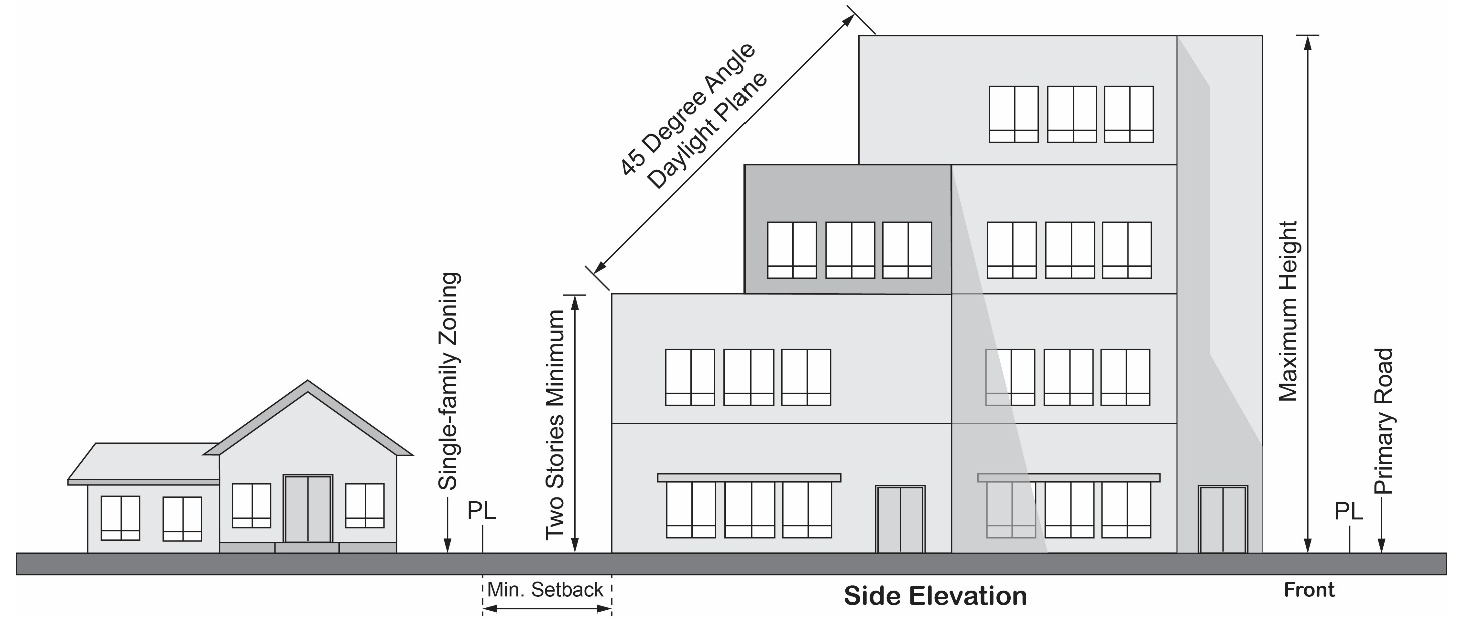
Building Step Back Requirements. Buildings located on MU zoned parcels shall provide a transitional element, a stepping back of the building at the third story and above, that is in addition to the minimum side and rear setback line. Taller elements of the building shall increasingly step back from adjacent single-family zones. No portion of the building, excluding parapets, shall extend above an imaginary plane drawn at the property line that is adjacent to the single-family zone, and extended at an angle of forty-five degrees toward the center of the MU zoned parcel as shown in Figure 18.35.030-F.

Figure 18.35.030-F: Building Step Back
G.

Building Frontage. New buildings are to be located in close proximity to the street for improved relationship to the street and pedestrians. For parcels less than fifteen acres in size, at least fifty percent of the lot width shall be occupied by primary building frontage and/or pedestrian features located between zero and thirty feet from the front property line. For parcels fifteen acres and greater in size, at least fifty percent of the lot width is occupied by primary building frontage and located between zero and eighty feet from the front property line.

H.

Open Space. The residential component of a mixed-use development shall provide open space areas subject to the following standards in addition to the requirements of Table 18.35.030.

1.

Private Open Space. Private open space shall be provided at each unit in the form of a patio, yard, balcony, immediately adjacent deck, or combination thereof and shall be directly adjacent to and accessible from each unit. Every private open space area that is provided shall have a minimum area of sixty square feet, a minimum dimension of six feet in any direction, and a minimum vertical clearance of eight feet.

2.

Active Common Open Space/Recreation Areas. Common open space/recreation areas shall be designed to provide specific amenities as outlined below based on the number of units proposed in the development. The list of amenities is both cumulative and additive, requiring that the base amenity type and minimum size be satisfied for the applicable number of units threshold, plus all preceding amenities, plus any additional increase in number or size of the amenity based upon the additional minimum ratio to be provided, where applicable.

As an example, a development consisting of twenty units shall provide a business center with at least two workstations OR a two hundred fifty square foot gym OR a one hundred fifty square foot meeting/study room OR a thirty-six square foot community garden; PLUS, either one barbeque with table seating for twelve adults OR an outdoor active use area a minimum of four hundred five square feet (Base Amenity of 400 sf + 5 sf for 10 additional du above the base). All fractional values shall be rounded up. Additional amenity types and square feet of amenities beyond the minimum required may be provided.

Table 18.35.030.H: List of Amenities for Active Common Open Space/Recreation Areas
Number of Units Base Amenity Type and Minimum Size or Number (plus all preceding amenities) Additional Minimum Ratio to Be Provided, Where Applicable 1
1—10 Provide at least one of the following:
• One Barbeque with Table Seating for 12 adults; or
• Outdoor Active Use Area - 400 sf
• 1 / 45 du, with additional seating not to exceed 12 adults
• 5 sf/10 du for active use area
11—20 Provide at least one of the following:
• Business Center - 2 workstations; or
• Gym - 250 sf; or
• Meeting/study room - 150 sf; or
• Community Garden - 36 sf
• 1 workstation/10 du up to 4 additional workstations maximum
• 5 sf/1 du up to additional 300 sf maximum gym
• 5 sf/1 du up to additional 300 sf maximum room
• 8 sf/5 du for garden
21—50 Provide either of the following:
• Clubhouse with kitchen - 400 sf; or
• Children's Play Area - 500 sf
• 15 sf/1 du
• 40 sf/5 du, up to additional 500 sf maximum
51—70 Provide at least one of the following:
• In-Ground or Below Deck Spa - 64 sf; or
• Sauna and/or steam room; or
• Dog run - 12 x 48 feet, and grooming station
• Below Ground/Deck Pool - 20,000 gallons
71+ Provide at least one of the following:
• Arcade/game room or pool table; or
• Full basketball court (or two half courts), pickleball court, or tennis court, or similar; or
• Cabanas, pergolas, or ramadas with a total cover of 300 sf; or
• Indoor theater for seating of a total 25 adults; or
• One Universal design office space of 80 square feet; or
• Concierge Desk and Secure Package Delivery Room; or
• One Additional Amenity Type Not Already Provided, at Director of Community Development's discretion
For projects with ≥ 100 + units, the below ground/deck pool of 20,000 gallons as listed in the preceding amenity type threshold may be one pool of this size, or two pools adding up to 20,000 gallons total.


1 Ratios to be applied for the additional number of units in the project that is above the amount listed in the "number of units" column, resulting in an increase in the amenity square footage or number in the "base amenity type and minimum size" column.

sf = square feet; du = dwelling unit

3.

Common Open Space Dimensions. Common open spaces shall have a minimum horizontal dimension in any direction of twenty feet on the ground floor level. Upper story decks shall be no less than ten by ten feet in horizontal dimension. Roof decks shall be no less than fifteen by fifteen feet in horizontal dimension. The minimum vertical dimension shall be fifteen feet.

4.

Common Open Space Location. Active common open spaces shall not be located in any required setback area. Active common open spaces may be located at ground level, on upper story decks, on roof decks, indoors, or outdoors. Areas located at upper story decks or on roof decks may contribute one hundred percent towards the required common open space area. Areas located indoors shall not contribute more than fifty percent of the required common open space area.

5.

Parking. The number of parking spaces provided for the allowed uses contained in Table 18.35.020, and the design of such parking areas shall satisfy the applicable requirements of Chapters 18.48 and 18.99. Shared parking for residential mixed-use development, either vertical or horizontal, shall be permitted, subject to review and approval of a parking study prepared in accordance with Section 18.48.030 for mixed occupancy requirements and Section 18.48.040 joint use authorization.

(Ord. No. 3159, § 3(Exh. A), 11-12-24)

18.35.040 - Community benefits program.

A.

Purpose. To promote added amenities on MU-3-zoned lots, a tiered development system using a community benefits program as provided herein may be applied. The program provides the city with tools to evaluate and determine how a development contributes to the urban fabric and creates special places that enhance the city. A two-tier system of benefits allows development to achieve higher densities and intensities in return for certain public and community-serving amenities being provided.

B.

Relationship to State Density Bonus Law. Any such density bonuses associated with the provisions outlined herein are supplementary to density bonus provisions established by state law.

C.

Relationship to the General Plan. At a minimum and in accordance with the general plan, development utilizing this program must provide a measurable and/or clearly identifiable community benefit in the form of affordable housing, jobs creation, parkland or open space.

D.

Eligibility. Multi-family and mixed-use residential development within the MU-3 zone are eligible for participation in the community benefits program. To be eligible for the program, mixed-use development must have at least two-thirds of the total floor area developed with residential uses.

E.

Types of Community Benefits. Table 18.35.040-E provides a list of community benefits and a general description of the minimum criteria to evaluate the community benefit that reflects public input on desired types of development, project features and amenities within the city.

Table 18.35.040.E: Community Benefits
Community Benefit Description
On-Site Affordable Units The project provides on-site affordable units in compliance with Chapter 18.11, including the minimum duration requirement for the units to remain affordable.
Additional On-Site Affordable
Units
The project exceeds the number of affordable units required by Chapter 18.11. All affordable units must remain affordable for the minimum duration required by Chapter 18.11.
Age-Restricted Housing All units are age-restricted for persons 55 and older (age of at least one occupant). Units must remain age-restricted for a period of not less than 30 years.
Housing for Artists/Artisans At least 20 percent of units are Live-Work units for artists, artisans, and similarly creative individuals. For units with working space, the working space must:
• constitute 50 percent of the floor area of the unit
• be a clearly defined area within the unit
• be reserved for and regularly used as artistic working space by the resident of the unit
Neighborhood-serving and local job creation A minimum of 25 percent of the total non-residential building square footage providing on-site space with emphasis on one or more of the following non-residential uses:
• Restaurants, Eating and Drinking Establishment
• Neighborhood Market
• Personal Services
• Retail, Limited
Public Art The project includes a public art component above and beyond the City's Public Art Program requirements increasing the base funding by an additional amount equal to at least two percent of total construction costs of the development. Public art must be permanent and is subject to the requirements found in Chapter 12.52.
Public Open Space On-site public open space that represents five percent of site area or 1,000 square feet, whichever is greater. Examples of public open space includes public plazas, courtyards, and other public gathering places that provide opportunities for people to informally meet and gather. Development shall grant an easement or other property interest for the perpetual benefit of the public for said open space. Open space must be accessible to the general public. Provisions must be made for ongoing operation and maintenance of the public open space and related improvements in perpetuity.
Public Infrastructure Public infrastructure improvements equal to two percent of total construction costs of the development. Improvements to streets, sidewalks, bicycle facilities, curbs, gutters, sanitary and storm sewers, street trees, lighting, and other public infrastructure above and beyond the minimum required by the City or other public agency shall be provided as determined most beneficial to the City. The equivalent payment of an in-lieu fee may satisfy this community benefit as part of the approval process.
Public Parking Providing additional parking spaces available for use by the general public within the same block as a transit stop, in an amount equal to at least ten percent of the number required to be provided on-site. Use of the additional spaces shall be designated as public and shall not be restricted. The additional spaces must be accessible to the public at all times, subject only to the same time limits or towing that is applicable to on-street parking as regulated by the California Vehicle Code.
Other Community Benefits - Tier 2 Development Projects Other community benefits not listed above as proposed as part of an eligible development that demonstrate a significant and substantially community benefit, as determined by the City, subject to an approval in concept by the City Council prior to the acceptance of a formal development application.


F.

Increased Density/Intensity. Table 18.35.040-F outlines the maximum allowable increase to residential density and/or intensity of non-residential development within a two-tier program for qualifying community benefits. The city may grant such increases up to the maximum by tier only when the community benefits or amenities offered satisfy the minimum amount and are not otherwise required by this title or any other provision of local, state or federal law.

Table 18.35.040-F: Community Benefits Program
Program Parameters Tier 1 Tier 2
Minimum Number of Community Benefits Provided Two Four
Maximum Density 50 du/ac 60 du/ac
Maximum Intensity 2.00 FAR 3.00 FAR
Maximum Height 60 feet 75 feet


G.

Required Approvals. Approval of an eligible development participating in the community benefits program requires the following review and approvals in conjunction with any other approvals as required by this title.

1.

Tier 1. A development that proposes to utilize the allowable increases to density, intensity, and/or height under the tier 1 community benefits program shall require planning commission review and approval.

2.

Tier 2. A development that proposes to utilize the allowable increase in density, intensity, and/or height under the tier 2 community benefits program shall require a recommendation of the planning commission to the city council for final review and approval. If a development agreement is utilized by the city to negotiate project design that maximizes community benefits, then such agreement shall be prepared and approved consistent with this title and Government Code Sections 65864 through 65869.5, including all required public noticing and hearings.

(Ord. No. 3159, § 3(Exh. A), 11-12-24)
