
Beaufort City Zoning Code
9
DEVELOPMENT REVIEW PROCEDURES
9.3: - APPLICATION REQUIREMENTS
The following general standards for various applications are intended to require only that data/information that is necessary to render an informed decision by the reviewing agency. A narrative explaining the scope of the project will be required for all applications. The "Application Submittal Requirements" list, on file with the Administrator, is intended to provide further guidance to applicants as to the necessary level of detail for each application component listed below.
(Ord. No. 2025/14, Exh. A, 8-19-2025)
9.1.1 - PURPOSE
In order to establish an orderly process to develop land within the jurisdiction of the City of Beaufort, the purpose of this article is to provide a clear and comprehensible development process that is fair and equitable to all interests, including the applicants, affected neighbors, city staff and related agencies, and the City Council.
(Ord. No. 2025/14, Exh. A, 8-19-2025)
9.1.2 - APPLICABILITY
The provisions of this article shall be applicable to all development activity under the jurisdiction of the City of Beaufort.
(Ord. No. 2025/14, Exh. A, 8-19-2025)
9.1.3 - CONFORMITY WITH CODE
The Administrator shall not issue a permit or license for any use, building, or purpose that conflicts with any provision of this Code.
(Ord. No. 2025/14, Exh. A, 8-19-2025)
9.1.4 - PERMIT/DEVELOPMENT DESIGN REVIEW/HISTORIC REVIEW APPLICATION TYPE TABLE
See following pages.
(Ord. No. 2025/14, Exh. A, 8-19-2025)
9.1.5 - PUBLIC NOTIFICATION
All public meetings shall be posted and advertised with the media as required by state law. The following procedures have been established for development applications/petitions that require additional notification of the public prior to consideration and/or approval.
A.
Basic Notice, Minimum Standards For Notice Of All Meetings And Hearings: Written public notice of dates, times and places of all City of Beaufort development review public meetings and hearings shall be provided in accordance with S.C. Code § 30-4-80, any other applicable provision of State Law, and this Code. This includes, at minimum, posting of a copy of the notice, including the agenda, in the building where the meeting shall be held, posting of the notice, the agenda, and the meeting materials packet on the website maintained by the City of Beaufort, and notifications to persons, organizations and news media requesting such notice as contemplated by S.C. Code § 30-4-80(E). While State Law requires a minimum of 24 hours written notice in the absence of a special notice requirement, City Staff shall provide, at a minimum, seven (7) calendar days of notice.
B.
Publication Of Notice Of A Hearing In A Newspaper: When required by State Law, a distinctive advertisement (public hearing notice) shall be placed by the Administrator in a local newspaper of general circulation within the City. This notice shall be published in accordance with the time limits required by State Law or, if none, not less than 15 calendar days prior to the meeting. The content of said published notice shall include all content required by State Law, including without limitation the following:
1.
The general location of land that is the subject of the application;
2.
The tax map, parcel number, and street address if available;
3.
The substance of the application, including the magnitude of proposed development and the current zone;
4.
The time, date, and location of the public hearing;
5.
A phone number to contact the City; and
6.
A statement that interested parties may appear at the public hearing.
C.
Notice of Application Sign: A notice of application sign shall be posted by the Administrator on the subject property in a location clearly visible from each street adjacent to the property as required by State Law, including without limitation for all hearings on applications for zoning or rezoning, variances, special exceptions, site plans, and preliminary plats, as well as demolition and design exceptions. The notice shall be posted no less than 15 calendar days prior to the hearing at which the application will be reviewed. The sign shall include the following information:
1.
Type of application;
2.
The date, time, and place of the public hearing; and
3.
A phone number to contact the city.
D.
Mailed/Emailed Notice: Mailed/emailed notice shall be provided as required by State Law, including without limitation mailed notice to adjoining property owners when required by State Law. Additionally, the City shall provide mailed/emailed notices upon request as per S.C. Code § 30-4-80(E) and the Policy and Procedures contained on the website operated by the City. For demolition of structures listed on the most recent "Above-Ground Historic Sites Survey" that are located outside the Historic District, written notice to members of the Historic District Review Board (HRB), Historic Beaufort Foundation (HBF), and neighbors within 500 feet of the property will be required at least 15 days before any permit is issued.
(Ord. No. 2025/14, Exh. A, 8-19-2025)
9.1.6 - DECISION BASED ON PUBLIC HEARING
This section intentionally left blank.
(Ord. No. 2025/14, Exh. A, 8-19-2025)
9.1.7 - WRITTEN NOTICE OF DECISIONS REQUIRED
Within 10 calendar days after a final decision is made by any reviewing body under the requirements of this Code, a copy of the written decision shall be sent to the applicant or appellant. A copy of the decision shall be filed in the office of the Administrator, where it shall be available for public inspection during regular office hours.
(Ord. No. 2025/14, Exh. A, 8-19-2025)
9.1.8 - TIME LIMITS FOR RESUBMISSION OF APPLICATIONS
In the event that any application required under this Code is denied or disapproved, an application for substantially the same request shall not be refiled for one year from the advertised public hearing date. Where no public hearing is required, time shall run from the date of mailing of the notice of denial.
(Ord. No. 2025/14, Exh. A, 8-19-2025)
9.1.9 - VESTED RIGHTS AND EXPIRATION OF APPROVALS
A.
General: Approval of any application pursuant to this Code shall authorize only the particular use, plan, or other specific activity for which the application was issued, and not any other approval requiring separate application.
B.
Vested Rights for Final Development Plans/Plats: For specific provisions see chart in chapter 9.1.4 and applicable provisions in chapter 7.
C.
Time Limitations For Other Types Of Approval:
1.
All permits and approvals not referenced in this section shall expire as shown in Section 9.1.4 (Permit/Development Design Review/Historic Review Application Type Table) without further action, unless the holder of the permit or approval either submits a complete application for the appropriate subsequent permit, approval, or extension, or if no subsequent permit, approval, or extension is required, completes the work described in the permit or approval within the timeframes established.
2.
Upon written request, an extension of an approval may be granted by the decision-making body for good cause for a period not to exceed that shown in Section 9.1.4 (Permit/Development Design Review/Historic Review Process Type Table). No written request for an extension shall be considered unless submitted to the Administrator no later than one month prior to expiration. Failure to submit an application for an extension within the time limits established by this section shall result in the approval's expiration.
(Ord. No. 2025/14, Exh. A, 8-19-2025)
9.2.1 - PRE-APPLICATION CONFERENCE
A.
Mandatory Pre-application Conference: A pre-application conference with the Administrator shall be required prior to filing an application for the following approvals:
1.
Subdivision review involving the creation of new streets.
2.
New construction, except for detached single-family homes not part of a new subdivision.
3.
Text and Map amendment (Rezoning).
4.
Site plan.
5.
Text amendment.
The Administrator shall have the authority to waive any mandatory pre-application conference where such conference is deemed unnecessary by the Administrator.
B.
Optional Pre-application Conference: Prior to the submission of any application required by this Code, a potential applicant may request an optional pre-application conference to discuss procedures, standards, or regulations required by this Code. Upon receipt of such request, the Administrator shall afford an opportunity for such a pre-application conference at the earliest reasonable time.
(Ord. No. 2025/14, Exh. A, 8-19-2025)
9.2.2 - APPLICATION FORMS AND FEES
The following regulations shall apply to all applications.
A.
Forms: Applications required under this Code shall be submitted on forms and in such numbers as required by the City.
B.
Fees:
1.
Filing fees shall be established from time to time by resolution of the City Council to defray the actual cost of processing the application.
2.
All required fees shall be made payable to "The City of Beaufort."
3.
An applicant who has paid an appropriate fee pursuant to the submission of an application, but who chooses to withdraw such application prior to any review or action taken, may request in writing a refund of 75 percent of the total amount paid.
(Ord. No. 2025/14, Exh. A, 8-19-2025)
9.2.3 - APPLICATION DEADLINE
This section intentionally left blank.
(Ord. No. 2025/14, Exh. A, 8-19-2025)
9.2.4 - COMPLETE APPLICATION REQUIRED
A.
The Administrator shall have 14 business days to review the application and shall determine whether the application is complete and ready to proceed.
B.
If the application is not complete, the Administrator shall inform the applicant in writing within the 14-day period, specifying the ways in which the application is incomplete, and the applicant shall have 60 days during which to provide the requested materials and complete the application. Any application for which additional materials have not been provided during this 60-day period shall be considered null and void. This application period may be extended by the Administrator upon mutual agreement to provide the required materials at some date certain in the future.
(Ord. No. 2025/14, Exh. A, 8-19-2025)
9.2.5 - CONCURRENT PROCESSING
Any applicant may submit an application for any sequential approvals (such as a zoning map amendment and site plan approval) required under this Code and request that such sequential approvals be processed concurrently; however, such concurrent processing shall proceed at the applicant's own risk and shall have no implication in regard to the approval of any of the various approvals requested.
(Ord. No. 2025/14, Exh. A, 8-19-2025)
9.4.1 - APPLICABILITY
Only Required Permit: A zoning permit certifying compliance with this Code shall be the only type of approval required for the following activities:
A.
Home Occupations as regulated by Section 3.3.2 (Home Occupations — Major and Minor).
B.
Temporary uses that do not materially affect the area's natural environment, parking requirements, transportation patterns, public health, or economic values. (See Section 3.12 Temporary Uses)
C.
Conditional uses not requiring a building permit.
D.
Special events.
E.
Changes of use, and any uses permitted with additional standards per Article 3 (Land Use Provisions).
F.
Removal of trees as regulated in Section 5.4 (Tree Removal).
(Ord. No. 2025/14, Exh. A, 8-19-2025)
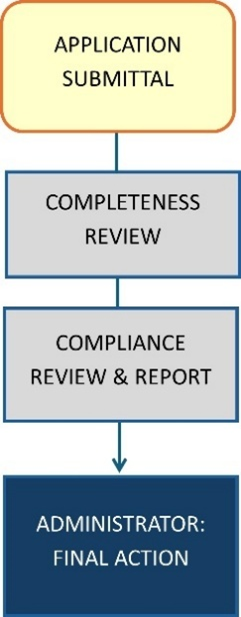
9.4.2 - PROCESS AND APPROVAL
A.
Process Type: Ministerial.
B.
Pre-Application Procedure: None.
C.
Required Application Information: See Administrator.
D.
Public Notification: None.
E.
Determination of Compliance: Once an application is deemed complete by the Administrator, the Administrator shall review the application and approve or deny it based on compliance with the standards contained in this Code.
F.
Permit Validity: Upon the approval of the zoning permit, the applicant shall have 6 months to take action on the approval. If no action is taken, the permit becomes null and void, and the applicant shall resubmit. Exception: Tree Removal Permits have no expiration.
G.
Permit Extension: The Administrator may grant a single extension of up to 6 months upon submittal by the applicant of sufficient justification for the extension. Permits issued for temporary uses may be renewed only if it is determined that said use is clearly of a temporary nature, will cause no traffic congestion, and would not create a nuisance to surrounding uses.
(Ord. No. 2025/14, Exh. A, 8-19-2025)
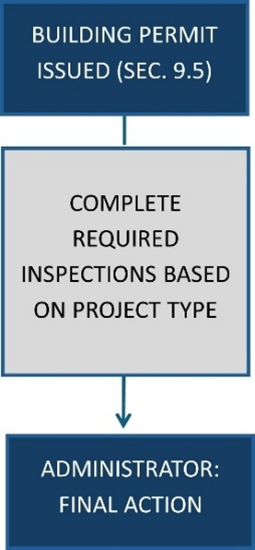
9.5.1 - APPLICABILITY
A Building Permit shall be required for any building, structure, or attachment to a structure to be erected, moved, added to, or structurally altered. This includes, but is not limited to:
A.
Site Work: Any modifications to a parcel of land, not to include construction of a structure.
B.
New Construction and Expansion:
1.
Primary Building(s): New construction of all types of structures.
2.
Accessory Structures or Uses: Accessory uses incidental to single-family residential structures (e.g., detached garage, swimming pool, tool shed) as regulated by Section 3.11 (Accessory Uses and Structures).
3.
Building Expansions: Heated and unheated (e.g., porches, decks, sunrooms) building expansions.
4.
Site Elements: Any site elements not attached to the building (e.g., porches, patios).
C.
Signs: Erection of new signs or modification to existing signs, including Master Sign Plans.
D.
Awnings: Includes new awnings and awning re-covers.
E.
Fences and Enclosures: Erection of, demolition of, or any changes to fences and other types of enclosures.
F.
Demolition: Removal of existing buildings, structures, or site work.
(Ord. No. 2025/14, Exh. A, 8-19-2025)
9.5.2 - PROCESS AND APPROVAL
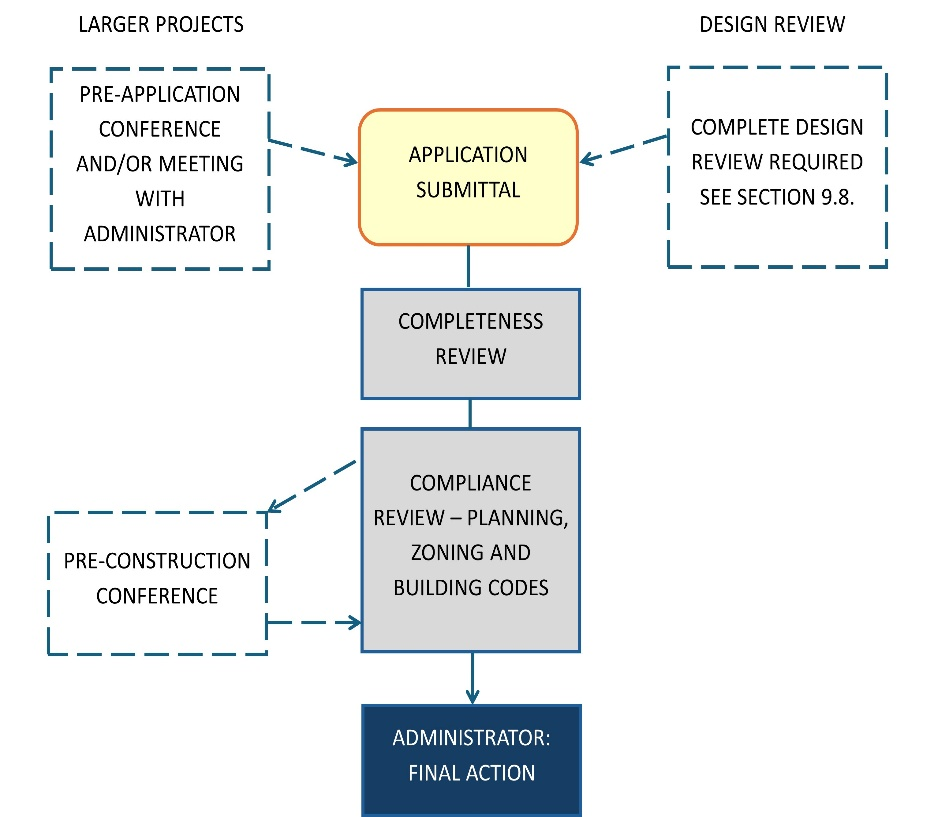
A.
Process Type: Ministerial.
B.
Pre-Application Procedure: For large-scale projects, a pre-construction meeting may be required. For all other projects, no meeting is required, but applicants are encouraged to call or visit the Administrator prior to requesting a Building Permit to determine what information is required for the application.
C.
Required Application Information: See Administrator. The application shall include all drawings and specifications required by building codes adopted by S.C. Code § 6-9-50.
D.
Determination of Conformity: The review, approval, and distribution of drawings and specifications required shall be coordinated by the Administrator in accordance with the building codes adopted by S.C. Code § 6-9-50. Upon issuance of a permit, the Administrator shall endorse, by writing or stamp, all sets of drawings showing approval. Such drawings shall be kept at the work site and made available for inspection by the Administrator upon request. Approved Building Permits shall be conspicuously posted by the applicant on the property for which they were obtained until the applicant has obtained a Certificate of Occupancy, pursuant to Section 9.7.
E.
Public Notification: None required.
F.
Changes to Approved Plans: If a project has undergone design review and received Design Approval or Beaufort Historic District - Certificate of Appropriateness, as applicable, no changes between the design review set and the building permit set shall be permitted unless they are presented in writing and approved by the Administrator at the time a Building Permit is sought. If the Administrator is not made aware of any changes, the plans submitted for design review will take precedence.
G.
Changes to Approved Permits:
1.
After a Building Permit has been issued, no changes or deviations from the terms of the permit or the application and accompanying plans shall be made without the specific written approval of such changes or deviations by the Administrator. Any exterior changes may require review and approval by the appropriate decision-making body.
2.
An amendment to a Building Permit that requires payment of an additional fee, either because of an increase in the size of the buildings, a change in the scope of work, or an increase in the estimated cost of the proposed work, shall not be approved until the applicant has paid the additional fees, and the amendment has been properly reviewed by the appropriate decision-making body.
H.
Notification and Approval Before Construction Begins:
1.
Before any work begins pursuant to the Building Permit, the applicant shall furnish the Administrator with the name of the general contractors, or the owner acting as the general contractor, who will be performing the work;
2.
The applicant or the applicant's authorized agent shall provide adequate advance notice to the Administrator at such time as the work is ready for inspection under the Building Code. Upon receiving such notification, the Administrator shall inspect the work.
I.
Licensed Specialty Contractor(s) May Be Required: Where any local ordinances or any provision of the South Carolina Law require that work be done by a licensed specialty contractor of any kind, no Building Permit for such work shall be issued unless it is to be performed by such licensed specialty contractor. It shall further be the contractor's responsibility to conform to all local ordinances and state building codes for all installations or repairs of a building or utility system.
J.
Permit Validity: Any Building Permit shall become null and void unless the work approved by the permit is commenced within 180 days after the date of issuance. No work shall be considered to have commenced for the purposes of this paragraph until an inspection has been made and recorded. If after commencement the work is discontinued for a period of 180 days, the permit shall immediately expire. No work authorized by any permit that has expired shall thereafter be performed until a new permit has been secured.
K.
Permit Extension: None - shall resubmit.
(Ord. No. 2025/14, Exh. A, 8-19-2025)
9.7.1 - APPLICABILITY
A Certificate of Occupancy shall be required for occupancy and use of a building that is erected or enlarged.
9.7.2 - PROCESS AND APPROVAL
A.
Process Type: Ministerial.
B.
Pre-Application Procedure: n/a.
C.
Required Application Information: See Administrator.
D.
Public Notification: None.
E.
Issuance of Certificate of Occupancy: A final Certificate of Occupancy shall not be issued by the Administrator until a design and landscape compliance review has been completed.
F.
Temporary Certificate of Occupancy: Pending the issuance of a permanent Certificate of Occupancy, a temporary certificate may be issued. The certificate shall be issued by the Administrator in conformity with the provisions of this Code and the building code. The temporary certificate may include such safeguards and conditions as will protect the safety of the occupants and the public. Where improvements required by this Code or the specific approval of the development are incomplete, a guarantee acceptable to the City — equal to 125% of the costs of such improvements — may be required to ensure the installation of the improvements.
G.
Permit Validity: n/a.
H.
Permit Extension: n/a.
(Ord. No. 2025/14, Exh. A, 8-19-2025)
9.8.1 - DEVELOPMENT DESIGN REVIEW (MINOR SITE PLAN)
A.
Applicability:
1.
All buildings, except single-family residential structures, in developments that contain 5 or fewer residential units.
2.
Demolition of structures of any size where no new building is proposed.
3.
Improvements to existing non-residential or multi-family structures that do not exceed 75 percent of the fair market value of the existing improvements.
B.
Exceptions:
1.
Detached single-family homes on individual lots outside of the Historic District are not subject to Development Design Review. However, they may be subject to the Building Design Standards laid out in Article 4, depending on the zoning district and Planning Commission (PC) conditions and approvals, if applicable, on Preliminary and Site Plans.
2.
Projects in the Beaufort Historic District are not subject to Development Design Review and shall instead be evaluated by the HRB for compliance with the Historic District Guidelines. (See Section 9.10.2 - Beaufort Historic District - Certificate of Appropriateness, Minor and Major)
3.
Projects in the LI Zone are not subject to Development Design Review. However, they are subject to the Building Design Standards described in [Section] 4.2.2.B.3.
C.
Process Type: Ministerial — The Administrator may submit any application subject to staff approval to the Planning Commission for approval.
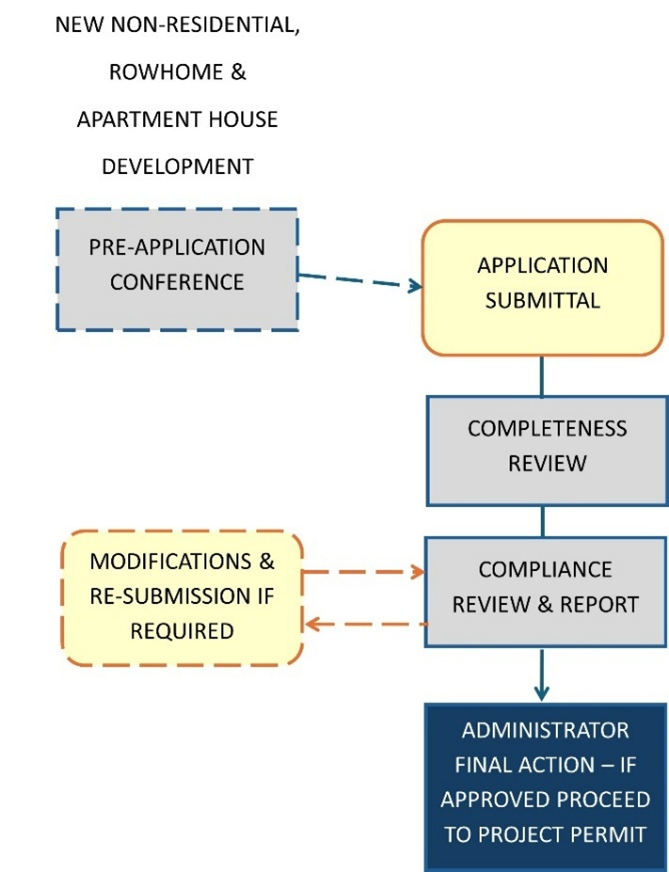
D.
Pre-Application Procedure: No meeting is required, but applicants are encouraged to call or visit the Administrator to determine what information is required for the application.
E.
Required Application Information: see Section 9.3 (Table) for specific Application Requirements — these may be waived by the Administrator as the Administrator deems appropriate.
F.
Public Notification: None.
G.
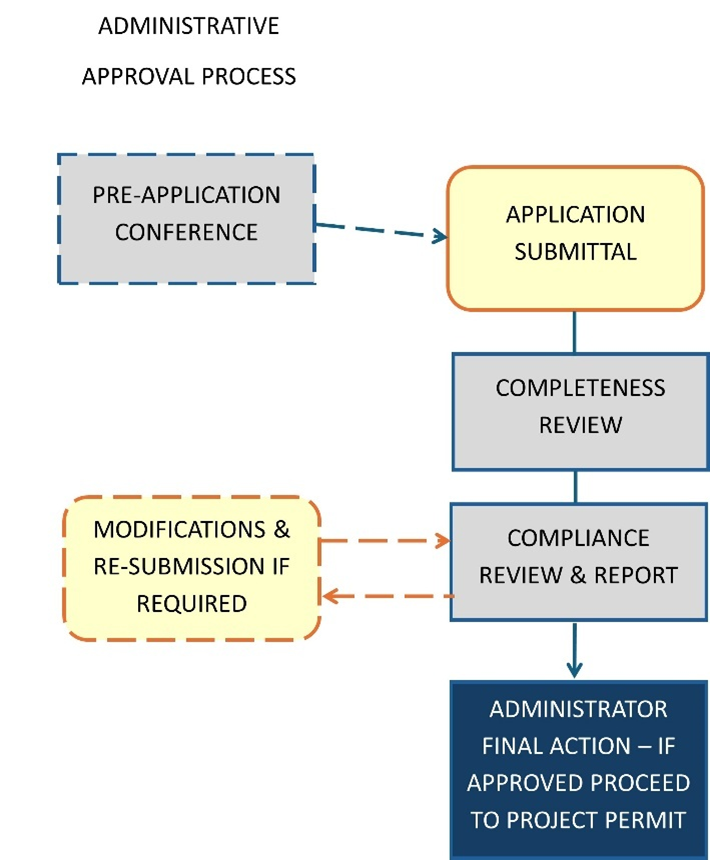
Determination of Compliance: Once an application is deemed complete by the Administrator, the Administrator shall review the application and approve, deny, or approve the plan with conditions based on compliance with the standards contained in this Code. All decisions shall be in writing. Following an approval or approval with conditions, the applicant shall be directed to prepare detailed Subdivision/Development Plats and/or Plans (see Section 7.5 for specific Subdivision and Site Plan Standards) for final approval by the Administrator.
H.
Permit Validity: Upon the approval of the Minor Development Design application, the applicant shall have 1 year to obtain a Building Permit. Failure to secure Building Permits for the permitted work within this time shall render the approval void. Any change to the approved plans that has not been authorized by the Administrator shall invalidate the Minor Development Design Plan and any subsequent Building Permits (see Section 9.5).
I.
Permit Extension: The Administrator may grant up to one 1-year extension of this time period upon submittal by the applicant of sufficient justification for the extension. Extensions shall be submitted at least 1 month prior to the expiration date.
(Ord. No. 2025/14, Exh. A, 8-19-2025)
9.8.2 - DEVELOPMENT DESIGN REVIEW (MAJOR SITE PLAN)
A.
Applicability:
1.
Civic and Educational Facilities: Any new development classified as a Civic Facility or Educational Facility (see Sections 3.4.1.A and 3.4.1.C, respectively).
2.
Vehicle-Related Uses: Any new development that includes fuel-dispensing facilities, drive-thru facilities, or structured parking.
3.
Nonresidential Development: Any commercial or industrial development.
4.
Residential Development: Single-family, attached, over 5 units or multi-family developments containing more than 5 units.
5.
Exceptions:
a.
Lots in the Beaufort Historic District are not subject to Development Design Review, and shall instead be evaluated by the HRB for compliance with the Historic District Guidelines (see Section 9.10 Beaufort Historic District - Certificate of Appropriateness, Minor and Major).
b.
Projects in Redevelopment District Overlay Districts, are not subject to review by the Planning Commission and shall instead be evaluated by the Administrator (see Section 2.7.3). The Administrator shall post all projects for review in said districts for a 15-day public review and comment period for each major submittal. Minor revisions to the plans (not related to use, density, building frontage, or building height) shall not constitute a major submittal. A copy of all public comments shall be disseminated to the applicant and Administrator for each public comment period. The Administrator shall respond in writing to all public comments after each major submittal, and the applicant will be required to attend a TRC committee meeting before the project is issued final approval.
c.
Design Exception: Design Exceptions may be used to modify any dimensional standards or design requirements, found in Articles 2 and 4, for development projects that have unique characteristics that justify a deviation from the underlying standards. Such deviations are intended to provide flexibility from the underlying standards to permit compatible development patterns which are indicative of the surrounding area and/or use an innovative approach or technique. The process is intended to provide the minimum relief necessary to create a more innovative and context-sensitive development consistent with the City's adopted plans. This tool is not intended to circumvent the map amendment (rezoning) procedure where that tool would provide a similar modification of standards.
i.
Applicability: Planning Commission shall have the authority to authorize a design exception from any applicable standard(s) set forth in Article 2 (Maps and Districts) — except for Section 2.6, Height and Section 2.7.4, Air Installation Compatibility Use Zone (AICUZ) overlay district standards — and Article 4 (Building Design and Infill Standards).
ii.
Review Criteria: Planning Commission may approve an application for a Design Exception where it reasonably determines that there will be no significant negative impact upon residents of surrounding property, or upon the general public. The board shall consider the following criteria in its review:
•
Compatibility: The proposed exception is appropriate for its location. It is compatible with the character of surrounding properties and the development permitted by the zoning of the surrounding properties, and will not reduce property values of surrounding properties.
•
No Adverse Impact: The design of the proposed exception minimizes adverse effects including visual impacts of the proposed use on surrounding properties; furthermore, the proposed exception does not create a nuisance for surrounding properties.
•
Consistency with Adopted Plans: The proposed development is in general conformity with the City's Comprehensive Plan, Civic Master Plan and other plans officially adopted by the City.
B.
Application Type, Requirements and Approval: See Table under Section 9.1.4 for standards and requirements.
(Ord. No. 2025/14, Exh. A, 8-19-2025)
9.9.1 - PROVISIONS FOR ALL SUBDIVISIONS
A.
Applicability and Requirements: See Article 7 of this code.
B.
Unlawful to Record Plat without City Approval: It shall be unlawful to offer and cause to be recorded any plan, plat, or replat of land within the city limits of Beaufort with the Beaufort County Register of Deeds office unless the same bears the endorsement and approval of the city.
C.
Permit Validity: A subdivision approval shall expire as set out in Section 9.1.9 (Vested Rights and Expiration of Approvals) of this Code unless a Certificate of Compliance is obtained, or it is recorded at the Beaufort County Register of Deeds office.
(Ord. No. 2025/14, Exh. A, 8-19-2025)
9.10.1 - APPLICABILITY
A.
A Certificate of Appropriateness shall be required for any construction activity in any historic district, including:
1.
New structures.
2.
Modification to, or expansion of, existing structures, including those that apply for the Bailey Bill Special Tax Assessment for Rehabilitated Historic Properties.
3.
Relocation of any existing structure.
B.
Demolition or partial demolition of any structure.
(Ord. No. 2025/14, Exh. A, 8-19-2025)
9.10.2 - PROCESS AND APPROVAL
A.
Process Type: The review process required to approve Certification of Appropriateness is based on the following project types:
1.
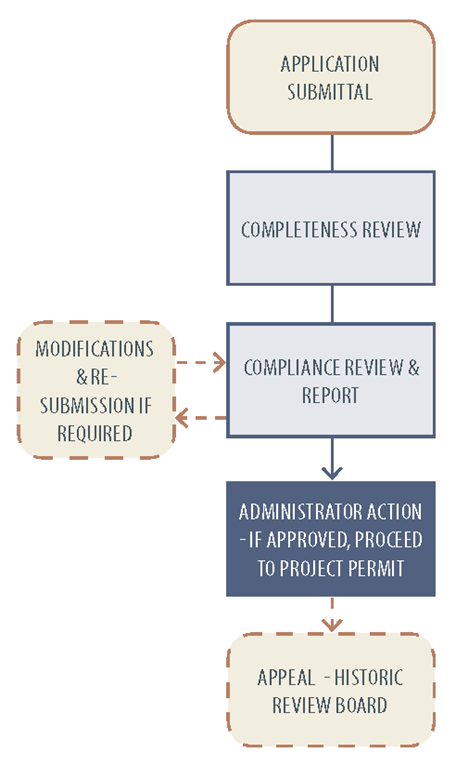
Minor: Administrative review shall apply to applications for a Certification of Appropriateness for the following items. The Administrator may submit any applications that are subject to staff approval to the Historic District Review Board (HRB) for approval.
a.
Changes to a building or property, to include fences, paint color, roof materials, canopies and awnings, site changes, and window replacements on noncontributing structures.
b.
New construction and building modifications to include construction of non-habitable accessory buildings in the Beaufort Preservation Neighborhood.
c.
Modifications to non-contributing structures in the BCN.
d.
Demolitions of non-contributing structures in the BCN.
e.
Demolition or partial demolition of a structure that is listed in the "1997 Beaufort County Historic Sites Survey," or the most recent historic sites survey, and lies outside the Beaufort Historic District.
f.
Demolition of noncontributing accessory structures (e.g., sheds, carports, etc.).
Such approval shall follow the procedures for Development Design Review-Minor Site Plan (Section 9.8.1).
2.
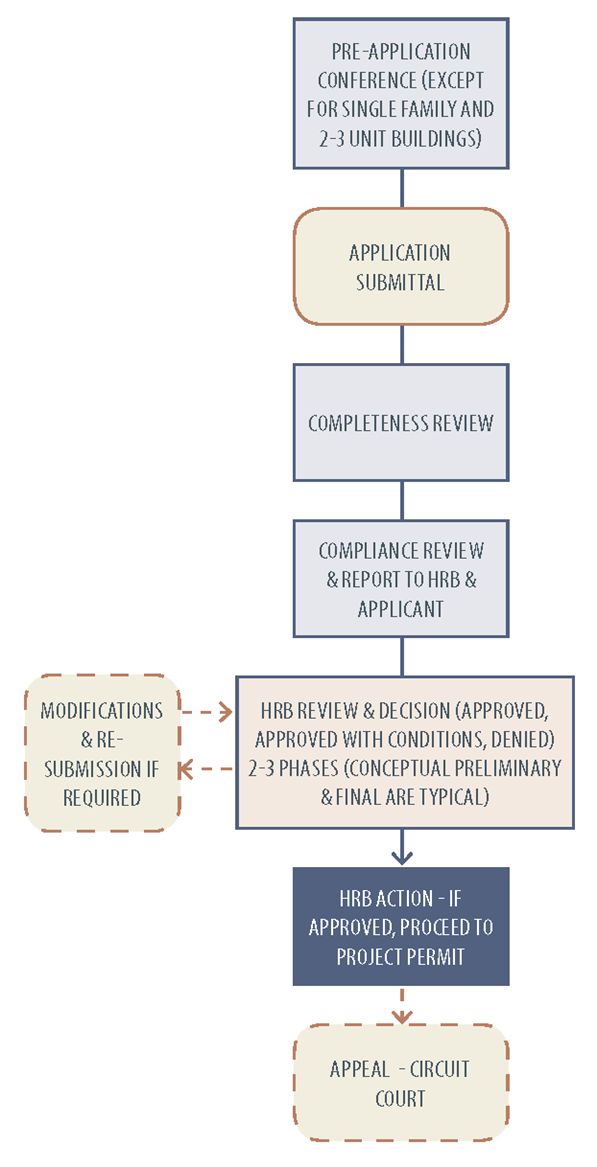
Major: Discretionary review by the HRB shall apply to all other applications for Certificates of Appropriateness.
3.
Design Exception: Design Exceptions shall be used to modify any dimensional standards or design requirements, found in Articles 2 and 4, for development projects that have unique characteristics that justify a deviation from the underlying standards. Such deviations are intended to provide flexibility from the underlying standards to permit compatible development patterns which are indicative of the surrounding area and/or use an innovative approach or technique. The process is intended to provide the minimum relief necessary to create a more innovative and context-sensitive development consistent with the City's adopted plans. This tool is not intended to circumvent the map amendment (rezoning) procedure where that tool would provide a similar modification of standards.
a.
Applicability: The HRB shall have the authority to authorize a variance of up to 35 percent from any numerical standard set forth in Article 2 (Maps and Districts) — except for Section 2.6, Height and Section 2.7.4, Air Installation Compatibility Use Zone (AICUZ) overlay district standards — and Article 4 (Building Design and Infill Standards).
b.
Review Criteria: The HRB may approve an application for a Design Exception where it reasonably determines that there will be no significant negative impact upon residents of surrounding property, or upon the general public. The board shall consider the following criteria in its review:
i.
Compatibility: The proposed exception is appropriate for its location. It is compatible with the character of surrounding properties and the development permitted by the zoning of the surrounding properties, and will not reduce property values of surrounding properties.
ii.
No Adverse Impact: The design of the proposed exception minimizes adverse effects including visual impacts of the proposed use on surrounding properties; furthermore, the proposed exception does not create a nuisance for surrounding properties.
iii.
Consistency with Adopted Plans: The proposed development is in general conformity with the City's Comprehensive Plan, Civic Master Plan and other plans officially adopted by the City.
B.
Guidance Standards, Maintenance of Consistent Policies: In order to provide guidance and insight into desirable goals and objectives for the Beaufort Historic District, the documents described in this section are hereby adopted for use by the HRB in the exercise of its authority granted under Section 10.7 of this Code.
1.
The "Beaufort Preservation Manual," August 1979, and the "Beaufort Preservation Manual, Supplement," August 1990, shall be utilized by the HRB for review of projects located within the Beaufort Preservation Neighborhood.
2.
The "Northwest Quadrant Design Principles," May 1999 shall be utilized by the HRB for the review of projects located within the Beaufort Conservation Neighborhood.
3.
The Secretary of Interior's "Standards for Rehabilitation" shall be utilized for review of all projects that modify a contributing structure.
4.
The Building Design Standards, in Article 4 of this Code, shall be utilized for review of all new construction.
5.
The Historic District Infill Design Guidelines, in Section 4.7 of this Code, shall be utilized for review of all new construction.
6.
Any special area policies adopted by the HRB.
C.
Approval of Certificate of Appropriateness: In reviewing an application, the HRB shall conduct a public meeting and consider, among other things, the historic, architectural and aesthetic features of such structure, the nature and character of the surrounding area, the use of such structure and its importance to the city, the character and appropriateness of design, scale of buildings, arrangement, texture, materials and color of the structure in question, and the relation of such elements to similar features of structures in the immediate surroundings. The HRB shall not consider the interior arrangement or interior design unless the interior arrangement or design affect the exterior appearance, nor shall it make requirements except for the purpose of preventing developments that are not in harmony with the prevailing character of the Beaufort Historic District, or that are obviously incongruous with this character.
D.
Demolitions:
1.
In all applications involving the demolition of a contributing primary structure or contributing accessory structure, provisions shall be made for a public hearing as set forth in Section 9.1.5. Demolition of non-contributing structures are approved by the Administrator.
2.
In any case involving the demolition or partial demolition of a structure, before granting approval or requiring a postponement, the HRB may call on the Administrator to provide them with a report on the state of repair and structural stability of the structure under consideration.
3.
Upon receiving an application for demolition or partial demolition of a structure that is listed in the "1997 Beaufort County Historic Sites Survey" and lies within the limits of the city but outside the Beaufort Historic District, the Administrator, within 30 days of receiving the application, shall either approve it, or find that the preservation and protection of historic places and the public interest will be best served by postponing the demolition for a designated period — this shall not exceed 60 days from the receipt of the application, and notify the applicant of such postponement. The application will be announced to the public in accordance with the notification standards set forth in Section 9.1.3. Within the period of postponement of demolition or alteration of any building, the Administrator shall take steps to ascertain what may be done to preserve the building, including consultation with private civic groups, interested private citizens and other public boards or agencies, including investigation of the potential use of the power of eminent domain when the preservation of a given building is clearly in the interest of the general welfare of the community and of certain historic and architectural significance.
E.
Denial of Certificate of Appropriateness: The HRB may refuse any application that, in the opinion of the HRB, does not comply with the standards and guidelines listed in Section 9.10.2.B and thus would be detrimental to the interests of the city. In case of disapproval, the HRB shall state the reasons therefore in a written statement to the applicant, and may give verbal advice to the applicant and make recommendations in regard to appropriateness of design, arrangement, texture, material, color, etc. of the property involved.
Among other grounds for considering a design inappropriate and requiring disapproval and resubmission are the following defects:
1.
Arresting and spectacular effects.
2.
Violent contrasts of materials or colors and intense or lurid colors.
3.
A multiplicity or incongruity of details resulting in a restless and disturbing appearance.
4.
The absence of unity and coherence in composition, that is not in consonance with the dignity and character of the present structure, in the case of repair.
5.
Construction of, remodeling, or enlargement of an existing building in a manner not consistent with the prevailing character of the neighborhood.
F.
Issuance of Certificate of Appropriateness: When a Certificate of Appropriateness and Building Permit have been issued, the Administrator shall, from time to time, inspect the alteration or construction approved by such certificate and may report such inspection to the HRB listing all work inspected and reporting any work that is not in accordance with such certificate, or that violates any ordinances of the city.
G.
Resubmittal: After disapproval of an application, the applicant may make modifications to the plans and resubmit. The applicant may not resubmit the same proposal, without modifying it based on HRB comments, for 12 months from the date of the original submission. Reconsideration of an application for demolition that has been denied by the HRB may not be heard until 12 months from the date of the original public hearing, unless a major change has occurred in the property condition that is attributable to natural causes.
H.
Appeal—Minor: Appeals of the decisions of the Administrator shall be heard by the HRB. The application for appeal shall be made within 30 days of the decision.
I.
Appeal—Major: Any party aggrieved by the decisions of the HRB may appeal to the circuit court within 30 days of the decision.
(Ord. No. 2025/14, Exh. A, 8-19-2025)
9.11.1 - STANDARDS FOR LOCAL HISTORIC DISTRICT DESIGNATION
A.
A structure, group of structures, site or district may be designated for historic preservation if it demonstrates at least one of the following:
1.
Historic, Cultural Importance:
a.
It has significant character, interest, or value as part of the development, or heritage of the community.
b.
It is the site of a historic event with a significant effect upon society.
c.
It exemplifies the cultural, political, economic, social, or historic heritage of the community.
2.
Architectural or Engineering Importance:
a.
It portrays the environment in an era of history characterized by a distinctive architectural style.
b.
It embodies those distinguishing characteristics of an architectural type or engineering specimen.
c.
It is the work of a designer whose individual work has significantly influenced the development of Beaufort.
d.
It contains elements of design, detail, materials, or craftsmanship that represent significant innovation.
3.
Geographical Importance:
a.
By being part of or related to a square, park, or other distinctive area, it should be developed or preserved according to a plan based on a historic, cultural, or architectural motif.
b.
Owing to its unique location or singular physical characteristic, it represents an established and familiar feature of the neighborhood, community or city.
4.
Archeological Importance:
a.
It has yielded, or may be likely to yield, information important in prehistory or history.
B.
An area may be designated as a Beaufort Conservation Neighborhood (BCN) if it meets one or more of the above criteria, and meets the following two additional criteria:
1.
There are a sizable number of properties in the subject area that are not considered to contribute to the architectural or historical significance of the area; and
2.
The cultural values or financial resources of a significant number of property owners in the subject area, as reasonably considered by Beaufort City Council, are such that the flexible standards of the BCN are appropriate.
C.
Individual structures, sites, and properties located within a BCN may be designated as notable properties to be subject to Beaufort Historic District standards, guidelines and procedures rather than BCN standards, guidelines, and procedures, at such time as standards, guidelines, and procedures may be established for the BCN that are different from those in effect for the remainder of the Historic District. Beaufort City Council may designate structures, sites, and properties as notable properties where it reasonably determines that those structures, sites, or properties embody a particularly high degree of significance in accordance with the criteria listed in this section.
(Ord. No. 2025/14, Exh. A, 8-19-2025)
9.11.2 - LOCAL HISTORIC DISTRICT DESIGNATION PROCESS
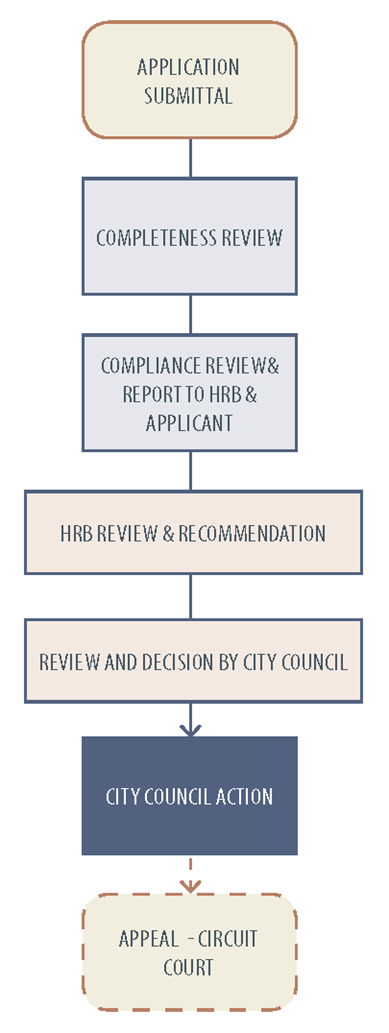
Based upon the criteria set forth in this section, the HRB shall review such proposed designations, and then it shall make a recommendation regarding the designation to City Council for final approval.
(Ord. No. 2025/14, Exh. A, 8-19-2025)
9.11.3 - HISTORIC SIGN DESIGNATION
A.
Historic Signs: A historic sign is a sign that, by its construction materials, unusual age, prominent location, unique design, or craftsmanship from another period, makes a contribution to the cultural, historic, or aesthetic quality of the city's streetscape.
1.
Signs are designated as historic signs by City Council upon a favorable recommendation of the HRB. The council shall hold a public hearing before designating a sign a historic sign. Before designating a sign as a historic sign, the council shall make a finding that all of the following conditions are met:
a.
The sign is at least 25 years old and has been at its present location for at least 25 years.
b.
The sign is an appurtenant graphic to the property, i.e., an on-premises sign that relates to the use of the property, as opposed to an off-premises billboard.
c.
The sign is structurally safe or is capable of being made so without substantially altering its historical significance.
d.
The sign is of exemplary technology, craftsmanship, or design of the period in which it was constructed, it uses historic sign materials (wood, metal, or paint directly applied to buildings) and means of illumination (neon or incandescent fixtures), and it is not significantly altered from its historic period. If the sign has been altered, it shall be restorable and shall be restored to its historic function and appearance.
e.
The sign is of extraordinary significance to the city.
2.
Historic signs are exempt from the requirements of Section 11.6 (Nonconforming Signs).
(Ord. No. 2025/14, Exh. A, 8-19-2025)
9.12.1 - PURPOSE AND APPLICABILITY
A.
Purpose: Administrative Adjustments are specified deviations from otherwise applicable development standards where development is proposed that would be:
1.
Compatible with surrounding land uses;
2.
Harmonious with the public interest; and
3.
Consistent with the purposes of this Code.
B.
Adjustment of Numerical Standard: The Administrator shall have the authority to authorize modification of up to 10 percent from any numerical standard set forth in Article 2 (Map and Districts) and Article 4 (Building Design and Infill Standards) of this Code. Any request greater than 10 percent shall be treated as a variance handled by the Zoning Board of Appeals (ZBOA), and subject to the requirements of Section 9.14.
1.
Specific to Landscaping and Tree Conservation: The following applies to landscaping and tree conservation requirements in Article 5 (Landscaping, Parking and Lighting) with regard to the criteria in Section 9.12.2.E:
a.
In unusual cases, where there are few existing trees on a site and the planned development is small in size relative to the size of the parcel, then the Administrator may adjust the tree planting requirements (Section 5.3) downward in order not to require excessive planting out of proportion to the scale of the development.
b.
In the case of multi-phase developments on one parcel, the tree planting requirements (Section 5.3) may be adjusted according to the size of each phase of the development.
c.
Any particular planting requirement shall be proportionately reduced where existing plant materials are of sufficient sizes and forms to satisfy the requirement.
C.
Adjustment of Building Design Standards: Where an existing condition (e.g. utility easement, restrictive covenant, tree or natural feature) prohibits strict compliance with the building design standards in Article 4, the Administrator may waive or adjust the standard as appropriate to assure compliance to the extent practical. This adjustment shall be as small as possible in order to accommodate the existing conditions.
D.
Permission of Flag Lot: Where conditions set forth in Section 2.5.5 C. are met, the Administrator may permit a flag lot. When a flag lot is proposed in conjunction with a Major Subdivision, it shall be incorporated into the process laid out in Section 9.9.
(Ord. No. 2025/14, Exh. A, 8-19-2025)
9.12.2 - PROCESS AND APPROVAL
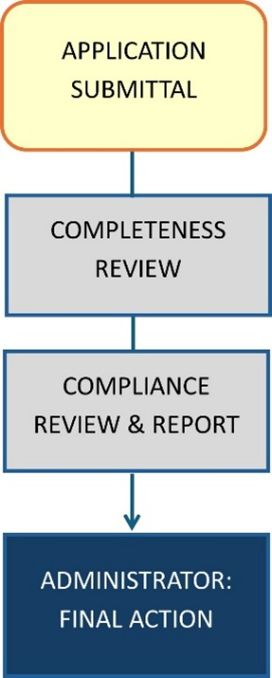
A.
Process Type: Ministerial.
B.
Public Notification: None.
C.
Required Application Information: An application for an Administrative Adjustment shall include a brief description of the requirement to be varied and any other material necessary to ensure the criteria in this section are met.
D.
Administrator Review: The Administrator shall review the application and approve, approve with conditions, or deny the application, based upon the criteria in Section 9.12.2.E. A written decision including affirmative findings on the criteria set forth below shall be transmitted to the applicant.
E.
Administrative Adjustment Criteria: To approve an application for an Administrative Adjustment, the Administrator shall make an affirmative finding that the following criteria are met:
1.
Granting the Administrative Adjustment will ensure the same general level of land use compatibility as the otherwise applicable standards.
2.
Granting the Administrative Adjustment will not materially and adversely affect adjacent land uses and the physical character of uses in the immediate vicinity of the proposed development because of inadequate buffering, screening, setbacks, and other land use considerations.
3.
Granting the Administrative Adjustment will not adversely affect property values in any material way.
4.
Granting the Administrative Adjustment will be generally consistent with the purposes and intent of this Code.
F.
Expiration and Lapse of Approval: Property owners shall have 6 months from the date of approval of an Administrative Adjustment to secure a Building Permit to carry out the proposed improvements. If a complete Building Permit application has not been filed within 6 months of the date of approval, the approval shall be void.
(Ord. No. 2025/14, Exh. A, 8-19-2025)
9.13.1 - APPLICABILITY
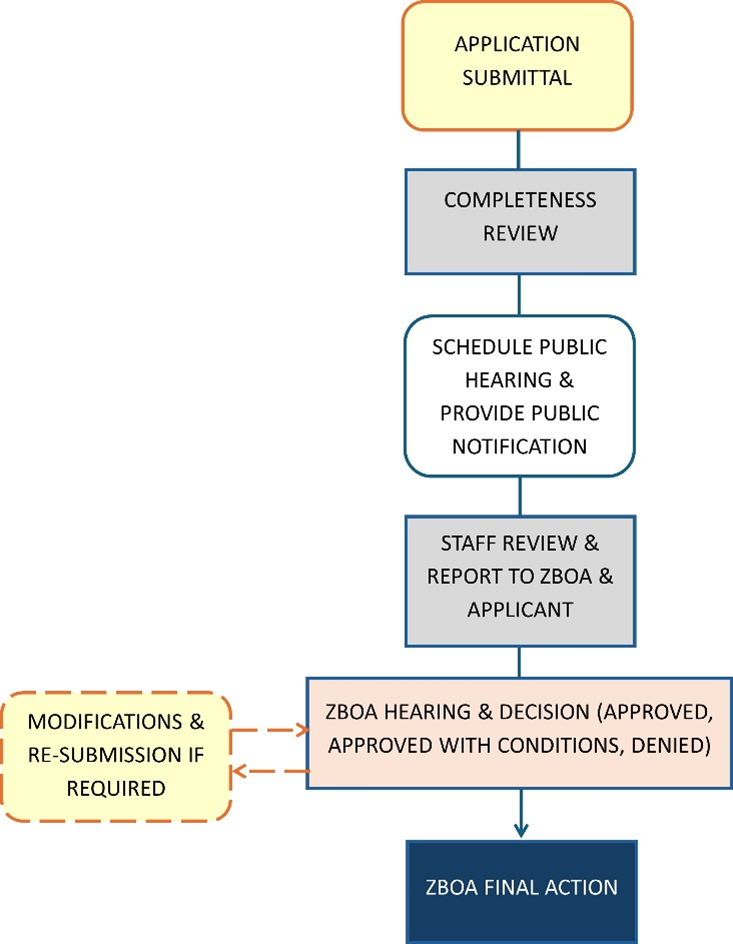
ZBOA Special Exceptions may be made for situations in which proposed land uses are generally compatible with the land uses permitted by-right in a district (per Section 3.2 Table of Permitted Uses) but require individual review of their location, design, and configuration to evaluate the potential for adverse impacts on adjacent property and uses. The ZBOA Special Exception process ensures the appropriateness of the use at a particular location within a given District.
(Ord. No. 2025/14, Exh. A, 8-19-2025)
9.13.2 - PROCESS AND APPROVAL
A.
Process Type: Discretionary.
B.
Required Application Information: All applicable forms as determined by the Administrator, along with such accompanying material as is required to ensure compliance with the criteria listed in Section 9.12.2.E.
C.
Public Notification: See Section 9.1.5 for specific Public Notification requirements.
D.
Staff Review and Report: The Administrator shall prepare a staff report that reviews the proposed development in light of the Comprehensive Plan, Civic Master Plan, the review criteria listed below, and the requirements of this Code. A copy of the report shall be provided to the Zoning Board of Appeals (ZBOA) and the applicant before the scheduled hearing.
E.
ZBOA Hearing:
1.
The ZBOA shall hold a public hearing on the Special Exception application.
2.
After review of the application and the public hearing, the ZBOA shall make a written finding and approve, approve with modifications or conditions, or disapprove the request.
3.
If approval, or approval with modifications or conditions, is granted, the decision shall be communicated in writing within 15 days to the applicant, and the applicant shall then be authorized to submit a development permit application consistent with this Code.
F.
ZBOA Special Exception Review Criteria: The ZBOA may approve an application for a Special Exception where it reasonably determines that there will be no significant negative impact upon residents of surrounding property/-ies or upon the general public. The ZBOA shall consider the following criteria in its review:
1.
The proposed use/-s is/are compatible with existing land uses in the surrounding area.
2.
The harmony of the proposed site plan, circulation plan, and schematic architectural designs with the character of the surrounding area.
3.
The likely impact on public infrastructure — such as roads, parking facilities, and water and sewer systems —and on public services — such as police and fire protection and solid waste collection — and the ability of existing infrastructure and services to adequately service the proposed use without negatively impacting existing uses in the area and in the City (a traffic impact analysis shall be required per Section 7.3.2).
4.
The general conformity of the proposed use and designs with the city's Civic Master Plan, Comprehensive Plan, and any other plans officially adopted by the City.
5.
The likely impact on public health and safety.
6.
The potential creation of noise, lights, fumes, dust, smoke, vibration, fire hazard, or other injurious or obnoxious impacts.
G.
Conditions: The ZBOA may impose such conditions and restrictions upon the application as may be necessary to minimize or mitigate any potential adverse impacts of the proposed use.
(Ord. No. 2025/14, Exh. A, 8-19-2025)
9.14.1 - APPLICABILITY
Variances to all ordinance standards may be requested with the following exceptions:
A.
No variances to the Table of Permitted Uses (Section 3.2) shall be permitted.
B.
No variances to sign regulations (Article 6) shall be permitted.
C.
No variances to parking provisions for Carriage Houses (4.5.3.B.9) shall be permitted.
D.
Design Exceptions (Sections 9.10.2.A.3) shall be approved by the Historic Review Board.
(Ord. No. 2025/14, Exh. A, 8-19-2025)
9.14.2 - PROCESS AND APPROVAL
A.
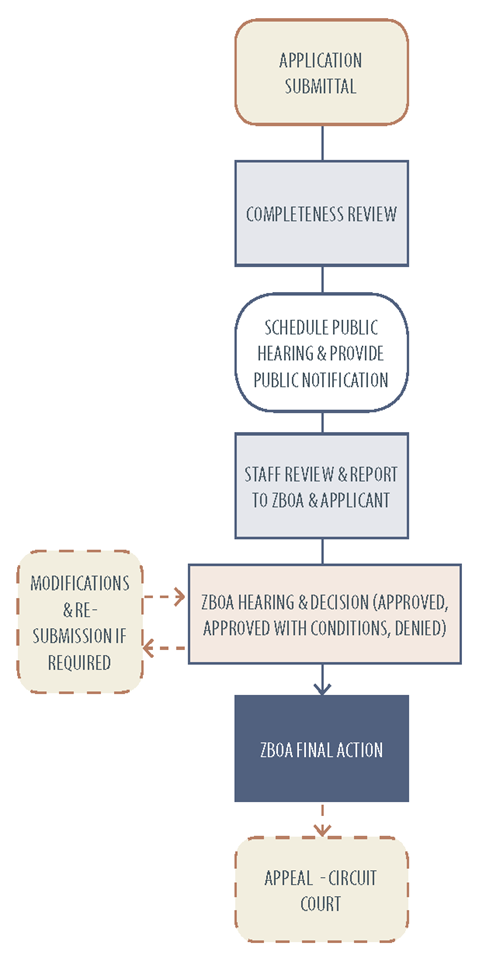
Process Type: Discretionary.
B.
Application Requirements: All applicable forms as determined by the Administrator, along with such accompanying material as is required to ensure compliance with the criteria listed in Section 9.14.2.F.
C.
Staff Review and Report: The Administrator shall prepare a staff report that shall be provided to the applicant or appellant and the ZBOA before the scheduled hearing.
D.
Public Notice: See Section 9.1.5 for specific Public Notification requirements.
E.
ZBOA Hearing:
1.
After review of the variance application and the public hearing, the ZBOA shall approve, approve with conditions, or deny the application.
2.
If approval or approval with conditions is granted, the decision shall be communicated in writing to the applicant within 15 days, and the applicant shall be authorized to submit a development permit application.
F.
Criteria for Approval of Variances:
1.
Required Findings: A variance may be granted by the ZBOA if it concludes that the strict enforcement of any design and performance standard set forth in this Code would result in unnecessary hardship to the applicant, and that by granting the variance, the spirit of this Code will be observed, public welfare and safety will not be diminished, and substantial justice will be done. A variance may be granted in an individual case of unnecessary hardship only when the ZBOA makes, and explains in writing, all of the following findings:
a.
There are extraordinary and exceptional conditions pertaining to the particular piece of property. For example, the variance is justified because of topographic or other special conditions unique to the property and development involved, in contradistinction to the mere inconvenience or financial disadvantage.
b.
These conditions do not generally apply to other property in the vicinity.
c.
The conditions are not the result of the applicant's own actions.
d.
Granting of the variance would not substantially conflict with the Comprehensive Plan, the Civic Master Plan and the purposes and intent of this Code.
e.
Because of these conditions, the application of this Code to the particular piece of property would effectively prohibit or unreasonably restrict the utilization of the property.
f.
The authorization of a variance will not be of substantial detriment to adjacent property or the public good, and the character of the zone will not be harmed by the granting of the variance.
2.
Limitations: The ZBOA may not grant a variance if it would do any of the following:
a.
Allow the establishment of a use not otherwise permitted in the applicable district.
b.
Increase the density of a use above which is permitted in the applicable district.
c.
Physically extend a nonconforming use of land.
d.
Change the zone boundaries shown on the Official Zoning Map.
3.
Profitability Not to Be Considered: Profitability shall not be considered grounds for a variance.
4.
Conditions: In granting a variance, the ZBOA may attach to it conditions regarding the location, character, or other features of the proposed building, structure, or use as the ZBOA considers advisable to protect established property values in the surrounding area, or to promote public health, safety, or general welfare.
5.
Design Review Recommendation: Projects requiring Design Review - see Sections 9.8 and 9.9 - shall obtain a formal recommendation to the ZBOA by the appropriate Design Review Body prior to the ZBOA making a decision on the project.
(Ord. No. 2025/14, Exh. A, 8-19-2025)
9.15.1 - APPLICABILITY
Any person aggrieved by a decision, interpretation or determination of the Administrator may appeal to the ZBOA. As per South Carolina Code of Laws Section 6-29-800, the Zoning Board of Appeals (ZBOA) has the power to hear and decide appeals where it is alleged there is error in an order, requirement, decision, or determination made by an administrative official in the enforcement of the zoning ordinance, i.e. The Beaufort Development Code.
(Ord. No. 2025/14, Exh. A, 8-19-2025)
9.15.2 - PROCESS AND APPROVAL
A.
Process Type: n/a.
B.
Pre-Application Procedure: n/a.
C.
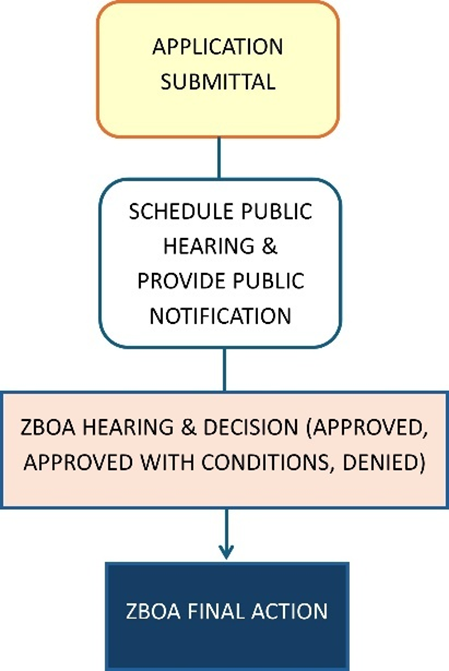
Required Application Information: Within 30 days of a decision or order of the Administrator, an application for appeal shall be filed with the Administrator and the ZBOA specifying the grounds of the appeal.
D.
Public Notification: See Section 9.1.5 for specific Public Notification requirements.
E.
Effect of Appeal: An appeal stays all legal proceedings in furtherance of the action in question, unless the Administrator certifies to the ZBOA that a stay would, in his/her opinion, cause imminent peril to life and property. In such case, proceedings shall not be stayed except by a restraining order that the ZBOA or by a court of record may grant.
F.
ZBOA Hearing: The ZBOA shall schedule the matter for a hearing at its next regularly-scheduled meeting, and give at least 15 days public notice of such hearing in a newspaper of general circulation in the city, as well as due notice to the parties of interest. At the hearing, any party may appear in person, by agent, or by attorney. Following the hearing, the ZBOA shall take one of the following actions, consistent with the provisions of this Code:
1.
Affirm the action of the Administrator;
2.
Modify the action of the Administrator, and to that end, the ZBOA shall have all the powers of the officer, board, or commission from which the appeal is taken, and may issue a permit or direct that a permit be issued; or
3.
Reverse the action of the Administrator, and to that end, the ZBOA shall have all the powers of the officer, board or commission from which the appeal is taken, and may issue a permit or direct that a permit be issued.
G.
Findings of Fact: The ZBOA, in its execution of the duties specified in this section, may subpoena witnesses, and in case of contempt, may certify such fact to the circuit court that has jurisdiction.
H.
Decision: All final decisions and orders of the ZBOA shall be in writing and shall be permanently filed in the office of the board as a public record. All findings of fact and conclusions of law shall be separately stated in final decisions or orders of the ZBOA, which shall be delivered to parties of interest within 15 days by certified mail.
I.
Contempt Penalty: In case of contempt by a party, witness, or other person before the ZBOA, the ZBOA may certify this fact to the circuit court of the county in which the contempt occurs, and the judge of the court, in open court or in chambers, after hearing, may impose a penalty as authorized by law.
(Ord. No. 2025/14, Exh. A, 8-19-2025)
9.16.1 - APPLICABILITY
When the public necessity, convenience, general welfare, or good zoning practice justify such action, and after the required review and report by the Planning Commission, the City Council may undertake the necessary steps to amend this Code, and its accompanying map.
(Ord. No. 2025/14, Exh. A, 8-19-2025)
9.16.2 - INITIATION OF AMENDMENTS
A proposed amendment to this Code may be initiated by any member of the City Council, the PC, the Administrator, or by any city resident or business owner filing an application with the Administrator.
(Ord. No. 2025/14, Exh. A, 8-19-2025)
9.16.3 - APPROVAL PROCESS
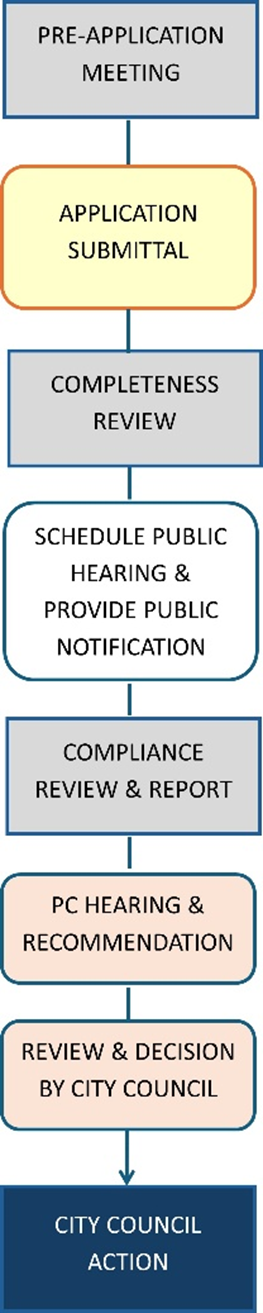
Requests to amend this Code shall be processed in accordance with the following requirements:
A.
Application Procedure: Application forms for code amendment requests shall be obtained from the Administrator. Completed forms, together with an application fee as required by Section 9.2.2, plus any additional information the applicant deems pertinent, shall be filed with the Administrator.
1.
Applications for zoning map amendments (rezoning) shall also include:
a.
Boundary map of the subject property that is prepared and sealed by a registered land surveyor.
b.
Where applicable, a copy of correspondence illustrating that the applicant has solicited written comments from the appropriate property owners' association regarding the requested amendment. Such correspondence shall encourage the association to direct any comments in writing to the Administrator and the applicant within 15 calendar days of receipt of the notification.
c.
Written consent from the owner of the property that is being considered for an amendment. This is required if the applicant is not the city.
B.
Staff Review and Report:
1.
The Administrator shall prepare a staff report that reviews the proposed amendment in light of the Comprehensive Plan and the general requirements of this Code. A copy shall be provided to the PC and the applicant before the scheduled public meeting.
2.
For amendments where the most intense permitted use in the proposed district would generate more than 50 external trips during the peak hour, a TIA (Section 7.3.2) may be required; all road improvements needed to maintain the current level of service shall be identified (based on that analysis), and assurances shall be provided so that all road improvements will be in place so the impacts of the development are accommodated, and the current level of service is maintained.
3.
At the discretion of the Planning Commission, the submittal may include the requirements of a Sketch Plan submittal as per Section 7.5.3, or a conceptual Site Plan (to include building elevations and any applicable Sketch Plan requirements as per Section 7.5.3) to be submitted with the map amendment request so that the impacts of development on the community are properly considered.
C.
Planning Commission Hearing:
1.
Public Notification: See Section 9.1.5 for specific Public Notification requirements.
2.
Hearing by PC: All papers and other data submitted by the applicant on behalf of the amendment request shall be transmitted to the PC. The PC, at regular meetings, shall review and prepare a recommendation for transmittal to the City Council. At such meeting(s), any party may appear in person, by agent, or by attorney. Following action by the PC, all papers and data pertinent to the application shall be transmitted to the City Council for final action. The PC shall study the proposed amendment, taking into account the following factors:
a.
Consistency (or lack thereof) with the Comprehensive Plan and Civic Master Plan;
b.
Compatibility with the present zoning, with conforming uses of nearby property, and with the character of the neighborhood;
c.
Suitability of the property that would be affected by the amendment;
d.
Compatibility with the natural features of — and any archaeological or cultural resources on — the property;
e.
Marketability of the property that would be affected by the amendment; and
f.
Availability of roads, sewer, water, and stormwater facilities generally suitable and adequate for the affected property.
3.
At the close of the public meeting, the PC shall recommend approval, modified approval, or denial of the amendment.
4.
Upon receipt of a recommendation from the PC, the staff shall have 30 days within which to submit its report of the PC's deliberations and recommendation City Council. If the PC or its staff fail to submit a report within the 30-day period, it shall be deemed to have recommended approval of the proposed amendment.
5.
If, after three PC meetings, no recommendation has been made (e.g., each meeting has resulted in the request being tabled), the item will proceed to City Council. Staff will prepare a report of the PC deliberations within 30 days of the third PC meeting.
D.
City Council Action:
1.
Public Notification: See Section 9.1.5 for specific Public Notification requirements.
2.
Timing: City Council shall consider the proposed map or text amendment at the earliest reasonable date and shall consider the report of the PC in making a decision.
3.
Decision: City Council may schedule an additional public hearing to approve, approve with modifications, or deny the proposed amendment.
4.
Notification of Result: The applicant shall be notified in writing within 15 days of City Council's action.
(Ord. No. 2025/14, Exh. A, 8-19-2025)
9.16.4 - UPDATE OF ZONING MAP
Following City Council's final action, any necessary changes shall be made to this Code, or to the Official Zoning Map within 7 days. A written record of the type and date of such change shall be maintained by the Administrator. After 7 days of the official action, the action by City Council shall be considered official even if the Administrator fails to make the written change to the appropriate document.
(Ord. No. 2025/14, Exh. A, 8-19-2025)
9.17.1 - APPLICABILITY
Any person or entity desiring to appeal any decision, order, requirement or determination of any official, board or other authority set forth in this Code, thereby taking advantage of certain enumerated appeal rights granted by the South Carolina legislature, are encouraged to carefully review the appeal provisions of the South Carolina Local Government Comprehensive Planning Enabling Act of 1994, as amended, codified at South Carolina Code of Laws, Title 6, Chapter 29, and to seek appropriate legal advice.
(Ord. No. 2025/14, Exh. A, 8-19-2025)
9.17.2 - SPECIFIC AUTHORITIES
The following statutes apply to the different types of appeals. They should be consulted if filing an appeal.
A.
Appeal from decision of the City Council on a Zoning Map amendment or other regulatory enactment under this Code. See S.C. Code § 6-29-760.
1.
Time Period: Within 60 days of the final decision.
2.
To Whom: Circuit Court.
B.
Appeal from decision of the Planning Commission on a Subdivision Preliminary Plat and a Major Development Site Plan. See S.C. Code §§ 6-29-1150 and 6-29-900, respectively.
1.
Time Period: Within 30 days after the affected party receives actual notice of the final decision.
2.
To Whom: Circuit Court.
C.
Appeal from decision of the Historic District Review Board. See S.C. Code § 6-29-900.
1.
Time Period: Within 30 days after the affected party receives actual notice of the final decision.
2.
To Whom: Circuit Court.
D.
Appeal from decision of the Zoning Board of Appeals. See S.C. Code § 6-29-820 et seq.
1.
Time Period: Within 30 days after the affected party receives actual notice of the final decision.
2.
To Whom: Circuit Court.
E.
Appeal of an alleged error in any order, requirement, determination or decision of administrative official on a Subdivision Sketch Plan, Preliminary or Final Plat, Minor Plat, or Site Plan and involving non-historic structures and neighborhoods under their legal purview. See S.C. Code §§ 6-29-880, 6-29-890, and 6-29-1150, respectively.
1.
Time Period: 30 days from date of the specific action appealed.
2.
To Whom: Planning Commission.
F.
Appeal of an alleged error in any order, requirement, determination or decision of administrative official involving historic structures and neighborhoods under their legal purview. See S.C. §§ 6-29-880 and 6-29-890, respectively.
1.
Time Period: 30 days from date of the specific action appealed.
2.
To Whom: Historic District Review Board.
G.
Appeal of an alleged error in any order, requirement, determination or decision of administrative official in the enforcement of the zoning ordinance, not subject to statutory authority of the Planning Commission or Historic District Review Board, as above. See S.C. Code § 6-29-800.
1.
Time Period: 30 days from date of the specific action appealed.
2.
To Whom: Zoning Board of Appeals.
H.
Appeal of the issuance or failure to issue a Zoning Permit. See S.C. Code § 6-29-800(A) and (C).
1.
Time Period: 30 days from date of the specific action appealed.
2.
To Whom: Zoning Board of Appeals.
I.
Appeal of the issuance or failure to issue a Building Permit and/or a Certificate of Occupancy. See S.C. Code §§ 6-29-880, 6-29-890, and 6-29-1150.
1.
Time Period: 30 days from date of the specific action appealed.
2.
To Whom: Planning Commission or Historic District Review Board, as applicable.
(Ord. No. 2025/14, Exh. A, 8-19-2025)

