
Beaufort City Zoning Code
4
BUILDING DESIGN AND INFILL STANDARDS
4.4: - PRIVATE FRONTAGE TYPES
| SECTION | PLAN | PERMITTED
ZONING DISTRICT(S) | |||
|---|---|---|---|---|---|
| Lot - Private Frontage | R.O.W. Public Frontage | Lot - Private Frontage | R.O.W./ Public Frontage | ||
| A. Common Yard: This is a planted Frontage, wherein the facade is set back substantially from the frontage line. The front yard created may be fenced or unfenced (see Section 2.5.6 H.). The deep setback provides a buffer from the higher speed thoroughfares. | 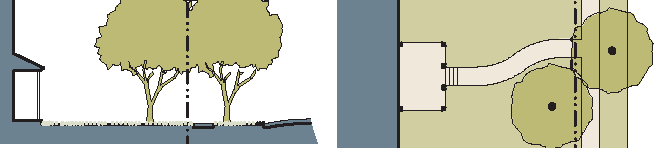 | T3 | |||
| B. Porch: This is a frontage wherein the facade is set back from the frontage line with an attached porch permitted to encroach (see Section 2.5.6). Porches may be constructed in front of the minimum required setback, but shall not extend into the right-of-way. Porches shall have a minimum depth of 8 feet and a minimum width of 25% of the primary facade. Porches may be screened; however, if screened, all architectural expression (columns, railings, pickets, etc.) must occur on the outside of the screen. Porch frontages may be fenced or unfenced (see Section 2.5.6 H.). | 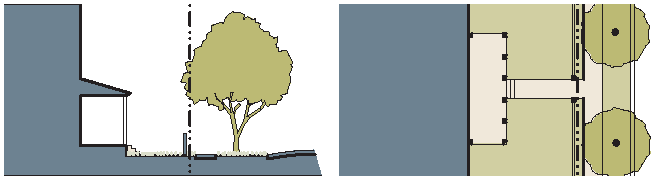 | T3, T4 | |||
| C. Forecourt: This is a frontage wherein a portion of the facade is close to the frontage line and the central portion is set back. Forecourts may be used in residential buildings to provide entry yards and/or shared garden space. Forecourts may be used in commercial and mixed-use buildings to provide areas for outdoor dining, display of merchandise, entries to individual tenants, or vehicular drop-off areas. Where provided, forecourts shall be a minimum of 12 feet in depth and 12 feet in width. This type should be allocated in conjunction with other frontage types. Large trees within the forecourts may overhang the sidewalks. | 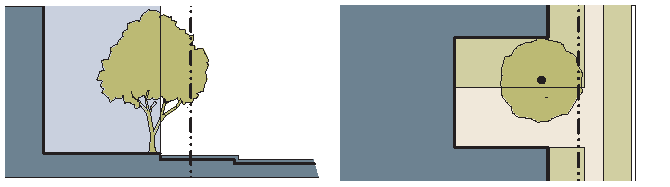 | T4, T5, RMX, IC | |||
| D. Stoop: This is a frontage wherein the facade is aligned close to the frontage line with the first story elevated from the sidewalk sufficiently to secure privacy for the windows. The entrance is usually an exterior stair and landing with a covered or recessed entry door. This type is recommended for ground-floor residential use. Stoops may be constructed in front of the minimum required setback, but shall not extend into the right-of-way. Stoops shall have a minimum depth and width of 4 feet. Stoops may be shared by 2 attached units. Stoop stairs may run to the front or to the side. | 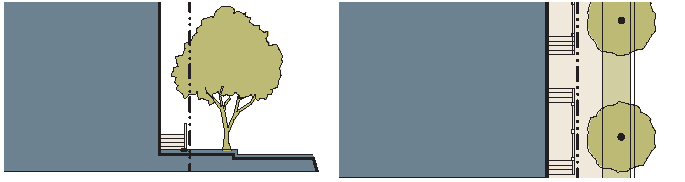 | T4, T5, RMX, IC | |||
| E. Balcony: This is a frontage wherein the facade is aligned close to the frontage line with an attached cantilevered or bracketed balcony(ies) above at least 50% of the facade, including major entries. This type is conventional for apartment houses and livework/mixed-use buildings. The balcony shall be no less than 3 feet deep and must be visually supported. French balconies (ones that are flush with the building) may be used, but are not considered balcony frontage, and would need to be combined with another frontage type. | 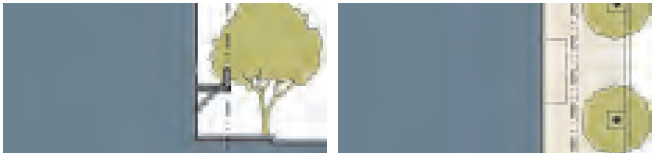 | T4, T5, RMX, IC, LI | |||
| F. Shopfront/Awning: This is a frontage wherein the facade is aligned close to the frontage line with the building entrance at sidewalk grade. This type is conventional for retail use. It has a substantial glazing on the sidewalk level. This frontage may also be used in conjunction with forecourt, Gallery/Colonnade, or balcony frontage types. Where an awning exists, it shall be a minimum of 5 feet deep and 8 feet above the sidewalk. Awnings shall be made of fabric or metal, but high-gloss and plasticized fabrics are prohibited. | 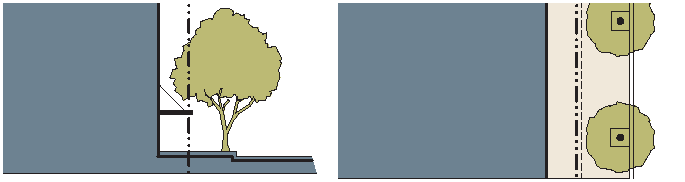 | T4, T5, RMX, IC, LI | |||
| G. Gallery/Colonnade: This is a frontage wherein the facade is aligned close to the frontage line with an attached cantilevered shed or a lightweight colonnade overlapping the sidewalk. This type is conventional for retail use. The gallery shall be a minimum of 10 feet wide and may overlap the sidewalk to within 2 feet of the curb. |  | T4, T5, RMX, IC, LI | |||
| H. Arcade: This is a colonnade supporting habitable space that overlaps the sidewalk, while the facade at sidewalk level remains at or behind the frontage line. This type is conventional for retail use. The Arcade shall be a minimum of 12 feet wide and may overlap the sidewalk to within 2 feet of the curb. |  | T4, T5, RMX, IC, LI | |||
4.5: - BUILDING TYPES
| SKETCH | PLAN | PERMITTED
ZONING DISTRICT(S) | |
|---|---|---|---|
| A. Carriage House: This is an accessory structure that provides small, flexible living spaces adjacent to a main house (a.k.a. Accessory Dwelling Unit [ADU], Granny Flat). It is often used for rental housing, and may be free standing, or located above a garage or parking area. | 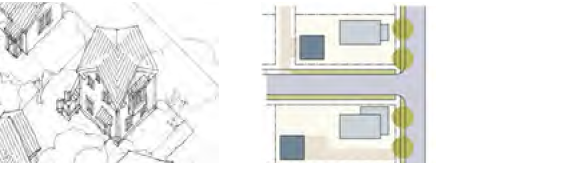 | T3, T4, T5, RMX, IC | |
| B. Single-Family Detached House: This is the predominant residential building type in Beaufort. This house sits on a private lot and can vary in size from a small cottage to a large mansion. Setbacks and frontage types vary by transect zone. | 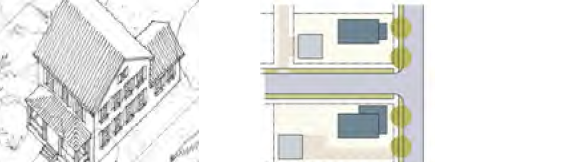 | T3, T4 | |
| C. 2-3 Unit House: This is a house-form that seamlessly fits into a predominantly single-family neighborhood, but contains multiple dwelling units. The units may be side-by-side, or stacked. They typically have separate entrances off of the street, but may share a common entrance. They are located under one roof and do not have parapets dividing the units. | 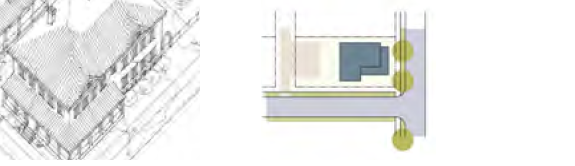 | T3, T4, T5, IC | |
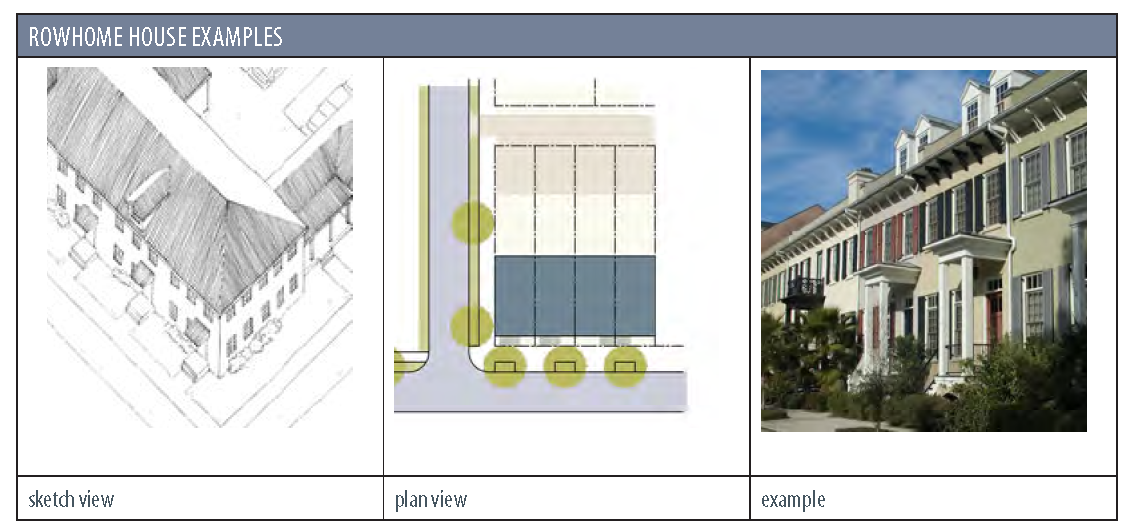
| D. Rowhome: This is an attached residential building type that is part of a series of other rowhomes with more than 3 units in a row. The combination of 3 or fewer units is considered a 2-3 unit building. Rowhomes may have parapet walls dividing the units, or be combined under one roof form. They are elevated above the street a minimum of 3 feet for privacy, and are typically accessed by stoops. They may also utilize the forecourt and porch frontage types. | 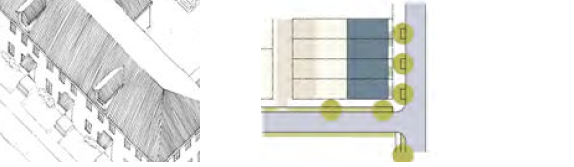 | T4-N, T5, RMX, IC | |
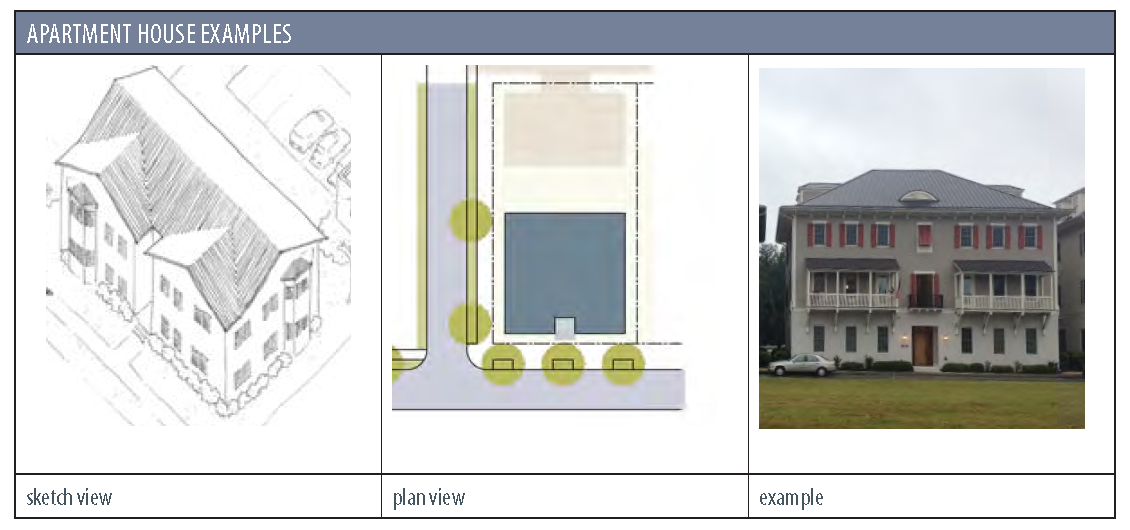
| E. Apartment House: This is a larger-scale building (a.k.a. Multi-Family Building) that contains 4 or more dwelling units. They often occupy corner lots, or are located in combination to create their own blocks. The ground floor is raised a minimum of 18 inches for privacy. | 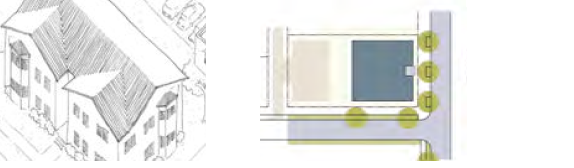 | T4, T5, RMX, IC | |
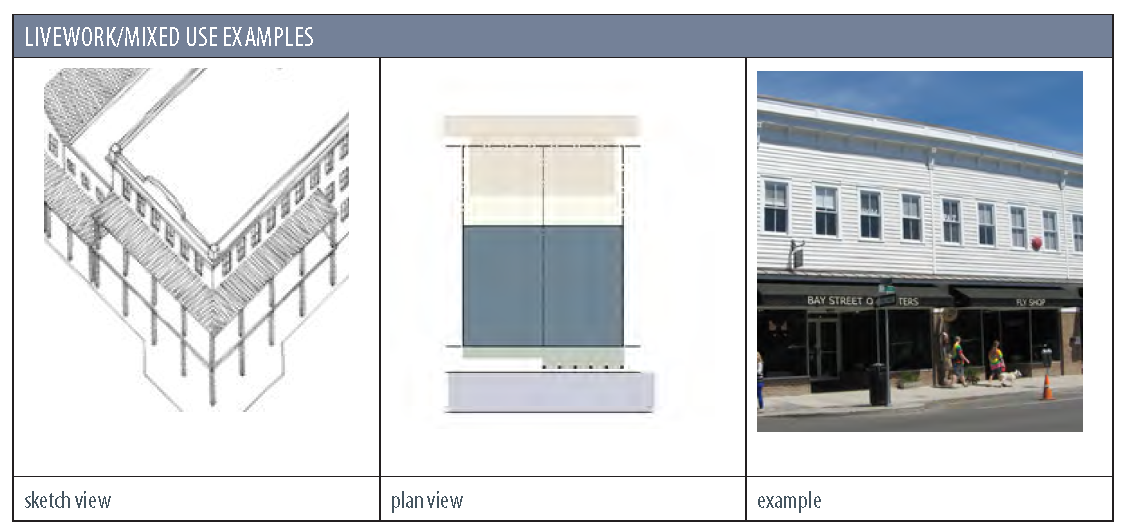
| F. Livework/Mixed-Use: This is a building that buildings contains commercial space, typically at grade, with office or residential living, typically located on the upper level(s). They are typically attached, but may be freestanding structures. The ground floor has a substantial amount of glazing, and often utilizes the shopfront frontage type. | 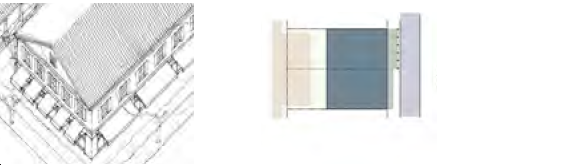 | T4, T5, RMX, LI, IC | |
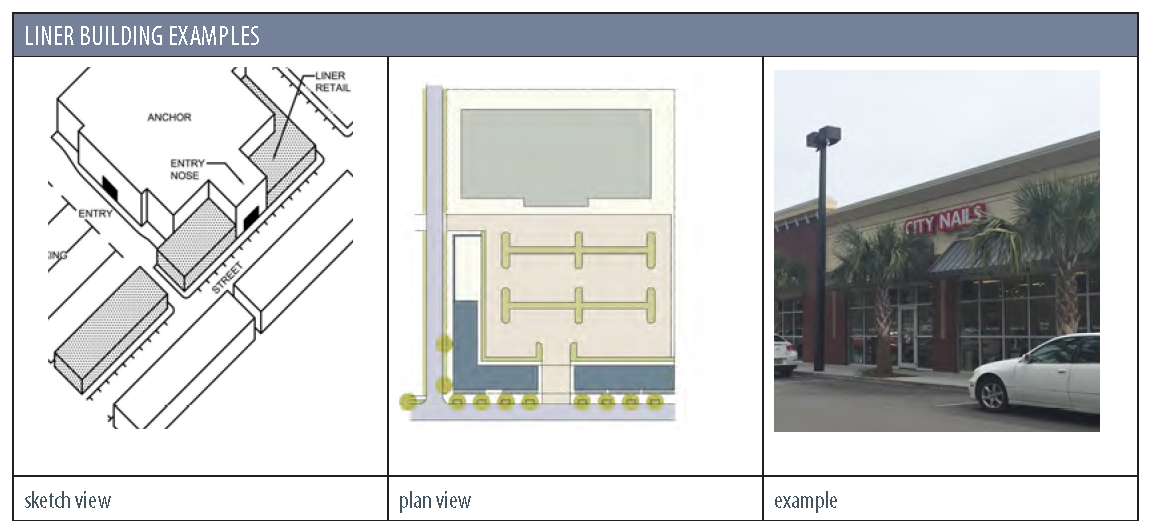
| G. Liner Building: This is a shallow structure, typically 25-30 feet deep, which is placed close to the street frontage. It is typically used in conjunction with other Liner Buildings to conceal surface or structured parking, or large-scale commercial buildings. These buildings may contain a variety of uses, including ground floor commercial, and upper-level offices or residential. | 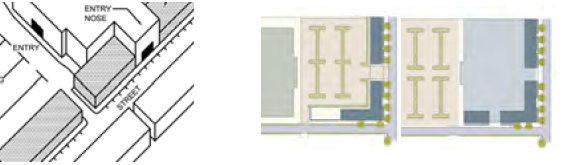 | T4, T5, RMX, IC | |
| H. Large Footprint Building: This is a building that has a footprint greater than 20,000 square feet. It is a type often used by big-box, national retailers. In the T4 and T5 transect zones, they shall be integrated into the streetscape or screened with Liner Buildings. | 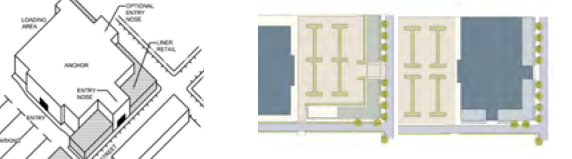 | T4, T5, RMX, IC, LI | |
| I. Structured Parking: This is a multi-level parking deck that may take up all or a significant portion of a block. | 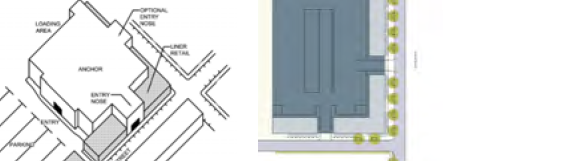 | T4, T5, RMX, IC, LI | |
| J. Gas/Fuel Station: This is a building type that contains a series of fuel pumps in conjunction with a convenience or retail store. | 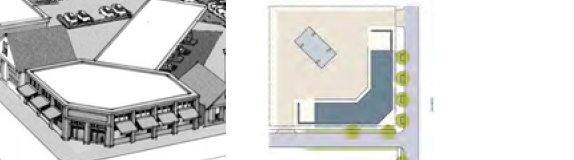 | T5, RMX | |
4.1.1 - PURPOSE
The purpose of this section is to:
A.
Protect and enhance Beaufort's unique aesthetic character.
B.
Support high quality streets and public spaces.
C.
Encourage architecture that blends harmoniously with the natural surroundings and neighboring development.
D.
Safeguard property values and long-term economic assets.
E.
Carefully preserve the character of Beaufort's National Historic Landmark District while permitting appropriate growth.
4.1.2 - INTENT
The standards and guidelines in this section are not meant to stifle innovative design or creativity. Instead, they are intended to serve as the minimum standards and guidelines necessary to ensure that new development and redevelopment meets the purposes described above.
4.2.1 - TERMINOLOGY
A.
Shall: This section establishes both binding standards and discretionary guidelines. Binding standards are typically signified the word "shall." They are specific and precise standards that are required to be met in the submitted design.
B.
Should, Encouraged and Discouraged: Discretionary guidelines are typically signified by the words "should," "encouraged," and "discouraged." They are general design objectives that are applied and interpreted by the appropriate Design Review Body in the review of development applications. "Shoulds" are the goal, but the Design Review Body has flexibility as to how they are administered.
C.
May: Discretionary guidelines with a greater degree of flexibility are signified by the word "may." They are ideal guidelines and a project following these guidelines would result in an outcome that is very compliant with the City's goals and objectives; however, they are not specifically required to be met.
4.2.2 - APPLICABILITY
A.
Applicability: The standards apply to all construction in:
1.
Transect-based Districts: T4, T5.
2.
Conventional Districts: RMX, IC.
B.
Exemptions: Where these standards are exempt, as listed below, this section may still be used as design guidelines for new construction as they outline building practices that are traditional to the Beaufort area.
1.
Modification to existing structures, unless they require design review as specified in Sections 9.8 and 9.9, are exempt from the requirements of this section.
2.
All construction in T3 districts is exempt from this section, except for:
a.
Carriage Houses (Section 4.5.3).
b.
2-3 Unit Houses (Section 4.5.5).
c.
Developments utilizing any of the Alternative Development Patterns (Section 2.8).
d.
Lots requesting a variance to subdivide and create one or more lots smaller than the minimum lot size per Section 2.3.1.
e.
Buildings in subdivisions 15 acres or larger.
3.
All construction in LI districts are exempt from all standards except for the provisions in 4.6.4.A, where the structure is visible from a Primary Street - See Street Hierarchy Diagram in Appendix C.
4.2.3 - RELATIONSHIP TO HISTORIC DISTRICT STANDARDS
A.
Applicability: In addition to the standards and guidelines in this article, any development located within the Beaufort Historic District is subject to the standards, guidelines, and procedures established in Section 9.10.
B.
Conflicts: In the event of a conflict between the requirements of this article and the requirements and guidance provided by the documents listed in 9.10.2.B, the later shall take precedence.
4.2.4 - RELATIONSHIP TO LAND USE PROVISIONS
A.
Applicability: Article 3 (Land Use Provisions) identifies use allowances by district and establishes additional standards applicable to specific uses. These provisions shall also apply in conjunction with the standards outlined in this article.
B.
Conflicts: In the event of a conflict between the requirements of this article and the requirements of Article 3, the most stringent requirement, as determined by the Administrator, shall apply.
4.3.1 - PURPOSE AND APPLICABILITY
All buildings possess a number of common elements that combine to express a structure both as an entity and as a part of the larger community. No building is so insulated from its surroundings as to avoid an impact on the surrounding context. Applications that require Major Design Review (Section 9.8) and Certificate of Appropriateness, Major (Section 9.10.2), are subject to the additional contextual design guidelines of this section. These guidelines shall be used by the Design Review Body as applicable, to evaluate the appropriateness of the proposed construction to its immediate context and the character of the broader community.
4.3.2 - SPECIFIC GUIDELINES
A.
Conformity to Civic Master Plan: The Civic Master Plan provides site-specific guidance for the development of many parcels within the city. The intent of this Code is to facilitate the vision and ensure the visions are permitted. In instances where the Civic Master Plan provides guidance for building and site design standards on a particular parcel, development applications on that parcel should meet the general intent of such guidance to the extent practicable, as determined by the Design Review Body.
B.
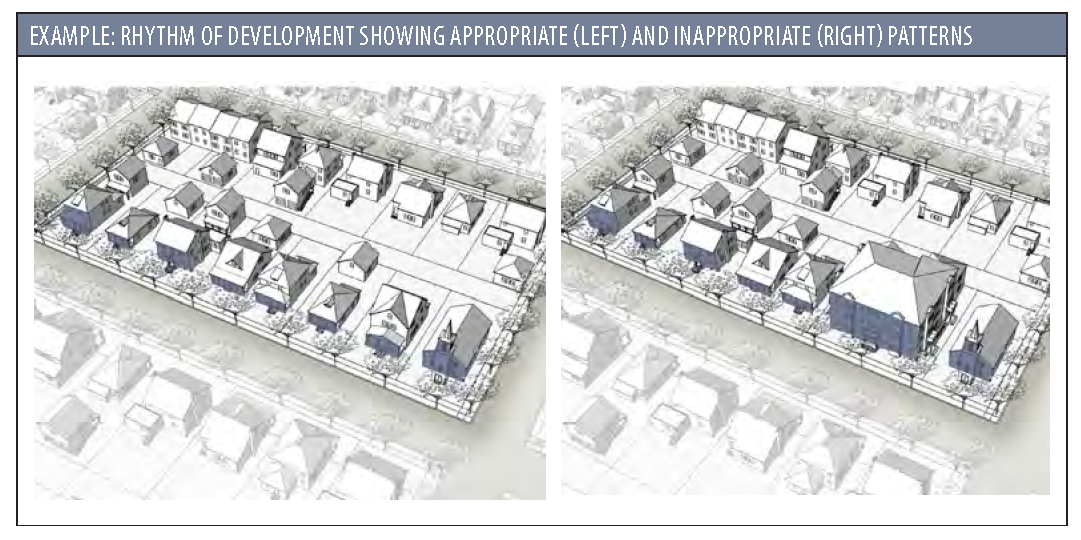
Rhythm of Development on the Street: Monolithic massing that disrupts the predominant building pattern of the neighborhood and corridor is strongly discouraged.
C.
Massing and Articulation:
1.
New construction should complement the massing of neighboring buildings by utilizing roof forms, architectural trim, differentiation of facade planes, and a relationship of solids (siding and walls) to voids (window and door openings) that are consistent with the patterns established in neighboring buildings.
2.
When large scale construction is proposed that is not consistent with the predominant building height and lot width of the surrounding area, special attention shall be paid to specific building design elements in order to articulate a building form that is appropriate to the neighborhood context. These include the items listed in the paragraph above, along with siting, setbacks, and facade treatments.
4.5.1 - GENERAL
A.
The transect provides a framework for determining where specific types of buildings can be located. This section gives an overview of the most common building types in Beaufort, and where and how they are permitted based on their transect zone. Some building types are permitted in multiple zones, but have different requirements based on their district. In case of a conflict between this section and Article 2, whichever requirement is stricter shall take precedence.
B.
This section is not intended to limit the variety of buildings or stifle creativity. Other building types may be permitted by the Design Review Body, as specified in Article 9, if the building meets the guidelines and requirements of this Article.
4.5.2 - APPLICABILITY
A.
The requirements of the districts, as stated in Article 2, shall apply to all building types, unless a more stringent requirement is listed as part of this section.
B.
Some of the building types listed have specific uses implied (e.g., Gas/Fuel Station) while others may be used flexibly for multiple uses.
4.5.3 - CARRIAGE HOUSE
A.
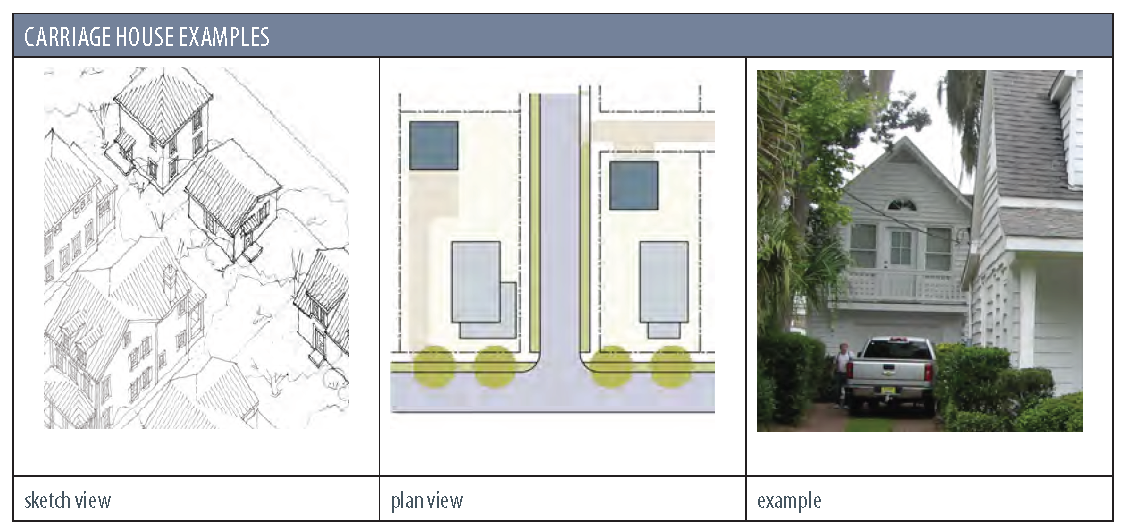
Description: This is an Accessory Structure that provides small, flexible living spaces adjacent to a main house (a.k.a. Accessory Dwelling Unit [ADU], Granny Flat). It is often used for rental housing, and may be free standing, or located above a garage or parking area.
B.
Special Requirements:
1.
Infrastructure: The lot shall be served with public water and sewer.
2.
Number allowed: 2 per lot, except in T3-S where 1 per lot is permitted.
3.
Placement on the Lot: The carriage house shall be located to the rear of the primary structure, or to the side as a secondary option, with the following exceptions:
a.
Units may be placed at the front of a lot where the front of the primary structure is not the street, and the structure has clearly been designed to take advantage of unique site amenities, such as location on the water.
b.
Units may be placed in the front of the lot where the prevailing character of the neighborhood has other similarly-placed units.
4.
Frontage Type: No frontage type is prescribed unless the building is close to the street; in which case, appropriate frontage types are: porch, stoop.
5.
Maximum Number of Bedrooms: 2.
6.
Minimum Size: 240 square feet in total area.
7.
Maximum Size: The footprint shall not exceed 50% of the footprint of the primary building, or 1,500 square feet, whichever is smaller. Conversions of existing accessory structures that exceed this maximum may be permitted if the administrator determines that there is no adverse impact on surrounding property.
8.
Compatibility with Primary Structure: Architectural details, including color, siding, roof pitch, window detailing, roofing materials, height, and foundation, shall be compatible with the primary dwelling unit.
9.
Parking: 1 parking space per Carriage House is required, and shall be clearly defined. See Section 7.3 for additional parking standards.
10.
Timing: The carriage house(s) shall be permitted to be built prior to the primary structure on the lot if the following requirements are met:
a.
A sketch plan showing the potential build-out, including parking, of the site is required;
b.
The size(s) must be appropriate to permit a primary structure without exceeding the maximum lot coverage; and
c.
Materials of the future primary structure must coordinate with the carriage house.
4.5.4 - SINGLE FAMILY DETACHED HOUSE
A.
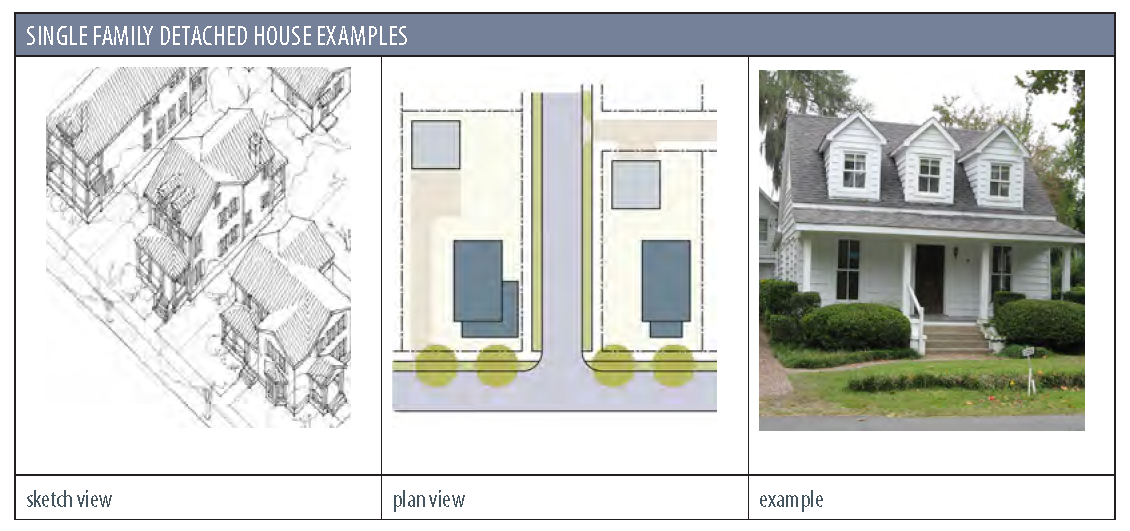
Description: This is the predominant residential building type in Beaufort. This house sits on a private lot and can vary in size from a small cottage to a large mansion. Setbacks and frontage types vary by Transect Zone.
B.
Special Requirements:
1.
Frontage Types: Common Yard, Porch, Stoop.
4.5.5 - 2-3 UNIT HOUSE
A.
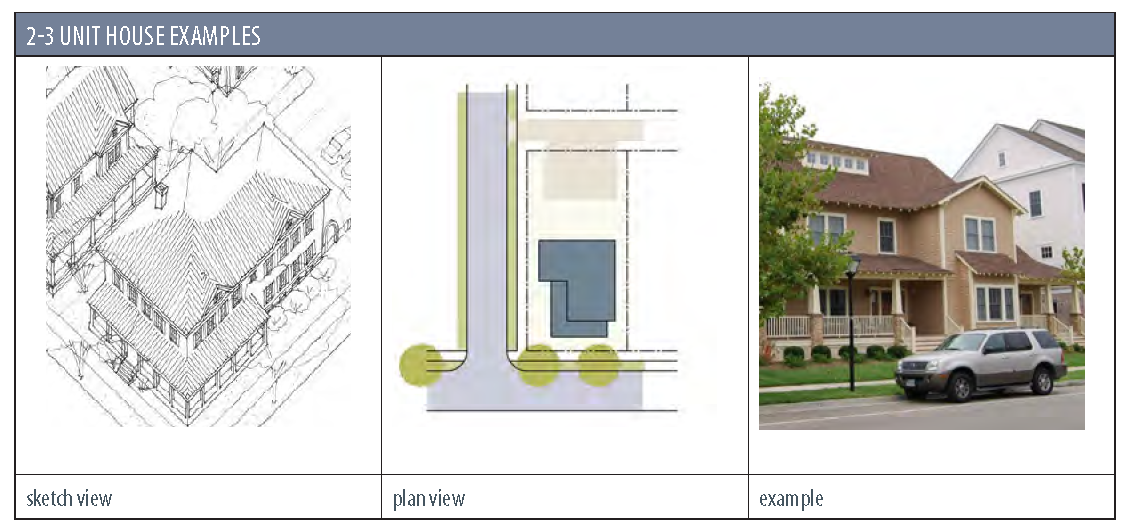
Description: This house-form seamlessly fits into a predominantly single-family neighborhood, but contains multiple dwelling units. The units may be side-by-side, or stacked. They typically have separate entrances off of the street, but may share a common entrance. They are located under one roof and do not have parapets dividing the units.
B.
Special Requirements:
1.
Frontage Types: Common Yard, Porch, Stoop.
2.
Parking: Parking must be well defined, located behind the building, and accessed off a side street or rear alley. On-site parking for all vehicles, including boats, must not be in front of the building. No variances to this provision are permitted.
3.
Location, Specific to T3-N: A 2-3 unit building is permitted in the following areas:
a.
On a corner lot; or
b.
Where alley access is provided; however, no more than 2 per block are permitted.
4.5.6 - ROWHOME
A.
Description: This is an attached residential building type that is part of a series of other rowhomes with more than three units in a row. Three or fewer is considered a 2—3 unit building. Rowhomes may have parapet walls dividing the units, or be combined under one roof form. They are elevated above the street a minimum of 3 feet for privacy, and are typically accessed by stoops. They may also utilize the forecourt and porch frontage types.
B.
Special Requirements:
1.
Frontage Types: Porch, stoop, forecourt.
2.
Parking: Parking must be well defined, located behind the building, and accessed off a side street or rear alley. On-site parking for all vehicles, including boats, must not be in front of the building.
3.
Specific to T4:
a.
Rowhomes are not permitted in the Historic District, except in the Bladen Street Redevelopment District.
b.
Rowhomes are not permitted in T4-NA.
4.5.7 - APARTMENT HOUSE
A.
Description: This is a larger-scale building (a.k.a. Multi-Family Building) that contains 4 or more dwelling units. They often occupy corner lots, or are located in combination to create their own blocks. The ground floor is raised a minimum of 18" for privacy.
B.
Special Requirements:
1.
Frontage Types: Stoop, Forecourt, Balcony. Porches are not preferred, but may be used in buildings containing 12 units or less if they provide direct access to the unit from the street or sidewalk.
2.
Building Entries: In buildings with more than 6 residential units, all ground floor units facing a frontage line shall have individual entrances from that frontage line. Buildings with formal entry courtyards or lobbies are exempt from this requirement.
3.
Parking: On-site parking must be located behind the building and accessed off a rear alley.
4.
Specific to T4:
a.
In the Historic District, these are limited to 6 dwelling units per building.
b.
Multi-family dwellings are not permitted in T4-NA.
(Ord. No. O-21-19, 12-10-2019)
4.5.8 - LIVEWORK/MIXED-USE
A.
Description: This is a building that buildings contains commercial space, typically at grade, with office or residential living, typically located on the upper level(s). They are typically attached, but may be freestanding structures. The ground floor has a substantial amount of glazing, and often utilizes the shopfront frontage type.
B.
Special Requirements:
1.
Frontage Types: Forecourt, balcony, Shopfront/Awning, Gallery/Colonnade, Arcade.
2.
Parking: Parking must be located behind the building, and accessed off a rear alley.
3.
Specific to T4-N and T4-NA: When no retail frontage overlay exists, the ground floor is limited to office, artisan and trail-related uses only.
4.
Specific to LI: Drive-thru facilities are prohibited.
4.5.9 - LINER BUILDING
A.
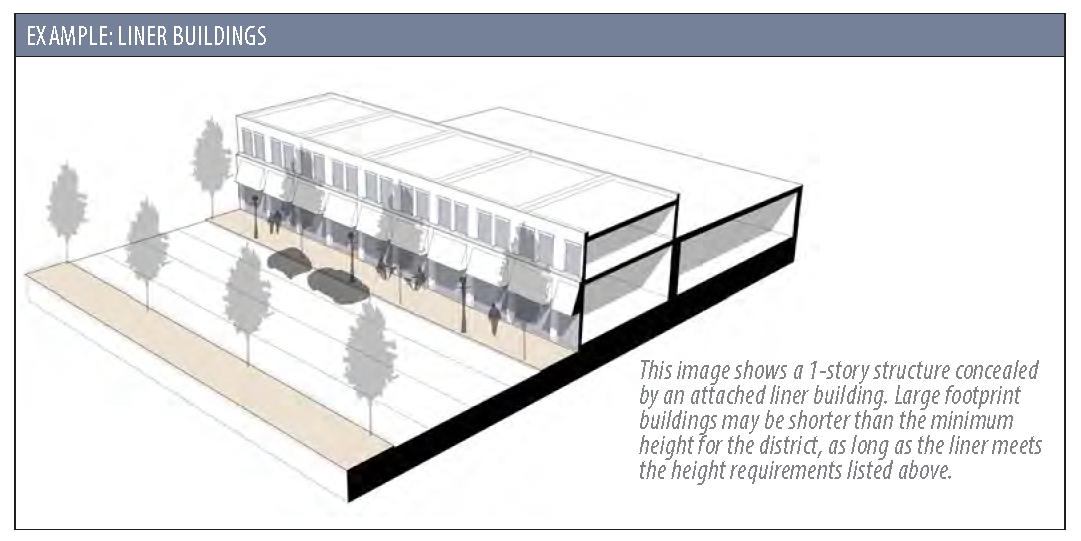
Description: This is a shallow structure, typically 25—30 feet deep, which is placed close to the street frontage. It is typically used in conjunction with other Liner Buildings to conceal surface or structured parking, or large-scale commercial buildings. These buildings may contain a variety of uses, including ground floor commercial, and upper-level offices or residential.
B.
Special Requirements:
1.
Frontage Types: Balcony, Shopfront/Awning, Gallery/Colonnade, Arcade.
2.
Frontage Build-Out: 75% minimum.
3.
Height: The minimum height for Liner Buildings is 1 story; however, when attached to another structure, it must be tall enough to conceal the building it is screening. Where Liner Buildings conceal a parking structure, the Liner Building shall be a minimum of 1 story; however it is preferred that it be built to such a height that the structure cannot be seen from the right-of-way.
4.
Connection: Liner Buildings may either be detached from or attached to the building they are lining.
4.5.10 - LARGE FOOTPRINT BUILDING
A.
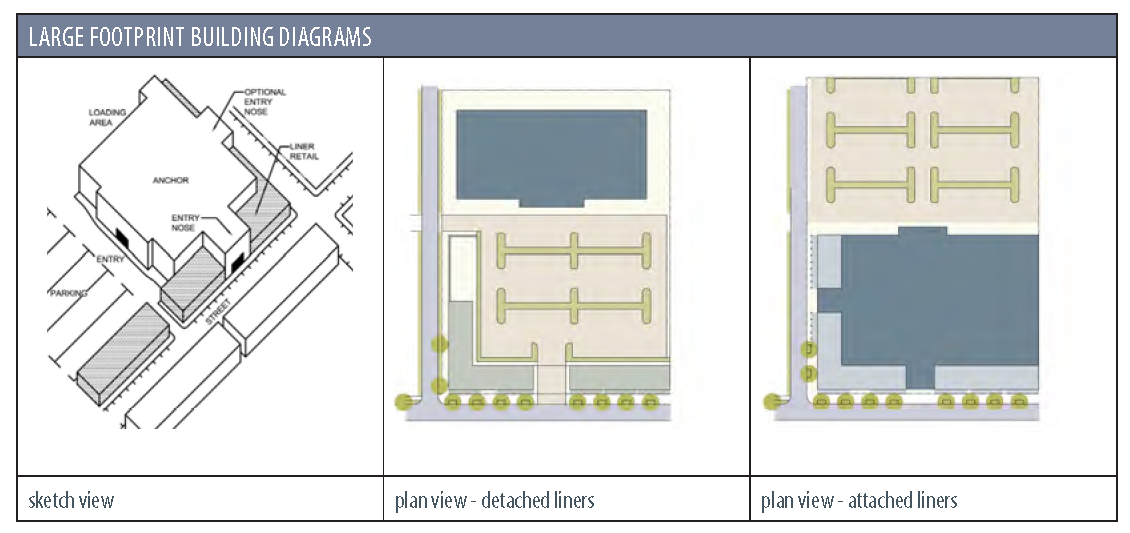
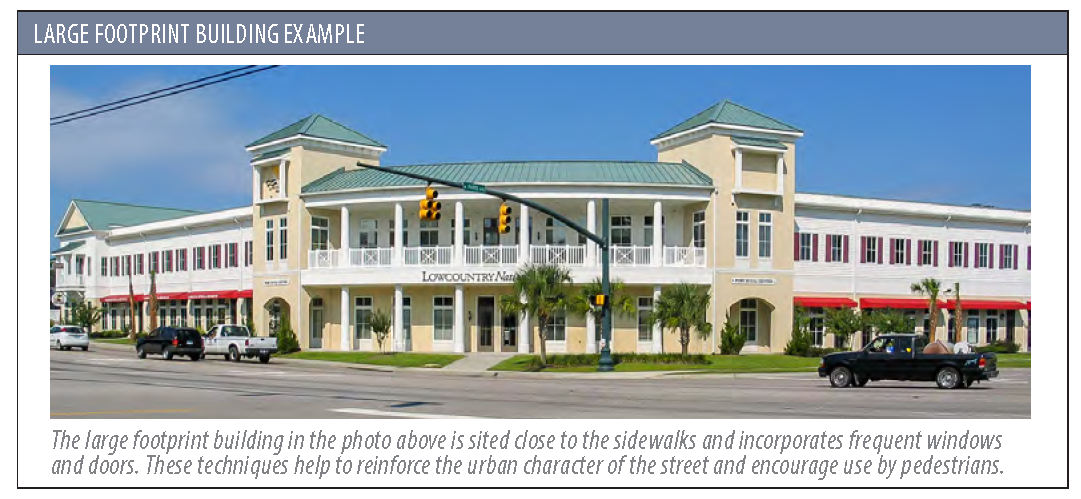
Description: This is a building that has a footprint greater than 20,000 square feet. It is a type often used by big-box, national retailers. In the T4 and T5 transect zones, they shall be integrated into the streetscape or screened with Liner Buildings (see Section 4.5.9).
B.
Special Requirements:
1.
Frontage Types: Shopfront/Awning, Gallery/Colonnade, Arcade — Balconies may be used if there is true habitable space on the upper floor(s).
2.
Liner Buildings: Liner Buildings (Section 4.5.9) are required in the T4 and T5 districts between the Large Footprint Building and the Primary Street frontage. They may be used in other districts to fulfill the requirements of this Code, such as height, entrances on the street, and parking location.
a.
Exceptions: When a Large Footprint building provides an entry on the primary street frontage, and a minimum of 40% clear and unobstructed glazing along that street, liners are not required.
3.
Height: Buildings may be 1 story in height on the interior of the block, but should be at least 2 stories in height along all Primary Street frontages (see Street Hierarchy Diagram in Appendix C). This may be accomplished with multi-story buildings, higher ceiling heights, parapets, and/or separate Liner Buildings. See Section 2.6.3 for more details on two-story building requirements.
4.
Entrances: See Section 2.5.1 D.
5.
Location: In the Historic District, except along Boundary Street, these are permitted by special exception only.
6.
Size: Building footprints shall not be larger than a single block. Floor area of buildings shall not cantilever over public rights-of-way.
7.
Parking Location:
a.
Specific to T4 and T5: A minimum of 75% of all parking shall be located behind the primary building or a Liner Building.
b.
All other districts: The majority of the parking spaces shall be located to the side or rear of the building, or behind a Liner Building.
4.5.11 - STRUCTURED PARKING
A.
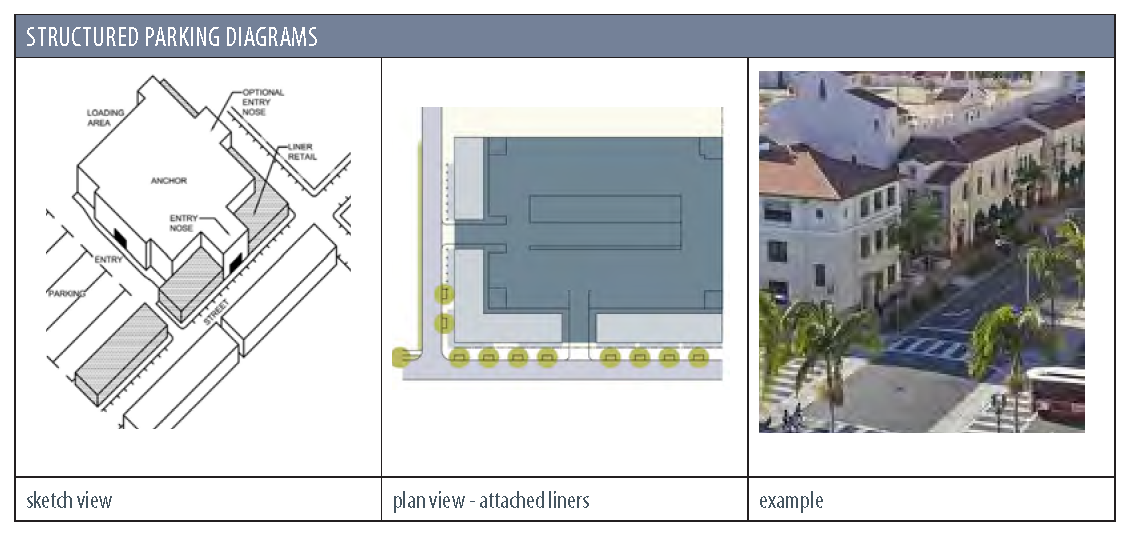
Description: This is a multi-level parking deck that may take up all or a significant portion of a block.
B.
Applicability: These standards apply to all above-ground parking structures that front a public street or right-of-way.
C.
General Requirements:
1.
Screening Required: Where an above-ground parking structure fronts a public street, the ground level shall be screened in such a way that cars are not visible from the street.
2.
Materials: Parking structure facades along pedestrian-oriented streets or primary pedestrian paths of travel shall be treated with high-quality materials, such as louvers, landscaped trellises, and/or crafted ornamental metal screens, to visually screen cars. The proportion should be broken down into bays that reflect the surrounding context.
3.
Entries: Pedestrian entries into the parking structure shall be clearly visible from the primary pedestrian paths of travel.
4.
Bicycle Parking: Parking structures shall provide bicycle parking within the structure. It shall be located on the level closest to the street and/or a primary building entrance.
5.
Liner Buildings: If liners exist, they should be designed according to the standards set out in Subsection E. below.
D.
Height: Each above-ground level counts as 75% of a story regardless of its relationship to habitable stories.
1.
Specific to T5-DC: The maximum height at the property line shall not exceed 35 feet to the top of the parapet.
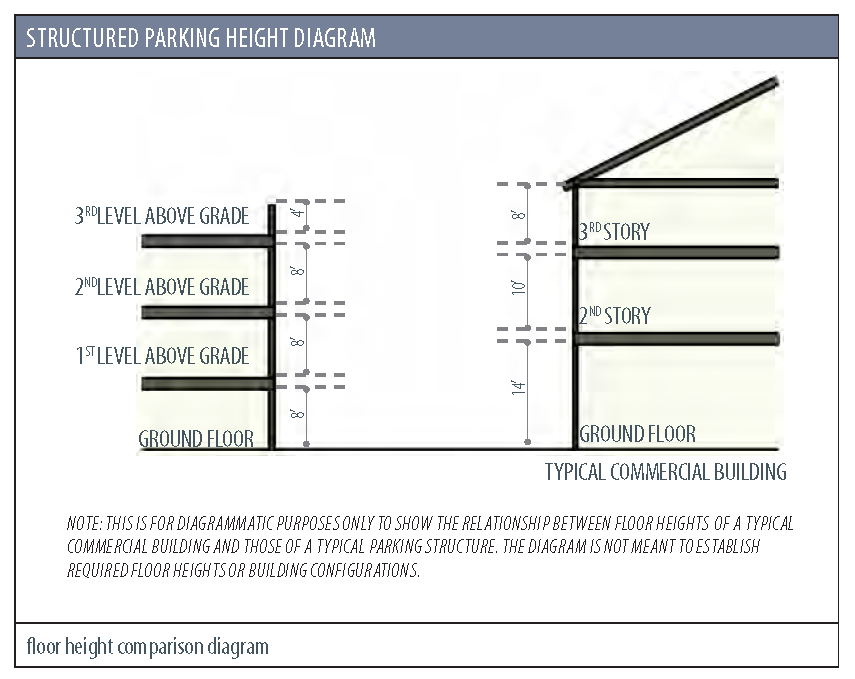
E.
Special Requirements Specific to Transect Zones:
1.
Disposition: Parking structures shall meet the required building setbacks except where Liner Buildings are required. In that case, parking structures should be set back from the property lines of the adjacent Primary Street(s) a minimum of 25 feet to reserve room for Liner Buildings between parking structures and the lot frontage— see Street Hierarchy Diagram in Appendix C for Primary and Secondary streets.
2.
Frontage Types: Shopfront/Awning, Gallery/Colonnade, Arcade — Balconies may be used if there is true habitable space on the upper floor(s).
3.
Liner Buildings:
a.
Liner Buildings (Section 4.5.9) are required in the T4 and T5 districts along Primary street frontage(s). Where parking structures face more than 1 street, requirements for Liner Buildings at secondary frontages are at the discretion of the Design Review Body. They may be used in other districts to fulfill the requirements of this Code, such as height and parking location.
b.
Exceptions to this requirement may be granted when lot width or depth is less than 140 feet. Where no Liner Buildings exist, along pedestrian-oriented streets, standards in Section 4.5.11 C.1. shall apply.
c.
Liner Buildings may be constructed concurrently with the parking garage, or space may be reserved for their construction in the future.
4.5.12 - GAS/FUEL STATIONS AND CAR WASHES
A.
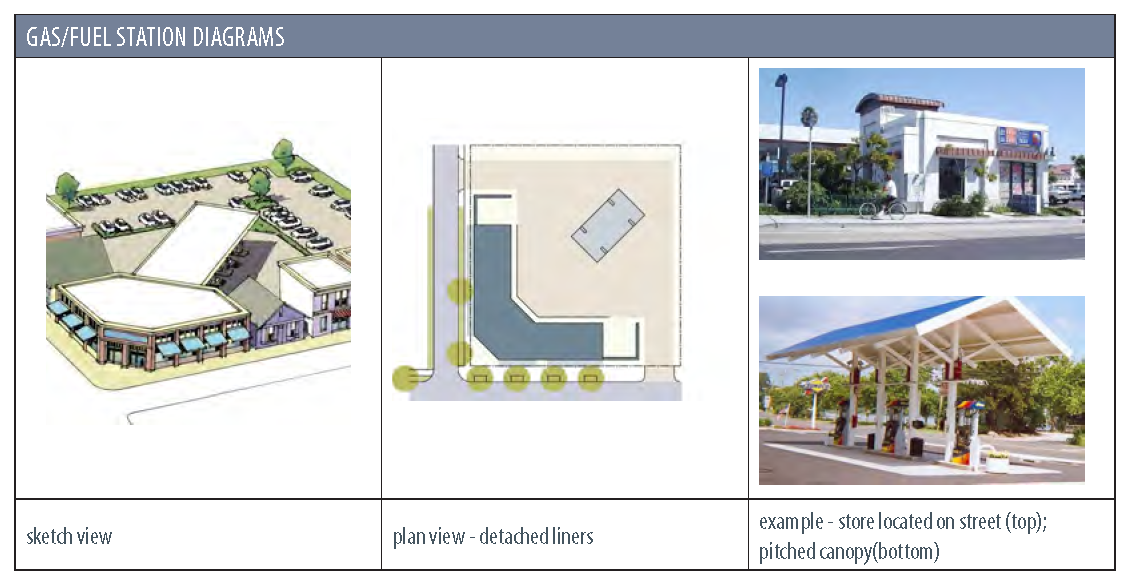
Description: This building type contains a series of fuel pumps in conjunction with a convenience or retail store.
B.
Building and Fueling Station Requirements:
1.
Specific to T5-UC:
a.
The number of pumps shall be limited to 3 — a maximum of six fueling positions — in the Historic District and 6 pumps elsewhere.
b.
The fueling stations shall be located behind the convenience store or a Liner Building. Outside of the Historic District, the fueling stations may be located to the side of the convenience store or Liner Building with the following provisions:
i.
The building shall be located on a corner.
ii.
The pumps shall be set back a minimum of 10 feet from the front line of the building.
iii.
The short side of the pumps shall be parallel to the Primary Street — see Street Hierarchy Diagram in Appendix C.
iv.
The frontage build-out percentage shall be met by the convenience store and/or Liner Building.
v.
Fueling stations shall not be located between the building and the adjacent street.
c.
One or more pedestrian entries shall be located along the Primary Street frontage.
2.
Specific to RMX and LI:
a.
The primary building should be at least ⅔ as long (measured parallel to the street) as the distance along the longest line of pumps — see the following diagram.
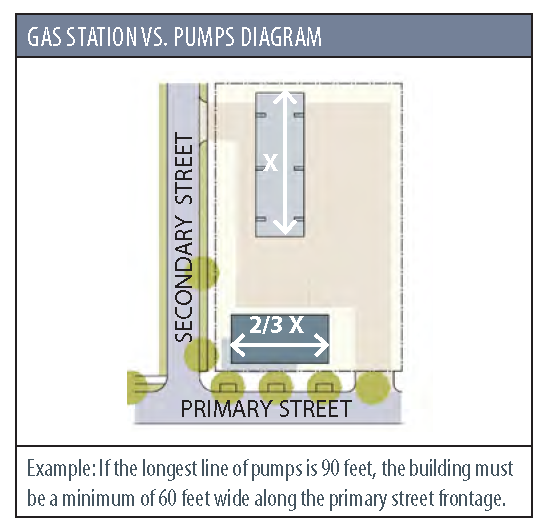
b.
The pumps should be located to the side or rear of the building where possible. They shall not be located between the building and the adjacent primary street. In cases where the pumps are located to the side of the building, the pumps, including the canopy, shall not project further toward the street than the front line of the building.
c.
Corners: On corner sites, significant architectural features, such as buildings or structures, should be provided at the corner.
3.
Kiosks: Kiosk-type fuel stations, where a structure sits within the pump canopy, are not permitted unless they are located behind a Liner Building.
4.
Existing Facilities: When pumps are proposed at existing facilities that do not meet these design standards for gas stations, a decorative wall not less than 3 feet in height shall be required along any side of the property adjoining a street.
C.
Signage: No signs shall be located on any canopy over the pumps.
D.
Car Wash:
1.
The bay door(s) to the garage or car wash bay(s) shall not be visible from the Primary Street frontage.
2.
For a stand-alone car wash not associated with a fuel station, the opening of the bay door shall either face away from the Primary Street or be screened from the street with a Liner Building (Section 4.5.9).
E.
Colors: Buildings and canopies shall not be painted in a color or pattern that expresses corporate identify, to the extent that the paint color or pattern is not consistent with the design standards of the district. The use of highly reflective or glossy materials is prohibited.
F.
Consistency: All sides of a building shall express consistent architectural detailing and character. All site walls, screen walls, pump island and canopies, and other outdoor covered areas shall be architecturally integrated with the building by using similar material, color, and detailing.
G.
Pump Design Guidelines:
1.
Pump Canopy:
a.
Canopies with a pitched roof are encouraged. Multiple canopies or canopies that express differing architectural masses are encouraged.
b.
Canopy ceiling shall be recessed.
c.
Lighting:
i.
Canopy lighting shall be recessed.
ii.
The sides (fascias) of the canopy should extend below the lens of the fixture 12 inches to block the direct view of the light sources and lenses from property line.
iii.
Any lighting mounted to the top or sides of the canopy, including outlining of canopies with light bands or tubes, is prohibited.
iv.
Any freestanding light fixtures shall be a maximum 15 feet in height if the property abuts or is located within a Transect-based District.
2.
Pump Island: The intent of this section is to encourage pump island designs that are well organized and consolidated to minimize visual clutter. Pump island components consist of fuel dispensers, refuse containers, automated payment points, safety bollards, and other appurtenances.
a.
The color of the various components of the pump island, including dispensers, bollards, and all appurtenances, are encouraged to be muted.
b.
The use of translucent materials and internally lighted cabinets is discouraged as finishes or as applied treatments at the pump island or on the canopy.
c.
Either a pump island curb or bollard is recommended for the protection of dispensing units.
4.5.13 - CIVIC BUILDINGS
Civic buildings contain uses of special public importance and may be located in any zoning district. They require special design standards as described below, but should also be compatible with the surrounding context. Civic buildings may include, but are not limited to, municipal buildings, churches, libraries, schools, hospitals, and public recreation facilities. Museums may sometimes be considered civic buildings. Civic buildings do not include day care facilities, retail buildings, residential buildings, and privately-owned office buildings.
A.
Placement: In order to provide greater flexibility to create a special architectural statement, civic buildings are not subject to minimum or maximum setback requirements. Instead, building placement should be designed with consideration of the following guidelines.
1.
Placement of civic buildings, depending upon program and site, can often benefit from being set back from the adjacent build-to lines of private development. This allows the scale of the building to have more visual emphasis and can create a public space in the foreground. The amount of this setback should be carefully determined, based on the urban design objectives of the particular site.
2.
Buildings should be oriented toward the public realm (streets, squares and plazas) in a very deliberate way.
3.
Civic buildings and their primary architectural elements should be placed at the termination of public vistas to provide an appropriate level of visual importance.
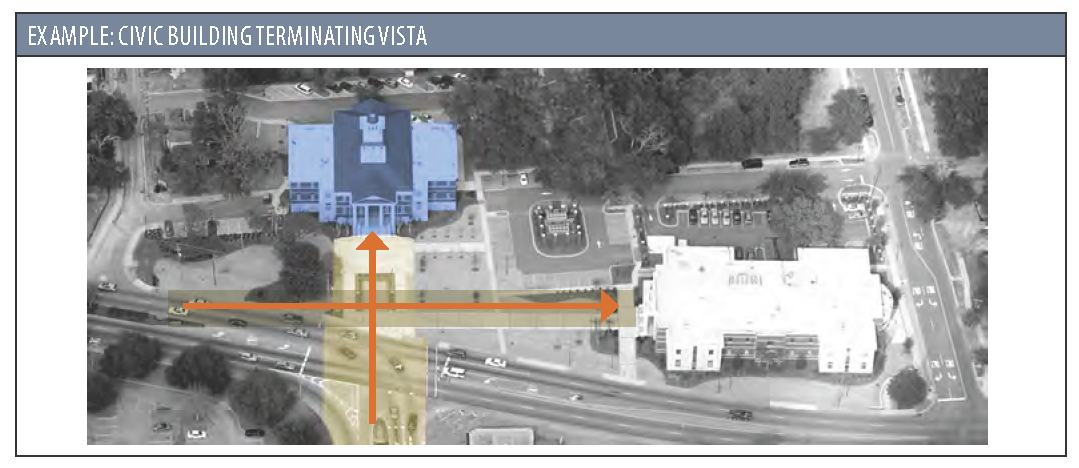
4.
Entrances should always be located on the most prominent facade(s). Avoid entrances that are at the rear or are visually concealed.
5.
Parking shall be located at the rear and/or side of the building. In general, parking location standards shall match the zoning district.
B.
Massing:
1.
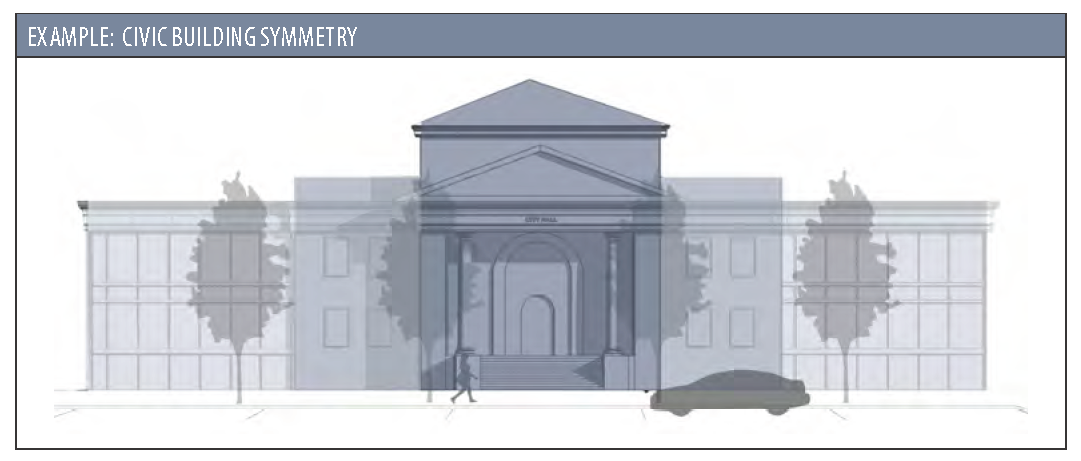
The primary massing of civic buildings should be symmetrical in form. The appearance of a balanced design increases the level of formality, which is appropriate to the public use.
2.
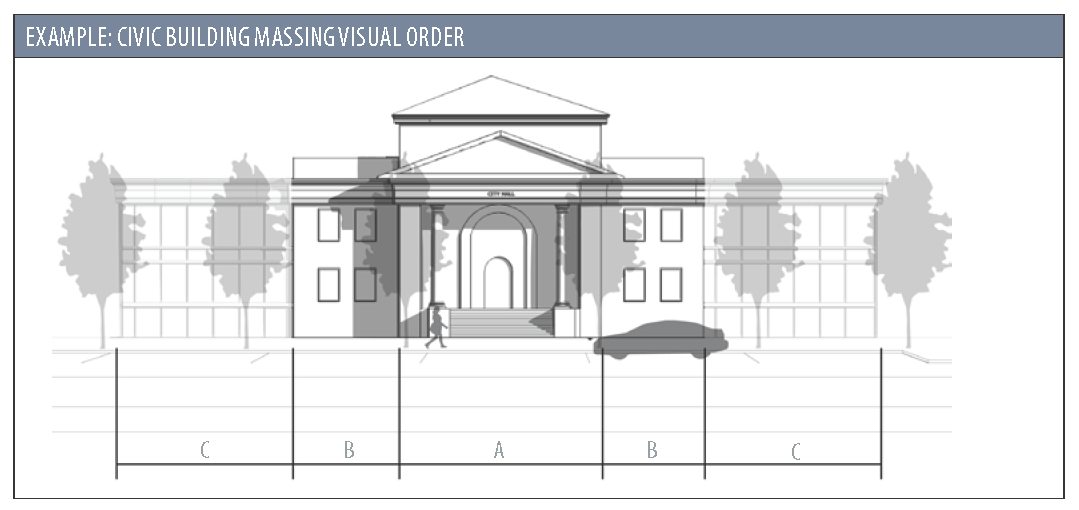
Massing of civic buildings, although often larger as a whole, should be divided into visually distinct sections. Massing divisions should provide visual order to the building and create vertical proportions within individual elements.
C.
Scale/Height:
1.
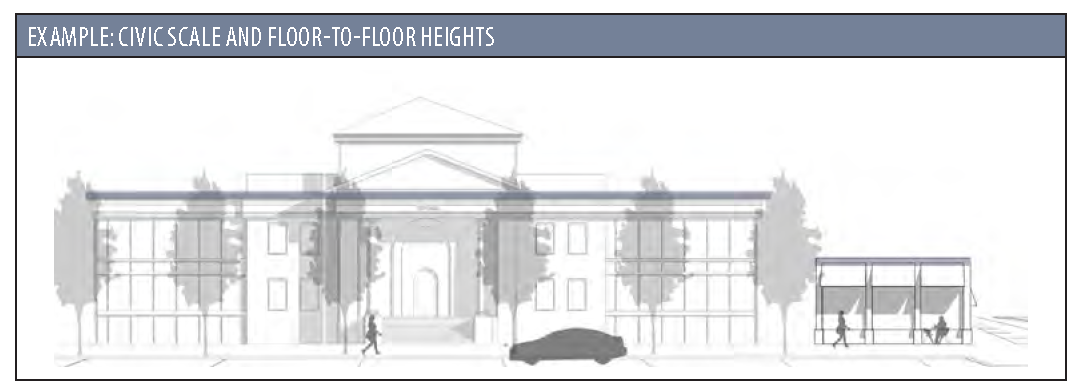
The scale of civic buildings should be larger and more monumental than corresponding buildings in order to be more prominent and visible across greater distances.
2.
Floor-to-floor heights and architectural details should be proportionately larger than those of private buildings that exist or are anticipated within adjacent blocks.
3.
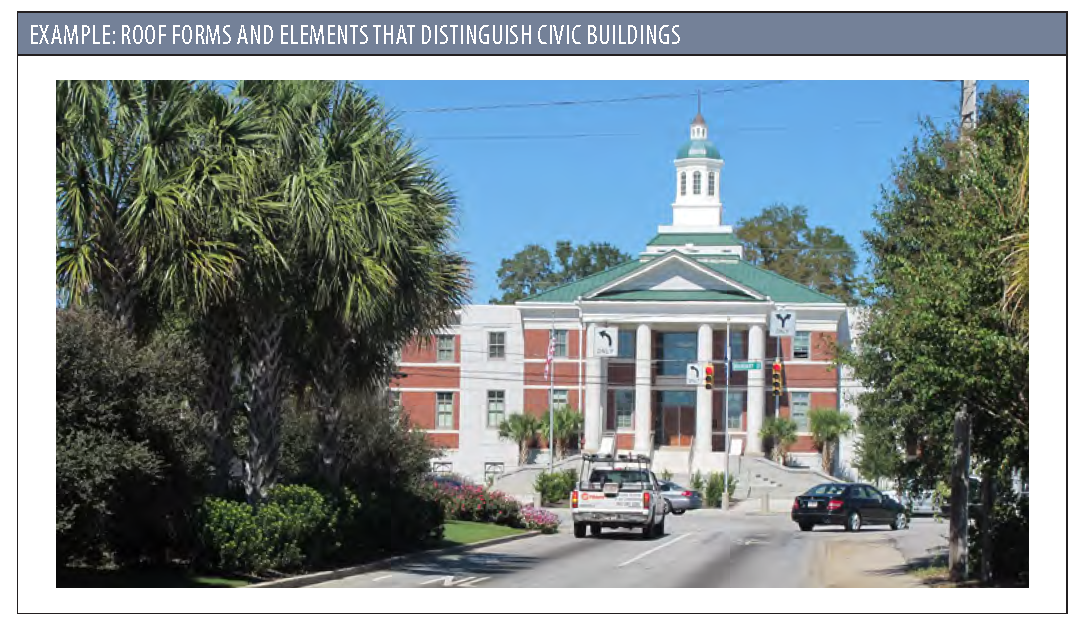
Prominent roof forms and additive elements, such as cupolas, should be used to visually extend the height of the building.
D.
Materials/Details:
1.
Civic buildings should evoke a civic character and be carefully designed to reflect the architectural character of Beaufort.
2.
Civic buildings should be made of durable, high-quality materials that create a sense of permanence and lend civic identity to the city. Preferred materials include brick, stone, and cast concrete. Stucco should only be utilized when applied over structural CMU.
3.
Building details should be designed at 2 scales. At the larger scale, details should be robust, so as to be read from a distance. Nearer to the building, the details of the lower levels should include another measure of refinement that can only be seen up-close at a pedestrian scale.
4.
Building design elements should be used which allow civic buildings to act as focal points of the community. Depending on the architectural style of the building, the following elements should be considered in the building design:
a.
Pronounced window lintels/sills/mullions, etc.
b.
Columns with a capital and base.
c.
A water table constructed of high-quality masonry units (such as cast-in-place stone) that extends beyond the face of the facade.
d.
Vertically oriented windows of at least a 2:1 ratio.
e.
Cornice lines with significant depth and multiple levels of relief.
f.
A monumental raised entryway.
g.
A formal landscaped area or plaza.
h.
A tower element with a turret, cupola, or similar treatment.
4.6.1 - GENERAL TO ALL APPLICABLE DISTRICTS (SEE 4.2.2)
A.
Size, Mass and Scale: The scale of buildings and accessory structures (including canopies) shall be appropriate to the scale of structures located in the neighboring context.
B.
Proportions of Bays and Openings: All building bays, including porches, colonnades and porticos as appropriate, shall be square or vertical in proportion, unless the design merits a horizontally-proportioned opening. Wall openings, with the exception of transoms and storefronts, shall be square or vertical in proportion. The facade of a proposed building should draw upon the proportion and number of bays in surrounding buildings, as defined by windows, doors, and column spacing, to establish a compatible scale.
C.
Building Materials: Building wall materials shall be combined on each facade only horizontally, unless the building is broken vertically by a change of plane, or a vertical architectural element. Heavier materials, such as masonry and stucco, shall be located below lighter materials, such as cement fiber or wood siding.
D.
Roof Forms: Where pitched roofs exist, primary roofs shall have a minimum slope of 4:12, while ancillary roof slopes may be no less than 2:12.
E.
Garages and Accessory Structures: Attached garages, detached garages, and other accessory structures shall be subordinate in height, footprint, and proportion to the primary structure on the site, and shall be compatible with the principal structure in terms of roof form, materials, and color. Where a garage contains an accessory dwelling unit above, it may exceed the height of the primary structure.
F.
Trash, Mechanical, Utility and Service Equipment and Areas:
1.
Loading docks, service areas, and trash disposal facilities (e.g., trash and recycling receptacles, compactors, dumpsters) shall be hidden or screened from view of streets, parks, squares, waterways, or significant pedestrian spaces. Loading areas may be oriented toward adjoining developed properties that are zoned for nonresidential uses, if such loading areas are screened from view. See Section 2.7.1 E. for specific provisions about these areas in the Historic District.
2.
Mechanical equipment, such as ventilation systems, commercial exhaust fans, rooftop terminations, commercial cooling equipment, heating and air conditioning units, TV antennas, and satellite dishes, shall be hidden or screened from view. Lattice, open brick enclosures, or vegetation can be used to conceal mechanical equipment. Screening material shall be properly maintained. If vegetation is used for screening, the mature size of the vegetation shall be considered so that equipment air flow will not be compromised.
G.
Colors: Buildings and additional site elements — e.g., bollards, arbors, drive-thru canopies, sign posts — shall not be painted in a color or pattern that expresses corporate identify, to the extent that the paint color or pattern is not consistent with the design standards of the district. Fluorescent colors, such as ASHTO safety yellow, are also prohibited except where required by a public agency.
H.
Outdoor Display of Merchandise:
1.
Definition of "Merchandise": For purposes of this section, merchandise is defined as any item that is for sale on the premises or is representative of an item that is for sale on the premises, regardless of whether or not that particular item is available for purchase.
2.
Arrangement, Location, and Type of Merchandise:
a.
Arrangement: Merchandise shall be arranged and spaced so as not to clutter the front of the property, as determined by the Administrator.
b.
Outdoor Merchandise: Except in T5-DC per Section 4.6.1 H.2.d., automobiles, trucks, boats, trailers, outdoor landscape structures (garden sheds, arbors, gazebos, etc.), plant materials, agricultural products, lawn maintenance equipment, and outdoor furniture may be displayed outdoors per the provisions of this section. Outdoor merchandise may remain outdoors when the business is closed.
c.
Indoor Merchandise: Merchandise other than that typically used and stored outdoors may be displayed outdoors within a maximum of 5 feet from, and directly in front of building or the tenant space. Indoor merchandise shall only be displayed during business hours.
d.
Specific to T5-DC:
i.
Display Hours: All merchandise shall be displayed outdoors during business hours only.
ii.
Location: All merchandise displayed outdoors shall be within 5 feet of the building and only in front of the building or the tenant space.
3.
Location:
a.
Merchandise shall not be placed on the public sidewalk or within the right-of-way without approval of the Administrator. If merchandise is displayed on any privately owned sidewalk, a minimum of 4 feet of the sidewalk as measured from the curb must remain open and unobstructed to facilitate safe pedestrian circulation.
b.
Areas designated for vehicular parking may not be used as outdoor display areas.
c.
Merchandise shall not be displayed on public street furniture or landscaping.
4.
Designation in Plans: plans for new developments or reuse of an existing space shall clearly designate any areas for outdoor display of outdoor merchandise. Outdoor display of merchandise shall only occur in areas designated for such display on the approved plan.
5.
Vending Machines and Realty Advertising Racks: Vending machines, except newspaper boxes, shall be screened from view from the street. Realty advertising racks, and other street furniture visible from the public right-of-way shall not display any advertising or other commercial message, except where such advertising or commercial message is counted as a sign under Article 6 (Signs). These racks shall be constructed of wood or metal.
6.
Gifts to the Street: Items such as benches, planters, or other decorative elements that enhance a shopfront, may be displayed so as not to clutter the street, and as long as they meet the clearance requirements of merchandise listed above. These elements must be properly maintained and may not contain advertising of any kind.
7.
Screening Requirements: Outdoor merchandise may be displayed on the site behind buffers meeting the requirements the Required Buffer Width and Planting Chart in Section 5.5.1.
I.
Fencing:
1.
Chain link fencing is not permitted to extend past the front of any primary structure or be located along any street right-of-way. Chain link fencing is not permitted in the Historic District.
2.
Barbed wire fencing is prohibited except in the LI district.
4.6.2 - T1 DISTRICT STANDARDS
There are no specific standards for this district. The Administrator will determine whether the proposed development is compatible with the surrounding context and may choose to permit the appropriate Design Review Body to review the project. In the Historic District, any development in T1 districts shall be reviewed by the Historic Review Board.
4.6.3 - SPECIFIC TO TRANSECT-BASED DISTRICTS (SEE 4.2.2)
A.
Building Materials and Details:
1.
Building walls shall be finished in 1 or more (but not more than 3) of the following materials:
a.
Wood.
b.
Fiber cement board siding, smooth finish.
c.
Concrete masonry units with stucco (CBS).
d.
Reinforced concrete with stucco.
e.
Brick.
f.
Tabby (or stucco with oyster shell aggregate, typ.).
g.
Corrugated metal, which may be approved by the Administrator based on the surrounding context and location on the site.
h.
Other materials as approved by the Administrator, based on visual compatibility with listed approved materials.
2.
Visible foundation walls and chimneys shall be finished in one of the following materials:
a.
Brick.
b.
Stucco.
c.
Tabby.
3.
Columns may be constructed of the following materials:
a.
Wood.
b.
Wood or fiber cement clad.
c.
Cast iron.
d.
Concrete with smooth stucco finish.
e.
Cast stone with smooth finish.
f.
Brick.
g.
*Perma-cast.
h.
*Other synthetic materials as approved by the Administrator, based on visual compatibility with listed approved materials.
4.
Railings and balustrades may be constructed of the following materials:
a.
Painted wood.
b.
Wrought iron.
c.
*Aluminum.
d.
*PVC.
e.
*Other synthetic material as approved by the Administrator, based on visual compatibility with listed approved materials.
5.
Doors shall be made of wood, metal, glass, or fiberglass*.
6.
Roofs with visible pitches shall be constructed of the following materials:
a.
25-year architectural dimension shingles.
b.
Tile (clay, cement, natural or manufactured stone).
c.
Nonreflective pre-finished metal.
d.
Slate.
e.
Reflective metal such as copper.
f.
Other similar metals as approved by the Administrator.
7.
The following materials are prohibited:
a.
Exposed concrete masonry units.
b.
Vinyl Siding.
c.
Plastic shutters.
d.
Stone.
e.
Metal panels.
f.
Day-glo, luminescent, iridescent, neon or similar types of color finishes.
g.
Mirrored glass with a reflectivity of 20% or more.
h.
Roofing.
i.
Plastic or PVC roof tile.
ii.
Nontraditional colors such as orange or purple.
8.
Exceptions: In the Historic District, materials indicated with an asterisk (*) may be permitted, on a context-specific basis, at the discretion of the Design Review Body.
B.
Roof Forms:
1.
Specific to zones T4 and T5:
a.
Permitted roof types include gabled, hipped, shed, barrel vaulted, flat, mono-pitch, and domed. Applied and partial (less than 3 sides) mansard roofs are not typically permitted but may be permitted at the discretion of the Design Review Body based on compatibility with the surrounding context, size, mass and scale of the structure.
b.
Shed, flat, and mono-pitch roofs shall be concealed with parapets along the street frontage, except on porches, balconies, or building extensions.
c.
Downspouts and gutters should be galvanized steel, aluminum, or copper and shall match in materials and finish.
d.
Roof penetrations shall be hidden or painted to match the color of the roof.
e.
Skylights must be flat to the pitch of the roof. In the Historic District and T5 districts, they shall not be located on any sloped roof facing the primary frontage.
C.
Windows and Doors:
1.
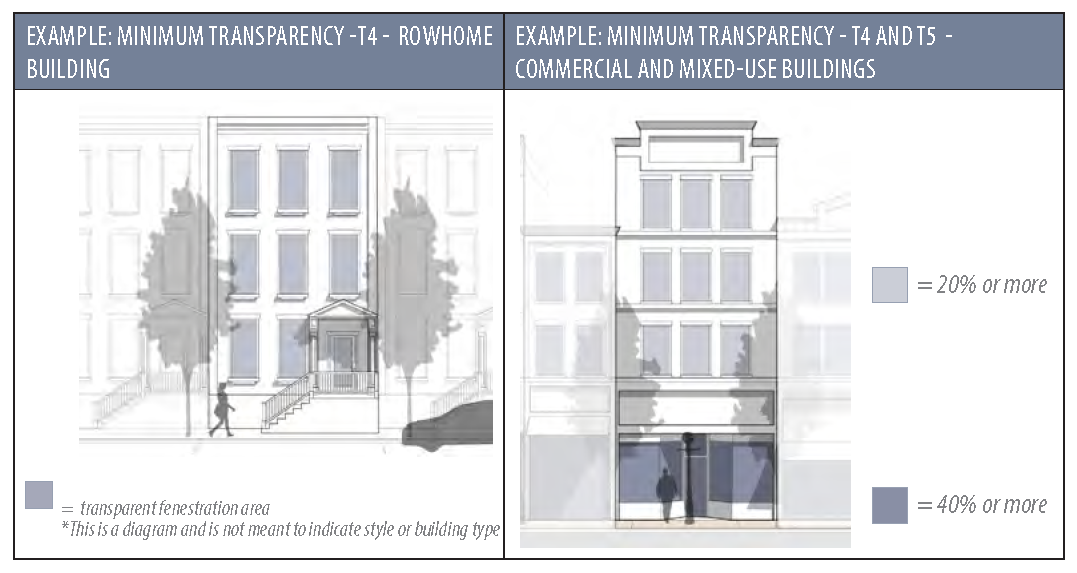
Transparency, specific to zones T4 and T5: Any commercial or mixed-use building elevation facing a street, waterway, or public space shall include a minimum of 40% of transparent fenestration (windows and doors) on the ground floor and 20% on upper floors. Apartment Houses shall conform to these requirements as much as possible, however the minimum percentage of transparent fenestration on the ground floor may be adjusted at the discretion of the Design Review Body. It shall not be reduced to lower than 30%.
2.
Proportion and Details:
a.
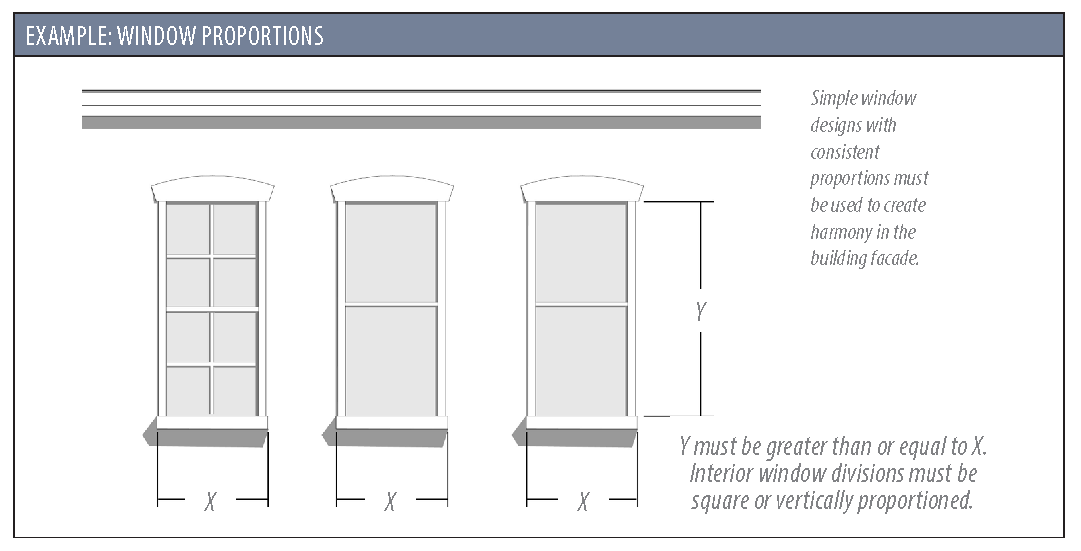
Windows shall not be flush with exterior wall treatments. Windows shall be provided with an architectural surround at the jambs and header, and a projecting sill.
b.
Window openings may be grouped horizontally, but trim between windows shall be at least 3.5 inches wide. This does not apply to storefront windows.
c.
Specific to zones T4 and T5:
i.
Facades should have several window sizes with smaller ones above. This is particularly important when buildings rise more than 2 stories.
ii.
Thin mullions or muntins shall be required on windows larger than 2 feet in any direction, except for shopfronts. The depth of the mullion shall not be less than the width.
D.
Architectural Details:
1.
Shutters: Shutters shall be sized and placed so as to equal the width that would be required to cover the window opening. Operable shutters are preferred.
a.
Specific to zones T4 and T5: Shutters must be operable and have all appropriate hardware.
2.
Column Bays: Columns and piers shall be spaced no farther apart than they are tall. Column bays shall be of equal and precise proportions.
3.
Specific to zones T4 and T5:
a.
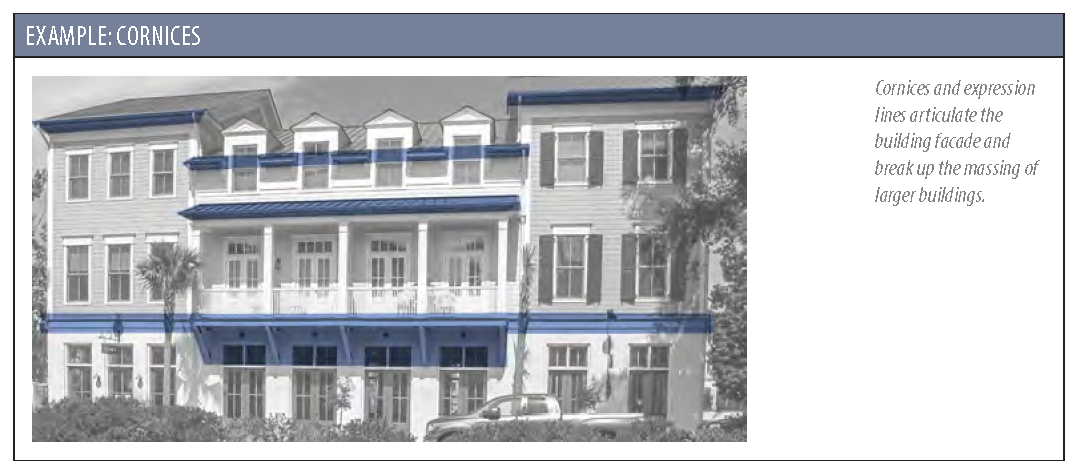
Cornices are required to delineate the tops of facades. Expression lines are required to delineate the divisions between the first floor and upper floors. Cornices and expression lines should either be a molding extending a minimum of 2 inches, or a jog in the surface plane of the building wall greater than 2 inches. Cornice or eave height shall be consistent with the dominant cornice or eave height of buildings on the same block.
b.
The elevation of the first floor and floor-to-floor heights shall be compatible with the expression of floors in the facades buildings on the same block.
c.
Buildings shall have a base, wherein the bottom is articulated differently from the rest of the building, either by change of material or a setback. Material and craftsmanship on the base shall be as or more durable and of equal or higher quality than the rest above. For single-family detached dwellings, the base consists of the porch and/or primary entry.
4.6.4 - SPECIFIC TO CONVENTIONAL DISTRICTS (SEE SECTION 4.2.2)
A.
Building Materials and Details:
1.
Building walls shall be finished in 1 or more (but not more than 3) of the following materials:
a.
Wood, painted or natural.
b.
Fiber cement board siding, smooth finish.
c.
Concrete masonry units with stucco (CBS).
d.
Reinforced concrete with stucco.
e.
Brick.
f.
Tabby (or stucco with oyster shell aggregate, typ.).
g.
Corrugated metal.
h.
Other compatible and authentic materials as approved by the Administrator.
2.
Specific to LI District: Building walls not visible from a public right-of-way may be finished in metal or exposed CMU block, in addition to the materials listed above.
3.
Visible foundation walls and chimneys shall be finished in 1 of the following materials:
a.
Brick.
b.
Stucco.
c.
Tabby.
d.
Specific to LI District: Painted CMU block is permitted.
B.
Roof Forms, Specific to RMX and IC Districts:
1.
In general a slope of 4:12-12:12 is appropriate for primary roofs, while ancillary roof slopes may be 3:12-5:12.
2.
Permitted roof types include gabled, hipped, shed, barrel vaulted, flat, mono-pitch, mansard, and domed. Applied and partial (less than 3 sides) mansard roofs are not typically permitted, but may be at the discretion of the Design Review Body based on compatibility with the surrounding context, size, mass and scale of the structure.
3.
Shed, flat, and mono-pitch roofs shall be concealed with parapets along the street frontage.
4.
Specific to IC District:
a.
Downspouts and gutters are to be galvanized steel, aluminum, or copper. Downspouts and gutters are to match in materials and finish.
b.
Chimneys shall have a masonry exterior finish.
c.
Roof penetrations shall be hidden or painted to match the color of the roof.
d.
Skylights must be flat to the pitch of the roof and shall not be located on any sloped roof facing the primary frontage.
C.
Windows and Doors:
1.
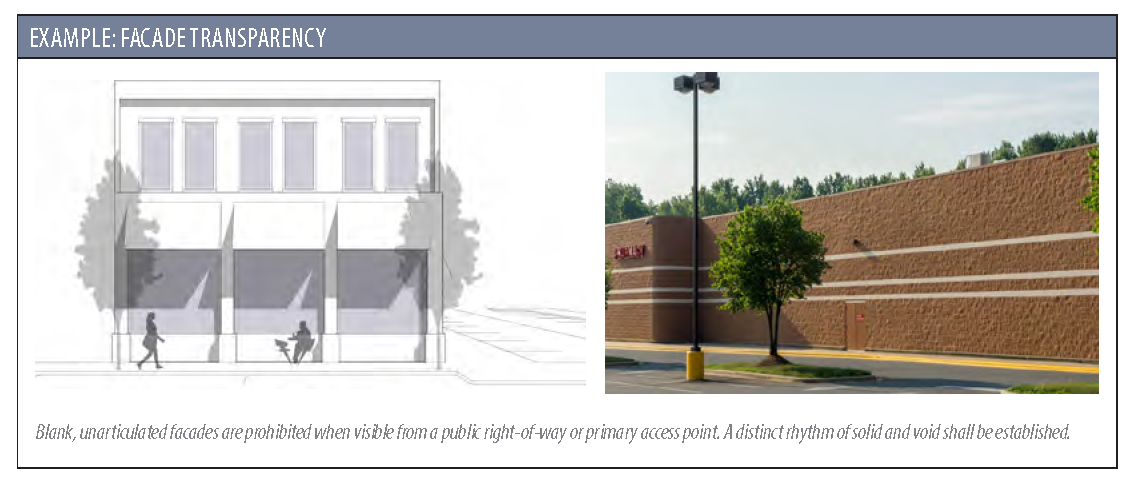
Transparency, Specific to RMX and IC Districts: Building elevations that face the street shall have at least 40% of the first-floor wall area consist of windows and/or doors, and 15% of upper floors.
D.
Massing and Articulation:
1.
Building footprints shall not be larger than a single block. Where there is not a defined block structure in the area, see Section 7.2.2 B. for additional standards.
2.
Facades that are visible from streets, parks, squares, waterways, significant pedestrian spaces, or primary vehicular access points or parking areas:
a.
Shall not include expanses of blank walls (without any transparent windows or doors) of 20 linear feet or greater.
b.
Shall be divided into architecturally distinct sections (or bays) with similar proportions. The bays should average no greater than 35 linear feet wide through the use of different architectural divisions or elements such as pilasters, columns, and/or changes in wall depths or floor and roof levels.
c.
Shall be in harmony with each other in terms of scale, proportion, detailing, material, color, and design.
3.
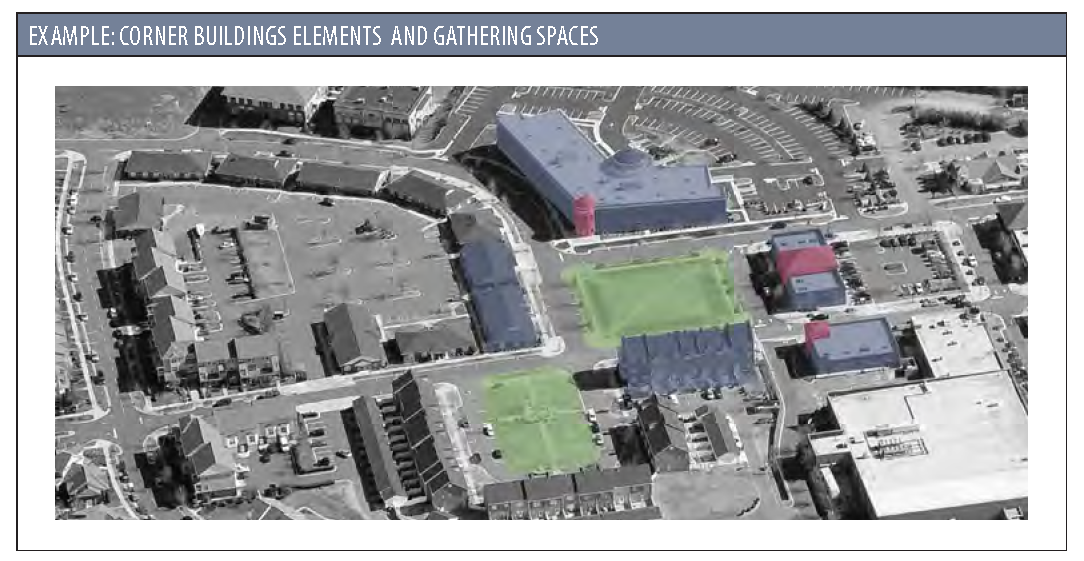
On corner lots, distinct roof or building elements shall be utilized, such as porches, canopies, Arcades, or towers. Buildings may be aligned to create public gathering spaces, while conforming to the building placement and orientation requirements set out in Section 2.5.1 C.
E.
Architectural Proportions and Details:
1.
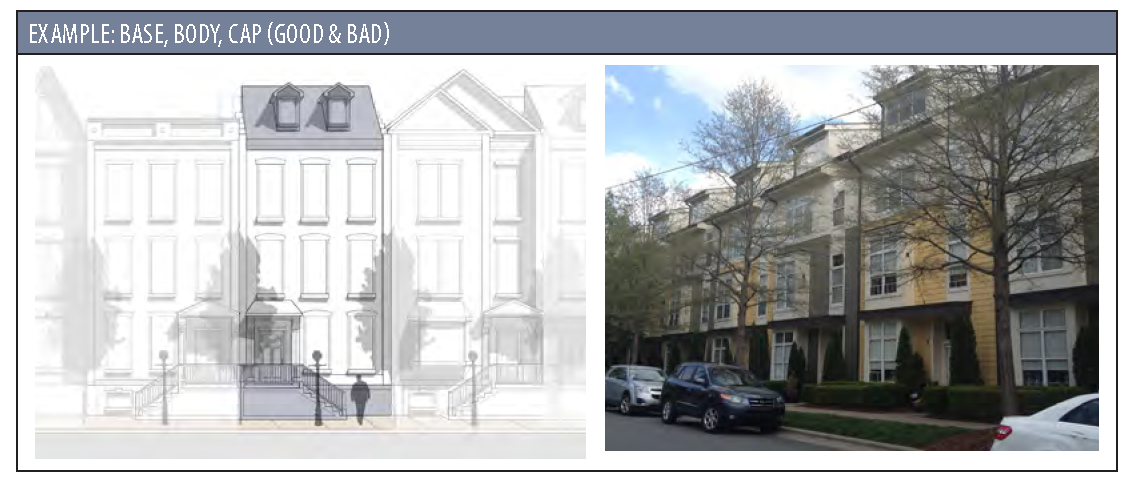
All buildings shall have a clearly discernible base, body, and cap, with masonry soldier courses or other horizontal expression lines separating each element.
2.
Cornices are recommended to delineate the tops of facades. Expression lines are recommended to delineate the divisions between the first floor and upper floors.
3.
Colors: Recommended colors are traditional historic colors, earth tones (greens, tans, light browns, terra cotta, grays, pale primary and secondary colors, and white and cream tones. Trademark colors are considered signage and will be counted as such unless they are consistent with the color palette as previously described.
F.
Additional Guidelines Specific to IC District: All buildings constructed as part of a campus may be subject to the guidelines for civic building outlined in Section 4.5.10, or shall be held to standards similar to the requirements in the surrounding context.
4.6.5 - MANUFACTURED HOME PARK DISTRICT STANDARDS
The following standards shall apply to all development within the Manufactured Home (MH) Park District:
A.
Site Size: Parcels shall be a minimum of 5 acres with a minimum width of 150 feet.
B.
Infrastructure: The site shall be served by public water and sewer facilities.
C.
Maximum Density: 7 manufactured home units per acre.
D.
Minimum Space Per Unit: 40 feet in width, and 4,000 square feet of area which shall be clearly defined.
E.
Minimum Unit Spacing: 20 feet of clearance between only those MHs parked end to end and any building located within the park.
F.
Open Space: Required dedication of open space shall be in accordance with the provisions of 7.4.
G.
Subdivision: All lots-regardless of whether they are proposed for sale or lease-shall undergo Subdivision Review (Section 9.9).
H.
Posting: The "certificate of occupancy" shall be conspicuously posted in the office or on the premises of the MH District.
I.
Administrative Procedures:
1.
A proposed Manufactured Home Park must be rezoned to the MH Park District through the amendment process in Section 9.16 (Amendments).
2.
Effect of Approval: If approved by city council, all information pertaining to the proposal shall be adopted as an amendment to this Code as the standards of development for the particular MH Park District.
J.
Permanent Installation:
1.
MHs shall be attached to a permanent foundation of brick, concrete, framing, or block that is unpierced, except for required ventilation and access or for flood hazard construction.
2.
Any tongue, axles, running lights, and removable towing apparatus must be removed prior to the issuance of a certificate of occupancy.
K.
Entrances:
1.
At the main entrance, there shall be an entryway transition, such as a porch or stoop, that is a minimum of 6 feet by 6 feet.
2.
Stairs, porches, entrance platforms, ramps, or other means of access shall be attached to the structure and anchored securely to the ground.
L.
Roof Form and Materials:
1.
Roofs shall have a minimum eave projection and roof overhang of 6 inches, not including the gutter.
2.
Roofs must be covered with a material that is customarily used on site-built dwellings. Aluminum or metal roofing is not permitted unless standing seam metal roofing or metal shingles are used.
M.
Wall Materials: Exterior siding shall be wood, vinyl, metal horizontal siding, brick, fiber cement board, stucco, or similar materials. Smooth, ribbed, or corrugated metal or plastic panels, exposed plywood, and materials with a high-gloss finish are not permitted.
4.7.1 - APPLICABILITY AND INTENT
The following principles shall be considered by the HRB for new construction within the Historic District overlay. The intent of these principles is to protect the integrity and coherence of the Historic District, and to provide clarity and consistency for developers, designers, and regulators.
4.7.2 - PRINCIPLES FOR COMPATIBLE INFILL
A.
The District is the Resource, Not Only Its Individual Parts: Beaufort is comprised of a number of individually significant buildings. Additionally, Beaufort's historic areas are significant as a collective whole, and shall be considered as such and protected in their entirety. This is the primary, overarching principle.
1.
New construction shall respond to and protect the integrity of the overall Historic District in much the same way as an addition does to a historic building.
2.
The integrity of the district — why, where and when a property is important — shall be upheld in all new construction and rehabilitation projects. Guidelines for determining integrity are as follows:
a.
Location: This is the relationship between the property and its historical context.
b.
Design: This is the combination of elements that create the feeling of a district or structure. These elements include building patterns, streetscapes, site elements, building size, mass and scale, spatial relationships, and specific architectural elements and details.
c.
Setting: This is the physical environment of a property, and should be evaluated on its context as well as on the historical role the property has played and continues to play. Important features include topography, vegetation, man-made features, and relationships between existing structures and their surroundings.
d.
Materials: These are the physical elements that make up a property or district.
e.
Workmanship: This is the physical evidence of the crafts of a particular culture or time period. This particularly applies to rehabilitation projects, but for new infill projects, workmanship of surrounding structures should be considered and respected. Retaining the details of the original craft and craftsman (i.e., wood, masonry, tabby etc.) of the original building ensures the historic fabric is retained and serves as an important component of the integrity and the patina of age of individual structures and the district as a whole.
f.
Feeling: This is the property's expression of the aesthetic or historic sense of a particular period of time. This particularly applies to rehabilitation projects, but for new infill projects, the feeling of surrounding structures should be considered and respected.
g.
Association: This is the direct link between an important historic event or person and a property. This particularly applies to rehabilitation projects, but for new infill projects, association of particular sites and neighborhoods should be considered.
B.
New Construction Shall Reinforce the Historic Significance of the District: Infill buildings should relate to and strengthen the core characteristics of the district, as identified in the National Register nomination's "Statement of Significance."
1.
New construction should build upon the history and established pattern of the district through its design, landscape, use, and cultural expression. An understanding of the character and significance of the district should predicate any design or development activities.
2.
If applicable, cultural expressions and/or historic uses within the district may be considered in design or development activities.
C.
New Construction Shall Complement and Support the District: The Historic District has a distinct rhythm of massing, scale, and siting. Infill buildings should not deviate in a detracting manner from these elements, but appear as complementary members of the district.
1.
Lot size, massing, siting, floor area ratio, and height must correspond to the adjacent buildings that contribute to or complement the rhythm of the district.
2.
The use of buildings will be secondary to their design and integration into the district. However, newly introduced uses should not be detrimental to the historic fabric.
D.
Infill Shall Be Compatible Yet Distinct: New buildings should be identifiable as being of their period of construction; however, they should not be so differentiated that they detract from - or visually compete with - their historic neighbors. Within historic districts, compatibility is more important than differentiation.
1.
Because the district is the resource, the reconstruction of buildings that existed within the district during the period of significance is allowed. Reconstructions shall be done in accordance with the Secretary of the Interior's "Standards for Reconstruction."
2.
Style is discouraged from being the primary indicator of differentiation.
3.
Means of differentiation may include materials, mechanical systems, and construction methods.
E.
The Exterior Envelope and Patterning of New Buildings Shall Reflect District Characteristics: Infill design elements, patterning, texture, and materials should reflect the aesthetic and historic themes of the district.
1.
Patterns of fenestration, building divisions, setbacks, and landscapes that are characteristic of the district should inform the design of new buildings.
2.
Mechanical and automobile infrastructure should be appropriately concealed when not consistent with the district's character.
F.
Contributing Buildings Should Not Be Demolished to Create Infill Opportunities: Properties deemed contributing in the "1997 Beaufort County Above Ground Historic Sites Survey," or in the most recent historic resources survey, should not be removed or rendered non-contributing to make way for new construction.
G.
Archeological Resources Shall Be Preserved in Place or Mitigated: When new construction disturbs or affects archaeological resources, mitigation measures should be taken such that the history of a the site can be traced. See Section 8.3 for archeological assessment requirements.
1.
Archaeological mitigation must conform to local, state, and federal laws and accepted professional standards.
2.
When appropriate, archaeological mitigation should be accessible to the general public in an educational capacity.
3.
Information yielded from archaeological mitigation should be interpreted in the new building and throughout the district.

