
Beaufort City Zoning Code
11
NONCONFORMITIES
11.1.1 - PURPOSE
The purpose of this article is to regulate and limit the continued existence of uses and structures established prior to the effective date of this Code (or any subsequent amendment) that do not conform to this Code. Any nonconformity created by a change in the classification of property or the text of these regulations shall also be regulated by the provisions of this section.
11.1.2 - INTENT
The provisions of this article are intended to limit substantial investment in nonconformities and to bring about their eventual elimination and/or lessen their impact upon surrounding conforming uses in order to preserve the integrity of the areas in which they are located.
11.1.3 - APPLICABILITY
The provisions of this article apply to all structures and parcels of land in the city with the following exceptions:
A.
Contributing historic structures in the Historic District, and structures outside the Historic District that are individually listed on the National Register of Historic Places.
B.
Existing Structures in the Boundary Street Redevelopment District, which shall comply with Section 2.7.3 G.2.
11.2.1 - MODIFICATIONS TO NONCONFORMITIES
A.
Applicability: The Administrator (Section 10.5) shall hear and decide changes of use from any landowner to:
1.
Make a change in use of a nonconforming use to a different, less-intense nonconforming use.
2.
Make a change in location of a nonconforming use of land to another location on the same property.
3.
Allow the replacement of a structure with a nonconforming use.
B.
Criteria for Approval: The Administrator may only grant a change for a nonconforming use or replacement of a nonconforming structure that has been destroyed after determining that:
1.
The proposed change will be more suitable and appropriate for the lot(s) on which it is located than the existing situation is.
2.
The proposed change will have a less harmful effect than the existing situation on the properties surrounding the lot(s) in question.
3.
The decision to grant the change will be consistent with the general purpose and intent of this Code, and will not adversely effect the neighborhood or otherwise be detrimental to the public welfare.
C.
Conditions of Approval: The Administrator, in granting such changes, may prescribe appropriate conditions and safeguards in conformity with this Code. Violation of such conditions and safeguards, when made a part of the terms upon which the change was granted, shall be deemed a violation of this Code, and shall be subject to enforcement provisions as prescribed per Article 12 (Violations and Enforcement).
11.3.1 - DEFINITION AND APPLICABILITY
A nonconforming use is a use of land, buildings, or structures that was lawfully established prior to the effective date of this Code, or a subsequent amendment thereto, but does not conform to the use regulations of Article 3 (Land Use Provisions) for the district in which it is located. This definition includes open uses of land (e.g., storage yards and parking lots), as well as the structures that contain nonconforming uses. The nonconformity may result from the adoption of this Code or any subsequent amendment.
11.3.2 - CONTINUATION OF EXISTING USE
A.
Any use existing at the time of the enactment of this chapter which does not conform with the provisions of this Code for the district in which it is located shall be deemed to be a nonconforming use and is subject to the standards of this Article. Once a nonconforming use is discontinued as per Section 11.3.4, it may not later be reestablished or converted to any other nonconforming use.
B.
When mobile home parks are located in districts other than the Mobile Home Park (MHP) District, the park may remain active, with units being brought in and replacing older units. However, the density shall not exceed the originally approved density without the property being rezoned to MHP.
11.3.3 - EXPANSION OF USE
A nonconforming use of land or building shall not be enlarged, intensified, or expanded except as follows: A nonconforming use may be extended throughout any parts of a building that were manifestly arranged or designed for such use at the time of adoption or amendment of this Code, but no such use shall be extended to occupy any land outside such building.
11.3.4 - ABANDONMENT/DISCONTINUANCE
A nonconforming use of a building or premises which has been discontinued shall not thereafter be returned to the same or any other that use.
A.
Determination of Discontinuance: A nonconforming use shall be deemed discontinued when any of the following has occurred within a continuous period of 180 days:
1.
The owner has, in writing or by public statement, indicated intent to abandon the use.
2.
A conforming use has replaced the preceding nonconforming use.
3.
All of the buildings or structures on the subject property housing the nonconforming use have been removed.
4.
Any basic utilities including water, electric and sewer service are disconnected by the utility provider.
5.
Business license has not been renewed.
6.
The property, structure or use has been vacant or inactive.
a.
This may be implied from acts — or the failure to act — including, but not limited to, the removal of and failure to replace the characteristic equipment and furnishings, lack of utility consumption necessary to maintain the use at an operable level, documented vacancy, or other circumstances.
b.
If operations have ceased for more than 180 consecutive days, the presence of characteristic equipment and furnishings is not, in and of itself, sufficient to establish the continuity/operation of the use.
c.
The mere vacancy of a structure for a period exceeding 180 consecutive days that was initially constructed as a single-family dwelling and whose most recent use was as a single-family dwelling shall not constitute a discontinuance of the use.
11.3.5 - DAMAGE OR DESTRUCTION
When a building or structure devoted to a nonconforming use is damaged by fire, flood, explosions, wind, earthquake, war, riot or other act, to the extent of more than 100% of the property's Fair Market Value — as shown on the county tax records — at the time of such damage, such a building, if restored, shall thereafter be devoted to conforming uses.
11.4.1 - DEFINITION AND APPLICABILITY
A nonconforming structure is a physical feature or characteristic of a use, building, structure, or other development of land that was lawfully established prior to the effective date of this Code, but does not conform to dimensional, design, locational, or other requirements of this Code.
11.4.2 - REPAIR AND MAINTENANCE OF EXISTING STRUCTURE
Any building existing at the time of the enactment of this Code that does not conform with the provisions of this Code for the district in which it is located shall be deemed to be a nonconforming structure and is subject to the standards of this article.
A.
Repairs, Alterations, and Maintenance: Any nonconforming building or structure that is renovated, repaired, altered, or otherwise improved by more than 100% of the Fair Market Value of the structure at the time of renovation, repair, or alteration shall be brought into conformance with landscaping, screening, sign, lighting, access, and parking requirements.
1.
In transect zones, the building must also be brought into compliance with setback, frontage, and architectural standards of this Code. If full compliance can not be achieved due to the scope of work (e.g., mostly interior) the building must be brought into compliance as much as possible.
2.
In conventional zones, architectural design changes required to bring the site into conformity with the requirements of this Code shall be in proportion to the alterations proposed by the applicant.
B.
Damage or Destruction:
1.
When a nonconforming building or structure damaged by fire, flood, explosions, wind, earthquake, war, riot or other act, to the extent of more than 75% of the Fair Market Value of the structure — as shown on the county tax records — at the time of such damage, such a building, if restored, shall conform to the requirements of this Code.
C.
Applicability: The provisions of this section shall not apply to any detached single-family dwelling used for residential purposes. In the case of a significant calamity, such properties may be repaired or rebuilt, regardless of the cost in relationship to the Fair Market Value of the structure, within the original (pre-disaster) building footprint.
11.4.3 - EXPANSION OF STRUCTURE
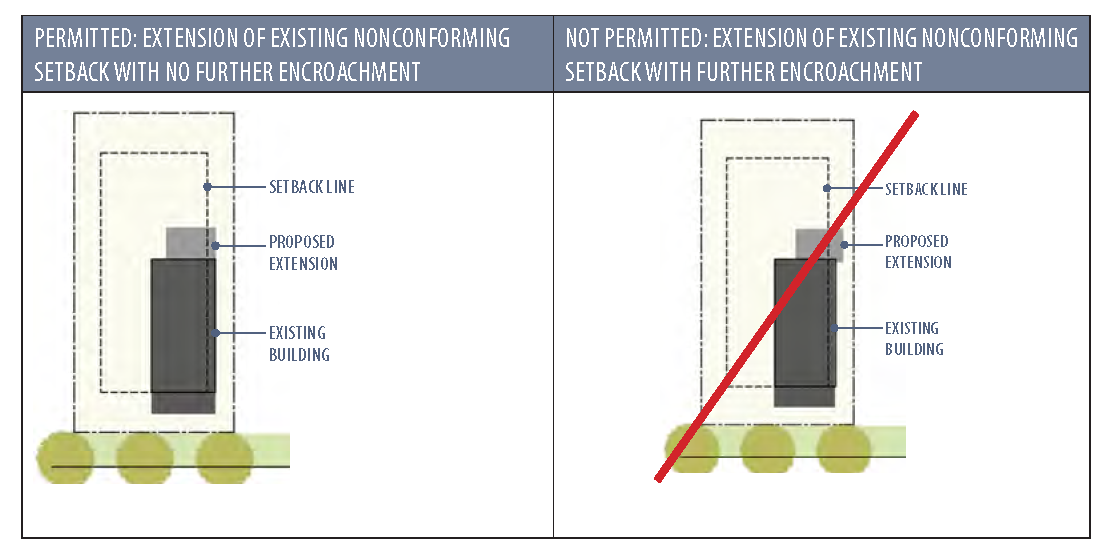
A nonconforming structure shall not be expanded in any way, except in conformity with this Code, except in cases where the primary building on a lot is nonconforming solely as a result of a setback encroachment, additions to the structure can be allowed, provided the new addition does not project into the setback. If a proposed addition would encroach into the same setback that already had been encroached upon, the addition can be allowed, provided it projects no further into the setback than the existing structure.
11.4.4 - RECONSTRUCTION
A nonconforming structure shall not be demolished and rebuilt as a nonconforming structure.
A.
Exceptions: A nonconforming structure listed as contributing in the "Beaufort County Above Ground Historic Resources Survey Beaufort County, South Carolina" may be allowed to be rebuilt within the original (pre-demolition) footprint.
11.5.1 - DEFINITION AND APPLICABILITY
A nonconforming lot is a lot that was lawfully created prior to the effective date of this Code, but that does not meet the dimensional requirements of Article 2 (Map and Districts) for the district in which it is located.
11.5.2 - STANDARDS FOR DEVELOPMENT
A.
Any existing platted lot, described above, is buildable.
B.
When the use proposed for a nonconforming lot is one that is conforming in all other respects, but the applicable setback requirements set forth in Article 2 cannot practicably be complied with, then the Administrator may allow deviations from the setback requirements if (s)he finds that:
1.
The property cannot reasonably be developed for the use proposed without such deviations.
2.
These deviations are necessitated by the size or shape of the nonconforming lot.
3.
The property can be developed as proposed without any significant adverse impact on surrounding properties or the public health or safety.
C.
For purposes of this section, compliance with applicable building setback requirements is not reasonably possible if a building serving the minimal needs of the proposed use cannot practicably be constructed and located on the lot in conformity with such setback requirements; however, mere financial hardship does not constitute grounds for finding that compliance is not reasonably possible.
11.6.1 - NONCONFORMING SIGNS
A.
Determination of Nonconformity: Any sign that does not meet the standards of this Code will be considered a legal nonconforming sign, provided that it received a permit prior to the adoption of this Code.
B.
Loss of Legal Nonconforming Status: A legal nonconforming sign shall lose this designation if:
1.
The sign is relocated or replaced.
2.
The structure, design, or size of the sign is altered in any way. This does not refer to normal maintenance or lettering changes on changeable copy signs, nor does it refer to minor modifications to sign-face attachment for the purposes of public safety.
3.
A tenant vacates a building, in which case all existing signs shall be removed within 30 days.
C.
Maintenance and Repair of Nonconforming Signs: An existing nonconforming sign cannot be modified in any way except for routine maintenance (e.g., rot repair, painting, fading, electrical) without bringing the sign into conformity with this section subject to the requirements of Section 11.6.1 D.1. and 11.6.1 D.2. Routine maintenance will include replacement of individual's names listed on signs. It will not include rebranding or changing business name or logo.
D.
Mandatory Compliance: All signs must comply with the standards of this Code with the following provisions:
1.
Any existing sign not meeting the requirements of this Code shall be brought into compliance with this Code before a business license will be issued for a new resident business, or before a business name can be changed.
2.
Temporary nonconforming signs that obtained a sign permit before the adoption date of this Code shall be permitted to remain for the life of the permit.
3.
Nonconforming monuments, supports and brackets, and unused signs must be completely removed before a new sign is installed. Any holes in the building must be appropriately patched.
4.
Nonconforming multi-tenant signs may continue to update individual business plaques; however, the size and design of the monument structure may not change without bringing the sign into compliance with this Code.
(Ord. No. O-9-19, 6-23-2020)
11.7.1 - PARKING NONCONFORMITIES
Specific to Conventional Zones Only: In cases of nonconformance due to insufficient automobile parking, buildings may not be enlarged or expanded until/unless parking accommodations satisfy the requirements for the new construction as described in Section 5.7 (Parking). The Administrator may waive or provide relief from this requirement if it is determined that doing so will have no material adverse impact on the property or surrounding community. Parcels located in Transect Zones are not subject to this requirement.
11.7.2 - LANDSCAPING NONCONFORMITIES
When modifications are made to developed nonconforming property, a certain percentage of the value of those modifications shall be expended toward landscaping on the overall site in order to incrementally bring the site closer to compliance as follows:
A.
When improvements to existing buildings or sites exceed $25,000 in value, 5% of the value of these improvements shall be expended towards bringing the site and landscaping into compliance with this Code.
1.
These improvements include additions to existing buildings, interior or exterior building renovations or improvement, addition of communications towers and antennae, and/or modifications made to the ground other than to structures, such as grading, paving, repaving, or re-striping of parking lots.
2.
These improvements do not include signage or landscaping, or routine maintenance items such as mechanical system updates, rot repair, painting, etc.
B.
Upon construction of new freestanding buildings, whether in greenfield or infill/redevelopment situations, all landscaping requirements for that zoning district shall apply (see Sections 5.5 and 5.6).
C.
The Administrator shall review and approve the proposed landscaping plan to assure optimal effectiveness in bringing the site closer to compliance. The priority for installation of landscaping is as follows:
1.
Creating or completing the streetscape based on the street regulating plan in Appendix C.
2.
Perimeter screening of parking areas.
3.
Planting of overstory trees in the interior of parking areas — the work may include removing portions of pavement in order to install landscaping peninsulas, perimeter buffers, and other landscaping areas. Where the overall circulation and parking pattern will be disrupted, the developer shall not be required to remove paving.
D.
Once the property is brought into compliance to the extent practicable, no further landscaping expenditures shall be required.
E.
Where parking spaces are removed in order to provide landscaping as required in this section, the required number of parking spaces specified in Section 5.7 shall be automatically reduced accordingly, but it may not go below 67% of the requirements in that section without a variance.
11.7.3 - LIGHTING NONCONFORMITIES
Any lighting that does not meet the standards set out in Section 5.8 and trespasses onto a neighboring property must be brought into compliance within 3 months of the date of adoption of this Code.
11.8.1 - APPEALS
Appeals of the decision of the Administrator may be made to the Zoning Board of Appeals as stated out in Section 9.15.2.
11.8.2 - EXTENSIONS
Where timeframes for action are given in this section, property owners may be granted up to two extensions of the given timeframe. Extensions requests be received in writing a minimum of one week prior to the time expiration.
Example: a non-conforming use is considered abandoned if it has been inactive for 180 days. The property owner may request up to two 180-day extensions to restart this non-conforming use.

