
Beaufort City Zoning Code
APPENDIX A
LANDSCAPING
A.2: - RECOMMENDED TREES AND SHRUBS
The following commonly found species of trees and evergreen shrubs are listed by category. The lists are not exhaustive and applicants are not required to select species found on these lists.
| BROAD-LEAVED OVERSTORY TREES | |
|---|---|
| American Beech | Fagus grandifolia |
| American Elm | Ulmus americana |
| American Sycamore | Platanus occidentalis |
| Ashleaf Maple | Acer negundo |
| Black Oak | Quercus velutina |
| Black Gum | Nyssa sylvatica |
| * Drake Elm (Everclear, Allee or Bosque) | Ulmus Parvifolia |
| Eastern Cottonwood | Populus deltoides |
| Honeylocust | Gleditsia triancanthos |
| * Cathedral Live Oak | Quercus virginiana 'Cathedral' |
| Laurel Oak | Quercus laurifolia |
| Live Oak | Quercus virginiana |
| * Overcup Oak | Quercus Iyrata 'Highbeam' |
| Pecan | Carya illinoensis |
| Pignut Hickory | Carya glabra |
| Pumpkin Ash | Fraxinus profunda |
| *Pyramidal European Hornbeam | Carpinus betulus 'Fastigiata' |
| Red Maple | Acer rubrum |
| *Nuttall oak | Quercus nuttalli |
| Shumard Oak | Quercus shumardii |
| Southern Magnolia | Magnolia grandiflora |
| Southern Red Oak | Quercus falcata |
| Swamp Chestnut Oak | Quercus michauxii |
| Sweet Gum | Liquidamber styraciflua |
| *Trident Maple | Acer buergeranium 'Aeryn' |
| Water Tupelo | Nyssa aquatica |
| White Oak | Quercus alba |
| Willow Oak | Quercus phellos |
| *Starred trees are recommended for street tree plantings | |
| CONE-BEARING OVERSTORY TREES | |
|---|---|
| *Bald Cypress | Taxodium distichim |
| Loblolly Pine | Pinus taeda |
| Long Leaf Pine | Pinus palustris |
| Pond Cypress | Taxodium distichum nutans |
| Pond Pine | Pinus serotina |
| Slash Pine | Pinus elliottii |
| Short Leaf Pine | Pinus echinata |
| Spruce Pine | Pinus glabra |
| *Starred trees are recommended for street tree plantings | |
| UNDERSTORY TREES | |
|---|---|
| Allegheny Chinkapin | Castanea pumila |
| American Holly | Ilex opaca |
| American Plum | Prunus americana |
| Bigleaf Snowbell | Styrax grandifolia |
| Bitternut Hickory | Carya cordiformis |
| Black Cherry | Prunus serotina |
| Black Willow | Salix nigra |
| Blackjack Oak | Quercus marilandica |
| Bluejack Oak | Quercus incana |
| Buckthorn Bumelia | Bumelia lycioides |
| Cabbage Palmetto | Sabal palmetto |
| Carolina Ash | Fraxinus caroliniana |
| *Carolina Basswood | Tilia caroliniana |
| Carolina Buckthorn | Rhamus caroliniana |
| Carolina Laurelcherry | Prunus caroliniana |
| Carolina Silverbell | Halesia carolina |
| Chickasaw Plum | Prunus augustifolia |
| Coastal Plain Willow | Salix caroliniana |
| Common Hoptree | Ptelea trifoliata |
| Common Persimmon | Diospyros virginiana |
| Common Sweetleaf | Symplocus tinctoria |
| *Crepe Myrtle | Lagerstroemia indica |
| *Dahoon Holly | Ilex cassine |
| Eagleston (a.k.a. Foster) Holly | Ilex attenuata 'Eagleston' or 'Fosteri' |
| Eastern Coralbean | Erythrina herbacea |
| Eastern Redbud | Cercis canadensis |
| Eastern Red Cedar | Juniperus virginiana |
| Flatwoods Plum | Prunus umbellata |
| Florida Basswood | Tilia floridana |
| Florida Maple | Acer barbatum |
| Flowering Dogwood | Cornus florida |
| Fringetree | Chionanthus virginicus |
| Green Ash | Fraxinus pennsylvanica |
| *Hasse Magnolia (a.k.a. Alta) | Magnolia grandiflora 'Hasse' or 'Alta' |
| Hercules Club | Anthoxylum clava-herculis |
| Ironwood | Carpinus caroliniana |
| Littlehip Hawthorn | Crataegus spathulata |
| Loblolly Bay | Gordonia lasianthus |
| Mockernut Hickory | Caryatomentosa |
| Myrtle Oak | Quercus myrtifolia |
| *Oklahoma Redbud | Cercis reniformis 'Oklahoma' |
| Parsley Hawthorn | Crataegus marshallii |
| Pawpaw | Asimina triloba |
| Planer Tree | Planera aquatica |
| Possumhaw Holly | Ilex decidua |
| Post Oak | Quercus stellata |
| Red Buckeye | Aesculus pavia |
| Red Mulberry | Morus rubra |
| Redbay | Persea borbonia |
| River Birch | Betula nigra |
| Hickory | Carya pallida |
| *Sabal Palm | Sabal palmetto |
| Sassafras | Sassafrass albidum |
| Sourwood | Oxydendrum arboreum |
| Southern Bayberry | Myrica cerifera |
| Southern Crab Apple | Malus angustifolia |
| Southern Red Cedar | Juniperis silicicola |
| Sparkleberry | Vaccinium arboreum |
| Sugarberry | Celtis laevigata |
| Swamp Cotton wood | Populus heterophylla |
| Sweetbay | Magnolia virginiana |
| Tough Bumelia | Bumelia tenax |
| Turkey Oak | Quercus laevis |
| Water Hickory | Carya aquatica |
| Water Oak | Quercus nigra |
| Waterlocust | Gleditsia aquatica |
| Witch Hazel | Hamamelis virginiana |
| *Yaupon Holly, Weeping | Ilex vomitoria 'Pendula' |
| *Starred trees are recommended for street tree plantings | |
| SCREENING SHRUBS | |
|---|---|
| Sasanqua | Cammellia sasanqua |
| Yaupon Holly | Ilex vomitoria |
| Chinese Mahonia | Mahonia fortuneiw |
| Nandina | Nandina domestica |
| Pittosporum | Pittosporum tobira |
| Podocarpus | Podocarpus macrophyllus |
| Indian Hawthorne | Raphiolepis indica |
| Cleyera | Ternstroemia gymnanthera |
| Laurestinus | Viburnum tinus |
| Japanese Viburnum | Viburnum macrophyllum |
| Elaeagnus | Elaeagnus pungens |
| So. Indica Azalea | Azalea indica |
| Burford Holly | Ilex cornuta "Burfordi" |
| Wax Myrtle | Myrica cerifera |
| Fatsia | Fatsia japonica |
| Florida Anise | Illicium floridanum |
| Pfitzer Juniper | Juniperus chinensis "pfi tzeriana" |
| Wax Leaf Ligustrum | Ligustrum japonicum |
| Oleander | Nerium oleander |
| Breath-of-Spring | Lonicera fragrantissima |
| Loropetalum | Loropetalum chinense |
| Juliana Barberry | Berberis julianae |
| Hedge Bamboo | Bambusa multiplex |
| Bay Laurel | Laurus nobilis |
| Banana Shrub | Michelia fi go |
| Sweet Myrtle | Myrtus communis |
| *Starred trees are recommended for street tree plantings | |
A.3: - SAMPLE TREE MITIGATION SCHEDULE
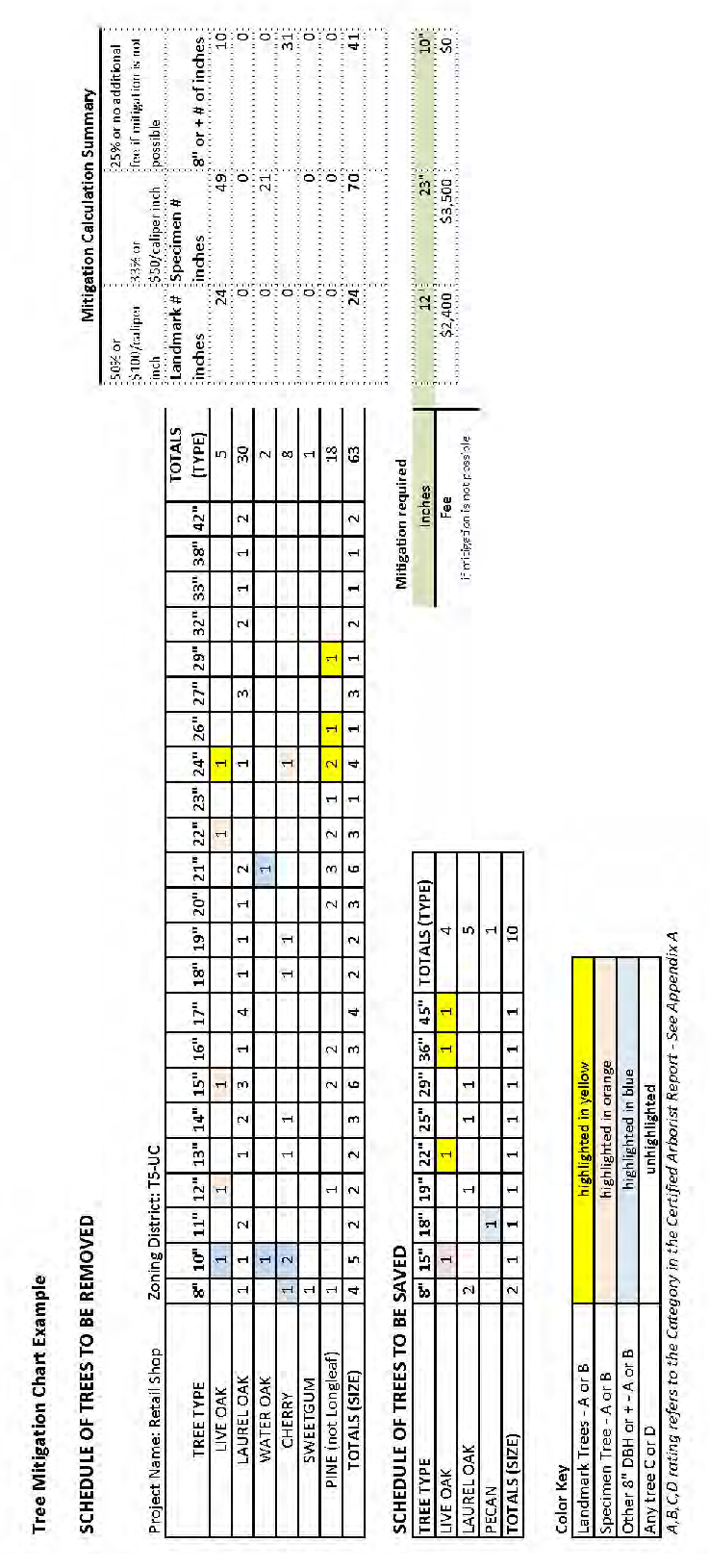
This is for illustrative purposes only and may be changed from time to time. An excel template for this planting schedule, along with typical tree planting details, can be found on the Planning Department's website.
A.1.1 - REQUIREMENTS
A Certified Arborist report is a document which provides visual assessment information based on a Level 2, Basic Tree Risk Assessment following the standards outlined in ANSI A300 - Part 9: Tree, Shrub and Other Woody Plant Management - Standard Practices. The report shall include:
A.
An outline of the individual health and condition of required tree(s) to be removed or saved;
B.
Root flare measurement for all specimen and landmark trees.
C.
Recommendations regarding performance and timing of pre-disturbance maintenance procedures using arboricultural practices for the promotion of individual tree health as required (e.g. crown pruning, root pruning and root fertilization) for all trees to be preserved; and
D.
Recommendations for follow-up procedures such as root invigoration and/or fertilization at conclusion of construction phase to be listed.
E.
Any special conditions required where development is required to encroach into a tree protection zone (e.g. special curbing, pervious paving, tree wells).
A.1.2 - FORMAT
The report format for specimen and landmark trees that are requested for removal should be placed into four categories based on structural and physical health factors, with each category highlighted with a specific color on the site plan:
Category A: Slight defects with a low risk of failure - Green.
Category B: Moderate defects with a reasonable risk of failure - Yellow.
Category C: Severe defects with a high risk of failure - Orange.
Category D: Critical defects with an imminent risk of failure - Red.
A.2.1 - SPECIFIC BEST PRACTICES
A.
Pruning Trees less than 6" caliper shall not be limbed up from the ground more than 7 feet to the lowest branches. For trees 6" caliper and larger, the live crown ratio - ratio of tree canopy height to trunk height - shall be no less than 2:1 (Example: A 30' tall tree should have a canopy no less than 20' tall and an exposed trunk no greater than 10' tall.)

