
Forsyth County Unincorporated
City Zoning Code
City Zoning Code
CHAPTER 10
- GENERAL PROVISIONS AND NONCONFORMING SITUATIONS11
Editor's note— Ord. No. 87, adopted January 11, 2006, amended chapter 10 in its entirety to read as herein set out. Former chapter 10, §§ 10-1.1—10-2.6, pertained to similar subject matter, and derived from the original codification of the Unified Development Code and Amendment D, § 1 of Oct. 14, 2002.
10-1.1. - Application of regulations.
No building, structure, land, water, or open space shall hereafter be used or occupied, and no building or structure or part thereof shall hereafter be erected, constructed, reconstructed, moved, structurally altered, and no new use or change shall be made of any building, structure, land, water, or open space unless in conformity with all the regulations specified in this Code. No utility may locate, operate, or expand without the approval of the board.
(Ord. No. 87, 1-11-2006)
10-1.2. - Minimum requirements.
The regulations set forth in this Code shall, unless the specific context indicates otherwise, be considered minimum requirements and shall apply uniformly to each class or kind of building, structure, or use.
(Ord. No. 87, 1-11-2006)
10-1.3. - Every use must be on a lot.
No building or structure shall be erected or use established unless it is on a lot of record, except as otherwise specifically provided.
(a)
For the purposes of this section, if a land disturbance permit that requires an as-built is necessary to develop a property for a non-residential use, a minor plat establishing a lot of record is not required prior to the submittal of the land disturbance permit application. Notwithstanding the foregoing exception, the approval of an LDP without a minor plat shall not waive any other requirements of this Code, and the as-built for the project shall not be approved without full compliance with this Code.
(Ord. No. 87, 1-11-2006; Amd. of 10-7-2021)
10-1.4. - One principal dwelling on a lot.
In any residential zoning district, only one principal dwelling and its accessory buildings may hereafter be erected on any one lot. In the A1 district, a maximum of two principal dwellings on a lot shall be permitted. Subject to application and receipt of a conditional use permit, a maximum of two principal dwellings on a lot may be permitted for the R1R district for lots five acres and greater in size.
(Ord. No. 87, 1-11-2006; Am. of 3-5-2020(2))
10-1.5. - Reduction in performance standards prohibited.
No lot shall be reduced, divided, or changed so that the size of lot, width of lot, street frontage, size of setbacks, or any other dimensional requirement of this Code is not maintained, unless such reduction or division is necessary to provide land which is acquired for a public purpose, or unless a variance is granted pursuant to applicable provisions of this Code.
(Ord. No. 87, 1-11-2006; Amd. of 11-11-2012)
10-1.6. - Setback reduction.
The front setback requirements of this Code may be reduced without requiring a variance in cases where one or more existing buildings located wholly or partially within 100 feet on either side of the proposed building or dwelling, on the same side of the same block and zoning district, and fronting on the same street of such block, is less than the minimum required front setback as shown on a survey provided by the applicant. In such cases, the setback on such lots may be less than the required setback, but not less than the average of the existing setbacks on the aforementioned lots, or a distance of ten feet from the closest edge of the street right-of-way line, whichever is greater.
(Ord. No. 87, 1-11-2006; Amd. of 11-11-2012)
10-1.7. - Setbacks and buffers, government line.
Where a lot or parcel of land is zoned residential or agricultural, the side and rear setbacks and exterior buffers required by this Code shall not apply when such property line is adjacent to, and contiguous with, property owned by the United States Army Corps of Engineers, United States of America.
(Ord. No. 87, 1-11-2006; Amd. of 11-11-2012)
10-1.8. - Setbacks and buffers, adjacent local governments.
Applicants for re-zoning adjacent to property outside the Forsyth County Government jurisdiction such as the City of Cumming shall submit official, current zoning verification of adjacent property from that jurisdiction. Such zoning may be subject to further investigation on the part of planning and community development staff. Setbacks and buffer requirements shall apply to the property per the adjacent property's zoning district equivalent in the Forsyth County UDC and its respective performance standards.
(Ord. No. 87, 1-11-2006; Amd. of 12-1-2011)
10-1.9. - Setbacks and buffers, lots accessed from an easement.
For all lots, in which an access easement serves as the primary method of access, the side of the lot that first abuts or intersects the easement shall be considered the front lot line for purposes of establishing setback and buffer requirements.
Figure 10.1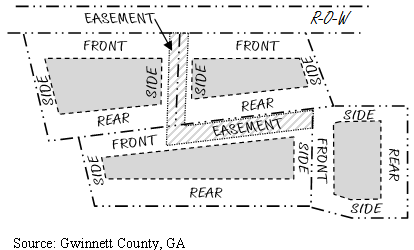
(Ord. No. 87, 1-11-2006; Amd. of 11-1-2007; Amd. of 11-11-2012)
10-1.10. - Setback and planting requirements for Georgia Highway 400.
A setback and visual buffer from Georgia Highway 400 is required to protect the beauty of the corridor through the county.
(a)
Limited access (Fulton County to 500 Feet North of SR 369 right-of-way).
(1)
A minimum setback of 60 feet from the right-of-way of Georgia Highway 400 must be maintained with the first 40 feet being an undisturbed buffer that shall meet the requirements of the Forsyth County Buffer Standards.
(2)
A limited encroachment shall be allowed into the setback and undisturbed buffer identified in 10-1.10(a)(1) if a property has satisfied those requirements under section 66-111(2) of the Forsyth County Sign Code, authorizing replacement of a legal non-conforming sign with two monument signs. The encroachment authorized by this subparagraph shall be the minimum encroachment required to install the monument signs and otherwise implement the enhanced landscaping and beautification measures set forth in section 66-111(2). It is the intention of this subparagraph that any encroachment authorized hereunder shall result in an overall buffer and setback that, from an aesthetic standpoint, provides a greater degree of landscaping enhancement than is otherwise required by the Forsyth County Buffer Standards. The encroachment and enhanced landscaping and beautification conemplated by this paragraph shall require application for an issuance of a land disturbance permit.
(b)
Controlled access (SR 369 right-of-way to Dawson County).
(1)
A minimum 60-foot front setback shall be maintained along all property fronting the Georgia Highway 400 right-of-way.
(Ord. No. 87, 1-11-2006; Amd. of 11-1-2007; Amd. of 11-11-2012; Amd. of 7-5-2018)
10-1.11. - Height limitations.
The height limitations established herein shall not apply to chimneys, smokestacks, church spires and steeples, domes, flag poles, public monuments, observation towers, water towers, non-commercial radio and television towers, electricity transmission towers, and utility poles.
(Ord. No. 87, 1-11-2006; Amd. of 4-20-2023)
10-1.12. - Use prohibited when not specified.
Except as otherwise provided, any use not specifically permitted in a zoning district as provided by this Code shall be prohibited in that district.
(Ord. No. 87, 1-11-2006)
10-1.13. - Outside construction.
Outside construction shall be limited to the hours of 7:00 a.m. to 7:00 p.m. Monday to Friday; 8:00 a.m. to 6:00 p.m. Saturday; and there will be no outside construction on Sunday. Concrete pours, including but not limited to tilt walls, slabs, and retaining walls, may be authorized outside those hour limits in order to avoid peak traffic, adverse temperatures, or weather, prevent unfavorable logistical impacts, or to complete the work in a single occurrence. The director of building and economic development is authorized to administratively approve such concrete pours for active commercial building permits. Such approval shall be limited to specified dates and times only and shall be sought prior to the pour occurring. Requests for such administrative approval shall be submitted via application provided by the department of building and economic development. Any application tendered after the pour has occurred shall be denied.
(Ord. No. 87, 1-11-2006; Amd. of 10-7-2021)
10-1.14. - Commercial maintenance requirements.
Developments in commercially zoned districts shall comply with the following site maintenance requirements once certificate of occupancy has been released; regardless of tenant or absence of tenant owner shall be responsible for ensuring that:
(a)
Cleanliness of the entire site shall be maintained by removing any trash, rubbish, or other debris deposited on the site.
(b)
Landscaping shall be maintained and dead or damage plants shall be replaced.
(c)
Damaged elements of building (such as but not limited to broken windows) and site (such as but not limited to curb stops, parking stripes, dumpster screening) shall be repaired or replaced if damaged, dilapidated or in disrepair.
(d)
Should any single occupant premise become vacant for more than 60 days, and the owner fails to maintain the property in accordance with the conditions above and upon notification from the county for such failure, the owner shall be subject to citation by the appropriate county code enforcement officer and shall be subject to the maximum fine permitted for ordinance violations for each violation of any provision of this ordinance.
(Ord. No. 87, 1-11-2006)
10-1.15. - Setback exemptions.
The following shall be exempted from setback requirements;
(a)
Fences and freestanding walls (per the requirements in chapter 16-4.13).
(b)
Uncovered entrance platforms.
(c)
Steps and patios which are on grade.
(d)
Roofed areas provided over common mailbox facilities.
(Amd. of 11-11-2012; Amd. of 10-22-2020(2); Amd. of 4-15-2021; Amd. of 10-7-2021; Amd. of 3-6-2025)
10-1.16. - Encroachments.
The following shall be permitted to encroach up to 18 inches into a required setback or building separation:
(a)
Gutters.
(b)
Overhangs.
(c)
Footers.
(d)
Sills.
(e)
Belt courses.
(f)
Cornices.
(g)
Chimneys.
(h)
Other architectural features as determined by the director.
(Amd. of 11-11-2012; Amd. of 7-18-2013)
10-1.17. - Determination of setbacks.
Front, side and rear setbacks shall be measured from their corresponding lot line(s). Corner lot frontage is determined per section 18-4.7.
Figure 10.2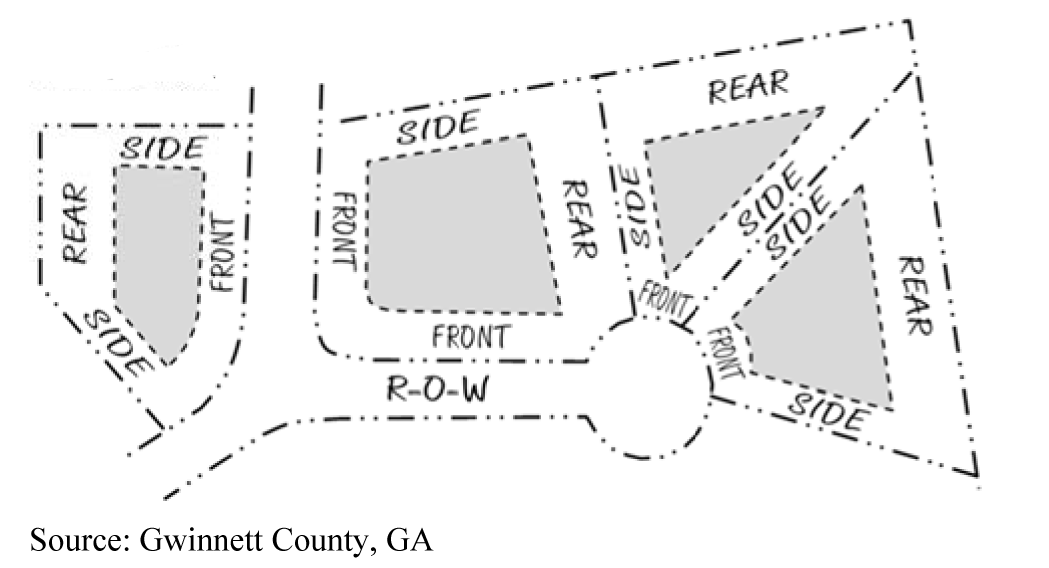
(a)
Flag lots. The lot line(s) adjacent and perpendicular to the "pole" of a flag lot shall be determined to be the front lot line(s) for purposes of setback calculation.
Figure 10.3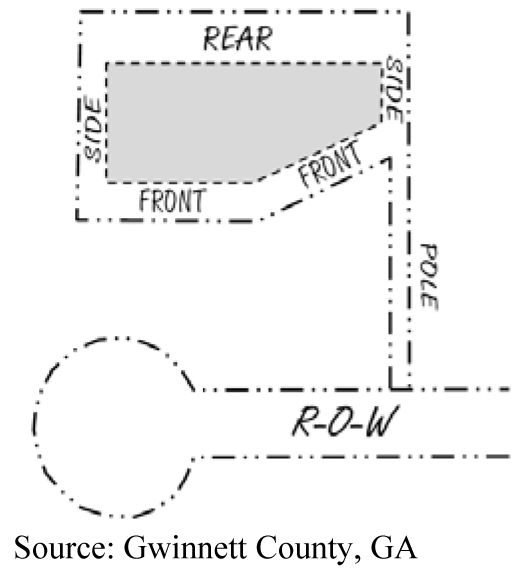
(b)
Triangular-shaped lots. A lot where two opposing side lot lines intersect at the rear of a lot shall be determined to have no rear lot line or corresponding setback requirement.
Figure 10.4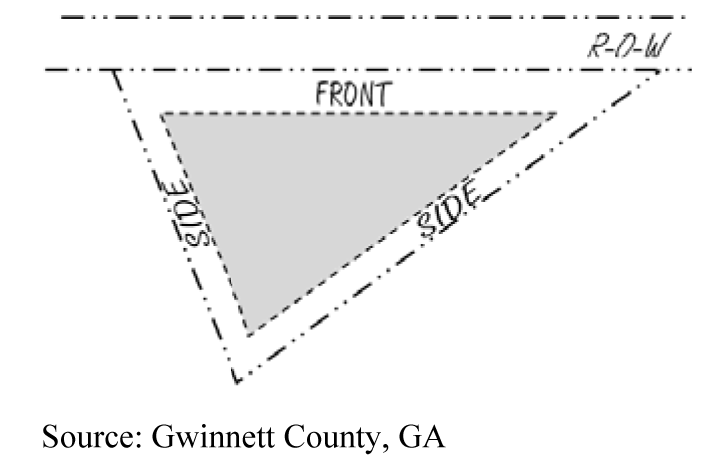
(Amd. of 11-11-2012; Amd. of 7-18-2013)
10-1.18. - Determination of yards.
(a)
Lots without a principal structure shall be determined as having no yards.
(b)
Lots with a principal structure shall have its yards determined as follows:
(1)
Front yard. A yard extending across the total width of a lot between side lot lines and being that area between the front lot line and that line or lines established by the front wall or walls of the principal structure projected to intersect the side lot lines. There can only be one front yard.
(2)
Rear yard. A yard extending across the total width of a lot between side lot lines and being that area between the rear lot line and that line or lines established by the rear wall or walls of the principal structure projected to intersect the side lot lines.
(3)
Side yard. A yard extending the total depth of a lot between the front and rear yards and being that area between the side lot lines and that line or lines established by the side wall or walls of the principal structure.
(Amd. of 11-11-2012)
10-1.19. - Setback and zoning buffer encroachments for accessory structures and accessory buildings.
(a)
Encroachments into the minimum required front or rear setbacks and zoning buffers otherwise required in this Code or previously approved zoning conditions are permitted for accessory structures, including pools, and accessory buildings for property located in residential, agricultural and mixed-use zoning districts with the exceptions as noted below:
(1)
Detached accessory apartments.
(2)
Detached offices, pool houses, or leisure sheds designed for recreational and leisure activities, but that do not qualify as a dwelling unit, and similar buildings.
(3)
Detached garages.
(4)
Storage and utility sheds.
(5)
Barns and other agricultural outbuildings.
(6)
Greenhouses, backyard chicken coops, and other structures related to non-commercial plant and animal shelter or storage.
(b)
Zoning buffers as referenced in this section include residential exterior buffers as required by zoning district performance standards or previously approved buffers as required by zoning conditions.
(c)
The maximum encroachment permitted pursuant to this section shall not exceed 50 percent of the minimum required front or rear setback or zoning buffer based on zoning district performance standards or previously approved zoning conditions, nor shall any such encroachment reduce the effective setback or buffer to less than 20 feet under any circumstance. Encroachments permitted pursuant to this section that would exceed the maximum indicated shall require a variance application and approval in accordance with sections 8-2, 8-3 and 8-6.
(Amd of 8-19-2021)
10-2.1. - Nonconforming lots.
A lot of record that does not conform to the minimum lot size or minimum lot width for the zoning district in which it is located may be used as a building site, provided that the access, height, and setback requirements of the zoning district in which the lot of record is located are complied with or a variance is obtained and provided further, that the lot meets all the current standards and requirements of the Forsyth County Health Department.
(a)
Legacy residential home exception. A tax parcel that is not a lot of record and which does not conform to the minimum lot size or minimum lot width for the zoning district in which it is located, but which in the opinion of the director has had located thereon a residential structure and been in uninterrupted residential use for at least 20 years, shall be entitled to apply for and receive building permits under UDC chapter 7, article II.
(Ord. No. 87, 1-11-2006; Amd. of 7-8-2021)
10-2.2. - Nonconforming structures.
A nonconforming structure may continue to be occupied and used, except that the nonconforming structure shall not be:
(a)
Repaired, rebuilt, or altered after damage exceeding 50 percent of its replacement cost at the time of destruction, except that a structure or structures located on property zoned R3 may be, where a certificate of occupancy was issued for the structure(s) prior to December 1, 2017, rebuilt and repaired even if the structure is completely destroyed or damaged, with such rebuilt or repaired structures allowed to operate in the same manner as existed immediately prior to the event causing the damage or destruction;
(b)
Enlarged or altered in a way which increases its nonconformity. For purposes of this section, conversion of any sign from a static or tri-vision sign face to LED display or an electronic message board shall constitute a prohibited enlargement or alteration which increases the non-conformity of the structure unless such conversion is authorized pursuant to the electronic message board upgrade provisions of the Forsyth County Sign Ordinance (Chapter 66 of the Code of Forsyth County).
(Ord. No. 87, 1-11-2006; Amd. of 6-1-2017(3); Amd. of 12-7-2017(2))
10-2.3. - Nonconforming uses.
To avoid undue hardship, the lawful but nonconforming use of any structure or land at the time of the enactment of this ordinance or any amendment thereto may be continued even though such use does not conform with the provisions of this ordinance, except that the nonconforming use shall not be:
(a)
Changed to another nonconforming use;
(b)
Re-established after discontinuance for 12 months or more except that a vehicle sales dealership and/or vehicle rental establishment may not be re-established after discontinuance for six months;
(c)
Repaired, rebuilt or altered after damage exceeding 50 percent of its replacement cost at the time of destruction, except that a use on property zoned R3 may be, where the use was established prior to December 1, 2017, continued even if any structure where such use occurs is completely destroyed or damaged, with such use allowed to continue in the same manner as existed immediately prior to the event causing the damage or destruction to the associated structure;
(d)
Enlarged or altered in a way which increases its nonconformity. For purposes of this section, conversion of any sign from a static or tri-vision to LED display or an electronic message board shall constitute a prohibited enlargement or alteration which increases the non-conformity of the use unless such conversion is authorized pursuant to the electronic message board upgrade provisions of the Forsyth County Sign Ordinance (Chapter 66 of the Code of Forsyth County, Georgia);
(e)
Subparagraph (c) of section 10-2.3 shall have no application if a property owner provides evidence to the director that a use was lawful at the time of commencement of the use and that the sole basis for legal nonconformity is that the owner's lot size was reduced by way of condemnation or by sale or dedication to an entity with the power of condemnation, and that the acreage so sold, dedicated or condemned reduced the lot size such that a previously legal use became a legal nonconforming use.
Nothing herein shall be deemed to prevent the strengthening or restoring to a safe condition any structure or part thereof declared to be unsafe by an official charged with protecting the public safety or health, upon order of such official.
(Ord. No. 87, 1-11-2006; Amd. of 5-1-2014; Amd. of 6-1-2017(3); Amd. of 12-7-2017(2); Amd. of 7-9-2020(4))
10-2.4. - Termination of nonconforming use.
(a)
Notwithstanding section 10-2.3, the board of commissioners declares the county may provide notice to the owner or operator of property upon which a nonconforming use is conducted that such nonconforming use shall terminate within 18 months after notice issuance upon the following:
(1)
The owner or operator, or their duly authorized employee or agent, of property upon which a nonconforming use is conducted is convicted of or enters a plea of guilty or no contest to a state law or county code violation arising from such nonconforming use; and
(2)
The subject nonconforming use is a principal use on the property or is a substantive ancillary use on the property (e.g. a kennel operated in conjunction with a residence).
(b)
No change in ownership of the property or change in employment or agency during the prosecution of a state law or county code violation shall serve as a basis to prevent the issuance of a termination notice under this section upon plea or conviction.
(c)
Notwithstanding the above, no conviction or plea to a violation of article II of chapter 22 of the County Code shall trigger the provisions of this section.
(d)
The owner or operator shall have the right to appeal to the zoning board of appeals, per section 8-7.1, et seq., the decision set forth in the notice that the state law or county code violation arose from a nonconforming use that is a principal use on the property or a substantive ancillary use on the property.
(Amd. of 8-7-2025)
10-2.5. - Buildings under construction.
Nothing in this article shall be construed to require a change in the plans, construction, or designated use of any building or structure on which actual construction was lawfully begun prior to the effective date of this Code.
(Ord. No. 87, 1-11-2006; Amd. of 8-7-2025)
10-2.6. - Cost to cure variance due to condemnation.
In the event that a condemning authority issues cost to cure documentation to a property owner as part of a condemnation of right-of-way or right-of-way easements or acquisition of such right-of-way or right-of-way easements in lieu of condemnation, the department, for a period of five years following transfer of title of the acquired property or interests in property to the condemning authority, shall recognize that minimum degree of variance from those then-existing performance standards that are necessitated by the cost to cure documentation such that a land disturbance permit shall issue for the balance of the property to implement same. The property owner or successor in interest, to derive the benefit of this paragraph, shall be required to provide the department at the time of land disturbance permit application with cost to cure documentation issued by a condemning authority as well as documentation establishing the date of transfer of title of the acquired property or interests in property to the condemning authority.
(Amd. of 5-3-2018; Amd. of 8-7-2025)

