
Forsyth County Unincorporated
City Zoning Code
City Zoning Code
CHAPTER 12
- COMMERCIAL AND OFFICE DISTRICTS13
Editor's note— Ord. No. 87, adopted January 11, 2006, amended chapter 12 in its entirety to read as herein set out. Former chapter 12, §§ 12-1.1—12-10.17, pertained to similar subject matter, and derived from the original codification of the Unified Development Code; Amd. of 3-26-2001; Amd. of 9-25-2003.
ARTICLE XII. - ADDITIONAL LOCATION AND ZONING REQUIREMENTS FOR LARGE-SCALE RETAIL ESTABLISHMENTS 75,000 SQUARE FEET OR GREATER
Individual large-scale retail establishments 75,000 square feet or greater shall comply with the provisions of this section to minimize their public impacts. This section regulates the location of individual retail establishments that are 75,000 square feet or greater and ensures that excessively sized buildings do not remain abandoned and/or empty for a significant period of time. The 75,000 square foot threshold refers to an individual structure and its associated outdoor areas used for display and storage.
12-1.1. - Purpose and intent.
Several areas have been designated as appropriate for development as neighborhood activity centers. Some neighborhood activity centers exist and are developed or developing according to a conventional automobile-dependent model for suburban shopping centers. It is the intent of the county that existing neighborhood shopping districts be encouraged, as additional development and redevelopment occurs within them, to be retrofitted as neighborhood activity centers, consistent with design guidelines for activity centers specified in this chapter.
Neighborhood shopping districts are activity centers that provide convenient commercial developments that serve residential areas within an approximate one-half mile radius. Generally, the uses permitted to locate in NS districts are those that have an economic threshold of 5,000 population or less. Some uses that are not retail or service in nature are also allowed so a variety of uses may locate in existing buildings. In any given location, NS districts are not intended to exceed ten acres of land or a total gross leaseable floor area of more than 75,000 square feet, and in many cases they are not that large in area or square footage. Individual establishments do not exceed 10,000 square feet. Neighborhood shopping districts contain uses of low intensity when compared to urban village districts and commercial business districts.
This district is intended to discourage the random sprawl of commercial development by concentrating neighborhood-serving businesses in activity centers at road intersections rather than in a strip or linear pattern, and to limit commercial and other uses to those that do not compete with the continued development of urban villages. Objectives of the neighborhood shopping district are to encourage new smaller-scale activity centers that have definable edges, to locate shops and services at high visibility places, and to require that new buildings respect the scale and design of existing neighborhoods and fit into the streetscape. Some of the residential areas served by neighborhood shopping districts are within walking distance, and therefore, pedestrian access is facilitated and off-street parking is restricted.
Development within the NS district is subject to the general site development and design regulations and is further encouraged to adhere to the design guidelines for activity centers.
(Ord. No. 87, 1-11-2006; Amd. of 10-6-2022)
12-1.2. - Permitted and conditional uses.
As provided in Table 12.1; and subject to the following provisions which apply to all uses in this district:
(a)
A conditional use is required for any establishment conducting around the clock business hours. Certain specific uses are regulated by chapter 16.
(Ord. No. 87, 1-11-2006; Amd. of 9-7-2017(8))
12-1.3. - Performance standards.
As provided in Table 12.2.
(Ord. No. 87, 1-11-2006)
12-1.4. - Site development regulations.
As provided in chapter 12, article X. In addition, development within the NS district should adhere to the design guidelines for activity centers as specified in chapter 13. However, newly established NS districts are expected to substantially conform to the design guidelines for activity centers.
(Ord. No. 87, 1-11-2006)
12-2.1. - Purpose and intent.
These districts are intended to provide mixed use centers of moderate intensity, including primarily commercial developments that serve the recurring weekly shopping and service needs of residential areas within an approximate one and one-half to two-mile radius. Generally, the uses permitted to locate in the UV district are those that have an economic threshold of between 10,000 and 40,000 population. In any given location, UV districts are not intended to exceed seventy-five acres of land. UV districts do not exceed a total gross leasable floor area of more than 300,000 square feet for retail and service uses. Individual establishments do not exceed 60,000 square feet. "Big box" retail is not considered appropriate in urban village zoning districts unless reduced considerably in scale and intensity and developed according to design guidelines for activity centers. UV districts contain uses of approximately twice the intensity of NS districts but of lower intensity when compared to the commercial business zoning district (CBD).
Urban village zoning districts are intended to discourage the random sprawl of commercial development by concentrating businesses in focus areas at road intersections rather than in a strip or linear pattern. Objectives of the urban village zoning district are to accommodate the automobile but provide environments that facilitate pedestrian access. The urban village should be pedestrian friendly and human scaled, with wide sidewalks, period furnishings and lighting, and landscape planting. Pedestrian safety must be facilitated with crosswalks, crossing lights, and shelters. Vehicular traffic should be slowed within the district and parking developed on-street where permitted and off-street.
Urban villages provide for a mixture of compatible land uses. Some uses that are not retail or service in nature are also allowed so a variety of uses may locate in existing buildings. This district may also include cultural and social activities, museums, and theaters. Objectives of UV districts are to encourage activity centers that have definable edges, to locate shops and services at high visibility places, and to provide for an attractive building arrangement and streetscape.
(Ord. No. 87, 1-11-2006)
12-2.2. - Permitted and conditional uses.
As provided in Table 12.1; and subject to the following provisions which apply to all uses in this district:
(a)
A conditional use is required for any establishment conducting around the clock business hours. Certain specific uses are regulated by chapter 16.
(Ord. No. 87, 1-11-2006; Amd. of 12-13-2007; Amd. of 9-7-2017(8))
12-2.3. - Performance standards.
As provided in Table 12.2.
(Ord. No. 87, 1-11-2006)
12-2.4. - Site development regulations.
As provided in chapter 12, article X. In addition, development within the UV district should adhere to the design guidelines for activity centers as specified in chapter 13. However, newly established UV districts are expected to substantially conform to the design guidelines for activity centers.
(Ord. No. 87, 1-11-2006)
12-3.1. - Purpose and intent.
This district is intended to provide for the more intensive commercial uses that serve the weekly and less frequent shopping and service needs of the locality and region. Commercial business districts permit uses of approximately twice the intensity of village activity center districts. While the size of establishment is unlimited, those developments that are 75,000 square feet or greater are limited to location criteria as defined by sections 12-11.4(c) and 12-12.3. Development is expected to be generally auto-accommodating, although adequate provision should be made for pedestrian and bicycle access per the bicycle transportation and pedestrian plan and for public transit where appropriate.
(Ord. No. 87, 1-11-2006; Amd. of 10-6-2022)
12-3.2. - Permitted and conditional uses.
As provided in Table 12.1; and subject to the following provisions which apply to all uses in this district:
(a)
A conditional use is required for any establishment conducting around the clock business hours. Certain specific uses are regulated by chapter 16.
(Ord. No. 87, 1-11-2006; Amd. of 12-13-2007; Amd. of 9-7-2017(8))
12-3.3. - Performance standards.
As provided in Table 12.2 and when applicable, per articles XI and XII.
(Ord. No. 87, 1-11-2006)
12-3.4. - Site development regulations.
As provided in chapter 12, article X and when applicable, articles XI and XII. Newly established CBD districts are not required to conform to chapter 13, design guidelines for activity centers. However, the principles and guidelines for activity centers may be considered in the rezoning process for CBD zoning districts to ensure compatibility with adjacent residential neighborhoods.
(Ord. No. 87, 1-11-2006)
12-4.1. - Purpose and intent.
These districts are intended to provide commercial activities specifically designed to serve patrons from automobiles and to serve automobile needs. Development in the highway business district is expected to be predominantly auto-accommodating. The county's intent in establishing this district is to provide for highway commercial developments while improving their appearance and function. A string of freestanding businesses leads to an anonymous character of most highways. This district is intended to provide for the gradual visual improvement of commercially developed corridors. Improvements and new development within this district must be consistent with general site development and design regulations that are designed to improve views from the roadway and provide for enhanced treatment of roadway edges. Strip commercial revitalization districts must protect adjacent single family residential areas with buffers and screening. The reuse of aging commercial areas is encouraged to reinforce the county's efforts to remain free of blight over the long term.
(Ord. No. 87, 1-11-2006)
12-4.2. - Permitted and conditional uses.
As provided in Table 12.1; and subject to the following provisions which apply to all uses in this district:
(a)
A conditional use is required for any establishment conducting around the clock business hours. Certain specific uses are regulated by chapter 16.
(Ord. No. 87, 1-11-2006; Amd. of 9-7-2017(8))
12-4.3. - Performance standards.
As provided in Table 12.2.
(Ord. No. 87, 1-11-2006)
12-4.4. - Site development regulations.
As provided in chapter 12, article X. Newly established HB districts are not required to conform to chapter 13, design guidelines for activity centers.
(Ord. No. 87, 1-11-2006)
12-5.1. - Purpose and intent.
These districts are intended to provide areas for the operation of heavy commercial uses such as contractor's establishments, open storage yards, and pre-fabricated metal shop and pole buildings. These districts are not suitable for location adjacent to single family residential subdivisions unless extensively buffered, screened, and separated from residential neighborhoods. Heavy commercial uses are generally not compatible with retail shopping and service uses, because they are not frequented by the traveling public but instead cater to a limited clientele. HC districts do not create pedestrian friendly environments. These areas do not necessarily require highway frontage but have access to major roads either directly or through other commercially zoned properties. Due to their infrequent or low volume use, heavy equipment storage and use areas are not necessary required to be paved with asphalt or concrete but must be appropriately surfaced with at least gravel and drained. Uses that require frequent visitations should provide for paved parking areas. Equipment and storage yards are typically required to be secured with chain link fencing, including barbed wire top strands. Lighting of yards is required for security purposes but not at a level needed for nighttime human activity. Activity is dormant outside of regular business hours, except for occasional starting, exiting, and entering of service vehicles and trucks.
(Ord. No. 87, 1-11-2006)
12-5.2. - Permitted and conditional uses.
As provided in Table 12.1; and subject to the following provisions which apply to all uses in this district:
(a)
A conditional use is required for any establishment conducting around the clock business hours. Certain specific uses are regulated by chapter 16.
(Ord. No. 87, 1-11-2006; Amd. of 9-7-2017(8))
12-5.3. - Performance standards.
As provided in Table 12.2.
(Ord. No. 87, 1-11-2006)
12-5.4. - Site development regulations.
As provided in chapter 12, article X. Newly established HC districts are not required, nor expected, to conform to chapter 13, design guidelines for activity centers.
(Ord. No. 87, 1-11-2006)
12-6.1. - Purpose and intent.
These districts are established to promote sound and harmonious economic development by providing high-quality business and distribution sites for research laboratories, wholesale centers, and commerce in an attractive, campus-style setting with good access to major roads and provided with public water supply and sewerage. Generally, a business park requires ten acres or more of land, with frontage on a state highway or with arterial access connecting to a nearby state highway, and requires the development of one or more new public roads built to accommodate large trucks. Business parks are intended to accommodate the overnight parking and storage of trucks and truck trailers subject to consistency with a campus-style environment. Roads and utilities are installed for multiple development sites that are graded and prepared for individual sale or lease. Campus developments that include individual sites to be sold and developed must comply with applicable requirements for subdivisions. In addition, proposals for BP districts are expected to submit for public review, and abide by, a set of restrictive covenants designed to ensure an attractive campus-style environment and compatibility with adjacent land uses.
(Ord. No. 87, 1-11-2006)
12-6.2. - Permitted and conditional uses.
As provided in Table 12.1; and subject to the following provisions which apply to all uses in this district:
(a)
A conditional use is required for any establishment conducting around the clock business hours. Certain specific uses are regulated by chapter 16.
(Ord. No. 87, 1-11-2006; Amd. of 9-7-2017(8))
12-6.3. - Performance standards.
As provided in Table 12-2.
(Ord. No. 87, 1-11-2006)
12-6.4. - Site development regulations.
As provided in chapter 12, article X. Newly established BP districts are not required to conform to chapter 13, design guidelines for activity centers. However, development is expected to be consistent with principles of campus planning for business parks and compatibility as may be articulated in restrictive covenants.
(Ord. No. 87, 1-11-2006)
12-7.1. - Purpose and intent.
These districts are established to promote the development of a complementary mix of professional, medical, and general offices and institutional uses that are oriented toward the provision of services rather than the sale of products. Generally, O&I districts are intended to accommodate office developments that provide in the aggregate less than 75,000 square feet of gross floor area. Office developments greater than 75,000 square feet are appropriate in CBD districts, or integrated into urban villages. Business services and restaurants that are integrated into, and which are primarily intended to serve office parks containing at least 50,000 square feet of gross floor area, are permitted so as to reduce vehicle trips. Restaurants that serve more than the office park or that cater to passerby traffic may be permitted as conditional uses. O&I districts may be appropriate as a transition between activity centers and single family residential neighborhoods, although vacant tracts situated as such shall not necessarily be assumed to be appropriate for O&I zoning.
(Ord. No. 87, 1-11-2006)
12-7.2. - Permitted and conditional uses.
As provided in Table 12.1; and subject to the following provisions which apply to all uses in this district:
(a)
A conditional use is required for any establishment conducting around the clock business hours. Certain specific uses are regulated by chapter 16.
(Ord. No. 87, 1-11-2006; Amd. of 12-13-2007; Amd. of 9-7-2017(8))
12-7.3. - Performance standards.
As provided in Table 12.2.
(Ord. No. 87, 1-11-2006)
12-7.4. - Site development regulations.
As provided in chapter 12, article X. Development within existing O&I districts is strongly encouraged to consider appropriate aspects of the activity center design guidelines specified in chapter 13. When new O&I districts are proposed to abut or are be located within 1,000 feet of a NS or UV zone, such districts will be reviewed for consistency with, and expected to conform to, design guidelines for activity centers.
(Ord. No. 87, 1-11-2006)
12-8.1. - Purpose and intent.
These districts are appropriate in areas situated between activity centers or office and institutional districts and single family residential areas. These districts are intended to provide for low intensity, small-scale offices that do not exceed 5,000 square feet of gross floor area devoted to offices on an individual site. Development is intended to be of an intensity, scale, and character similar to nearby residential development to promote compatibility with the surrounding area. All new development is required to be in architectural harmony with existing residential structures.
OR districts are particularly appropriate for properties that front collector or arterial streets on the fringe of stable residential neighborhoods. Rezoning to the OR district is anticipated at the individual parcel level in such locations, though parcels situated as such shall not necessarily be assumed to appropriate for OR uses. Development within OR districts are expected to have roof-pitches and architectural treatments similar to detached single-family residences, parking areas in proportion to single family residential uses, and site development features that ensure a coexistence with the adjacent, quiet residential living environment. OR districts allow the conversion of existing residential structures to offices. Small-scale institutional residential facilities are permitted as conditional uses.
(Ord. No. 87, 1-11-2006; Amd. of 12-1-2016)
12-8.2. - Permitted and conditional uses.
As provided in Table 12.1; and subject to the following provisions which apply to all uses in this district:
(a)
A conditional use is required for any establishment conducting around the clock business hours. Certain specific uses are regulated by chapter 16.
(Ord. No. 87, 1-11-2006; Amd. of 9-7-2017(8))
12-8.3. - Performance standards.
As provided in Table 12.2.
(Ord. No. 87, 1-11-2006)
12-8.4. - Site development regulations.
As provided in chapter 12, article X. Development within OR districts is strongly encouraged to consider applicable residential design guidelines to ensure compatibility with adjacent residential neighborhoods.
(Ord. No. 87, 1-11-2006)
12-9.1. - Purpose and intent.
These districts are intended to provide for significant vertical (multi-story) developments within employment centers. Uses within these districts are primarily office and major institutional uses but may include a mix of retail, service, and restaurant space, typically on the ground floor within a single building. Only those commercial uses that support a predominantly pedestrian orientation are permitted. Automobile-related businesses, open air businesses, open storage yards, and other uses that do not support pedestrian activity between and among uses in the employment center are not permitted. Individual business establishments do not exceed 25,000 square feet in these districts.
A minimum of 15 acres is required to establish an office-commercial multi-story district; this requirement is intended to ensure that buildings and developments are master planned, to provide adequate setbacks and buffering, and to avoid small-scale, piecemeal, uncoordinated development of multi-story buildings that would be out of character with the purposes of this district. These districts are not appropriate adjacent to residential and office residential districts unless extensively separated and buffered at side and rear property lines according to a sliding scale of increased buffer widths and building setbacks determined on the basis of the number of stories. In most instances, multi-story buildings will need to be accompanied by decked parking structures rather than (or in addition to) surface parking lots because of the limitations on building coverage and the minimum open space requirements. These districts are only appropriate in areas with arterial road access and where developments are adequately served by public water, sanitary sewerage, fire, emergency medical services, police and/or private security, and other public facilities and services.
(Ord. No. 87, 1-11-2006; Amd. of 6-7-2018)
12-9.2. - Permitted and conditional uses.
As provided in Table 12.1; and subject to the following provisions which apply to all uses in this district:
(a)
A conditional use is required for any establishment conducting around the clock business hours. Certain specific uses are regulated by chapter 16.
(Ord. No. 87, 1-11-2006; Amd. of 9-7-2017(8))
12-9.3. - Performance standards.
As provided in Table 12.2.
(Ord. No. 87, 1-11-2006)
12-9.4. - Site development regulations.
As provided in chapter 12, article X.
(Ord. No. 87, 1-11-2006)
TABLE 12.1
PERMITTED USES IN COMMERCIAL AND OFFICE DISTRICTS
P = Permitted
C = Conditional
X = Not Permitted
* For any establishment conducting around the clock business hours, a conditional use permit is required.
Notes:
Table 12.1
(1)
Prior to development of any associated accessory uses, approval of the site plan must be granted by the board of commissioners. If the accessory use is a school, a conditional use permit is required and all requirements for a conditional use permit must be followed.
(2)
Within the business park (BP) and office and institutional (O&I) zoning districts, only the following indoor commercial recreational facilities shall be considered as conditional uses (C): assembly halls, auditoriums, meeting halls, art galleries and museums, physical fitness centers, and health clubs. All other indoor commercial recreational facilities are considered prohibited (X).
(3)
See Ordinance No. 103 (Shooting Range Ordinance).
(4)
In cases where a use is proposed but is not listed in this table, the director shall make an administrative determination as to whether or not the use is permitted in the zoning district or districts in question. The director will compare the proposed use to substantially similar uses to determine if the proposed use will be considered a prohibited, permitted, or conditional use. In making such determinations, the director shall consult the purpose and intent statements of the zoning district or districts in question, in addition to comparing the use in question to uses specifically listed in this table.
(5)
Places of worship for which a CUP, rezoning or development permit application is being processed, that have been approved but not constructed, that are under construction, or that have received a Certificate of Occupancy prior to February 2, 2017, are exempt from the size cap. In addition, property immediately adjacent to the property on which a place of worship that is exempt pursuant to this note is located, that is purchased after February 2, 2017, is also exempt from the size cap. For properties exempted from the size cap pursuant to this note, the requirements for places of worship 10,000 square feet or less in aggregate size (either conditional use permit (C) or not permitted (X)) shall apply for each zoning district. For purposes of this chart, "aggregate size" shall mean total square footage of all structures on the property on which the place of worship is located.
(6)
Within the UV, CBD, and O&I zoning districts, build-to-rent shall be considered as a conditional use only for senior housing as provided in section 16-4.9 of this Code. All other build-to-rent developments within these districts are considered prohibited.
(Amd. of 1-3-2013; Ord. of 3-3-2016(1), § 2; Amd. of 12-1-2016; Amd. of 12-20-2016; Amd. of 2-2-2017(7); Amd. of 9-7-2017(8); Amd. of 3-7-2019; Amd. of 4-18-2019; Amd. of 7-11-2019; Amd. of 11-7-2019; Amd. of 10-8-2020(1); Amd. of 12-3-2020(1); Amd. of 5-25-2021; Amd. of 9-2-2021; Amd. of 5-5-2022; Amd. of 10-6-2022, § 4; Amd. of 1-5-2023; Amd. of 11-2-2023; Amd. of 3-7-2024; Amd. of 4-18-2024)
TABLE 12.2
PERFORMANCE STANDARDS FOR COMMERCIAL AND OFFICE DISTRICTS
Notes:
Table 12.2
(1)
A smaller area can be rezoned to this category if combined with an existing and when combined, the two parcels meet this minimum size.
(2)
This provision does not apply to manufacturing, processing, and assembling, office uses, and wholesale or warehousing uses, when permitted and located in the BP district.
(3)
The minimum heated floor area per dwelling unit excludes common areas such as common hallways and shared spaces. This performance standard is solely for those properties zoned commercial with a conditional use permit for residential dwellings approved prior to the May 17, 2004 amendments to the UDC. This performance standard should not be interpreted as permitting residential dwellings in a commercial district.
(4)
Measured from the dedicated right-of-way.
(5)
The side building setback/side yard in a NS, UV, or CBD zoning district may be reduced to zero setback on a side where an existing building(s) on property abutting the subject property is or will be constructed without a side building setback/side yard. The purpose of this provision is to allow for a continuous building façade across property lines to create a pedestrian-oriented streetscape that would otherwise be interrupted by a side setback requirement.
(6)
Where permitted, single family detached dwellings, single family attached dwellings, two family dwellings (duplexes), and multifamily dwellings within the NS, UV and CBD districts shall be limited to 25 percent of the total acreage. Such residential uses shall be connected to sewer. This performance standard is solely for those properties zoned commercial with a conditional use permit for residential dwellings approved prior to the May 17, 2004 amendments to the UDC. This performance standard should not be interpreted as permitting residential dwellings in a commercial district.
(7)
For individual retail 40,000 square feet or greater, see also article XI and article XII for minimum standards.
(8)
The maximum height for any use not referenced for this node shall be the maximum height allowed for the character area in which the node is located.
(9)
Height maximum of 125 feet for office uses is permitted within the portion of the McFarland/Shiloh Road Regional Node illustrated below:
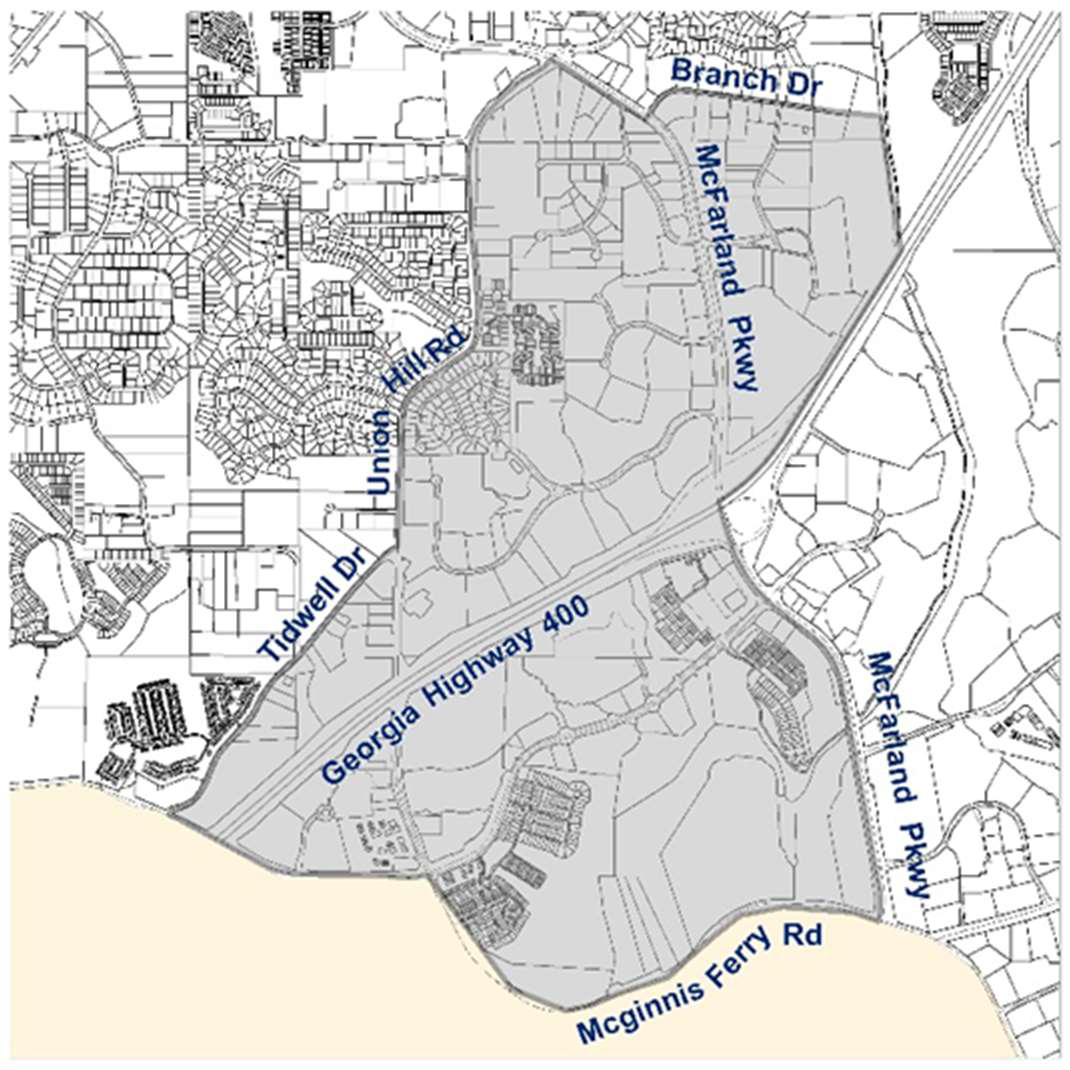
(Amd. of 10-2-2008; Amd. of 7-1-2010; Amd. of 9-7-2017(8); Amd. of 6-7-2018; Amd. of 12-2-2021; Amd. of 3-6-2025)
12-10.1. - Purpose and intent.
Careful attention to attractive and citizen-friendly urban design is in the economic interests of the county, its citizens, and business owners. The county's land use element of the comprehensive plan places an emphasis on design guidelines to improve the aesthetic appearance and function of the county's commercial areas. The land use element reveals civic concerns over design-related issues, such as pedestrian access, safe bike routes, roadway landscaping and medians, attractive shopping centers, and less intrusive parking lots. Attractive and integrated urban design features tend to improve the county's image, raise overall property values, attract new businesses and residents, and improve the quality of life. Investment in design features tends to result in a positive return on investment for government, private industry, and property owners. For example, the money spent on landscaped roadway medians, sidewalks, and street trees is likely to be amply returned in the form of increased tax revenue resulting from the overall increase in property values that accompanies attractive and desirable urban and suburban areas.
Much of the existing commercial development in Forsyth County, particularly development along the county's principal highways, is in need of aesthetic and functional enhancement. Existing conditions that are inconsistent with the objectives of the county's land use element include: chain link fencing enclosures of autos and trailers without adequate screening; various building materials and/or equipment stored in front yards in view of the traveling public; continuous, uncurbed, highway access; old, dilapidated, and/or unattractive awnings and façade treatments; excessive signage in the form of fluttering ribbons, portable signs, sandwich signs, and welcome flags; a lack of front yard landscaping; storage/maintenance bay doors and loading areas facing the highway; dumpsters placed in front/side yards in unobstructed view from highways; and a general lack of interparcel access (i.e., connections between adjacent developments).
It is the intent of Forsyth County to require that new commercial developments install appropriate improvements and comply with general design regulations that are intended to improve aesthetic appearance and function. It is also the intent of the county to require substantial progress toward compliance with these improvement requirements and general design regulations in cases where existing businesses are expanded.
These design regulations are intended to merge traffic engineering, civil engineering, urban design, landscape architecture, and land use planning principles into a set of regulations for commercial developments and properties in the unincorporated areas of the county. The regulations are the minimum necessary to: preserve the carrying capacity of major arteries; reduce the number of vehicular turning movements to and from the major artery, thereby reducing the potential for automobile and pedestrian traffic accidents; encourage and promote the most suitable uses of land; ensure the adequate grading and draining of developments; promote an environment which reduces the visual clutter and other distracting characteristics resulting from various aspects typical of urban and suburban commercial strip development; prohibit the needless, wasteful and purposeless aesthetic degradation of the county's highway and major street corridors; and promote a more healthy environment.
(Ord. No. 87, 1-11-2006)
12-10.2. - Applicability.
This article shall apply to all properties located within all commercial and office zoning districts of unincorporated Forsyth County. New development shall be required to conform to these regulations. A substantial improvement of an existing development shall be required to conform to these regulations or make substantial progress toward meeting the regulations contained within this chapter.
(Ord. No. 87, 1-11-2006)
12-10.3. - Utilities.
All telephone and electricity transmission lines serving uses on site shall be installed underground.
(Ord. No. 87, 1-11-2006)
12-10.4. - Grading and site development.
Buildings and parking lots shall be appropriately drained so as to prevent damage to abutting properties or public streets. Grading plans for new development shall be submitted to the director, who shall disseminate the plans to all appropriate departments for review and approval, and all grading activities shall comply with approved plans. Stormwater management plans shall be submitted to the director and shall be reviewed by the director of engineering for review and approval, and all such drainage improvements shall be designed, installed and maintained in accordance with the standards of Ordinance No. 75 (Storm Water Management Ordinance) as adopted and as may be amended from time to time. All disturbed or graded ground areas of a building site not used for buildings or open storage areas shall be appropriately stabilized and grassed or covered with plants or landscaping materials.
(Ord. No. 87, 1-11-2006)
12-10.5. - Curb cuts and access specifications.
All entrances or exits of any street or driveway, public or private, from or to any state highway shall be approved by the state department of transportation and the director of engineering prior to the construction of such entrances or exits and prior to the issuance of any development permit for any improvement to be served by such entrances or exits.
No curb cut or access driveway shall be permitted to be located closer than 100 feet to the nearest existing or proposed right-of-way of an intersecting roadway or closer than 40 feet to a side property line unless the adjacent property owner is in agreement with the encroachment of the driveway and approval is obtained from the director of engineering. Curb cuts or access driveways shall be no narrower than 24 feet from back of curb to back of curb. Strict adherence to these requirements may not be practical in all instances as determined by the director of engineering. The director of engineering may limit the maximum width of a curb cut and/or the number of curb cuts to a parcel as necessary when it is deemed to be of benefit to the safety and welfare of the public.
The director of engineering must approve any commercial or office development accessed by an easement. Such approval will only be granted upon verification that the proposed access maintains a safe and efficient transportation network.
In cases of a substantial improvement of an existing development on a site that does not meet these curb cut and access specifications, the applicant may be required by the director of engineering to prepare an access plan as part of plans for the substantial improvement that either meets these requirements or moves substantially toward compliance with these regulations. Approval by the Georgia Department of Transportation and the director of engineering shall be required, as applicable.
Additional right-of-way shall be dedicated to the public as required by the most current functional classification of Forsyth County roads as designated in the major transportation plan. Roadway entrances and improvements, including necessary acceleration and/or deceleration lane(s) and right/left turn lanes, shall be designed, installed, and maintained as approved by the state department of transportation, as applicable, or the director of engineering, in accordance with state or county requirements, as applicable and as may be amended from time to time.
The following factors may be considered during the review and approval of a specific location of an entrance: 1) The location of existing or planned median breaks; 2) separation requirements between the entrance and major intersections; 3) separation requirements between other entrances; 4) the need to provide shared access with other sites; 5) the need to align with previously approved or constructed access points on the opposite side of the street; 6) and the minimum number of entrances needed to move traffic onto and off the site safely and efficiently.
(Amd. of 11-15-2004; Ord. No. 87, 1-11-2006)
12-10.6. - Interparcel connections.
The standards below are intended to provide safe and convenient vehicular and pedestrian access within developments and between adjacent developments and to lessen traffic congestion and increase connectivity.
(a)
New developments and substantial improvements to existing developments shall provide for pedestrian and automobile access connections between adjacent properties and shall prepare and have recorded in the real property records of the county cross access connection easements to confirm such access. The director shall have the discretion to waive this requirement if the anticipated land uses are incompatible.
(b)
Parcels and buildings must be arranged and designed so as to allow for the opening of future streets and must provide access to those areas not presently served by streets. No development may be designed to completely eliminate street access to abutting parcels.
(c)
The stub-out street right-of-way, pavement, and curbing must extend to the boundary of the abutting parcel at the point where the connection to the anticipated street is expected.
(d)
If a stub-out street exists next to an abutting parcel, the street system of any new or substantially renovated development must connect to the stub-out street to form a through street.
(e)
The department may eliminate the requirement for a stub-out street or require pedestrian and bicycle-only access when steep slopes in excess of 25 percent, freeways, waterways, tree conservation areas, stream buffers, cemeteries, open space or easements would make the provision of a stub-out street infeasible.
(f)
Where pedestrian crossings must cross parking areas and drives, decorative paving material (i.e., pavers, stamped or textured concrete, or color concrete) shall be used to delineate the pedestrian crossing.
(Ord. No. 87, 1-11-2006; Amd. of 11-1-2007; Amd. of 6-7-2018)
12-10.7. - Location of loading and unloading areas.
All areas and facilities devoted to the loading and unloading of goods and merchandise shall be located to the side or rear of the building and lot. Loading and unloading areas shall not front the right-of-way of the highway or major street. Overhead doors for loading bays shall not face the highway or major street.
In cases where this regulation is not practical for new development, or in cases where an existing building to be substantially improved does not meet the requirements in this section, the property shall be screened from view from the highway or major street along the entire property frontage, except in cases where access areas are approved. Buildings that are permitted to have overhead doors facing the public right-of-way shall incorporate design features so that aesthetic impact of the overhead doors is softened through architectural detailing, or staggering with recesses and projections.
(Ord. No. 87, 1-11-2006)
12-10.8. - Location of parking areas.
Parking areas shall be set back at least ten feet from public rights-of-ways. Parking areas are encouraged but not required to be located in side and rear yards where such parking areas can be partially or wholly screened by buildings from the public right-of-way.
(Ord. No. 87, 1-11-2006)
12-10.9. - Open display of vehicles, equipment, and merchandise.
In commercial zoning districts where permitted, the outside storage or display of vehicles, equipment, and merchandise to be rented, leased, or sold, shall be visible along no more than 30 percent of the frontage of the property abutting the highway or major street, excluding approved driveway entrances and exits. Major streets include all roads classified by the Forsyth County Transportation Plan as minor arterial and greater and include Freedom Parkway, Ronald Reagan Boulevard and Old Atlanta Road. Screening may be accomplished by vegetation, by a building that meets architectural standards of this chapter, by an earthen berm, by a 100 percent opaque, solid wooden fence or wall, or combination of these screening methods. Vegetative screening must be specified on the applicant's landscape plan. The use of low-lying landscaping that does not screen the display areas from view from the public right-of-way shall not be deemed to comply with this requirement.
(Ord. No. 87, 1-11-2006; Amd. 2-1-2007; Amd. of 11-1-2007)
12-10.10. - Screening of outside storage yards.
All areas devoted to the outside storage of vehicles, merchandise, and/or equipment not intended for display for public rent, lease, or sale, shall be screened from view from the right-of-way of the highway or major street along the entire property frontage, except in areas where access crossings have been approved. Screening may be accomplished by vegetation, by a building that meets architectural standards of this chapter, by an earthen berm, by a 100 percent opaque, solid wooden fence or wall, or combination of these screening methods. Vegetative screening must be specified on the applicant's landscape plan. The use of low-lying landscaping that does not screen the display areas from view from the public right-of-way shall not be deemed to comply with this requirement.
(Ord. No. 87, 1-11-2006; Amd. of 2-1-2007)
12-10.11. - Screening of dumpsters.
All garbage dumpsters and other similar areas devoted to the storage of waste materials shall be screened on three sides of said dumpster or area with a minimum six-foot high solid wooden fence, or a wall constructed of materials substantially similar in appearance to the building on site that complies with the architectural requirements of these regulations. In addition, said dumpster areas shall be gated on the fourth side, and the gate shall be architecturally finished.
(Ord. No. 87, 1-11-2006)
12-10.12. - Outdoor lighting.
See chapter 16.
(Ord. No. 87, 1-11-2006)
12-10.13. - Building materials.
Building exteriors not screened from view from the right-of-way or any property line shall have an architectural treatment of brick, brick/frame, stone, or stucco, or another architectural treatment approved by the director. Any awnings shall be maintained in good order, and any dilapidated awnings or canopies shall be removed.
(Ord. No. 87, 1-11-2006)
12-10.14. - Building and utility appurtenances.
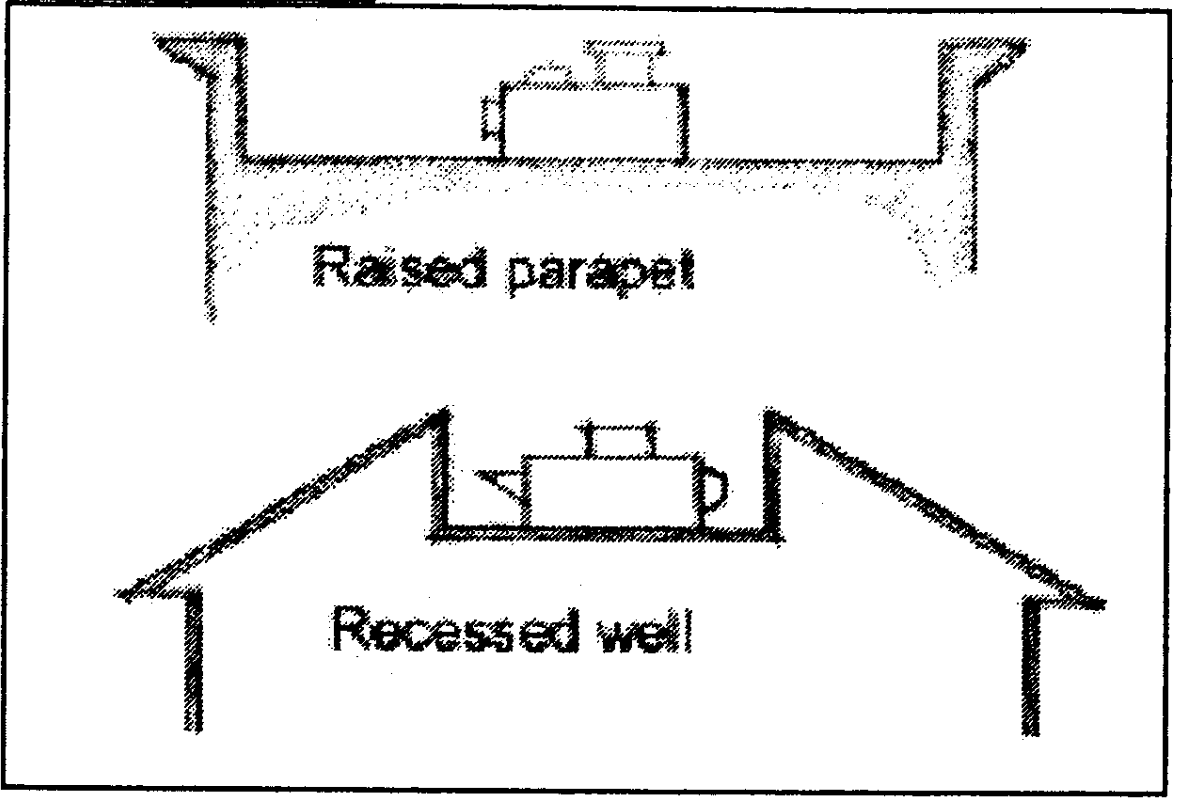
All water towers, cooling towers, storage tanks, and other structures or equipment incidental to the primary use of a building or site shall be architecturally compatible with the principal building or effectively screened from view from the public rights-of-way. All rooftop mechanical equipment shall be screened from the view from the public right-of-way and adjacent streets by material compatible with the building architecture, by the use of a parapet wall, or by specially designed rooftop penthouse enclosures. Ground mounted equipment such as power transformers and air-conditioning units shall be screened from view from public rights-of-way by fencing or landscaping.
(Ord. No. 87, 1-11-2006)
12-10.15. - Landscaping.
Every building site and commercial use area shall be landscaped. A minimum ten-foot wide landscape strip shall be installed and maintained along the entire property fronting the highway or major street, except in cases where access areas are approved. A minimum ten-foot wide landscape strip shall be required along all side and rear lot or lease lines, except in cases where access areas are approved. The area surrounding the road entrance(s) to the site or area, the front landscape strip, required parking lot landscaping, and all other required landscape and/or open spaces, shall be designed, installed, and maintained according to plans prepared by a professional landscape architect, architect, surveyor, engineer, or land planner submitted to and approved by the Forsyth County Planning and Community Development Department. Landscaping shall be reviewed and approved via submittal of a landscaping plan prior to the issuance of a site development permit. Plantings shall be completed prior to issuance of a final plat or as built approval by the department. Tree installation and removal shall be in compliance standards provided in Ordinance No. 98 (Tree Protection and Replacement Ordinance), as may be amended from time to time, and administrative standards for the preservation and replacement of trees as adopted and as may be amended from time to time. The landscape strips required in this section shall not be required for any front, side, or rear lot or lease lines that require a buffer, which is equal to or greater than the depth of the otherwise required landscape strip.
(Ord. No. 87, 1-11-2006; Amd. of 11-1-2007; Amd. of 12-1-2011; Amd. of 9-7-2017(8))
12-10.16. - Signage.
All signs in commercial districts shall comply as applicable with Ordinance No. 74 (Sign Ordinance), as may be amended from time to time.
(Ord. No. 87, 1-11-2006)
12-10.17. - Plans.
Site development as-built drawings, containing a boundary survey, location, elevation, height, and square footage of buildings, parking areas, utilities, walls, and stormwater facilities, pertinent site development data, and any other requirements of the planning and community development director or director of engineering, shall be submitted to and approved by the department prior to the issuance of a certificate of occupancy.
(Ord. No. 87, 1-11-2006; Amd. of 12-1-2011)
12-10.18. - Maintenance.
Commercially zoned properties require maintenance per section 10-1.14.
(Ord. No. 87, 1-11-2006)
12-10.19. - Fencing.
(a)
Chain link fencing is prohibited along any road frontage in all commercial zoning districts except heavy commercial (HC). Road frontage is defined as the property line abutting a public right-of-way that provides public access or visibility to the premises.
(b)
Chain link fencing may be allowed along the sides or rear if screened from view of the right-of-way with vegetation for the full length and height of fencing material. Chain link fencing may also be allowed if located within the front yard as long as the length of fencing does not measure more than 25 percent of the road frontage length if screened from view of the right-of-way with vegetation for the full length and height of fencing material.
(Added 2-1-2007)
12-11.1. - Purpose and intent.
"Large-scale retail" refers to any individual retail establishment that is 40,000 square feet or greater. This size threshold refers to an individual establishment and its associated outdoor areas used for display and storage. The purpose of establishing requirements for large-scale retail establishments is to apply design standards and additional conditions to large developments proposed in Forsyth County in order to ensure that such developments are appropriately located, are integrated with surrounding area or positively contribute to the changing community character, and meet the county's goals for new commercial development per the comprehensive plan. As such, these regulations intend to promote high quality materials and design, promote pedestrian-friendly environments, encourage infrastructure concurrency, and encourage responsible storm-water management practices.
Furthermore, within newly emerging centers of commercial activity, large-scale retail development plays an important role in defining the direction of the community character. In the absence of previously adopted overlay design standards regulating sites for new large-scale retail, prior to the issuance of a land-disturbance permit, applicants shall work with planning and community development staff to establish an architectural theme for the area in keeping with surrounding characteristics and/or with goals documented in the comprehensive plan. The architectural theme area shall be the subject of a future overlay designation to be defined by the board of commissioners.
(Ord. No. 87, 1-11-2006; Amd. of 12-1-2011; Amd. of 10-6-2022)
12-11.2. - Restrictive covenants.
For individual retail establishments 75,000 square feet or greater, a landlord shall not be permitted to enter into a lease agreement whereby the landlord is precluded from marketing and renting to future lessees once a tenant has vacated the premises. Once a tenant has vacated the premises, the landlord shall be free to market to any person or company allowed by county codes.
(Ord. No. 87, 1-11-2006)
12-11.3. - Delivery and garbage pick-up.
Hours for truck delivery or for garbage pick-up services shall be limited to the hours between 7:00 a.m. and 9:00 p.m. Trucks shall turn off their engines during deliveries; trucks with refrigeration units may be exempt from this provision. Signs posted in delivery area shall advise truck drivers of this requirement.
(Ord. No. 87, 1-11-2006)
12-11.4. - Infrastructure requirements.
(a)
Availability of sewer. Large-scale retail establishments shall be served by either public sewer, or an existing private sewage treatment plant. Private sewage treatment plant service shall only be approved if the proposed site was approved by the Forsyth County BOC as part of the service area for the private plant. If the property where the development is to be located is already correctly zoned, proof of sewer availability must be demonstrated prior to a land disturbance permit being issued. If the property needs to be rezoned or obtain sketch plat approval, the applicant for the rezoning/sketch plat approval must demonstrate sewer will be available within one year of the rezoning/sketch plat request being approved or by the time a land disturbance permit is issued, whichever is sooner. In no case shall a certificate of occupancy be released without existing, operational access to off-site sewage treatment.
(b)
Traffic study. A traffic study is required for all large-scale retail development. Two copies of said traffic study shall be submitted with all rezoning requests and/or sketch plat applications for approval by the director of engineering. If rezoning or sketch plat approval is not required, two copies of a traffic study shall be submitted with an application for a land disturbance permit. Based on the approved traffic study, the Forsyth County Master Transportation Plan, and any other local, state or federal requirements, the director of engineering shall determine all necessary road improvements to be completed.
(c)
Access road classification. Additionally, individual retail establishments 75,000 square feet or greater shall not be accessed via minor collector or local streets, as classified by the master transportation plan, unless there is also frontage on a road of higher classification (arterial, highway, etc). Under exceptionally unusual circumstances, if there already exists a concentration of commercial activity, the director of engineering may waive the road classification criteria based upon documentation that road improvements with identified funding sources will accommodate anticipated project-generated traffic volume to the degree that LOS D or better is maintained for the affected road segment.
(Ord. No. 87, 1-11-2006)
12-11.5. - Site design guidelines and requirements.
(a)
Open Space. A minimum of 20 percent of the site shall be landscaped open space.
(b)
Location of loading and unloading areas. All areas and facilities devoted to loading and unloading of goods and merchandise shall be located to the side or rear of the building and lot. Location should be restricted, however, to whichever location does not abut a residentially zoned property, if applicable.
(c)
Outdoor storage and display. Neither parking lots, nor areas immediately adjacent to the buildings other than garden center uses shall be used for storage or sale of goods. Garden center goods shall be within areas enclosed by decorative fencing and be at least partially screened. Display or sale of goods outside the interior permanent and sheltered portions of a building is prohibited. Exceptions to this provision include: seasonal holiday trees, seasonal sales of nursery supplies, and pumpkin sales. In no instance shall outdoor display obstruct sidewalks or otherwise impede pedestrian movement to entrance of the store.
(d)
Setbacks and buffer, adjacent to residentially zoned parcels. If the subject property abuts a residential, OR, A1, or AG-Res district, the following minimum side or rear setback and buffer requirements apply:
(1)
The minimum building setback shall be 100 feet, the first 50 feet being an undisturbed buffer, which shall meet the requirements of the Forsyth County Buffer Standards.
(2)
To ensure that a visual buffer is achieved, the county may or may not require the installation of a four-foot high earthen berm with plantings per the Forsyth County Buffer Standards. The county arborist will make the determination of a berm requirement based upon a review of the tree protection and replacement plan and existing topography and vegetation.
(e)
Landscaping.
(1)
Walkways shall feature adjoining planted landscaped areas for no less than 50 percent of their length.
(2)
Along the building façade featuring the primary entrance, within in an area no further than 15 feet from the foundation, there shall be landscaping with trees. Minimum installation requires four and one-half caliper inches per 100 linear feet with a one and one-half-inch caliper and eight-foot installation height minimum for each tree. Trees shall count towards the tree density requirement as outlined in Ordinance No. 98 (Tree Protection and Replacement Ordinance). Tree placement should be grouped and staggered rather than following a regulated line along the façade. Tree placement must be approved by the county arborist. Trees located in the sidewalks or other areas subject to pedestrian traffic shall require tree grates or other suitable tree protection measures; method of tree protection shall be indicated on plans.
(3)
Landscape strips requirements. In addition to section 12-10.15:
a.
The required minimum landscape strip shall be 20-feet wide along the entire property fronting a public street.
b.
All landscape strips are required to contain a combination of at least two of the following elements: vegetative ground cover, herbaceous ornamentals, or low to mid-level shrubs; they must also include a combination of large canopy trees with either understory trees or large shrubs. One-third of landscaping plantings shall be of the evergreen variety. Understory trees must be six to eight feet in height at time of planting. Large shrubs must be four to six feet in height at time of planting and reach a height of at least eight feet.
(4)
Landscape installment and maintenance. A landscape installment guaranty must be provided prior to the release of certificate of occupancy (CO). The guaranty shall be stamped and signed by a registered landscape architect certifying that landscaping meets the standards of this Code. Landscape plantings must be replaced if damaged or dead.
(f)
Parking and pedestrian circulation and parking islands. Parking areas are transitional spaces where users change modes of travel from car, bus or bicycle to pedestrian. As such, parking areas should provide safe, convenient, and efficient access to serve all travel modes. They should be distributed around large buildings in order to shorten the distance to other buildings and public sidewalks and to reduce the overall visual impact of the paved surface. If buildings are located closer to streets, the visual scale of the complex is reduced, pedestrian traffic is encouraged, and architectural details take on added importance.
(1)
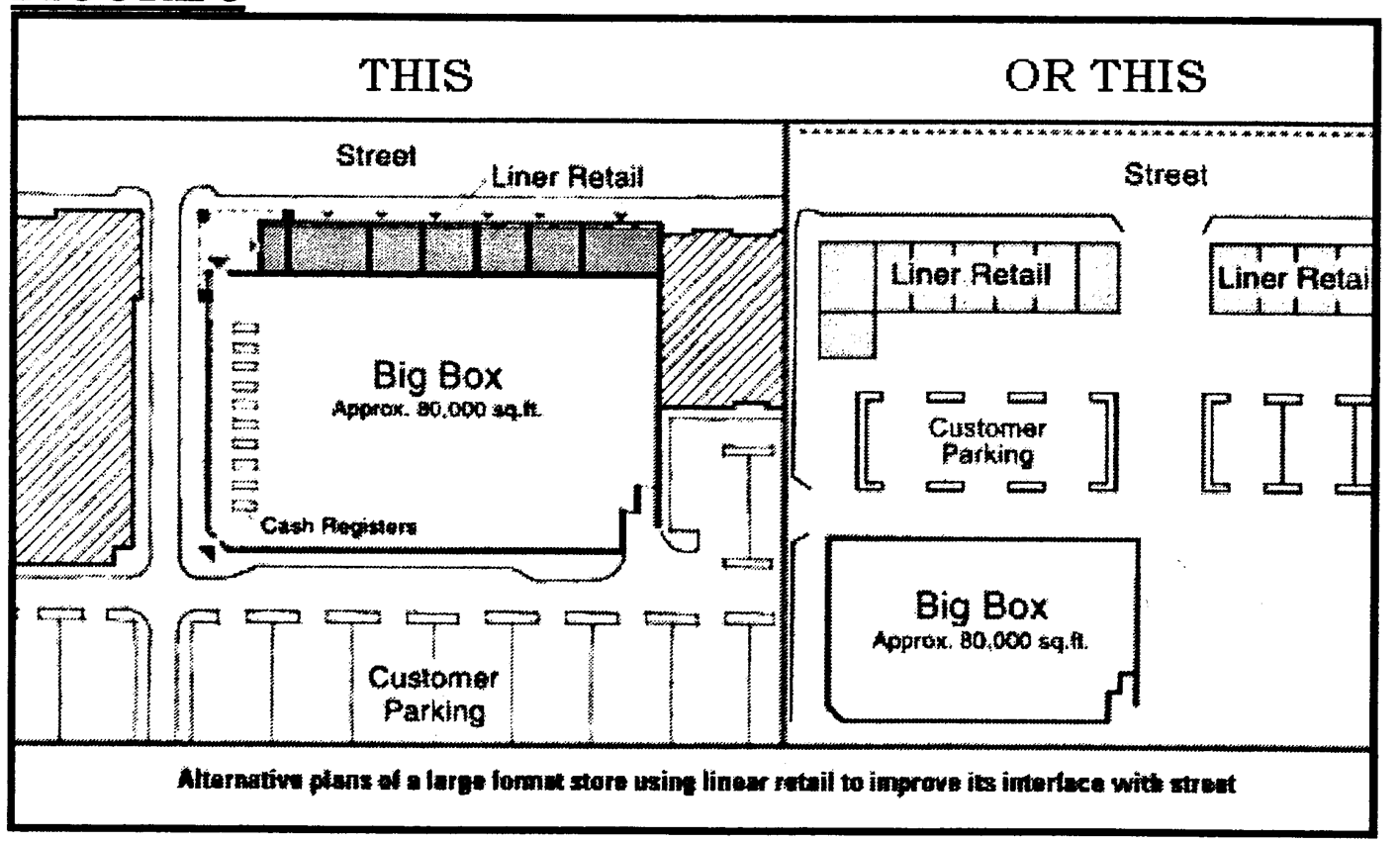
Parking lot location. Parking areas should be distributed around large buildings along not less than two façades (front, rear or sides) in order to shorten the distance to other buildings and public sidewalks. Parking shall be of an adequate distance from loading areas as to avoid any points of conflict and ensure pedestrian safety. No more than 50 percent of the off-street parking area for the lot, tract or area of land devoted to the large retail establishment should be located along the property fronting a public road and between the front façade and the road (the "front parking area"). See Figures 1, 2, and 3 for examples that compare desirable layouts to traditional parking distribution.
FIGURE 1
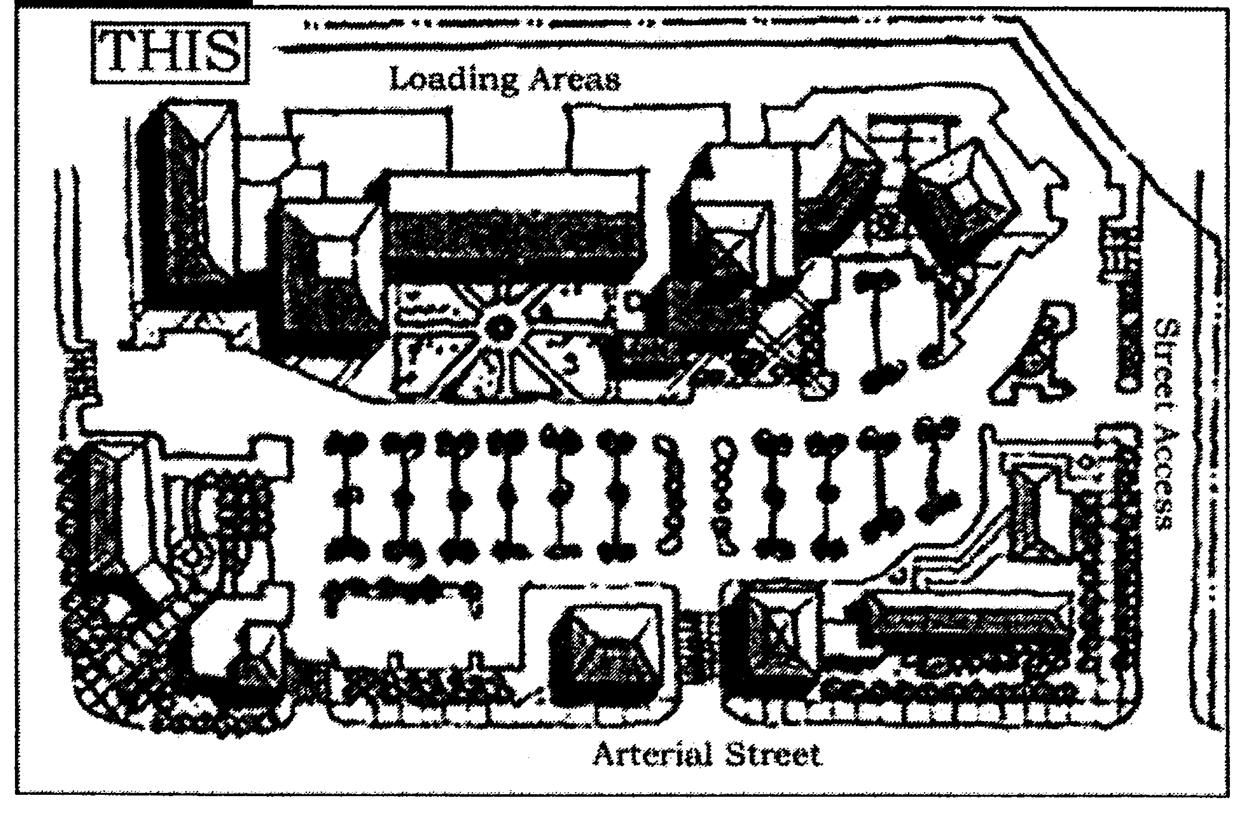
Source: Surprise, AZ
FIGURE 2
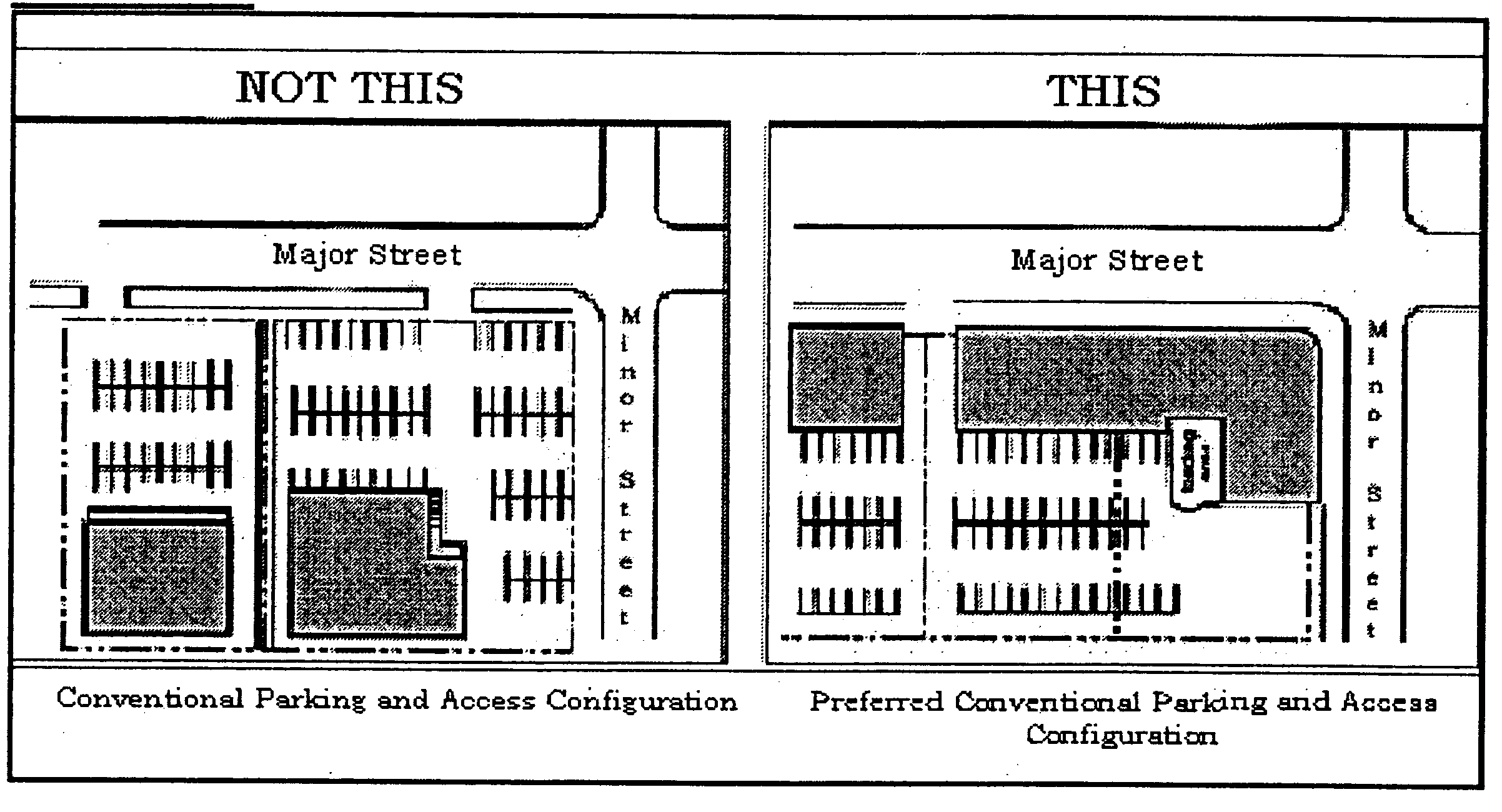
FIGURE 3
(2)
Parking lot location and parking islands requirements. Large-scale retail establishments shall provide a minimum of 15 percent of the total front parking area as landscaped islands. Side and rear parking lots shall provide a minimum of 12.5 percent of the total parking area as landscaped islands.
a.
Each parking island is required to contain a combination of at least two of the following elements: grass, shrubbery, flowers, or other landscaping material, in addition to the tree requirements delineated below.
b.
Parking island tree specifications. In addition to the requirements of the Ordinance No. 98 (Tree Protection and Replacement Ordinance), the following standards for tree islands apply:
(i)
Trees shall be provided and maintained adjacent to, and in the interior portion of, parking lots in a ratio of one tree for each seven parking spaces. In addition, every parking space shall be within 50 feet of the trunk of a tree.
(ii)
Trees shall be at least three inches in caliper and shall be an overstory species. The minimum planting area or island for each tree shall be at least 200 square feet. If shared with other trees, 100 square feet for each additional tree shall be added.
(iii)
Each planting area or island shall not be less than four feet in width in any direction. Each landscape island shall be maintained such that plantings are allowed to be established. Any dead plantings shall be replaced.
c.
Landscape islands shall be located at the end of every parking bay and at every 150 linear feet of continuous parking space. Measuring from the trunk, the tree must be a minimum of six feet from the back of the curb. No portion of an island less than three feet in width may be counted in the area. Landscape islands for single parking bays shall contain a minimum of 200 square feet. Landscape islands for double parking bays shall require a minimum of two 200 square foot islands or one continuous landscape island of 400 square feet.
d.
Landscape islands shall be located in such a manner as to divide and break up the parking area. A planting area, which intrudes upon or is located wholly within a generally rectangular area that is (a) devoted to parking and (b) between a building and a lot line or between two buildings will generally serve this purpose.
(3)
Pedestrian circulation.
a.
Sidewalks at least five feet in width shall be provided along all sides of the lot that abut a public street.
b.
Continuous internal pedestrian walkways, no less than five feet in width, shall be provided from the public sidewalk or right-of-way to the principal customer entrance of all principal buildings on the site. At a minimum, walkways shall connect focal points of pedestrian activity such as, but not limited to, transit stops, street crossings, building and store entry points.
c.
Sidewalks, no less than five feet in width, shall be provided along the full length of the building along any façade featuring a customer entrance, and along any façade abutting public parking areas. Such sidewalks shall be located at least six feet from the façade of the building to meet landscaping requirements in section 12-11.5(e)(2) above.
d.
All internal pedestrian walkways shall be distinguished from driving surfaces through the use of color and durable, low maintenance surface materials such as pavers, bricks, or scored concrete to enhance pedestrian safety and comfort, as well as the attractiveness of the walkways.
(4)
Excess parking. To avoid excessive parking surpluses which increase impervious surfaces, parking shall not be provided in quantities greater than ten percent of the required minimum. For large-scale retail developments exceeding the minimum parking requirements, all excess parking shall be of porous material.
(5)
Interconnectivity. Unless waived by the planning and community development director, developments shall provide direct connections and safe street crossings to adjacent land uses, either to existing adjacent commercial (via shared curb-cuts or cross-access easements) or plan for such connectivity to future adjacent commercial by providing drive-way stub-out.
(g)
Transit stops. Large-scale retail developments 75,000 square feet or greater shall cooperate with the Georgia Department of Transportation and the Georgia Regional Transportation Authority or its successor to establish park and ride lots should these agents deem the site an appropriate location.
(h)
Public spaces. Each retail establishment subject to these standards shall contribute to the establishment or enhancement of community and public spaces by providing at least two of the following: patio/seating area, pedestrian plaza with benches, transportation center, window shopping walkway, outdoor playground area, kiosk area, water feature, clock tower, or other such deliberately shaped area and/or a focal feature or amenity that, in the judgment of the planning and community development director, adequately enhances such community and public spaces. Any such areas shall have direct access to the public sidewalk network and such features shall not be constructed of materials that are inferior to the principal materials of the building and landscape.
(Ord. No. 87, 1-11-2006; Amd. of 11-1-2007; Amd. of 7-1-2010; Amd. of 12-1-2011; Amd. of 9-7-2017(8))
12-11.6. - Architectural design standards.
The intent of architectural design standards is to ensure a base level of quality architecture that is responsive to its context and contributes to the architectural character of an area rather than a design solution that is based on a standardized formula or market prototype superimposed on the selected site.
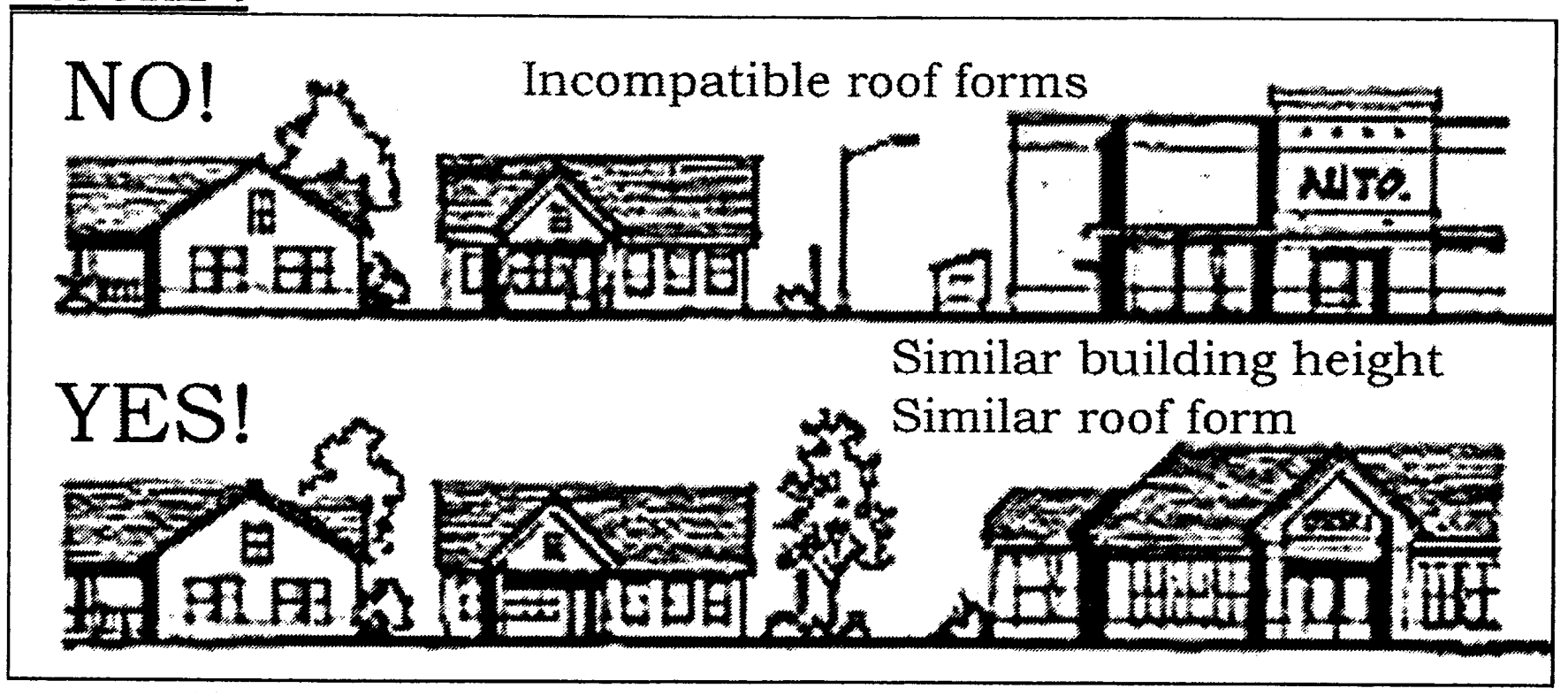
All buildings shall be designed to be compatible with the surrounding land uses. In predominantly rural or rural-residential areas, proposals must demonstrate landscaping and architectural treatment aimed to integrate into the surrounding character; in the case of poor context (i.e., areas in transition or ready for redevelopment) then the proposed development will cultivate new standards for the area by meeting the minimum requirements below.
FIGURE 4
Source: City of Toledo
In multiple building developments, all buildings and structures in the development shall be of similar architectural style and shall demonstrate an overall cohesive architectural theme that creates a sense of place. Building design that is based on a standardized formula associated with a business or franchise shall be modified to meet the provisions of this section.
(a)
Facades and exterior walls.
(1)
Front façades greater than 100 feet in length, measured horizontally, shall incorporate wall plane projections or recesses having a depth of at least three percent of the length of the façade. No uninterrupted length of any façade shall exceed 100 horizontal feet.
(2)
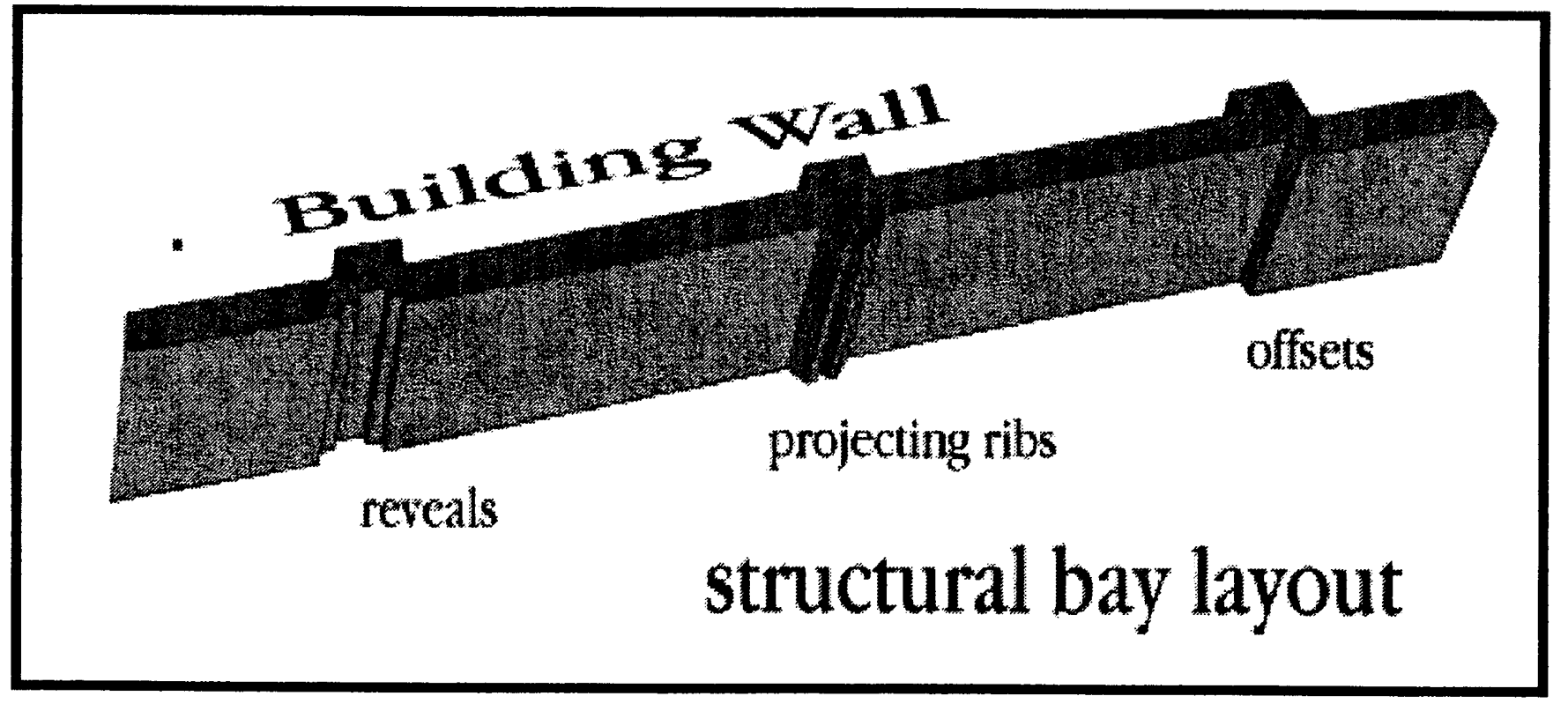
Minimum wall articulation. Front façade design shall provide varying wall offsets and other architectural features to create horizontal (wall) and vertical building articulation. Along with the wall plane requirements in (1) above, at least two of the following treatments shall be incorporated:
(a)
Change in texture or masonry pattern.
(b)
Fenestration (window treatment).
(c)
An expression of architectural or structural bays through a change in plane no less than 12 inches in width, such as an offset, reveal or projecting rib.
(d)
An equivalent element that subdivides the wall into pedestrian scale proportions, as approved by the director of planning.
FIGURE 5
Source: Fort Collins, CO
(b)
Entryways.
(1)
The principal entry area of a building or, if among larger development, the largest tenant or central location of a group of buildings shall be articulated and should express greater architectural detail than other portions of the building, featuring no fewer than three of the following elements:
(a)
Overhangs.
(b)
Canopies.
(c)
Recesses/projections.
(d)
Arcades.
(e)
Corniced parapets over the door.
(f)
Peaked roof forms.
(g)
Arches.
(h)
Display windows.
(i)
Moldings or tile work integrated into the building.
(j)
Integral planters or wing walls that incorporate landscaped areas and/or places for sitting.
Where additional stores will be located in the large retail establishment, each such store that is 5,000 square feet and greater shall have at least one exterior customer entrance, which shall conform to the above requirements.
(c)
Roof features. Rooflines shall incorporate roof features (extensions, and/or projections such as gable, hip, parapet, dormers or others) that achieve visual interest through variation along 35 percent of the entire horizontal length of roofline. These features shall conform to the following specifications:
(1)
Roof projections shall extend a minimum 15 feet from the exterior wall except for parapet extensions which shall rise a minimum of ten feet above the parapet's baseline. Parapets shall feature three dimensional cornice treatment. Roof features shall not exceed the average height of the supporting walls.
(2)
Cornices, if present, shall feature three dimensional treatments of not less than 12 inches in profile. Overhang eaves, if present, shall extend no less than three feet past the supporting walls.
(3)
The roof pitch of sloped roofs shall be a minimum of 4:12.
(d)
Screening rooftop equipment. Roof top equipment such as HVAC units shall be fully screened. Screening shall be of material that serves as sound proofing to minimize noise trespass.
FIGURE 6
(e)
Colors. The use of muted, subdued, or earth tone colors are required for all buildings and associated structures. Vending and ice machines, lock boxes and other dispensing equipment visible from the public right-of-way shall use only earth tone and/or neutral colors. Fuel dispensing units visible from the public right-of-way shall feature earth tone and/or neutral colors in their overall design. Notwithstanding the foregoing requirement, small functional parts of the fuel dispensing units and reasonable safety features may utilize additional colors for enhanced visibility and safety purposes, subject to the discretion of the director. In addition, any wall or fence shall use only earth tone and/or neutral colors. Earth tone colors refer to browns, umbers, sienna, or terracotta and brick tones. Neutral colors refer to blacks, whites, beiges, or grays. Glass, unpainted metal, natural stones, and sign faces are excluded from the color requirements. Building trim and accent areas may feature higher intensity colors, subject to approval of the planning and community development director.
(f)
Exterior building material. The following building materials are prohibited from front and side façades: smooth-faced concrete block, plastic siding, smooth-faced tilt-up concrete panels, corrugated metal siding, and prefabricated steel panels. Textured concrete masonry units (CMU) is permitted but shall be limited to 70 percent of total front façade with remaining façade material composed of brick, stone, stucco, glass or other high quality material. Tilt-up panels may be used only for rear loading areas that are not visible to the public.
(g)
Exemptions. The planning and community development director may exempt all or parts of the design standards in this section for commissioned buildings by an architect for a site when the design constitutes a unique, one of a kind building that meets or exceeds the intent of these design standards, as demonstrated by architectural elevations.
(Ord. No. 87, 1-11-2006; Amd. of 11-1-2007; Amd. of 12-1-2011; Amd. of 11-2-2023)
12-12.1. - Re-use of properties.
Plans for the removal or adaptive re-use of the principal structure governed by this ordinance shall be made should the facility not be used for commercial retail purposes for a period of 24 consecutive months.
The owner and/or lessee meets the intent of this section if he or she provides an executed lease, a sale agreement or evidence of a pending lease/sale agreement (executed within 24 months), or executes an adaptive reuse agreement with the county.
(Ord. No. 87, 1-11-2006)
12-12.2. - Vacancy maintenance requirements.
In addition to maintenance requirements established by UDC 10-1.14, owner shall provide security patrols on the site to deter vandalism or other illegal activities on the property.
(Ord. No. 87, 1-11-2006)
12-12.3. - Location criteria.
Individual retail establishments 75,000 square feet or greater may only locate on property that is properly zoned and meets the location criteria established herein. Establishments under the same corporate ownership proposed on the same development site but with separate structures aimed to defeat the intent of this Code may still be limited to this location criteria, per administrative decision by the planning and community development director. In addition to the items established in Chapter 8 of this Code, for considering zoning amendments, the following will be considered to evaluate approval or denial of proposed large-scale retail use:
(a)
Individual establishments 75,000 square feet or greater shall not be adjacent to existing residential subdivisions composed of 30 lots or more, except that this prohibition shall not be applicable if along the shared property line a 150 foot setback is provided, of which 100 feet shall be an undisturbed buffer. Furthermore, the undisturbed buffer shall be augmented with plantings per the county buffer standards if existing vegetation does not achieve the intended visual screen.
(Ord. No. 87, 1-11-2006; Amd. of 10-6-2022)
12-13.1. - Intent.
The intent of this article is to provide a set of design standards that elevate the quality and durability of commercial construction permitted in south Forsyth County. This article aims to enhance a sense of place, inspire a variety of building appearances, and address Comprehensive Plan character area goals including enhancing the relationship between buildings and the street while providing improved connectivity to the community.
12-13.2. - Delineation of South Forsyth.
The South Forsyth design standards set out in this article shall apply to all properties located within the area indicated in Figure 7, the boundary of which area is described as follows: Beginning at the point where McGinnis Ferry Road meets the eastern boundary of the county, following McGinnis Ferry Road west (generally) to US 19/GA 400, then following US 19/GA 400 northeast (generally) to the City limits of Cumming, Georgia, then following the City limits of Cumming, Georgia northeast (generally) to the northern boundary of the Haw Creek and Daves Creek character area as depicted in the July 6, 2017 Forsyth County Comprehensive Plan 2017-2037, then following said northern boundary east (generally) to the eastern boundary of the county, then following the eastern boundary of the county south (generally) to McGinnis Ferry Road and the point of beginning.
12-13.3. - Design plan administrative review.
Design review for development that meets the applicability requirements of section 12-13.4 shall be performed by staff. All plans shall address and conform to all provisions set forth under chapter 12, article XIII. Any numerical nonconformance to the standards contained within this article shall require the submittal of a variance application in accordance with chapter 8, article VI. Should a design not meet all of the non-numerical standards contained within this article, then the proposed design must be submitted, for public hearing, to the Forsyth County Board of Commissioners for review and approval as an alternate design. In considering whether to approve such alternate design, the board of commissioners shall consider the special considerations set forth in section 8-5.5(f)(2)b. of this Code. Architectural elevations, exterior finish schedules and sample boards, landscape plans and lighting plans for lighting not attached to buildings must be submitted to the department at the time of application for a land disturbance permit. Lighting plans for fixtures attached to building exteriors must be submitted at the time of application for a building permit. See chapter 7 and chapter 18 for land disturbance and building permit procedures.
Figure 7: South Forsyth Boundary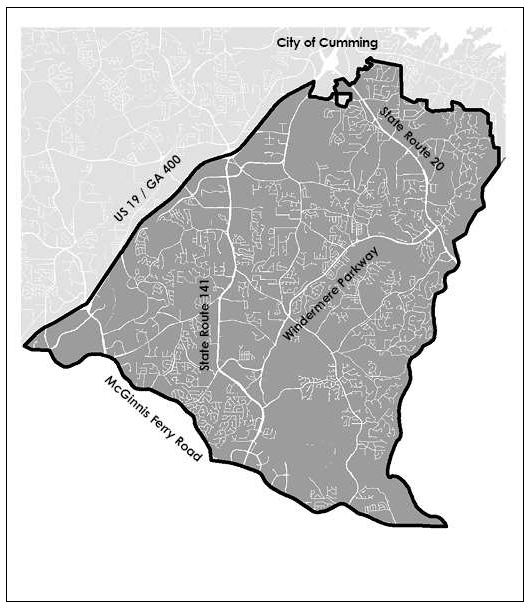
12-13.4 - Applicability.
(a)
New developments. The standards will apply to new commercial developments within the study area with the exception of the following uses:
(1)
Clubs or lodges not contained within a commercial retail center or office complex.
(2)
Colleges and trade schools not contained within a commercial retail center or office complex.
(3)
Places of worship not contained within a commercial center or office complex.
(4)
Private and parochial schools not contained within a commercial retail center or office complex.
(5)
Schools for dance, martial arts, and other disciplines not contained within a commercial retail center or office complex.
The South Forsyth commercial design standards described in this article are meant to be supplemental to other design standards and requirements of this Code and shall be applied in conjunction therewith where possible; however, property located in the delineated South Forsyth area shall be exempt from the requirements of sections 12-10.9, 12-10.10, 12-10.11, 12-10.12, 12-10.13, 12-10.16, and 12-10.19. In the event of a conflict between the South Forsyth design standards and those standards found elsewhere in this Code, the South Forsyth design standards shall apply. Notwithstanding the foregoing sentence, in the event of a conflict between the South Forsyth design standards and those standards governing an overlay district identified in chapter 21, the overlay district standards of chapter 21 shall apply.
(b)
Existing sites. Redeveloped or expanded commercial sites or buildings where more than 25 percent of the original building or planned site improvements is impacted shall comply with these standards.
12-13.5. - Landscaping and pedestrian improvements.
(a)
Required zones. The following zones with the widths specified in Table 12.3 shall be required on the site of any development required to comply with this article per section 12-13.4:
(1)
Front landscape strip zone. The front landscape strip zone is required against any property line fronting a public right-of-way. On property where buildings are pulled close to the roadway and the parking area is shifted to the side and/or rear of the building, the front landscape strip zone must maintain a minimum width of ten feet along a public right-of-way to comply with the Forsyth County Ordinance No. 98 (Tree Protection and Replacement Ordinance) with the remaining five feet in required zone width, for roads that are four lanes or wider, to be shifted in order to be adjacent to the pedestrian landscape zone.
(2)
Pedestrian landscape zone. The pedestrian landscape zone is required between any parking areas and the sidewalk zone. The pedestrian landscape zone shall be the location for required outdoor amenity furniture.
(3)
Sidewalk zone. The sidewalk zone is required between any parking area and any building.
(4)
Façade landscape zone. The façade landscape zone is located along any building and is directly adjacent to the sidewalk zone. This zone may be used as an alternate location for required outdoor amenity furniture. In lieu of this zone, an expanded pedestrian landscape Zone with a 14-foot minimum width may be substituted to provide design flexibility.
TABLE 12.3
MINIMUM ZONE WIDTH REQUIREMENTS
(b)
Landscape requirements. Landscaping located within zones as noted in Table 12.3 as well as any other required landscape strip must contain a combination of vegetative ground cover, herbaceous ornamentals, and shrubs. Additionally, the following requirements apply:
(1)
Trees, where required, shall be planted at regular intervals. In addition, deciduous trees shall have lower branches pruned for seven feet upwards from the base of the tree to allow visibility. All pruning shall be in accordance with ANSI A300 Part 1 and the International Society of Arboriculture Best Management Practices for Pruning. In no case shall the pruning required by this section remove more than 25 percent of the tree's foliage in any one growing season nor reduce the live crown ratio to less than 60 percent without prior approval of the County Arborist. Tree placement may be clustered for purposes of adequate site distance, utility and stormwater considerations as well as monument sign placement.
(2)
Columnar trees shall not count towards the required minimum trees within the front landscape strip zone or pedestrian landscape zone except in cases of limited growing space due to above ground power lines or in circumstances that such trees are planted beyond the required minimum number within these zones and only as approved by the county arborist.
(3)
Shrubs shall be maintained to a maximum height of four feet to allow visibility.
(4)
Permitted encroachments include but are not limited to water meter vaults, fire vaults, fire hydrants and perpendicular utility crossings. Stormwater ponds, including required easements, may not be located within required zones.
(c)
Front landscape strip zone.
(1)
Front landscape strip zones shall be planted with shrubs that are a minimum of two feet high at the time of planting and spaced five feet apart on center.
(2)
A minimum of two overstory trees shall be required per 50 linear feet. Overstory trees shall have a minimum caliper of three inches at the time of planting. Shrubs, groundcover and herbaceous ornamentals shall fill in the remaining space.
(3)
Berms shall not be permitted in front landscape strip zones when located within character area nodes as designated in the Forsyth County Comprehensive Plan.
(d)
Pedestrian landscape zone.
(1)
Overstory trees are required to be planted at regular 40-foot intervals. Overstory trees shall have a minimum caliper of two inches at the time of planting. Ground cover, herbaceous ornamentals, and shrubs shall fill in the remaining space. Shrubs shall be planted every five feet on center but spacing may be adjusted to accommodate outdoor amenity furniture if the total number of shrubs required are planted within the zone. If an expanded pedestrian landscape zone is utilized as referenced in section 12-13.5(a)(4), the planting material requirements for the facade landscape zone shall also be installed within the pedestrian landscape zone.
(e)
Facade landscape zone. Facade landscape zones shall be planted with shrubs installed every five feet on center, but shrub spacing may be adjusted to accommodate outdoor amenity furniture, if the total number of shrubs required are planted within the zone. Ground cover and herbaceous ornamentals shall fill in the remaining space with associated mulching around such plantings. A minimum of two caliper inches of understory tree for each 50 feet of façade length is required. Columnar trees may be appropriate in some locations as approved by the county arborist as long as the ability to grow vertically has adequate expansion clearance. Spacing may be adjusted to accommodate outdoor amenity furniture, building entrances, and similar elements if the total number of caliper inches required are planted within the zone.
(f)
Sidewalk zone. The Sidewalk Zone shall be a minimum of six feet wide and shall consist of a clear level surface for walking.
(g)
Outdoor amenity furniture. Where required, the following requirements apply:
(1)
Inside character area nodes, as designated in the Forsyth County Comprehensive Plan, the following shall be required:
a.
Benches: Provide one for every 100 linear feet of pedestrian landscape zone or façade landscape zone.
b.
Trash/recycling cans: Provide one of each for every 100 linear feet of pedestrian landscape zone or façade landscape zone.
(2)
Outside character area nodes, as designated in the Forsyth County Comprehensive Plan, the following shall be required:
a.
Benches: Provide one for every 200 linear feet of Pedestrian Landscape Zone or Façade Landscape Zone.
b.
Trash/recycling cans: Provide one of each for every 200 linear feet of pedestrian landscape zone or façade landscape zone.
12-13.6. - Parking.
(a)
Parking islands. One landscaped parking island shall be required for every ten parking spaces. Parking island size and planting requirements shall adhere to requirements as established in Ordinance No. 98 (Tree Protection and Replacement Ordinance).
(b)
Character area nodes. Additional requirements inside character area nodes, as designated in the Forsyth County Comprehensive Plan:
(1)
A maximum of one double-sided parking aisle is to be located between any principal building and any public right-of-way. Additional parking shall be located to the side or rear of the building.
(2)
On properties with primary frontage on roads with less than four lanes, all off street parking shall be located to the side or rear of the principal building.
12-13.7. - Access.
(a)
General requirements.
(1)
Bike parking. One bicycle rack per 50 parking spaces, but no less than one, is required for every building. A rack shall consist of a fixed location for locking two bicycles.
(2)
Trail connection. If any programmed parks or trails are within 500 feet of the property line of a development, a stub out trail leading to an existing or proposed park or trail shall be provided up to the property line. If a neighboring property has an existing stub out trail planned (by virtue of the submission of plans showing the stub out trail) or constructed in place at the time the development first submits an application requiring connection to the same park or trail, the development shall connect to the planned or existing stub out trail on the neighboring property. Trails shall be at least eight feet wide and shall be paved. An exception to this requirement for unnecessary hardship due to topography or natural features may be granted by the director.
(3)
Entrance walkway. A sidewalk with a minimum width of five feet shall be provided between the main building entrance and any existing sidewalk or trail in the public right-of-way or to the edge of the public right-of-way if a pedestrian improvement is proposed in the Forsyth County Bicycle Transportation and Pedestrian Walkways Plan. Pedestrian crossings shall also be required when the entrance walkway(s) crosses a parking lot or internal driveway or street and shall be constructed of bricks, pavers or concrete that is stamped and colored.
(4)
Electric vehicle charging. Electric vehicle charging locations shall be required for establishments 10,000 square feet or greater.
a.
Electric vehicle charging stations shall be located outside of all required zones noted in Table 12.3 as well as parking islands.
b.
Nine percent of the total provided parking spaces shall be electric vehicle capable spaces where an electrical panel, branch circuit, and raceway are provided prior to tenant occupancy, ready for an SAE J1772 Level 2, 208-240 Volt Alternating Current Electric Vehicle charging station to be installed at a later date.
c.
One percent of the total provided parking spaces shall install an SAE J1772 Level 2, 208-240 Volt Alternating Current minimum 30 amp electric vehicle charging station. Calculations for this requirement will not utilize a rounding method.
(b)
Character area nodes. Additional requirements inside character area nodes, as designated in the Forsyth County Comprehensive Plan, shall include the following:
(1)
Pedestrian crossing. Pedestrian crossings as required for entrance walkways shall be constructed of bricks or pavers only.
(2)
Short-term parking. Provide a minimum of one short-term parking space per 50 required spaces, plus one additional space for every bar or restaurant.
12-13.8. - Commercial amenity.
(a)
Beautification area. Commercial sites shall provide an area of beautification, which shall include the following elements:
(1)
Shall be accessible to the public.
(2)
Shall be located between the building and the public right-of-way.
(3)
Shall be located in the pedestrian landscape zone or the façade landscape zone, unless the director approves an alternate location upon the request of the developer or property owner and a showing that the alternate location will achieve the minimum goals of this section with respect to the inclusion of beautification areas.
(4)
Shall include two or more of the following items:
a.
An enhanced landscape area of not less than three percent of the total property area. This area shall consist of accent plant materials including a minimum of 30 percent shrubs and 30 percent annuals or perennials. The area must achieve 75 percent coverage within three years of planting while following nursery recommended spacing.
b.
Fountain(s), drinking fountain(s), sculpture(s) or other public art, decorative hardscape feature(s); or
c.
Other amenities for public beautification as approved by the director that will achieve the minimum goals of this section with respect to the inclusion of beautification areas as determined by the director.
(b)
Corner sites. Sites located on the corner of two public rights-of-way shall provide an additional 1,000 square feet of enhanced landscape area per the requirements of "A" above. This enhanced landscape area shall be located in the front landscape strip zone and provide at least one of the following: Fountain, sculpture, or other public art or entrance feature.
12-13.9. - Building materials.
Building material requirements are applicable to all facades of any new building.
(a)
Primary materials. A minimum 75 percent of each façade shall consist of glass, brick, ceramic, or unpainted natural stone. Glass alone may not exceed 65 percent of the façade. Brick or stone shall be a minimum of one and three-quarters (1.75) inch depth and, when utilized, shall wrap building corners as shown below:
Figure 8: Wall masonry corner wrapping
(b)
Accent materials. Accent materials shall not exceed 25 percent of each facade and may consist of but are not limited to stucco, painted wood, and metal panels.
12-13.10. - Massing.
(a)
Façade length. Facades must provide a 16-inch horizontal offset at least every 60 feet when facing a pedestrian walkway, driveway, or public right-of-way.
(b)
Building entrances. All building entrances shall be articulated by the use of at least two of the techniques below:
(1)
Exaggeration of form, such as enlarged arches or columns.
(2)
Change in exterior materials around the entrance.
(3)
Recesses/projections of at least four inches.
(4)
A change of roof pattern (e.g. a tower, awning, or change in roof or parapet height).
(5)
Planters or wing walls including seating that leads toward the entrance.
12-13.11. - Roofing.
(a)
Rooftop equipment. New buildings shall provide a parapet wall, architectural screen, or other architectural element that is compatible with the principal building in terms of texture, quality, material, and color and that screens roof-mounted equipment, including rooftop mechanical units and satellite dishes, from ground level view at the property line abutting the public right-of-way.
(b)
Gutter material. Vinyl or other plastic gutters shall be prohibited.
(c)
Sloped roofs.
(1)
The depth of roof overhang shall be at least ten percent of the wall height.
(2)
Shed roofs are only permitted over porches.
(3)
Vents and stacks shall be painted to match roof color.
(d)
Low-slope roofs. Low slope roofs are defined as those that have less than 3:12 pitch.
(1)
A parapet shall be required with a minimum two-foot height wherever present.
(2)
A cornice or other detailing or ornamentation shall be required at the top of the building wall, with a depth of overhang equal to at least five percent of the wall height.
12-13.12. - Windows.
(a)
Window area. Window glazing shall comprise at least 45 percent of the area of each building façade that faces a public right-of-way.
(b)
Blank walls. No wall facing a pedestrian walkway, driveway or public right-of-way may exceed 20 feet in length without windows, doors, or window displays that provide visual interest.
(c)
Other visual interest. Geometric or organic patterning on building exteriors may count toward visual interest to meet the requirement of subsection (b) above.
(d)
Service windows. Service windows, such as those for drive-throughs, shall be prohibited from facing a public right-of-way.
12-13.13. - Screening.
(a)
Outdoor display. Outdoor display, including seasonal merchandise, is permitted, but shall be 90 percent screened from view from the public rights-of-way with either opaque walls or evergreen trees and/or shrubs that are able to reach sufficient height within two growing seasons. Outdoor display shall not block or impede passage within the sidewalk zone or façade landscape zone. The following items are prohibited from outdoor display:
(1)
Tires and other automotive parts or accessory materials.
(2)
Outdoor kennels.
(3)
Sheds, gazebos, arbors, doghouses, or similar pre-made structures that constitute retail or wholesale merchandise.
(b)
Outdoor storage. All areas devoted to the stockpiling of materials, products, vehicles, trailers, and the like shall be screened from view from the public rights-of-way. Screening may be accomplished with the primary building or with a wall and evergreen trees or shrubs at least six feet in height.
(c)
Vending and lock boxes.
(1)
Vending machines, ice machines or lockable boxes for customer pickup outside the primary building shall meet the following standards:
a.
Limited to one per 90 linear feet of road frontage.
b.
Maximum size of 86 inches wide by 40 inches deep by 84 inches high.
c.
Shall match the color of the surrounding building materials, be screened using opaque fencing or walls that match the color and material of the primary building or be located along a façade of the building that is not facing any public right-of-way.
d.
Shall not block or impede passage within the sidewalk zone or façade landscape zone.
(d)
Mechanical equipment. Mechanical equipment at ground level shall be screened from the public right-of-way and pedestrian paths by opaque walls or fencing, and a screen of evergreen shrubs.
(e)
Loading areas. Loading areas, as well as entrances and service bays for vehicles, shall not face any public right-of-way.
(f)
Dumpsters and dumpster enclosures.
(1)
Dumpster enclosures are required, shall be opaque and shall enclose the dumpster on three sides. Enclosures shall be constructed of materials and colors that match the building on site and shall be at least one foot taller than the highest point of the dumpster or compactor.
(2)
Dumpster enclosures are subject to building setback requirements.
(3)
A gate is required and shall be composed of metal or other durable material which shall reach the height of the three-sided enclosure. Gate color shall be coordinated to match the design of the dumpster enclosure and gates shall be oriented towards the interior of the site.
(4)
All dumpsters and compactors shall be equipped with lids.
(g)
Stormwater ponds.
(1)
Any stormwater pond requiring a fence must not be visible from the public right-of-way unless a 20-foot wide planted buffer is provided outside of the required fencing. The required buffer shall meet the planting requirements of the Forsyth County Buffer standards.
(2)
Access to stormwater ponds shall not be facing the public right-of-way.
12-13.14. - Color.
The use of muted, subdued, or earth tone colors are required for all buildings and associated structures. Vending and ice machines, lock boxes, and other dispensing equipment visible from the public right-of-way shall use only earth tone and/or neutral colors. Fuel dispensing units visible from the public right-of-way shall feature earth tone and/or neutral colors in their overall design. Notwithstanding the foregoing requirement, small functional parts of the fuel dispensing units and reasonable safety features may utilize additional colors for enhanced visibility and safety purposes, subject to the discretion of the director. In addition, any wall or fence shall use only earth tone and/or neutral colors. Earth tone colors refer to browns, umbers, sienna, or terracotta and brick tones. Neutral colors refer to blacks, whites, beiges, or grays.
(Amd. of 11-2-2023)
12-13.15. - Signs.
(a)
Applicability. All permissible sign types shall meet the respective requirements of the Forsyth County Sign Ordinance, whether or not the signs are visible from the public right-of-way. Notwithstanding the provisions of the Forsyth County Sign Ordinance limiting the definition of a sign to certain displays, devices or communications that are "visible from the public right-of-way of a county, city, or state road," any display, device or communication on property used or zoned for commercial purposes in South Forsyth that would otherwise qualify as a sign but for the fact that it is not visible from the public right-of-way, shall be regulated as if they constituted a sign under the sign ordinance if the display, device or communication is visible from the property line.
(b)
Window signs. Window signs shall not exceed 20 percent of the total area of each window in which the sign is located.
(c)
Electronic message boards. Electronic message boards (EMBs) are prohibited except for:
(1)
Fuel stations monument signs, which are allowed one EMB per road frontage. The total electronic or changeable copy area for each sign shall not exceed a total of 46 square feet.
(2)
Where the property has a principal use that is either a religious facility, college, university, private school as defined at O.C.G.A. § 20-2-690(b), hospital, military or veteran organization, art gallery, museum, conference center, theater, or amphitheater.
(d)
Primary building materials. Monument signs shall match primary building materials.
12-13.16. - Fencing.
(a)
Prohibited materials. The following fencing materials are prohibited:
(1)
Chain link fencing, except brown, green, or black vinyl-coated fencing where located to the side if the side is not facing a public right-of-way or the rear of the building, and where hidden from view by continuous evergreen shrubs that cover the full height within two growing seasons, and where not adjacent to a residential zoned property.
(2)
Vinyl fencing of any kind, except for vinyl coated fencing as noted in subsection (1) above.
(3)
Unpainted, unstained, and untreated wood.
(4)
Metal not treated to resist corrosion.
12-13.17. - Retaining walls.
(a)
Materials. Gabion walls and concrete walls not textured to have the appearance of stone, brick, or wood are prohibited. Retaining walls shall be screened with evergreen shrubs at least six feet in height at the time of planting.
(b)
Height. When visible from any walkway, driveway, or public right-of-way in the development or adjacent to a park, trail, or residential zoned property, retaining walls shall be limited to 20 feet in height. Where multiple retaining walls are necessary, they must be separated by at least five horizontal feet.
12-13.18. - Self-service storage facilities.
The following requirements shall apply to climate controlled, self-service storage facilities as defined by this Code:
(a)
Stories. Facades which face a public right-of-way shall be limited to a maximum of three stories above finished grade in visual appearance from the roadway.
(b)
Entrance. At least one pedestrian entrance shall be provided on any side of a primary building which faces a public right-of-way.
12-13.19. - Fuel stations.
These regulations shall apply to all fuel stations, including convenience stores with fuel dispensing units:
(a)
Access and internal circulation.
(1)
Setbacks. Fuel dispensing units on property located inside Character Area Nodes, as designated in the Forsyth County Comprehensive Plan, shall adhere to a minimum setback of 50 feet from all public rights-of-way.
(b)
Architectural design.
(1)
All walls, screen walls, fuel dispensing unit canopies, canopy support columns and other outdoor covered areas shall be architecturally integrated with the building using similar materials, colors, and detailing. The design of a facility that shares access with a commercial center shall be designed to reflect the design elements of that center, provided the commercial center meets the standards of this article.
(2)
Business identity shall not be a dominant architectural feature, either with awnings, accent bands, paint or other applied color schemes, signage, parapet details, or other design embellishments.
(3)
Building accents shall be expressed through differing materials or architectural detailing rather than thin, applied finishes such as paint.
(4)
Either fuel dispensing unit curbs or bollards are required for protection of fuel dispensing units.
(c)
Canopy.
(1)
Lighted or painted bands of color that indicate business identity are prohibited.
(2)
The sides (fascia) of the canopy shall extend 12 inches below the canopy to minimize the direct view of the light fixtures from adjoining properties.
(3)
Lighting shall not be mounted on top of the canopy and the sides shall not be illuminated either internally or externally. This requirement shall not apply to signage attached to the canopy that is internally illuminated.
(4)
Canopies inside character area nodes, as designated in the Forsyth County Comprehensive Plan, shall adhere to a minimum setback of 35 feet from all public rights-of-way.
(d)
Display and storage.
(1)
Promotional displays shall not impede pedestrian ingress and egress or vehicular traffic sight lines.
(e)
Landscaping. One continuous row of evergreen trees shall be planted in the front landscape strip zone and shall count towards requirements as noted in subsection 12-13.5(a)(1). This row shall be at least 50 percent as long as the canopy. Trees shall be spaced no more than ten feet on center.
(Amd. of 11-2-2023)
12-13.20. - Vehicle rental/sales/service establishments and car washes.
(a)
Access and internal circulation.
(1)
When service bays face a side lot line, screening such as fences or evergreen landscaping shall be used to partially screen the view from the public right-of-way into service work areas.
(2)
Adequate space shall be allocated and reserved on site when the business use involves the unloading of vehicles brought to the site by vehicle carriers. No trailers or vehicles shall be parked in customer parking or unloading areas with the intention of advertising the trailer or vehicle for sale or rent.
(b)
Architectural design.
(1)
A facility that shares access with a commercial center shall be designed to reflect the design elements of that center, provided the commercial center meets the standards of this article.
(2)
Business identity shall not be a dominant architectural feature, either with awnings, accent bands, paint or other applied color schemes, signage, parapet details, or other design embellishments.
(3)
Building accents shall be expressed through differing materials or architectural detailing rather than thin, applied finishes such as paint.
(c)
Loudspeakers. Outside loudspeakers shall be prohibited.
(d)
Business office. A permanent structure for the use of a business or sales office is required for all vehicle rental/sales/service establishments.
(e)
Car washes. All car washing, including hand washing and drying, interior cleaning, vacuuming, and detailing, shall take place inside a building so such activities are either not visible from the public right-of-way or any adjacent parcel, or where such activities are located in an area that is 90 percent screened from view from the public right-of-way and adjacent parcels through the use of architecturally finished walls that match the primary building and/or evergreen shrubs.
12-13.21. - Parking structures.
Multilevel parking decks or structures shall meet the following criteria:
(a)
Similarity to principal structure. Decks or structures shall have the same architectural treatment as the principal building(s).
(b)
Height. The height of parking decks or structures shall not exceed the height of the principal building(s).
(c)
Setback. Decks or structures shall adhere to a minimum setback of 150 feet from all residential zoned properties.
(Amd. of 11-2-2023)

