
Forsyth County Unincorporated
City Zoning Code
City Zoning Code
CHAPTER 15
- AGRICULTURAL DISTRICTS
ARTICLE II. - AGRICULTURAL-RESIDENTIAL DISTRICTS (AG-RES)[15]
Editor's note— An amendment adopted July 1, 2010, repealed article II. Formerly, such article pertained to agricultural protection district (A2). Therefore, article III, §§ 15-3.1—15-3.3 was renumbered as article II, §§ 15-2.1—15-2.3.
ARTICLE III. - REQUIREMENTS FOR SPECIAL EVENTS AND SPECIAL EVENT FACILITIES ON A-1 PROPERTY[16]
Editor's note— An amendment adopted August 6, 2020, amended Chapter 15, Article III in Appendix A, Unified Development Code in its entirety to read as herein set out. Former Chapter 15, Article III, §§ 15-3.1, 15-3.2, pertained to requirements for private events on A-1 property, and derived from Amd. of 9-4-2014.
15-1.1. - Purpose and intent.
Land designated as agricultural constitutes a valuable natural resource whose protection is in the public interest. The agricultural district is established to maintain those areas with land characteristics such as soil moisture, temperature and content suitable for farming (fields, pastures, farmsteads, specialty farms), dairy, livestock, forestry operations and other agricultural activities; to protect land used or needed for food production and other agricultural uses from encroachment by untimely and unplanned residential, commercial or industrial development; and to permit the continuation of agricultural uses in areas where it remains viable.
The agricultural district is intended to provide for the continuation of agriculture as a viable land use and component of the local economy until market conditions and public services support conversion of agricultural land to rural or suburban residential land subdivisions and uses, or other uses. The agricultural district also helps to preserve the rural, open space character that exists in many portions of the county. Such areas are accessed only by rural roads, do not have existing public sanitary sewerage facilities, are predominantly rural in character, and consist substantially of larger unsubdivided and undeveloped tracts.
15-1.2. - Permitted and conditional uses.
As provided in Table 15.1; and subject to the following provisions which apply to all uses in this district:
(a)
A conditional use is required for any establishment conducting around the clock business hours. Certain specific uses are regulated by chapter 16.
(Amd. of 9-7-2017(3))
15-1.3. - Performance standards.
As provided in Table 15.2.
15-1.4. - Incentives for large lots.
To encourage the development of large lots, the following shall apply in the A1 zoning district:
(a)
Minor subdivisions. For minor subdivisions with minimum lot sizes of two acres or larger, and a maximum of one principal dwelling on each lot, the following shall apply:
(1)
The front setback shall be reduced to 40 feet.
(2)
Connection to sewer shall not be required, however appropriately located sewer easements of at least 50 feet shall be provided to serve upstream parcels.
(3)
If required, payment of sewer tap fees shall be deferred to the time of application for a building.
(b)
Major subdivisions. For major subdivisions that meet all of the requirements listed in subsection (1) below, the incentives listed in subsection (2) shall apply.
(1)
Requirements.
(a)
The minimum lot sizes shall be two acres.
(b)
The maximum number of one principal dwelling on a lot shall be permitted.
(c)
The minimum home size shall be 2,000 heated square feet.
(d)
Manufactured/mobile homes are prohibited.
(e)
Compliance with chapter 11, article IX, site development and design standards for all residential districts, excluding MHP district, other than the requirement for sidewalks, shall be required.
(2)
Incentives.
(a)
Application for sketch plat shall not be required.
(b)
The Forsyth County Tree Ordinance shall not apply.
(c)
Internal sidewalks shall not be required.
(d)
The front setback shall be reduced to 40 feet.
(e)
Connection to sewer shall not be required, however appropriately located sewer easements of at least 50 feet shall be provided to serve upstream parcels.
(f)
If required, payment of sewer tap fees shall be deferred to the time of application for a building permit.
(Amd. of 7-8-2021; Amd. of 11-21-2024)
15-2.1. - Purpose and intent.
Agricultural-residential districts are established to provide for rural farm or very low density, development in areas where agricultural pursuits and low-density residential uses can coexist without conflict. Agricultural-residential districts do not allow intensive agricultural uses such as hog farms and poultry houses that could have malodorous effects on residential uses. Subdivision road improvements for curb and gutter, required by chapter 18 of this Code, do not apply to properties within agricultural-residential districts.
(Amd. of 7-1-2010)
15-2.2. - Permitted and conditional uses.
As provided in Table 15.1; and subject to the following provisions which apply to all uses in this district:
(a)
A conditional use is required for any establishment conducting around the clock business hours. Certain specific uses are regulated by Chapter 16.
(Amd. of 7-1-2010; Amd. of 9-7-2017(3))
15-2.3. - Performance standards.
As provided in Table 15.2.
(Amd. of 7-1-2010)
15-3.1. - Purpose and intent.
The purpose of this article is to establish regulations relating to the operation and management of special events and special event facilities so as to address potential impacts to residents and visitors, and ensure minimal disruption to neighboring property owners. For various reasons, including but not limited to size or special requirements, some special events may be held at a special event facility which is permitted to offer additional uses including overnight accommodation. Due to this elevated intensity, special event facilities are subject to the additional requirements below.
(Amd. of 8-6-2020(2))
15-3.2. - Special events.
(a)
A special event shall not occur on property that is less than five acres in size.
(b)
Hours of operation of a special event shall be between the hours of 7:00 a.m. to 11:00 p.m., excluding event preparation and clean-up.
(c)
Cleanliness of the entire site shall be maintained by removing any trash, rubbish, or other debris deposited on the site promptly following the event.
(d)
All special events shall comply with the Forsyth County Noise Ordinance.
(e)
All special event parking shall be fully contained within the A-1 property. Special event parking shall not occur within or along governmentally-owned right-of-way.
(f)
Any alcohol sales or consumption at a special event shall comply with the Forsyth County Alcohol Code and applicable State law.
(g)
Catered special events shall comply with all Forsyth County Health Department regulations.
(h)
A special event shall provide adequate potable water and sanitary waste disposal systems as determined by the Forsyth County Health Department.
(i)
Tents, pavilions, and other temporary structures used during a special event shall comply with Forsyth County Fire Marshall regulations.
(j)
Conservation easements and covenants.
(1)
If a property owner chooses to conduct special events on property that is otherwise subject to a conservation easement, the property owner should consider and conclude whether the special event may constitute a violation of the easement.
(2)
If a property owner chooses to conduct special events on property that is otherwise subject to a covenant regarding a bona fide conservation use on property, the property owner should consider and conclude whether the special event may constitute a violation or breach of that conservation use.
(Amd. of 8-6-2020(2))
15-3.3. - Special event facilities.
In addition to the requirements set forth in 15-3.2, the following shall apply with respect to special event facilities:
(a)
A maximum of two special event lodging units per acre of land are permitted for overnight lodging accommodations for use by guests of a special event held at the special event facility.
(b)
Special event lodging units permitted in conjunction with a special event facility shall be limited to use by guests of a special event held at the special event facility. No special event lodging unit(s) permitted pursuant to subsection (b) shall be rented or otherwise used as a separate dwelling unit.
(c)
Mobile homes are prohibited for use as a special event lodging unit.
(d)
The maximum length of stay shall span no longer than two days prior and two days after the event has occurred. Guests are prohibited from staying overnight at a special event lodging unit for more than seven consecutive days.
(e)
All structures associated with a special event facility shall adhere to commercial building permit requirements.
(f)
A minimum buffer of 25 feet shall apply to the side and rear of the property. As part of the board's consideration of a special event facility, the board may include a zoning condition increasing the size of the buffer where determined appropriate.
(g)
Pervious material, including the use of gravel, is encouraged for overflow parking areas.
(h)
Cleanliness of the entire site shall be maintained by removing any trash, rubbish, or other debris deposited on the site promptly following the event.
(Amd. of 8-6-2020(2))
15-3.4. - Hotel/motel excise taxes.
The Forsyth County Code, section 74-31, requires structures that wholly or partially contain guestrooms for rent pay an excise tax to Forsyth County. As part of the board's consideration of a special event facility, the board may consider the extent to which a proposed facility will contain guestrooms for rent subject to the tax. The board may include a condition specifying that a special event facility is considered a hotel or guestroom establishment under section 74-31. For purposes of this paragraph, the definitions of guestroom, hotel, and rent shall be as set forth in Forsyth County Code, section 74-34. Nothing in this paragraph shall require the board to make such a finding nor shall the omission of such a condition exempt an entity from paying the excise tax if they otherwise satisfy the requirements of section 74-31.
(Amd. of 8-6-2020(2))
15-4.1. - Purpose and intent.
The purpose of this article is to establish regulations relating to agricultural tourism to ensure this use is facilitated at an appropriate scale and intensity that limits impacts to adjacent properties, maintains the rural character, and preserves the agricultural heritage of the county.
(Amd. of 7-8-2021)
15-4.2. - Requirements.
(a)
The minimum size of any property conducting agritourism shall be 20 acres.
(b)
Agricultural activity such as, but not limited to, farming, horticulture, and livestock rearing, shall be conducted on site. All services, attractions, or products offered, including retail as part of an agritourism use, shall be related to and support such agricultural activities.
(c)
Overnight lodging is prohibited as any part of the agritourism use.
(d)
Pervious material, including the use of gravel, is encouraged for overflow parking areas.
(Amd. of 7-8-2021)
TABLE 15.1
USES PERMITTED IN AGRICULTURAL DISTRICTS
P = Permitted
C = Conditional
X = Not permitted
*For any establishment conducting around the clock business hours, a conditional use permit is required.
Notes:
Table 15.1
(1)
Reserved.
(2)
In cases where a use is proposed but is not listed in this table, the director shall make an administrative determination as to whether or not the use is permitted in the zoning district or districts in question. The director will compare the proposed use to substantially similar uses to determine if the proposed use will be considered a prohibited, permitted, or conditional use. In making such determinations, the director shall consult the purpose and intent statements of the zoning district or districts in question, in addition to comparing the use in question to uses specifically listed in this table.
(3)
All accessory uses shall be identified in the conditional use permit application and on the associated site plan. Accessory uses proposed to be added after the initial conditional use permit approval shall require a new conditional use permit.
(4)
Regulations for special events and special event facilities are found in chapter 15, article 3.
(5)
Regulations for home businesses are found in chapter 16, article 3.
(6)
Places of worship for which a CUP, rezoning or development permit application is being processed, that have been approved but not constructed, that are under construction, or that have received a Certificate of Occupancy prior to February 2, 2017, are exempt from the size cap. In addition, property immediately adjacent to the property on which a place of worship that is exempt pursuant to this note is located, that is purchased after February 2, 2017, is also exempt from the size cap. For properties exempted from the size cap pursuant to this note, the requirements for places of worship 10,000 square feet or less in aggregate size (either conditional use permit (C) or not permitted (X)) shall apply for each zoning district. For purposes of this chart, "aggregate size" shall mean total square footage of all structures on the property on which the place of worship is located.
(7)
Contiguity shall exist if parcels are divided by a public road.
(8)
Major subdivisions may only be permitted within the A1 zoning district when compliance with section 15-1.4(b) is met. Requirements and incentives for major and minor subdivisions with large lots on A1 property are found in section 15-1.4.
(9)
Regulations for agritourism are found in chapter 15, article 4.
(10)
Regulations for sheds are found in chapter 16, article 4.
(11)
Cottage food operations are prohibited within major subdivisons.
(12)
Regulations for the keeping of backyard chickens are found in section 16-4.4.
(Amd. of 9-25-2003; Amd. of 10-2-2008; Amd. of 7-1-2010; Amd. of 1-3-2013; Amd. of 9-4-2014; Ord. of 3-3-2016(1), § 4; Amd. of 12-1-2016; Amd. of 2-2-2017(2); Amd. of 9-7-2017(3); Amd. of 3-6-2018; Amd. of 4-4-2019; Amd. of 4-18-2019; Amd. of 8-6-2020(2); Amd. of 7-8-2021; Amd. of 9-2-2021; Amd. of 11-4-2021; Amd. of 10-6-2022, § 6; Amd. of 8-3-2023; Amd. of 4-18-2024; Amd. of 5-2-2024)
TABLE 15.2
PERFORMANCE STANDARDS FOR AGRICULTURAL DISTRICTS
Notes:
(1)
This requirement only applies to commercial uses in these districts. The director shall make the determination of a proposed use is considered commercial. This requirement shall not apply to agritourism. A special event facility shall follow buffer requirements as indicated in section 15-3.3(F).
(2)
The maximum height for any use not referenced for this node shall be the maximum height allowed for the character area in which the node is located.
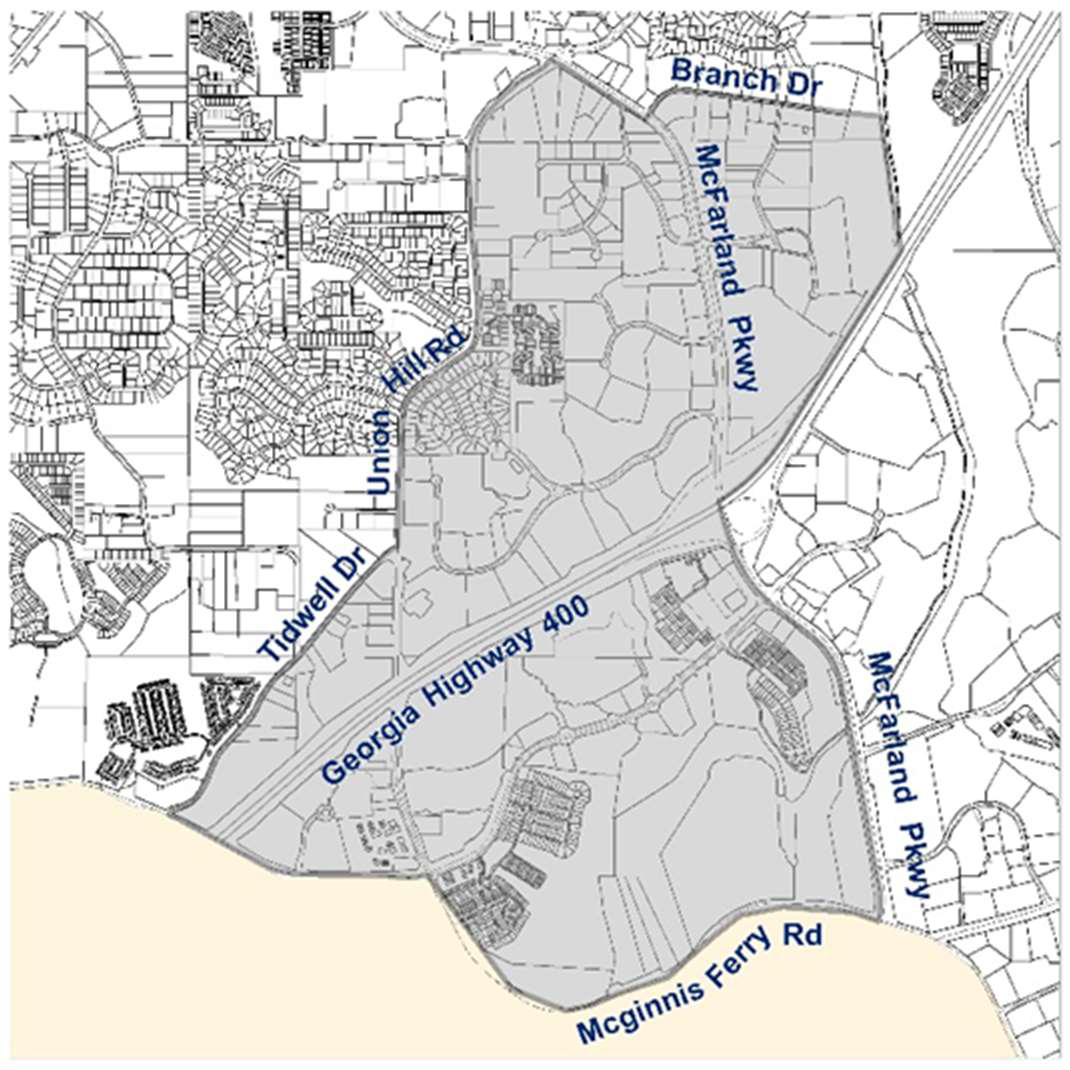
(3)
Height maximum of 125 feet for office uses is permitted within the portion of the McFarland/Shiloh Road Regional Node illustrated below:
(Amd. of 3-26-2001; Amd. of 9-25-2003; Amd. of 7-1-2010; Amd. of 6-7-2018; Amd. of 8-6-2020(2); Amd. of 7-8-2021; Amd. of 12-2-2021; Amd. of 4-18-2024)
15-5.1. - Purpose and intent.
The purpose of this article is to establish regulations relating to cottage food operations to ensure this use does not have a noticeable and negative impact on the agricultural and rural character of the subject property and adjacent properties.
(Amd. of 8-3-2023)
15-5.2. - Requirements.
(a)
Only cottage food products listed on the Georgia Department of Agriculture Cottage Food License issued to the cottage food operator shall be produced within a home kitchen of the operator's domestic residence, and only for sale directly to the consumer. Cottage food products are subject to the rules and regulations of the Goergia Department of Agriculture.
(b)
The cottage food producer shall maintain a valid Forsyth County business license. Failure to hold a valid business license will invalidate the Forsyth County Cottage Food Permit.
(c)
Cottage food operations are prohibited within major subdivisions.
(d)
Off-street parking must be provided to accommodate all customers. The maximum number of customers on the premises shall not exceed five at any given time.
(Amd. of 8-3-2023)

