
Forsyth County Unincorporated
City Zoning Code
City Zoning Code
CHAPTER 14
- INDUSTRIAL AND MINING DISTRICTS14
Cross reference— Businesses, ch. 22.
14-1.1. - Purpose and intent.
The purposes of these districts are to provide and reserve suitable areas for a variety of industrial uses including manufacturing, wholesale trade and distribution activities. Restricted industrial districts are only intended to be located in areas with relatively level topography, adequate water and sewerage facilities, and access to arterial streets and highways. Restricted industrial districts may be appropriate at the single lot level of development; however, restricted industrial uses are encouraged to locate in planned industrial parks and be designed in a campus-style setting. Vehicular activities in restricted industrial districts consist predominantly of trucks, with some passenger vehicle traffic, and the road system is built to support truck traffic. Provisions for pedestrians are not required, although pedestrian access to such districts is possible.
The industries locating in this district are characterized as lower in intensity, cleaner, and generally more compatible when located adjacent to commercial areas than are heavy manufacturing uses. Restricted industrial districts are intended to permit only those light industrial and other uses that will not generate excessive noise, particulate matter, vibration, smoke, dust, gas, fumes, odors, radiation and other nuisance characteristics. Restricted industry is capable of operation in such a manner as to control the external effects of the manufacturing process, such as odors, vibrations, emissions, or other nuisance characteristics through prevention or mitigation devices and conduct of operations within the confines of buildings. Heavy commercial activities businesses are also included as permitted uses in these districts; however, restricted industrial districts do not service the general public and, therefore, business uses are generally not permitted.
(Amd. of 9-7-2017(4))
14-1.2. - Permitted and conditional uses.
As provided in Table 14.1; and subject to the following provisions which apply to all uses in this district:
(a)
A conditional use is required for any establishment conducting around the clock business hours. Certain specific uses are regulated by chapter 16.
(Amd. of 9-7-2017(4))
14-1.3. - Performance standards.
As provided in Table 14.2.
14-1.4. - Site development regulations.
As provided in article IV of this chapter.
14-2.1. - Purpose and intent.
Heavy industrial districts are intended to provide suitable areas for manufacturing, assembling, fabrication and processing, bulk handling, storage, warehousing and trucking. The uses associated with this district are likely to generate significant levels of truck traffic, noise, pollution, vibration, dust, fumes, odors, radiation, radioactivity, poisons, pesticides, herbicides, or other hazardous materials, fire or explosion hazards, or other undesirable conditions. Conditional uses permitted in this district are primarily those known to create a safety hazard or produce particulate matter, thus being subject to various state and/or federal environmental laws. Heavy industrial districts are highly unsuitable adjacent to residential districts and are generally unfit for the sustained activity of humans and animals. Therefore, uses involving human activity such as dwellings, care centers, and certain commercial uses are not permitted. Conditional uses require impact statements to determine their compatibility with adjacent and nearby uses. Activity at heavy industrial sites consists predominantly of trucks, rather than passenger vehicles, and the road system is built to support truck traffic. Provisions for pedestrians are not required.
14-2.2. - Permitted and conditional uses.
As provided in Table 14.1; and subject to the following provisions which apply to all uses in this district:
(a)
A conditional use is required for any establishment conducting around the clock business hours. Certain specific uses are regulated by chapter 16.
(Amd. of 9-7-2017(4))
14-2.3. - Performance standards.
As provided in Table 14.2.
14-2.4. - Site development regulations.
As provided in article IV of this chapter.
14-2.5. - Application requirements for conditional uses.
In addition to the requirements for conditional uses as required by this Code, applications for a conditional use in the M2 district shall include an impact statement prepared by a qualified professional that addresses the impact of the proposed use on abutting and nearby buildings, uses, and properties. The impact statement shall address those external effects determined by the director to be likely to exist if said use is established, including but not limited to, electromagnetic interference, noise, vibration, fumes, odors, dust and air particulates, illumination, truck traffic, and water table protection. The impact statement shall recommend specific measures to mitigate such impacts and provisions for monitoring and enforcing mitigation measures, and, if approved, the recommendations of the impact statement shall be considered conditions of approval unless otherwise specified by action of the Forsyth County Board of Commissioners. At the option of the board of commissioners at the county's expense, an independent impact statement may be secured prior to its taking action on a conditional use in the M2 district to review the impact statement submitted by the applicant or to otherwise address probable adverse impacts of the proposed development; provided that an application process for a conditional use in the M2 district shall be extended no more than 62 days beyond normal processing times for the purposes of securing an independent impact statement.
14-3.1. - Purpose and intent.
These districts are specifically established to provide for the mining, extraction, crushing, and quarrying, as appropriate, of sand, rock, precious metals, and other minerals or elements removed from the earth. Mining districts allow a range of other heavy industrial uses that may be accessory to mining operations or economically linked to such uses. However, uses permitted in industrial districts should be sited in industrial districts, not the MINE district unless such uses involve extraction of materials.
These districts may be suitable adjacent to agricultural zoning districts. Extensive building and operation setbacks and generous buffers are required to ensure that mining districts do not pose physical hazards or nuisances (e.g., dust, noise, vibration, etc.) to neighboring dwellings, schools, parks, places of worship, hospitals, commercial buildings, and public buildings and roads.
(Amd. of 2-2-2017(3))
14-3.2. - Permitted and conditional uses.
As provided in Table 14.1; and subject to the following provisions which apply to all uses in this district:
(a)
A conditional use is required for any establishment conducting around the clock business hours. Certain specific uses are regulated by chapter 16.
(Amd. of 9-7-2017(4))
14-3.3. - Performance standards.
As provided in Table 14.2.
14-3.4. - Site development regulations.
As provided in article IV of this chapter.
14-3.5. - Application requirements.
Any application for rezoning to the MINE district must be accompanied by the following:
(a)
A detailed site plan as required by the director. At a minimum, the site plan shall indicate the following: proposed location of phased mining operations; proposed locations or disposition of topsoil, overburden, and by-products, on- or off-site.
(b)
A letter of intent describing the date proposed for the commencement of operations and their expected durations, including proposed hours and days of operation. Operations shall not be permitted on Sundays and holidays, nor will they be permitted within the hours of 7:00 p.m. and 7:00 a.m. on any day. Said letter shall also describe the nature of mining operations, method(s) of extraction, and equipment and materials (e.g., explosives) to be used. The letter of intent and any actions stipulated to or reasonably implied from the language of the letter of intent shall become conditions of development approval, if the rezoning application is approved.
(c)
Written evidence by a geologist or other competent professional qualified to make such a judgement that the site to be rezoned MINE contains a mineral resource area or other valuable surface or subsurface substances that can be economically mined.
(d)
An impact statement prepared by a qualified professional that addresses the impact of the proposed mining operation on abutting and nearby buildings, uses, and properties. The impact statement shall address those external effects determined by the director to be likely to exist if said use is established, including but not limited to as appropriate, electromagnetic interference, noise, vibration, fumes, odors, dust and air particulates, illumination, truck traffic, and water table protection. The impact statement shall recommend specific measures to mitigate such impacts and provisions for monitoring and enforcing mitigation measures, and, if approved, the recommendations of the impact statement shall be considered conditions of approval unless otherwise specified by action of the Forsyth County Board of Commissioners. At the option of the board of commissioners and at the applicant's expense, an independent impact statement may be secured prior to its taking action on a rezoning request for MINE district to review the impact statement submitted by the applicant or to otherwise address probable adverse impacts of the proposed development; provided that an application process for rezoning to MINE shall be extended no more than 62 days beyond normal processing times for the purposes of securing an independent impact statement.
(e)
An operations plan and all documents submitted or prepared for submission to the Georgia Department of Natural Resources for the purpose of obtaining a state mining permit. It shall be the responsibility of the applicant to update all information during the state application process and to inform the director of the final disposition of the state permit process. Operations plans, if approved, shall be considered conditions of development approval, unless otherwise specified by the director.
(f)
A reclamation plan which shall include a description of how the excavated land will be restored, statement of intended future use of the land, and phasing and timing estimates of reclamation and rehabilitation activities. Reclamation plans, if approved, shall be considered conditions of development approval, unless otherwise specified by the director. The Board of Commissioners of Forsyth County may require an applicant to post a bond calculated on a specific amount per acre for the purpose of insuring proper reclamation of the land.
TABLE 14.1
PERMITTED USES IN INDUSTRIAL AND MINING DISTRICTS
P = Permitted
C = Conditional
X = Not permitted
*For any establishment conducting around the clock business hours, a conditional use permit is required.
Notes:
Table 14.1
(1)
See the Forsyth County Adult Establishment Ordinance, Ordinance 85.
(2)
Prior to development of any associated accessory uses, approval of the site plan must be granted by the board of commissioners. If the accessory use is a school, a conditional use permit is required and all requirements for a conditional use permits must be met.
(3)
The office commercial multiple story (OCMS) zoning district uses and performance standards may be applied within the M1 district per conditional use.
(4)
See Ordinance No. 103 (Shooting Range Ordinance).
(5)
In cases where a use is proposed but is not listed in this table, the director shall make an administrative determination as to whether or not the use is permitted in the zoning district or districts in question. The director will compare the proposed use to substantially similar uses to determine if the proposed use will be considered a prohibited, permitted, or conditional use. In making such determinations, the director shall consult the purpose and intent statements of the zoning district or districts in question, in addition to comparing the use in question to uses specifically listed in this table.
(6)
Sales, unenclosed or enclosed, shall not exceed 20 percent of the lot area.
(7)
Places of worship for which a CUP, rezoning or development permit application is being processed, that have been approved but not constructed, that are under construction, or that have received a Certificate of Occupancy prior to February 2, 2017, are exempt from the size cap. In addition, property immediately adjacent to the property on which a place of worship that is exempt pursuant to this note is located, that is purchased after February 2, 2017, is also exempt from the size cap. For properties exempted from the size cap pursuant to this note, the requirements for places of worship 10,000 square feet or less in aggregate size (either conditional use permit (C) or not permitted (X)) shall apply for each zoning district. For purposes of this chart, "aggregate size" shall mean total square footage of all structures on the property on which the place of worship is located.
(Amd. of 3-26-2001; Amd. of 9-25-2003; Amd. of 1-3-2013; Ord. of 3-3-2016(1), § 3; Amd. of 12-1-2016; Amd. of 12-20-2016; Amd. of 2-2-2017(3); Amd. of 9-7-2017(4); Amd. of 3-7-2019; Amd. of 4-18-2019; Amd. of 7-11-2019; Amd. of 11-7-2019; Amd. of 7-9-2020(1); Amd. of 10-8-2020(1); Amd. of 9-2-2021; Amd. of 10-6-2022, § 5; Amd. of 1-5-23; Amd. of 11-2-2023; Amd. of 3-6-2025)
TABLE 14.2
PERFORMANCE STANDARDS FOR INDUSTRIAL AND MINING OPERATIONS
Notes
Table 14.2
(1)
One acre is required to rezone to the M1 district, unless the property is adjoining property already zoned industrial, in which case the property to be rezoned can be less than one acre. This does not imply that the lot smaller than one acre to be rezoned industrial is required to be included as part of the lot already zoned industrial.
(2)
Buffer and landscape strips along roadways shall begin at the dedicated right-of-way lines, and at the existing right-of-way line if a state route.
(3)
This standard shall not apply to an industrial lot that has been platted and developed for industrial use but on which a building has not been constructed, when a residential, OR, A1, or AG-Res zoning district is subsequently established abutting the side or rear lot line of said industrial lot.
(4)
For MINE districts, setbacks shall apply to all mining activities as well as buildings and structures.
(5)
The maximum height for any use not referenced for this node shall be the maximum height allowed for the character area in which the node is located.
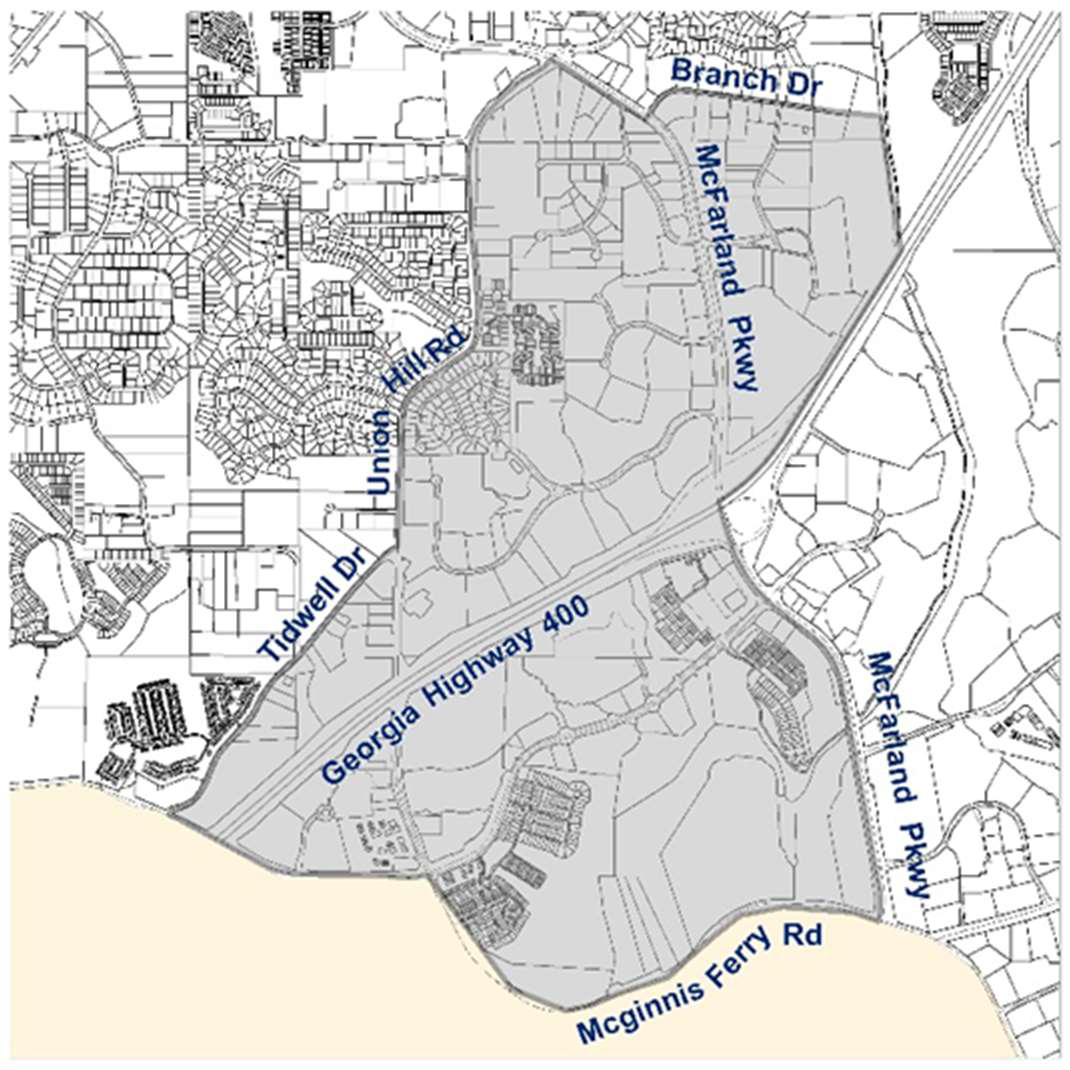
(6)
Height maximum of 125 feet for office uses is permitted within the portion of the McFarland/Shiloh Road Regional Node illustrated below:
(Amd. of 3-26-2001; Amd. of 9-25-2003; Amd. of 10-2-2008; Amd. of 7-1-2010; Amd. of 6-7-2018; Amd. of 10-7-2021; Amd. of 12-2-2021; Amd. of 3-6-2025)
14-4.1. - Purpose and intent.
It is the intent of Forsyth County to require that new industrial developments and mining operations install appropriate improvements and comply with general design regulations that are intended to improve their appearance, compatibility, and function. It is also the intent of the county to require substantial progress toward compliance with these improvement requirements and general design regulations in cases where existing industrial or mining operations are expanded.
14-4.2. - Applicability.
This article shall apply to all properties located within all industrial and mining zoning districts of unincorporated Forsyth County. New development shall be required to conform to these regulations. A substantial improvement of an existing development shall be required to conform to these regulations or make substantial progress toward meeting the regulations contained within this chapter.
14-4.3. - Utilities.
All telephone, electricity, and gas transmission lines serving uses on site shall be installed underground.
14-4.4. - Grading and site development.
Buildings and parking lots shall be appropriately drained so as to prevent damage to abutting properties or public streets. Grading plans for new development shall be submitted to the planning and community development director for review and approval by the planning and community development department and director of engineering, and all grading activities shall comply with approved plans. Stormwater management plans shall be submitted to the planning and community development director for review and approval by the planning and community development department and director of engineering, and all such drainage improvements shall be designed, installed and maintained in accordance with the standards of Ordinance No. 75 (Storm Water Management Ordinance) as adopted and as may be amended from time to time. All disturbed or graded ground areas of a building site not used for buildings or open storage areas shall be appropriately stabilized and grassed or covered with plants or landscaping materials.
(Amd. of 9-7-2006; Amd. of 12-1-2011)
14-4.5. - Curb cuts and access specifications.
All entrances or exits of any street or driveway, public or private, from or to any state highway shall be approved by the state department of transportation and the director of engineering prior to the construction of such entrances or exits and prior to the issuance of any development permit for any improvement to be served by such entrances or exits.
No curb cut or access driveway shall be permitted to be located closer than 100 feet to the nearest existing or proposed right-of-way of an intersecting roadway or closer than 40 feet to a side property line unless the adjacent property owner is in agreement with the encroachment of the driveway and approval is obtained from the director of engineering. Curb cuts or access driveways shall be no narrower than 24 feet from back of curb to back of curb. Strict adherence to these requirements may not be practical in all instances as determined by the director of engineering. The director of engineering may limit the maximum width of a curb cut and/or the number of curb cuts to a parcel as necessary when it is deemed to be of benefit to the safety and welfare of the public.
In cases of a substantial improvement of an existing development on a site that does not meet these curb cut and access specifications, the applicant may be required by the director of engineering to prepare an access plan as part of plans for the substantial improvement that either meets these requirements or moves substantially toward compliance with these regulations. Approval by the Georgia Department of Transportation and the director of engineering shall be required, as applicable.
Additional right-of-way shall be dedicated to the public as required by the most current functional classification of Forsyth County roads as designated in the major transportation plan. Roadway entrances and improvements, including necessary acceleration and/or deceleration lane(s) and left/right turn lanes, shall be designed, installed, and maintained as approved by the state department of transportation, as applicable, or the director of engineering, in accordance with state or county requirements, as applicable and as may be amended from time to time.
The following factors may be considered during the review and approval of a specific location of an entrance: The location of existing or planned median breaks; separation requirements between the entrance and major intersections; separation requirements between other entrances; the need to provide shared access with other sites; the need to align with previously approved or constructed access points on the opposite side of the street; and the minimum number of entrances needed to move traffic onto and off the site safely and efficiently.
14-4.6. - Interparcel connections.
Interparcel connections are not required between developments in industrial and mining districts. However, connections between adjacent properties under different ownership within commercial and/or industrial districts may be provided when the uses of the properties are of such compatibility that truck traffic may be needed between buildings or uses.
14-4.7. - Location of loading and unloading areas.
Loading and unloading areas shall not be located closer than 50 feet from the right-of-way of a public street.
14-4.8. - Screening of outside storage yards.
All areas devoted to the outside storage of vehicles, merchandise, and/or equipment shall be screened from view from the right-of-way of the highway or major street along the entire property frontage, except in areas where access crossings have been approved. Screening may be accomplished by a natural vegetative buffer, by a building that meets architectural standards of this chapter, by an earthen berm, by a 100 percent opaque, solid wooden fence or wall, or combination of these screening methods. The use of low-lying landscaping that does not screen the storage areas from view from the public right-of-way shall not be deemed to comply with this requirement.
14-4.9. - Screening of dumpsters.
All garbage dumpsters and other similar areas devoted to the storage of waste materials shall be screened on three sides of said dumpster or area with a minimum six-foot high solid wooden fence, or a wall constructed of materials substantially similar in appearance to the building on site that complies with the architectural requirements of these regulations. In addition, said dumpster areas shall be gated on the fourth side, and the gate shall be architecturally finished.
(Amd. of 11-15-2004)
14-4.10. - Outdoor lighting.
See chapter 16.
(Amd. of 11-15-2004)
14-4.11. - Building materials.
Building exteriors not screened from view from the right-of-way or any property line shall be of masonry or decorative type metal construction with a 20-year finish, its equivalent, or superior construction. Uncolored or exposed galvanized iron or aluminum or fiberglass shall not be utilized as an exterior finish. Prohibited construction materials shall include, without limitation, exposed concrete block, weeping mortar joints, unnatural brick tones, uncolored or exposed galvanized iron or aluminum or fiberglass.
14-4.12. - Building and utility appurtenances.
All water towers, cooling towers, storage tanks, and other structures or equipment incidental to the primary use of a building or site shall be architecturally compatible with the principal building or effectively screened from view from the public rights-of-way. All rooftop mechanical equipment shall be screened from the view from the public right-of-way and adjacent streets by material compatible with the building architecture, by the use of a parapet wall, or by specially designed rooftop penthouse enclosures. Ground mounted equipment such as power transformers and air conditioning units shall be screened from view from public rights-of-way by fencing or landscaping.
14-4.13. - Landscaping.
Every building site and industrial use area shall be landscaped. In addition to the minimum front yard landscape strip required in Table 14.2, a minimum six-foot wide landscape strip shall be required along all side and rear lot or lease lines, except in cases where access areas are approved. The area surrounding the road entrance(s) to the site or area, front, side, and rear landscape strips, required parking lot landscaping, and all other required landscaping and/or open spaces shall be designed, installed, and maintained according to plans prepared by a professional landscape architect, architect, surveyor, engineer, or land planner submitted to and approved by the Forsyth County Planning and Community Development Department. Landscaping shall be completed prior to issuance of a certificate of occupancy by the department, unless appropriate provisions are made to guarantee the installation of landscaping after such certificate is issued, such as approval by the department of a bond for landscaping. Tree installation and removal shall be in compliance with standards provided in Ordinance No. 98 (Tree Protection and Replacement Ordinance), as may be amended from time to time, and administrative standards for the preservation and replacement of trees as adopted and as may be amended from time to time.
(Amd. of 9-7-2006; Amd. of 12-1-2011)
14-4.14. - Signage.
All signs in industrial and mining districts shall comply as applicable with Ordinance No. 74 (Sign Ordinance), as may be amended from time to time.
(Amd. of 9-7-2006)
14-4.15. - Plans.
Site development as-built drawings, containing a boundary survey, location, elevation, height, and square footage of buildings, parking areas, utilities, walls, and stormwater facilities, pertinent site development data, and any other requirements of the planning and community development director or director of engineering, shall be submitted to and approved by the department prior to the issuance of a certificate of occupancy.
(Amd. of 12-1-2011)

