
Forsyth County Unincorporated
City Zoning Code
City Zoning Code
CHAPTER 11
- RESIDENTIAL DISTRICTS12
Editor's note— Ord. No. 87, adopted January 11, 2006, amended chapter 11 in its entirety to read as herein set out. Former chapter 11, §§ 11-1.1—11-6.6, pertained to similar subject matter, and derived from the original codification of the Unified Development Code; Amd. of 9-25-2003 and Amd. of 2-2-2004.
11-1.1. - Purpose and intent.
Residential districts existent prior to September 25, 2003, are to comply with permitted uses and performance standards as specified in this article.
(Amd. of 1-3-2013)
11-1.2. - Permitted and conditional uses.
As provided in Table 11.1(a); and subject to the following provisions which apply to all uses in this district:
(a)
A conditional use is required for any establishment conducting around the clock business hours.
(Amd. of 1-3-2013; Amd. of 9-7-2017(2))
11-1.3. - Performance standards.
As provided in Table 11.2(a).
(Amd. of 1-3-2013)
11-1.4. - Design standards.
As provided in article IX, section 11-9.3
(Amd. of 7-5-2018)
11-2.1. - Purpose and intent.
Res1 districts are intended to provide for subdivisions and neighborhoods consisting of detached single family dwellings surrounded by yards that provide a desirable and healthy environment. Res1 districts provide for detached manufactured/mobile homes and site built single family detached dwellings on individual lots. Res1 districts are generally served by public water supply, and public sanitary sewer is generally not available. This district shall be considered appropriate in areas designated as such in the Forsyth County Comprehensive Plan and where compatible with surrounding land uses, density and performance standards.
(Ord. No. 87, 1-11-2006; Amd. of 1-3-2013; Amd. of 2-7-2013; Amd. of 9-4-2014)
11-2.2. - Permitted and conditional uses.
As provided in Table 11.1(b); and subject to the following provisions which apply to all uses in this district:
(a)
A conditional use is required for any establishment conducting around the clock business hours. Certain specific uses are regulated by Chapter 16.
(Ord. No. 87, 1-11-2006; Amd. of 1-3-2013; Amd. of 9-7-2017(2))
11-2.3. - Performance standards.
As provided in Table 11.2(b).
(Ord. No. 87, 1-11-2006; Amd. of 1-3-2013)
11-2.4. - Design standards.
As provided in article IX, section 11-9.3
(Amd. of 7-5-2018)
11-2.5. - Incentives for large lots.
To encourage the development of large lots in the Res1 zoning district, any requirement to connect to sewer found elsewhere in this Code shall be waived for both major and minor subdivisions with a minimum lot size of one acre or larger. A conditional use permit shall be required for a large lot subdivision not connected to sewer.
(Amd. of 7-8-2021)
11-3.1. - Purpose and intent.
Res2 districts are intended to provide for subdivisions and neighborhoods consisting of detached single family dwellings surrounded by yards that provide a desirable and healthy environment. Res2 districts are generally served by public water supply, and public sanitary sewer is generally not available. Because Res2 districts are generally served by individual septic tanks, maximum density is based on the health requirement that lots must be large enough to accommodate a septic tank drain field and replacement drain field area. This district shall be considered appropriate in areas designated as such in the Forsyth County Comprehensive Plan and where compatible with surrounding land uses, density and performance standards.
(Ord. No. 87, 1-11-2006; Amd. of 1-3-2013; Amd. of 9-4-2014)
11-3.2. - Permitted and conditional uses.
As provided in Table 11.1(b); and subject to the following provisions which apply to all uses in this district:
(a)
A conditional use is required for any establishment conducting around the clock business hours. Certain specific uses are regulated by chapter 16.
(Ord. No. 87, 1-11-2006; Amd. of 12-13-2007; Amd. of 1-3-2013; Amd. of 9-7-2017(2))
11-3.3. - Performance standards.
As provided in Table 11.2(b).
(Ord. No. 87, 1-11-2006; Amd. of 1-3-2013)
11-3.4. - Design standards.
As provided in article IX, section 11-9.3
(Amd. of 7-5-2018)
11-4.1. - Purpose and intent.
CR2 districts are intended to provide for subdivisions and neighborhoods consisting of detached single family dwellings surrounded by yards that provide a desirable and healthy environment. The CR2 district is intended for larger-scale subdivisions built to higher than minimum standards allowing for variability in lot sizes to encourage variation in design to enhance neighborhood character. Development within this district must be served by public water and public sewer or an existing private sewage treatment plant with sufficient capacity. This district shall be considered appropriate in areas designated as such in the Forsyth County Comprehensive Plan and where compatible with surrounding land uses, density and performance standards.
(Amd. of 4-2-2015; Amd. of 12-3-2015)
11-4.2. - Permitted and conditional uses.
As provided in Table 11.1(b); and subject to the following provisions which apply to all uses in this district:
(A)
A conditional use is required for any establishment conducting around the clock business hours. Certain specific uses are regulated by Chapter 16.
(Amd. of 4-2-2015; Amd. of 9-7-2017(2))
11-4.3. - Performance standards.
As provided in Table 11.2(b).
(Amd. of 4-2-2015)
11-4.4. - Design standards.
As provided in article IX, section 11-9.3
(Amd. of 7-5-2018)
11-5.1. - Purpose and intent.
Res3 districts are intended to provide for subdivisions and neighborhoods consisting of detached single family dwellings surrounded by yards that provide a desirable and healthy environment. The Res3 district is intended for larger-scale subdivisions built to higher than minimum standards. Open space should be provided for throughout the development and should be accessible and available for recreational use by residents. Since a higher density is permitted, Res3 districts must be served by public water and Public Sewer or an Existing Private Sewage Treatment Plant with Sufficient Capacity. This district shall be considered appropriate in areas designated as such in the Forsyth County Comprehensive Plan and where compatible with surrounding land uses, density and performance standards.
(Ord. No. 87, 1-11-2006; Amd. of 11-15-2004; Amd. of 11-1-2007; Amd. of 1-3-2013; Amd. of 9-4-2014; Amd. of 4-2-2015; Amd. of 12-3-2015)
11-5.2. - Permitted and conditional uses.
As provided in Table 11.1(b); and subject to the following provisions which apply to all uses in this district:
(a)
A conditional use is required for any establishment conducting around the clock business hours. Certain specific uses are regulated by chapter 16.
(Ord. No. 87, 1-11-2006; Amd. of 12-13-2007; Amd. of 1-3-2013; Amd. of 4-2-2015; Amd. of 9-7-2017(2))
11-5.3. - Performance standards.
As provided in Table 11.2(b).
(Ord. No. 87, 1-11-2006; Amd. of 1-3-2013; Amd. of 4-2-2015)
11-5.4. - Design standards.
As provided in article IX, section 11-9.3
(Amd. of 7-5-2018)
11-6.1. - Purpose and intent.
The Res4 district is solely intended to provide for age-restricted housing in which at least one person 55 years or older inhabits at least 90 percent of occupied units within a given development, with all applicable verification requirements to the U. S. Department of Housing and Urban Development (HUD) in UDC section 16-4.31(c) otherwise receiving compliance. The Res4 district is to be composed of single family, primarily detached dwellings, situated on smaller lots and with buildings located closely together; attached duplex and quadraplex units may also be permitted. To compensate for reduced lot sizes and setbacks, greater open space is required. Open space should be provided for throughout the development and should be accessible and available for recreational use by residents. Public water and sanitary sewer are required for developments within Res4 districts. Res4 districts shall connect to public sewer or an existing private sewage treatment plant with sufficient capacity. This district shall be considered appropriate in areas designated as such in the Forsyth County Comprehensive Plan and where compatible with surrounding land uses, density and performance standards.
(Ord. No. 87, 1-11-2006; Amd. of 11-15-2004; Amd. of 11-1-2007; Amd. of 1-3-2013; Amd. of 9-4-2014; Amd. of 4-2-2015; Amd. of 6-1-2017(2); Amd. of 3-6-2025)
11-6.2. - Permitted and conditional uses.
As provided in Table 11.1(b); and subject to the following provisions which apply to all uses in this district:
(a)
A conditional use is required for any establishment conducting around the clock business hours. Certain specific uses are regulated by chapter 16.
(Ord. No. 87, 1-11-2006; Amd. of 12-13-2007; Amd. of 1-3-2013; Amd. of 4-2-2015; Amd. of 9-7-2017(2))
11-6.3. - Performance standards.
As provided in Table 11.2(b).
(Ord. No. 87, 1-11-2006; Amd. of 1-3-2013; Amd. of 4-2-2015)
11-6.4. - Special application requirements.
Applications for rezoning to the Res4 zoning district shall, in addition to the general requirements for rezoning applications specified in chapter 8, submit the following as part of the application:
(a)
Proof of availability of adequate sewer capacity including the size and location of connection points;
(Ord. No. 87, 1-11-2006; Amd. of 11-1-2007; Amd. of 1-3-2013; Amd. of 4-2-2015; Amd. of 12-3-2015)
11-6.5. - Design standards.
As provided in article IX, section 11-9.3
(Amd. of 7-5-2018)
11-7.1. - Purpose and intent.
The Res6 district is intended to provide for single family attached dwellings that allow options to increase housing variety and opportunities. In addition, Res6 districts may allow institutional type residences and other conditional institutional uses, but not to such an extent as to sacrifice the overall residential image and character. Open space should be provided for throughout the development and shall be accessible and available for recreational use by residents. Public water and sanitary sewer are required for developments within Res6 districts. Res6 districts shall connect to Public Sewer or an Existing Private Sewage Treatment Plant with Sufficient Capacity. The overall density of Res6 developments is four units per acre and therefore allows for fee simple townhouses and condominiums. This district shall be considered appropriate in areas designated as such in the Forsyth County Comprehensive Plan and where compatible with surrounding land uses, density and performance standards.
(Amd. of 11-15-2004; Ord. No. 87, 1-11-2006; Amd. of 11-1-2007; Amd. of 1-3-2013; Amd. of 9-4-2014; Amd. of 4-2-2015; Amd. of 9-7-2017(2); Amd. of 6-3-2021)
11-7.2. - Permitted and conditional uses.
As provided in Table 11.1(b); and subject to the following provisions which apply to all uses in this district:
(a)
A conditional use is required for any establishment conducting around the clock business hours. Certain specific uses are regulated by chapter 16.
(Ord. No. 87, 1-11-2006; Amd. of 12-13-2007; Amd. of 1-3-2013; Amd. of 4-2-2015; Amd. of 9-7-2017(2))
11-7.3. - Performance standards.
As provided in Table 11.2(b).
(Ord. No. 87, 1-11-2006; Amd. of 1-3-2013; Amd. of 4-2-2015)
11-7.4. - Special application requirements.
Applications for rezoning to the Res6 zoning district shall, in addition to the general requirements for rezoning applications specified in chapter 8, submit the following as part of the application:
(a)
Proof of availability of adequate sewer capacity including the size and location of connection points.
(Ord. No. 87, 1-11-2006; Amd. of 11-1-2007; Amd. of 1-3-2013; Amd. of 4-2-2015; Amd. of 12-3-2015)
11-7.5. - Design standards.
As provided in article IX, section 11-9.3
(Amd. of 7-5-2018)
11-8.1. - Purpose and intent.
MHP districts are intended to provide for affordable housing developments consisting of detached manufactured/mobile homes surrounded by minimal yards. The manufactured/mobile home park district is intended to provide for the leasing of spaces for the placement of manufactured/mobile homes, owned or rented by tenants, within a planned residential community. A manufactured/mobile home park is different from a residential subdivision in that the individual home spaces for manufactured/mobile homes are leased rather than platted and sold. By requiring less land per home space, manufactured/mobile home parks are built at densities greater than those for other detached dwellings. Service facilities such as laundry and leasing office are permitted uses in MHP districts. This district shall be considered appropriate in areas designated as such in the Forsyth County Comprehensive Plan and where compatible with surrounding land uses, density and performance standards.
(Ord. No. 87, 1-11-2006; Amd. of 1-3-2013; Amd. of 2-7-2013; Amd. of 9-4-2014; Amd. of 4-2-2015)
11-8.2. - Permitted and conditional uses.
As provided in Table 11.1(b); and subject to the following provisions which apply to all uses in this district:
(a)
A conditional use is required for any establishment conducting around the clock business hours. Certain specific uses are regulated by chapter 16.
(Ord. No. 87, 1-11-2006; Amd. of 1-3-2013; Amd. of 4-2-2015; Amd. of 9-7-2017(2))
11-8.3. - Performance standards.
As provided in Table 11.2(b).
(Ord. No. 87, 1-11-2006; Amd. of 1-3-2013; Amd. of 4-2-2015)
11-8.4. - Site plan review and approval required.
No manufactured/mobile home park shall be developed until and unless a site plan shall have been approved by the director and director of engineering.
(Ord. No. 87, 1-11-2006; Amd. of 1-3-2013; Amd. of 2-7-2013; Amd. of 4-2-2015)
11-8.5. - General development requirements.
In addition to the performance standards specified in Table 11.2(b), development within the MHP district shall meet the following requirements:
(a)
Site frontage and minimum width. Properties containing manufactured/mobile home parks shall have a minimum of 200 feet of public road frontage and a minimum lot width of 200 feet throughout the entire depth of the developed portion of the property.
(b)
Perimeter buffer or landscaping. A minimum 20-foot wide buffer, where natural vegetation exists, or where no natural vegetation exists, a landscape strip with evergreen trees and a solid wooden fence of six feet in height shall be installed and maintained around the entire perimeter of the development, except for approved access crossings.
(c)
Open and recreational areas. A minimum of 20 percent of the site area shall be open space and recreational area, including the required perimeter buffer and landscaping. A minimum of five percent of the total site area, counted as part of the required 20 percent, shall be devoted to active recreational facilities.
(d)
Community services. As part of the site plan review process, the developer may propose and the county may approve one or more other structures for manufactured/mobile home park occupants, such as laundries, storage, garages, parking, and park offices. Any structure that draws its trade from outside the park boundaries is prohibited.
(e)
Access. The road system, both within and adjacent to the proposed park, shall be designed to meet the requirements of the County Fire Marshal's Office and the traveling public to include the following: 1) All interior roads shall be private but constructed to provide fire apparatus access and paved; 2) One-way interior roads shall be constructed with a minimum surface width of fourteen (14) feet, and shall be designated "no parking"; 3) Two-way interior roads shall be constructed with a minimum surface width of 24 feet, and shall be designated "no parking"; 4) Interior roads shall be clearly marked at each intersection to identify traffic directions and space numbers served by the road.
(f)
Guest parking. In addition to on-site parking, guest parking spaces shall be provided as part of the development, at a ratio of one parking space for every six home spaces. Guest parking spaces shall be grouped and distributed evenly throughout the manufactured/mobile home park.
(g)
Utilities. All manufactured/mobile home parks, and each home space within the park, shall be served by approved public water and public sanitary sewer or community sewerage system.
(h)
Drainage. Drainage facilities shall be designed by an engineer and are subject to the approval of the director of engineering as part of the site plan review process.
(i)
Refuse collection. Each manufactured/mobile home park shall provide refuse collection pads at locations convenient to each home space.
(j)
Walkways. Sidewalks shall be required along one side of the street and in areas where pedestrian traffic is expected, such as around recreation, management, mailbox groupings if provided, and service areas.
(k)
Park rules. The property owner or manager shall submit operating rules and regulations governing the park to the director.
(Ord. No. 87, 1-11-2006; Amd. of 1-3-2013; Amd. of 2-7-2013; Amd. of 4-2-2015)
11-8.6. - Home spaces in manufactured/mobile home parks.
(a)
Design. Each home space shall be designed and constructed at such elevation, distance, and angle with respect to its access to provide for safe and efficient placement and removal of manufactured/mobile homes.
(b)
Width, depth, and size of spaces. Each home space shall be at least 40 feet wide and 75 feet in depth. The minimum area for a home space shall be 3,000 square feet.
(c)
Stands. Each home space shall be provided with a concrete pad of sufficient size to accommodate the typical manufactured/mobile home to be located within that space, and the pad should be large enough to accommodate patios and provide for the anchoring of the home to secure it against movement; provided, however, that any individual stand shall be no less than 14 feet by 60 feet and spaces intended to serve double-wide homes shall be at least 24 feet by 60 feet.
(d)
Use of spaces. No more than one manufactured/mobile home shall occupy any individual home space. Recreational vehicles shall not be permitted on any home space, except that park management may permit a household with a valid lease agreement for a recreational vehicle to occupy a home space on a home space not occupied by a manufactured/mobile home for a period not to exceed 14 days within any six-month period.
(e)
Space identification numbers. Home space numbers at least four inches in height shall identify each home space and shall remain readily identifiable while in use.
(f)
Parking. Two on-site parking spaces shall be provided on each home space or immediately off-site.
(g)
Walkways. A walkway at least two feet wide must be provided from each individual home space to connect the manufactured/mobile home with the common walk or street.
(h)
Setbacks. No manufactured/mobile home shall be located closer than five feet to a home space boundary, and home spaces shall be designed to provide for a minimum of 20 feet of separation between manufactured/mobile homes on abutting home spaces.
(i)
Additions and accessory structures. Decks, porches, outdoor storage, or other exterior additions may be constructed or erected on a home space, subject to the approval of the park management. No such accessory structure shall be located closer than five feet to a manufactured/mobile home space boundary.
(Amd. of 2-7-2013; Amd. of 4-2-2015)
TABLE 11.1(a)
USES PERMITTED IN RESIDENTIAL DISTRICTS*
P = Permitted
C = Conditional
X = Not Permitted
* For any establishment conducting around the clock business hours, a conditional use permit is required.
Notes:
Table 11.1(a)
(1)
In cases where a use is proposed but is not listed in this table, the director shall make an administrative determination as to whether or not the use is permitted in the zoning district or districts in question. The director will compare the proposed use to substantially similar uses to determine if the proposed use will be considered a prohibited, permitted, or conditional use. In making such determinations, the director shall consult the purpose and intent statements of the zoning district or districts in question, in addition to comparing the use in question to uses specifically listed in this table.
(2)
Rezonings approved as conservation subdivisions prior to xx/xx/xx, must comply with Chapter 19, Conservation Subdivisions.
(3)
All accessory uses shall be identified in the conditional use permit application and on the associated site plan. Accessory uses proposed to be added after the initial conditional use permit approval shall require a new conditional use permit.
(4)
In addition to receiving county approval, all applicable state and federal approvals must be obtained.
(5)
In the R3 zoning district, major and minor subdivisions for single family detached dwellings require a 6,000 square feet lot and have a maximum density of four units per acre.
(6)
Regulations for home businesses are found in chapter 16, article 3.
(7)
Places of worship for which a CUP, rezoning or development permit application is being processed, that have been approved but not constructed, that are under construction, or that have received a certificate of occupancy prior to February 2, 2017, are exempt from the size cap. In addition, property immediately adjacent to the property on which a place of worship that is exempt pursuant to this note is located, that is purchased after February 2, 2017, is also exempt from the size cap. For properties exempted from the size cap pursuant to this note, the requirements for places of worship 10,000 square feet or less in aggregate size (either conditional use permit (C) or not permitted (X)) shall apply for each zoning district. For purposes of this chart, "aggregate size" shall mean total square footage of all structures on the property on which the place of worship is located.
(8)
Second principal dwelling for lots five acres and greater only.
(9)
Regulations for the keeping of backyard chickens are found in section 16-4.4.
(10)
Regulations for accessory structures are found in section 16-4.3.
(11)
For new major subdivisions in the LR district, a minimum of 15 percent of the dwellings must include an oversized garage measuring at least 15 feet by 35 feet with a height of no less than 13 feet. Where a fraction results during the calculation of required oversized garages, the required number of oversized garages shall be construed to be only the whole number.
(Amd. of 7-1-2010; Amd. of 1-3-2013; Amd. of 2-7-2013; Amd. of 12-1-2016; Amd. of 2-2-2017(1); Am. of 9-7-2017(2); Am. of 12-7-2017(3); Amd. of 4-18-2019; Amd. of 3-5-2020(4); Amd. of 4-15-2021; Amd. of 9-2-2021; Ord. of 10-06-2022, § 2; Amd. of 5-4-2023; Amd. of 4-18-2024; Amd. of 8-1-2024; Amd. of 3-6-2025; Amd. of 4-17-2025)
TABLE 11.1(b)
USES PERMITTED IN RESIDENTIAL DISTRICTS*
P = Permitted
C = Conditional
X = Not Permitted
* For any establishment conducting around the clock business hours, a conditional use permit is required.
Notes:
Table 11.1(b)
(1)
In cases where a use is proposed but is not listed in this table, the director shall make an administrative determination as to whether or not the use is permitted in the zoning district or districts in question. The director will compare the proposed use to substantially similar uses to determine if the proposed use will be considered a prohibited, permitted, or conditional use. In making such determinations, the director shall consult the purpose and intent statements of the zoning district or districts in question, in addition to comparing the use in question to uses specifically listed in this table.
(2)
Rezonings approved as conservation subdivisions prior to xx/xx/xx, must comply with Chapter 19, Conservation Subdivisions.
(3)
All accessory uses shall be identified in the conditional use permit application and on the associated site plan. Accessory uses proposed to be added after the initial conditional use permit approval shall require a new conditional use permit.
(4)
In addition to the receiving county approval, all applicable state and federal approvals must be obtained.
(5)
Deleted.
(6)
Regulations for home businesses are found in chapter 16, article 3.
(7)
Places of worship for which a CUP, rezoning or development permit application is being processed, that have been approved but not constructed, that are under construction, or that have received a certificate of occupancy prior to February 2, 2017, are exempt from the size cap. In addition, property immediately adjacent to the property on which a place of worship that is exempt pursuant to this note is located, that is purchased after February 2, 2017, is also exempt from the size cap. For properties exempted from the size cap pursuant to this note, the requirements for places of worship 10,000 square feet or less in aggregate size (either conditional use permit (C) or not permitted (X)) shall apply for each zoning district. For purposes of this chart, "aggregate size" shall mean total square footage of all structures on the property on which the place of worship is located.
(8)
Regulations for the keeping of backyard chickens are found in section 16-4.4.
(9)
Regulations for major and minor subdivisions with a minimum lot size of one acre or larger are found in section 11-2.5.
(10)
Regulations for accessory structures are found in section 16-4.3.
(Amd. of 7-1-2010; Amd. of 1-3-2013; Amd. of 2-7-2013; Amd. of 4-2-2015; Amd. of 12-1-2016; Amd. of 2-2-2017(1); Amd. of 9-9-2017(2); Amd. of 4-18-2019; Amd. of 7-9-2020(6); Amd. of 4-15-2021; Amd. of 6-3-2021; Amd. of 7-8-2021; Amd. of 9-2-2021; Ord. of 10-6-2022, § 3; Amd. of 4-20-2023; Amd. of 4-18-2024; Amd. of 8-1-2024; Amd. of 3-6-2025)
TABLE 11.2(a)
PERFORMANCE STANDARDS FOR RESIDENTIAL DISTRICTS
Notes:
Table 11.2(a)
(1)
For corner lots and double frontage lots, this setback shall be observed along both frontages.
(2)
The minimum lot width for single family detached units shall be 60 feet for any project that is zoned R3 and has an approved sketch plat that identifies the proposed use as single family detached units.
(3)
The maximum height for any use not referenced for this node shall be the maximum height allowed for the character area in which the node is located.
(4)
The exterior buffer shall begin at the edge of the lot line, dedicated right-of-way, or property line, whichever is applicable. The buffer may be disturbed, but it must be replanted in accordance with the Forsyth County Buffer Standards. If the buffer is undisturbed, it must be supplemented with additional plantings if it is not visually impervious. Buffer plantings must be identified on either a landscape plan or Tree Protection and Replacement Plan to demonstrate compliance. Any plantings that die within the first year must be replaced.
(5)
Maximum lot coverage for the purposes of this chapter means the percentage of the lot covered by all structures including primary and any accessory buildings, however lot coverage does not include other impervious surfaces such as driveways, pools, at grade patios or at grade pool decks.
(6)
For major subdivisions in the LR zoning district where the exterior of the development abuts the right-of-way, the development shall comply with the requirements of section 11-9.6(j). For LR minor subdivisions, no exterior buffer is required.
(7)
Performance standards identified by this notation apply to LR zoned properties seeking minor or final plat subdivision where such applications are filed with the County after April 17, 2025. For all other LR zoned properties, the minimum front setback shall be 25 feet, the minimum side setback shall be ten feet, and maximum lot coverage shall not apply.
(Amd. of 4-17-2025)
TABLE 11.2(b)
PERFORMANCE STANDARDS FOR RESIDENTIAL DISTRICTS
Notes:
Table 11.2(b)
(1)
Res3 rezoning applications applied for and/or approved by the board of commissioners between the following dates may comply with the minimum lot size requirements as follows - between July 18, 2013 and October 2, 2014: 10,000 sq. ft.
(2)
For corner lots and double frontage lots, this setback shall be observed along both frontages.
(3)
The exterior buffer shall begin at the edge of the lot line, dedicated right-of-way, or property line, whichever is applicable. The buffer may be disturbed, but it must be replanted in accordance with the Forsyth County Buffer Standards. If the buffer is undisturbed, it must be supplemented with additional plantings if it is not visually impervious. Buffer plantings must be identified on either a landscape plan or tree protection and replacement plan to demonstrate compliance. Any plantings that die within the first year must be replaced.
(4)
A maximum lot size of 32,670 sq. ft. (¾ acre) shall be allowed for use in the calculation of the minimum average lot size.
(5)
The maximum height for any use not referenced for this node shall be the maximum height allowed for the character area in which the node is located.
(6)
Front setback may be reduced to ten feet for the principal dwelling if pulling the house to the street is a preferred design strategy as specified within character area guidelines for appropriate zoning classifications identified in the Forsyth County Comprehensive Plan. Setbacks must be consistent for all principal dwellings located on the same street.
(7)
Maximum lot coverage for the purposes of this chapter means the percentage of the lot covered by all structures including primary and any accessory buildings, however lot coverage does not include other impervious surfaces such as driveways, pools, at grade patios or at grade pool decks.
(8)
For Res1, CR2, Res6, and MHP when paralleling right-of-way, the minimum exterior buffer width increases to 40 feet.
(9)
For Res2, Res3 and Res4 major subdivisions where the exterior of the development abuts the right-of-way, the development shall comply with the requirements of section 11-9.6(j). For Res2, Res3 and Res4 minor subdivisions, no exterior buffer is required.
(10)
One thousand two hundred fifty square feet minimum for lots not part of a major subdivision.
(11)
Eight hundred square feet minimum for lots not part of a major subdivision.
(12)
Height maximum of 125 feet for office uses is permitted within the portion of the McFarland/Shiloh Road Regional Node illustrated below:
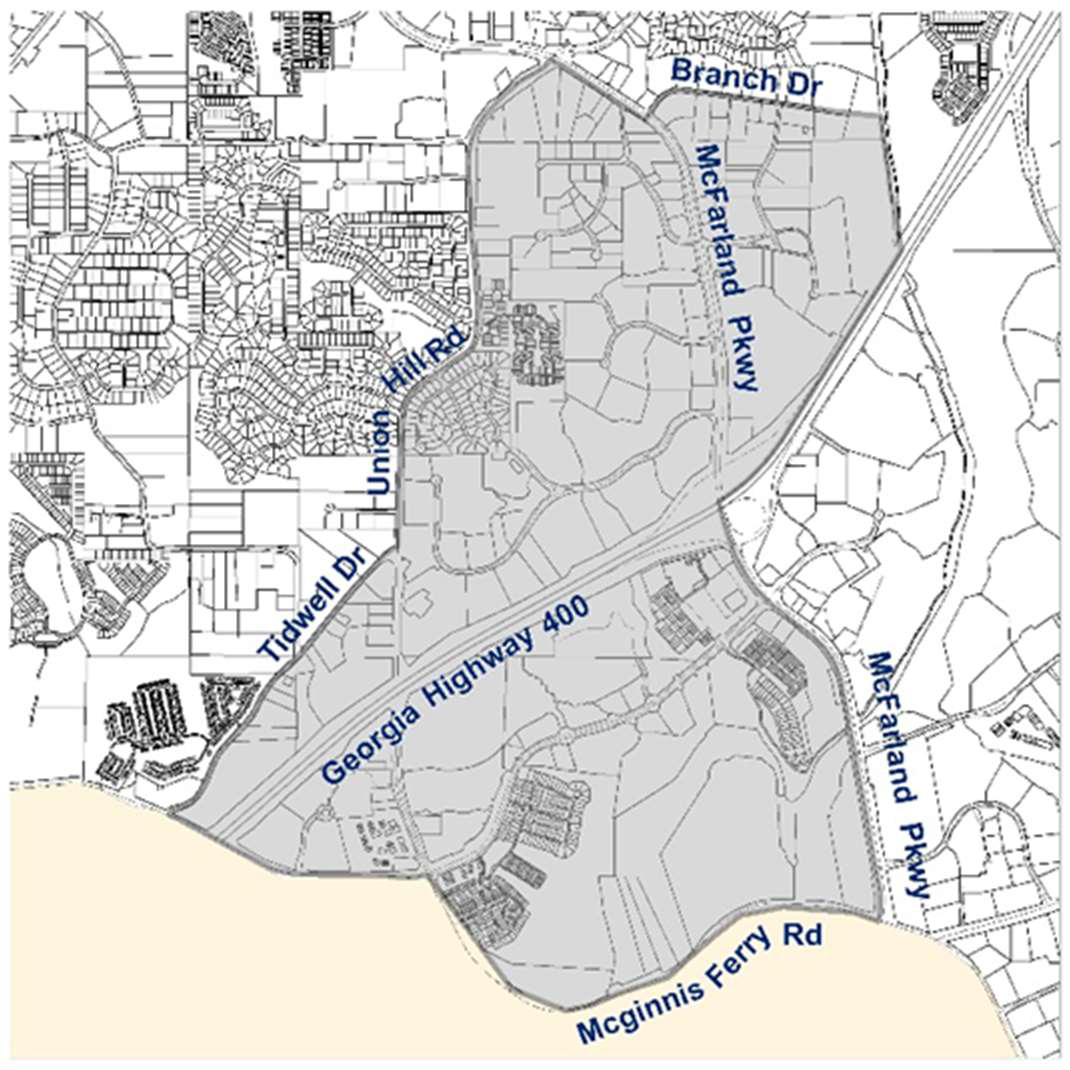
(13)
For subdivisions in the CR2 zoning district, common area shall be required regardless of the number of planned units.
(Ord. No. 87, 1-11-2006; Amd. of 1-3-2013; Amd. of 5-2-2013; Amd. of 9-4-2014; Amd. of 10-2-2014; Amd. of 4-2-2015; Ord. of 10-6-2016(2), § 1; Amd. of 6-1-2017(2); Amd. of 9-7-2017(2); Amd. of 6-7-2018; Amd. of 12-6-2019; Amd. of 7-9-2020(6); Amd. of 6-3-2021; Amd. of 8-12-2021; Amd. of 12-2-2021; Amd. of 4-17-2025)
11-9.1. - Purpose and intent.
Residential design regulations are intended to improve aesthetic appearance and enhance community character. Mindful consideration of attractive and quality residential design is essential to implement policy goals identified in the county's comprehensive plan that focus upon the creation and maintenance of quality building and site design standards. The objective of this article is to bolster community identity through the establishment of requirements that promote distinctive materials and craftsmanship in residential building.
Community character areas identified within the comprehensive plan seek to distinguish neighborhoods within given vicinities through the promotion of identifiable characteristics related to house design, lot requirements and subdivision guidelines. A strategic approach to achieving quality design is through the incororation of regulations pertaining to elements such as building details, siting, circulation and landscaping as well as the location of amenities. These types of measures shall accommodate growth while ensuring community character is prioritized, which ultimately supports the qualityof life aspiration that has been acknowledged as a key component of the county's vision statement communicated in the comprehensive plan.
(Amd. of 7-5-2018)
11-9.2. - Applicability.
(a)
All new major subdivisions within all residential zoning districts of unincorporated Forsyth County, excluding the MHP district, shall comply with 11-9.4.
(b)
Notwithstanding, subparagraph (a), this article shall not apply to the remodel of or addition to an existing structure to the extent the existing structure does not comply with the provisions of this article.
(c)
If a structure for which this article would otherwise apply is damaged, the structure may be rebuilt without needing to comply with those provisions of this article with which the prior structure did not comply at the time of destruction.
(d)
New, major subdivisions located within R2R, CR1, CR2, LR, Res2, Res3, and Res4 zoning districts must comply with sections 11-9.3, 11-9.5 and 11-9.6. New, major subdivisions within the Res6 zoning district must comply with sections 11-9.3 and 11-9.5 for any single family detached product.
(e)
Future phases of existing, major subdivisions within R2R, CR1, CR2, LR, Res2, Res3 and Res4 zoning districts for which houses have not been permitted shall comply with sections 11-9.3 and 11-9.5. This requirement shall also pertain to any future phases of existing, major subdivisions for which houses have not been permitted and which involve single family detached products within the Res6 zoning district. This requirement shall be waived for the final phase of a multi-phased development, which was approved under a single zoning application with a single multi-phase site plan, that is in need of a land disturbance permit in order to complete its final phase when all other phases are either complete or when no less than 90 percent of the total approved residential structures in the other phases have been issued certificates of occupancy.
(f)
New, minor subdivisions within R2R, CR1, CR2, LR, Res2, Res3 and Res4 zoning districts for which houses have not been permitted must comply with sections 11-9.3, 11-9.4 and 11-9.5. New, minor subdivisions within the Res6 zoning district for which houses have not been permitted must comply with sections 11-9.3 and 11-9.5 for any single family detached product.
(Amd. of 7-5-2018; Amd. of 12-6-2018; Amd. of 12-6-2019; Amd. of 3-5-2020(3); Amd. of 8-12-2021)
11-9.3. - Application requirements.
(a)
Submission of the materials otherwise required in this section may be waived if neither the district performance standards nor the scope of the application request would be affected by the materials.
(b)
Where required by the applicability requirements of section 11-9.2, and not otherwise waved, the following materials must be submitted with a building permit applications.
(1)
Elevation drawings of all building types; renderings may also be submitted in addition to required elevations.
(2)
Visual examples including photographs or physical samples and narrative description of exterior building materials.
(3)
Details, finish material imagery, and descriptions for fencing and retaining walls.
(c)
At the time of final plat for new, major subdivisions or building permitting for platted lots and new, minor subdivisions, the following shall be submitted.
(1)
Details pertaining to windows, garage doors, porches, decks, exterior walls, gutters and roof detailing.
(2)
Details pertaining to walkways, landscaping and exterior lighting.
(3)
Details pertaining to design and finish materials for fencing and retaining walls.
(4)
Sidewalks, planting strips and trails must be shown on the site plan.
(5)
Images or other visual examples of the proposed open space character.
(Amd. of 7-5-2018; Amd. of 12-6-2018; Amd. of 12-6-2019)
11-9.4. - Building materials.
Where required by the applicability requirements of section 11-9.2, vinyl exterior wall cladding of any kind is prohibited.
(Amd. of 7-5-2018; Amd. of 12-6-2018; Amd. of 12-6-2019)
11-9.5. - Lot standards.
Where required by the applicability requirements of section 11-9.2, the following standards apply to individual lots.
(a)
Wall finishes. Exterior wall finish materials (excluding foundations, trim, windows, and doors) are limited to the following:
(1)
Brick: Full-depth masonry brick, but not adhered brick veneers;
(2)
Stone: Unpainted natural stone, unpainted cast stone or manufactured stone having the appearance of natural stone, and unpainted terra cotta;
(3)
True three-coat cement stucco;
(4)
Siding: Natural wood or cementitious siding including lap siding and board and batten; and
(5)
Shingles: Wood or cementitious shakes and shingles.
(b)
Siding. Cementitious siding must have a 20-year or greater warranty.
(c)
Lap siding. Lap siding must have a seven inches maximum lap exposure with the director authorized to provide an administrative variance to increase or decrease this numerical requirement subject to the director's determination that the requested variance is consistent with the size and scale of the dwelling.
(d)
Foundation walls. Exposed foundation walls must be faced in brick, stone, or manufactured stone to the level of the first finished floor when there is a basement or at least 18 inches above grade for the entire perimeter wall when the building has a slab on grade.
(e)
Massing. Any exterior wall of a single-family detached dwelling which is longer than 20 feet and which faces a right-of-way or public space that is exterior to the development must incorporate exterior wall projections or recesses of at least 18 inches. Porches shall count toward this requirement, but chimneys shall not be counted toward this requirement.
(f)
Eaves and overhangs. Eaves on sloped roofs must extend a minimum of 12 inches from the face of the building. Roof overhangs at gables must extend a minimum of six inches from face of the building.
(g)
Roof shingles. Asphalt shingle roofs must have a 25-year or greater manufacturer's warranty.
(h)
Gutters. Where provided, all gutters must be metal. Gutters must be provided on all sloped roofs except roofs which project less than two feet from the face of the building, roofs on dormers, or roofs above bay windows.
(i)
Windows. Any exterior wall facing the side yard must provide window openings or false windows as defined in section 11-9.5(j) that equal or exceed five percent of the total area of that wall. Any exterior wall facing the front yard must provide window openings that equal or exceed 13 percent of the area of the wall. Walls that face the side yard and are finished in brick, stone, or manufactured stone are exempt from the window area requirement.
(j)
False windows and louvers. False windows may count toward the side window area requirement in section 11-9.5(i) where they are similar in size, shape, and materials to other windows on that building and consist of trim with closed shutters that have the appearance of a shuttered window or windows. A single louvered panel with trim may also count toward this requirement. False windows shall not be allowed to count toward this requirement unless shutters adjacent to a true window or windows are also provided on another exterior wall.
(k)
Window depth. The window glass pane must be recessed a minimum of one and three-sixteenths (1.1875) inches from either the adjacent exterior wall (when no trim is provided) or from the trim (when trim of at least three and one-half inches wide is provided).
(l)
Garage doors. For single-family detached dwellings with attached garages, garage doors facing a street must not project or be recessed less than 18 inches, or project more than ten feet from the surface of the exterior wall or from the front face of a porch. For the sake of this requirement, a porch must be:
(1)
At least six feet deep. The depth of a porch shall be measured from the outer most edge of the walking surface to the lowest projecting face of the wall cladding.
(2)
At least 33 percent of the width of the exterior wall from which it projects.
(3)
Covered and continuous.
(4)
If a porch exceeds the 33 percent width requirement, the portion which exceeds this standard may measure less than six feet in depth.
(m)
Variation in facades. No more than three adjacent houses located on the same side of the street may have identical facade designs. Differentiation between adjacent houses may be accomplished by at least four of the following:
(1)
Different exterior wall materials (color alone is not sufficient);
(2)
Different window placement, including a change of at least 24 inches or a different window type;
(3)
Different building heights, including a variation of at least 24 inches between adjacent buildings; and
(4)
Different roof forms, including but not limited to slope, gables, hips, or dormers; and
(5)
Different garage configuration, including garage doors facing a different direction or a variation in the setback of the garage door from the main building or porch as defined in section 11-9.5(l) of at least 24 inches as well as a different garage door type.
(n)
Landscape. A minimum of ten percent of the uncovered area of the lot must be planted in trees, shrubs, or perennial ground cover other than turf grass.
(o)
Tree planting. Trees in the front yard must be planted five feet measured in a straight line from the center of the trunk to the edge of the right-of-way. In Res2 and Res3 zoning districts provide at least one two-inch caliper minimum overstory tree for each lot in addition to the requirements of the Forsyth County Ordinance 98 (Tree Protection and Replacement Ordinance).
(1)
In order to provide adequate growing area and soil volume for planted trees, the following minimum criteria must be observed unless otherwise approved by the county arborist to improve the viability of the planted trees:
(a)
Minimum open soil surface area with average soil depths greater than or equal to three feet:
Overstory trees: 400 square feet.
Understory trees: 100 square feet.
(b)
Minimum setbacks from exterior of trunk to buildings:
Overstory trees: 20 feet.
Understory trees: 10 feet.
(c)
Minimum setbacks from exterior of trunk to sidewalks, driveways, and other impervious surfaces:
Overstory trees: 8 feet.
Understory trees: 4 feet.
(2)
In some situations, certain conditions or constraints, such as but not limited to existing or proposed utilities, infrastructure, streams, wetlands or other environmental factors, may limit the ability of a site to support the minimum number of required trees. The county arborist may approve and/or require alternative planting locations or other means of compliance for fulfilling the planting requirement for any tree required by the Tree Ordinance, UDC, or other development regulations. Such decisions shall be based on established principles and practices of arboriculture and with the tree's health and contribution to the landscape and environment in order to fulfill the purpose and intent of this article.
(Amd. of 12-6-2019; Amd. of 5-6-2021; Amd. of 3-3-2022)
11-9.6. - Subdivision standards.
Where required by the applicability requirements of section 11-9.2, the following subdivision-based standards apply:
(a)
Retaining walls. Retaining walls must be faced with natural stone, brick, or minimum four-inch thick manufactured stone; modular block is allowed. The underlying substrate may not be visible through the facing material. Retaining walls located on individual lots are not subject to this requirement.
(b)
Gabion walls. Retaining walls constructed of metal cages filled with rock or similar material are prohibited where visible from any adjacent or nearby lot, or any public or private street. In addition, gabion walls are restricted to the location of designated common areas and stormwater facilities. Maintenance of the gabion wall structure and any associated vegetation shall be the responsibility of the homeowner association.
(c)
Retaining wall height. Retaining walls are limited to six feet in height. When multiple retaining walls are needed, each wall must step back a distance equal to at least two-thirds of the maximum height of the other two nearest retaining walls.
(d)
Common mailbox facilities. Common mailbox areas must include a roofed area to provide shelter to the patron from the elements and provide a fixed trashcan or recycling bin within the covered area.
(e)
Amenity area location.
(1)
Active amenity areas such as pools are not permitted within 200 feet of street frontage outside of the development or to be visible from a public street outside of the development.
(2)
Alternatively the active amenity areas must be screened from the public street by a 20-foot wide buffer planted with evergreen trees and shrubs that will reach a minimum height of six feet within a year of planting. The above required buffer applies in addition to the exterior buffer requirements of section 11-9.6(j).
(f)
Street layout. Straight street lengths are limited to no more than 1,000 feet without an intervening street intersection or a horizontal curve with a centerline radius of no more than 200 feet. An exception to this requirement for unnecessary hardship due to topography or natural features may be granted by the director of engineering.
(g)
Light fixtures. Any lighting fixture not attached to a building must be full-cutoff, this shall take precedence over section 16-4.25(b)(3)(a).
(h)
Common area size. Common area shall be no smaller than 8,000 square feet in size.
(i)
New trees. All new trees planted in homeowner association maintained areas must be two-inch caliper minimum in size, planted before the issuance of the final plat.
(j)
Exterior buffer. Exterior buffers must be provided according to either (1) or (2) as noted below:
(1)
A forty-foot buffer must be provided along the right(s)-of-way, with an additional ten-foot landscape strip adjacent to the right(s)-of-way. Both the buffer and the landscape strip shall be owned and maintained by the homeowner association. If the undisturbed buffer is sparsely vegetated as determined by the county arborist, the buffer must be planted to meet the requirements of the Forsyth County Buffer Standards. Each 100 linear feet of landscape strip must contain a minimum mix of three overstory trees, two-inch caliper size minimum; 64 two-gallon evergreen shrubs; and 32 two-gallon perennials. Alternative configurations that meet the intent of this article are allowed if approved by the county arborist. Notwithstanding the requirements of section 18-10.3, driveways and signage within 30 feet of the edge of driveway pavement shall be exempt from this requirement.
(2)
Where consistent with the intent of this article, the rear yard may face a public right-of-way when treated with the identified, front facade elements below:
(a)
The rear pedestrian entrance must face a public street. A minimum three-foot walkway must be provided from the rear pedestrian entrance of the house to the adjacent sidewalk along the public right-of-way.
(b)
Any wall facing the rear yard must provide window openings whose area sum equals or exceeds 15 percent of the area of the wall.
(c)
Trees in the rear yard must meet the front yard tree requirements of the Tree Ordinance, and
(d)
Maximum front yard fence height requirements from section 16-4.13(a) shall apply to the rear yard fencing.
(k)
Park and trail connection. If any trails or pedestrian paths within an existing public park are located within 500 feet of the property line of a development, a connection to that pedestrian path or trail must be provided from a sidewalk or tail within the development. If any parks or trails are proposed in any county-approved plan within 500 feet of the property line of a development, a stub out trail leading to the proposed park or trail must be provided up to the property line. Walking trails must be at least five feet wide and shall be surfaced with tree mulch, rock dust, pea gravel, or similar material appropriate for pedestrian use. An exception to this requirement for unnecessary hardship due to topography or natural features may be granted by the director. The trail or path area required by this section both on and off the property may count towards required common area.
(l)
Sidewalks required. Five-foot sidewalks are required on one side of all new streets. Sidewalks and trails must form a continuous network.
(Amd. of 12-6-2019; Amd. of 10-8-2020(1); Amd. of 4-15-2021; Amd. of 10-7-2021; Amd. of 12-2-2021; Amd. of 3-6-2025)
11-9.7. - Southeast Forsyth design standards.
(a)
Intent. The intent of this article is to provide a set of design standards that elevate the quality of residential construction permitted in Southeast Forsyth County. In creating a higher standard of construction, this article aims to enhance a sense of place, inspire a variety of building appearances, and address Comprehensive Plan character area goals including tightening the relationship between buildings and the street and providing enhanced connectivity to the community.
(b)
Delineation of Southeast Forsyth. The Southeast Forsyth design standards set out in this section shall apply to all properties located within the area indicated in Illustration 11.1, the boundary of which area is described as follows: Beginning at the point where McGinnis Ferry Road meets the eastern boundary of the county, following McGinnis Ferry Road west (generally) to McFarland Road, then following McFarland Road northwest (generally) to US 19/GA 400, then following US 19/GA 400 northeast (generally) to the city limits of Cumming, Georgia, then following the city limits of Cumming, Georgia northeast (generally) to the northern boundary of the Haw Creek and Daves Creek character area as depicted in the July 6, 2017 Forsyth County Comprehensive Plan 2017—2037, then following said northern boundary west (generally) the eastern boundary of the county, then following the eastern boundary of the county south (generally) to McGinnis Ferry Road and the point of beginning. The Southeast Forsyth design standards are meant to be supplemental to other design standards and requirements of this Code and shall be applied in conjunction therewith where possible. In the event of a direct conflict between the Southeast Forsyth design standards and those standards found elsewhere in this Code, the Southeast Forsyth design standards shall apply. Notwithstanding the foregoing sentence, in the event of a direct conflict between the Southeast Forsyth design standards and those standards governing an overlay district identified in chapter 21, the overlay district standards of chapter 21 shall apply.
Illustration 11.1: Southeast Forsyth Boundary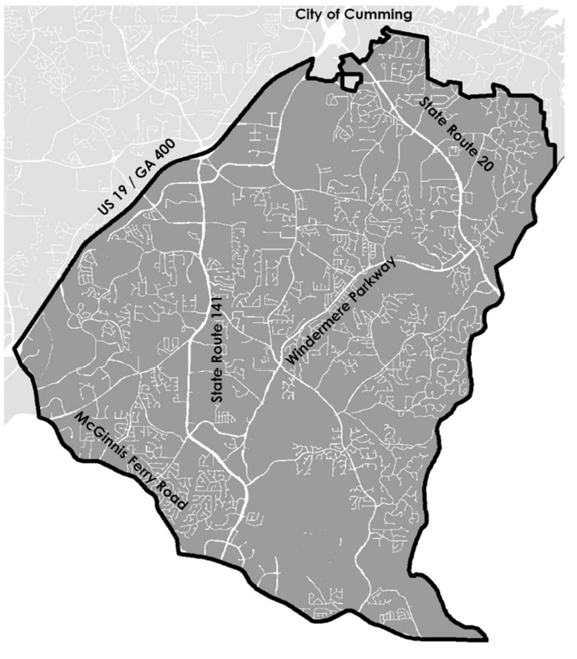
(c)
Design plan administrative review. Design review shall be performed by county staff. All plans shall address and conform to all provisions set forth under section 11-9.7 of this Code. Any numerical nonconformance to the standards contained within this section shall require the submittal of a variance application in accordance with section 8-6.4 of this Code. Should a design not meet all of the non-numerical standards contained within this section, then the proposed design must be submitted, for public hearing, to the Forsyth County Board of Commissioners for review and approval as an alternate design. In considering whether to approve such alternate design, the board of commissioners shall consider the special considerations set forth in section 8-5.5(f)(2)(b) of this Code. Architectural elevations, exterior finish schedules, and landscape plans must be submitted to the department at the time of application for a land disturbance permit. Lighting plans must be submitted prior to the issuance of a building permit. See chapter 7 and chapter 18 for land disturbance and building permit procedures.
(d)
Lot standards.
(1)
Landscaping.
(a)
Foundation planting. Foundation plantings are required in the form of evergreen shrubs, which must be planted no further than three feet from all street-facing foundation walls and be spaced no more than three feet apart.
(b)
Species diversity. No more than 33 percent of shrubs on a lot may be a single species.
(c)
Minimum size. New trees must be at least three-inch caliper. New shrubs must be at least five gallons in size.
(d)
Planting beds. At least five percent of the front yard must be devoted to planting beds, in addition to the foundation planting and tree requirements.
(e)
Planting bed materials. Planting beds must have a minimum of one annual or perennial plant per square foot at the time of installation.
(2)
Materials.
(a)
Wall finishes. Exterior wall finish materials more than 18 inches above grade (excluding trim, windows, and doors) are limited to the following:
(i)
Brick: Full-depth masonry brick, but not adhered brick veneers;
(ii)
Stone: Unpainted natural stone, unpainted cast stone having the appearance of natural stone, and unpainted terra cotta;
(iii)
True three-coat cement stucco;
(iv)
Siding: Natural wood or cementitious siding including lap siding and board and batten; and
(v)
Shingles: Wood or cementitious shakes and shingles.
(b)
Lower wall finishes. Exterior wall finish materials less than 18 inches above grade are limited to the following:
(i)
Brick: Full-depth masonry brick, but not adhered brick veneers;
(ii)
Stone: Unpainted natural stone, unpainted cast stone having the appearance of natural stone, and unpainted terra cotta.
(c)
Vertical joints. At the vertical meeting of different exterior wall finish materials, the transition between the materials must occur at inside corners as shown in Illustration 11.2.
Illustration 11.2: Vertical wall material joints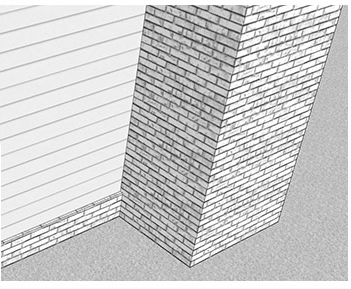
(3)
Windows.
(a)
Shutters. Where present, shutters must match one-half the width and shape of the window opening to which they are adjacent.
(b)
Front window coverage. All walls facing the front yard must provide window openings whose total area equals or exceeds 15 percent of the total area of that wall.
(c)
Side window coverage. All walls facing the side yard must provide window openings whose area equals or exceeds ten percent of the total area of that wall.
(d)
Window depth. Where no trim is provided or trim is provided but is less than three and one-half inches in width, window panes must be recessed a minimum of one and one-half inches from the outermost finished surface of the adjacent exterior wall. Where trim of at least three and one-half inches wide is provided, window panes must be recessed a minimum of one and one-half inches from the surface of the adjacent trim.
(4)
Garage doors. For single family detached dwellings with attached garages, garage doors facing a street must be recessed at least ten feet from the surface of the front, exterior wall of the dwelling.
(5)
Building orientation to street.
(a)
Pedestrian entrance. The primary pedestrian entrance for each main building must face a street or public open space. A walkway with a minimum width of three feet and distinct from the driveway must be provided between the primary pedestrian entrance and the adjacent sidewalk. If no sidewalk is present, and the driveway connects to the same public street that the primary pedestrian entrance faces, and the primary pedestrian entrance is more than 30 feet from the property line, a walkway with a minimum width of three feet must be provided between the primary pedestrian entrance and the driveway.
(b)
Alley-loaded fronts. All lots with vehicular access exclusively from an alley and with a main building located less than 25 feet from any adjacent street must provide a continuous evergreen hedge, wood or metal fence, or full-depth brick wall between the main building and the street. Said hedge, fence, or wall must be at least 18 inches and no more than 48 inches in height.
(6)
Accessory buildings and structures.
(a)
Exterior materials. Accessory buildings and structures must use the same exterior wall materials as the primary building.
(b)
Floor area. The total flood area of all accessory buildings and structures on a lot may not exceed 50 percent of the total floor area of the primary building on that same lot.
(e)
Subdivision standards.
(1)
Open space. Public open spaces not including buffers must preserve or provide 20 overstory trees per acre. Preserved healthy overstory trees over 16-inch dbh shall count as three overstory trees for the sake of this requirement, subject to confirmation by the county arborist.
(2)
Connectivity and walking.
(a)
Walking trail connections. All culs-de-sac greater than 500 feet in length must be connected to the closest adjacent cul-de-sac that is greater than 500 feet in length by a walking trail, unless prevented by topographical or hydrological constraints, as determined by the director. Walking trails must be at least five feet wide and must be surfaced with tree mulch, rock dust, pea gravel, or similar material appropriate for pedestrian use.
(b)
Sidewalk requirement. Five-foot wide sidewalks are required on one side of all new streets. For streets that provide vehicular access to 30 or more houses, a five-foot wide sidewalk must be provided on both sides of the street. Sidewalks and trails must form a continuous network.
(3)
Monument signs. Monument signs located at the entrance of residential subdivisions shall comply with the following standards:
(a)
Sign supports: The supporting sign structure may be constructed with the following durable materials:
(i)
Brick: Full-depth masonry brick, but not adhered brick veneers;
(ii)
Stone: Unpainted natural stone, unpainted cast stone having the appearance of natural stone, and unpainted terra cotta.
(b)
Sign supports disallowed. The supporting structure may not be constructed of wood, treated or untreated.
(c)
Sign face. Sign faces may be composed of the following materials:
(i)
Metal: Painted or unpainted;
(ii)
Wood: Treated to withstand water or painted;
(iii)
Synthetic material having the appearance of wood or metal;
(iv)
Any material permitted for the supporting structure.
(d)
Lighting. Internally illuminated signs are prohibited.
(4)
Lighting.
(a)
Consistency. Subdivisions must provide a consistent pole-mounted light fixture throughout the development.
(b)
Light levels. The provided lighting must illuminate all sidewalks and common areas intended for use after dark and must provide a minimum of 1 footcandle average of illuminance, with a range of 0.5 to 2 footcandles to avoid excessive dark and bright spots.
(5)
Landscaping.
(a)
Diversity of trees. No more than 33 percent of newly planted trees in a development may be of a single species.
(6)
Site design.
(a)
Retaining walls. Retaining walls must be faced with natural stone, brick, or minimum four-inch thick manufactured stone. The underlying substrate may not be visible through the facing material.
(b)
Gabion walls. Retaining walls constructed of metal cages filled with rock or similar material are prohibited.
(c)
Street layout. Straight street segments are limited to no more than 600 feet in length without an intervening intersection or a horizontal curve with a centerline radius of no more than 90 feet.
(d)
Exterior buffer. Lots along the exterior property line of a development that do not abut a right-of-way or public space must provide a 30-foot buffer.
(Amd. of 12-6-2019; Amd. of 4-15-2021; Amd. of 10-3-2024)
11-10.1. - Purpose and intent.
The residential design regulations in this article are intended to increase the overall durability, construction quality and attractiveness of single-family attached and multi-family residential developments. The objectives are to address community character, enhance attractiveness of the built environment and contribute to quality of life for residents. The design guidelines are functional in both maintaining comfortable living standards and shaping the development pattern within the larger community. These guidelines shall ensure that single-family attached and multi-family residential developments are architecturally diverse, but also strengthen a cohesive neighborhood identity to complement the setting and character of residential neighborhoods.
(Amd. of 5-6-2021)
11-10.2. - Applicability.
(a)
This article shall not apply to the remodel of or addition to an existing structure to the extent the existing structure does not comply with the provisions of this article.
(b)
If a structure for which this article would otherwise apply is damaged, the structure may be rebuilt without needing to comply with those provisions of this article with which the prior structure did not comply at the time of destruction.
(c)
Residential development for which units have not been permitted must comply with sections 11-10.3 and 11-10.4. If at least one building permit has been issued for a residential unit on the property or within the same subdivision prior to the effective date of this article, compliance with sections 11-10.3 and 11-10.4 is not required for any further residential development on the property or within the same subdivision.
(d)
New, minor subdivisions and platted lots not located within subdivisions shall be exempt from the site standard requirements found in 11-10.4(a)(6) and 11-10.4(b)(7).
(Amd. of 5-6-2021)
11-10.3. - Application requirements.
(a)
Submission of the materials otherwise required in this section may be waived if neither the zoning district performance standards nor the scope of the application request would be affected by the materials.
(b)
Where required by the applicability requirements of section 11-10.2, and not otherwise waived, the following materials must be submitted with a road construction permit for townhomes:
(1)
Details pertaining to sidewalks and pedestrian paths that connect each unit with adjacent public streets and all on-site amenities.
(2)
Details pertaining to building orientation with primary entrance and front façade of each unit oriented towards, streets, private drives, or enhanced open space.
(c)
Where required by the applicability requirements of section 11-10.2, and not otherwise waived, the following materials must be submitted with a site development permit for apartments, condominiums, quadplexes, triplexes, and duplexes:
(1)
Details pertaining to sidewalks and pedestrian paths that connect each building with adjacent public streets and all on-site amenities.
(2)
Details pertaining to building orientation with primary entrance and front façade of each unit oriented towards, streets, private drives, or enhanced open space for quadplexes, triplexes, and duplexes.
(3)
Details pertaining to fencing materials.
(d)
At the time of building plan review for any single family attached product within a major subdivision or for any multi-family development, the following shall be submitted to illustrate building design standards:
(1)
Details pertaining to wall finishes with indication of primary and secondary wall cladding material.
(2)
Details pertaining to facade design elements, including façade ratio and window requirements.
(3)
Details pertaining to roof types, roof slope, and roof material.
(4)
Details pertaining to optional landscape elements to address blank walls.
(5)
Details pertaining to exterior lighting.
(e)
At the time of building permitting for new, minor subdivisions and platted lots not located within subdivisions, the following shall be submitted to illustrate building design standards:
(1)
Details pertaining to wall finishes with indication of primary and secondary wall cladding material.
(2)
Details pertaining to facade design elements, including façade ratio and window requirements.
(3)
Details pertaining to roof types, roof slope, and roof material.
(Amd. of 5-6-2021)
11-10.4. - Architectural standards.
(a)
Single-family attached residential.
(1)
Wall finishes.
(a)
A minimum of 60 percent of the total façade of all exterior walls, excluding windows and doors, must consist of primary wall cladding materials as listed below.
(i)
Brick or masonry brick veneer;
(ii)
Manufactured or natural stone or stone veneer;
(iii)
True three coat cement stucco;
(iv)
Cementitious siding including lap siding and board and batten.
(b)
A maximum of 40 percent of the total façade of all exterior walls, excluding windows and doors, may consist of secondary wall cladding materials as listed below.
(i)
Natural wood siding;
(ii)
Cementitious shakes and shingles;
(iii)
Exterior Insulation and Finish System (EIFS). If within three feet of grade or within six feet of grade adjoining a public right-of-way or a parking area, shall be compliant with impact resistance standards set by ASTM.
(c)
The use of the following materials is prohibited for the exterior of buildings:
(i)
Architectural concrete masonry units (CMUs);
(ii)
Plywood and oriented strand board (OSB);
(iii)
Standing seam or corrugated metal panels;
(iv)
Vinyl siding and other polymeric siding;
(v)
Mirrored glass;
(vi)
Corrugated fiberglass;
(vii)
Any spray-on materials, such as shot-crete.
(d)
On the arrangement of façade materials
(i)
Where two or more materials are proposed to be combined on a façade, the heavier material shall be located below the lighter material as shown in Illustration 11.3. Material changes on a façade shall occur along a continuous horizontal line or where two building forms meet. The use of brick, manufactured or natural stone, or stone veneer shall be considered equivalent for the purpose of material weight.
Illustration 11.3: Material arrangement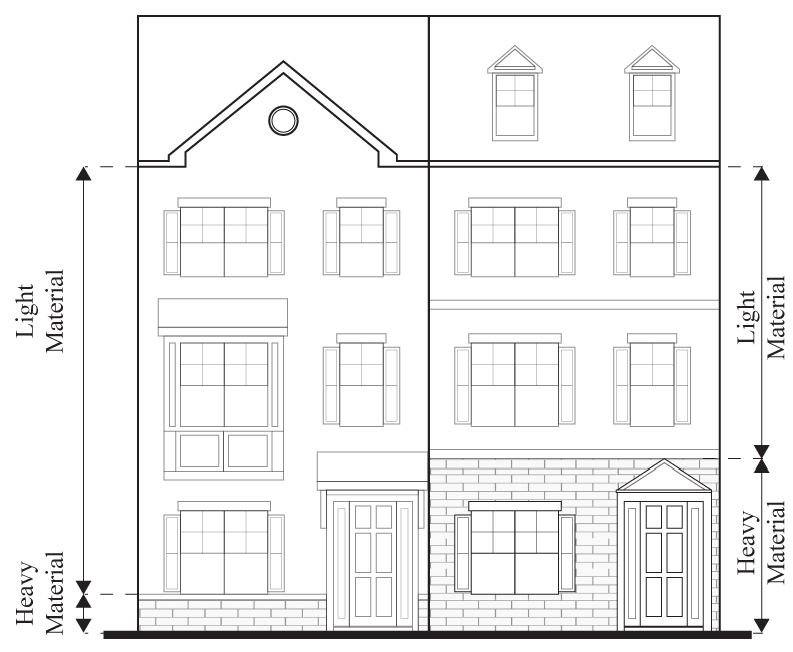
(ii)
Primary front façade materials shall wrap around at outside building corners at a continuous height until they reach an interior corner or another architectural feature. See Illustration 11.4.
Illustration 11.4: Building Corners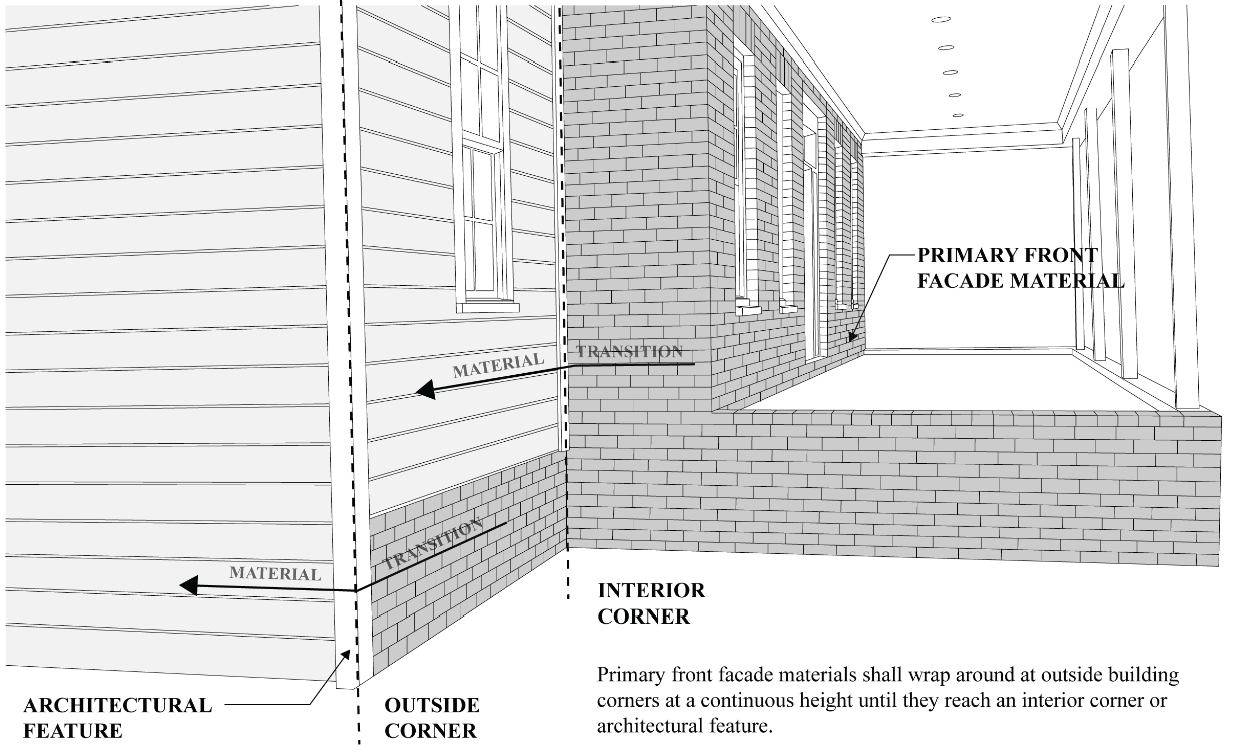
(e)
Accessory materials.
(i)
The exterior of accessory buildings shall be constructed of similar materials, colors, and detailing to match those used on the principal structure(s).
(f)
In cases where a material is proposed but is not listed, the director shall make an administrative determination as to whether or not the material shall be permitted under present design standards based on the purpose and intent of this article.
(2)
Variation in facades. For the purpose of this subsection, a building façade shall be considered the entire wall surface on a building side from the finished grade level to the bottom of an overhanging eave or to the top of a cornice as shown in Illustration 11.5.
(a)
Front facades shall be varied to avoid long, flat building fronts. Any building containing more than three units shall have the façade of each attached unit distinct from the other.
(b)
All facades shall provide doors, porches, stoops, balconies, or windows in the following ratios:
(i)
A minimum of 30 percent of the front building façade. Garage doors shall not count towards compliance with this requirement.
(ii)
A minimum of ten percent of the side building façade. Garage doors shall not count towards compliance with this requirement.
(iii)
A minimum of 25 percent of the rear building façade. Rear-loaded garages are encouraged and shall count towards compliance with this requirement.
(iv)
Windowless walls are prohibited along all facades. A minimum of one-quarter of the front and side building façade ratio requirements shall be comprised of windows.
(v)
Faux window treatments may be used to satisfy ratio requirements for side and rear facades.
(vi)
Garage door windows may count towards ratio requirements.
(vii)
Box or bay windows as well as roof projections above a porch, stoop, or balcony shall count towards the façade ratio requirements.
(c)
All front facades shall provide a minimum of three of the following design features for each unit:
(i)
Projection(s) or recess(es) in the façade plane that differentiate the unit from the adjacent unit, with a minimum depth or projection of 18 inches;
(ii)
Decorative patterns on the exterior finish such as wainscoting, moldings, and similar features;
(iii)
A stoop, porch, balcony, or a recessed entrance with a minimum of 18 inches from the front façade;
(iv)
A box or bay window with a minimum 18-inch projection from the façade plane;
(v)
Window and door openings in masonry facades that express a lintel or arch above the opening. Lintels or arches used either structurally or as a decorative trim, shall extend beyond the width of the opening;
(vi)
Eaves with either exposed rafters or a cornice projecting a minimum of 12 inches from the façade plane;
(vii)
A minimum of three ornamental features, including but not limited to: gable vents or windows, minimum window trim of four (4) inches, decorative brackets or corbels, transom windows, and window shutters. For purposes of the minimum design features for front facades, the inclusion of three ornamental features pursuant to this subsection shall constitute a single design feature.
Illustration 11.5: Front facade area measurements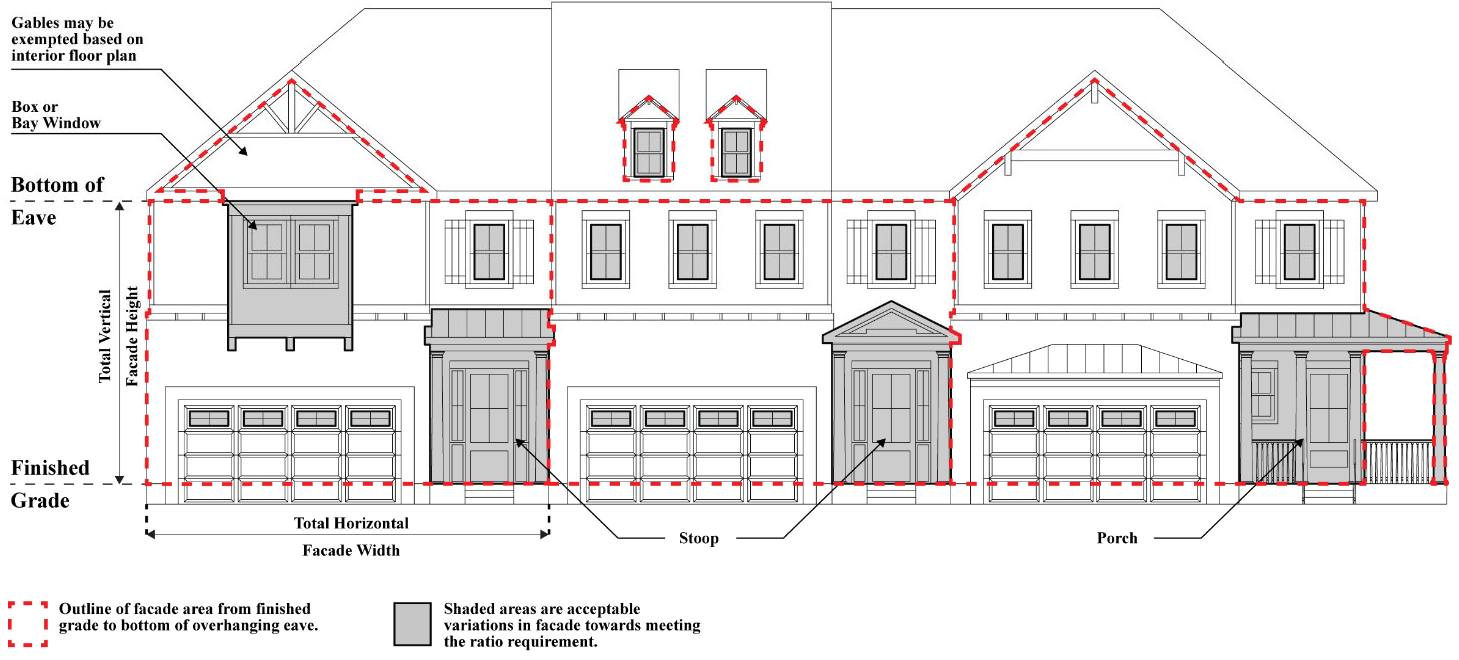
(3)
Building elements. Notwithstanding the requirements of Tables 11.2(a) and 11.2(b), a porch, stoop, or balcony shall follow the standards listed below. These standards are to ensure that certain building elements when added to a building façade are of sufficient size to be both usable and functional and be architecturally compatible with the frontage to which they are attached.
(a)
The depth of a porch, stoop, or balcony shall be measured from the outer most edge of the walking surface to the lowest projecting face of the wall cladding.
(b)
Porch. Porches shall comply with the following standards listed below. See Illustration 11.6.
(i)
Shall be at least six feet deep, not including the steps;
(ii)
A front porch must be contiguous to the building facade, with at least 33 percent of the width of the exterior wall from which it projects;
(iii)
If a porch exceeds the 33 percent width requirement, the portion which exceeds this standard may measure less than six feet in depth;
(iv)
Shall be roofed and may be screened but shall not be fully enclosed by walls;
(v)
Shall not encroach into the public right-of-way or required sidewalk;
(vi)
May extend up to eight feet, including steps, into the required front setback, provided that such an extension is at least two feet from the lot or lease line.
Illustration 11.6: Porch requirements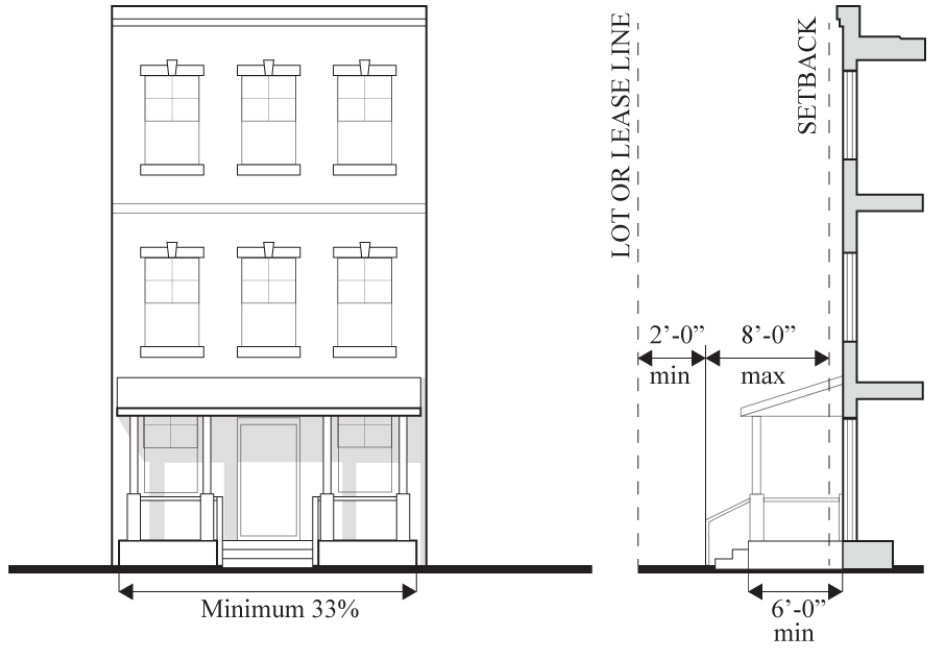
(c)
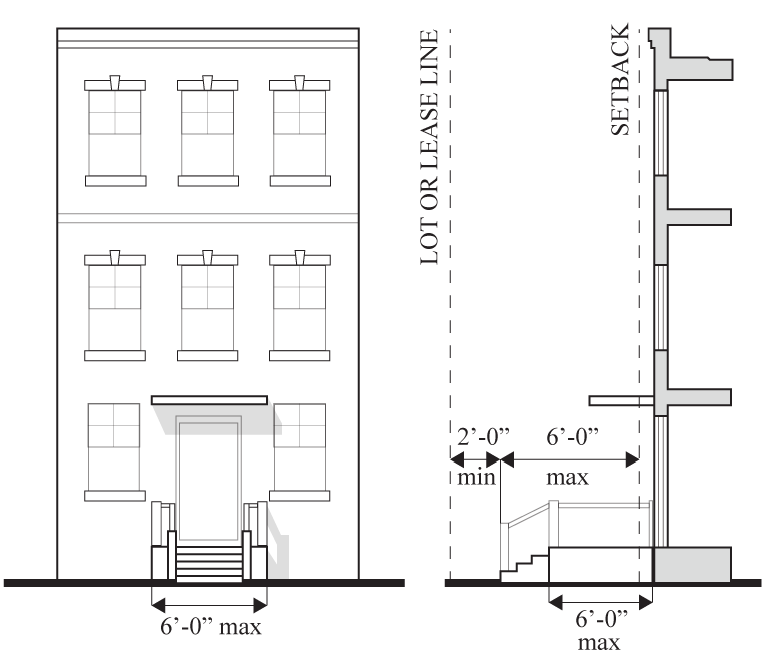
Stoop. Stoops shall comply with the following standards listed below. See Illustration 11.7.
(i)
Shall be no more than six feet deep and six feet wide, not including steps;
(ii)
May be covered but shall not be fully enclosed;
(iii)
Shall not encroach into the public right-of-way or required sidewalk;
(iv)
May extend up to six feet, including steps, into the required front setback, provided that such an extension is at least two feet from the lot or lease line.
(d)
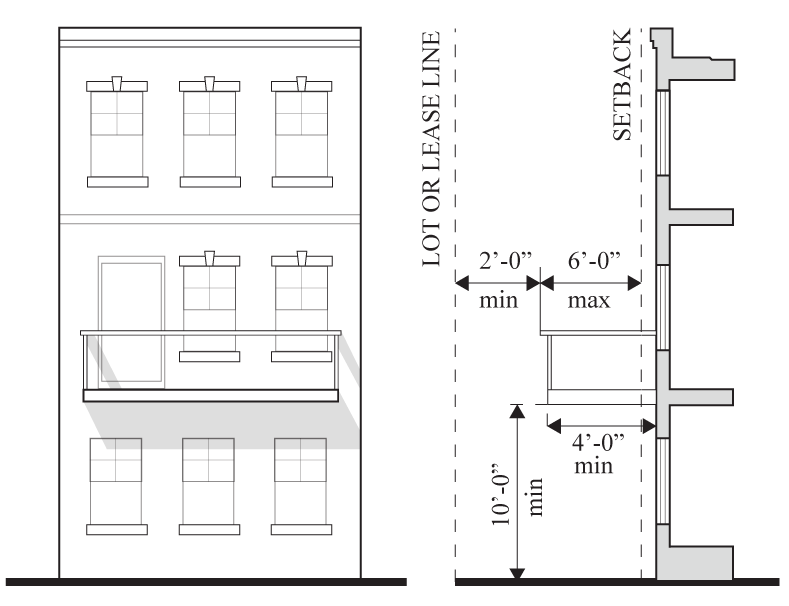
Balcony. Balconies shall comply with the following standards listed below. See Illustration 11.8.
(i)
Shall be at least four feet deep;
(ii)
Shall have a clear height above the sidewalk of a minimum of ten feet;
(iii)
May be covered and screened, but not fully enclosed;
(iv)
May extend up to six feet into the required setback, provided that such extension is at least two feet from the lot or lease line, but shall not encroach into the public right-of-way.
| Illustration 11.7: Stoop requirements | Illustration 11.8: Balcony requirements |
|---|---|
 |  |
(4)
Garage doors. Garage doors shall be recessed a minimum of 12 inches from the front façade. In the case of rear loaded, garage doors shall be recessed a minimum of nine inches from the front façade.
(5)
Roofs. The roofs of each unit shall comply with the following standards:
(a)
Roofs shall be symmetrical gables, flat with parapet along the front façade, or shed style. Alternative roof forms or pitches may be used over porches, covered stoops, covered balconies, entryways, or similar features;
(b)
Shed style roofs shall have a minimum roof pitch of 4:12;
(c)
Symmetrical gable style roofs shall have a minimum roof pitch of 3:12;
(d)
Hip roofs shall be permissible provided that the roof line is stepped between each unit when facing the front façade or when visible from the right of way. Hip roofs shall have a minimum roof pitch of 4:12;
(e)
When a parapet is part of the roof design, the projection of the front façade must be varied and must use decorative elements such as crown molding, dentils, brick soldier courses, or similar ornamental features;
(f)
Additional roof forms, such as dormers, shall be permitted to enhance the aesthetic of the roofline;
(g)
Overhangs, if provided, shall be no less than 12 inches;
(h)
Sloped roofs on primary buildings shall be clad in wood shingles, standing seam metal, clay or concrete tile, stone coated metal tile, painted metal tile, recycled rubber tile, slate, asphalt shingles or similar material or combination of materials. This regulation does not prohibit the application of solar panels, which shall not be considered an architectural material for purposes of building form regulations;
(i)
In cases where an alternative roofing material is proposed but is not listed, the director shall make an administrative determination as to whether or not the material shall be permitted under present design standards based on the purpose and intent of this Article.
(6)
Site standards.
(a)
Sidewalks and pedestrian pathways shall provide a continuous network that connects each unit with adjacent public streets and all on-site amenities designed for use by residents of the development.
(b)
The primary entrance and front façade of individual units within a single family attached development may be oriented toward streets, private drives or enhanced open space, and shall not be oriented toward off-street parking lots, garages, alleyways, or carports except in cases where the director is presented with evidence showing that ADA compliance requires such orientation.
(b)
Multi-family residential.
(1)
Wall finishes.
(a)
A minimum of 60 percent of the total façade of all exterior walls, excluding windows and doors, must consist of primary wall cladding materials as listed below.
(i)
Brick or masonry brick veneer;
(ii)
Manufactured or natural stone or stone veneer;
(iii)
True three coat cement stucco;
(iv)
Cementitious siding including lap siding and board and batten.
(b)
A maximum of 40 percent of the total façade of all exterior walls, excluding windows and doors, may consist of secondary wall cladding materials as listed below.
(i)
Exterior Insulation and Finish System (EIFS). If within three feet of grade or within six feet of grade adjoining a public right-of-way or a parking area, shall be compliant with impact resistance standards set by ASTM.
(ii)
Architectural grade metal wall panels, which shall:
(a)
Be matte finish in neutral or earth tone and;
(b)
Include two or more of the following elements:
i.
Visible window and door trim painted or finished in a complementary color.
ii.
Color and edge trim that cover exposed edges of the sheet metal panels.
iii.
A base constructed from the materials listed in section 11-10.4(b)(1)(a).
(c)
The use of the following materials is prohibited for the exterior of buildings:
(i)
Architectural concrete masonry units (CMUs);
(ii)
Plywood and oriented strand board (OSB);
(iii)
Vinyl siding and other polymeric siding;
(iv)
Mirrored glass;
(v)
Corrugated fiberglass;
(vi)
Any spray-on materials, such as shot-crete.
(d)
On the arrangement of façade materials
(i)
Where two or more materials are proposed to be combined on a façade, the heavier material shall be located below the lighter material as shown in Illustration 11.3 in section 11-10.4(A)(1). Material changes on a façade shall occur along a continuous horizontal line or where two building forms meet. The use of brick, manufactured or natural stone, or stone veneer shall be considered equivalent for the purpose of material weight.
(ii)
Primary front façade materials shall wrap around at outside building corners at a continuous height until they reach an interior corner or another architectural feature. See Illustration 11.4 in section 11-10.4(a)(1).
(e)
Accessory structure materials.
(i)
The exterior of accessory buildings shall be constructed of similar materials, colors, and detailing to match those used on the principal structure(s).
(f)
In cases where a material is proposed but is not listed, the director shall make an administrative determination as to whether or not the material shall be permitted under present design standards based on the purpose and intent of this Article.
(2)
Site materials. Except as otherwise stated, use of the following materials is prohibited on the property:
(a)
Crushed color rock or tumbled glass;
(b)
Chain link fencing shall be permissible on the property provided it is vinyl coated. All vinyl coated chain link fences must be fully screened by vegetation and not visible from the public right-of-way.
(3)
Variation in facades. For the purpose of this subsection, a building façade shall be considered the entire wall surface on a building side from the finished grade level to the bottom of an overhanging eave or to the top of a cornice as shown in Illustration 11.5 in section 11-10.4(A)(2). The facades of multi-family buildings shall incorporate several design techniques to create an appropriate building scale and to provide distinction between similar structures.
(a)
All facades shall provide doors, porches, stoops, balconies, or windows in the following ratios:
(i)
A minimum of 40 percent of the front building façade.
(ii)
A minimum of 20 percent of the side building façade.
(iii)
A minimum of 30 percent of the rear building façade.
(iv)
Windowless walls are prohibited along all facades. A minimum of one-quarter of the front, side, and rear building façade ratio requirements shall be comprised of windows.
(b)
Faux window treatments shall be permitted for side and rear facades to comply with window ratio requirements.
(c)
For buildings over three stories, over 5,000 square feet in gross building footprint or with façades longer than 100 feet.
(i)
The "articulation interval" at which the repetitive element repeats should not be greater than 50 feet in length measured horizontally as shown in Illustration 11.9.
(ii)
The building shall provide a minimum of three of the following modulations or articulation design features listed below as shown in Illustration 11.9:
(a)
Horizontal modulation. The stepping back or extending forward of building stories or horizontal building elements, the depth (extension out or set back from the building facade) of the modulation must be at least two feet when tied to a change in the roofline and at least five feet in other situations;
(b)
Vertical modulation. The extension or stepping back of vertical elements of a building, the minimum depth of modulation is 18 inches and minimum width for each modulation is 15 feet;
(c)
Porch, stoop, patio, deck or covered entry at each articulation interval;
(d)
Distinctive window patterns repeated at intervals less than the articulation interval;
(e)
Lighting fixtures, trellises, or other landscape features within each articulation interval;
(f)
Incorporation of projections such as windows, porch additions, stair enclosures, chimneys, balconies, recesses at windows, entryways, doors or other openings, and minor projecting masses;
(g)
Change in materials with a change in building plane;
(h)
Use of materials and colors to emphasize both major and minor changes in building scale to introduce sense of detail and create distinctions between structures.
Illustration 11.9: Modulation Example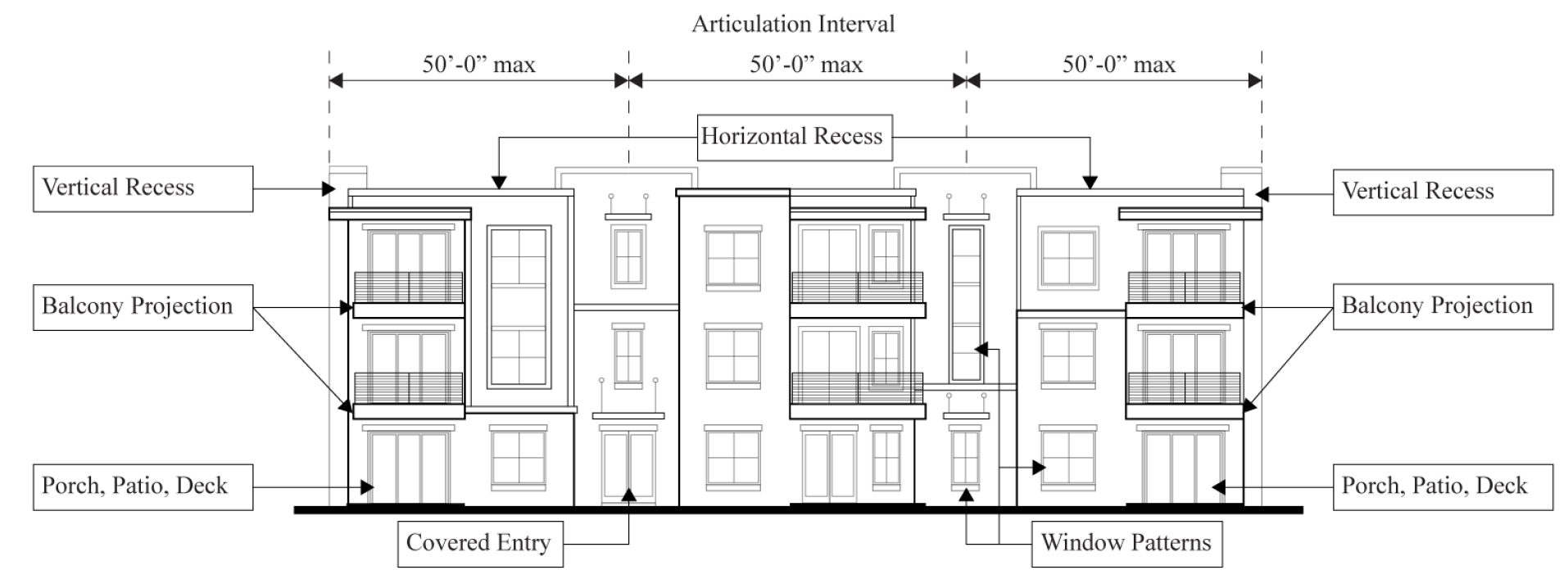
(4)
Blank walls. For the purpose of this section, a "blank wall" is any portion of wall that either has a surface area of at least 200 square feet of vertical surface without a window, door or building modulation or other architectural feature; or is over four feet in height from ground level and longer than 15 feet as measured horizontally without having a window, door, building modulation or other architectural feature as shown in Illustration 11.10. All blank walls visible from an adjacent or nearby lot, or a public street or private street, shall be treated in one or more of the following ways:
(a)
A vertical trellis in front of the wall with climbing vines or other plant material. The trellis must be used in conjunction with other treatments described below.
(b)
A landscaped planting bed or raised planter bed in front of the wall.
(1)
Plant material shall be selected to screen at least 50 percent of the blank wall's surface within four years.
(c)
A combination of building materials as listed in sections 11-10.4(b)(1)(a) and 11-10.4(b)(1)(b) to provide visual interest and craftmanship to building façades consistent with the purpose and intent of this article.
Illustration 11.10: Example Blank Wall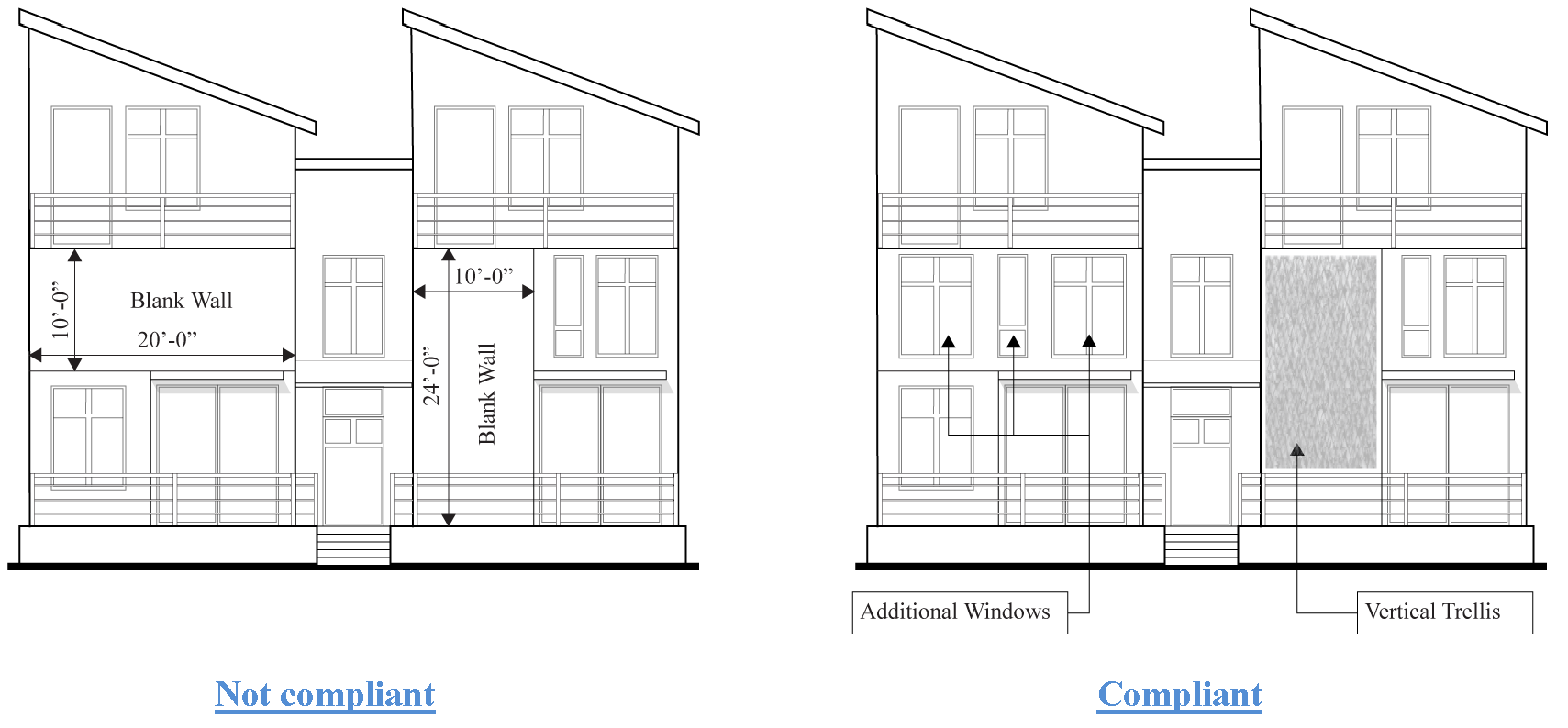
(5)
Exterior lighting.
(a)
Full cutoff fixtures shall be required with the exception of special architectural lighting that adheres to the following:
(i)
Uplighting shall be shielded by a roof overhang or a similar structural shield.
(ii)
Luminaires shall be aimed to shield the lamp and its reflective surfaces from off-site view and to prevent light output beyond the building.
(iii)
A licensed architect or engineer shall stamp a prepared lighting plan that ensures that all exterior lighting adheres to county design standards.
(6)
Roofs. All roofs shall comply with the following standards:
(a)
Roofs shall be symmetrical gables, flat with parapet along the front facing façade, hip-style, or shed style. Alternative roof forms or pitches may be used over porches, covered stoops, entryways, or similar features;
(b)
Shed style roofs shall have a minimum roof pitch of 4:12;
(c)
Symmetrical gable and hip-style roofs shall have a minimum roof pitch of 3:12;
(d)
Additional roof forms, such as dormers, shall be permitted to enhance the aesthetic of the roofline.
(e)
All building entrances shall be sheltered by roof forms, and/or additional roof features;
(f)
Overhangs, if provided, shall be no less than 12 inches;
(g)
For flat roofs or facades with horizontal fascia or parapet, the roofline shall vary at least every 60 feet. There shall be a minimum vertical dimension of roofline modulation of two feet;
(h)
Other roof forms such as arched or saw-toothed may satisfy this design standard if the individual segments of the roof with no change in slope or discontinuity are less than 60 feet in width;
(i)
Sloped roofs on primary buildings shall be clad in wood shingles, standing seam metal, clay or concrete tile, stone coated metal tile, painted metal tile, recycled rubber tile, slate, asphalt shingles or similar material or combination of materials. This regulation does not prohibit the application of solar panels, which shall not be considered an architectural material for purposes of building form regulations;
(j)
In cases where an alternative roofing material is proposed but is not listed, the director shall make an administrative determination as to whether or not the material shall be permitted under present design standards based on the purpose and intent of this Article.
(7)
Site standards.
(a)
Sidewalks and pedestrian pathways shall provide a continuous network that connects each building entrance with adjacent public streets and all on-site amenities designed for use by residents of the development.
(Amd. of 5-6-2021)

