Forsyth County Unincorporated
City Zoning Code
City Zoning Code
CHAPTER 13
- DESIGN GUIDELINES FOR ACTIVITY CENTERS
13-1.1. - Purpose and intent.
This chapter presents a set of general design guidelines for the development of neighborhood shopping districts and urban village districts. Such guidelines are in addition to, and do not negate or supersede, the regulations applicable to activity centers in article X of chapter 12 and any other applicable requirements of this Code. Requests to rezone property to a neighborhood shopping district or urban village district shall be evaluated against these design guidelines, and substantial nonconformity with these design guidelines may be the basis for denying a request for neighborhood shopping or urban village zoning districts.
Development designs should utilize the opportunities and reflect the constraints created by flood plains, slopes, soils, native vegetation, and other physical features. Engineering techniques should not be utilized to force-fit development into the natural environment.
(Amd. of 11-15-2004)
13-2.1. - Detention basins.
Open storm drainage and detention areas visible to the public should be incorporated into the design of the development as an attractive amenity or focal point. For example, spray fountains or water falls are attractive alternatives for moving water. Wet-bottom basins are encouraged for basins visible to the public or from adjacent property. Dry basins, where used, should be sloped adequately to ensure proper surface drainage, designed so slopes and bottoms can be easily maintained, and extensively landscaped.
13-2.2. - Connectivity and roadway design criteria.
The roadway pattern within an activity center should not require short trips between developments in the activity center to use arterials; it should be possible for trips of this sort to be made using access connections between developments within the activity center. The road network of any one development or site within the activity center should interconnect with the road network of any adjacent development or site within the activity center. Developments where the internal road networks are isolated from all adjacent sites are discouraged.
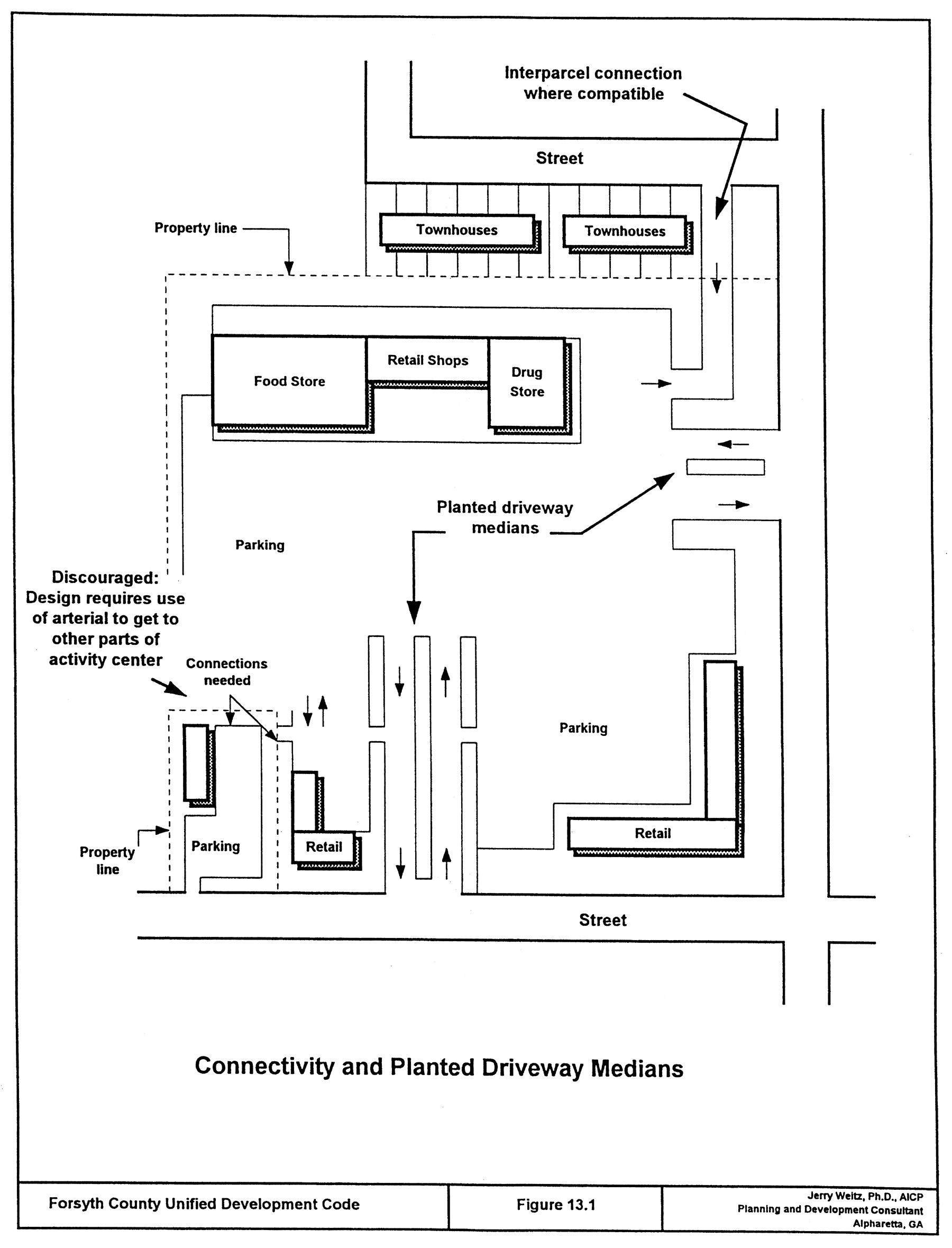
Where compatible, automobile trips from adjacent residential neighborhood(s) to the neighborhood shopping zoning district or urban village zoning district should be possible without requiring travel along the major street. Outparcels should be connected to and served from the internal streets of the activity center of which they are a part. Major driveways serving the activity center should include planted center medians. Planted medians are desired because they: 1) enhance the overall appearance of the activity center and improve economic attractiveness; 2) provide refuge for pedestrians; and 3) improve traffic safety. Road speeds within an activity center should generally not exceed 30 mph, and should be compatible with the pedestrian nature and scale of the activity center.
13-2.3. - Building height and mass.
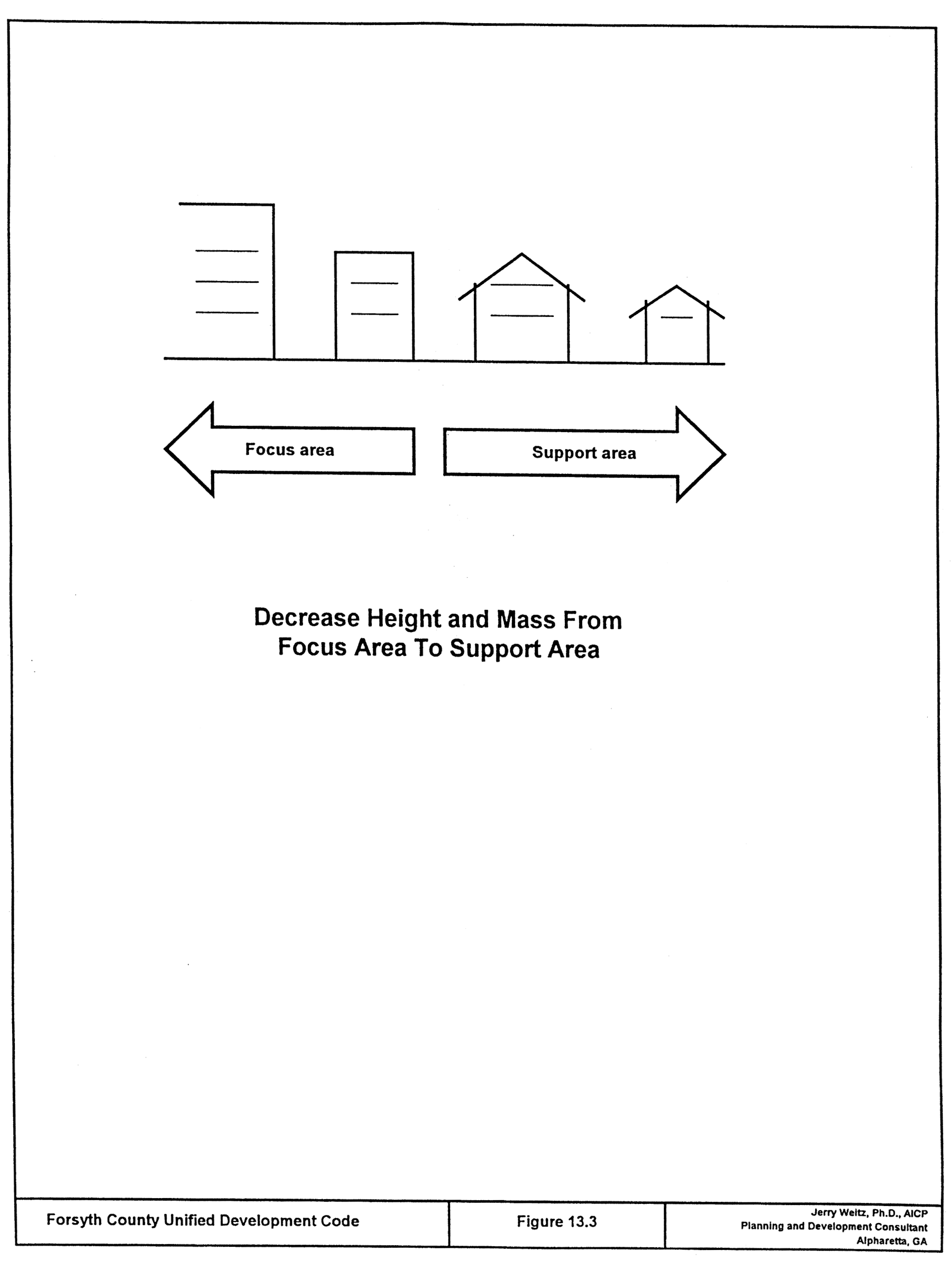
Within an activity center, a logical hierarchy of building forms should be created. Building heights and masses should be greatest in the focus area and inner portion of the support area (the part closest to the focus area), and should transition to lower heights and less mass outward from the focus area to the outer edge of the support area. Building massing should be varied to create a logical hierarchy of building forms, to break up long expanses of façade, and to create shade and shadow. Buildings at the outer edge of an activity center's support area should be comparable in height and mass with the surrounding neighborhood beyond the support area.
(Amd. of 6-7-2018)
Cross reference— Buildings and building regulations, ch. 18.
13-2.4. - Arrangement and siting of buildings.
Building location, setbacks, and orientation should be carefully considered so as to increase pedestrian comfort. For example, a shaded pedestrian plaza may be created by siting buildings to maximize shade potential. Buildings in an activity center should be arranged in a manner that creates a sense of enclosure and defined space. A site's buildings should be arranged so that they help to frame and define the fronting streets, as well as the internal streets of the activity center, giving deliberate form to streets and sidewalk areas. Buildings on a site in a neighborhood shopping zoning district or urban village zoning district should be arranged so that a sufficient number of the site's buildings or portion of the site's aggregate building mass has an orientation towards the fronting street(s), and the buildings are located in relatively close relation to those fronting street(s), so as to effectively frame and define the fronting street(s) and the pedestrian accesses along those streets.
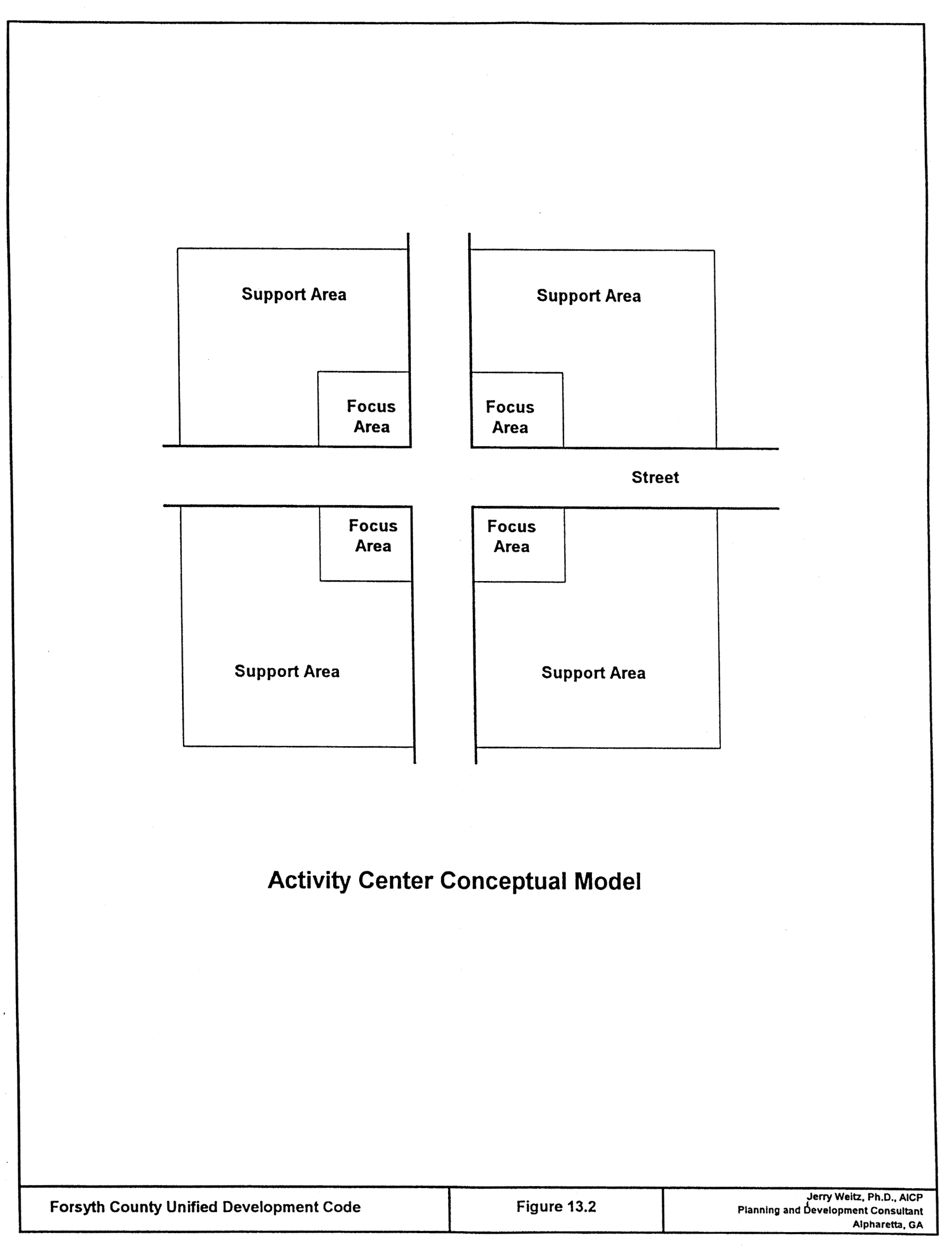
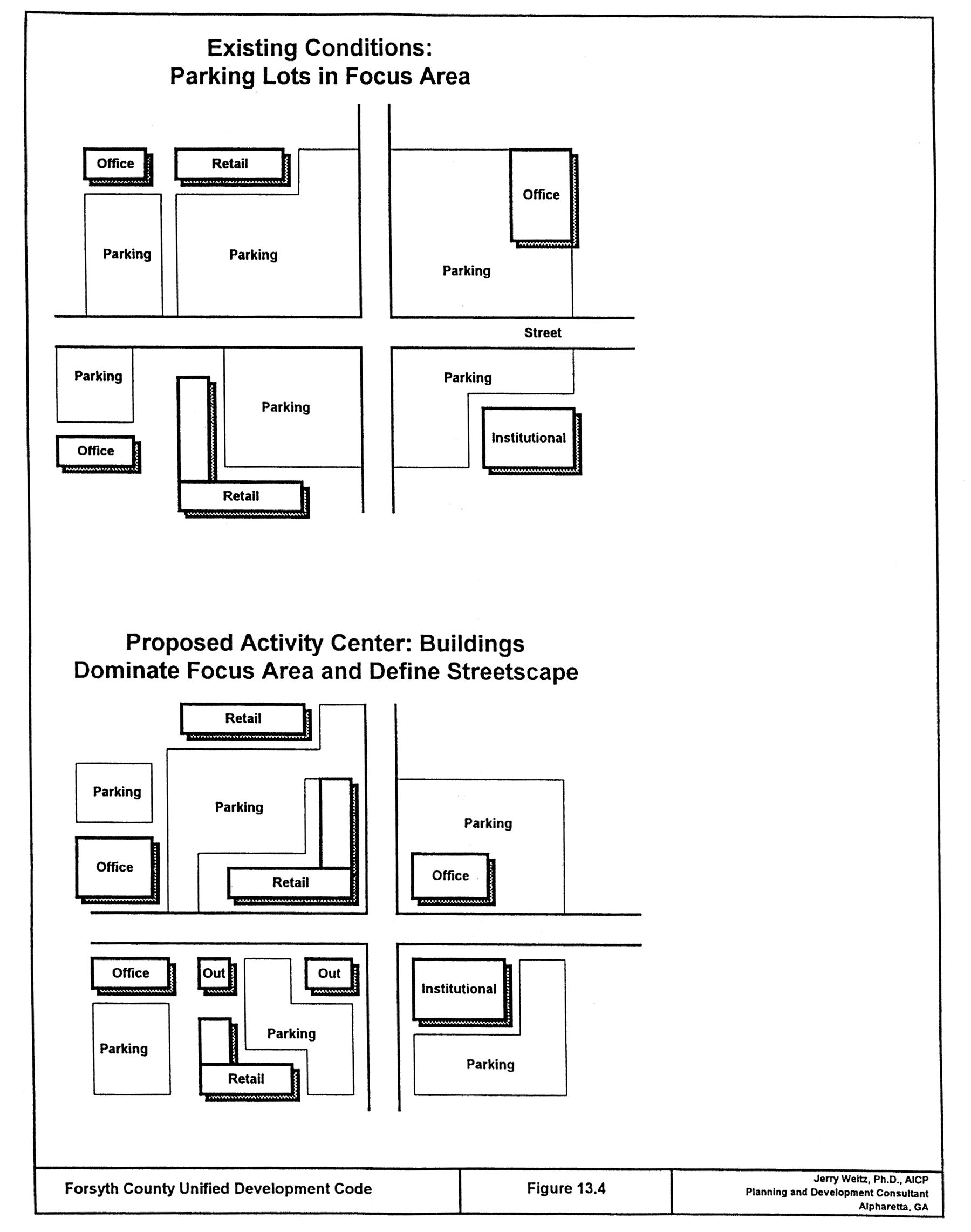
As far as practicable, buildings in activity centers should not be separated from fronting streets by large parking lots. At a minimum, placement of outparcel buildings between a large parking lot and the street should be used to help define the streetscape, and lessen the visual impact of the parking lot from the street. Whenever an activity center is split across streets or quadrants of an intersection, the buildings on the different quadrants of the street should not be separated from each other by parking lots. The line and massing of the buildings and structures on each quadrant should be arranged such that they are as close to each other as possible and linked by crosswalks and pedestrian paths, so as to encourage pedestrian movement between the quadrants on opposite sides of the street(s).
At a minimum, sensitive placement of outparcel buildings along the opposite sides of the street can be used to help define the streetscape, and bring development on quadrants of intersections in closer relation to each other. In such cases, the outparcel buildings should also be located in close relation to the street and to each other, and in a common alignment. Outparcels should also be connected to and served from the internal streets of the activity center or development. In activity centers, the design of outparcel buildings and sites should be integrated into the overall design of the activity center. Outparcel buildings should have architectural, design, and pedestrian connections strongly linking them with the rest of the activity center. For example, covered pedestrian walkways linking outparcel buildings with the main buildings of the center could provide a strong design connection.
All buildings in the activity center should be in close physical proximity to each other, to the extent allowed by site topography, and well-connected by pedestrian sidewalks and ways as opposed to being separated from one another by large parking areas. One should not have to walk in and along parking aisles, driveways, or roadways to get from any one building to another; rather, pedestrian ways should be well defined and separated where possible from automobile access ways.
13-2.5. - Compatibility.
Building design and landscaping in activity centers should be compatible and harmonious with adjacent neighborhoods. In general, residential densities and non-residential intensities should be highest within activity centers, transitioning to progressively lower densities moving outwards from the focus area to the outer edge of the activity center.
Adverse noise and lighting impacts from one site onto adjacent or nearby sites should be avoided, minimized, or mitigated. Design elements should be accomplished in a manner to control noise generated from service activities and mechanical equipment. Vegetated buffers and screening should be provided to ensure appropriate separations and transitions between activity centers and abutting residential neighborhoods or other lower-intensity land uses. If a development or individual building is designed to back up to residential or other site sensitive areas, significant landscaping and berms are strongly encouraged in addition to screening walls or fences to provide an adequate buffer.
When fencing is provided along a property line, a decorative fencing material and architectural accents should be used which are compatible with the building façades in the activity center. Fencing that creates variety, such as staggering the fence line and incorporating wrought-iron and masonry columns, is encouraged. Screening walls should reflect the same level of architectural design as the primary structure, including landscaping to soften the wall's appearance.
13-2.6. - Building appearance and architectural details.
The design, architecture, materials, and colors of buildings within an activity center should be harmonious and adhere to a common design theme. Architectural designs should provide visual interest and variety, yet be consistent with the architectural character of the activity center.
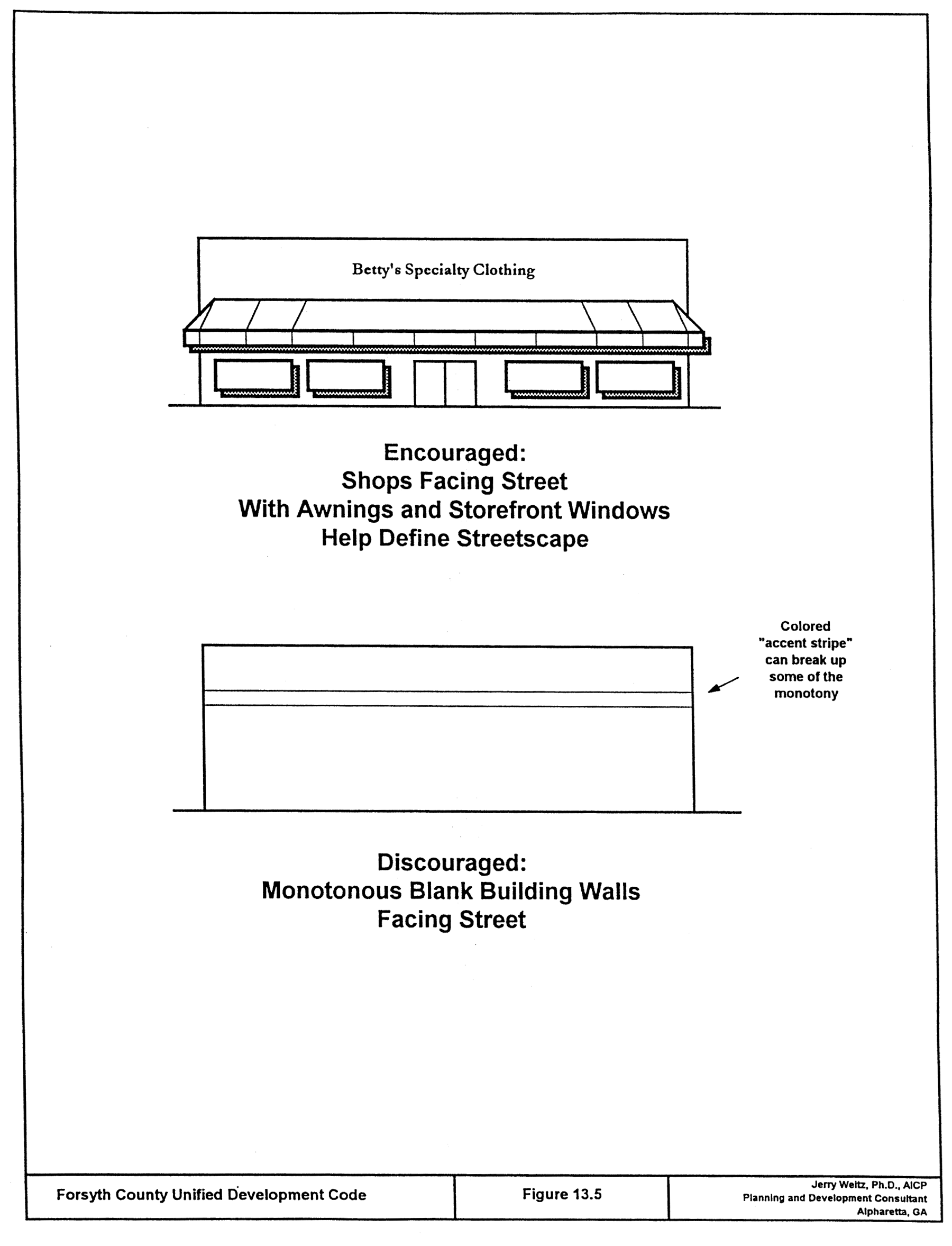
Buildings that are oriented towards the fronting street(s), and buildings located in relatively close relation to fronting street(s) should include architectural elements such as canopies or awnings and street-level display windows. Covered building fronts facing streets should not be permanently enclosed. Soft, flameproof awnings are encouraged over the first floors of buildings facing streets.
All building elevations should be finished with the same level of architectural detail and quality. Architectural details such as texture, pattern, color, and building form used on front façade(s) should be incorporated on all visible building façades. However, such guidelines do not apply to any façade(s) facing service courts or other areas generally not visible to the public. Monotonous blank building walls should be avoided.
Materials requiring low maintenance are recommended over high maintenance materials. For example, materials with integral color are generally recommended over materials that require painting.
Individual corporate image architectural design elements and colors should be incorporated only as secondary elements to the development and not as the dominant element. Such corporate image elements should be consistent with and blend into the larger theme of the activity center.
Ground and building-mounted mechanical equipment, such as coolers, HVAC equipment, meters, utility banks, trash receptacles, and electrical or telephone utility cabinets should be placed within interior side and rear yards or when required in front or corner side yards should be screened with landscape materials.
13-2.7. - Signage.
Window panes should not be painted for permanent advertising purposes, but lettering for the identification of the place of business is encouraged, provided the letters are not greater than six inches in height. Wooden signs of a small scale that hang from a projection support by chain adjacent to pedestrian ways and sidewalks are encouraged to provide a main street atmosphere. Monument signs are strongly encouraged over pole-mounted signs.
13-2.8. - Parking.
For any sites or developments that include significant amounts of parking, site design should avoid a "sea of parking" impression from the fronting streets (i.e., where vast amounts of surface parking dominate the view(s) from the fronting street(s) to the site's primary buildings). This design guideline is particularly applicable to shopping centers.
The presence of vast parking lots between the fronting street and the buildings results in the principal buildings being set back from the roadway to such an extent that it discourages pedestrian access to the site and will frustrate any future transit connections to the site. Streetscapes that are dominated by parking lots detract from the character proposed to be created by the activity center. Single, very large parking lots should be avoided. Rather than having a single, very large contiguous parking area between the fronting street and the buildings, the parking should be broken up into smaller lots or fields of 50—100 cars by landscape strips, peninsulas, or grade separations. Generous amounts of parking should be directed to the rear and sides of the buildings or site. This guideline does not mean that there should be no parking areas between the fronting street(s) and the principal buildings in shopping centers or other large nonresidential or multifamily developments. The intent is to significantly reduce the amount of large surface parking between the fronting street(s) and the principal buildings, allowing the buildings to be brought closer to the fronting street(s), in support of a more attractive and pedestrian-friendly environment.
Parking lots that face a street should be partially screened from the street by a low fence, wall, hedge, berm, or vegetated buffer. If a parking lot fronts an arterial or major collector, and is of such a size that it dominates views from the fronting arterial/collector and detracts from the overall streetscape and community appearance, then it is recommended that the parking lot be screened or buffered in its entirety from view along the fronting roadway(s).
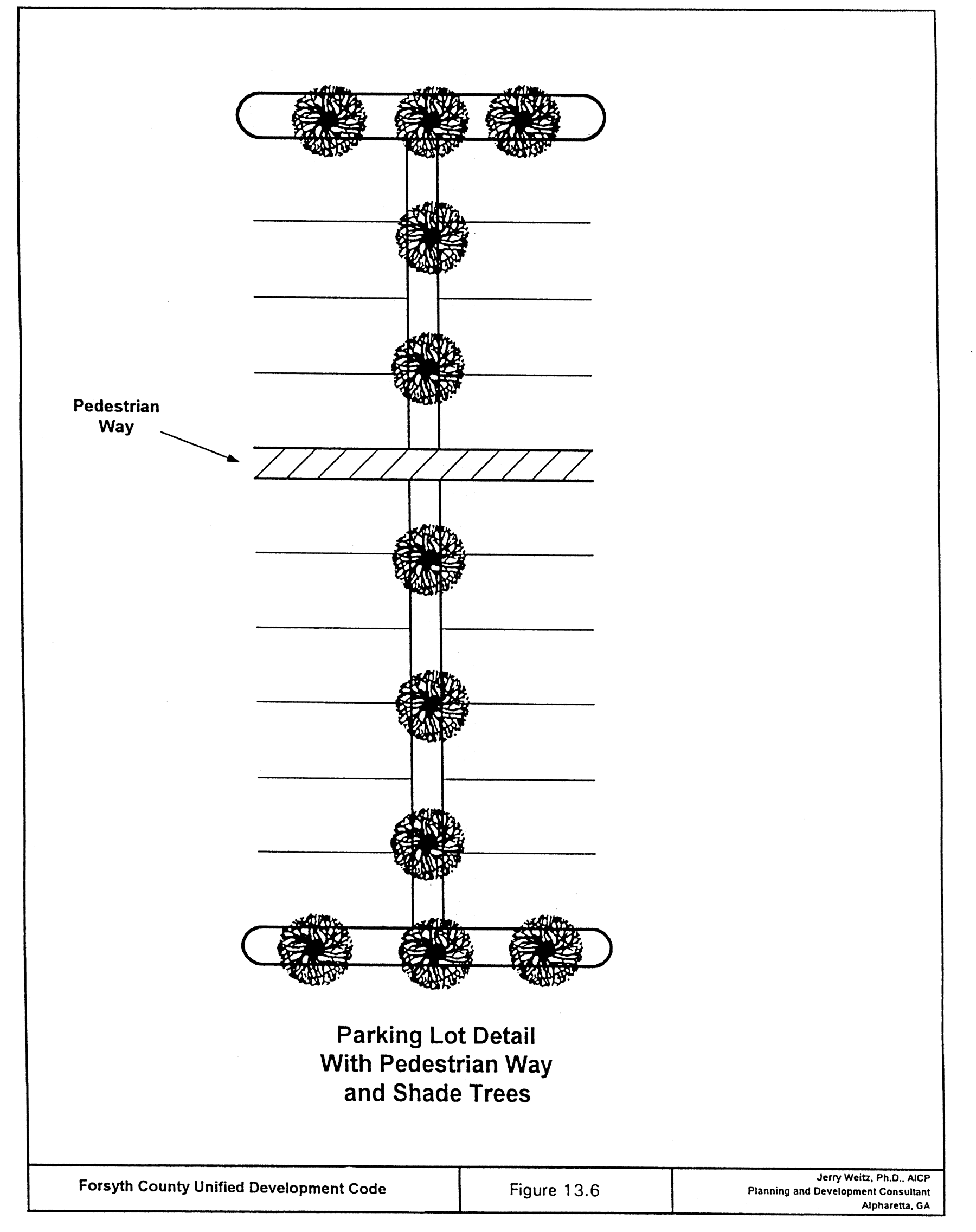
Parking aisles should be separated from one another by planted medians with shade trees. When possible, it is recommended that parking aisles and their shade trees be aligned in a solar orientation to cast shade on parked cars during the summer months, if such an orientation does not compromise other design criteria in this chapter.
13-2.9. - Landscaping, trees, and natural environment.
Significant landscaped and/or natural streetscapes along roadways are encouraged. Landscaping areas should be combined to form larger clusters at highly visible locations. Landscape design should create variety, interest, and view corridors for visibility. Plant materials should be placed intermittently against long expanses of building walls, fences, and other barriers to create a softening effect. Foundation planters should be provided as appropriate along front building façades. A variety of deciduous and evergreen species should be used to provide visual interest and resist disease; however, a minimum of one-third of the plantings should be evergreen coniferous species.
Existing vegetation and large specimen trees should be preserved and incorporated into site design when possible, in order to create a natural appearance and the impression of a mature landscape. A sufficient number of trees, of appropriate type, should be preserved along road frontages adjacent to and within the activity center. Additional trees should be planted between curbs and sidewalks to create a tree canopy that helps to define the streetscape and that provides shade at maturity. Parking aisles should be separated from one another by planted medians with shade trees. Trees should be incorporated around the building exterior to soften the building appearance and to create a place of relief from the summer sun.
Trees recommended for providing large canopy potential include but are not limited to Live Oak, Maple, Sycamore, Elm, Hickory, and Ash. Trees with a pyramidal canopy potential include Slash Pine, Red Cedar, Magnolia, Cypress, American Holly, and River Birch. Understory trees, six to eight feet in height, and that may reach a height of twenty feet at maturity include but are not limited to Dogwood, Wax Myrtle, and Crepe Myrtle. Large shrubs, four to six feet in height at time of planting, and that may reach a height of at least eight feet, include Elaeagnus, Photinia, Juniper, Holly, Viburnum, and Pampas Grass. Tree installation and removal shall be in compliance standards provided in Ordinance Number 81 of Forsyth County (Tree Preservation and Replacement Ordinance), as may be amended from time to time, and administrative standards for the preservation and replacement of trees as adopted and as may be amended from time to time.
Development should generally conform to the natural terrain to the extent practical, but not at the expense of compromising other guidelines, or at the expense of precluding innovative design that would be an asset to the community, in accord with the general spirit and intent of these guidelines.
Cross reference— Enviornment, ch. 34; vegetation, ch. 86.
13-2.10. - Public spaces and streetscape improvements.
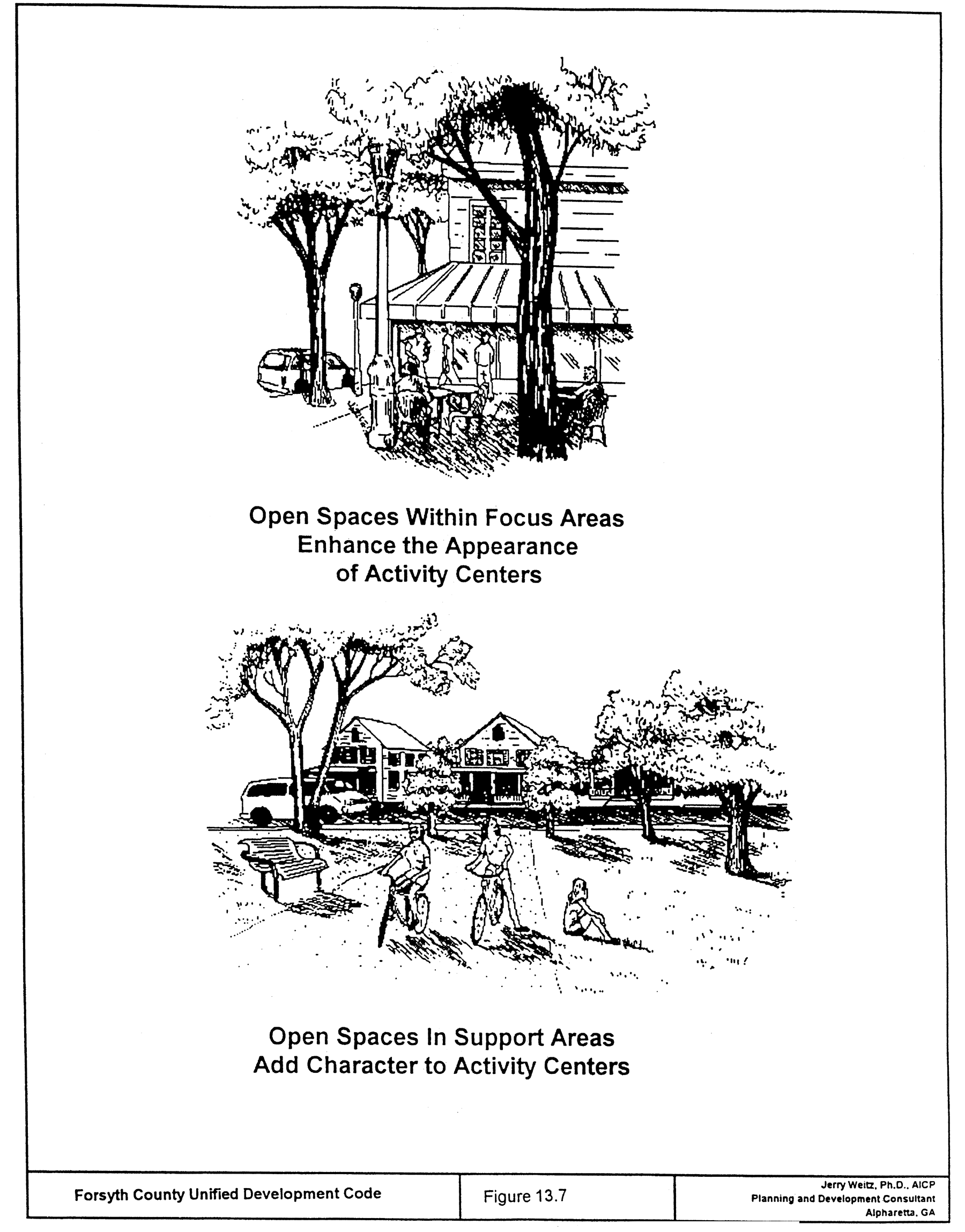
Elements such as landscaping, street furniture, public open spaces and plazas, and amenities create contrast to and soften the built environment by making the walking experience more enjoyable and inviting. Landscape areas should be designed to form plazas, open spaces, and other focal points within the activity center. Pedestrian-oriented public outdoor spaces should be incorporated as design elements into activity centers. These public spaces may include a formal park or town green, small formal parks/plazas, and so forth, as focal points for community interaction. These public spaces should be integrated purposefully into the overall design of the activity center, and not merely be residual areas left over after buildings and parking lots are sited. These spaces should also be placed next to the areas that generate the users, such as street corners, shops and restaurants, stores, daycare, and dwellings.
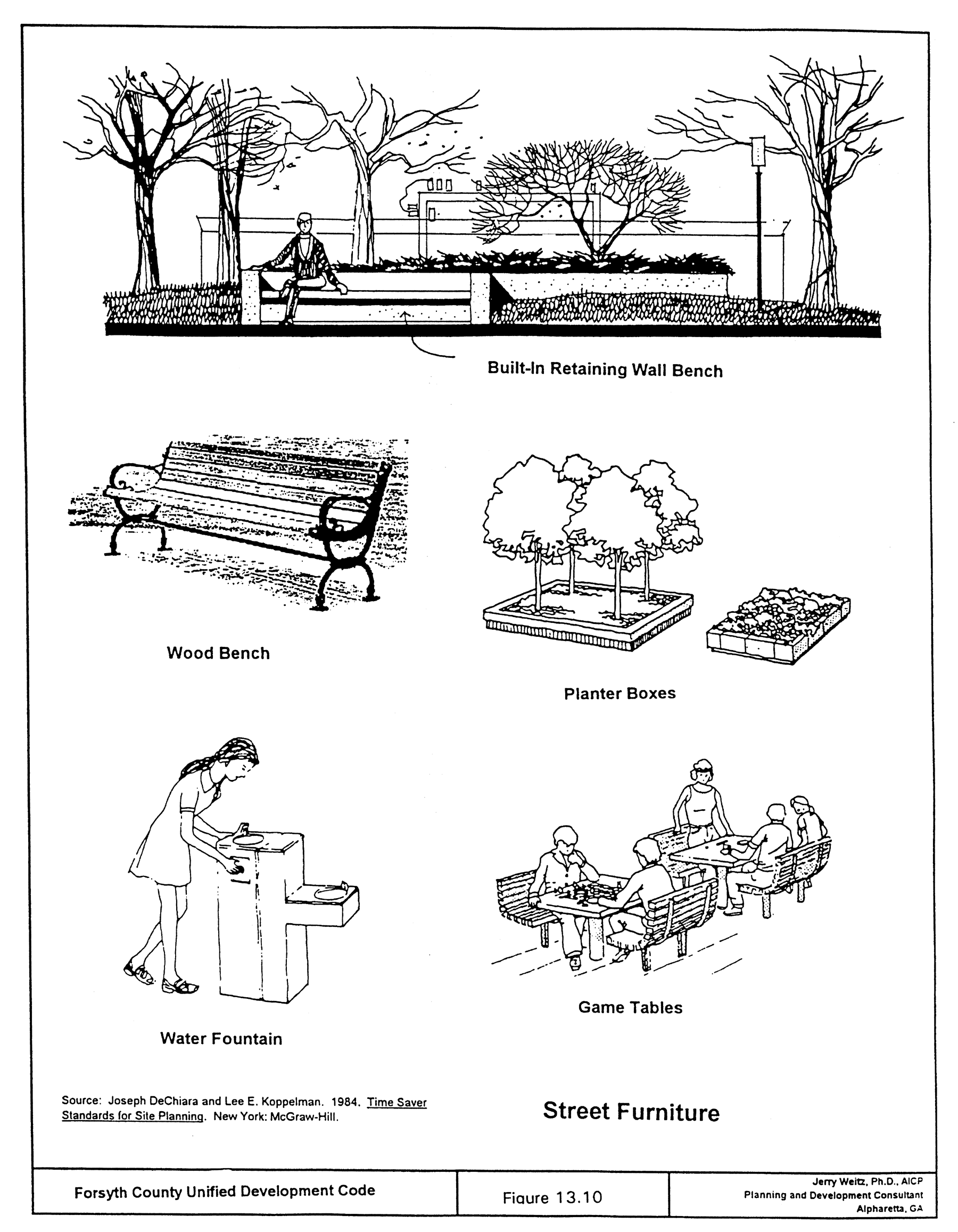
Within an activity center, street furniture (e.g., benches, trash receptacles), lighting, and sensitively arranged uses such as outdoor cafes should be provided to encourage human interaction and street life. Street furniture, including benches, and trash receptacles (waste bins) should be provided along streets in focus areas and preferably extended with the same architectural theme along public streets in the support areas of the activity center as well. Street furniture plans should include pedestrian walk lighting, trash receptacles (waste bins), and seating facilities for every 400 feet of walk. Advertising is not permitted on street furniture. Public telephones and water fountains are encouraged. Outdoor public art may be provided in open spaces, plazas, and along streetscapes to provide visual interest and diversity.
13-2.11. - Pedestrian and bicycle access and connections.
Access to developments within activity centers should serve the needs of the pedestrian and bicyclist as well as the motorist. Equal importance should be placed on accommodating and providing for pedestrian and bicycle circulation patterns. The pedestrian and bicycle paths of any one development or site within the activity center should interconnect with the pedestrian and bicycle paths of any adjacent development or site. Sidewalks should be provided along all road frontages to connect with existing or future sidewalks along the road frontages on adjacent properties. An activity center should provide for pedestrian connections into adjacent residential neighborhoods. Sidewalks should also connect buildings within the activity center to the county's open space or greenway system as may be established. All points of human activity within a development or site should be accessible to pedestrian and bicycle traffic via pedestrian/bicycle paths. Walkways should be provided between buildings in the activity center. Covered walkways are encouraged, particularly where short distances exist between buildings.
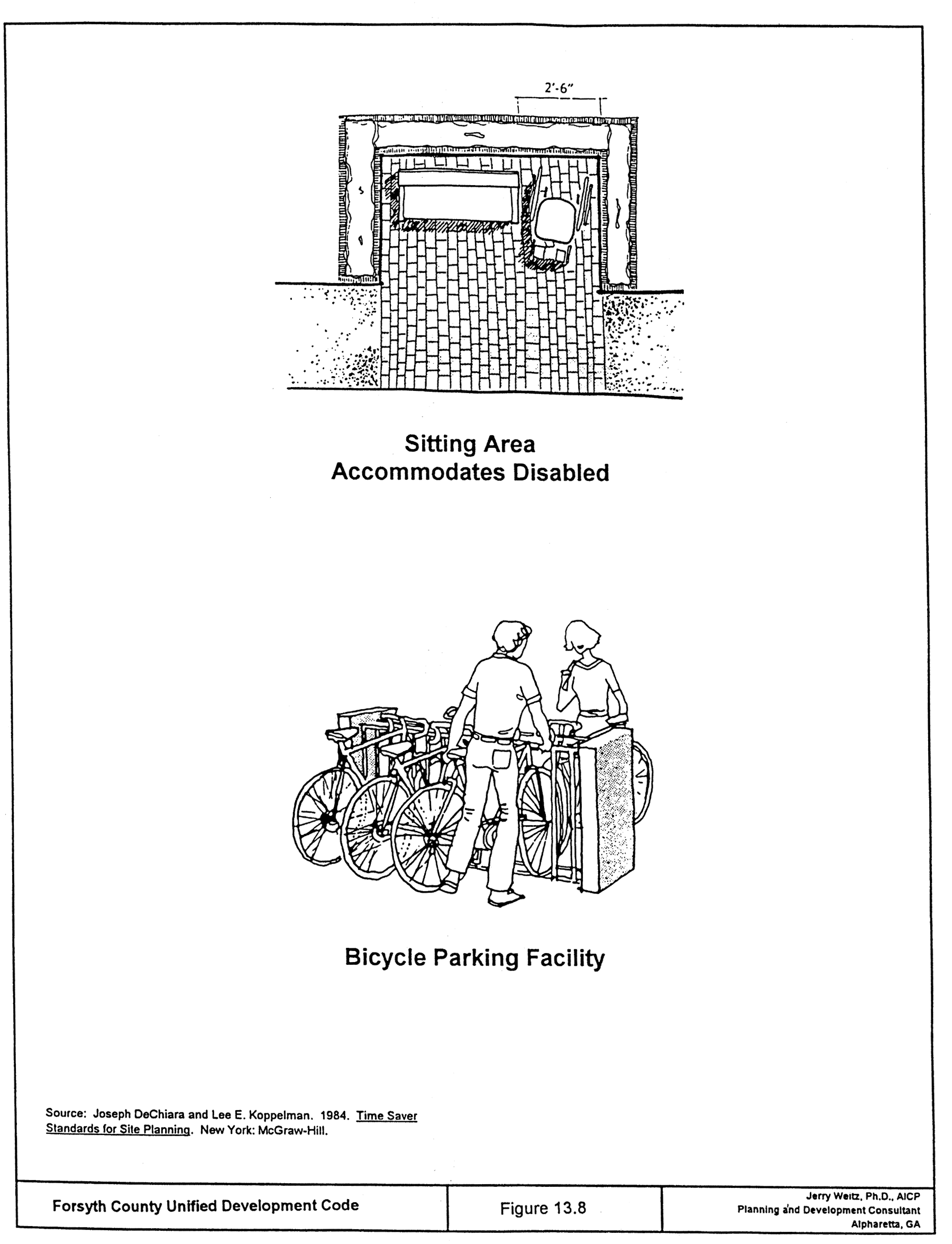
Pedestrian crosswalks and bicycle crossings should be provided throughout the activity center as necessary for the safety and convenience of pedestrian travel and bicycle traffic between residential, shopping, employment, recreation, and institutional uses in the center. The number and length of pedestrian crossings through paved parking areas and drives should be kept to a minimum. Where pedestrian crossings must cross paved parking areas and drives, decorative paving material (i.e., pavers, stamped or textured concrete, or color concrete) should be used to delineate the pedestrian crossing. Ramps meeting the Americans With Disabilities Act (ADA) requirements must be installed at all crossings.
The travel ways for bicycle traffic should be designed to minimize automobile-bicycle travel conflict, keeping bicyclists safely out of the automotive stream. Specifically designated bicycle parking or places to store/park and lock bicycles should be provided or accommodated at points throughout an activity center's focus area and in close proximity to on-site structures and uses. Generally, activity centers should provide one bicycle parking space for every 20 vehicle parking spaces provided.
13-2.12. - Transit access and connections.
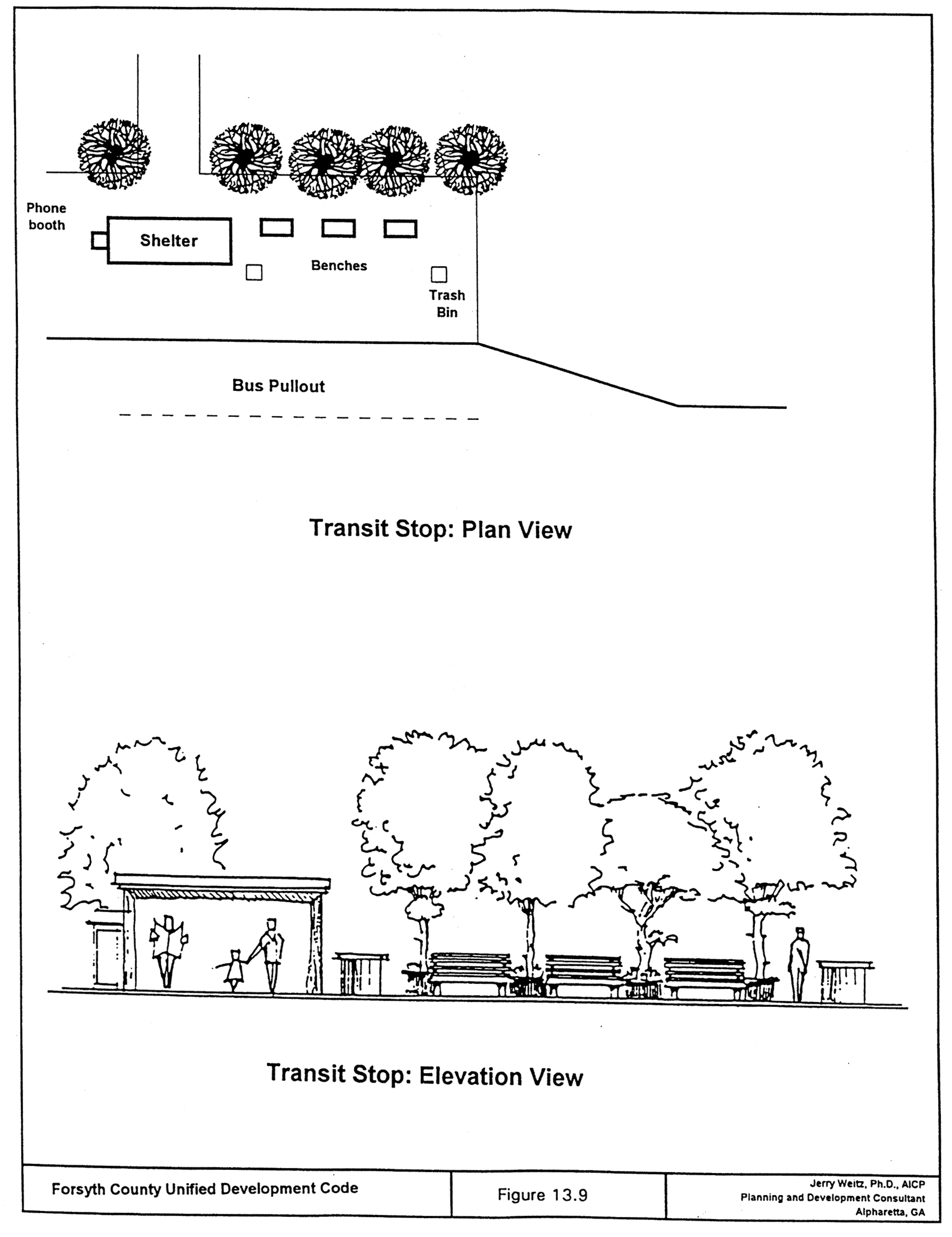
Activity centers should accommodate existing bus stops or include location(s) for future local transit stop(s), sited in accordance with long range county plans for transit. Transit stops should include a bus pullout bay, designed to appropriate standards of the county or transit provider. All transit stop facilities must be designed to ensure safe movement of pedestrians and the handicapped.
Transit stops should be connected with the area's pedestrian/bicycle pathway system. Transit stops in an activity center should be identifiable, well lighted, and within a reasonable walk of all buildings in the activity center. Transit stops should have one or more shelters to protect users during inclement weather. Separate shelters may not be necessary if shelter design is incorporated into the building design in a manner that is suitable for waiting out of inclement weather while waiting for transit. Seating within and outside of the shelter should be provided. Landscaping around shelters, especially that which provides shading, is strongly encouraged.
Street furniture, including benches, and trash receptacles (waste bins) should be provided at transit stops. Any architectural theme for street furniture should be continued and extended throughout the development, especially along the same road frontage, in order to provide the link of consistence and uniformity needed to create and expand the activity center concept. Street furniture plans should include pedestrian walk lighting, trash receptacles (waste bins), and seating facilities for every 400 feet of walk. Advertising is not permitted on street furniture or transit shelters. Phone booths and information displays showing transit routing are also encouraged.
The reservation or provision of parking space for park and ride or carpool uses is encouraged within activity centers.
13-2.13. - Lighting.
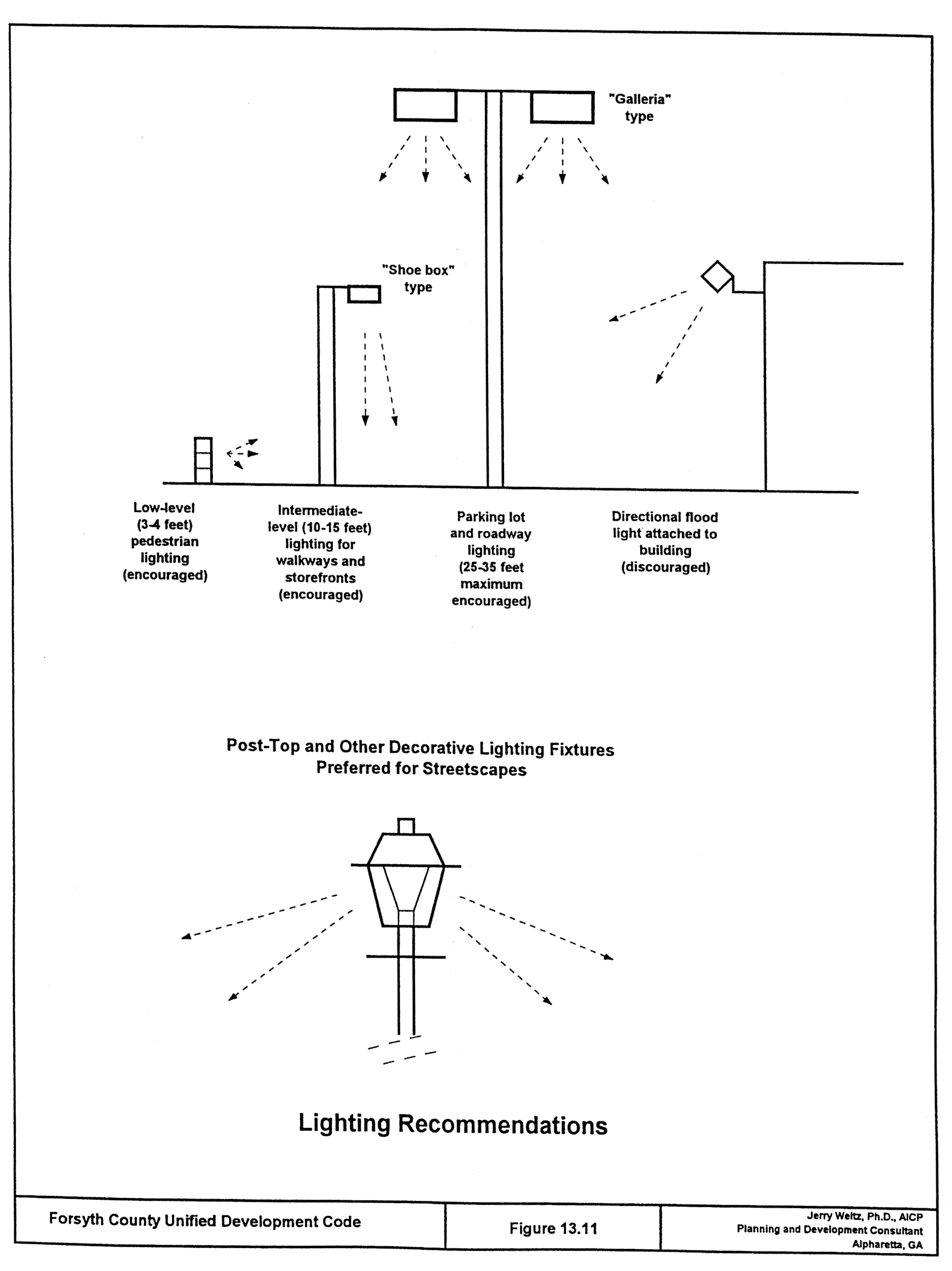
Lighting should be used to highlight or accent architectural features and create visual interest. Exterior neon lighting, illuminated banding, or other lighting that creates a glow is strongly discouraged unless approved as part of an overall theme for the activity center. The style of lighting should reflect the architectural character of the activity center. Post top lighting fixtures and poles and decorative lamps are strongly preferred.