
Morgan Hill City Zoning Code
CHAPTER 18
40 - ALTERNATIVE STANDARDS FOR MEDIUM DENSITY RESIDENTIAL DEVELOPMENT
18.40.010 - Purpose.
The purpose of this chapter is to provide alternative development standards for medium density residential development including single-family detached and attached housing units on small lots (less than seven thousand square feet). The intent of these standards is to:
A.
Ensure that small lot development blends with the surrounding community and is compatible with neighborhoods, is sensitive to its context, and incorporates appropriate amenities and high-quality design;
B.
Implement residential development standards to enhance the appearance of the surrounding neighborhood and be well integrated with existing homes nearby;
C.
Discourage abrupt transitions in height, mass, and prevailing setback patterns and separations caused by high, solid walls and blank building faces;
D.
Recognize small lot and medium density development as a more efficient form of land use than lower density development, a means of reducing the environmental impacts of housing development, and a way to create more walkable neighborhoods;
E.
Guide new development while accommodating creativity, innovation, and flexibility in housing design; and
F.
Implement Morgan Hill Housing Element policies which encourage greater housing diversity and affordability in Morgan Hill.
(Ord. No. 2277 N.S., § 5(Exh. A), 6-6-2018)
18.40.020 - Applicability.
A.
The provisions of this chapter are intended for use in the residential attached low density (RAL) and residential attached medium density (RAM) zoning districts and are principally intended for single-family homes, townhomes, patio homes, courtyard homes, duets, and similar single-family detached and attached housing types. The provisions of this chapter shall not be applicable in the residential detached (RDL, RDM, RDH), residential attached high density (RAH) and mixed use (MU-D, MU-N, MU-F) zoning districts.
B.
The standards in this chapter may be used as an alternative to the development standards for the RAL and RAM zoning districts contained in Chapter 18.18 (Residential Attached Zoning Districts). The standards in this chapter are not mandatory but instead provide an alternative to accommodate a wider range of housing types in a manner that enhances Morgan Hill's unique feel and minimizes impacts on adjacent properties.
C.
Modifications to homes in small lot developments already existing as of October 7, 2015 shall be exempt from these standards.
(Ord. No. 2277 N.S., § 5(Exh. A), 6-6-2018)
18.40.030 - Design permit required.
Proposed projects subject to the requirements of this chapter shall obtain a design permit pursuant to Section 18.108.040 (Design Permits).
(Ord. No. 2277 N.S., § 5(Exh. A), 6-6-2018)
18.40.040 - Permitted housing types.
Housing types allowed in the RAL and RAM zoning districts subject to the requirements of this chapter are shown in Table 18.40-1.
Table 18.40-1: Permitted Housing Types
Note:
[1] The development of detached single family dwellings shall be no greater than 25 percent of the gross buildable site area (including lots and streets).
(Ord. No. 2277 N.S., § 5(Exh. A), 6-6-2018)
18.40.050 - Development standards.
A.
General. Minimum lot sizes and dimensions for specific housing types are shown in Table 18.40-2. Lot sizes, dimensions, coverage limits, and setback standards may vary based on the use within the specified zoning district.
Table 18.40-2: Medium Density Residential Development Standards
Notes:
[1] Subject to the density requirements specified in the General Plan.
[2] Standards are for individual lots and not for the subdivision as a whole.
[3] Lot coverage limits apply to individual, subdivided parcels and to accessory structures as well as the primary residential structure on the site. Development in the RAL and RAM zoning districts is also subject to an aggregate lot coverage limit for the entire subdivision. See Section 18.18.060.A.
[4] Additional requirements apply for street-facing garages. See Section 18.40.070.H.7.
[5] A zero-foot setback is acceptable for Duets along the property line on the shared building wall
[6] A reduced setback (as low as zero feet) is acceptable on one side yard; provided, that the sum of both side yard setbacks is at least eight feet.
[7] A reduced setback (as low as zero feet) is acceptable on one side yard; provided, that the sum of both side yard setbacks is at least ten feet.
(Ord. No. 2277 N.S., § 5(Exh. A), 6-6-2018; Ord. No. 2319 N.S., § 6, 1-20-2021; Ord. No. 2362, § 6, 2-19-2025)
18.40.060 - Standards for all housing types.
A.
Aggregate Lot Coverage. For all projects in the RAL and RAM zoning districts, the sum total coverage of all proposed buildings and structures shall not exceed forty percent of the gross land area of the subdivision.
B.
Transitional Standards. When a proposed project is adjacent to a residential zoning district, excluding the RAH zoning district, the following transitional standards shall apply:
1.
The building setback from the adjacent residential zoning district properties shall be five feet for interior side yards;
2.
The building setback from the abutting residential zoning district properties shall be twenty feet for rear yards for lots three thousand to five thousand ninety-nine square feet and fifteen feet for rear yards for lots one thousand four hundred forty to two thousand nine-hundred ninety-nine square feet.
3.
The building height at the above-mentioned setback lines may not exceed thirty feet. On lots where heights greater than thirty feet are allowed, the height may increase at a rate of one foot of vertical rise for every one foot of linear distance away from the setback line, to the maximum indicated in the corresponding zone district.
4.
A landscaped planter strip of at least five feet in width shall be provided along the abutting property line between a small lot subdivision or townhome development and any adjoining residential zoning district boundaries. Trees shall be planted within this area to provide screening between the small lot subdivision and the adjacent lower density uses.
C.
Open Space — Multifamily Dwellings. Common and private open space for multifamily dwellings shall be provided as shown in Table 18.40-3.
Table 18.40-3: Usable Open Space for Multifamily Dwellings
Notes:
[1] Common open space shall be fully landscaped and accessible to all residents.
[2] Roof terraces and roof gardens may provide up to fifty percent of the required common open space area if the planning commission finds that roof terraces and roof gardens provide quality open space for residents and minimize noise, privacy and other potential impacts on neighboring properties.
D.
Open Space — Attached and Detached Single-Family Homes. The following open space provisions apply specifically to small lot, courtyard, and townhome housing types, and other new developments with similar housing types. The standards recognize that small lot subdivisions may have greater common open space needs than conventional single-family development due to their smaller yard areas.
1.
Private Open Space. Each lot must include a private open space area, such as a private yard, porch, balcony, roof garden, or patio. Private open space must be contiguous to the unit it serves and accessible and visible from the living area of the unit. The minimum amount of private open space per unit shown in Table 18.40-4 may be reduced by up to twenty-five percent if off-set by the equivalent increase in common open space.
2.
Common Open Space. Developments which have either: (a) average lot size of smaller than four thousand three hundred fifty-six square feet (e.g., density of more than ten units per net acre) or (b) fifteen units or more, are required to provide common open space for the development's residents. Table 18.40-4 identifies the open space requirements, which vary based on lot size. Such common open space shall be visible from internal or external streets and shall be designed for informal surveillance from private residences to enhance neighborhood security. Common open space shall have a minimum usable width of fifteen feet and a minimum area of five hundred square feet, a slope of no more than ten percent, accessibility to all units, and be open to the sky. It may contain amenities which enhance usability, such as swimming pools, play equipment, benches and tables, and barbecues. Parking, loading, and service areas may not be counted as open space.
Table 18.40-4: Usable Open Space for Attached and Detached Single-Family Homes
Notes:
[1] Private open space per unit may be reduced by up to twenty-five percent if off-set by the equivalent increase in common open space.
E.
Landscaping, Lighting, and Other Site Improvements. Landscaping, lighting and other site improvements shall be designed to diminish the impact of the denser development and provide a softer appearance as follows:
1.
No more than fifty percent of any required front or street-facing side yard shall be covered with a paved or impervious surface.
2.
A planter strip at least five feet wide shall be provided on the street-facing side of all walls fronting public or private roads in addition to landscaping provided as part of the streetscape.
3.
A sufficient number and type of trees shall be provided to shade the sidewalks. Planting shall be done at the time public improvements are constructed.
4.
Street lights shall be designed and scaled at a pedestrian scale with a maximum height of sixteen feet. "Cobra head" type street lights are prohibited.
F.
Orientation. All units located along public streets shall have the primary entrance facing the street right-of-way. Exceptions to this requirement may be approved by the city for projects which are located on four-lane streets carrying high traffic volumes and streets that do not allow on-street parking. In such cases, the project may be oriented around private streets or courtyards.
G.
Roof-Mounted Equipment. Any roof-mounted mechanical equipment shall be incorporated into the roof design in such a way that it becomes an integral part of the architecture or is concealed from view.
H.
Screening. Mechanical equipment and individual refuse and recycling bins shall be screened as follows:
1.
Air conditioners, heaters, utility equipment, meters, and similar equipment shall be screened from public view. Above-ground utility transformers and other above grade equipment shall not be located within the front yard along a street.
2.
Fencing, landscaping or view-obscuring structures shall be provided to screen individual refuse and recycling bins or other refuse containers from view from public rights-of-way while still providing easy access to trash receptacles (see Figure 18.40-1).
3.
A gate wide enough to allow for passage of city standard individual refuse and recycling bins shall be provided.
4.
Individual refuse and recycling bin storage areas shall have a smooth solid surface such as concrete.
5.
The location of refuse and recycling bins shall be shown on plans submitted for planning and building permits.
Figure 18.40-1: Standards for Trash Storage and Screening in Small Lot Subdivisions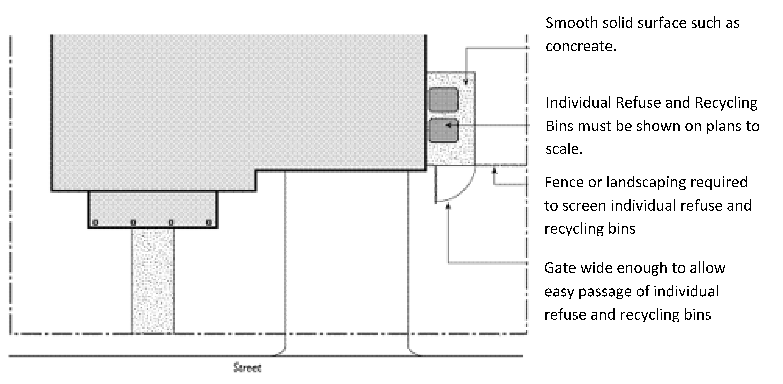
I.
Homeowners' Association. A homeowners' association ("HOA") shall be required to provide ongoing maintenance for private streets and utilities, alleys, private open space and recreational facilities, stormwater drainage facilities, common landscaping, lighting, and other common areas, utilities, and facilities.
J.
Terminology. For purposes of this chapter, the following terms shall be defined as follows:
1.
Adjacent. "Adjacent" means directly abutting, having a boundary or property line(s) in common or bordering directly, or contiguous to.
2.
Feasible. "Feasible" means capable of being accomplished in a successful manner within a reasonable period of time, taking into account economic, environmental, social, and technological factors.
(Ord. No. 2277 N.S., § 5(Exh. A), 6-6-2018; Ord. No. 2328 N.S., § 1, 12-15-2021)
18.40.070 - Design criteria for small lot single-family subdivisions.
A.
Applicability. The standards in this section apply to small lot single-family subdivisions. They are not applicable to townhome developments or other development where the predominant unit type is attached housing.
B.
Unit Types. Units in small lot subdivisions may include single-family detached homes and "duets" which share a common wall on one side.
C.
Lot Patterns. Lot patterns shall be varied to avoid monotonous streetscapes and shall include:
1.
A variety of lot widths, depths, shapes, and sizes, such that there is a perceptible difference between lot sizes on a block. Lots shall be designed to accommodate a variety of home styles, setbacks, and garage placements;
2.
Larger lots on corners;
3.
Smaller lots surrounding common open space areas; and
4.
Blocks no longer than six hundred linear feet.
D.
Floor Plans and Front Elevations. The excessive repetition of identical floor plans and elevations shall be avoided. In subdivisions with fewer than twenty lots, at least three unique front elevations and floor plans shall be provided. In subdivisions with twenty lots or greater, at least four unique front elevations and floor plans shall be provided. Location of identical models on adjacent lots, including "back to back" lots, shall be avoided.
E.
Four-Sided Design. Facades facing the side and rear yard shall include details which are compatible with those on the front facade, with similar types and treatments of roofs, windows, shutters, planter boxes, and other architectural elements.
F.
Front Setbacks. Front yard setbacks shall be varied (see Figure 18.40-2). Generally, at least fifty percent of the homes shall have front yard setbacks which are greater than the minimum required (excluding porches and non-habitable space). This component may be implemented by recording "build to" lines on the final subdivision map.
Figure 18.40-2: Small Lot Single-Family Subdivision Front Yard Setbacks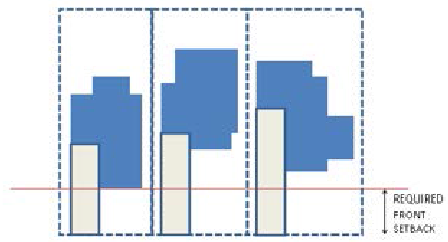
G.
Rear Setbacks. A variety of rear setbacks shall be provided in order to avoid the appearance of long, monotonous walls from adjacent properties along the rear lot lines.
H.
Building Size and Design. A variety of unit types and sizes, sited to provide compatibility with nearby neighborhoods, shall be provided. Buildings shall incorporate the following design features:
1.
Roof Variation. Rooflines along the longer axis of the building shall be broken with varied pitches at the skyline level. Features such as turrets, dormers, and other variations that add architectural interest and distinction are encouraged.
2.
Building Height Variation. Homes shall feature a variety of building heights, potentially including single story, two-story, three-story, split level units, and units with partial second floors. Units abutting lower density development on the perimeter of a subdivision shall generally be lower in height, or split level in design to enhance compatibility.
3.
Recessed Upper Stories. For at least fifty percent of the units, the second and third stories shall be recessed relative to the first story to reduce the appearance of building mass. The design shall avoid tall sheer walls, and preserve the privacy of adjacent properties.
4.
Primary Entrances. Primary entrances to homes shall be in a prominent and visible location facing the street. Primary entrances shall not face the side yard setback or a deep recess of the building.
5.
Usable Porches, Wherever Feasible. Porches shall have a minimum depth of five feet and a minimum width of eight feet, preferably extending a minimum of fifty percent of the width of the front facade, excluding the garage. Porches shall also incorporate different architectural features such as railings, short walls, trellises, and varied roof elements to provide architectural detail, character, and visual interest.
6.
Garage Entries. There shall be a minimum of two locations of garage entries, such as front-facing attached garages, detached garages, and garages which are side-facing or accessed via a rear alley.
7.
Recessed Garages. Garage faces shall be recessed a minimum of five feet from the primary facade of the residence (where they face the street and not a rear alley), in order to minimize the impact of the garage on the streetscape. The garage shall not comprise more than fifty percent of the front building facade (see Figure 18.40-3) on a residential unit. If additional articulation and architectural features are introduced to minimize the impact of the garage on the streetscape, the garage front facade length may be increased to sixty-seven percent. Driveways shall facilitate tandem parking where feasible.
Figure 18.40-3: Standards for Street-Facing Attached Garages in Small Lot Subdivisions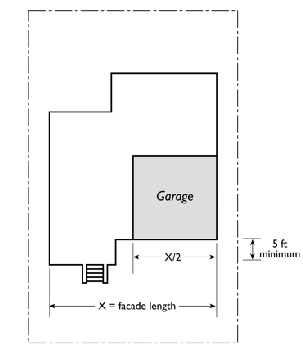
I.
Driveways. Driveways shall be designed to reduce the amount of pavement within the subdivision to the greatest extent possible, as follows:
1.
Maximum driveway width shall be twenty feet unless a wider driveway, up to twenty-four feet, is required for safe access;
2.
Shared driveways, such that there is a single curb cut providing access to two houses, shall be encouraged in order to reduce the number of curb cuts along a street;
3.
Driveways (and related curb cuts) shall be sited to maximize opportunities for on-street parking; and
4.
Side driveways to rear garages shall be designed wherever feasible to create opportunities for off-street tandem parking in the side yard.
J.
Parking. Parking requirements shall conform to the standards set in Chapter 18.72 (Parking and Loading), except as otherwise indicated below:
1.
Two covered parking spaces shall be required for each housing unit; and
2.
Two additional parking spaces for each unit shall be available for the use of residents and guests. These spaces may include a combination of driveway parking (including tandem parking), alley parking, on-street parking in front of the residence, and designated guest parking areas.
(Ord. No. 2277 N.S., § 5(Exh. A), 6-6-2018)
18.40.080 - Special criteria for townhome developments.
A.
Applicability. This section applies specifically to townhome developments. For the purposes of this section, a townhome shall be defined as a series of three or more adjacent single-family dwelling units, each on an independent parcel, which are connected by common walls along the side property lines. Townhomes include row houses but do not include duplexes or duets. Interior unit townhomes typically have zero feet side yard setbacks on both sides, while end unit townhomes have a zero feet side yard setback on one side.
B.
Facade Articulation. All building facades shall have at least one horizontal or vertical projection or recess at least four feet in depth, or two projections at least two and one-half feet in depth, for every twenty-five horizontal feet of wall. The articulated elements must be greater than one story in height and may be grouped rather than evenly spaced in twenty-five-foot modules. Front porches, stoops, fireplaces, overhangs, trellises, and similar projections into the front yard may count toward this requirement.
C.
Variable Roof Forms. Variable roof forms shall be incorporated into the building design. No more than two side-by-side units may be covered by one unarticulated roof. Articulations may be accomplished by changing roof height, offsets, and direction of slope and by introducing elements such as dormers, towers, and parapets. Alternative design approaches may be approved by the city, provided the goal of breaking down large building masses into smaller units is achieved.
D.
Garage Location. Garages shall be located to the rear of the townhome and accessed via an alley or shared driveway wherever feasible. Garage faces shall be recessed a minimum of five feet from the primary facade of the residence (where the garage faces the street and not a rear alley) in order to minimize the impact of the garage on the streetscape. The garage shall not comprise more than fifty percent of the front building facade on a residential unit.
E.
Facade Detailing and Materials. All visible building facades shall incorporate details, such as window trim, window recesses, cornices, changes in materials, or other design elements, in an integrated composition. Each side of a building that is visible from a public right-of-way, courtyard, or common open space, shall be designed with a complementary level of detailing and quality of materials.
F.
Projections and Recesses. Facades shall incorporate balconies, bay windows, porches, and similar projections and recesses in a pattern that creates architectural interest across the length of the facade of a row of townhomes. Roofed projections or recesses shall be provided for all building entrances.
G.
End Units. The side-facing facades at the end of a row of townhouses (or rowhouses) shall be consistent in design quality, materials, and massing with the street-facing building facades. End unit facades shall be designed to create a strong relationship with the street, with elements such as wrap around porches and bay windows facing the street or side yard area.
H.
Entry Elevation. The ground floor elevation of a townhome shall be no more than thirty inches above the finished grade immediately adjacent to the entry.
I.
Walkways. Walkways shall be provided to link the townhomes to recreational and other internal facilities as well as the other residential units and nearby public streets. Paseos, or pedestrian walks through common open space areas, are strongly encouraged.
(Ord. No. 2277 N.S., § 5(Exh. A), 6-6-2018)
18.40.090 - Special criteria for courtyard home development.
A.
Applicability. This section shall specifically apply to courtyard home development. For the purposes of this section, courtyard homes are defined as individual homes on small lots arranged around a common driveway. Courtyard homes are intended to lessen the impact of curb cuts and garages on the streetscape and enable homes to be oriented to a public street or open space rather than a driveway and street-facing garage.
B.
Units Per Courtyard. No more than six units shall be accessed from a single courtyard.
C.
Orientation. Homes adjacent to the street to which the courtyard connects shall face that street (rather than the courtyard) whenever feasible.
D.
Courtyard Design and Pavement. The portion of the courtyard used for vehicle circulation shall be finished with decorative pavement and shall be at least sixteen feet wide, with a minimum width of twenty feet at its entrance to the adjacent street. Courtyards shall not exceed one hundred feet in length.
E.
Vistas. Terminating vistas of the courtyard from nearby streets shall not be dominated by garages.
F.
Garage Aprons. Paved areas in front of garage doors shall have a minimum backout dimension of twenty-four feet. To avoid obstruction of the courtyard, garage aprons shall be either less than six feet deep or more than eighteen feet deep. Aprons shall be limited to the rear units on a courtyard so that the parking aprons are not visible from the adjacent public or private streets.
G.
Recessing of Garages. Garages shall be recessed behind the main dwelling unit by at least two feet.
H.
Architectural Unity. All units on a court shall share a common architectural theme, although variations in building types and elevations on end units are encouraged.
I.
Windows. Windows shall be sited and designed to maximize privacy and shall be set back from the property line to the maximum extent feasible. Second floor windows overlooking private open space areas of adjacent units shall be avoided wherever feasible.
(Ord. No. 2277 N.S., § 5(Exh. A), 6-6-2018)
18.40.100 - Special criteria for condominium developments.
A.
Applicability. This section applies specifically to condominium developments. For the purposes of this section, a residential condominium development shall be defined as:
1.
A residential project that consists of an undivided interest in common in a portion of real property coupled with a separate interest in space called a unit, the boundaries of which are described on a recorded final map, parcel map, or condominium plan in sufficient detail to locate all boundaries thereof. The area within these boundaries may be filled with air, earth, water, or fixtures, or any combination thereof, and need not be physically attached to land except by easements for access and, if necessary, support. The description of the unit may refer to: (1) boundaries described in the recorded final map, parcel map, or condominium plan; (2) physical boundaries, either in existence, or to be constructed, such as walls, floors, and ceilings of a structure or any portion thereof; (3) an entire structure containing one or more units; or (4) any combination thereof.
2.
The portion or portions of the real property held in undivided interest may be all of the real property, except for the separate interests, or may include a particular three-dimensional portion thereof, the boundaries of which are described on a recorded final map, parcel map, or condominium plan. The area within these boundaries may be filled with air, earth, water, or fixtures, or any combination thereof, and need not be physically attached to land except by easements for access and, if necessary, support.
3.
An individual condominium within a condominium project may include, in addition, a separate interest in other portions of the real property.
B.
Condominium Plan. A condominium plan shall contain all of the following:
1.
A description or survey map of a condominium project, which shall refer to or show monumentation on the ground.
2.
A three-dimensional description of a condominium project, one or more dimensions of which may extend for an indefinite distance upwards or downwards, in sufficient detail to identify the common area and each separate interest.
3.
A certificate consenting to the recordation of the condominium plan pursuant to the provisions of the Civil Code and acknowledged as provided in Section 4290 of the Civil Code.
C.
Utility Metering.
1.
The consumption of gas and electricity within each unit shall be separately metered so that the unit owner can be separately billed for each utility.
2.
Each dwelling unit shall be served by a separate city water meter. An additional separate city meter shall be provided to serve the common landscape areas in the condominium project.
D.
Laundry Facilities. Each unit shall be provided with space and utility hookups within the unit or attached garage to accommodate a standard sized washer and dryer. The minimum dimensions shall be six feet wide and three feet deep.
E.
Sound Transmission. Each condominium unit shall comply with the state of California's Noise Insulation Standards (Title 24 of the California Code of Regulations).
F.
Building Code Requirements. Each unit of a condominium project and all commonly owned portions of a condominium building shall comply with all applicable building code standards. Nothing herein shall be construed to prevent or prohibit the applicant or the city from providing or requiring building standards greater than those set forth in the building code where the greater standards are found to be necessary to carry out the purposes and intent of this chapter.
G.
Design Standards. Design standards in this chapter applicable to specific housing type(s) (e.g., townhomes, multifamily) shall apply to those housing types within a condominium project.
(Ord. No. 2277 N.S., § 5(Exh. A), 6-6-2018)
18.40.110 - Special criteria for multifamily development.
A.
Applicability. This section shall specifically apply to multifamily developments which shall be defined as a building designed and used as a residence for three or more families living independently of each other and containing three or more dwelling units.
B.
Laundry Facilities. Adequate laundry facilities shall be provided for all multiple-unit projects with at least one washing machine and one dryer per each five dwelling units.
C.
Storage Area. Each unit shall be provided a separate storage area consisting of at least one hundred cubic feet and having a minimum horizontal surface of twenty-five square feet.
D.
Building Frontage and Orientation. Units shall face streets, open spaces and internal private streets whenever possible. Building fronts shall include porches and door facing streets.
E.
Open Space. Common open space shall be centralized and directly accessible to units. Open common space shall be linked to adjacent parks, paseos, and paths.
F.
Variable Roof Forms. Variable roof forms shall be incorporated into the building design. Articulations may be accomplished by changing roof height, offsets, and direction of slope, and by introducing elements such as dormers, towers, and parapets. Alternative design approaches may be approved by the City, provided the goal of breaking down large building masses into smaller units is achieved.
G.
Facade Detailing and Materials. All visible building facades shall incorporate details, such as window trim, window recesses, cornices, changes in materials or other design elements, in an integrated composition. Each side of a building that is visible from a public right-of-way, courtyard, or common open space shall be designed with a complementary level of detailing and quality of materials.
H.
Projections and Recesses. Facades shall incorporate balconies, bay windows, porches, and similar projections and recesses in a pattern that creates architectural interest across the length of the facade. Roofed projections or recesses shall be provided for all building entrances.
I.
End Units. The side-facing facades at the end of a multifamily building shall be consistent in design quality, materials, and massing with the street-facing building facades. End unit facades shall be designed to create a strong relationship with the street, with elements such as wraparound porches and bay windows facing the street or side yard area.
J.
Walkways. Walkways shall be provided to link the multifamily units to recreational and other internal facilities as well as the other residential units and nearby public streets. Paseos, or pedestrian walks through common open space areas, are strongly encouraged.
(Ord. No. 2277 N.S., § 5(Exh. A), 6-6-2018)

