
Morgan Hill City Zoning Code
CHAPTER 18
92 - SUPPLEMENTAL STANDARDS
18.92.010 - Purpose.
This chapter establishes supplemental standards that apply to specific land uses and development in all zoning districts.
(Ord. No. 2277 N.S., § 5(Exh. A), 6-6-2018)
18.92.020 - Adult businesses.
A.
Purpose and Applicability. This section establishes standards for the location, approval, and operation of adult businesses as defined in Subsection C (Definitions) below.
B.
Exceptions. The following types of businesses are exempt from the requirements of this section:
1.
Therapeutic or Holistic Massage. Massage which is conducted by doctors, nurses, osteopaths or chiropractors, teachers, barbers, beauticians or by massage practitioners or employees as licensed by or otherwise exempted under Municipal Coder Chapter 5.32 (Massage Establishments).
2.
Medical or Psychological Therapies. The medical or psychological therapeutic activities of state-licensed doctors, psychologists, psychiatrists or marital or sexual therapists are exempt.
3.
Modeling or Theatrical Performances. Nude modeling done at infrequent intervals in connection with a college or art school, accredited by a nationally recognized accreditation organization, for students who have enrolled on a semester or quarterly basis with tuition is exempt. Occasional theatrical performances, either live or in motion picture theaters, in which nudity is incidental to the content of the presentation, are exempt.
4.
Incidental Sale or Rental of Merchandise. Businesses which incidentally sell or rent adult merchandise, involving less than twenty percent of the floor space of the establishment or less than twenty percent of the net receipts, whichever is greater, are exempt, providing that all other laws on obscenity and indecent behavior are complied with.
5.
Private Noncommercial Behavior. This title does not regulate the private behavior of adults, which is otherwise permitted by law, where there is no payment, gratuity, exchange of labor or goods, or other consideration of a transaction.
C.
Definitions.
1.
Adult Business. "Adult business" means a business which includes any of the following:
a.
Sells or rents items related to specified anatomical areas or specified sexual activities for over twenty percent of the year, and which items represent over twenty percent of the inventory or stock in trade or titles offered or floor space and/or over twenty percent of the net receipts of the business, whichever is greater.
b.
Depicts or projects still or moving photographs related to specified anatomical areas or specified sexual activities for over twenty percent of the year, which depiction or projection represents over twenty percent of the net receipts of the business.
c.
Provides live entertainment, massage or other service to patrons, regardless of percentage of net receipts or other measurement of share of the overall business, which is related to specified anatomical areas or specified sexual activities.
d.
"Adult businesses" include but are not limited to: adult bookstores, adult video stores, adult novelty stores, adult arcades, adult motels, adult theaters, adult entertainment enterprises, adult cabarets, escort agencies, massage parlors, nude modeling studios; or places which engage in or allow couch dancing, topless dancing, nude or semi-nude mud wrestling or similar businesses.
2.
Specified Anatomical Areas. "Specified anatomical areas" means and includes any of the following:
a.
Less than completely and opaquely covered human genitals, pubic region, anus or female breasts below a point immediately above the top of the areolae; or
b.
Human male genitals in a discernibly turgid state, even if completely and opaquely covered.
3.
Specified Sexual Activities. "Specified sexual activities" means any of the following:
a.
The fondling or other intentional touching of human genitals, pubic region, buttocks, anus or female breasts; or
b.
Sex acts, actual or simulated, including intercourse, oral copulation or sodomy; or
c.
Masturbation, actual or simulated;
d.
Human genitals in a state of sexual stimulation, arousal or tumescence; or
e.
Excretory functions as part of or in connection with any of the activities set forth in this section.
D.
Standards. All adult businesses shall comply with the following standards:
1.
Location.
a.
An adult business may be located no less than five hundred feet from a sensitive use or area.
b.
A sensitive use or area means any one the following:
(1)
A religious institution, on land leased or owned by any church, synagogue, mosque, temple or any school or meeting hall operated by such institution.
(2)
A public or private elementary, junior high or high school, preschool or child day care center.
(3)
A public park on which recreation games may be played, including lawn and parking areas, but excluding natural open space on slopes exceeding twenty percent.
(4)
A public assembly or public use civic building, including City Hall, the library and the post office, but excluding police and fire stations.
(5)
An area developed with or shown on the general plan land use map for future residential development.
(6)
A hospital except a veterinary hospital.
(7)
A freeway or arterial street identified in the general plan and which residential and visitor traffic uses to access other sensitive areas.
2.
Required Police Permit.
a.
All adult businesses shall receive and maintain approval a police permit pursuant to Municipal Code Section 5.60.010 (Police Permits).
b.
Adult businesses shall cease and desist operations within forty-eight hours of the city's denial or revocation of a police permit.
3.
Operational Standards. Adult businesses shall comply with all standards in Municipal Code Section 5.60.020 (Operational Standards).
(Ord. No. 2277 N.S., § 5(Exh. A), 6-6-2018)
18.92.030 - Convenience markets.
A.
Purpose. This section establishes standards for convenience markets in order to:
1.
Ensure the compatibility of convenience markets with neighboring commercial and residential land uses;
2.
Minimize potential negative impacts from convenience markets on adjacent land uses; and
3.
Require new convenience markets to incorporate crime prevention measures to protect the public health, safety, and welfare.
B.
Separation from Schools. A new convenience market shall be located a minimum of one thousand feet from the boundary of an existing school or a proposed school site as designated by the Morgan Hill Unified School District.
C.
Loiter Control.
1.
Public pay telephones on an exterior wall of the convenience market or anywhere on the site shall not allow incoming calls. Public telephones allowing incoming calls are allowed within the building interior.
2.
Video games may not be installed or operated on the premises of the convenience market.
3.
The police department may require additional loiter control measures as conditions of approval for the convenience market conditional use permit.
D.
Crime Prevention Measures.
1.
The exterior of the convenience market shall be illuminated during all hours of darkness during which the market is open for business. Exterior illumination shall allow law enforcement personnel to easily identify persons within front entry areas, adjacent public sidewalks, parking areas, throughways, and alleys under control by the convenience market. Illumination shall be located and designed to minimize interference with the quiet enjoyment of nearby residential properties.
2.
Commercial alarm systems and video security cameras shall be installed and maintained within the building to the specifications of the police department as required by the conditional use permit.
3.
The police department may require additional crime prevention measures as conditions of approval for the convenience market conditional use permit.
4.
Persons under the age of eighteen who are employed in a capacity which allows for selling of alcoholic beverages must be under the continual supervision of a person twenty-one years of age or older.
E.
Sale of Alcoholic Beverages.
1.
No alcoholic beverages shall be displayed within ten feet of the cash register or front door unless located within a permanently affixed cooler.
2.
No display or sale of alcoholic beverages shall be made from an ice tub.
3.
No alcoholic beverage advertising shall be located on buildings or windows.
4.
Employees on duty between the hours of ten p.m. and two a.m. who sell beer or wine shall be at least twenty-one years of age.
(Ord. No. 2277 N.S., § 5(Exh. A), 6-6-2018; Ord. No. 2310 N.S. § 2, 12-18-2019)
18.92.031 - Liquor store.
A.
Purpose. This section establishes standards for liquor stores in order to:
1.
Ensure the compatibility, concentration of liquor stores with neighboring commercial and residential land uses;
2.
Minimize potential negative impacts from liquor stores on adjacent land uses; and
3.
Require new liquor stores to incorporate crime prevention measures to protect the public health, safety, and welfare.
B.
Separation Between Liquor Stores.
1.
A new liquor store shall be located a minimum of one thousand feet from an existing or approved liquor store except as allowed by subsection (2) below. The distance between liquor stores shall be measured as the straight-line distance between the exterior walls of the market structures.
2.
The city may allow exceptions to the separation requirement in subsection (1) above for one liquor store (regardless of size) per interchange on property adjacent to the interchange of Highway 101 and Dunne Avenue, Tennant Avenue, and Cochrane Road; and
C.
Separation from Schools. A new liquor store shall be located a minimum of one thousand feet from the boundary of an existing school or a proposed school site as designated by the Morgan Hill Unified School District.
D.
Loiter Control.
1.
Public pay telephones on an exterior wall of the liquor store or anywhere on the site shall not allow incoming calls. Public telephones allowing incoming calls are allowed within the building interior.
2.
Video games may not be installed or operated on the premises of the liquor store.
3.
The police department may require additional loiter control measures as conditions of approval for the liquor store conditional use permit.
E.
Crime Prevention Measures.
1.
The exterior of the liquor store shall be illuminated during all hours of darkness during which the market is open for business. Exterior illumination shall allow law enforcement personnel to easily identify persons within front entry areas, adjacent public sidewalks, parking areas, throughways, and alleys under control by the liquor store. Illumination shall be located and designed to minimize interference with the quiet enjoyment of nearby residential properties.
2.
Commercial alarm systems and video security cameras shall be installed and maintained within the building to the specifications of the police department as required by the conditional use permit.
3.
The police department may require additional crime prevention measures as conditions of approval for the liquor store conditional use permit.
4.
Persons under the age of eighteen who are employed in a capacity which allows for selling of alcoholic beverages must be under the continual supervision of a person twenty-one years of age or older.
(Ord. No. 2310, § 3, 12-18-2019)
18.92.032 - Convenience markets with fuel and service stations.
A.
Purpose. This section establishes standards for convenience markets which also have fuel and service stations, as described in Section 18.124.040(Q)(1), in order to:
1.
Ensure the compatibility, concentration of convenience markets with fuel and service stations with neighboring commercial and residential land uses;
2.
Minimize potential negative impacts from convenience markets with fuel and service stations on adjacent land uses; and
3.
Require new convenience markets with fuel and service stations to incorporate crime prevention measures to protect the public health, safety, and welfare.
B.
Separation from Schools. A new convenience market shall be located a minimum of one thousand feet from the boundary of an existing school or a proposed school site as designated by the Morgan Hill Unified School District.
C.
Restrooms. Convenience markets which also sell automotive fuels shall provide the following additional services without charge:
1.
One restroom for women and one restroom for men available to customers and employees. If restroom entrances open directly to the outside of the building, the restroom entrances shall be screened from public view and shall comply with the lighting and crime prevention measures in subsection (E) of this section.
2.
Hoses conveying air and water for the service of automotive vehicles available for public uses in locations approved by the development services department.
D.
Loiter Control.
1.
Public pay telephones on an exterior wall of the convenience market fuel and service stations or anywhere on the site shall not allow incoming calls. Public telephones allowing incoming calls are allowed within the building interior.
2.
Video games may not be installed or operated on the premises of the convenience market with fuel and service stations.
3.
The police department may require additional loiter control measures as conditions of approval for the convenience market with fuel and service stations conditional use permit.
E.
Crime Prevention Measures.
1.
The exterior of the convenience market with fuel and service stations shall be illuminated during all hours of darkness during which the market is open for business. Exterior illumination shall allow law enforcement personnel to easily identify persons within front entry areas, adjacent public sidewalks, parking areas, throughways, and alleys under control by the convenience market. Illumination shall be located and designed to minimize interference with the quiet enjoyment of nearby residential properties.
2.
Commercial alarm systems and video security cameras shall be installed and maintained within the building to the specifications of the police department as required by the conditional use permit.
3.
The police department may require additional crime prevention measures as conditions of approval for the convenience market with fuel and service stations conditional use permit.
4.
Persons under the age of eighteen who are employed in a capacity which allows for selling of alcoholic beverages must be under the continual supervision of a person twenty-one years of age or older.
F.
Concurrent Sale of Alcoholic Beverages and Automotive Fuels. If concurrent sale of alcoholic beverages and automotive fuels are proposed in conjunction with the convenience market with fuel and service stations use, the following additional requirements shall apply as specified in Section 23790.5 of the Business and Professions Code:
1.
No alcoholic beverages shall be displayed within ten feet of the cash register or front door unless located within a permanently affixed cooler.
2.
No display or sale of alcoholic beverages shall be made from an ice tub.
3.
No alcoholic beverage advertising shall be located on fuel pump islands and no self-illuminated advertising for alcoholic beverages shall be located on buildings or windows.
4.
Employees on duty between the hours of ten p.m. and two a.m. who sell beer or wine shall be at least twenty-one years of age.
G.
A liquor store with a fuel and service station is not a permitted use.
H.
Parking.
1.
For convenience markets permitted prior to January 1, 2019, the planning commission may consider a reduction in on-site parking as set forth in subsection 18.72.060(K) Any reductions in on-site parking requires planning commission approval through a conditional use permit.
(Ord. No. 2310, § 3, 12-18-2019)
18.92.040 - Drive-through facilities.
A.
Purpose. This section establishes standards for drive-through facilities to ensure adequate circulation of vehicles entering and exiting the facility and to protect pedestrian safety within the vicinity of the facility.
B.
Drive-Through Lane Capacity. Drive-through lanes for fast food restaurants shall have a capacity for at least eight vehicles, at twenty feet per vehicle. Drive-through lane capacity for other types of drive-through establishment uses will be determined by the planning commission through the conditional use permit process based on appropriate traffic engineering criteria and addressing the following issues:
1.
Nature of the product or services being offered;
2.
Method by which the order is processed;
3.
Time required to serve a typical customer;
4.
Arrival rate of customers; and
5.
Peak demand hours.
C.
Drive-Through Lane Separation. Drive-through lanes shall be separate from the circulation lanes necessary for entering and exiting the property and providing access to parking.
D.
Pedestrian Access. Pedestrian access routes shall not cross a drive-through lane within the minimum stacking space distance as provided under subsection A above.
E.
Drive-Through Lane Setback from Intersection. Vehicular entrance or exit to a drive-through establishment shall be setback from the nearest public street intersection as shown in Table 18.92-1:
Table 18.92-1: Drive-Through Lane Setback from Intersection
(Ord. No. 2277 N.S., § 5(Exh. A), 6-6-2018)
18.92.050 - Emergency shelters.
A.
Purpose. The purpose of this section is to comply with State Government Code Section 65583(a)(4), which requires that emergency shelters be permitted by-right in at least one zone with sufficient capacity to accommodate the local need for emergency shelter.
B.
Applicability. Standards for emergency shelters contained in this section apply to all emergency shelters where permitted by this title.
C.
Minimum Performance Standards.
1.
The number of beds shall be limited to thirty.
2.
The size of outdoor waiting areas shall be sufficient to accommodate the expected number of clients without infringing upon the public right-of-way.
3.
On-site management shall be provided during the hours that the emergency shelter is in operation.
4.
An emergency shelter shall be located at least three hundred feet from other emergency shelters.
5.
The length of stay at any emergency shelter shall not exceed ninety days, unless the management plan provides for longer residency by those enrolled and regularly participating in a training or rehabilitation program.
6.
Exterior lighting of the property shall be designed to provide a minimum maintained horizontal illumination of at least one foot candle of light on parking surfaces and walkways that serve the facility.
7.
Security shall be provided during the hours that the emergency shelter is in operation.
(Ord. No. 2277 N.S., § 5(Exh. A), 6-6-2018; Ord. No. 2352, § 14, 4-24-2024)
18.92.060 - Home occupations.
A.
Purpose. This section establishes standards for home occupations and cottage food operations to allow residents to conduct business and employment activities in their home in a manner compatible with a residential setting.
B.
Permit Required.
1.
A zoning clearance is required for all home occupations.
2.
A zoning clearance for a home occupation is valid only for the original permit holder and may not be transferred to a new resident in the dwelling unit who replaces the original permit holder.
C.
Business License. All persons conducting a home occupation shall obtain a Morgan Hill business license and pay the required license tax in accordance with Municipal Code Chapter 5.04 (Business Taxes, Licenses, and Regulations).
D.
Standards. All home occupations shall comply with the following standards:
1.
Size. Home occupations may not occupy more than twenty-five percent of the floor area of the dwelling unit or four hundred square feet, whichever is less.
2.
Employees. Employees of a home occupation shall be limited to the persons residing in the dwelling unit. The planning commission may allow a home occupation with up to two employees not residing in the dwelling unit with the approval of a conditional use permit.
3.
Outdoor Storage Prohibited. Goods, equipment, and materials associated with a home occupation shall be stored within an enclosed structure or in a manner that is not visible from the property line.
4.
Hazardous Materials Prohibited. The storage of flammable, combustible, or explosive materials is prohibited.
5.
Performance Standards. Home occupations shall not generate dust, odors, noise, vibration, or electrical interference or fluctuation that is perceptible beyond the property line.
6.
Residential Appearance. The appearance of the dwelling shall not be altered, nor shall the home occupation be conducted in such a manner that it may be reasonably recognized as serving a nonresidential use, either by color, materials, construction, lighting, signs, sounds, odors, or vibrations.
7.
On-Site Client Contact. No more than one client/customer at the property at one time. Customer or client visits are limited to three per day, or six per day for personal instruction services (e.g., musical instruction or training, art lessons, academic tutoring).
8.
Signs. Signs or displays used to identify the home occupation are prohibited.
9.
Licenses and Registrations. Persons conducting home occupation shall obtain all applicable licenses and registrations required by local, state, and federal law.
10.
Vehicle Traffic. Home occupations may not generate more than twenty vehicle trips per day. A round trip to and from the residence is one vehicle trip and multiple trips by the same vehicle shall count towards the maximum amount. Vehicle trips include trips by customers, vendors, delivery services or any other vehicle associated with the home occupation. A home occupation that requires marketing meetings or gatherings may exceed the maximum vehicle trips on two occasions per month.
11.
Business Vehicles. No more than two vehicles used in the operation of the home occupation may be kept, garaged or parked on the property associated with the home occupation or any adjacent residentially zoned area.
12.
Nonresident Employee Vehicles. Nonresident employee vehicles associated with the home occupation may not be kept, garaged or parked on the property or any adjacent residentially zoned area.
E.
Cottage Food Operations. Cottage food operations (CFO) as defined in Assembly Bill No. 1616 - Chapter 415, Chapter 6.1 Section 51035 to Part 1 of Division 1 of Title 5 of the Government Code is a permitted home occupation subject to the following requirements:
1.
The cottage food operation shall comply with Chapter 18.76 (Performance Standards).
2.
The use of any commercial equipment as listed in the California Mechanical Code is prohibited.
3.
The cottage food operation shall comply with California Department of Public Health regulations, including:
a.
Cottage food operations overview;
b.
Registration and permit requirements; and
c.
Approved cottage foods list.
4.
All cottage food operations shall be registered or permitted by Santa Clara County Department of Environmental Health before commencing business.
a.
"Class A" cottage food operations must submit a completed self-certification checklist approved by the local environmental health agency when they submit their registration application.
b.
"Class B" operations must submit a permit application and be inspected prior to obtaining a permit from the local environmental health agency.
5.
The cottage food operation must provide the city with a copy of approved county registration application before a business license or zoning clearance will be issued.
F.
Prohibited Home Occupations. The following uses are prohibited as home occupations:
1.
Medical offices and clinics.
2.
Schools.
3.
Animal boarding.
4.
Restaurants.
5.
Retail involving on-site sales.
6.
Vehicle-related uses, including vehicle repair and maintenance and vehicle washing
7.
Construction and material yards.
8.
Other similar uses as determined by the community development director.
G.
Violations and Enforcement. The zoning clearance for a home occupation that violates any of the standards in Subsection D (Standards) above may be revoked in accordance with Chapter 18.120 (Enforcement) and the city may abate the violation according to the procedures in municipal code Chapter 1.18 (Administrative Citations and Fines).
(Ord. No. 2277 N.S., § 5(Exh. A), 6-6-2018)
18.92.070 - Interim uses in the MU-D and MU-F zoning districts.
A.
Purpose. This section establishes a process to allow interim non-profit uses in the Downtown Mixed Use (MU-D) and Mixed Use Flex (MU-F) zoning districts to defer on-site improvements.
B.
Permit Required. Eligible uses which defer of on-site improvements as allowed by this section require planning commission approval of a conditional use permit.
C.
Eligible Interim Uses. Non-profit entities that engage in uses permitted or conditionally permitted in the MU-D and MU-F zoning districts may request a deferment of on-site improvements as allowed by this section.
D.
Improvements Eligible for Deferment.
1.
The city may allow eligible interim uses to defer physical on-site improvements if such deferment would not adversely impact the public health, safety or welfare and would not violate any requirement of state or federal law.
2.
Development impact fees may not be deferred or waived under this section.
E.
Application - General. A conditional use permit application for an interim use shall be submitted and reviewed by the city in accordance with Chapter 18.104 (Common Permit Requirements) and Section 18.108.030 (Conditional Use Permits).
F.
Application Submittal Requirements. In addition to application materials required by the development services department for the conditional use permit, applications for an interim use shall also contain the following information and materials:
1.
A detailed list of required on-site improvements, the estimated cost of each improvement, the improvements requested to be deferred, and the impact on health and safety from the deferral of improvements.
2.
Statement of proposed operations, including but not limited to:
a.
A general overview of services to be provided and staffing;
b.
The expected time for provision of such services;
c.
Expected vehicle and pedestrian traffic generated by the operation; and
d.
The expected use of hazardous materials, if any.
3.
A copy of the lease and all attached documents.
4.
A plan for exiting the site, including but not limited to:
a.
A timeline for purchase and/or lease of a permanent site;
b.
Relocation funding sources; and
c.
Plans for moving operations to an alternate site, including personnel responsible for administering the move.
5.
Other information as required by the development services department to evaluate the application.
G.
Findings. To approve the interim use, the planning commission must make all of the findings for approval in Section 18.108.030 (Conditional Use Permits) plus the following additional findings:
1.
The use will not adversely impact nearby property values.
2.
The applicant has submitted a viable exist plan for future relocation to an alternative site.
3.
The use will comply with minimum required on-site safety standards to protect the public health, safety, and welfare.
4.
The use will provide a public benefit to the community.
H.
Performance Bond. The planning commission may require the applicant to submit a performance guarantee in compliance with Section 18.104.190 (Performance Guarantees) to ensure the future restoration and cleanup of the site.
I.
Annual Review. Within one year of approval and one year thereafter, the permit holder shall provide a written report on the status of the use and plans to relocate to an alternative permanent location. The community development director shall review each written report and verify compliance with the conditional use permit and conditions of approval.
J.
Violations. The permit holder shall correct any violations of conditional use permit or conditions of approval within 30 days of receiving notice of violation. The city may revoke the conditional use permit in accordance with Section 18.104.240 (Permit Revocation) if the permit holder does not correct the violation.
K.
Permit Duration. The conditional use permit for the interim use shall expire whenever the non-profit ceases operations, moves from the site, or three years after initial approval, whichever occurs first. Conditional use permits for interim uses may not be renewed or extended.
(Ord. No. 2277 N.S., § 5(Exh. A), 6-6-2018)
18.92.080 - Intersection sight distance.
A.
Clear Vision Triangle Required. In zoning districts which require a front and street side setback for primary structures, all corner parcels shall provide and maintain a clear vision triangle at the intersection of the streets' right-of-way for the purpose of traffic safety.
B.
Clear Vision Triangle Defined. The intersection clear vision triangle shall be the area formed by measuring twenty feet along two intersecting streets from the point of intersection, and diagonally connecting the ends of the two lines. See Figure 18.92-1.
Figure 18.92-1: Vision Triangle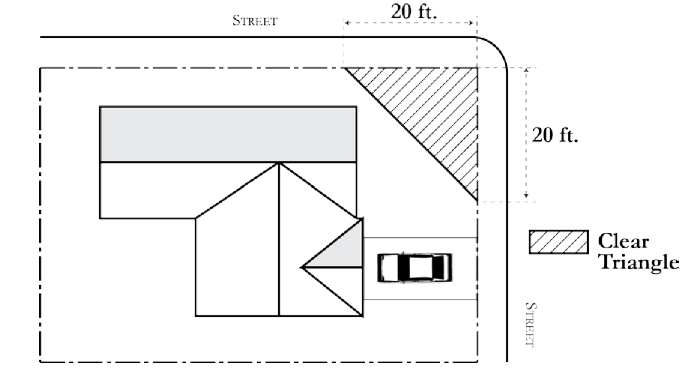
C.
Maintenance of Sight Lines.
1.
No structure, vehicle, object, or landscaping over three feet in height may be placed within a clear vision triangle, except as allowed by subsection 2 below.
2.
Trees pruned at least eight feet above the established grade of the curb so as to provide clear view by motor vehicle drivers are permitted within a clear vision triangle.
(Ord. No. 2277 N.S., § 5(Exh. A), 6-6-2018)
18.92.090 - Marijuana.
Marijuana cultivation, marijuana delivery, and marijuana distribution facilities, as defined in Chapter 9.16 (Marijuana), are prohibited uses in all zoning districts in the city of Morgan Hill.
(Ord. No. 2277 N.S., § 5(Exh. A), 6-6-2018)
18.92.100 - Mini-storage.
A.
Purpose. This section establishes standards for mini-storage facilities that apply to all mini-storage facilities where permitted by Part 2 (Zoning Districts and Overlay Zones).
B.
Minimum Separation
1.
A mini-storage facility established after July 7, 2018, must be located a minimum of five thousand feet from another mini-storage facility.
2.
The distance between two mini-storage facilities shall be measured as the shortest possible straight line connecting each facility's exterior property line.
C.
Permitted Storage. Storage shall be limited to "dead storage" only. Dead storage means goods that are not radioactive, explosive, flammable or hazardous materials, that are not living plants or animals, that are not in use and not associated with any commercial use on the premises.
D.
On-Site Supervision. All mini-storage facilities shall have adequate on-site supervision as determined by the review authority.
E.
Controlled Access. All mini-storage facilities shall provide controlled access through the use of a security gate that is operated by a passcard system or by a manager.
F.
Caretakers Units. Caretakers units may be allowed with the approval of a Conditional Use Permit.
G.
Maximum Size — Individual Units. Individual storage unit may not exceed six hundred square feet in area.
H.
Outdoor Vehicle Storage. Outdoor storage of vehicles including cars, boats, motor homes, travel trailers, motorcycles, all-terrain and off-road vehicles is allowed in designated areas only. Designated areas shall be adequately screened from public view, shall be fenced and secured under lock and key.
I.
Prohibited Activities.
1.
The servicing of equipment or vehicles and the operating of power tools is prohibited.
2.
The use of a mini-storage facility for flea markets, commercial storage, transfer business, auctions or sales of any type is prohibited with the exception of on-site auction of unclaimed or confiscated goods from on-site storage lockers no more than three times per year, per facility.
J.
Vehicle Circulation.
1.
The minimum distance between the entrances of drive-up storage units on opposite sides of the same drive aisle way shall be twenty-six feet.
2.
Walk-up indoor storage units which do not open directly onto a drive aisle shall be located within one hundred feet of a twenty-six-foot wide drive aisle.
3.
The minimum distance between walk-up storage buildings shall be ten feet.
4.
Vehicular access between walk-up buildings shall be prohibited except in cases where a standard twenty-six-foot wide drive aisle is provided between buildings.
(Ord. No. 2277 N.S., § 5(Exh. A), 6-6-2018)
18.92.110 - Natural resource and hazard setbacks.
All development shall be setback from natural resources and hazards as shown in Table 18.92-2.
Table 18.92-2: Setbacks from Natural Resources and Hazards
Note:
[1] See Santa Clara Valley Habitat Plan Chapter 6, Section 6.5, Condition 11.
(Ord. No. 2277 N.S., § 5(Exh. A), 6-6-2018)
18.92.120 - Outdoor sales and displays.
A.
Permitted Displays. A single permanent outdoor display of retail goods that complies with this section is permitted as an accessory use to a primary commercial use in the mixed use, commercial, and industrial zoning districts.
B.
Permits Required. Approval of a zoning clearance is required for a permanent outdoor display consistent with the standards in Subsection D (Standards).
C.
Exceptions to Standards. The planning commission may allow outdoor displays that deviate from the standards in Subsection D below for with approval of a conditional use permit.
D.
Standards.
1.
Height. Displayed items shall not exceed six feet in height.
2.
Size. Display areas are limited to eight feet wide or ten percent of the width of the front building elevation. A display area may extend a maximum of three feet from the front building wall.
3.
Goods Permitted. Displayed items shall be of the same type that are lawfully displayed and sold inside the building occupied by the primary commercial use. Only the business or entity occupying the building may sell merchandise in an outdoor display area.
4.
Hours. Items shall be displayed only during the operating hours of the primary commercial use. Items shall be removed from display and moved into a permanently enclosed structure upon close of business.
5.
Screening. If outdoor display areas are proposed as part of a project subject to discretionary review and approval by the City, the review authority may require that display areas be screened from view from neighboring properties with a solid wall, fence, or landscaped berm.
6.
Design Standards.
a.
Outdoor displays shall be self-supporting, stable, and constructed to withstand wind or contact. The display shall not be permanently affixed to any object, structure or the ground including utility poles, light poles, and trees.
b.
Outdoor displays shall be continuously maintained in a state of order, security, safety and repair. The display surface shall be kept clean, neatly painted, and free of rust, corrosion, protruding tacks, nails and/or wires.
7.
Location.
a.
All outdoor display area shall be located on the same parcel as the primary commercial use.
b.
Outdoor display areas may not be placed within any permanent landscaped area, required parking space, or loading area.
c.
No items may be displayed within the public right-of-way, including public sidewalks.
d.
Outdoor display areas may not be placed in a location that would cause a safety hazard, obstruct the entrance to a building, encroach upon driveways, or otherwise create hazards for pedestrian or vehicle traffic.
(Ord. No. 2277 N.S., § 5(Exh. A), 6-6-2018)
18.92.125 - Refuse and recycling enclosures.
A.
Purpose. This section establishes refuse and recycling enclosure design and access standards to adequately screen refuse and recycling bins and prevent pollutant discharge for non-residential and residential uses.
B.
Applicability. Refuse and Recycling Enclosures are required for the following:
1.
New non-residential structures.
2.
An addition to a non-residential building which exceeds thirty percent of the existing floor area of the building(s) on a site.
3.
When there is a change of use.
4.
New residential projects proposing refuse and recycling enclosures.
C.
Development Standards for Refuse and Recycling Enclosures.
1.
Refuse and Recycling Enclosures shall be a minimum of twelve-feet wide by nine-feet deep to contain a minimum of three collection containers (solid waste, organic materials, and recycling) and other bins that may be required per the business type as reviewed and approved by the City's franchised waste hauler.
2.
Enclosure shall be separated from adjacent parking stalls with a minimum three-foot wide planter and a twelve-inch wide paved surface behind the curb.
3.
Enclosure walls shall be a minimum of six-feet in height.
4.
A 12-inch curb, bumper, or other method shall be incorporated along interior base to prevent dumpster from hitting the sides of the enclosure.
5.
Enclosure shall have a solid all-weather non-combustible roof structure to prevent storm water from entering the enclosure's contents and the sanitary sewer system.
6.
An area drain with hose bib and approved vandal proof drain shall be installed and plumbed to the sanitary sewer system with a grease trap.
7.
Enclosure pad shall be designed to drain inward, and the outside grade surrounding the enclosure shall not drain into the enclosure.
8.
A pedestrian entrance to the enclosure shall be provided.
9.
Bin gates shall be attached to separate metal poles and have the ability to be locked. Bin gates shall not be connected directly to the enclosure wall.
10.
The pad and entrance apron of the enclosure shall be concrete.
D.
Design Standards.
1.
Enclosures shall be designed with the same materials, colors, and architecture as the principal building.
2.
Enclosure walls shall be constructed of a solid masonry material and finished to match the building materials of the principal building.
3.
Enclosures shall include solid view-obstructing gates. Chain link with or without wooden/plastic slats is prohibited.
4.
The roof of the enclosure shall consist of the same materials, colors, and architecture as the principal building and shall be painted with rust-inhibitive paint.
E.
Enclosure Location.
1.
Enclosures shall not be visible from public rights-of-way or primary entry driveways and shall be screened from public view.
2.
Landscaped planters utilized for screening shall incorporate a minimum three-foot wide planter on the sides and rear of the enclosure.
3.
Enclosures shall be connected to an accessible route for service vehicles.
4.
Non-Residential enclosures shall be located a minimum of fifteen-feet away from adjacent properties zoned for residential uses.
F.
Temporary Conformance for Non-conforming Enclosures. Existing enclosures that do not meet the minimum size requirements or the number of bins required in Section 18.92.125.C. shall install a temporary bin or bins outside of the existing non-conforming enclosure. The temporary bin(s) shall:
1.
Have a secured and lockable lid.
2.
Be secured to the existing enclosure, building, or ground to prevent free movement and possible damage to adjacent structures or automobiles.
3.
Be kept clean.
4.
The area around the temporary bin(s) be kept free and clear of garbage debris and/or spillage.
5.
Shall not create objectionable odors consistent with Section 18.76.100 (Odors).
If temporary conformance standards outlined in 18.92.125.F cannot be met, compliance with Section 18.92.125.C, 18.92.125.D, and 18.92.125.E is required.
G.
All non-conforming and temporarily conforming refuse and recycling enclosures shall conform with Sections 18.92.125.C, 18.92.125.D, and 18.92.125.E by January 1, 2030.
(Ord. No. 2328 N.S., § 2, 12-15-2021)
18.92.130 - Residential transition standards.
A.
Purpose. This section establishes increased setback, height, and landscaping standards for non-residential land uses that abut residential properties.
B.
Applicability. The standards in this section apply to all properties in a mixed use, commercial, or industrial zoning district that abut a residential zoning district or land use.
C.
Standards.
1.
Setbacks. The minimum setback from the residential property line shall be fifteen feet for interior side yards, twenty feet for rear yards, and twenty feet for any property line abutting a residential rear yard.
2.
Daylight Plane. No structure shall extend above or beyond a daylight plane having a height of twenty-five feet at the minimum required setback from the residential property line and extending into the parcel at an angle of forty-five degrees. See Figure 18.92-2.
3.
Landscaping. A landscaped planting area, extending a minimum of ten feet from the property line, shall be provided along all residential property lines. A tree screen shall be planted in this area with trees planted at a maximum interval of fifteen feet. The planning commission may allow a greater interval distance for tree species that will provide an adequate buffer and visual screen at maturity.
4.
Loading. Loading and unloading shall be designed to have the least amount of impact on neighboring residential uses. When feasible, loading and unloading provided from the commercial frontage rather than from areas adjacent residential uses.
Figure 18.92-2: Residential Transitions — Daylight Plane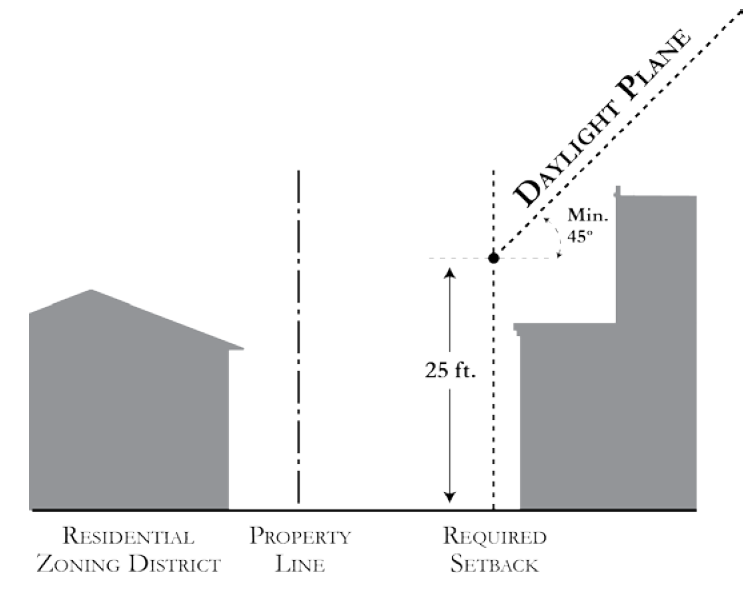
(Ord. No. 2277 N.S., § 5(Exh. A), 6-6-2018; Ord. No. 2341 N.S., § 12, 2-15-2023)
18.92.140 - Rooftop solar energy systems.
A.
Required Permits. Rooftop solar energy systems are a permitted use in all zoning districts. No permit or approval other than a building permit is required.
B.
Height Exceptions. Rooftop solar energy systems may project up to four feet above the maximum permitted structure height in the applicable zoning district.
C.
Building Permit Review and Approval — Rooftop Systems. Building permit applications for rooftop solar energy systems shall be reviewed and approved in compliance with Government Code Section 65850.5. Applications shall be submitted using the city's standard building permit application form.
(Ord. No. 2277 N.S., § 5(Exh. A), 6-6-2018)
18.92.150 - Temporary uses and structures.
A.
Purpose. This section establishes requirements for the establishment and operation of temporary uses and structures. These requirements allow for temporary uses and structures in Morgan Hill while limiting impacts on neighboring properties and the general public.
B.
Temporary Uses Allowed By-Right. The following temporary uses are permitted by right. No permits or approvals from the development services department are required.
1.
Garage Sales. Garage sales for individual residences limited to three, one- to two-day events per calendar year. One block or neighborhood sale per calendar year is allowed in addition to individual sales.
2.
Storage Containers. Storage containers delivered to a home, loaded by residents, and delivered to another location, for a maximum of two weeks on private property. Storage containers on a residential property for more than two weeks may be approved by the community development director with a temporary use permit.
3.
Outdoor Fund Raising Events. Outdoor fund raising events on commercial sites when sponsored by a non-profit organization directly engaged in civic or charitable efforts. Outdoor fund raising events with property owner permission are limited to two days each month for each sponsoring organization.
4.
Construction Trailers. A trailer or modular unit on an active construction site in a non-residential zone limited to an eighteen-month period, subject to the following requirements:
a.
The trailer or modular unit may be used for security personnel, storage, office, residence of the property owner, or other similar temporary use.
b.
The trailer or modular unit may be installed only after issuance of a Building Permit.
c.
Trailers or modular units may not exceed a maximum size of six hundred fifty square feet and shall be placed on the site in compliance with the setback requirements of the applicable zone.
C.
Temporary Uses Requiring a Temporary Use Permit. A temporary use permit is required for the following temporary uses.
1.
Parking Lot/Sidewalk Sales. Parking lot/sidewalk sales limited to seven days in any one hundred eighty-day period, subject to the following requirements:
a.
The business or entity conducting a parking lot/sidewalk sale shall obtain a Morgan Hill business license at least fourteen days prior to the start of the sale.
b.
Prior to issuance of a temporary use permit, an application for a temporary seller's permit shall be filed with the state of California Board of Equalization stating that the sales will occur in Morgan Hill.
c.
Prior to issuance of a temporary use permit, the applicant shall provide a cash deposit to the development services department in an amount necessary to ensure the parking lot is returned to a clean and debris-free state.
2.
Arts and Crafts Shows. Arts and crafts shows limited to seven days within any one hundred eighty-day period
3.
Holiday Sales. Holiday sales (e.g., Christmas trees, pumpkins) for a maximum of forty-five calendar days, no more than four times per year on a single property. Seasonal sales are prohibited on residentially zoned property.
4.
Seasonal Sale of Agricultural Goods. Seasonal sale of agricultural goods limited to ninety days per calendar year, not to exceed thirty consecutive days.
5.
Traveling Amusements. Traveling amusements (e.g., carnivals, rodeos) limited to fifteen consecutive days or three weekends in any one hundred eighty-day period, subject to the following requirements:
a.
Traveling amusement uses shall be setback a minimum of one hundred feet from any residential zone or use.
b.
Rest room facilities shall be provided.
c.
All lighting shall be directed away from adjacent properties and public rights-of-way.
d.
Noise attenuation for generators and carnival rides shall be provided to the satisfaction of the community development director.
6.
Sales or Leasing Offices. Leasing offices for commercial and industrial projects for a two-year period or thirty days after the final sale or lease, whichever comes first, subject to the following requirements:
a.
The sales or leasing office shall be located in a trailer or tenant space. The sales or leasing office may be used only for sales or leasing activities for the project where the office is located. All other uses are prohibited.
b.
Street improvements and temporary off-street parking at a rate of four spaces per office shall be installed prior to the start of sales or leasing activities.
c.
A cash deposit of one thousand dollars shall be posted for sales or leasing offices. The office and all related improvements shall be removed within thirty days of the final sale or lease.
d.
Flags or banners in conjunction with the sales or leasing office are prohibited.
7.
Promotional Sales. Promotional sales and retail sales of items not typically sold from premises limited to twenty-four days per calendar year. Such uses must locate upon developed commercial property with approval of property owner.
8.
Other Similar Activities. Similar temporary activities determined by the community development director to be compatible with the applicable zoning district and surrounding uses.
D.
Conditions of Approval. The community development director shall attach conditions of approval to a temporary use permit in accordance with Section 18.108.G (Conditions of Approval) to ensure compatibility of the temporary use with neighboring uses and development.
E.
Temporary Signage. Signs associated with a temporary use shall comply with Section 18.88.120 (Temporary Signs).
F.
Events on Public Property. Temporary uses and events on public property shall conform to Chapter 12.16 (Events on Public Property).
(Ord. No. 2277 N.S., § 5(Exh. A), 6-6-2018)
18.92.160 - Retaining existing vegetation.
In all zoning districts, existing natural vegetation shall be retained and protected to the maximum extent feasible as part of any development project.
(Ord. No. 2277 N.S., § 5(Exh. A), 6-6-2018)

