
Morgan Hill City Zoning Code
CHAPTER 18
52 - FENCES AND WALLS
18.52.010 - Purpose and applicability.
This chapter establishes standards for fences and walls that apply in all zoning districts. For the purposes of this title, the term "fence" includes fences or walls. Walls that are required by a mitigation measure and designed and approved through a discretionary permit for noise attenuation are exempt from this chapter.
(Ord. No. 2277 N.S., § 5(Exh. A), 6-6-2018; Ord. No. 2319 N.S., § 8, 1-20-2021)
18.52.020 - Required permits and approvals.
A.
No Planning Permit Required. Fences and walls consistent with this chapter are permitted by-right without the requirement to obtain any planning permit unless otherwise stated.
B.
Building Permit. Fences and walls may require a building permit as required by California Building Code.
C.
Encroachment Permit. A fence or wall in the public right-of-way requires approval of an encroachment permit consistent with Municipal Code Chapter 12.08 (Excavation and Encroachment).
D.
Minor Exception. The community development director may grant a minor exception to increase the maximum permit height of a fence or wall as described in Section 18.52.050 (Exceptions to Height Limits).
(Ord. No. 2277 N.S., § 5(Exh. A), 6-6-2018; Ord. No. 2319 N.S., § 8, 1-20-2021)
18.52.030 - Measurement of fence and wall height.
A.
Measurement of Height. The height of a fence or wall is measured from the finished grade at the base of the fence or wall to the top edge of the fence or wall.
B.
Fences on Retaining Walls. If a fence or wall is atop a retaining wall, the height of the fence or wall shall be determined exclusive of the height of the retaining wall such that the top of the retaining wall is considered the finished grade.
C.
Fences Not Located on a Retaining Wall. If the adjacent finished grade is different on opposite sides of a fence or wall, and the fence or wall is not located on top of a retaining wall, the height is measured from the side with the lowest finished grade to the highest point on the fence or wall.
(Ord. No. 2277 N.S., § 5(Exh. A), 6-6-2018; Ord. No. 2319 N.S., § 8, 1-20-2021; Ord. No. 2341 N.S., § 3, 2-15-2023)
18.52.040 - Height limits.
A.
Maximum Height. Fences and walls may not exceed the maximum height shown in Table 18.52-1 and Figure 18.52-1 except as allowed by Section 18.52.050 (Exceptions to Fence Height Limit).
Table 18.52-1: Maximum Fence and Wall Height
Notes:
[1] An additional one foot of fence height up to a maximum of seven feet is permitted for lattice work and other decorative features uniformly open to the passage of light and air.
Figure 18.52-1: Maximum Fence and Wall Height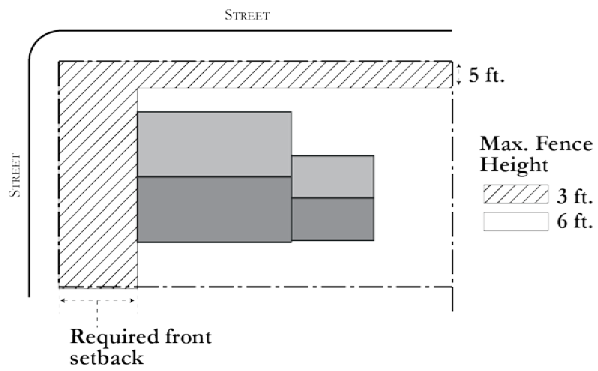
B.
Decorative Features. A decorative arch, gate, trellis or other entry feature located along a street frontage may exceed the height limit shown in Table 18.52-1. Decorative features shall be limited to ten feet in width and ten feet in height. Only one decorative feature is permitted per street frontage. See Figure 18.52-2.
C.
Clear Triangle. Walls and fences shall comply with clear triangle requirements in Section 18.92.080 (Intersection Site Distance).
Figure 18.52-2: Decorative Entry Features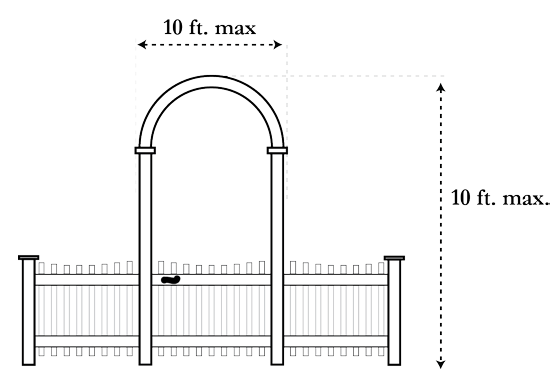
(Ord. No. 2277 N.S., § 5(Exh. A), 6-6-2018; Ord. No. 2319 N.S., § 8, 1-20-2021)
18.52.050 - Exceptions to height limits.
The community development director may approve a minor exception (Section 18.108.070) to allow an increase to the maximum permitted height of a fence or wall as described below.
A.
Open Space and Residential Estate Zoning Districts.
1.
Within the open space and residential estate zoning districts, the community development director may grant a minor exception to increase the maximum height of a fence in the front setback area to a maximum six feet in height.
2.
This exception applies only to open, wrought iron or decorative fences that are at least seventy percent open to the passage of light and air.
3.
Chain link, chain link with wood or vinyl slats, solid board fences, or any other type of view obstructing fencing may not exceed three feet in height in the front setback area.
B.
All Zoning Districts. The community development director may grant a minor exception to increase the maximum height of a fence or wall by two feet in the front setback area and one foot behind the front setback line in the following cases:
1.
The topography of sloping sites or a difference in grade between adjoining sites warrants such increase in height to maintain privacy, security, or effectiveness of screening.
2.
A property is located adjacent to public parks, other public spaces or adjacent to private common area parks and open space where an increase in fence or wall height would not unreasonably affect desirable views or vistas or the open space value of abutting sites.
(Ord. No. 2277 N.S., § 5(Exh. A), 6-6-2018; Ord. No. 2319 N.S., § 8, 1-20-2021)
18.52.060 - Materials.
The following fence and wall materials and types are prohibited unless otherwise approved by the planning commission:
A.
Residential zoning districts: Barbed wire, razor wire, chain link, sheet metal, and electric fences.
B.
Commercial zoning districts: Chain link and sheet metal fences. Barbed wire, razor wire and electric fences within the front setback area or where a property abuts a residential zoning district or residential land use designation.
C.
Industrial zoning districts: Barbed wire, razor wire, chain link, sheet metal and electric fences within the front setback area.
(Ord. No. 2277 N.S., § 5(Exh. A), 6-6-2018; Ord. No. 2319 N.S., § 8, 1-20-2021)
18.52.070 - Nonconforming fences and walls.
See Chapter 18.68 (Nonconforming Uses and Structures).
(Ord. No. 2277 N.S., § 5(Exh. A), 6-6-2018; Ord. No. 2319 N.S., § 8, 1-20-2021)
18.52.080 - Special fence and wall requirements.
A.
Fence and Wall Design. Fences and walls shall be constructed of attractive, long-lasting materials (e.g., masonry, wood, tubular steel, fiberglass, or stone). Walls shall consist of a decorative design and/or be screened with landscaping.
B.
Public Frontage Fencing of Nonresidential and Multifamily Projects. Where fencing is proposed along public frontages of nonresidential and multifamily projects, such fencing shall be open view unless otherwise required to be solid for noise attenuation. Open view fencing shall also be required when located adjacent to open space areas.
C.
Screening of Outdoor Storage. Outdoor storage shall be fenced or screened from view. Such screening shall utilize enclosures including, but not limited to, fences, walls, landscaping, or earthen berms. Screening shall be visually compatible with the primary buildings and landscape on the property.
D.
Screening for Commercial or Industrial Uses Adjacent to Residential Zones. Commercial and industrial uses shall be screened from adjacent residential zones by a decorative or landscaped masonry wall with a minimum height of seven feet to screen the commercial or industrial use. This requirement is not intended to preclude the development of pedestrian/bicycle access points between commercial and residential.
E.
Screening of Loading Docks and Refuse Areas. Loading docks and refuse storage areas shall be screened from public view, adjoining public streets and rights-of-way, and residentially zoned areas. The method of screening shall be architecturally compatible with other on-site development in terms of colors and materials.
F.
Maintenance. Fences and walls shall be continuously maintained in an orderly and good condition.
(Ord. No. 2319 N.S., § 8, 1-20-2021)

