
Morgan Hill City Zoning Code
CHAPTER 18
72 - PARKING AND LOADING
18.72.010 - Purpose.
This chapter establishes on-site parking and loading requirements in order to:
A.
Provide a sufficient number of on-site parking spaces for all land uses.
B.
Provide for functional on-site parking areas that are safe for vehicles and pedestrians.
C.
Ensure that parking areas are well-designed and contribute to a high-quality design environment in Morgan Hill.
D.
Allow for flexibility in on-site parking requirements to support a multi-modal transportation system and sustainable development pattern.
E.
Ensure that on-site parking areas do not adversely impact land uses on neighboring properties.
(Ord. No. 2277 N.S., § 5(Exh. A), 6-6-2018)
18.72.020 - Applicability.
A.
New Buildings and Uses. On-site parking and loading as required by this chapter shall be provided anytime a new building is constructed or a land use is established where no land use previously existed.
B.
Change of Use. Where an existing use is changed to a new use, parking shall be provided for the incremental intensification of the new use. For example, if a new use requiring five on-site parking spaces replaces an existing use requiring four on-site parking spaces, the new use must provide one additional parking space regardless of the number of on-site parking spaces provided by the existing use.
C.
Expansions and Enlargements. Where an existing structure is expanded or enlarged, additional parking is required to serve only the expanded or enlarged area. Additional parking is not required to remedy parking deficiencies existing prior to the expansion or enlargement.
D.
Continued Use of Parking for Existing Parcels, Buildings, and Land Uses. On-site parking and loading as required by this chapter shall be continually available and located to provide parking for the use they were intended to serve.
(Ord. No. 2277 N.S., § 5(Exh. A), 6-6-2018; Ord. No. 2341 N.S., § 6, 2-15-2023)
18.72.030 - Required parking spaces.
A.
MU-D and RAH Zoning Districts. Land uses in the Downtown Mixed Use (MU-D) and Residential Attached High Density (RAH) zoning districts shall provide on-site parking as specified in Table 18.72-1. Required parking for uses not listed in Table 18.72-1 shall be the same as required for land uses in other zoning districts as shown in Table 18.72-2.
Table 18.72-1: Required On-Site Parking, MU-D and RAH Zoning Districts
B.
Other Zoning Districts. Land uses in zoning districts other the Downtown Mixed Use (MU-D) and Residential Attached High Density (RAH) zoning districts shall provide on-site parking as specified in Table 18.72-2.
Table 18.72-2: Required On-Site Parking, Other Zoning Districts
Notes:
[1] Minimum required on-site parking shall not apply if the development is located within one-half mile of a public transit stop.
C.
Guest Parking.
1.
Number of Guest Spaces. All residential land uses shall provide the minimum number of guest parking spaces as specified in Table 18.72-3.
Table 18.72-3: Required Guest Parking Spaces
2.
Location of Guest Spaces. Guest spaces shall be located no more than 150 feet from the residential dwellings they serve.
3.
Downtown Exemption. Guest parking is not required for proposed residential development within the Downtown Specific Plan overlay zone.
D.
Calculation of Required Spaces.
1.
Floor Area. Where a parking requirement is a ratio of parking spaces to floor area, the floor area is assumed to be gross floor area, unless otherwise stated. The floor area of a use shall be calculated as described in Section 18.12.050 (Floor Area and Floor Area Ratio).
2.
Employees. Where a parking requirement is stated as a ratio of parking spaces to employees, the number of employees is based on the largest shift that occurs in a typical week.
3.
Seats. Where a parking requirement is stated as a ratio of parking spaces to seats, each twenty-four inches of bench-type seating at maximum seating capacity is counted as one seat.
4.
Fractional Spaces. In determining the number of required parking, fractions of spaces over one-half shall be rounded up to the next whole number.
E.
Unlisted Uses.
1.
Commercial uses not listed: One space for each two hundred fifty square feet of gross floor area.
2.
The parking requirement for land uses not listed in Table 18.72-1 and Table 18.72-2 shall be determined by the community development director based on the requirement for the most comparable similar use, the particular characteristics of the proposed use, and any other relevant data regarding parking demand.
F.
Sites with Multiple Uses. Where more than one land use is conducted on a site, the minimum number of required on-site parking spaces shall be the sum of the number of parking spaces required for each individual use.
G.
Parking Not Required within One-Half Mile of a Major Transit Stop.
1.
Minimum parking requirements identified within this Section shall not be required within one-half mile of a major transit stop as defined in Public Resources Code Section 21155.
2.
The city may impose minimum parking requirements within one-half mile of a major transit stop if written findings are made that not imposing or enforcing minimum parking requirements on the development would have a substantially negative impact on any of the following:
a.
The city's ability to meet its share of the regional housing need for low- and very low-income households.
b.
The city's ability to meet any special housing needs for the elderly or persons with disabilities.
c.
Existing residential or commercial parking within one-half mile of the housing development project.
3.
For a housing development project, Subdivision 18.72.030.G.2 shall not apply if the housing development project satisfies any of the following:
a.
The development dedicates a minimum of twenty percent of the total number of housing units to very low-, low-, or moderate-income households, students, the elderly, or persons with disabilities.
b.
The development contains fewer than twenty housing units.
c.
The development is subject to parking reductions based on the provisions of any other applicable law.
4.
Notwithstanding the above, an event center shall provide parking for employees and other workers.
5.
This subsection shall not apply to hotels, motels, bed and breakfasts, or other transient lodging.
6.
This subsection shall not reduce, eliminate, or preclude new multi-family residential or non-residential development to provide electric vehicle supply equipment installed parking spaces or parking spaces that are accessible to persons with disabilities.
(Ord. No. 2277 N.S., § 5(Exh. A), 6-6-2018; Ord. No. 2352, §§ 7, 8, 4-24-2024; Ord. No. 2362, § 10, 2-19-2025)
18.72.040 - General requirements.
A.
Availability and Use of Spaces.
1.
Required parking spaces for multifamily and non-residential uses shall be permanently available and maintained to provide parking for the use they are intended to serve.
2.
Owners, lessees, tenants, or persons having control of the operation of a use for which parking spaces are required shall not prevent or restrict authorized persons from using these spaces.
3.
Required parking spaces shall be used exclusively for the temporary parking of vehicles and shall not be used for the sale, lease, display, repair, advertising, or storage of vehicles, trailers, boats, campers, mobile homes, merchandise, or equipment, or for any other use not authorized by the zoning code.
B.
Location of Parking.
1.
Residential Uses. Required minimum on-site parking to serve all residential uses shall be located on the same parcel or site as the use which it serves except as allowed by Section 18.72.050.D (Off-Site Parking).
2.
Non-Residential Uses. Required minimum on-site parking to serve all non-residential residential uses shall be located on the same parcel or site as the use which it serves except as allowed by Section 18.72.050.D (Off-Site Parking).
3.
Parking on Landscape Violation. No person shall park or store any automobile or other vehicle, including, but not limited to, motorcycles, campers, boats, trailers, or other similar vehicles, in any front yard in any residential district. Parking shall be permitted for automobiles only in and upon an improved paved driveway in said front yard area if each vehicle is currently licensed and operative. Parking for camper, boat, trailer, and other similar vehicles shall comply with Section 18.72.040.F.
C.
Electric Vehicle Charging. Refer to Chapter 15.62 (Electric Vehicle Charging Infrastructure) for electric vehicle charging requirements.
D.
Garage and Carport Setbacks. Garages and carports in the detached residential zoning districts shall comply with setback requirements in Section 18.16.030 (Garage and Carport Setbacks).
E.
Parking for Persons with Disabilities.
1.
Parking spaces for persons with disabilities shall be provided in compliance with California Code of Regulations Title 24.
2.
Parking spaces required for the disabled shall count toward compliance with the number of parking spaces required by Table 18.72-1 and Table 18.72-2.
F.
Camper, Boat, and Trailer Parking. Camper, boat, and trailer parking spaces shall be located and screened so as not to be visible from the public street.
(Ord. No. 2277 N.S., § 5(Exh. A), 6-6-2018; Ord. No. 2341 N.S., § 7, 2-15-2023; Ord. No. 2352, § 9, 4-24-2024)
18.72.050 - On-site parking alternatives.
A.
Purpose. This section identifies alternatives to required on-site parking to:
1.
Allow for creative parking solutions;
2.
Enhance economic vitality in Morgan Hill;
3.
Promote walking, biking, and use of transit; and
4.
Encourage the efficient use of land resources consistent with the general plan.
B.
Required Approval. Unless otherwise indicated, all reductions in on-site parking described in this section require planning commission approval of a conditional use permit.
C.
In-Lieu Payments. Within the MU-D and MU-N zoning districts, on-site parking requirements may be satisfied by payment of an in-lieu parking fee consistent with the city's Downtown in-lieu fee parking program.
D.
Off-Site Parking.
1.
For multifamily housing and non-residential uses, the planning commission may allow off-site parking if the commission finds that practical difficulties prevent the parking from being located on the same lot it is intended to serve.
2.
Off-site parking shall be located within a reasonable distance of the use it is intended to serve, as determined by the planning commission.
3.
A covenant record, approved by the city attorney, shall be filed with the county recorder. The covenant record shall require the owner of the property where the on-site parking is located to continue to maintain the parking space so long as the building, structure, or improvement is maintained in Morgan Hill. This covenant shall stipulate that the title and right to use the parcels shall not be subject to multiple covenant or contract for use without prior written consent of the city.
E.
Consolidated Parking.
1.
The required on-site parking for multiple uses may be consolidated into one central parking area located within the same block or within three hundred feet of any individual use.
2.
The number of parking spaces required shall be the sum total of the required parking for each individual use unless the city approves a shared parking reduction in accordance with Section 18.72.050.F (Shared Parking).
F.
Shared Parking. When an entity is not using the required on-site parking to meet parking requirements, the city shall allow the entity with underutilized parking to share their underutilized parking spaces with the public, local agencies, or other entities, if those entities submit a shared parking agreement to the city and information identifying the benefits of the proposed shared parking agreement. Within this subsection, underutilized parking shall mean parking where twenty percent or more of a development's parking spaces are not occupied during the period that the parking is proposed to be shared by another user, group, development, or the public.
1.
In cases where an entity is entering into a shared parking agreement and proposes to use the shared parking spaces to meet the required on-site parking, all of the following shall apply:
a.
The City shall approve a shared parking agreement if it:
i.
Includes a parking analysis using peer-reviewed methodologies developed by a professional planning association, such as the methodology established by the Urban Land Institute, National Parking Association, and the International Council of Shopping Centers, sufficient to determine how many parking spaces can be reasonably shared between uses to fulfill parking requirements.
ii.
Secures long-term provision of parking spaces or affords the opportunity for periodic review and approval by the city.
b.
The city shall allow parking spaces identified in a shared parking agreement to count toward meeting any automobile parking requirement for a new or existing development or use, including, but not limited to, shared parking in underutilized spaces and in parking lots and garages that will be constructed as part of the development or developments under any of the following conditions:
i.
The entities that will share the parking are located on the same, or contiguous, parcels.
ii.
The sites of the entities that will share parking are separated by no more than two thousand feet of travel by the shortest walking route.
iii.
The sites of the entities that will share the parking are separated by more than two thousand feet of travel by the shortest walking route, but there is a plan for shuttles or other accommodations to move between the parking and site, including a demonstrated commitment to sustain such transportation accommodations.
c.
The shared parking agreement shall be recorded against the parcels that are part of the agreement.
2.
If entities submit a shared parking agreement without the parking analysis described above, the development services director shall decide whether to approve or deny the shared parking agreement, and determine the number of parking spaces that can be reasonably shared between uses to fulfill parking requirements.
3.
For shared parking agreements for developments of ten residential units or more, or eighteen thousand square feet or more, before making the determination, the development services director shall:
a.
Notify all property owners within 300 feet of the shared parking spaces of the proposed agreement, including that the property owner has fourteen days to request a public meeting before the city decides whether to approve or deny the shared parking agreement.
b.
If the development services director receives a request to hold a public meeting within fourteen days of notifying property owners, the development services director shall hold a public meeting on the shared parking agreement to approve or deny the shared parking agreement and determine the number of parking spaces that can be reasonably shared between uses to fulfill parking requirements.
4.
The development services director shall not require the curing of any preexisting deficit of the number of parking spaces as a condition for approval of the shared parking agreement.
5.
The development services director shall not withhold approval of a shared parking agreement between entities solely on the basis that it will temporarily reduce or eliminate the availability of parking spaces for the original proposed uses.
6.
For a development project in which a designated historical resource on a federal, state, or local register of historic places is being converted or adapted, the development services director shall allow the project applicant to meet minimum parking requirements through the use of off-site shared parking.
7.
This section shall not reduce, eliminate, or preclude the enforcement of any requirement imposed on a residential or nonresidential development to provide parking spaces that are accessible to persons with disabilities that would have otherwise applied to the development.
8.
This section shall not reduce the percentage of parking spaces that are designated for electric vehicles that would otherwise have applied.
9.
The city, private landowner, or lessor shall examine the feasibility of shared parking agreements to replace new parking construction or limit the number of new parking spaces that will be constructed, in either of the following circumstances:
a.
When state funds are being used on a proposed new development and the funding availability is announced after June 30, 2024.
b.
When public funds are being used to develop a parking structure or surface parking and the public funding has not been awarded as of June 30, 2024.
G.
Valet Parking. The planning commission may allow up to twenty-five percent of the required on-site parking spaces to be valet spaces. Valet parking shall comply with the following standards:
1.
Valet parking lots must be staffed at all times by an attendant who is authorized and able to move vehicles.
2.
A valet parking plan shall be reviewed and approved by the community development director in consultation with the city engineer.
3.
Valet parking may not interfere with or obstruct vehicle or pedestrian circulation on the site or on any public street or sidewalk.
4.
The use served by valet parking shall provide a designated drop-off and pick-up area. The drop-off and pick-up area may be located adjacent to the building, but it may not be located within a fire lane, impede vehicular and/or pedestrian circulation, or cause queuing in the right-of-way or drive aisle.
H.
Low Demand. The number of required on-site parking spaces may be reduced if the planning commission finds that the land use will not utilize the required number of spaces due to the nature of the specific use. This finding shall be supported by the results of a parking demand study approved by the community development director in consultation with the city engineer.
I.
Transportation Demand Management Plan. The planning commission may reduce the number of required on-site parking spaces for employers that adopt and implement a transportation demand management (TDM) plan subject to the following requirements and limitations:
1.
A TDM Plan reduction is available only to employers with twenty-five or more employees.
2.
Required on-site parking spaces may be reduced by no more than fifteen percent.
3.
The TDM plan shall be approved by the community development director in consultation with the city engineer.
4.
The TDM plan shall identify specific measures that will measurably reduce the demand for on-site parking spaces.
5.
The employer shall appoint a program coordinator to oversee transportation demand management activities.
6.
The program coordinator must provide a report annually to the planning commission that details the implementation strategies and effectiveness of the TDM plan.
7.
The planning commission may revoke the TDM plan at any time and require additional parking spaces on site upon finding that that the plan has not been implemented as required or that the plan has not produced the reduction the demand for on-site parking spaces as originally intended.
(Ord. No. 2277 N.S., § 5(Exh. A), 6-6-2018; Ord. No. 2352, §§ 10, 11, 4-24-2024)
18.72.060 - Parking design and development standards.
A.
Conformance with City Standards. All parking spaces, lots, driveways and other improvements intended and used for vehicle parking and circulation shall comply with the design standards and standard details for construction as maintained by the city of Morgan Hill engineering division.
B.
Parking Space and Lot Dimensions.
1.
General. The dimensions of parking spaces, maneuvering aisles, and access ways within a parking lot shall conform to the city's official parking space standard specifications maintained by the engineering division and as shown in Figure 18.72-1. All required parking spaces shall be full size parking spaces. Alternatively, with the issuance of a design permit, up to thirty percent of the required parking spaces may be compact spaces.
2.
Garage Spaces. All parking spaces within a structure shall be a minimum of ten feet in width and twenty feet in length.
3.
Access to Spaces. All access to spaces in a parking lot shall be from the lot.
4.
Driveway Width. The minimum required driveway with at the street entrance shall be as shown in Table 18.72-4.
Figure 18.72-1: Parking Lot Dimensions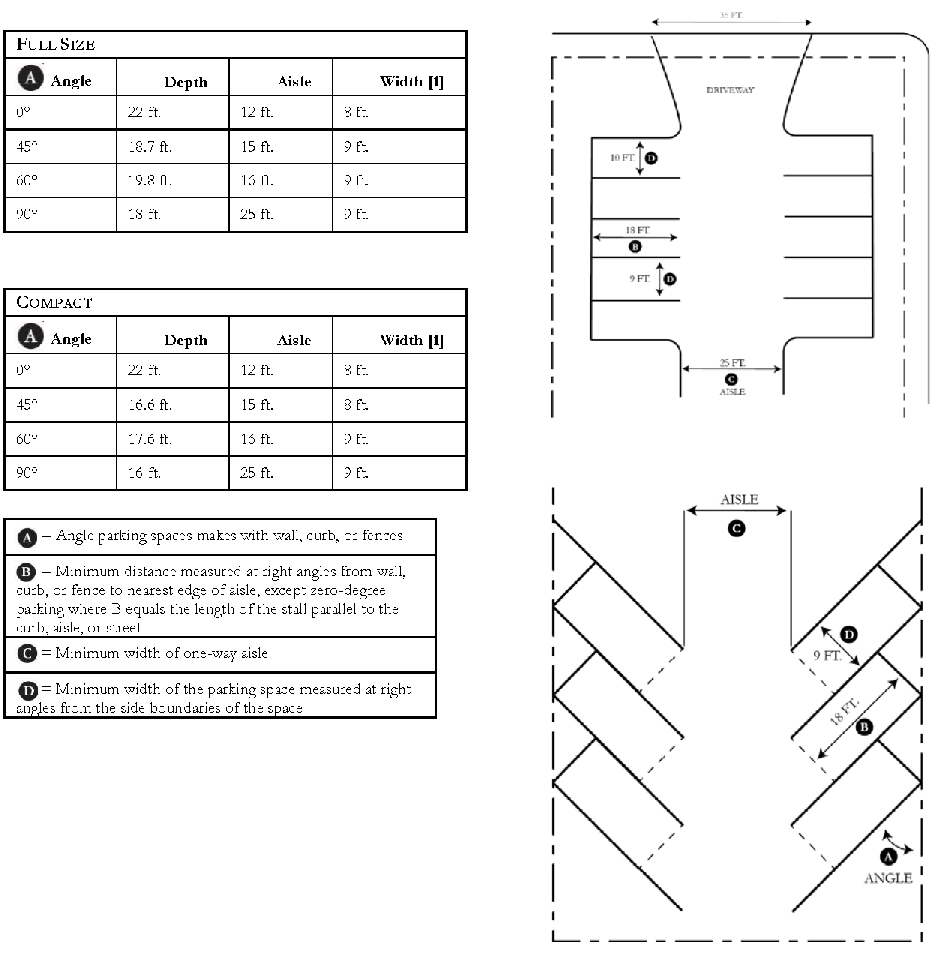
Notes:
[1] Minimum ten-foot width for spaces with one or two sides adjacent to a landscaped area.
Table 18.72-4: Minimum Driveway Widths
5.
Circulation Drive Aisle Width. Main circulation drive aisles within a shopping center or other commercial development shall be a minimum of thirty feet in width.
6.
Stacking Area. All parking lots shall provide a minimum forty-foot stacking from the travel lane of the adjoining street.
C.
Surfacing.
1.
All parking spaces, maneuvering aisles, and access ways shall be paved with asphalt, concrete, or other all-weather surface.
2.
Permeable paving materials, such as porous concrete/asphalt, open-jointed pavers, and turf grids, are a permitted surface material, subject to approval by the development services department.
D.
Tandem Parking Spaces. Tandem parking spaces are permitted for all residential land uses, provided that they comply with the following standards:
1.
Parking spaces in a tandem configuration shall be reserved for and assigned to a single dwelling unit. All required guest parking shall be provided as single, non-tandem parking spaces.
2.
Tandem parking spaces shall not block the use of the driveway to access other parking spaces located within the parking area.
3.
Tandem parking spaces shall be used to accommodate passenger vehicles only.
E.
Forward Entrance and Exit. For parking areas adjacent to an arterial or collector roadway, sufficient maneuvering area shall be provided so that vehicles may enter and exit an abutting street in a forward direction.
F.
Parking Lifts. Required parking may be provided using elevator-like mechanical parking systems ("lifts") provided the lifts are located within an enclosed structure or otherwise screened from public view.
G.
Lighting.
1.
A parking area with six or more parking spaces shall include outdoor lighting that provides a minimum illumination of 1.0 foot-candles over the entire parking area.
2.
Outdoor lighting as required above shall be provided during nighttime business hours.
3.
All parking space area lighting shall be energy efficient and designed so that any glare or spillage is directed away from residential properties.
4.
All fixtures shall be hooded and downward facing.
5.
Parking structures shall provide indoor lighting as required by the California Building Code.
H.
Pedestrian Access.
1.
Parking lots with more than thirty parking spaces shall include a pedestrian walkway in compliance with ADA requirements.
2.
The design of the pedestrian walkway shall be clearly visible and distinguished from parking and circulation areas through striping, contrasting paving material, or other similar method as approved by the community development director.
I.
Screening. Parking lots of six spaces or more shall comply with the following screening standards.
1.
Location. Screening shall be provided along the perimeter of parking lots fronting a street or abutting a residential zoning district.
2.
Height.
a.
Screening adjacent to streets shall have a minimum height of three feet.
b.
For parking lots within ten feet of a residential zoning district, screening shall have a minimum height of six feet.
3.
Materials. Required screening may consist of one or more of the following materials:
a.
Low-profile walls constructed of brick, stone, stucco or other durable and graffiti-proof coating material.
b.
Evergreen plants that form an opaque screen.
c.
An open fence combined with landscaping to form an opaque screen.
d.
A berm landscaped with ground cover, shrubs, or trees.
e.
Parking lots within ten feet of a residential zoning district shall be screened by a six-foot masonry wall.
J.
Driveway Spacing.
1.
Driveways shall be setback from street intersections as shown in Table 18.72-5:
Table 18.72-5: Driveway Setbacks from Intersections
2.
Setbacks shall be measured from corner radius or thirty feet, whichever is greater. The corner radius shall be the arc length measured between the linear distance of the adjoining street.
K.
Adjustments to Parking Design and Development Standards. The Planning Commission may allow adjustments to parking design and development standards in this section through the approval of a Minor Exception as described in Chapter 18.108.070 (Minor Exceptions).
(Ord. No. 2277 N.S., § 5(Exh. A), 6-6-2018; Ord. No. 2341 N.S., § 8, 2-15-2023)
18.72.070 - Parking lot landscaping.
A.
General Standards. All landscaping within parking lots shall comply with the requirements of Chapter 18.72 (Landscaping) in addition to the standards within this section.
B.
Landscaping Defined. Except as otherwise specified in this section, landscaping and landscaped areas shall consist of plant materials, including any combination of trees, shrubs, and ground cover.
C.
Interior Landscaping. All areas within a parking lot not utilized for parking spaces or access/circulation shall be landscaped. For parking lots with more than fifteen spaces, the minimum amount of interior landscaping is specified in Table 18.72-6. Interior landscaping is defined as any landscaped area surrounded on at least two sides by parking spaces or drive aisles, and excluding areas around the perimeter of the parcel or development site.
Table 18.72-6: Minimum Required Parking Lot Landscaping
D.
Shade Trees.
1.
One shade tree shall be provided for every five parking spaces in a parking lot.
2.
Shade trees shall be a minimum twenty-four-inch box in size and shall provide a minimum thirty-foot canopy at maturity.
3.
Shade trees shall be of a type that can reach maturity within fifteen years of planting and shall be selected from a city-recommended list of canopy tree species.
4.
Shade trees shall be arranged in a parking lot to provide maximum shade coverage (based on a thirty-foot canopy) on August 21. The arrangement should approximate nearly fifty percent shade coverage.
E.
Concrete Curbs.
1.
All landscape areas shall be separated from parking spaces, drive aisles and driveways by a continuous, raised concrete curb. Raised concrete curbs shall be a minimum of six inches high by four inches deep.
2.
The city may approve alternatives to raised concrete curbs as needed to comply with any mandatory stormwater drainage standards.
F.
Parking Space Landscaping. A maximum of two feet at the front end of a parking space may be landscaped with low shrubs or ground cover in which a vehicle could extend over in lieu of paving surface. This landscaping may not count toward minimum required parking lot landscaped area.
G.
Timing. Landscaping shall be installed prior to the city's authorization to occupy any buildings served by the parking area, or prior to the final inspection for the parking lot.
H.
Green Parking Exemptions. Parking lots that incorporate solar panels, bioswales, and other similar green features not otherwise required by post construction stormwater requirements are eligible for reduced parking lot landscaping requirements with the approval of a conditional use permit.
(Ord. No. 2277 N.S., § 5(Exh. A), 6-6-2018)
18.72.080 - Bicycle parking.
A.
Applicability. All multifamily developments of five units or more and commercial and commercial parking lots of ten spaces or more shall provide bicycle parking as specified in this section.
B.
Types of Bicycle Parking.
1.
Short-Term/Class II Bicycle Parking. Short-term/class II bicycle parking provides shoppers, customers, messengers and other visitors who generally park for two hours or less a convenient and readily accessible place to park bicycles.
2.
Long-Term/Class I Parking. Long-term/class I bicycle parking provides employees, residents, visitors and others who generally stay at a site for several hours a secure and weather-protected place to park bicycles. Long-term parking may be located in garages or other limited access areas for exclusive use by tenants or residents.
C.
Bicycle Parking Spaces Required. Short-term and long-term bicycle parking spaces shall be provided as specified in Table 18.72-7.
Table 18.72-7: Required Bicycle Parking Spaces
D.
Short-Term/Class II Bicycle Parking Standards. Short-term bicycle parking shall be located within one hundred feet of the primary entrance of the structure or use it is intended to serve.
E.
Long-Term Bicycle Parking Standards. The following standards apply to long-term bicycle parking:
1.
Location. Long-term bicycle parking shall be located on or within seven hundred fifty feet of the use that it is intended to serve.
2.
Security. Long-term bicycle parking spaces shall be secured. Spaces are considered secured if they are:
a.
In a locked room or area enclosed by a fence with a locked gate;
b.
Within view or within one hundred feet of an attendant or security guard;
c.
In an area that is monitored by a security camera; or
d.
Visible from employee work areas.
F.
Parking Space Dimensions.
1.
Minimum dimensions of two feet by six feet shall be provided for each bicycle parking space.
2.
An aisle of at least five feet shall be provided behind all bicycle parking to allow room for maneuvering.
3.
2 feet of clearance shall be provided between bicycle parking spaces and adjacent walls, polls, landscaping, pedestrian paths, and other similar features.
4.
Four feet of clearance shall be provided between bicycle parking spaces and adjacent automobile parking spaces and drive aisles.
G.
Rack Design. Bicycle racks must be capable of locking both the wheels and the frame of the bicycle and of supporting bicycles in an upright position.
H.
Cover. Required cover for bicycle parking spaces shall be permanent, designed to protect the bicycle from rainfall, and at least seven feet above the floor or ground.
(Ord. No. 2277 N.S., § 5(Exh. A), 6-6-2018)
18.72.090 - On-site loading.
A.
Applicability. All retail, hotel, warehousing, manufacturing, and similar uses that involve the frequent receipt or delivery of materials or merchandise shall provide on-site loading spaces consistent with the requirements of this section.
B.
Number of Loading Spaces. The minimum number of required loading spaces shall be as specified in Table 18.72-8.
Table 18.72-8: Required Loading Spaces
C.
Location.
1.
Required loading spaces shall be located on the same lot as the use they are intended to serve.
2.
No loading space shall be located closer than fifty feet to a residential zoning district, unless the loading space is wholly enclosed within a building or screened by a solid wall not less than eight feet in height.
D.
Dimensions.
1.
Each loading space shall have minimum dimensions of twelve feet wide, forty feet long, and fourteen feet in vertical clearance.
2.
Deviations from the minimum dimensions standards may be approved by the community development director if the spatial needs are less than the minimum required due to the truck size and type that will be utilized in the operation of a specific business.
E.
Design and Configuration.
1.
Loading spaces shall be configured to ensure that loading and unloading takes place on-site and not within adjacent public rights-of way.
2.
Sufficient maneuvering area shall be provided for loading spaces so that vehicles may enter and exit an abutting street in a forward direction.
3.
Loading spaces and their associated maneuvering areas shall not encroach into required employee or visitor parking areas or other on-site areas required for vehicle circulation.
4.
Loading spaces shall be striped and clearly identified as for loading purposes only.
(Ord. No. 2277 N.S., § 5(Exh. A), 6-6-2018)

