
Morgan Hill City Zoning Code
CHAPTER 18
64 - LANDSCAPING
18.64.010 - Purpose.
This chapter establishes landscaping standards to enhance the aesthetic appearance of developed areas in Morgan Hill and to promote the efficient use of water resources.
(Ord. No. 2277 N.S., § 5(Exh. A), 6-6-2018)
18.64.020 - Applicability.
The requirements in this chapter apply to projects requiring a design permit as specified in Section 18.108.040 (Design Permits) and that involve either:
A.
The construction of new buildings; or
B.
Additions that increase by twenty-five percent or more the floor area or market value of one or more buildings on the property.
(Ord. No. 2277 N.S., § 5(Exh. A), 6-6-2018)
18.64.030 - Water conservation in landscaping ordinance.
In addition to the requirements of this chapter, all applicable development in Morgan Hill shall also comply with Chapter 18.148 (Water Conservation in Landscaping) as required by the California Water Conservation in Landscaping Act (Government Code Section 65591 et seq.). If conflicts occur between Chapter 18.148 and this chapter, the more restrictive shall control.
(Ord. No. 2277 N.S., § 5(Exh. A), 6-6-2018)
18.64.040 - Landscape plan required.
All projects subject to the requirements of this chapter shall submit a landscape plan as part of the design permit application and subsequent building permit applications.
A.
Required Contents. Landscape plans shall include the following features and information:
1.
Site boundaries.
2.
Existing conditions on the property, including contours and existing structures.
3.
Structures immediately adjacent to the property.
4.
New structures and improvements proposed as part of the development project.
5.
Existing landscaping, trees, and vegetation to be retained specifying plant location, species, and size. Details of existing trees shall also include tree diameter measured forty-eight inches above existing grade and outer limit of tree canopy.
6.
New landscaping proposed as part of the development project specifying plant location, species, and size.
7.
Irrigation plan specifying the location, type, and size of all components of the irrigation system.
8.
Proposed grading.
9.
Additional information as determined by the development services department to demonstrate compliance with the requirements of this chapter.
B.
Review and Approval. The development services department shall review all landscape plans to verify compliance with this chapter. Landscape plans shall be approved by the review authority responsible for approving the design permit required for the proposed project.
C.
Changes to Approved Landscape Plans.
1.
Substantial modifications to an approved landscape plan shall be allowed only by the review authority which approved the landscape plan.
2.
The community development director may approve minor modifications to a landscape plan previously approved by the planning commission. Minor modifications are defined as changes to a landscape plan that do not alter the general design character of the landscaped area or alter a feature of the landscaped area specifically required by the planning commission.
(Ord. No. 2277 N.S., § 5(Exh. A), 6-6-2018)
18.64.050 - Required landscape areas.
A.
Residential Zoning Districts.
1.
All required front and street side setback areas, excluding areas required for access to the property, shall be landscaped and maintained. See Figure 18.64-1.
2.
Landscaping may consist of any combination of living plants, such as trees, shrubs and grass or related natural features, such as rock, stone, or mulch. Decorative hardscape featuring pervious materials is permitted within required landscaping areas.
Figure 18.64-1: Required Landscaped Area in Residential Zoning Districts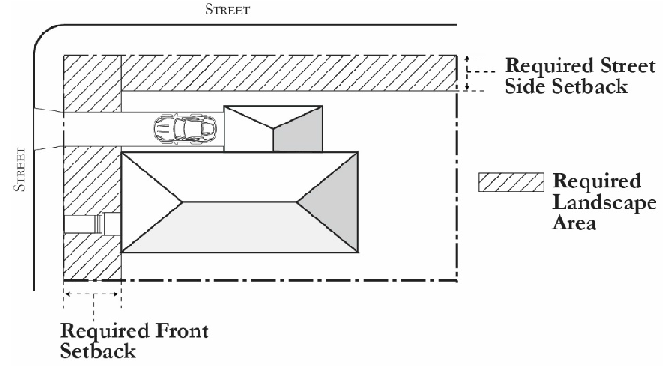
B.
Non-Residential Zoning Districts.
1.
The minimum landscaped area on a site for non-residential zoning districts is shown in Table 18.64-1.
2.
In the MU-D and MU-N, and MU-F zones, outdoor dining areas, courtyards, and other similar quasi-public areas may count toward landscaping requirements. In all other zoning districts these areas may not count toward landscaping requirements.
Table 18.64-1: Minimum Landscaped Area in Non-Residential Zones
3.
Except in the industrial zoning district, all required front and street side setback areas shall be landscaped, excluding areas required for access to the property and public or quasi-public open space such as courtyards and outdoor seating.
(Ord. No. 2277 N.S., § 5(Exh. A), 6-6-2018)
18.64.060 - General landscape requirement.
A.
General Standards.
1.
Plant Selection. All plants and trees shall be categorized as low or very low water use in the Central Coast as defined by the water use classification of landscape species (WUCOLS) database.
2.
Turf Lawns. Turf areas shall be limited to flat areas designed exclusively for active recreation and shall be consistent with Chapter 18.148 (Water Conservation) of this code.
3.
Plant Groupings. Where irrigation is proposed, plants shall be grouped in separate hydrozones (i.e., plants within each irrigation valve area shall have the same watering requirements).
4.
Water Features. Decorative water features (e.g., fountains, ponds, waterfalls) must be approved by the planning commission and shall have recirculating water systems.
5.
Watering Times. Watering shall start after seven p.m. and end before nine a.m.
6.
Public Safety. Plant species shall be selected and located so that at maturity they do not interfere with pedestrian, bicycle, or vehicular circulation and do not conflict with overhead lights or utility lines.
B.
Irrigation and Water Efficiency. Irrigation systems shall be designed to avoid runoff, low head drainage, overspray, and other similar conditions where water flows outside of landscaped areas. Irrigation systems shall feature the following equipment:
1.
Irrigation systems shall meet a minimum irrigation efficiency of seventy-five percent.
2.
Separate landscape water meters for landscape areas exceeding five thousand square feet.
3.
Irrigation controllers capable of percent adjustment, multiple programming, and rain sensor.
4.
Drip or bubbler irrigation is required in all areas except turf areas installed per subsection A.2 above. Micro-spray sprinklers are prohibited. Overhead spray irrigation installed to irrigate turf areas shall have a precipitation rate of no more than three-quarters of one inch per hour.
5.
Separated valves and circuits based on water use and sun exposure. Separate valves for turf and non-turf and berm areas are required.
6.
Sprinkler heads and emitters selected for proper area coverage, application rate, operation pressure, adjustment capability, and ease of maintenance.
7.
Rain-sensing override devices are required for all irrigation systems.
8.
Drip or bubbler irrigation is required for all trees.
9.
State-approved back flow prevention devices shall be installed on all irrigation systems.
C.
Timing of Installation. Landscaping systems shall be installed prior to final building permit inspection or certification of occupancy.
(Ord. No. 2277 N.S., § 5(Exh. A), 6-6-2018; Ord. No. 2327 N.S., § 14, 12-15-2021; Ord. No. 2341 N.S., § 5, 2-15-2023)
18.64.070 - Landscaping maintenance and enforcement.
The following maintenance requirements and enforcement procedures apply to landscaping installed as part of a design permit approved by the city.
A.
Maintenance Required.
1.
Approved Plans. Landscaping shall be maintained consistent with the plans approved as part of the design permit. Any significant alteration to the landscaping requires development services director's approval.
2.
Dead and Dying Plants. All landscaping shall be maintained free of physical damage or injury from lack of water, excess chemical fertilizer or other toxic chemical, blight or disease. Dead or dying plants shall be removed and replaced with landscaping of similar size and maturity.
3.
Weed Removal. Landscaping shall be kept free from weeds and undesirable grasses.
4.
Tree Pruning. Trees shall be allowed to grow their natural size and shape. Periodic pruning shall be as appropriate for the health of the tree species and may not exceed twenty-five percent of the tree height or volume at any given time unless the development services director approves a tree removal permit in accordance with Municipal Code Chapter 12.32.
5.
Tree Topping/Heading Cuts. Topping/heading cuts that reduce a tree's size and height by shortening of limbs or branches back to a predetermined crown limit is prohibited unless the development services director approves a tree removal permit in accordance with Municipal Code Chapter 12.32 (Protected and Significant Trees).
B.
Landscape Maintenance Agreements and Bonds.
1.
General.
a.
Prior to the issuance of a certificate of occupancy, the community development director may require a landscape maintenance agreement and/or a landscape maintenance bond to guarantee the proper maintenance of landscaping installed for a development project.
b.
Landscape maintenance agreements and bonds shall not be required for landscaping maintained by a homeowners association.
2.
Landscape Maintenance Agreement. When required, landscape maintenance agreements shall guarantee maintenance of landscaping for a minimum of two years following installation.
3.
Landscape Maintenance Bond.
a.
The community development director may require an applicant to submit a landscape maintenance bond in addition to or instead of a landscape maintenance agreement.
b.
Landscape maintenance bonds shall be in an amount equal to one hundred percent of the value of landscaping and irrigation systems for the project, shall be held by the city for two years, and shall be administered in accordance with Section 18.104.180 (Performance Guarantees).
C.
Compliance and Enforcement.
1.
Notification of Violation. Whenever the community development director determines that landscaping is maintained in violation of approved design permit plans, the director may require, upon thirty days' written notice, that the property owner correct the violation. The director's determination of violation may be appealed to the planning commission in accordance with Chapter 18.112 (Appeals).
2.
City Correction of Violation. If the property owner does not correct violation the director may cause work to be done to bring the landscaping into compliance. The method of reimbursement for such work shall be stated in the landscape maintenance agreement signed by the permit hold and may include forfeiture of a landscape maintenance bond up to one hundred percent of the cost of landscape improvements.
(Ord. No. 2277 N.S., § 5(Exh. A), 6-6-2018; Ord. No. 2362, § 9, 2-19-2025)

