
Morgan Hill City Zoning Code
CHAPTER 18
88 - SIGNS
18.88.010 - Purpose.
This chapter establishes standards relating to the permitted type, size, height, placement, number, and design of signs. The intent of these standards is to:
A.
Support economically viable businesses serving city residents, workers, and visitors.
B.
Allow for signage that identifies businesses in a fair and equitable manner.
C.
Protect and enhance the aesthetic qualities of the city.
D.
Minimize hazards to motorists and pedestrians resulting from excessive, confusing, and distracting signs.
E.
Allow for a simple and streamlined sign permitting process.
(Ord. No. 2277 N.S., § 5(Exh. A), 6-6-2018)
18.88.020 - Definitions.
A.
Abandoned Sign. A sign whose advertised use or service has ceased to function for a period of ninety days or more.
B.
Off-Site Sign. A sign advertising a land use, business, product, or service not located or available on the premises where the sign is located.
C.
Portable Sign. A movable sign not permanently attached to the ground or building.
D.
Sign. Any structure, object, or device that uses letters, numbers, graphics, colors or other means of communication to advertise, announce, or communicate information of any kind to the public.
E.
Sign Copy. The area of a sign occupied by letters, numbers, graphics, or other content intended to communicate information.
F.
Sign Face. The area of a sign where sign copy is placed.
G.
Types of Signs.
1.
A-Frame Sign. A portable sign with two opposing flat faces designed to be self-supporting on the ground.
2.
Awning Sign. A sign incorporated into, attached, or painted on the face or valance of an awning.
3.
Banner Sign. A sign composed of lightweight, flexible, non-rigid material either enclosed or not enclosed in a rigid frame.
4.
Beacon Sign. A beam of light designed to draw attention to a particular location.
5.
Changeable Copy Sign. A sign with copy that that can be changed or rearranged electronically or manually without altering the face or surface of the sign.
6.
Directional Signs. A sign that provides directions to a place, structure or use, excluding signs installed by a public agency.
7.
Directory Sign. A sign which lists and identifies the location of the occupants of a multi-tenant building or site.
8.
Hospital Sign. A sign for a medical facility providing patient services primarily on an in-patient basis.
9.
Inflatable Balloon Sign. A sign consisting of a flexible envelope of nonporous materials that gains its shape from inserted air or other gas.
10.
Feather Sign. A sign composed of durable lightweight fabric with a sturdy frame enclosing only a portion of the material's edge so that it can remain upright and still be flexible in the breeze, generally shaped to be tall and narrow when affixed into the ground or other bottom support, affixed to a pole. Includes teardrop signs.
11.
Flags. Fabric, textile, or material with colors and/or patterns which display a symbol of a nation, state, company, or idea.
12.
Freeway-Oriented Sign. A sign intended to be viewed primarily by motorists traveling on Highway 101.
13.
Freestanding Sign. A sign attached to an independent, freestanding structure that is not attached to a building.
14.
Marque Sign. A sign made a part of or in any manner attached to a marquee.
15.
Monument Signs. A freestanding sign that is supported by a solid-appearing base constructed of permanent material.
16.
Pole Sign. A freestanding sign that is supported by one or more poles which do not have a solid-appearing base constructed of permanent material.
17.
Political Sign. A temporary sign that encourages a particular vote in a scheduled election.
18.
Post Sign. A temporary sign suspended from a horizontal swingpost that is attached to a vertical post mounted in the ground.
19.
Projecting Sign. A sign permanently attached to a building or wall such that the sign face or faces are perpendicular to the building or wall.
20.
Property Identification Sign. A sign identifying the name of a residential property or subdivision with ten or more units.
21.
Roof Signs. A sign erected upon, against, or directly above a roof above the parapet of a building.
22.
Site Sign. A temporary sign allowed on sites with uses under construction or not yet occupied.
23.
Suspended Sign. A sign attached to or suspended from the underside of an arcade, canopy, or marquee and oriented to pedestrian traffic.
24.
Wall Sign. A sign attached to or painted on the exterior wall of a structure with the display surface of the sign approximately parallel to the building wall.
25.
Window Sign. A sign posted, painted, placed, or affixed in or on a window exposed to public view.
(Ord. No. 2277 N.S., § 5(Exh. A), 6-6-2018; Ord. No. 2362, § 13, 2-19-2025)
18.88.030 - Required permits.
A.
Sign Permits.
1.
When Required. A sign permit is required to install, display, or alter a sign except for signs exempt from sign permit requirements as specified in Section 18.88.040 (Signs Allowed Without Permits).
2.
Review Authority.
a.
The community development director shall review and act on all sign permit applications except for signs reviewed by the planning commission as specified in Paragraph b below.
b.
The planning commission shall review and act on sign permit applications for the following types of signs:
(1)
Changeable copy message board for automotive-related business adjacent to Highway 101 consistent with Section 18.88.100.B (Changeable Copy Signs);
(2)
Freestanding freeway-oriented signs consistent with Section 18.88.100.C (Freestanding Freeway Oriented Signs);
(3)
Off-site hospital signs consistent with Section 18.88.100.D (Hospital Signs);
(4)
Off-site monument signs consistent with Section 18.88.100.D (Off-site Monument Signs);
(5)
Adjustments to sign standards consistent with Section 18.88.070 (Adjustment to Sign Standards); and
(6)
Master sign programs consistent with Section 18.88.110 (Master Sign Program).
B.
Encroachment Permit. A sign which projects into the public right-of-way requires city engineer approval of an encroachment permit.
C.
Building Permit. For signs that require a building permit, the city may not issue the sign permit until the building permit has been approved by the building official.
(Ord. No. 2277 N.S., § 5(Exh. A), 6-6-2018; Ord. No. 2327 N.S., § 16, 12-15-2021)
18.88.040 - Signs allowed without permits.
A.
Types of Signs. The following signs are exempt from the permit requirements of this chapter and shall not be counted towards the allowable sign area or number of signs on a parcel:
1.
A-Frame Signs. Each commercial business location shall be permitted one A-frame sign per street frontage. The sign shall not exceed four feet in height or a width of three feet, shall be unlighted, and shall be stored indoors during non-business hours. A multiple-occupancy building shall constitute one business location for the purpose of determining the number of signs permitted. A-frame signs shall not obscure or visually impair vehicular traffic and shall not be placed within a public right-of-way or on publicly owned property or affect access to a structure.
2.
Alley and Service Area Signs. Signs fronting an alley or service area mounted flat against a wall and not exceeding twenty-five square feet in aggregate area.
3.
Commemorative Plaques. One commemorative plaque identifying a building name, date of construction, or similar information that is cut into, carved, or made of stone, concrete, metal, or other similar permanent material.
4.
Decorations. Holiday and cultural observance decorations on private property which do not include any commercial advertising.
5.
Directional Signs. On-site directional signs located entirely on the property to which they pertain, identifying direction to parking, restrooms, and similar public facilities, each not exceeding five feet in height and five square feet in area for non-residential uses and two square feet for residential uses.
6.
Directory Signs. One directory sign per street frontage as follows:
a.
Maximum area: One square foot per tenant up to twenty-four square feet.
b.
Maximum height: Six feet if freestanding.
c.
Internal illumination prohibited.
7.
Feather Signs. Up to three feather signs may be allowed for thirty days after the initial opening (i.e., grand opening) of a business or housing development. The sign shall not exceed nine feet in height or a width of three feet and shall be unlighted. The signs shall not obscure or visually impair vehicular traffic and shall not be placed within a public right-of-way or on publicly owned property or affect access to a structure.
8.
Flags. Flags bearing noncommercial messages or graphic symbols as follows:
a.
No more than three flags are permitted per parcel.
b.
For flags flown on a flagpole longer than six feet, the longest dimension of the flag shall not exceed one-third the height of the flagpole; otherwise the longest flag dimension shall not exceed six feet.
9.
Government Signs. Signs installed by a governmental agency, including signs advertising community activities and local nonprofit, civic, or fraternal organizations.
10.
House Number and Nameplates. House numbers and nameplates up to four square feet for each residential dwelling.
11.
Informational Signs. Signs with information for the safety and convenience of the public such as address, hours and days of operation, whether a business is open or closed, no smoking notices, up to three square feet per sign and ten square feet in total.
12.
Internal Signs. Signs within a building, or on the premises of a building, that are not visible from the public right-of-way and are intended for interior viewing only.
13.
No Trespassing Signs. "No trespassing" signs, each not more than one square foot in size, placed at each corner and each entrance to property, and at intervals of not less than one hundred feet, or in compliance with the requirements of state or federal law.
14.
Non-Commercial Bulletin Boards. One bulletin board on a parcel occupied by a non-commercial place of public assembly, with a maximum area of twelve square feet.
15.
Political Signs. Temporary political signs consistent with Section 18.88.120 (Temporary Signs) that are generally placed not sooner than ninety days prior to the scheduled election and are typically removed within ten days after that election and has a statement of responsibility filed with the city certifying a person who will be responsible for removing the temporary political sign and who will be responsible for any incurred violations of this Chapter.
16.
Real Estate Listings. Real estate listings posted in the window of a real estate office, with a maximum area of twenty-five percent of the total window area.
17.
Restaurant Menu Signs. Restaurant menu signs attached to a building, with a maximum area of three square feet.
18.
Temporary Signs. Temporary signs consistent with Section 18.88.120 (Temporary Signs).
19.
Traffic-Control Devices. Official traffic-control devices in accordance with Municipal Code Chapter 10.16 (Traffic-Control Devices)
B.
Changes to Sign Face. Changes to a sign face that do not structurally alter or enlarge a legally-established sign are exempt from the permit requirements of this chapter.
C.
Routine Maintenance. The painting, cleaning, repair, and normal maintenance of a legally-established sign are exempt from the permit requirements of this chapter.
D.
Murals and Decorations. Murals and decorations on the exterior of a building that do not advertise a product, business, or service are not considered signs and are not subject to the requirements of this chapter.
(Ord. No. 2277 N.S., § 5(Exh. A), 6-6-2018; Ord. No. 2362, § 14, 2-19-2025)
18.88.050 - Prohibited signs.
A.
Prohibited Sign Types. The following types of signs are prohibited:
1.
Banners signs and pennants except when uses as a temporary sign consistent with Section 18.88.120 (Temporary Signs).
2.
Beacon signs and searchlights.
3.
Inflatable balloon signs and signs attached to inflated or gas-filled features.
4.
Off-site signs, except for:
a.
Off-site hospital signs consistent with Section 18.88.100.D (Hospital Signs);
b.
Off-site monument signs consistent with Section 18.88.100.D (Off-site Monument Signs);
c.
Off-site directional signs for community assembly uses in compliance with Section 18.88.100.H (Off-site Directional Signs for Community Assembly Uses);
d.
Temporary off-site directional signs in compliance with Section 18.88.120.D (Temporary Off-site Directional Signs).
5.
Pole signs.
6.
Portable signs.
7.
Roof signs.
8.
Abandoned signs.
9.
Murals and decorations on the exterior of a building that advertise a product, business, or service.
B.
Prohibited Location or Placement. Signs with the following location and/or placement characteristics are prohibited:
1.
Signs attached to or placed adjacent to any utility pole, parking meter, traffic signpost, traffic signal, or any other traffic control device.
2.
Signs attached to trees.
3.
Signs erected or maintained with horizontal or vertical clearance from overhead utilities less than required by state agencies.
4.
Signs installed without permission of the owner or the owner's agent of the property on which the sign is located.
5.
Signs mounted or attached to a vehicle parked for the purpose of calling attention to or advertising a business establishment.
6.
Signs projecting over a public roadway which have not received an encroachment permit from the city engineer.
7.
Signs that obstruct or interfere with the free use of a fire escape, exit, stairway, door, ventilator or window in violation of the California Building or Fire Code.
8.
Signs that interfere with visibility at an intersection, public right-of-way, driveway, or other point of ingress/egress. The city may require sign setbacks greater than specified in this chapter as needed to maintain adequate visibility for motorists and pedestrians.
C.
Prohibited Design Features. Signs with the following design features and/or physical characteristics are prohibited:
1.
Signs which constitute a traffic hazard due to highly reflective and fluorescent painted signs.
2.
Signs which simulate in size, color, lettering, or design a traffic control sign or signal.
3.
Animated signs which move, rotate, revolve and other similar signs that visibly moving or rotating parts or visible mechanical movement of any kind.
4.
Signs which flash, blink, change color, or change intensity including digital display and electronic readerboard signs, except for changeable-copy signs for automotive businesses adjacent to Highway 101 and movie theater signs consistent with Section 18.88.120 (Changeable Copy Signs).
5.
Signs emitting audible sounds, odor, or visible matter.
6.
Signs that feature a flag, pennant, whirligig, or any device which is designed to wave, flutter, rotate or display other movement under the influence of wind.
7.
Any sign that utilizes visible guy wires, angle irons and iron frame structures.
8.
Signs or sign structures which have become a public nuisance or hazard due to inadequate maintenance, or dilapidation.
D.
Prohibited Sign Content.
1.
The following sign content is prohibited:
a.
Obscene or indecent text or graphics.
b.
Text or graphics that advertise unlawful activity.
c.
Text or graphics that constitute defamation, incitement to imminent lawless action, or true threats.
d.
Text or graphics that present a clear and present danger due to their potential confusion with signs that provide public safety information (for example, signs that use the words "Caution," or "Danger," or comparable words, phrases, symbols, or characters in such a manner as to imply a safety hazard that does not exist).
e.
Content advertising a use that has ceased to function for a period of 90 days or more.
2.
The content prohibited by paragraph 1 above is either not protected by the United States or California Constitutions or are offered limited protection that is outweighed by the substantial governmental interests in protecting the public safety and welfare. It is the intent of the city council that each subparagraph of paragraph 1 above be individually severable in the event that a court of competent jurisdiction were to hold one or more of them to be inconsistent with the United States or California Constitutions.
(Ord. No. 2277 N.S., § 5(Exh. A), 6-6-2018)
18.88.060 - General standards.
A.
Measuring Sign Area.
1.
Sign area is measured as the area of all sign copy, framing, or other display enclosed within a continuous perimeter composed of squares or rectangles. See Figure 18.88-1.
Figure 18.88-1: Measurement of Sign Area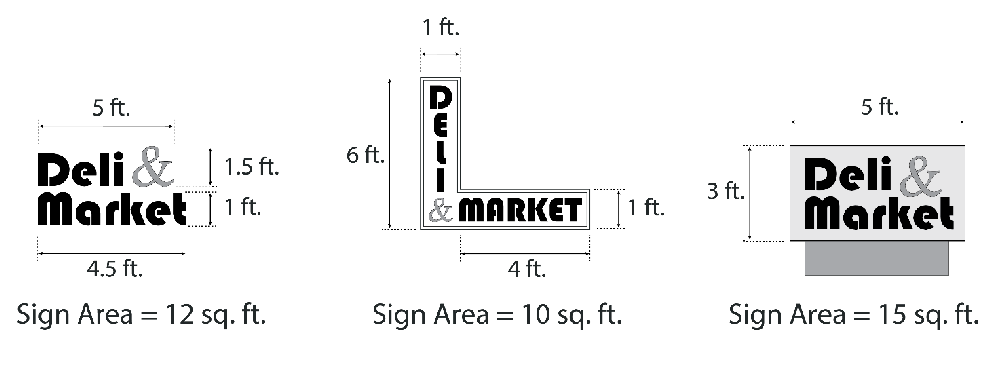
2.
Supporting framework or bracing that is clearly incidental to the display itself shall not be calculated as sign area.
3.
The area of a double-faced (back-to-back) sign shall be calculated as a single sign face if the distance between each sign face does not exceed 18 inches and the two faces are parallel with each other.
4.
The area of spherical, free-form, sculptural or other non-planar signs are measured as fifty percent of the sum of the area enclosed within the four vertical sides of the smallest four-sided polyhedron that will encompass the sign structure. See Figure 18.88-2.
Figure 18.88-2: Non-Planer Sign Area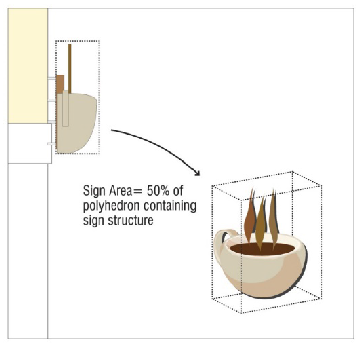
B.
Building Code Compliance. All signs shall comply with Chapter 15.08 (Building Code) and Chapter 15.12 (Electrical Code) of the Morgan Hill Municipal Code.
C.
Maintenance. Signs, including all supports, braces, and anchors, shall be maintained in a state of good repair at all times. If the city determines that a sign has been damaged beyond fifty percent of its serviceable value, the sign shall be repaired and brought into compliance with all applicable requirements of this chapter.
D.
Building Surface Repair. When an existing sign is replaced or modified, any newly exposed portions of a building surface on which the sign is displayed shall be repaired and repainted to restore a uniform appearance to the surface. Compliance with this requirement includes the removal of any excess conduit and supports, and the patching or filling of any exposed holes.
E.
Illumination.
1.
Non-residential signs may be internally or externally illuminated except where specifically prohibited. Internal illumination is permitted only when the portion of the sign that appears illuminated is primarily the sign lettering, registered trademark, or logo.
2.
The light source for externally illuminated signs shall be positioned so that light does not shine directly on adjoining properties or cause glare for motorists or pedestrians.
3.
Exposed bulbs are not permitted.
4.
Freestanding signs within the gateway areas as shown in the city of Morgan Hill Scenic Gateway Guidelines shall be non-illuminated or indirectly illuminated by exterior lighting sources only.
F.
Materials and Design.
1.
Except for interior window signs, all permanent signs shall be constructed of wood, metal, plastic, glass, or similar durable and weatherproof material.
2.
The design of signs, including its shape, features, materials, colors, and textures, shall be compatible with the design character of the development or use it identifies and will not have an adverse effect on the character and integrity of the surrounding area.
G.
Downtown Signs. Signs located within the Downtown Specific Plan overlay zone shall comply with the signage guidelines in the Downtown Specific Plan to the extent appropriate as determined by the review authority.
(Ord. No. 2277 N.S., § 5(Exh. A), 6-6-2018)
18.88.070 - Adjustments to sign standards.
This section establishes procedures to allow the planning commission to approve signs that deviate from certain standards to provide reasonable flexibility in the administration of the sign ordinance.
A.
Permit Required. Adjustments to sign standards allowed by this section requires planning commission approval of a sign permit.
B.
Permitted Adjustments. The planning commission may allow adjustment to the following sign standards:
1.
The maximum permitted sign area up to a twenty-five percent increase.
2.
The maximum permitted sign height up to twenty-five percent increase.
3.
The maximum number of permitted signs.
4.
Requirements for temporary signs.
C.
Findings. The planning commission may approve an adjustment to sign standards as allowed by this section if the following findings can be made in addition to findings required to approve the sign permit applications:
1.
The sign will be compatible with adjacent structures and uses and is consistent with the character of the neighborhood or district where it is located.
2.
The sign will not adversely impact neighboring properties or the community at large.
3.
The adjustment is necessary due to unique characteristics of the subject property, structure, or use.
4.
The sign will be consistent with the purpose of the zoning district, the general plan, any applicable specific plan, and any adopted area or neighborhood plan.
5.
The adjustment will not establish an undesirable precedent.
(Ord. No. 2277 N.S., § 5(Exh. A), 6-6-2018)
18.88.080 - Sign standards for non-residential zones.
The sign standards in this section apply to properties in the mixed use (MU-D, MU-N, MUF), commercial (CN, CG, CH, CS), industrial (IL, IG, IC, IO), public facilities (PF), and sports recreation leisure (SRL) zones.
A.
Signs Exempt from Permit Requirements. Signs that are exempt from the permit requirements of this chapter and do not count towards the allowable sign area or number of signs on a parcel are identified in Section 18.88.040 (Signs Allowed Without Permits).
B.
Total Sign Area.
1.
General. The maximum permitted aggregate sign area allowed on a parcel is as follows and as shown in Figure 18.88-3.
Figure 18.88-3: Maximum Aggregate Sign Area - Single Frontage Outside Downtown Specific
Plan Overlay Zone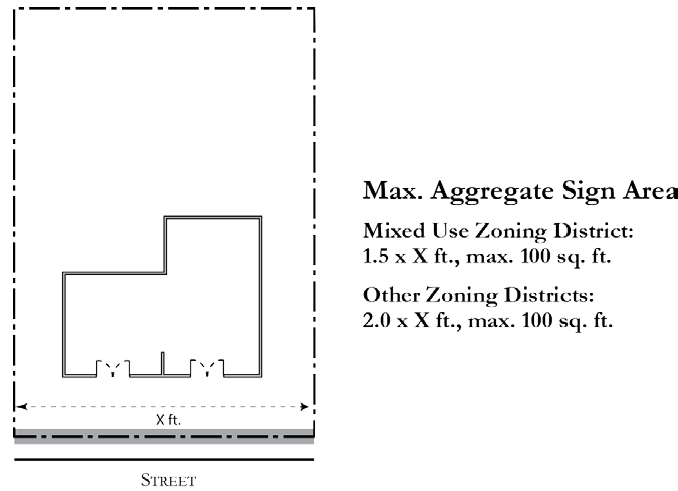
a.
Mixed Use Zones: One and one-half square feet per lineal feet of street frontage to a maximum of one hundred square feet.
b.
Commercial, Industrial, Public Facilities, and Sports Recreation Leisure Zones: Two square feet per lineal feet of street frontage to a maximum of one hundred square feet.
2.
Downtown Specific Plan Overlay Zone. The maximum permitted aggregate sign area allowed on a parcel in the Downtown Specific Plan Overlay Zone is as follows.
a.
Buildings fronting Monterey Road, Third Street, and Depot Street: One square feet per lineal feet of street frontage.
b.
Buildings Fronting Other Streets: Three-fourths of one square foot per lineal feet of street frontage.
3.
Sites with Multiple Frontages. On parcels and sites with more than one frontage on a public street (excluding alleys), the maximum permitted sign area is calculated as follows:
a.
Corner and Through Lots. Where a lot fronts on two streets (a corner or "through lot"), either both the front and side, or front and rear lot lines as related to the applicable frontages may be used for calculating the allowable sign area.
Figure 18.88-4: Maximum Aggregate Sign Area — Double Frontage Outside Downtown Specific
Plan Overlay Zone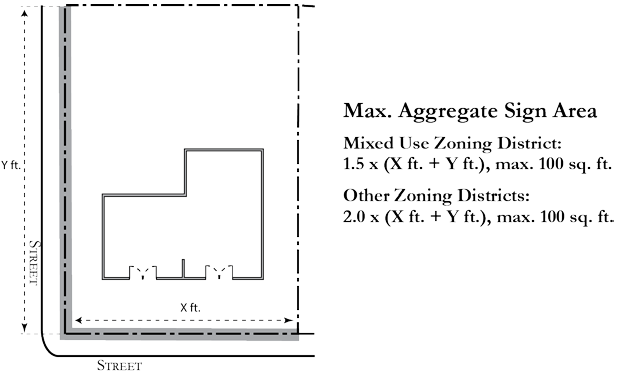
b.
Three or More Frontages. Where a lot has three or more frontages on a public street, the length of only two contiguous sides, one of which must be the principal street frontage, are added together to determine allowable sign area.
4.
Multiple-Occupancy Commercial Sites with Limited Frontage. Where a multiple-occupancy commercial site has public street frontage equal to twenty percent or less of the perimeter measurement of the site, the maximum allowable sign area for the site is calculated as follows:
a.
One square foot of sign area per one lineal foot of public street frontage; plus
b.
One lineal foot of exterior building walls fronting on driveways and parking lots that are generally used for public access and are located on the same site.
5.
Minimum Allowance in Multi-Tenant Projects. For multi-tenant commercial projects, the aggregate sign area may be increased to the extent that each tenant has a minimum of one-half of one square foot of sign area per lineal foot of business frontage on the primary street frontage.
C.
Standards for Sign Types. Signs within non-residential zoning districts shall comply with Section 18.88.100 (Standards for Specific Sign Types).
D.
Signage Guidelines — Downtown Signs. Signs located within the Downtown Specific Plan overlay zone boundaries shall conform to the signage guidelines in the Downtown Specific Plan.
E.
Temporary Signs. Temporary signs allowed in non-residential zoning districts are identified in Section 18.88.120 (Temporary Signs).
(Ord. No. 2277 N.S., § 5(Exh. A), 6-6-2018; Ord. No. 2341 N.S., § 11, 2-15-2023)
18.88.090 - Sign standards for residential and open space zones.
The sign standards in this section apply to signs in the residential and open space zoning districts.
A.
Signs Exempt from Permit Requirements. Signs that are exempt from the permit requirements of this chapter and do not count towards the allowable sign area or number of signs on a parcel are identified in Section 18.88.040 (Signs Allowed Without Permits).
B.
Property Identification Signs. Residential properties or subdivisions with ten or more units may have property identification signs consistent with the following standards:
1.
Maximum Number: Two per street entrance.
2.
Permitted Type: Monument sign or attached to a masonry wall.
3.
Minimum Setbacks: Five feet from property line.
4.
Maximum Sign Area: Thirty-two square feet, which may be a single sign or divided between two signs on opposite sides of the street entrance.
5.
Maximum Height: Six feet for monument signs.
6.
Landscaping: Must include landscaping around the base with minimum horizontal dimension of at least Four feet.
7.
Illumination: External illumination only.
C.
Non-Residential Signs. Signs for permitted non-residential uses in residential zones shall comply with the following standards:
1.
Maximum Number: One monument sign and one wall sign per street frontage.
2.
Permitted Type: Monument and wall signs.
3.
Maximum Sign Area: Thirty-two square feet for monument signs and twenty-four square feet for wall signs.
4.
Maximum Height: Six feet for monument signs and twelve feet for wall signs.
5.
Minimum Setback: Ten feet from property line for monument signs.
6.
Illumination: External illumination only.
(Ord. No. 2277 N.S., § 5(Exh. A), 6-6-2018)
18.88.100 - Standards for specific sign types.
This section establishes standards for specific sign types where such signs are permitted.
A.
Awning Signs.
1.
Maximum Area: Two-thirds of awning valance area and fifteen percent of awning face, or twenty-five square feet, whichever is less.
2.
Maximum Projection from Building Wall: No greater than the awning.
3.
Minimum Vertical Clearance: Six feet.
4.
Minimum Horizontal Clearance: Two feet from street or drive aisle curb.
5.
Placement: Sign may only be mounted on the wall area below the second floor.
6.
Materials: Awnings shall be constructed of durable, long lasting fabric. Plastic or vinyl material is not permitted.
B.
Changeable Copy Signs. The city council finds that automotive-related businesses near to Highway 101 have unique needs for communicating their message due to large market area of car dealerships, the site area required to maintain inventory, and the tendency for multiple car dealerships to cluster in a single location. the City Council also finds that movie-theatres have unique needs for communicating their message due to the number of and frequent change to films typically showing at a single time.
1.
Where Permitted: Changeable copy signs are permitted only for:
a.
Automotive-related business within one hundred feet of the Highway 101 right-of-way; and
b.
Movie theatres.
2.
Frequency of Copy Change: Copy may change no frequently than every two minutes.
C.
Freestanding Freeway-Oriented Signs. The city council finds that large retail developments adjacent to Highway 101 have unique needs of communicating their message due to the high speed of vehicles traveling on the highway and the size and number of tenants located immediately to the freeway.
1.
Eligibility: Freestanding freeway-oriented signs are permitted on sites that are:
a.
Occupied by an existing or proposed unified commercial retail development of one hundred thousand square feet or more;
b.
A minimum of ten acres; and
c.
Directly abuts the Highway 101 right-of way.
2.
Permit Required. Freestanding freeway-oriented signs require planning commission approval of a sign permit.
3.
Maximum Number: One per site.
4.
Maximum Height: Fifty feet.
5.
Maximum Area: Two hundred square feet. Ancillary components of a sign such as shopping center identification that does not exceed twenty-five percent of the total sign area may be excluded from the calculation of the sign area.
6.
Setbacks: Ten feet minimum from the highway right-of-way or other distance as determined by Caltrans and two hundred feet minimum from a residential zone.
7.
Total Aggregate Sign Area: The area of a freestanding freeway-oriented sign shall not be included in the calculation of the maximum total aggregate sign area for the parcel or site.
8.
Minimum Separation: A freestanding freeway-oriented sign shall be separated a minimum of one thousand feet from another freestanding freeway-oriented sign.
9.
Design: The sign shall be compatible with surrounding development and the uses which it serves in general appearance and materials.
10.
Landscaping. The sign base area shall be located in an irrigated landscaped planting area.
D.
Hospital Signs. The city council finds that special allowance for off-site hospital signs are necessary to facilitate wayfinding to a hospital in case of an emergency and to protect the public health, safety, and welfare. Two types of off-site hospital signs are permitted: freeway-oriented hospital signs and hospital directional signs.
1.
Off-Site Freeway-Oriented Hospital Signs.
a.
Location: Signs must be located within one hundred feet of the Highway 101 right-of-way and within five hundred feet the closest highway off-ramp closest to the hospital.
b.
Maximum Number: one sign per hospital.
c.
Maximum Height: fifteen feet.
d.
Maximum Area: four hundred twenty-five square feet.
2.
Off-Site Hospital Directional Signs.
a.
Maximum Number: As necessary to provide adequate wayfinding to the hospital as determined by the community development director.
b.
Maximum Height: six feet.
c.
Maximum Area: fifteen square feet.
3.
Permit Required. Off-site freeway-oriented hospital signs and off-site hospital directional signs require planning commission approval of a sign permit.
E.
Marque Signs.
1.
Maximum Number: one per use.
2.
Maximum Height: thirty-five feet.
3.
Maximum Area: five hundred square feet total for all sign faces.
4.
Use Restriction: Limited to theatres, auditoriums, and indoor amusement/entertainment facilities.
5.
Maximum Projection from Building Wall: twelve feet.
6.
Minimum Vertical Clearance: eight feet.
7.
Placement: Sign shall be affixed to a building wall directly above the primary public entrance of the use.
8.
Animation: Flashing or chase lights only.
F.
Monument Signs.
1.
Maximum Number: one per street frontage or one per vehicle access point from street, whichever is greater
2.
Maximum Height: eight feet.
3.
Maximum Area: one-half of one square foot per lineal foot of property street frontage up to fifty square feet.
4.
Setbacks: six feet minimum from vehicle access ways and three feet minimum from property lines.
5.
Minimum Separation: Monument signs shall be separated a minimum of seventy-five feet from monument signs on abutting properties and one hundred feet from monument signs on the same property.
6.
Landscaping: The sign base area shall be located in an irrigated landscaped planting area.
G.
Off-Site Monument Signs.
1.
Permit Required: The planning commission may allow an off-site monument sign consistent with this section with the approval of a sign permit.
2.
Findings for Approval: The planning commission may approve a sign permit an off-site monument sign upon making all of the following findings:
a.
The site is geographically located such that the business has limited visibility from an arterial road.
b.
The proposed off-site signage is necessary and appropriate to allow the business to be competitive with other businesses of a similar nature located elsewhere.
c.
The proposed off-site signage will not have a significant adverse effect on the character and integrity of the surrounding area.
3.
Standards: Off-site monument signs shall comply with standards for monument signs in Subsection F (Monument Signs) above.
4.
Additional On-Site Sign Prohibited: A business that is advertised on an off-site sign may not also be advertised on an on-site monument sign.
H.
Off-Site Directional Signs for Community Assembly Uses. City council finds that community assembly uses have unique needs for communicating their messages due to their frequent location in residential neighborhoods and role as quasi-public uses within the community.
1.
Eligible Uses: The city may install off-site directional signs for community assembly uses as defined in Section 18.124.030 (Community Assembly Uses).
2.
Maximum Number: Two per use.
3.
Location: Within public right-of-way.
4.
Other Requirements: Signs shall be installed and maintained by the city at the applicant's expense.
I.
Projecting Signs.
1.
Maximum Number: One per building or tenant space.
2.
Maximum Area: Eight square feet.
3.
Maximum Projection from Building Wall: Four feet.
4.
Signs in a Public Alley: A sign which projects into a public alley shall be located at least fourteen feet above the alley grade and may not project more than twelve inches from the wall to which it is attached.
5.
Minimum Vertical Clearance: eighteen feet.
6.
Minimum Horizontal Clearance: two feet from the street or drive aisle curb.
7.
Placement: Signs may only be mounted on the wall area below the second floor.
J.
Suspended Signs.
1.
Maximum Area: five square feet.
2.
Maximum Projection from Building Wall: no greater than the structure to which it is attached.
3.
Minimum Vertical Clearance: eight feet.
4.
Minimum Horizontal Clearance: two feet from street or drive aisle curb.
5.
Placement: Sign shall be suspended below a ground-level awning, canopy, or ceiling of an arcade and shall be adjacent to the primary public entrance to the use.
K.
Wall Signs.
1.
Maximum Number: One per building frontage for single-tenant buildings and one per tenant space for multi-tenant buildings.
2.
Maximum Height: Not to exceed the roof line or parapet of the building wall to which it is attached.
3.
Maximum Area: For single-tenant buildings, one and one-half square feet per lineal foot of building wall to which it is attached. For multi-tenant buildings, one and one-half square feet per lineal foot of tenant frontage to which it is attached.
4.
Projection from Building Wall: Not to exceed six inches.
5.
Placement: Sign shall be attached to the building wall of the use associated with the sign. For multi-tenant buildings, sign shall be affixed to the portion of the wall where the business is located.
L.
Window Signs.
1.
Maximum Area: twenty-five percent of window to which it is attached.
2.
Placement: Permitted only on ground floor windows.
3.
Transparency: A minimum of seventy-five percent of the total window area for a use shall be transparent and free of signage features. Any sign attached to a window, within two feet of a window, or attached to a display located within two feet of a window is considered a window sign.
(Ord. No. 2277 N.S., § 5(Exh. A), 6-6-2018)
18.88.110 - Master sign program.
A.
Purpose. The purpose of the master sign program is to provide a coordinated approach to signage for multifamily development and multi-tenant commercial developments.
B.
Applicability. A master sign program is required for:
1.
Multifamily uses with more than one permanent sign proposed;
2.
Any non-residential development with four or more tenants; and/or
3.
Any building containing more than one business or tenant in the Downtown Specific Plan overlay zone.
C.
Permit Required. A master sign program requires planning commission approval of a sign permit.
D.
Applications. Applications shall be filed with the development services department on the appropriate city forms, together with all the necessary fees, deposits, exhibits, maps, and other information required by the department to clearly and accurately describe the proposed master sign program.
E.
Master Sign Program Contents. All master sign programs shall identify the materials, color, size, type, placement and general design of signs located on a project or property.
F.
Design Standards.
1.
Master sign programs shall feature a unified and coordinated approach to the materials, color, size, type, placement and general design of signs proposed for a project or property. Master sign programs may allow for variety in the design of individual signs provided that the signs contribute to a consistent visual theme within the property.
2.
A Master sign program may deviate from standards contained in this chapter relating to permitted sign height, number of signs, sign area, and type of sign. A master sign program may not allow prohibited signs as identified in Section 18.88.050 (Prohibited Signs).
G.
Effect of Master Sign Program.
1.
All subsequent signs proposed for a development or property subject to an approved master sign program shall comply with the standards and specifications included in the master sign program.
2.
Signs consistent with an approved master sign program are allowed with an administrative sign permit.
3.
Approval of a master sign program shall supersede the regulations of this chapter. Any aspect of the proposed signs not addressed by the master sign program shall be in compliance with this chapter.
(Ord. No. 2277 N.S., § 5(Exh. A), 6-6-2018; Ord. No. 2327 N.S., § 17, 12-15-2021)
18.88.120 - Temporary signs.
A.
Residential Zoning Districts. Temporary signs in residential zoning districts shall comply with the standards in Table 18.88-1.
Table 18.88-1: Temporary Residential Sign Standards
B.
Non-Residential Zoning Districts. Temporary signs in non-residential zoning districts shall comply with the standards in Table 18.88-2.
Table 18.88-2: Temporary Non-Residential Sign Standards
C.
Duration. Temporary signs in all zoning districts shall be removed the earliest of when:
1.
A commercial message is obsolete and has become misleading (e.g., a "for lease" or "for sale" sign in front of a building that is leased or sold);
2.
The sign falls into disrepair; or
3.
The sign has been displayed for the maximum number of days shown in Table 18.88-3.
Table 18.88-3: Temporary Sign Duration Standards
D.
Temporary Off-Site Directional Signs. The city council finds that due to the existing configuration of streets and general development pattern there is a need to enhance wayfinding to large new development projects in Morgan Hill. As such, the city may allow temporary off-site directional signs within the public right-of-way as described below.
1.
When Allowed. Temporary off-site directional signs are allowed to provide enhanced wayfinding to any development project under construction or not yet occupied on a site of two acres or more.
2.
Location. Temporary off-site directional signs may be located within park strips between the curb and sidewalk or behind the sidewalk within the public right-of-way.
3.
Permit Required.
a.
Installation of temporary off-site directional signs requires the approval of a temporary use permit in accordance with Section 18.92.150 (Temporary Uses and Structures).
b.
Applications for temporary off-site directional signs shall show the proposed location of signs in addition to all required fees, information, and materials as specified by the development services department.
c.
Temporary use permits shall be valid for one year and may extended in accordance with Section 18.104.210 (Time Limits and Extensions).
d.
The city may revoke the temporary use permit at any time if the signs threaten the public health, safety, and welfare.
4.
Number and Size of Signs.
a.
A maximum of thirty off-site directional signs are permitted per project.
b.
Each sign may have an area of no more than four square feet per side and a height of no more than four feet.
5.
Sign Material and Design.
a.
Signs shall be constructed of flexible and weatherproof plastic or reinforced paper material that is permanently attached to a plastic or wooden stake. The top of the stake shall be flat or rounded and shall not be pointed.
b.
Signs may not be illuminated, inflatable or have moving parts.
c.
Signs may not include balloons, streamers, ribbons or other similar devices designed to move in the wind.
d.
Signs may not resemble traffic-control signs or devices.
6.
Display Hours.
a.
Signs may be displayed in the period from five p.m. on Friday to no more than four hours after sunset on Sunday, and from five p.m. on the day prior to a holiday to no more than four hours after sunset on the day of the holiday.
b.
Stakes and cable ties must be removed when the signs are removed.
7.
Sign Attachment.
a.
Signs shall be securely positioned and shall be either:
(1)
Staked into the ground, or
(2)
Attached to poles or posts by means of at least two plastic strips that are a minimum of one-quarter-inch wide (commonly known as "cable ties"), provided that no sign may be attached to any utility pole, traffic signal light post or to any pole or post displaying a traffic sign, motorist call box or historical marker as provided in Section 21464(a) of the California Vehicle Code. Where placement on a pole is allowed, a maximum of one directional sign may be installed. Cable ties must be sufficiently spaced to insure that the support stake is mounted parallel to the pole or post.
b.
Signs may not be attached in any manner to trees, utility poles, utility cabinets, street or traffic signs, benches, hydrants, mailboxes, traffic signal light post, or any pole or post displaying a traffic sign, motorist call box or historical marker.
8.
Sign Location.
a.
Sign must be separated by at least five hundred feet when on the same roadway, except that two signs on the same roadway may be may be located within fifty feet of an intersection if the signs are directing traffic to turn at the intersection.
b.
Signs must be setback at least twenty-five feet from a temporary park strip sign for a different development project.
c.
Signs may not be located:
(1)
Within eighteen inches of a curb where parking is allowed;
(2)
In any bus stop zone;
(3)
So that any part of the sign extends into any bus stop zone or sidewalk area;
(4)
Within twenty feet of a driveway or curb cut access ramp;
(5)
On medians, street barricades or on any structure located within the unimproved portions of the public right-of-way which exists beyond any face of curb or future curb line;
(6)
Within twenty feet of any traffic-control sign or device installed by a public agency;
(7)
Along any state or county right-of-way; or
(8)
Within the Downtown Specific Plan overlay zone.
9.
Property Owner Consent.
a.
Signs may be placed on a park strip or behind the sidewalk only with the consent of the property owner and/or occupant of the parcel adjacent to the park strip or sidewalk where the sign is placed.
b.
The property owner and/or occupant of the parcel adjacent to the park strip or sidewalk where the sign is placed may remove signs at any time.
10.
Insurance. The applicant shall name the city as an additional insured in coverage amounts and types as required by the city risk manager.
11.
Indemnification. The applicant shall agree to defend, indemnify, and hold harmless the city and its officers, officials, agents, and employees from and against any and all liability, claims, demands, actions, losses, damages, injuries arising out of or in connection with the temporary park strip signs.
12.
Removal. The applicant shall agree to compensate the city to remove the signs if necessary for maintenance activities or to protect the public health, safety, and welfare.
(Ord. No. 2277 N.S., § 5(Exh. A), 6-6-2018; Ord. No. 2362, §§ 15, 16, 2-19-2025)
18.88.130 - Nonconforming signs.
This section applies to all legally-established signs that do not conform to current requirements in this chapter.
A.
Continuation. A nonconforming sign may continue its use as a sign if it was legally established in compliance with all applicable regulations in effect at the time it was established. It is the applicant's responsibility to demonstrate that the sign was legally established.
B.
Allowed Changes.
1.
Changes to sign copy/face and repainting of legal nonconforming signs is permitted as long as there is no alteration to the physical structure or support elements of the sign.
2.
A legal-nonconforming sign that sustains less than fifty-percent damage to its structure may be repaired to its original pre-damaged condition, provided that such repair is completed within one hundred eighty days after the date of the damage.
C.
Required Compliance. A legal nonconforming sign shall be removed or brought into compliance with this chapter in the following situations:
1.
The use advertised by the sign has ceased to function for a period of 90 days or more.
2.
The sign has sustained at least fifty-percent damage to its structure.
3.
The sign is located on a remodeled building façade.
4.
The sign is relocated to a different lot or building.
(Ord. No. 2277 N.S., § 5(Exh. A), 6-6-2018)
18.88.140 - Violations and enforcement.
A.
Illegal Signs. It is unlawful for any person to install, place, construct, repair, maintain, alter or move a sign in a manner that does not comply with the requirements of this chapter.
B.
Enforcement — General. The city shall enforce the requirements of this chapter and undertake legal action to correct violations in accordance with Chapter 18.120 (Enforcement) and Municipal Code Title 1 (General Provisions).
1.
The city may immediately remove or cause the removal of any sign that places the public in immediate peril or that is located within the public right-of-way.
2.
For illegal signs that do not place the public in immediate peril and are located on private property, the city shall serve the business owner, property owner, or person responsible for the sign a written certified notice that:
a.
Describes the physical characteristics of the subject sign.
b.
Explains the nature of the violation.
c.
States that the sign shall be removed or brought into compliance with this article within ten days after the notice is received.
d.
States that the city may remove the sign if the business owner, property owner, or person responsible for sign does not correct the violation within ten days after the notice is received.
e.
States that the city may destroy the illegal sign if it is not retrieved within ten days after removal by the city.
f.
States that the business owner, property owner, or person responsible for sign shall be responsible for all costs associated with the removal, storage, and destruction of the sign.
3.
If an illegal sign is not removed or brought into compliance within ten days after a notice is received, the city may issue a citation to the business owner, property owner, or person responsible for the sign as provided in Chapter 18.120 (Enforcement) and Municipal Code Title 1 (General Provisions) and may remove or cause the removal of the sign.
4.
Any accessory structures, foundations, or mounting materials which are unsightly or a danger to the public health, safety, and welfare shall be removed at the time of the sign removal.
D.
A sign removed by the city shall be stored for a minimum of thirty days. If the sign is not retrieved by the business owner or person responsible for the sign within this thirty-day period, the city may destroy the sign.
(Ord. No. 2277 N.S., § 5(Exh. A), 6-6-2018; Ord. No. 2362, § 17, 2-19-2025)

