
Morris City Zoning Code
ARTICLE II
- DESIGN STANDARDS
Sec. 48-27. - Use limitations; control.
(a)
The uses of land and the erection, alteration, and use of buildings or structures shall be limited to:
(1)
Uses lawfully established and existing on the effective date of the ordinance codified in this article, except uses lawfully established and existing on the effective date of the ordinance codified in this article and rendered nonconforming by the provisions herein shall be subject to the regulations of article XXIV of this chapter;
(2)
Uses permitted or conditionally permitted in the zoning district in which the land, building, or structure is to be located.
(b)
Where a use which is classified as a conditionally permitted use by this article exists on the effective date of the ordinance codified in this article, it shall be considered to be a lawful conditionally permitted use.
(c)
Where the construction of a building or structure has begun prior to the effective date of the ordinance codified in this article, and is being prosecuted to completion, such building or structure may be completed and occupied.
(d)
Where plans for the construction of a building on structure have been filed with the city clerk within ten days after the effective date of the ordinance codified in this article, the building or structure may be constructed and occupied if construction is commenced within six months and completed within one year of the filing date.
(Code 2012, § 17.09.010; Ord. of 9-28-1966, § 5(A))
Sec. 48-28. - Control over bulk.
(a)
New buildings or structures shall conform to the bulk regulations established by this article for the district in which each such building or structure is located. Existing buildings or structures shall not be enlarged, reconstructed, structurally altered, converted, or relocated in such a manner as to conflict or to increase any existing conflict with the bulk regulations of this article for the district in which such structures are located, except as specifically allowed in the manufacturing districts.
(b)
However, a lot of record at the time of the adoption of the ordinance codified in this article in a residence district which is unable to meet the requirements of this article as to area (either in width or depth) may be used for a single-family detached dwelling, provided it shall meet all the other requirements of this article and applicable city ordinances, regulations, and codes. The zoning officer may, when requested by the owner of a lot of record, approve in specific cases a reduction in the yard requirements for a side yard adjoining a street, but such side yard shall have a width of not less than ten percent of the width of the lot, or five feet, whichever is greater. A lot of record existing on the effective date of the ordinance codified in this article, referred to above, shall be as follows:
(1)
In residence districts, a lot, parcel on tract of land which was recorded in the office of the county recorder of deeds prior to the effective date of the ordinance codified in this article;
(2)
In residence districts, a lot in a subdivision which was so recorded after the effective date of the ordinance codified in this article, provided a preliminary plat for such subdivision had been given tentative approval, as required by the subdivision regulations chapter prior to the effective date of the ordinance codified in this article, and a final plat had been submitted and approved by the city council and thereafter recorded in the office of the county recorder of deeds within the time periods required by such subdivision regulations for filing and application for final plat approval and for recording after approval.
(c)
The zoning officer shall issue a zoning certificate for erecting a single-family detached dwelling on a lot of record upon compliance with all of the foregoing provisions.
(Code 2012, § 17.09.020; Ord. of 9-28-1966, § 5(B))
Sec. 48-29. - Number of buildings on a lot.
In any residence district, every single-family detached dwelling erected or structurally altered after the effective date of the ordinance codified in this article shall be located on a lot, and there shall be not more than one such dwelling on a lot.
(Code 2012, § 17.09.030; Ord. of 9-28-1966, § 5(C))
Sec. 48-30. - Lot division.
No lot containing a structure or use shall, after the effective date of the ordinance codified in this article, be divided in order to secure one or more additional lots for transfer of ownership and establishment of a principal use thereon, unless each lot, including also the lot containing the structure or use, resulting from such division, has the minimum lot area and lot width as required in this article for the district in which the lot is located.
(Code 2012, § 17.09.040; Ord. of 9-28-1966, § 5(D))
Sec. 48-49. - Location.
Yards and other open spaces as required by this article shall be located on the same lot as the principal building, structure or use.
(Code 2012, § 17.09.050; Ord. of 9-28-1966, § 5(E)(1))
Sec. 48-50. - Lot line regulations.
On through lots, the front lot line shall be along the street line designated by the zoning officer, except that when a front line has been established along the same street line, the street line designated as the front lot line for such lot on lots shall be the front lot line on all vacant through lots in such block. Only those obstructions permitted in this article in front yards shall be located in that part of a rear yard adjoining a street that is equivalent in depth to a required front yard, except where a no-access strip has been provided for such lots on the recorded plat.
(Code 2012, § 17.09.060; Ord. of 9-28-1966, § 5(E)(2))
Sec. 48-51. - Use for meeting other lot requirements unlawful.
No legally required yards, open space, or lot area for any use or structure shall be used to satisfy yard, open space, or lot area requirements for any other structure or use.
(Code 2012, § 17.09.070; Ord. of 9-28-1966, § 5(E)(3))
Sec. 48-52. - Reduction unlawful.
No yards allocated to a building, structure or use existing on the effective date of the ordinance codified in this article shall be subsequently reduced or further reduced below the yard requirements of this article, except a yard adjoining a street may be reduced in depth in the event and to the extent the right-of-way width of such street adjoining such yard is subsequently increased.
(Code 2012, § 17.09.080; Ord. of 9-28-1966, § 5(E)(4))
Sec. 48-78. - Minimum distance.
Minimum setbacks on lots abutting a street shall be the distance required for a front yard, or side yard adjoining a street, in the district in which they are located and shall be measured from the street line, or from the proposed street line if one has been designated on the official map.
(Code 2012, § 17.09.090; Ord. of 9-28-1966, § 5(F)(1))
Sec. 48-79. - Designated.
When lots fronting one side of a street within a block have established building setbacks of a depth other than required in this article for a front yard in the district in which the lot is located and where the contiguous street is not designated on the official map for right-of-way widening, the setback for each remaining lot along such street frontage shall be as follows:
(1)
Interior lots. The depth of the setback on any lot shall be the average of the setbacks already established on the two lots located on each side of such lot, and if no setback is established on one of the adjacent lots, the required front yard depth for that lot shall be used in calculating the average setback of the two adjacent lots (see illustration No. 1 in this section).
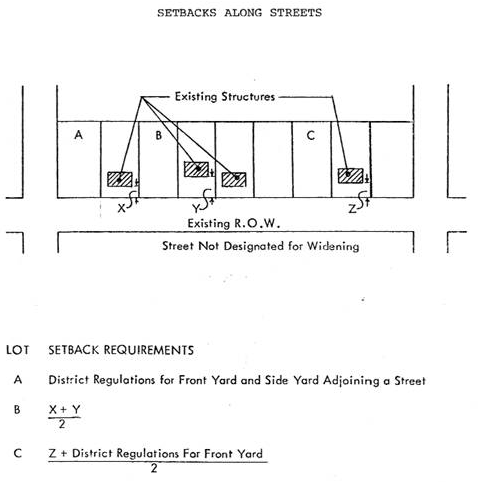
Illustriation No. 1
(2)
Corner lots. The depth of the setback lines shall be as required in this article for front yards or side yards adjoining streets in the districts where the lots are located.
(Code 2012, § 17.09.100; Ord. of 9-28-1966, § 5(F)(2))
Sec. 48-102. - Cargo containers.
(a)
Cargo containers are allowed as a permitted use in a M-1 or M-2 manufacturing zone, provided such containers are not stacked.
(b)
Cargo containers may be allowed as a permitted use in a commercial zone for the temporary storage of any equipment and/or materials at a construction or building site during the course of any construction or building project that is authorized by a city building permit. Cargo containers shall not be allowed in any residentially zoned areas within the city.
(1)
The number of cargo containers on any such construction or building project shall be determined by the city building and zoning officer, and the following factors shall be considered:
a.
The number of contractors, subcontractors or material suppliers on any such building or construction site;
b.
The projected time in which a building or construction project is expected to exist;
c.
The number and size of cargo containers which have been requested to be located at any such construction or building site;
d.
The items, materials or other products which are expected to be stored within any such cargo container.
(2)
Any such cargo containers authorized to be located within the city shall not exceed a length of 30 feet, nor a height of ten feet. Additionally, such cargo containers shall be located to minimize the visual impact to adjacent properties, parks, trails and rights-of-way, and any such cargo containers shall not be located within any required setback requirements for the zoning district where they are allowed. All cargo containers authorized in this article shall be placed on a level hard surface, shall have working doors and locks and under no circumstances shall any cargo containers be stacked upon each other.
(3)
Any cargo containers authorized in this article shall not be allowed to remain at any such construction or building site subsequent to the issuance of an occupancy permit or the completion of construction, whichever occurs first. A final occupancy permit shall not be issued until any such cargo containers have been removed. In order to facilitate this provision, the applicant shall post a bond or other security in a form that is required by the city building and zoning officer in the amount of $2,000.00 per cargo container, which shall be returned to the applicant upon the removal of such cargo containers.
(c)
Cargo containers shall not be allowed in any residentially zoned areas within the city.
(Code 2012, § 17.09.105; Ord. No. 3476, § 2, 5-3-2004; Ord. No. 4647, § 3, 10-21-2024)
Sec. 48-103. - Establishment; compatibility with principal use.
Accessory buildings, structures, and uses shall be compatible with the principal use and shall not be established prior to the establishment of the principal use.
(Code 2012, § 17.09.110; Ord. of 9-28-1966, § 5(G)(1))
Sec. 48-104. - Animal regulations.
Accessory uses shall not include the keeping, propagation, or culture of pigeons, poultry, rabbits, bees, livestock, or other nonhousehold animals for profit, except on such lots where the pursuit of agriculture is a permitted principal or accessory use.
(Code 2012, § 17.09.120; Ord. of 9-28-1966, § 5(G)(2))
Sec. 48-105. - Erection in required yards.
Accessory buildings, structures, and uses shall not be erected or altered in required yards, courts, or other open areas, except those that are permitted in this article as obstructions in yards, courts, or other open areas.
(Code 2012, § 17.09.130; Ord. of 9-28-1966, § 5(G)(3))
Sec. 48-106. - Detached buildings—Permitted as obstructions.
Except as otherwise required in this article for a specific accessory use, detached accessory buildings, as permitted in this article as obstructions in required rear yards, shall:
(1)
Be not more than one story or 15 feet in height, whichever is lower;
(2)
Cover not more than 30 percent of the area of the rear yard;
(3)
Be located not less than ten feet from a rear lot line, and not less than ten percent of the lot width from the side lot line, except:
a.
On corner lots, not nearer to the side street lot line than the distance required for a side yard adjoining a street, or in the case of a reverse corner lot, not nearer to the side street lot line than the distance required for a front yard on such lot adjoining the rear lot line;
b.
On through lots that do not have a rear lot line adjoining a no-access strip, not nearer to the rear lot line adjoining a street than the distance required for a front yard;
c.
A lot which abuts a public alley, not less than three feet from the rear lot line;
d.
As otherwise provided for in the R2 Single-Family Detached Residential District zoning regulations (see section 48-454).
(Code 2012, § 17.09.140; Ord. of 9-28-1966, § 5(G)(4); Ord. No. 3456, § 5, 2-2-2004; Ord. No. 4239, § 2, 6-4-2018)
Sec. 48-107. - Detached buildings—Height limitation, distance from principal building.
Except as hereinafter provided for an accessory building containing a dwelling unit or lodging rooms for domestic employees of the occupants of the principal dwelling, no detached building accessory to a single-family detached dwelling hereafter erected or altered at any location on a lot shall be more than one story or 15 feet in height, whichever is lower, nor shall it be nearer than ten feet from the principal building on the lot.
(Code 2012, § 17.09.150; Ord. of 9-28-1966, § 5(G)(5))
Sec. 48-108. - Detached dwellings—Distance from principal building.
Accessory single-family detached dwellings or detached buildings containing dwelling units or lodging rooms for domestic employees of the occupants of principal single-family detached dwellings, or for students, faculty, and personnel authorized to live on the premises of institutional on other nonresidential uses shall not be located in a yard or other open area required for the principal building, and shall be located not less than 40 feet from the principal building, except:
(1)
On a lot five acres or more in area, such an accessory building when designed as a part of an architectural entrance feature may be located in a required front yard on side yard adjoining a street;
(2)
When located in back of a principal building, the rear yard of the principal building shall be measured from the rear yard line to the nearest building wall of such accessory building.
(Code 2012, § 17.09.160; Ord. of 9-28-1966, § 5(G)(6))
_____
Sec. 48-109. - Permitted in required yards.
The following accessory buildings, structures, and uses are permitted and may be obstructions in yards and courts:
Note:
(1)
F Denotes permitted in front yard and side yards adjoining streets.
(2)
S Denotes permitted in interior side yards.
(3)
R Denotes permitted in rear yards.
(4)
C Denotes permitted in open courts.
(Code 2012, § 17.09.170; Ord. of 9-28-1966, § 5(H))
Secs. 48-110—48-131. - Reserved.
_____
Sec. 48-132. - Application in particular cases.
Where a building, lawfully existing at the date of adoption of the ordinance codified in this chapter exceeds the permitted maximum floor area ratio, an addition to such existing building to be constructed on an adjoining lot shall be entitled to the maximum floor area ratio permitted in the district in which it is located.
(Code 2012, § 17.09.180; Ord. of 9-28-1966, § 5(I))
Sec. 48-133. - Mobile homes, travel trailers and camping trailers.
(a)
Trailers shall not be permanently affixed to the ground as a principal or accessory use on a lot in any district.
(b)
Mobile homes, travel trailers or camping trailers shall not be occupied for dwelling purposes except in lawfully established mobile home parks or tourist camps. Mobile homes, travel trailers, and camping trailers shall not be parked or stored on any lot other than in a lawfully established mobile home park, tourist camp, or trailer sales or manufacturing establishment; except, in a residence district, one travel trailer on camping trailer may be parked on stored in a required rear yard.
(c)
Temporary parking and use of trailers shall be permitted in any district for temporary office or storage uses and in a residence district for temporary living quarters when a permit has been issued by the zoning officer. The zoning officer shall issue such permit for a period of one year and may renew said permit for one additional year. Such permit shall not be renewable again, except during a period of actual construction wherein the use of the trailer is incidental to the construction. All permits issued under this section shall be for trailers located on the same or contiguous lots as the construction on building development.
(d)
The city council may cause to he issued a permit for a trailer for use as a temporary dwelling for a custodian or guard in any city park or recreation area within the city wherein it is deemed necessary on desirable by the city council that such custodian or guard live on the premises.
(Code 2012, § 17.09.190; Ord. of 9-28-1966, § 5(J)(1))
Sec. 48-134. - Tents.
Tents shall not be erected, used, or maintained on any lot, except such small tents as are customarily used for recreation purposes and located on the same lot as a dwelling. Temporary use of tents for religious, amusement and recreation, business on manufacturing purposes shall be permitted when a permit has been issued by the zoning officer.
(Code 2012, § 17.09.200; Ord. of 9-28-1966, § 5(J)(2))
Sec. 48-135. - Boats.
In a residence district, one boat owned by the occupant of the dwelling may be stored or parked in the rear yard of a lot, provided no major repair, disassembly, or rebuilding operations are conducted thereon.
(Code 2012, § 17.09.210; Ord. of 9-28-1966, § 5(J)(3))
Sec. 48-154. - Public system required.
Each use established after the effective date of the ordinance codified in this article which requires sewerage and water facilities shall be served by public or community sewerage and water systems, except as provided in section 48-154.
(Code 2012, § 17.09.220; Ord. of 9-28-1966, § 5(K)(1))
Sec. 48-155. - Individual system—Permitted when.
Lots in areas that are not served with public sewerage or water systems may be served with individual sewage disposal systems or private wells, provided the city council finds, after receiving the recommendation of the planning commission, that it is impracticable to extend public or community sewer or water lines to serve the area, and there is an irrevocable commitment by the owner of the lot that connections shall be made to a public on community sewerage or water system not less than six months after such system has been installed on extended to serve the lot.
(Code 2012, § 17.09.230; Ord. of 9-28-1966, § 5(K)(2))
Sec. 48-156. - Individual system—Installation standards.
Installation of individual sewage disposal systems and private wells or community sewerage and water systems shall be in accordance with standards and specifications set forth in applicable laws of the city, county, state and Environmental Protection Agency.
(Code 2012, § 17.09.240; Ord. of 9-28-1966, § 5(K)(3))
Sec. 48-157. - Individual system—Lot size requirements.
A lot that was not a lot of record on the effective date of the ordinance codified in this article which is to be used for a single-family detached dwelling served with an individual sewerage disposal system shall have an area of not less than one acre and a width of not less than 150 feet or a greater area or width if required to conform with regulations contained in section 48-156.
(Code 2012, § 17.09.250; Ord. of 9-28-1966, § 5(K)(4))
Sec. 48-183. - Floodplain area.
The ground floor, including also a cellar on crawl space floor, of any building erected after the effective date of the ordinance codified in this article, structurally altered, enlarged, or moved to a floodplain area shall have an elevation that is equal to or above flood-crest level, or the distance above flood-crest level that may be required by the zoning officer for specific locations.
(Code 2012, § 17.09.260; Ord. of 9-28-1966, § 5(L))
Sec. 48-184. - Building height.
No building shall be erected, converted, enlarged, reconstructed or structurally altered to exceed the height limit herein established for the district in which the building is located, except that penthouses or roof structures for the housing of elevators, stairways, tanks, ventilating fans or similar equipment required to operate and maintain the building and fine or parapet walls, skylights, towers, steeples, flagpoles, chimneys, smokestacks, radio and television aerials, wireless masts, water tanks, silos, storage hoppers, elevators, on similar structures may be erected above the height limits herein prescribed; except, on land bordering, adjacent to, or in the vicinity of an airport, no building or structure shall be erected, converted, enlarged, reconstructed or structurally altered to exceed the height limits for the area in which it is located which now are or shall hereafter be established under the airport approach plan prepared by the state, or the maximum height limit herein required for the district, whichever is the lower height. A copy of the airport approach plan shall be maintained in the office of the zoning officer as a public record.
(Code 2012, § 17.09.270; Ord. of 9-28-1966, § 5(M))
Sec. 48-185. - Utility exemptions.
The following public utility uses are permitted in any district: wires, cables, conduits, vaults, laterals, pipes, mains and valves or other similar distributing equipment, provided that the installation and location shall conform with the rules and regulations of applicable administrative authorities.
(Code 2012, § 17.09.280; Ord. of 9-28-1966, § 5(N))
Sec. 48-186. - Conditionally permitted uses.
Application for zoning certificates and occupancy permits for the erection, major alteration or enlargement and occupancy of a conditionally permitted use shall be subject to the regulations of article XXVI of this chapter.
(Code 2012, § 17.09.290; Ord. of 9-28-1966, § 5(O))
Sec. 48-211. - Small wind energy systems.
(a)
Conditional use required. A small wind energy system complying with the standards in subsection (b) of this section within manufacturing districts (M1, M2, M3 or LM) shall be a permitted use. Any small wind energy system in any residential or business district shall require a conditional use permit (see article XXVI of this chapter for conditional use procedures).
(b)
Standards. Any small wind energy system shall meet the following standards unless modified through a condition attached to the ordinance approving the special use:
(1)
Roof-mounted small wind energy systems shall not exceed 15 feet in height above the elevation of the roof installation point, measured from the point of attachment to the top of the turbine blade at its highest point. Small wind energy systems shall be located no closer than ten feet from an adjacent property line.
(2)
Freestanding small wind energy system shall be set back a distance equal to 110 percent of the combined height of the tower plus the length to the tip of the blade from all adjacent property lines. Additionally, no portion of the small wind energy system, including guy wire anchors, may extend closer than ten feet to the property line. The wind energy system shall maintain a circular clear zone that has a radius which is equivalent to 110 percent of the combined distance of the tower height plus the length to the tip of the blade. This clear zone shall be maintained free of any occupied structures, tanks containing combustible/flammable liquids, and above ground utility/electrical lines.
(3)
Small wind energy systems shall have a non-reflective finish and shall be neutral in color. Small wind energy systems shall not be artificially lighted.
(4)
A building permit shall be required prior to erecting any small wind energy system. Mounting for such systems shall be in conformance with all electrical codes and building codes to ensure wind and weight loading requirements are met. Plans shall be stamped by a licensed structural engineer and inspected by a qualified inspector for such installations.
(5)
An emergency direct current disconnect switch shall be provided in an accessible location near the electric meter to shut off such system in the event of an emergency.
(6)
Small wind energy systems shall have a governor installed to regulate and limit the speed of the turbine in high wind events.
(7)
Small wind energy systems not in service for a period of 180 days shall be removed and the property on which it is located restored to its original condition within 30 days.
(8)
Small wind energy systems shall be primarily used to generate energy for the property where it is located.
(9)
The small wind energy system shall not exceed 55 decibels using the A scale (dBA), as measured at the site property line, except during short-term events such as severe windstorms and utility outages.
(Code 2012, § 17.09.300; Ord. No. 4071, § 4, 5-4-2015)
Sec. 48-212. - Roof-mounted solar energy systems.
(a)
Solar panels shall be a permitted use on any roof in any zoning district as permitted accessory uses. No freestanding panels shall be allowed in any residential zoning district.
(b)
Solar panels shall be flush with the roofline when possible and shall not be elevated more than 30 degrees off the roof pitch where it is attached or no more than five feet, whichever is less. Solar panels shall not extend beyond the roofline and shall be located no closer than ten feet from an adjacent property line. Solar panels shall not cover more than 50 percent of the total roof surface of a structure. Solar panels may cover 100 percent of the roof of nonresidential buildings, provided that they are fully screened from view on all sides of the buildings as viewed from ground level and appropriate provisions are made for fire safety access.
(c)
Solar shingles shall be permitted to cover any amount of a roof without the location limitation in subsection (b) of this section, provided that they are incorporated into and made to appear as part of the roof, continuous in area without gaps, rectangular in shape and do not cause glare to reflect on to neighboring properties.
(d)
All frame and visible structural parts of a solar panel shall match the roof color. No solar panels shall be artificially lighted.
(e)
A building permit shall be required prior to erecting any solar panel. Mounting for such systems shall be in conformance with all electrical codes and building codes to ensure wind and weight loading requirements are met. Plans shall be stamped by a licensed structural engineer and by a qualified inspector for such installation.
(f)
Solar panels shall not be permitted in any location other than the surface of the roof of the structure, unless otherwise specified in the subject zoning district.
(g)
Solar panels shall be primarily used to generate energy for the property on which they are located.
(Code 2012, § 17.09.310; Ord. No. 4071, § 5, 5-4-2015; Ord. No. 4469, § 3, 9-7-2021)
Sec. 48-213. - Ground-mounted solar energy systems.
(a)
Ground-mounted panels shall be a conditionally permitted use in any manufacturing or business zoning district as accessory uses. No ground-mounted solar panels shall be allowed in any residential district. If the ground-mounted solar panels will be located in a yard adjacent to a residential zoning district, then site plan review per the provisions of article XXVI of this chapter shall be required.
(b)
Solar panels shall be set back as follows:
(1)
In all zoning districts, systems shall comply with the respective setback requirements, as measured from the property line to the closest edge of the system.
(2)
The total solar panel surface area shall be included in the floor area ratio calculations for the respective zoning district.
(c)
Solar panels shall not exceed the height limits for accessory structures in the respective zoning district, as measured from adjoining grade at base to the highest elevation of the equipment.
(d)
Solar panels shall be sited behind existing vegetation (which shall be supplemented with landscaping where not adequate to screen the project) or be sited using the natural topography to screen the project.
(e)
Solar panels shall be enclosed by a fence or other appropriate means to prevent or restrict unauthorized persons or vehicles from entering the parcels.
(f)
A building permit shall be required prior to erecting any solar panel. Mounting for such systems shall be in conformance with all electrical codes and building codes to ensure wind and weight loading requirement are met. Plans shall be stamped by a licensed structural engineer and by a qualified inspector for such installation. Plans should identify any buffering and how the area under the solar panels will be maintained.
(Code 2012, § 17.09.311; Ord. No. 4071, § 6, 5-4-2015)

