
Morris City Zoning Code
ARTICLE III
- SIGNAGE REGULATIONS
Sec. 48-235. - Purpose.
This article is established to create the standards for a comprehensive and balanced system of signage regulations for the following purposes:
(1)
To encourage, as a means of communication in the city, the employment of signs that are:
a.
Compatible with their surroundings;
b.
Appropriate to the type of activity to which they pertain;
c.
Expressive of the identity of individual proprietors;
d.
Legible in the circumstances in which they are seen;
e.
Respectful of the reasonable rights of other property and sign owners;
(2)
To preserve, protect and promote the public health, safety and welfare;
(3)
To improve pedestrian and traffic safety;
(4)
To maintain and enhance community appearance and the city's ability to attract sources of economic development by promoting the reasonable, orderly and effective display of signs;
(5)
To minimize the possible adverse effect of signs on nearby public and private property;
(6)
To ensure the value of private property by assuring that compatibility of signs with surrounding land use values;
(7)
To ensure that signs are designed as integral architectural elements of the building and site, to which they principally relate.
(Code 2012, § 17.10.010; Ord. No. 3765, § 2, 10-6-2008; Ord. No. 4468, § 3, 9-7-2021)
Sec. 48-236. - Scope and applicability.
From and after the effective date of the ordinance from which this chapter is derived, the use of all signs and portions of signs erected, altered with respect to height and area or sign face, added to, or relocated in the city shall be in conformity with the provisions of this article. Any existing sign not in conformity with the regulations prescribed in this article shall be regarded as nonconforming.
(Code 2012, § 17.10.020; Ord. No. 3765, § 2, 10-6-2008)
Sec. 48-237. - Interpretation.
(a)
The provisions of this article shall be deemed to be an expression of the maximum allowable number and size of signs which causes the least potential conflict with surrounding uses, and which promotes a more attractive business climate within the city.
(b)
Where the conditions imposed by any provision of this article upon the control of signs are either more restrictive or less restrictive than comparable conditions imposed by the provisions of any other law, ordinance, statute, resolution rule or regulation of any governmental body, the regulations which are more restrictive, or which impose higher standards shall govern.
(c)
This article is not intended to abolish any easement, covenant, or any other private agreement, provided that where the provisions of this article are more restrictive or impose higher standards or requirements than such easements, covenants, or private agreements, the provisions of this article shall govern.
(d)
When a sign type is not specifically listed in the sections devoted to permitted signs, it shall be assumed that such signs are hereby expressly prohibited. If it is determined by the building and zoning officer that said sign is similar to and more objectionable than signs listed, such signs may be permitted.
(Code 2012, § 17.10.030; Ord. No. 3765, § 2, 10-6-2008)
Sec. 48-238. - Measuring distances or standards.
All measured distances or standards shall be to the nearer integer. If a fraction is one-half or less, the lower integer shall be taken.
(Code 2012, § 17.10.040; Ord. No. 3765, § 2, 10-6-2008)
Sec. 48-239. - Definitions.
The following words, terms and phrases, when used in this article, shall have the meanings ascribed to them in this section, except where the context clearly indicates a different meaning:
Animated sign means any sign that uses movement or change of lighting at a frequency of eight seconds or less to depict action or create a special effect or scene. The term "animated sign" also includes flashing signs (see Figure 1).
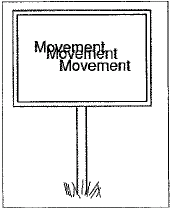
Figure 1
Automotive service station. See Gasoline service station.
Awning means a roof-like cover structure, constructed of cloth, metal or a similar material that is supported by the exterior wall of a building and constructed on a supporting framework. Such a structure may be either a retractable or fixed shelter.
Awning sign means any sign that is attached to or incorporated into an awning.
Banner sign means any sign of lightweight fabric or similar material that is displayed on a pole, building or attached to a staff of line. National flags, state, or municipal flags, or the official flag of any institution or business shall not be considered banners (see Figure 2).
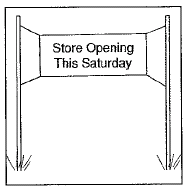
Figure 2
Building and zoning officer means the building and zoning officer, his designee and/or any person to whom the mayor delegates such authority with the advice and consent of the city council.
Building frontage means the linear distance of the building space occupied by the particular business measured on a straight line parallel to the street. Where a business does not parallel a street, the frontage shall be measured along the exterior of the building space occupied by the particular business (see Figure 3).
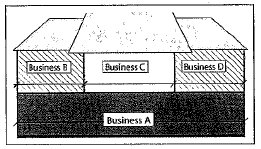
Figure 3
Canopy means a permanent roof-like shelter, other than an awning, that extends from part or all of a building face and is constructed of nonrigid material, except for the supporting framework.
Changeable copy sign means a permanent sign upon which letters or characters may be placed in or upon the surface area, either manually or electronically (but not both) to provide a message or picture. A sign of which the only copy that changes is an electronic or mechanical indication of time or temperature shall be considered a "time and temperature" portion of a sign and not a changeable copy sign. Changeable copy signs are also sometimes referred to as reader boards (see Figure 4).
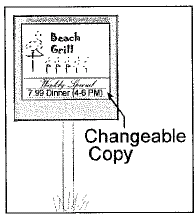
Figure 4
Commercial sign or sign of a commercial nature means any sign, the content of which advertises or publicizes any business, commodity, service, activity, idea, slogan, or entertainment conducted, sold, offered, or available by a person, corporation or entity which has as its goal or effect the distribution of profits to the owners of the advertising enterprise.
Directional and warning signs means signs that provide instruction, direction or warning. Directional signs may identify restrooms, public telephones, walkways, parking lot entrances and exits, and features of a similar nature. Warning signs may indicate "no trespassing," "no dumping" and similar messages.
Façade means the exterior face or wall of a building as it is presented to view. The apparent width and/or height of a building as viewed from streets, driveways, and parking lots. Minor changes in wall elevations do not constitute the creation of additional façades.
Flag means any fabric or bunting containing distinctive colors patterns, or symbols, used as a symbol of a government, political subdivision or other entity.
Flashing sign. See Animated sign.
Freestanding sign means any permanent sign not attached to a building, supported by structures or supports that are placed on or anchored in the ground, primarily comprised of ground, pole and pylon signs (see Figure 5).
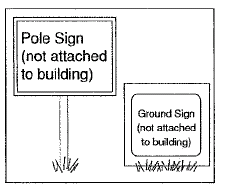
Figure 5
Gasoline service station means a business facility which is primarily distinguished by the retail sale of gasoline and related petroleum products necessary for the day-to-day operation of automobiles and commonly referred to as a "gas station." Such a facility may, in addition, offer automobile maintenance and repair services.
Ground sign means any sign where the bottom side of the sign is placed or mounted on a base at least as wide as the sign that is permanently placed, on the ground. A ground sign shall have no visible posts, poles, pylons or other supports designed to raise the sign above the ground. Ground signs are also referred to as monument signs.
Identification sign means a sign used to display and identify the name of the individual, business, professional, organization or institution occupying the premises upon which such sign is located.
Illuminated sign, external, means a sign illuminated by an artificial source of light that is cast upon the surface or face of the sign and not contained within the sign itself (see Figure 6).
Illuminated sign, internal, means a sign illuminated with an artificial source of light concealed or contained within the sign itself (see Figure 6).
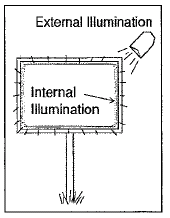
Figure 6
Inflatable sign means an inflatable object or balloon at least three feet in diameter, typically shaped as a gorilla, dragon, or other attention getting form (see Figure 7).

Figure 7
Marquee means a permanent roof-like shelter that extends from part or all of a building face and is partially supported by posts or columns.
Marquee sign means any sign attached to the front or sides of a marquee and not extending beyond the exterior dimensions of the marquee (see Figure 8).
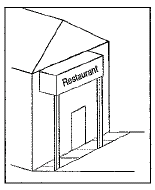
Figure 8
Menu board sign means a permanent sign used to inform the public of the list of food or drinks available in a restaurant and may include the corresponding prices. Menu boards are typically associated with a drive-through facility.
Moving sign. See Animated sign.
Mural sign means a sign painted directly on a building for advertising or city beautification purposes.
Nonconforming sign means any existing sign that does not conform to all the standards and regulations of this article.
Obsolete sign means a sign identifying or advertising a tenant, business; organization, activity, or service that has ceased to operate at or occupy the site of the sign for a period of longer than 30 days.
Off-site sign means a sign that relates in whole or in part to a business use or profession conducted, or to commodities, services, activities, ideas, slogans or entertainment not offered at or relating to the zoning lot upon which the sign is placed. The term "off-site sign" includes billboards.
On-site sign means a sign that relates solely to a business use or profession conducted, or to a principal commodity service or entertainment sold, provided or offered upon the premises where the sign is located.
Pennant means any lightweight plastic, fabric, or other material, whether or not containing a message of any kind, suspended from a rope, wire or string.
Permanent sign means any sign that is not a temporary sign. Such signs shall be constructed in accordance with the city building code in effect at the time of construction.
Pole sign means a sign mounted on one or more freestanding poles or pylons (see Figure 9).
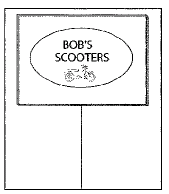
Figure 9
Portable sign means any sign not permanently attached to the ground or other permanent structure, or a sign designed to be transported, including, but not limited to, signs designed to be transported by trailer or means of wheels.
Projecting sign means any sign affixed to a building or wall in such a manner that its leading edge extends more than 12 inches beyond the surface of such building or wall (see Figure 10).
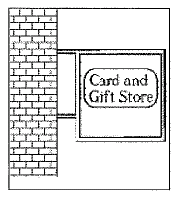
Figure 10
Real estate sign means a sign placed upon a property advertising that particular property for sale, lease, rent or open house (see Figure 11).
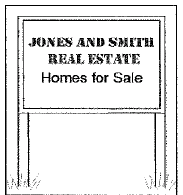
Figure 11
Residential development sign means a permanent sign placed at major entrances to a residential subdivision or planned development for the purpose of identification.
Roof sign means any sign erected and constructed wholly on and over the roof of a building and supported by the roof structure.
Roofline means either the edge of the roof or the top of the parapet, whichever forms the top line of the building silhouette, in cases where a building has several roof levels, this roof or parapet shall be the one belonging to that portion of the building on whose wall the sign is located.
Rummage sale or garage sale sign means a sign advertising the sale of used household goods by a person other than a merchant of those items at a residence or other property at which no routine for-profit activity is conducted.
Sidewalk signs means a temporary sign placed on a sidewalk and used to advertise specific items, products, services or events such as menu items, special and promotional sales. Such signs shall typically be of A-frame construction, hinged at the apex and folded into a sandwich position when transported or stored.
Sign means any structure, vehicle, device, or part thereof, which shall be used to identify, advertise or attract attention to any object, product, place, activity, person, institution, organization, firm, group, commodity, profession, enterprise, industry, or business and which shall display or is intended to display or include any letter, work, model, number, banner, flag, pennant, insignia, device or representation used as announcement, direction or advertisement. The term "sign" shall not, however, be interpreted as prohibiting any structure, vehicle, device or any part thereof used for the purpose of dissemination of political, economic, social or philosophical ideas entitled to constitutional protection. In any instance where this article would claim to prohibit any activity, the conditions of this article shall be interpreted as permitting the utilization of a sign to express such noncommercial speech subject to such other limitations as are included in this article.
Sign area means the area of a sign shall include the area contained within straight lines connecting the extreme projections, corners or edges of the letters, characters and other figures creating the sign taken as a whole. Where a sign has two or more display faces of unequal dimensions, the area of the largest face shall determine the sign surface area. The area shall include all decorative edging and moldings.
Sign face means the surface of a sign on which a message is displayed.
Temporary sign means a sign intended to be displayed a limited and usually fixed length of time.
Theater means a facility for showing movies or for indoor events such as plays, concerts, etc.
Vehicle sign means a sign attached or painted on a vehicle which is parked on or adjacent to any property, the primary purpose of which is to attract attention to a product sold or an activity of a business located on such property.
Wall sign means any sign parallel and attached to, but within 12 inches of, an exterior wall (see Figure 12).
Window sign means a temporary or permanent sign that is placed within or on the outside of a window or on the inside of a glass window in such a manner that it can be seen from the exterior of the structure (see Figure 12).
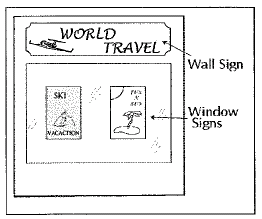
Figure 12
(Code 2012, § 17.10.050; Ord. No. 3765, § 2, 10-6-2008)
Sec. 48-257. - Measurements.
(a)
Area of individual signs.
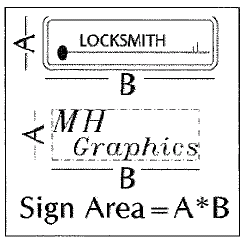
Figure 13
Area Calculation of
Individual Signs
(1)
The area of a sign shall be determined by the outer dimensions of the frame or enclosure surrounding the sign face. Brick or other sign framing shall not be included in the sign area calculation.
(2)
The area of a sign face or lettering not enclosed in a frame, is determined by calculating the smallest square, circle, rectangle, triangle, or combination that will encompass the extreme limits of the sign, together with any material or color forming an integral part of the background of the display or used to differentiate the sign from the backdrop or structure against which it is placed. This area calculation does not include any supporting framework, bracing, or decorative fence or wall when such fence or wall otherwise meets zoning ordinance regulations and is clearly incidental to the display itself.
(3)
A double-faced sign shall count as a single sign.
(b)
Height of individual signs. Height of signs shall be measured from the highest point of the sign to the crown of the street directly opposite the sign, or above grade at the base of the sign, whichever is less.
(Code 2012, § 17.10.060; Ord. No. 3765, § 2, 10-6-2008)
Sec. 48-258. - Prohibited signs.
The following signs are prohibited in all zoning districts within the city unless otherwise provided for in this article:
(1)
Off-site signs, unless granted a conditional use permit within the B4 district or specifically approved as a part of a planned unit development;
(2)
Animated signs, unless specifically approved as a part of a planned unit development. Traditional barber poles shall also be permitted, not to exceed two feet in height or protrude more than 12 inches from the building, and shall be utilized only for identification of a hair-cutting establishment (in authorizing the exemption for traditional barber poles, the corporate authorities find it in the public interest to retain this historic symbol of American commerce);
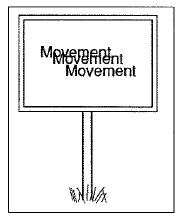
Figure 14
Animated Signs are Prohibited
(3)
Obsolete signs. Property owners are required to remove signs within 30 days of the date that a tenant, business, organization, activity or service has ceased to operate or occupy the site of the sign. However, if the sign structure is in good repair and meets all setback, size and other regulations of this article, the structure may be left in place and a blank sign panel installed;
(4)
Vehicle signs, except when all of the following criteria are met:
a.
Such vehicle at no time remains in one visible place for more than 24 consecutive hours;
b.
Such vehicle is actually used by its owner or another as a means of transportation of people or goods;
c.
Such vehicle displays current registration and is insured to operate on public streets in the state;
d.
Any sign determined by the building and zoning officer and/or police chief to not constitute a traffic or pedestrian danger, by reason of size, condition or illumination.
(5)
Roof signs.
(6)
Decorative lights. Illuminated tubing, strips of LED lights and/or strings of lights, used to outline or delineate property lines, sales areas, rooflines, doors, windows, and/or similar areas, shall be prohibited. However, temporary perimeter or border window lighting that is clearly decorative in nature and incidental to a commercial purpose displayed during commonly recognized national, state or local holiday seasons shall be exempted from this provision for a period of 21 days before and after the recognized holiday date.
(Code 2012, § 17.10.070; Ord. No. 3765, § 2, 10-6-2008; Ord. No. 4647, § 4, 10-21-2024)
Sec. 48-259. - Exemptions.
Unless otherwise stated, signs listed in this section are permitted in all zoning districts. The following exempt signs do not require a sign permit and shall not be counted when calculating the number of signs or square footage on a premises. However, such signs shall conform to all other general regulations in this article (for example; height area, setbacks, clearance, etc.):
(1)
Identification tags which give only the name, address and telephone number of the owner of the item or property to which such tag is affixed. This identification tag shall be limited to not more than one square foot in sign area.
(2)
Memorial signs or tablets and signs denoting the date of erection of buildings, no larger than five square feet.
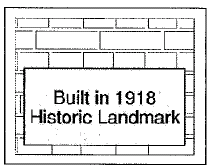
Figure 15
Memorial Sign
(3)
On-site directional and warning signs not exceeding five square feet in area.
(4)
Signs erected by a governmental body, or under the direction of such a body, such as traffic signs, railroad crossing signs, safety signs, and signs identifying public schools and playgrounds. Community entry signs and directional signs are also considered exempt signs.
(5)
Political signs.
(6)
Real estate signs, provided such signs shall not be more than six square feet in area, and no more than one such sign shall be permitted in each yard abutting a public street. Real estate signs shall be freestanding signs set back no less than ten feet from any lot line, shall not exceed six feet in height, and shall not be illuminated.
(7)
Rummage sale or garage sale signs, provided that:
a.
Sign shall not exceed four square feet in area per sign;
b.
Sign shall not be put up more than 24 hours prior to the event and must be removed no later than 24 hours after the event has ended;
c.
Signs may be placed off-site on private property subject to the consent of the property owner;
d.
No more than four directional signs shall be erected and maintained per event.
(8)
The flag, pennant or insignia of any government or of any religious, charitable or fraternal organization shall be allowed, provided it is flown with and is not larger than the American flag.
(9)
One logo flag of a company shall be allowed provided it is flown with and is not larger than the American flag.
(10)
Sidewalk signs, provided that:
a.
Only one sandwich sign is permitted per business. It must be located directly in front of the premises being advertised and must not interfere with movement of pedestrians;
b.
Shall not exceed 30 inches in width and 36 inches in height;
c.
May be displayed during permitted store hours and when the store is open for business;
d.
Shall not require electrical in any form and shall not display lights or contain moving parts;
e.
In the B-2 zoning district a sign must be placed close to the building frontage and shall not reduce the width of the sidewalk to less than four feet.
(11)
Window signs, provided that:
a.
Total window sign area should not exceed 40 percent of the window area of an individual window pain.
b.
Window signs shall contain no flashing elements.
(Code 2012, § 17.10.080; Ord. No. 3765, § 2, 10-6-2008)
Sec. 48-260. - Temporary signs.
(a)
The following signs are permitted for a period of not more than 30 days and require a permit from the building and zoning department. Permits are renewable for a single additional period of 30 days.
(1)
Balloon or inflatable signs; or other types of inflatable devices; said inflatable signs or devices are prohibited from roofs.
(2)
Banner signs; except that banner signs on public streetlights are allowable by permission of the city council for a period of time determined by them.
(3)
Flags and pennants.
(4)
Portable signs.
(5)
Special event signs.
(6)
Sales and/or marketing signs.
(7)
Spotlights and/or searchlights, provided that such devices are further restricted to use for a maximum of 15 days per business, per year.
(b)
In addition, all temporary signs shall:
(1)
Identify the date the sign was installed in the front, lower right corner with lettering a minimum of one inch in height.
(2)
Be securely anchored and meet other legibility, safety and maintenance criteria listed in section 48-268.
(Code 2012, § 17.10.090; Ord. No. 3765, § 2, 10-6-2008)
Sec. 48-261. - Downtown city sign district.
(a)
Downtown sign district boundaries. The downtown city sign district boundaries are illustrated in Figure 16, Downtown Sign District Boundary.
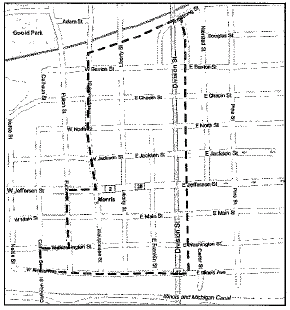
Figure 16 — Downtown Sign District Boundary Base Map; Microsoft Virtual Earth
(b)
Intent. The downtown city sign district is intended to preserve the historic character of the downtown area, while promoting the economic vitality of the downtown businesses. This district is also intended to implement the downtown city design guidelines, approved by the city council on June 3, 1997.
(c)
Standards. Signs permitted in the underlying district, as described in section 48-262 through 48-264 of this article, are permitted in the downtown city sign district subject to the following:
(1)
Number of signs. Each storefront shall be limited to two signs, one primary sign and one secondary sign. The primary sign shall be located on the building façade, above storefront display windows and below sills of second story windows. Secondary signs may be projecting signs (small hanging signs) or painted on a door or window, not to exceed 25 percent of the door or glass area. Projecting signs must maintain a seven-foot clearance between the bottom of the sign and the ground below the sign.
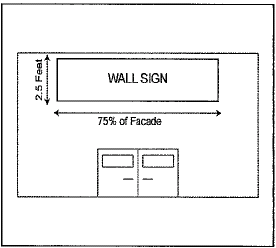
Figure 17
Wall Signs
(2)
Projection signs. Projecting signs must maintain a seven-foot clearance between the bottom of the sign and the ground below the sign. Projecting signs may not be more than 12 square feet in area, and no exterior dimension shall be more than four feet. The projecting sign and mounting system shall not project more than seven feet from the building wall and may not extend beyond the buildings parapet. Projecting signs are not restricted to a particular shape, allowing for creativity in sign design, such as an object or symbol for a type of business. Projected signs may not be internally illuminated unless a variance is granted.
(3)
Ground signs. One ground sign may be permitted provided such ground sign shall not exceed eight feet in height and shall not be located closer than five feet from any property line. The surface area of a ground sign in the downtown city sign district shall not exceed 100 square feet in surface area minus the total surface area of the primary wall sign.
(4)
Awnings and canopies. Existing awnings and canopies should be retained and repaired if possible. New awnings and canopies should be complimentary in placement, proportion and color to the building's original fixtures. Vinyl, plastic or metal awnings and canopies are discouraged. Lettering on awnings may be appropriate for primary or secondary signage, and lettering may be painted or sewn onto the valance.
(5)
Style and materials. Consideration of neighboring buildings, as well as the whole block, should be given when choosing colors and materials. Matching original historic signage should be attempted when possible. Wooden signs with raised lettering, metal signs, painted signs and neon and gold leaf are all appropriate in the downtown. Nationally distributed or mass-produced signs should be avoided.
(Code 2012, § 17.10.100; Ord. No. 3765, § 2, 10-6-2008; Ord. No. 4468, § 4, 9-7-2021)
Sec. 48-262. - Residential districts.
The following signs will be permitted in residential districts:
(1)
All signs enumerated in section 48-259.
(2)
All signs enumerated in section 48-260 for permitted or conditionally permitted nonresidential uses.
(3)
Residential nameplates:
a.
For a single-family or two-family dwelling, a nameplate indicating the street address number, apartment, number, name of occupant, or similar identifying information, not to exceed one square foot in area for each dwelling.
b.
For a multiple-family dwelling (three to nine units), a nameplate indicating the street address number, apartment number, name of building, complex, owner or similar identifying information, not to exceed three square feet total in area.
c.
For a multiple-family dwelling (greater than nine units), a nameplate indicating the street number, apartment number, name of building, complex, or owner or similar identifying information, not to exceed 32 square feet total in area. Said nameplate may be located in a front yard not less than five feet from the front lot line, nor be higher than six feet above curb level.
(4)
A sign identifying a lawful home occupation limited to a nameplate sign not to exceed one square foot in area.
(5)
Identification signs for permitted nonresidential uses, such as churches, public and quasi-public buildings, cemeteries, golf courses, recreational areas, etc. provided such signs are limited to one sign per building entrance, and, provided that each sign be limited to 32 square feet of area, and six feet in height. The maximum area may be increased up to 64 square feet of area and ten feet in height for listed uses occupying at least four acres. Changeable copy area may be incorporated into an identification sign.
(6)
Permanent residential development signs at entrances to a residential development or a planned unit development and containing no commercial advertising, constructed of material used in the buildings and as approved by the building and zoning officer. No more than two signs per entrance are permitted.
(Code 2012, § 17.10.110; Ord. No. 3765, § 2, 10-6-2008)
Sec. 48-263. - Business districts.
The following signs will be permitted in business districts:
(1)
All signs enumerated in sections 48-259 and 48-260.
(2)
Freestanding ground signs, subject to the following:
a.
There shall be a limit of one sign per lot, which shall be erected for the purpose of identifying the establishment.
b.
No ground sign shall exceed ten feet in height. No ground sign located adjacent to a residentially zoned lot shall exceed eight feet in height (see figure 18).
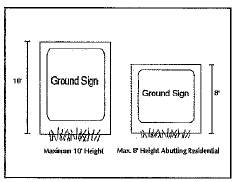
Figure 18
Freestanding Sign
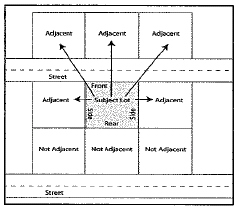
Figure 19
Adjacent to Residential
c.
The total surface area of a freestanding sign shall not exceed three-tenths square feet times the total linear frontage of the lot. No freestanding sign shall exceed a maximum surface area of 100 square feet including any changeable copy sign components.
d.
Freestanding signs shall be located no closer than five feet from any property line.
e.
A landscaped area shall be provided around the base of a ground sign. This landscape area shall consist of living landscape material, including shrubs, perennial groundcover plant, or a combination of both. Plantings shall be selected and placed such that the view of the sign is not blocked.
f.
No freestanding sign shall interfere with any parking space, loading area, driveway or maneuvering aisle.
g.
Freestanding signs shall be illuminated in accordance with section 48-266.
h.
Two freestanding menu board signs per lot shall be permitted for restaurants with drive-through facilities, provided such menu board signs do not exceed 24 square feet in area or eight feet in height.
(3)
Pole signs. Due to the small lot sizes and visibility concerns related to ground signs, one pole sign may be substituted for the permitted ground sign, for properties that front onto Illinois Route 47, from Interstate 80 to the north, and Armstrong Street to the south (see Figure 20). Pole signs are otherwise prohibited within business zoning districts (except for highway identification pole signs as regulated in section 48-267). Such pole signs shall not exceed 20 feet in height, shall not be located closer than ten feet from any property line, and shall otherwise comply with the requirements for permitted ground signs in business zoning districts.
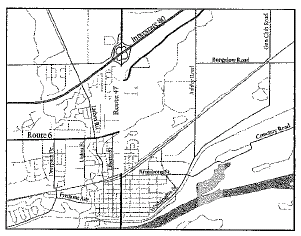
Figure 20 — Pole Signs Allowed Along Route 47 from I-80 (North) to Armstrong Street (South)
(4)
Wall signs shall be permitted, subject to the following:
a.
Wall signs shall be permitted on a building façade containing a public entrance or having frontage upon a public or private street.
b.
No wall signs shall be permitted for individual tenants in a multi-story or multi-tenant office building, unless specifically approved as a part of a planned unit development.
c.
Wall signs may be murals.
d.
The total surface area of all wall signs on each permitted building façade shall not exceed 1½ square feet per one linear foot of business frontage, or 300 square feet, whichever is less, unless specifically approved as a part of an approved planned development. Murals larger than this maximum area may be permitted for community beautification and celebration purposes, such as to identify particular historic resources or special districts. Any mural which will exceed the maximum area shall require site plan review as detailed in the site plan review ordinance, as codified in article XXVII of this chapter, or as amended.
e.
No wall sign shall project from the building wall more than 12 inches.
f.
Wall signs may be internally or externally illuminated in accordance with section 48-266.
g.
One canopy or awning sign shall be permitted provided no wall sign faces the same street frontage. Canopy signs shall count towards the total sign area permitted and shall maintain a clearance of eight feet between the lowest point of the canopy and the grade below.
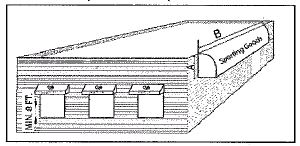
Figure 21
Canopy and Awning Signs
(5)
Changeable copy. Such signs are permitted as a part of a ground, pole, or wall sign if:
a.
If electronically-operated, any electronic message (other than a time or temperature message), must remain fixed within the display area for a minimum of eight seconds to avoid a flashing or blinking effect, or move slowly from right to left.
b.
If electronically-operated, it constitutes no more than 40 percent of the area of such sign and any electronic message (other than a time or temperature message), must remain fixed within the display area for a minimum of eight seconds to avoid a flashing or blinking effect, or move slowly from right to left;
c.
If manually-operated, it constitutes no more than 50 percent of the area of such sign.
(Code 2012, § 17.10.120; Ord. No. 3765, § 2, 10-6-2008; Ord. No. 4468, § 5, 9-7-2021)
Sec. 48-264. - Manufacturing districts.
The following signs will be permitted in manufacturing districts:
(1)
All signs enumerated in sections 48-259 and 48-260.
(2)
Wall signs are limited to an area equal to ten percent of the façade upon which the sign is to be mounted, up to a maximum of 225 square feet per façade.
(3)
One freestanding ground sign, provided it shall not exceed five-tenths square feet times the total linear frontage of the lot, up to a maximum of 150 square feet. Such signs may incorporate changeable copy.
(4)
Manufacturing signs may be illuminated in accordance with section 48-266.
(5)
A landscaped area shall be provided around the base of a ground sign. This landscape area shall consist of living landscape material, including shrubs, perennial groundcover plant, or a combination of both. Plantings shall be selected and placed such that the view of the sign is not blocked.
(6)
Changeable copy. Such signs are permitted as a part of a ground or wall sign if:
a.
It is an integral part of such sign;
b.
Such sign and any electronic message (other than a time or temperature message) must remain fixed within the display area for a minimum of eight seconds to avoid a flashing or blinking effect or move slowly from right to left.
(Code 2012, § 17.10.130; Ord. No. 3765, § 2, 10-6-2008; Ord. No. 4468, § 6, 9-7-2021)
Sec. 48-265. - Placement on lots.
(a)
Only signs erected by the city or the state shall be permitted within a public right-of-way. All other signs shall be placed no closer than five feet from any lot line.
(b)
Corner lots. No sign having a height of more than 30 inches above the crown of the adjacent streets shall be constructed or placed within a triangular area of 25 feet from the point of intersection of the two street right-of-way lines forming such corner lot.
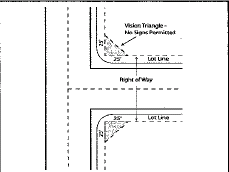
Figure 22 — Signs Not Permitted Within 25' Triangle at Driveway Intersection
(Code 2012, § 17.10.140; Ord. No. 3765, § 2, 10-6-2008)
Sec. 48-266. - Illumination.
(a)
The illumination of signs shall be diffused or indirect and shall be arranged so no direct rays shall reflect into a public way or any lot on the perimeter of the premises on which the signs are located.
(b)
Exposed light bulbs, flashing, blinking or traveling and similar illumination are prohibited unless approved as a part of a planned unit development (PUD).
(c)
Pole and pylon signs, if illuminated, shall be illuminated internally. The light source shall be visible only through a translucent surface or recessed into the sign.
(d)
Ground signs, if illuminated internally, shall adhere to the pole, pylon, and wall standards. If illuminated externally, light sources shall be contained in a protective enclosure and concealed by landscaping.
(e)
Curfews. All illumination, both internal and external, for signs located adjacent to a residentially zoned lot, shall be turned off on or before 11:00 p.m. or when the business closes, whichever is later. Signs subject to curfews are required to have functioning and properly adjusted automatic shut-off timers. See figure 19 for the definition of the term "adjacent lot."
(Code 2012, § 17.10.150; Ord. No. 3765, § 2, 10-6-2008)
Sec. 48-267. - Permitted extra signs.
Certain business operations are hereby found to be unique with respect to their sign requirements, and therefore, are permitted to have extra signs, in addition to those specified in sections 48-259 through 48-263, as specified below, including:
(1)
Gasoline stations. In addition to the signs permitted by other sections of this article, the following are permitted uniquely to gasoline stations:
a.
Two signs per pump island which designate the function of the island as self-service or full service. Such sign shall not have more than two faces and shall not exceed three square feet per face.
b.
One sign displaying the price of fuel sold, with a maximum surface area of six square feet per fuel type. Such signs shall not have more than two faces.
c.
One nonilluminated sign identifying the service performed in each service bay may be placed over the opening to each bay, having one face and not exceeding three square feet in area.
d.
One nonilluminated nameplate identifying the owner/operator may be placed adjacent to the doorway to the station, having one face and not exceeding two square feet in area.
e.
Temporary signs advertising batteries, tires, oil or other products, which are directly related to motor vehicles, if the signs are located directly adjacent to a display of the products described. Such signs may have two faces and shall not exceed 15 square feet.
f.
One sign over each pump stand not to exceed 24 inches in height.
g.
One wall sign on a detached car wash building, provided it complies will all other provisions for wall signs.
h.
Any signs required by state or federal government.
(2)
Movie and live entertainment theatres. In addition to the signs permitted by other sections of this article, the following signs are permitted uniquely to movie and live entertainment theatres:
a.
Each theater may have one sign up to 50 square feet to accommodate changeable copy lettering. Where the building contains more than one theater, additional display surface area may be permitted up to a maximum of 30 square feet of sign area for each theater. This sign area shall be in addition to an identification sign for the theaters.
b.
The permitted changeable copy sign may have two faces if freestanding, but both faces must be parallel and located no more than two feet apart.
c.
The permitted changeable copy sign may be located on a marquee, provided it does not project above or beyond the structural limits of such marquee.
(3)
On-premises freestanding highway identification pole signs. In addition to any signs otherwise permitted under this chapter, one on-premises freestanding sign used for highway identification, not to exceed 400 square feet in surface area, and not to exceed 60 feet in height, shall be allowed per subdivision or planned development unless otherwise specified, provided that the following criteria are met:
a.
The property is located in a B-3 district.
b.
All of the property is located within 1,500 feet of the centerline of Interstate 80.
c.
The property is not less than one acre in size.
d.
The minimum separation distance between one on-premises freestanding highway identification pole sign and another on-premises freestanding highway identification pole sign shall be 500 feet.
e.
No on-premises freestanding highway identification pole sign shall be located nearer than 500 feet from any residential district, residential use in a planned development, school, public park or place of worship.
f.
Collocation of multiple tenant signs on a single pole structure is encouraged over multiple individual signs. No more than five individual tenant signs shall be permitted per pole, and each individual tenant sign shall be limited to 100 square feet in surface area, allowing a maximum total combined sign area of 500 square feet. Commercial users located in a single subdivision or planned development desiring an individual sign instead of collocating on a multiple tenant sign shall be required to obtain a variance.
g.
Such signs shall in all other respects be in conformance with all other applicable requirements of this article.
(4)
Directory signs. Directory signs shall be permitted in the B-3, M1 and M2 zoning districts and erected in accordance with the following standards:
a.
Directory signs shall only be permitted for planned multiple-occupancy developments, such as a regional shopping center, an industrial park or a business park;
b.
Directory signs shall be a freestanding (ground, pole, pylon, etc.) sign which may be located on the premises or in the immediate vicinity. If said sign is located on a lot other than which it advertises, the sign must be located in a recorded easement that permits the installation of a sign and authorizes access to the party responsible for maintenance and repair of the sign;
c.
One sign shall be allowed at each point of vehicular access. No more than two directory signs shall be permitted for planned multiple-occupancy developments. Planned developments with property adjacent to Interstate 80 are allowed one additional directory sign at the property line adjacent to Interstate 80;
d.
Maximum of two sides per sign;
e.
Maximum sign area for a freestanding sign shall be no more than 300 square feet per side for planned multiple-occupancy developments;
f.
No portion of any sign shall be located closer than ten feet from front property lines and 18 inches from all rear and side property lines;
g.
Maximum height for a freestanding (pole, pylon, etc.) sign shall be 35 feet;
h.
The tenant panels shall only indicate the name and/or logo of the businesses within the planned development. Tenant panels may be used to display the sale, lease or rental of tenant space or outlots, but shall be removed within 14 days after the sale, lease or rental.
(Code 2012, § 17.10.160; Ord. No. 3765, § 2, 10-6-2008)
Sec. 48-268. - Liability, safety and maintenance.
(a)
Permitted signs shall be legible and all parts shall be in good repair.
(b)
Every sign and all parts thereof, including framework, supports, background, anchors, and wiring systems shall be constructed and maintained in compliance with the building, electrical and fire protection codes of the city. Signs may not be painted directly on any surface of a building, unless specifically permitted by section 48-261.
(Code 2012, § 17.10.170; Ord. No. 3765, § 2, 10-6-2008)
Sec. 48-269. - Obscenity prohibited.
It is unlawful for any person to display upon any sign or other advertising structure any matter in writing or in picture, which, considered as a whole, predominantly appeals to prurient interests, that is, a shameful or morbid interest in nudity, sex, or excretion, and goes substantially beyond customary limits of candor in descriptive representation of such matters.
(Code 2012, § 17.10.180; Ord. No. 3765, § 2, 10-6-2008)
Sec. 48-270. - Sign removal; abandoned or obsolete signs and structures.
For any sign or sign structure now or hereafter existing, which advertises a business, commodity, service, entertainment, activity, or event that has been discontinued for more than 90 days or is located on property which has been vacant and unoccupied, the building and zoning officer may give written notice requiring removal of the sign. Notice shall be provided to the owner as noted on the sign permit. If such owner cannot be located or is no longer the owner, then the property owner of record per the county assessor's records will be contacted. If, after notification, the proper person fails to remove the sign or sign structure within 60 days after such notice the building and zoning officer is hereby authorized to have such sign or sign structure removed. In lieu of complete sign removal, an abandoned or obsolete sign may have a blank white or black panel inserted into the sign frame provided the sign otherwise meets all requirements of this article. Legal nonconforming multi-tenant signs may remain in place if partially abandoned or obsolete, provided at least one advertised business is still in operation.
(Code 2012, § 17.10.190; Ord. No. 3765, § 2, 10-6-2008)
Sec. 48-271. - Nonconforming signs.
Any sign which existed lawfully at the time of the adoption of the ordinance from which this article is derived, and which becomes nonconforming upon adoption of the ordinance from which this article is derived shall be considered as a legal nonconforming sign and permitted to remain (grandfathered). Nonconforming signs shall be subject to the provisions set forth in article XXIV of this chapter.
(Code 2012, § 17.10.200; Ord. No. 3765, § 2, 10-6-2008)
Sec. 48-291. - Administration.
(a)
Permits. No sign (other than those exempted in section 48-259) shall hereafter be erected, altered or moved within the city without first obtaining a permit from the building and zoning officer. Such permit shall be issued only when the building and zoning officer verifies that the sign meets all of the applicable provisions of this article. The fee for granting such a permit shall be established by the city council and shall be available for review at city hall.
(b)
Application requirements. Any person requesting a permit for a sign shall file an application on the proper form as supplied by the building and zoning officer. Such application shall include the following:
(1)
Name, address, telephone number and e-mail (if applicable) of the applicant;
(2)
Name, address, telephone number, e-mail (if applicable), and property tax ID number of the business where the sign is to be located;
(3)
Name, address, telephone number and e-mail (if applicable) of the person/business that is erecting/altering/moving the sign;
(4)
A map drawn to scale showing the location of the building for which the sign is to be located, showing the location of the sign in relation to the building, neighboring buildings and roadways;
(5)
A plan drawn to scale showing the design of the sign, materials, square footage, height, lighting, method of construction, and means of attachment to the building/ground;
(6)
Written consent of the owner of the property on which the sign is to be located;
(7)
Any other information the building and zoning officer requires to properly and adequately review the application for compliance with this article.
(Code 2012, § 17.10.210; Ord. No. 3765, § 2, 10-6-2008)
Sec. 48-292. - Variances.
(a)
Variances to this article may be granted by the city council. The zoning board of appeals shall consider a request for a variation at a regular or special meeting of the board. The zoning board of appeals shall report its recommendation regarding the variance, in writing, to the city council. The city council shall approve or deny the variance within 30 days after receipt of the recommendation of the zoning board of appeals.
(b)
The zoning board of appeals or the city council may require from the applicants such sketches, drawings, or photographs as shall be necessary to indicate the present condition of the property or sign after the variation is granted. The zoning board of appeals may request, and the city council may impose reasonable restrictions or conditions that the applicant shall be required to observe if the variance is granted. In considering the application for variance, the zoning board of appeals and city council shall consider any unique physical property of the land involved, the available locations for adequate signing on the property, the effect of the proposed sign on pedestrian and motor traffic, the cost to the applicant of complying with the sign ordinance as opposed to the detriment, if any, to the public from the granting of the variance and the general intent of the sign ordinance.
(c)
The zoning board of appeals shall have the power to recommend a variance from the provisions or requirements of this article only where the following criteria have been considered:
(1)
The literal interpretation and strict application of the provisions and requirements of this article would cause undue and unnecessary hardship to the sign user because of unique or unusual conditions pertaining to the specific building or property in question.
(2)
The granting of the requested variance would not be detrimental to or endanger the public health, safety, morals, comfort or general welfare.
(3)
The granting of the variance would not be injurious to the use and enjoyment of other property in the immediate vicinity nor substantially diminish or impair property values within the adjacent area.
(4)
The unusual conditions applying to the specific property do not apply generally to other buildings or properties in the city.
(5)
The granting of the variance will not be contrary to the general objectives set forth in section 48-235.
(Code 2012, § 17.10.220; Ord. No. 3765, § 2, 10-6-2008)
Sec. 48-293. - Appeal jurisdiction.
The zoning board of appeals shall have the power to hear and rule on appeals from any decision of the building and zoning officer enforcing this article. Such appeals shall be similar in procedure to the appeal provisions of this chapter.
(Code 2012, § 17.10.230; Ord. No. 3765, § 2, 10-6-2008)
Sec. 48-294. - Duties.
The building and zoning officer or his designee shall examine all applications for permits for erection of new signs which conform to the requirements of this article, record and file all applications for permits with any accompanying plans and documents, make a periodic inspection of all signs in the city, and submit reports as directed by the city council.
(Code 2012, § 17.10.240; Ord. No. 3765, § 2, 10-6-2008)
Sec. 48-295. - Penalties.
Any person, firm or corporation who violates any provisions of this article shall be subject to a fine neither less than $50.00 nor more than $750.00. Each day a violation occurs or continues to occur shall be deemed a separate violation as provided by local ordinance.
(Code 2012, § 17.10.250; Ord. No. 3765, § 2, 10-6-2008)

