
Morris City Zoning Code
ARTICLE XXIII
- OFF-STREET PARKING AND LOADING8
Editor's note— Ord. No. 4647, § 5, adopted October 21, 2024, repealed the former Art. XXIII, §§ 48-1435—48-1445, 48-1469—48-1473, 48-1495—48-1498, 48-1530—48-1537, 48-1563, 48-1564, and enacted a new Art. XXIII as set out herein. The former Art. XXIII pertained to off-street parking and off-street loading and derived from §§ 10(A)—(D), app. I, app. II, from Ord. adopted September 28, 1966; Code 2012, §§ 17.57.010—17.51.280, ch. 17.57, apps. I, II, adopted 2012; Ord. No. 2509, adopted September 22, 1980; Ord. No. 2647, adopted May 27, 1986; Ord. No. 3202, adopted March 13, 2000; Ord. No. 3456, §§ 6—9, adopted February 2, 2004; Ord. No. 4536, §§ 3, 4, adopted August 1, 2022.
Sec. 48-1435. - Scope of regulations; applicability.
The off-street parking and loading provisions of this article shall apply as follows:
(1)
Accessory off-street parking and loading facilities shall be provided as required by the regulations of this article for all buildings and structures erected, altered, or enlarged and all uses of land established in each district after the effective date of the ordinance codified in this article.
(2)
When the intensity of use of any building, structure, or premises is increased through the addition of dwelling units, gross floor area, seating capacity, or other units of measurement in the amount specified in this article requiring parking or loading facilities, such required parking and loading facilities for only the addition shall be provided.
(3)
Whenever the existing use of a building or structure is hereafter changed to a new use, parking or loading facilities shall be provided as required for such new use. However, if the building or structure was erected prior to the effective date of the ordinance codified in this article, additional parking or loading facilities are mandatory only in the amount by which the requirements for the new use would exceed those for the existing use, if the latter were subject to the parking and loading provisions of this.
(Ord. No. 4647, § 5, 10-21-2024)
Sec. 48-1436. - Permissive parking and loading facilities.
Nothing in this article shall be deemed to prevent the voluntary establishment of off-street parking and loading facilities to serve any existing use of land or buildings, provided that there is adherence to all regulations herein governing the location, design, and operation of such facilities.
(Ord. No. 4647, § 5, 10-21-2024)
Sec. 48-1437. - Damage or destruction to conforming or nonconforming building.
When any conforming or nonconforming building or use which is in existence on the effective date of the ordinance codified in this article, which is restored and continued in operation after being damaged or destroyed by fire, collapse, explosion, or other cause, to the extent that the cost of restoration does not exceed 60 percent of the assessed value, there may be provided only the off-street parking or loading facilities equivalent to any maintained at the time of such damage or destruction. However, in no case shall it be necessary to restore or maintain parking or loading facilities in excess of those required by this article for equivalent new uses or construction.
(Ord. No. 4647, § 5, 10-21-2024)
Sec. 48-1469. - Open and enclosed spaces.
Accessory off-street parking spaces located on the same lot as occupied by the use served may be open to the sky or enclosed in a building. Accessory off-street parking spaces that may be permitted elsewhere than on the same lot occupied by the use shall be open to the sky, except when an off-site storage garage or parking structure is recommended by the planning commission and authorized by the city council.
(Ord. No. 4647, § 5, 10-21-2024)
Sec. 48-1470. - Surface specifications.
All open off-street parking areas available for public or employee uses shall be improved with a compacted base, and an all-weather, dust-free surface, such as asphalt, concrete or pavers, as approved by the city engineer. Exceptions: Storage of farm and landscaping implements shall be exempt from this requirement.
A base with a temporary dust-free surfacing shall be permitted for the first year. However, within one year from the issuance of the building permit, subject parking lots shall be improved with a permanent wearing surface, such as asphalt, concrete or pavers, as approved by the city engineer. All off-street loading spaces, access drives, aisles, and maneuvering spaces shall be improved in accordance with the regulations set forth in section 48-1534.
(Ord. No. 4647, § 5, 10-21-2024)
Sec. 48-1471. - Screening and landscaping.
Subject to the provisions of article XXVII, site plan review, all open off-street parking areas containing more than four parking spaces shall incorporate proper landscaping design following the requirements in section 48-1963. Parking lots that are located less than 40 feet from the nearest property line of a lot in a residential district, shall be effectively screened on each side adjoining or fronting on such property line by a wall, solid or semi-opaque fence, or densely planted compact hedge, not less than five feet nor more than eight feet in height.
(Ord. No. 4647, § 5, 10-21-2024)
Sec. 48-1472. - Lighting.
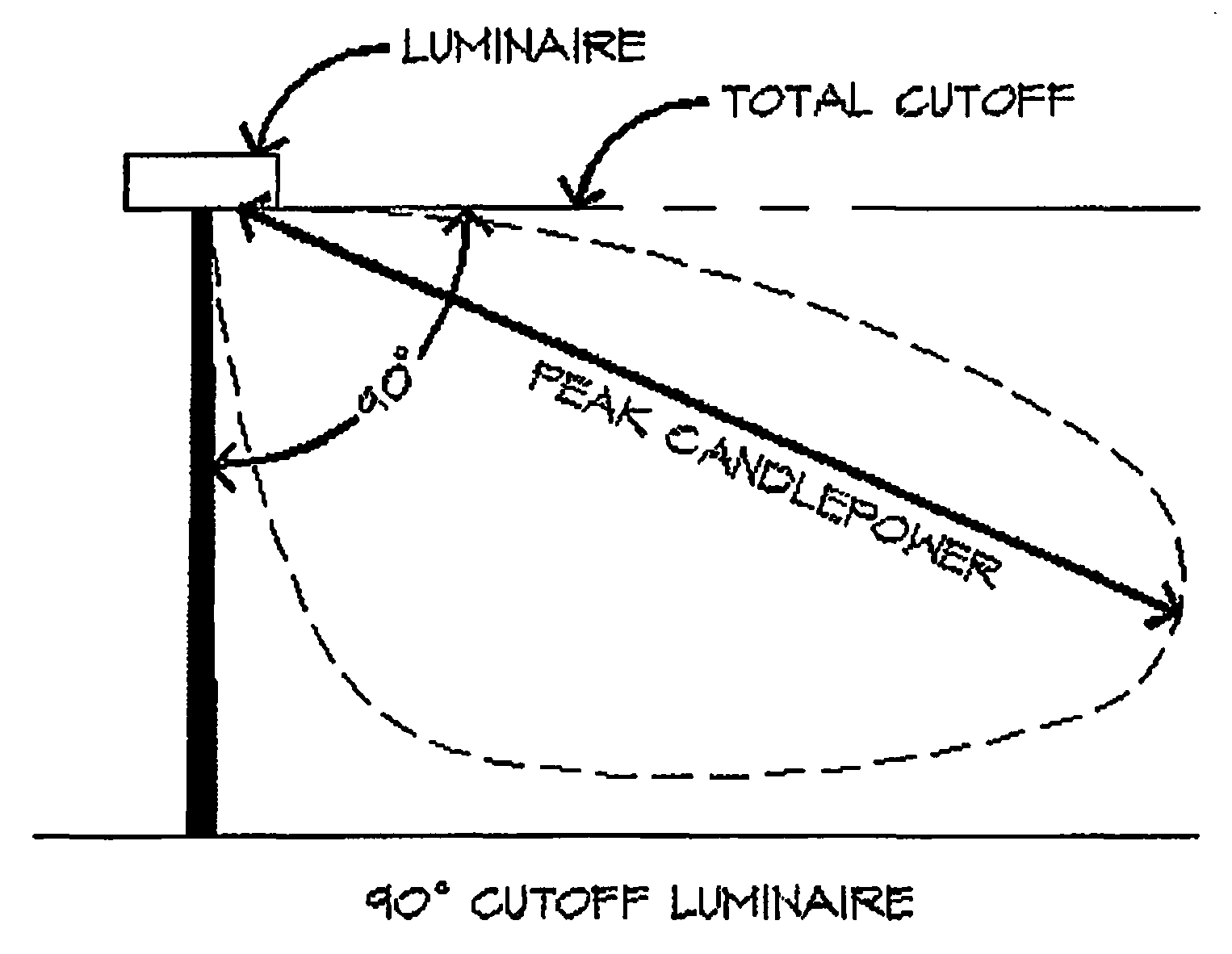
Any lighting used to illuminate off-street parking areas shall be arranged so as not to reflect direct rays of light into streets or adjacent residential districts. In no case shall lighting in a residential zoning district exceed one foot-candle measured at the property line (Figure 10-1). All lighting should use recessed, shielded or cutoff fixtures, with a cutoff angle of 90 degrees or less as shown below. In a parking area containing more than four parking spaces such lighting shall be extinguished one-half hour after the close of business, except as may otherwise be permitted or required by the zoning board of appeals for maintaining illumination with less candle power after the time specified above.
(Ord. No. 4647, § 5, 10-21-2024)
Sec. 48-1473. - Repair and service.
No motor vehicle repair work or service of any kind shall be permitted in off-street parking areas. No gasoline or motor oil shall be sold in conjunction with any accessory parking facilities.
(Ord. No. 4647, § 5, 10-21-2024)
Sec. 48-1474. - Maintenance.
The owner and tenant shall be jointly and severally responsible for the maintenance of all components comprising an off-street parking area, including pavement, stall striping, lighting and signage. Parking areas shall be maintained in good condition to present a neat and orderly appearance, and shall be kept free from broken pavement, potholes, refuse and debris. Striping shall be visible and clearly define all parking spaces, including handicapped signage. Lighting fixtures and standards shall be operational and free of damage or rust. Signage shall be readable and properly maintained and located for their respective purpose. An owner shall address any maintenance issue identified within 20 days after receiving written notification from the city.
(Ord. No. 4647, § 5, 10-21-2024)
Sec. 48-1475. - Best management practices (BMPs) and permeable pavements.
The use of best management practices (BMPs) or permeable surface materials is not mandatory; however, the integration of permeable landscape designs and pavements are encouraged as a means of reducing stormwater runoff in the city. The following are some examples of practices for sustainable landscape design, construction, and landscape maintenance in off-street parking areas:
(1)
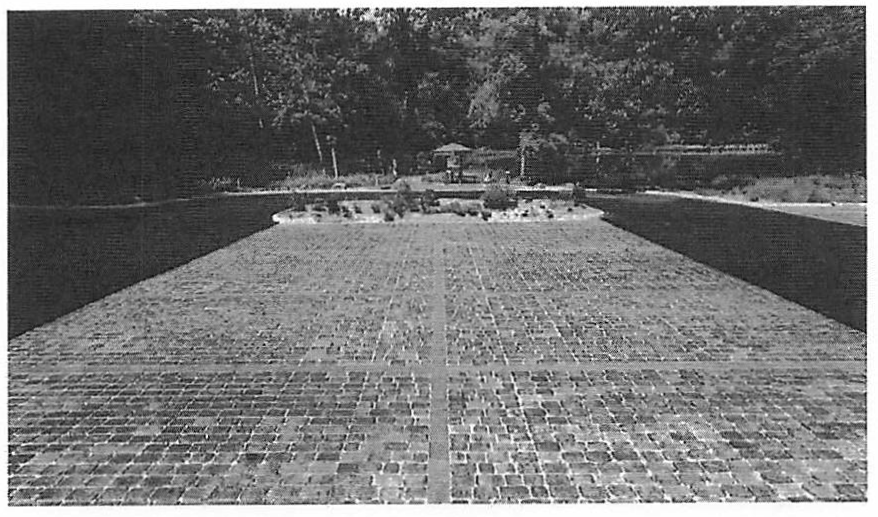
Permeable pavement and pavers. Permeable pavement (as shown below) and pavers are an alternative method of hard surface that allows stormwater runoff to filter through voids material. The use of this porous material can help promote the natural cleaning and infiltration of water, instead of allowing it to wash into streets and down storm drains. Use of this material is allowed in designated drive or path areas.
(2)
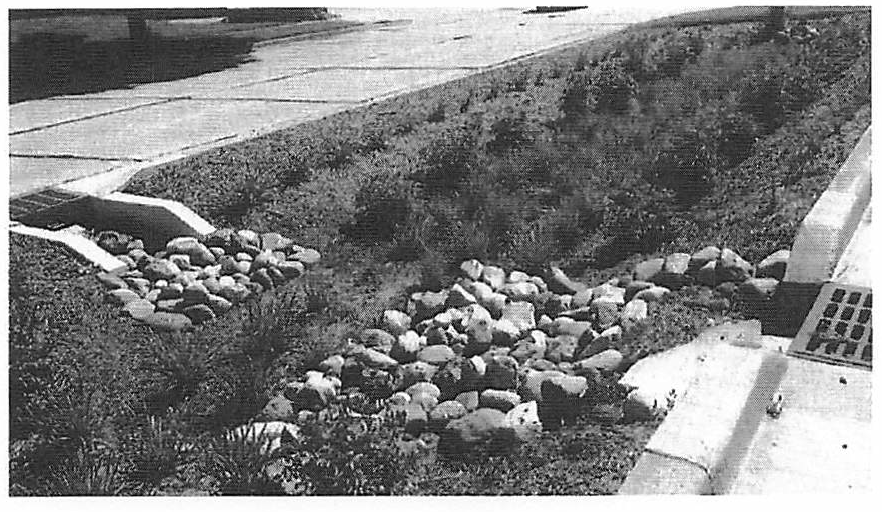
Bioswales or retention ponds. Bioswales and retention ponds (as shown below) are vegetated landscaped depressions that capture, treat, and slow down stormwater runoff. They provide a more aesthetically pleasing environment than the typical required concrete stormwater fixtures. These landscaped areas often use native species and water-tolerant plantings.
(3)
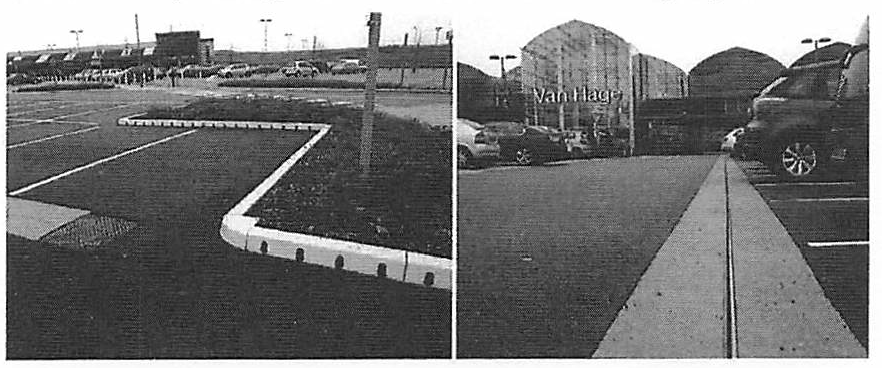
Parking lot drainage. Stormwater drainage is an integral component in the design of parking lots (as shown below). The concept below shows how stormwater would be infiltrated into the planting areas and then drained to a specified area.
(4)
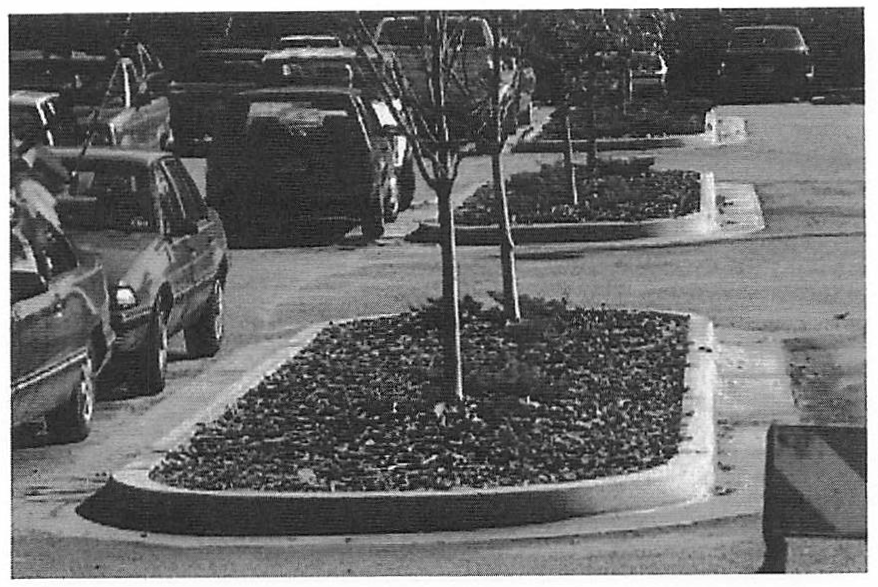
Parking lot islands. To help reduce stormwater run-off and provide shade, landscape islands are also encouraged in smaller parking lots. These should generally be located at the end of parking rows to aid in vehicular circulation. Landscape islands shall be the size of a standard parking space or larger and shall contain a minimum of one shade tree and a ground-covering plant layer or turf grass. For each landscape island provided in the interior of a parking lot the required number of spaces shall be reduced an equivalent number.
(Ord. No. 4647, § 5, 10-21-2024)
Sec. 48-1495. - Control of off-site parking facilities.
In cases where parking facilities are permitted on a lot other than the lot on which the structure or use served is located, the owner of record of such lot shall be the same as the owner of record of the lot occupied by the structure or use in which the parking facilities are accessory. A covenant running with the land must be recorded in the office of the county recorder of deeds, on the lot upon which the accessory off-street parking is located which prohibits any other use on that lot, and a copy of the recorded covenant certified by the county recorder of deeds, must be deposited with the building inspector. The covenant shall not be released until such time as either one of the following conditions occurs:
(1)
The structure on the lot containing the principal use is removed and the principal use terminated;
(2)
Another lot of the required size within the required distance is properly developed and used for the required accessory off-street parking in place of and in lieu of the initial lot used for accessory off-street parking with the same requirements, covenants, and conditions attaching to such substitute accessory use lot as approved by the same authority as required for approval of such initial lot.
(Ord. No. 4647, § 5, 10-21-2024)
Sec. 48-1496. - Existing parking facilities.
Accessory off-street parking facilities in existence on the effective date of the ordinance codified in this article and located on the same lot as the building or use served shall not hereafter be reduced below, or if already less than, shall not be further reduced below the requirements for a similar new building or use under the provisions of this article.
(Ord. No. 4647, § 5, 10-21-2024)
Sec. 48-1497. - Location of parking spaces.
(a)
Required accessory off-street parking spaces shall be located on the same lot as the use served, except when the planning commission recommends and the city council authorizes, for a specific use, the location of all or a part of the required off-street parking spaces on a lot that does not contain the principal use or structure.
(b)
Unless such permitted off-street parking spaces are provided by permitted collective use of accessory off-street parking spaces for another use, they shall be located in a district where parking lots are allowable principal uses. However, there shall be compliance with regulations set forth in section 48-1495 for required accessory parking spaces not located on the same lot as the principal use or structure.
(Ord. No. 4647, § 5, 10-21-2024)
Sec. 48-1498. - Size of space.
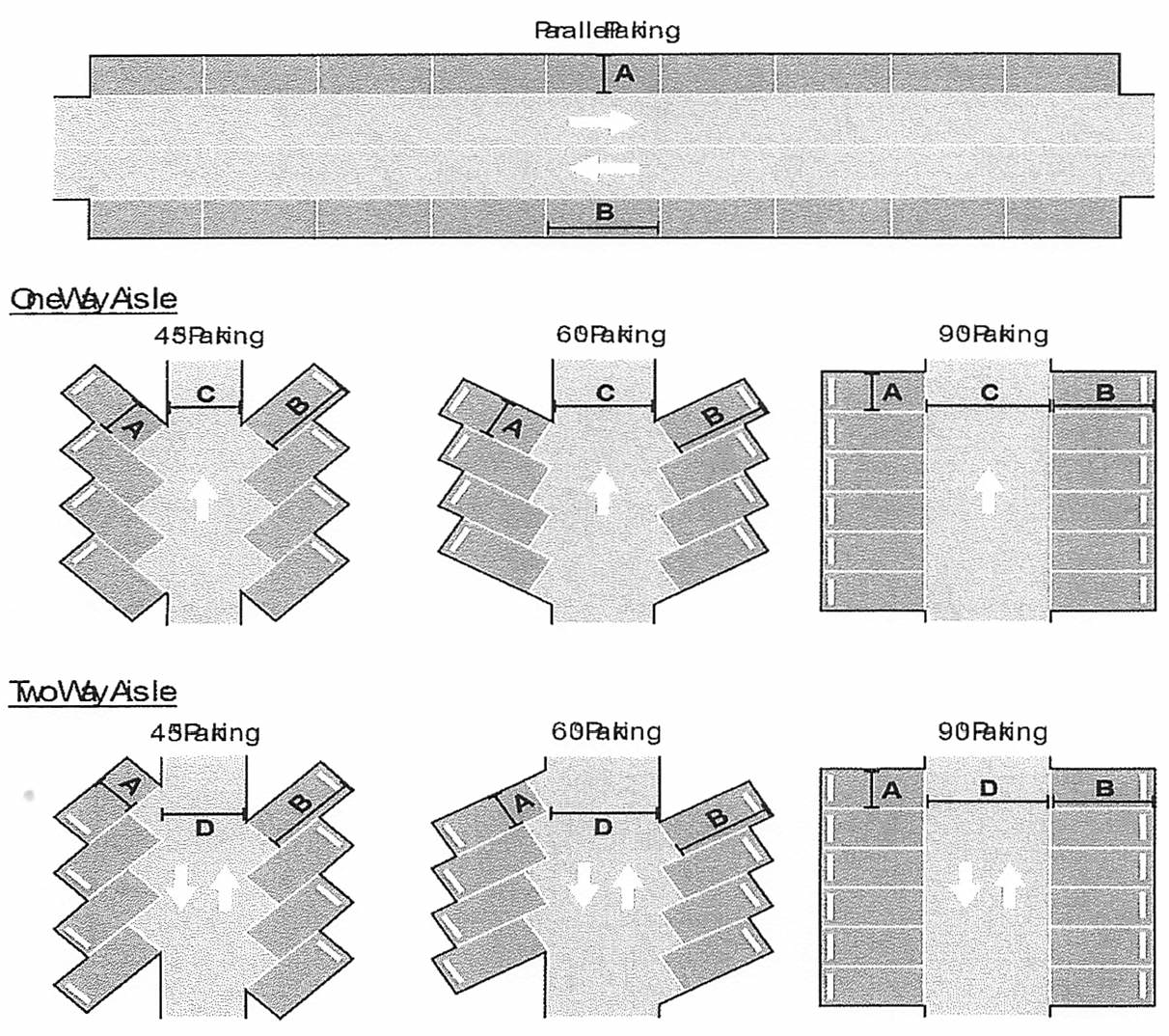
A required off-street parking space shall have a width and length, exclusive of access drives or aisles, ramps, columns, or office and work areas in accordance with standards set forth in appendix I in section 48-1563. Enclosed parking spaces shall have a vertical clearance of at least seven feet.
(Ord. No. 4647, § 5, 10-21-2024)
Sec. 48-1499. - Access of parking area.
Each required off-street parking space shall open directly upon an aisle or driveway of a width and design in accordance with standards set forth in appendix I in section 48-1563. All off-street parking facilities shall be provided with appropriate means of vehicular access to a street or alley with location and design of intersection of parking area access driveway and the street or alley in accordance with regulations set forth in appendix II in section 48-1564.
(Ord. No. 4647, § 5, 10-21-2024)
Sec. 48-1500. - Use of facilities; bus spaces.
Accessory off-street parking facilities required as accessory to uses listed herein shall be solely for the parking of automobiles of patrons, occupants, or employees. When bus transportation is provided for patrons, occupants, or employees of a specific establishment, additional open or enclosed off-street parking spaces for each bus to be parked on the premises shall be provided in accordance with regulations for access (section 48-1441), in yards (section 48-1444), design and maintenance (sections 48-1469 through 48-1473), and area applicable to accommodating such buses.
(Ord. No. 4647, § 5, 10-21-2024)
Sec. 48-1501. - Computation of fractional space requirements.
When determination of the number of off-street parking spaces required by this article results in a requirement of a fractional space, any fraction of one-half or less may be discounted while a fraction in excess of one-half shall be counted as one parking space.
(Ord. No. 4647, § 5, 10-21-2024)
Sec. 48-1502. - Parking in yards.
Off-street parking spaces, open to the sky, may be located in required interior side yards, not less than five feet from the nearest lot line, except a parking area containing four or more parking spaces shall not be located nearer than 20 feet from a residence district boundary line; except as to churches existing at the time of the passage of the ordinance codified in this article, which shall comply with the business and commercial off-street parking requirements as set forth in this article. In business and commercial districts, the required off-street parking spaces must be at least five feet from the property line. For properties adjoining the major roadways listed in section 48-1963, additional landscape setback shall be provided.
(Ord. No. 4647, § 5, 10-21-2024)
Sec. 48-1503. - Employee parking.
Parking spaces required on an employee basis shall be based on the maximum number of employees on duty or residing, or both, on the premises at any one time.
(Ord. No. 4647, § 5, 10-21-2024)
Sec. 48-1504. - Shared parking.
Shared parking is an arrangement whereby two or more owners or users of nonresidential properties with different peak-hour parking demands use the same off-street parking spaces to satisfy their off-street parking requirements.
The building and zoning officer, with advice from the city planner and engineer, is authorized to make an administrative adjustment allowing shared parking arrangements for nonresidential uses that have different hours of operation on a property. The building and zoning officer may allow up to 100 percent of the parking required for a use with peak weekday daytime demand to be supplied with parking spaces provided for a use with peak weekday nighttime or Sunday demand and vice versa. Shared parking spaces shall be located within 500 feet of the primary entrance of all uses served accessible parking spaces may not be shared and must be located on-site.
In order to approve such an administrative adjustment, the city planner must find that:
(1)
Based on evidence provided by the property owners there is no substantial conflict or overlap in the principal operating hours for which the shared parking is proposed;
(2)
The shared parking facility is located within 300 feet walking distance of each of the uses, as measured from the entrance of each use to the nearest parking space in the facility; and
(3)
There are convenient, visible pedestrian connections between the facility and all of the sharing properties.
The parties involved in a shared parking plan shall execute an agreement on the shared parking and file it with the building and zoning officer and the city attorney. The shared parking agreement shall remain in effect only so long as the agreement remains in force. If the agreement is no longer in force, the property owners must provide parking as otherwise required by this article.
(Ord. No. 4647, § 5, 10-21-2024)
Sec. 48-1505. - Cross-access between adjacent lots.
Where parking lots for separate uses are adjacent to one another and the opportunity for connected cross-access exists, such access is encouraged. Cross-access should be done in a logical manner that results in safe and efficient circulation between adjacent parking areas.
(Ord. No. 4647, § 5, 10-21-2024)
Sec. 48-1506. - Land-banked future parking.
Land-banking refers to setting aside part of the site that would have been required for parking and landscaping this space initially. If the parking spaces are needed in the future, they can be added when actually needed. The city council may grant relief from city parking requirements to allow land-banking up to 25 percent of the required parking spaces. In any business or manufacturing zoning districts, land-banking requests shall be determined on a case-by-case basis. In all cases, approval for land-banking may be granted, provided that:
(1)
Sufficient evidence is provided by the applicant that supports the reduced parking needs;
(2)
The area proposed for land-banking of parking spaces shall be an area suitable for parking at a future time;
(3)
Landscaping of the land-banked area shall, at a minimum, be landscaped with turf. As a result of site plan review, additional landscaping of the land-banked area may be required;
(4)
The land-banking area will not be used for any other use. The land-banked parking area cannot be used to fulfill other landscaping requirements within article XXVII;
(5)
As part of the site plan review process, the applicant shall show the area to be banked on the site plan and marked as "Land-Banked Future Parking."
The building and zoning officer, at their sole discretion, based on increased parking demand for the use, or provided parking proving to be inadequate, may require the conversion of all or part of the land-banked area to paved off-street parking spaces. The owner may convert the land-banked area to parking prior to city notification, subject to all required permits.
(Ord. No. 4647, § 5, 10-21-2024)
Sec. 48-1507. - Downtown parking zone.
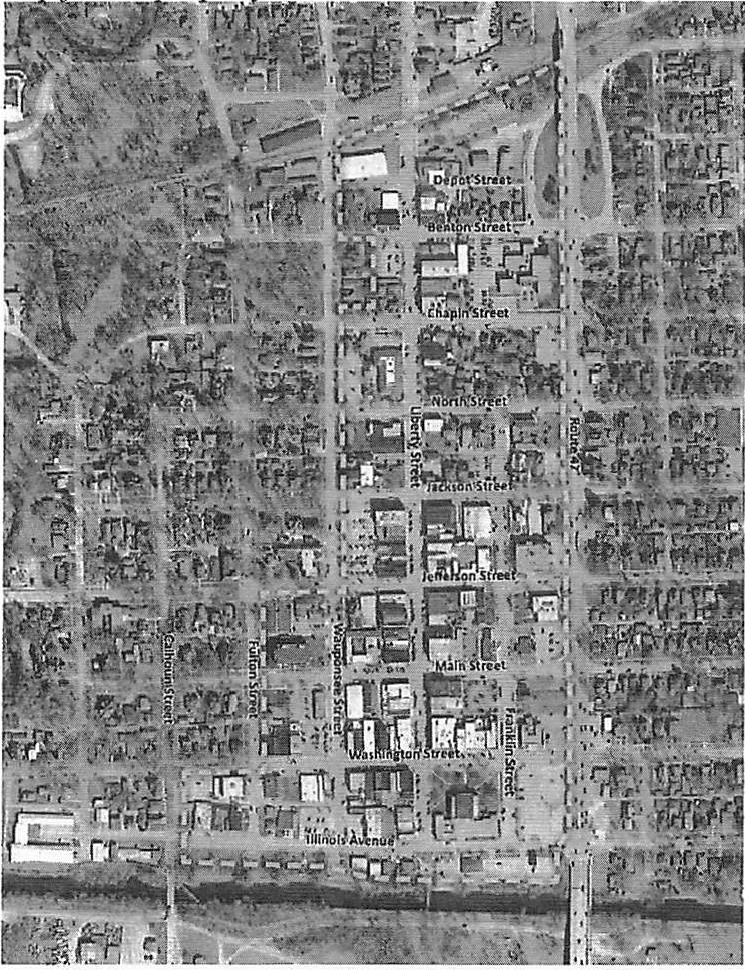
The establishment of the downtown parking zone (DPZ) intends to encourage the preservation of older buildings, create a pedestrian-friendly environment, and ensure robust economic activity for commercial establishments in the historic downtown area. The DPZ covers the area that historically has been identified as Morris's downtown between the CSXT railroad and the Illinois River. Traditionally, the DPZ is occupied with older buildings on small lots. Such development, which occurred before the current level of automobile use, often means that parcels are not of an adequate size to accommodate the required number of off-street parking spaces. This area has access to many municipal parking lots, and extensive on-street parking. The DPZ allows for an area-wide approach to provide a realistic solution for the parking demands in the downtown area while intending to maintain the existing built environment.
(1)
Most nonresidential land uses within the DPZ are exempt from the minimum parking requirements of this section. For a nonresidential land use with a gross floor area of 7,500 square feet or more, an administrative review will be required by the city planner to ensure such scale of development will not significantly impact the availability of parking spaces in the DPZ. For a development that provides residential units, at least one parking space per dwelling unit shall be provided.
(2)
If parking is required of a particular use in the DPZ, on-street parking spaces within 250 feet and any parking spaces within public parking lots within 500 feet may be considered in the calculation for the required number of off-street parking spaces. Such distances shall be measured from the customer entrance to the commercial use to the parking spaces.
(3)
Shared parking arrangements (see section 9-74 and section 9-75) are permissible and encouraged.
(4)
The city planner may grant administrative adjustment of parking requirements for nonresidential land uses within the DPZ. In order to approve such an administrative adjustment, the city planner must find that:
a.
Based on evidence provided by the property owner, parking demand for the property can be met with available on- and off-street parking in the immediate vicinity; and
b.
An administrative adjustment of the parking requirements will have minimal adverse effects on other nearby land uses and surrounding neighborhoods; and
c.
Strict adherence to the parking requirements of this article would cause undue hardship for the property owner.
Figure—Boundary of Downtown Morris
(Ord. No. 4647, § 5, 10-21-2024)
Sec. 48-1508. - Required spaces.
There shall be provided for each building, structure, and use hereafter erected, structurally altered, or enlarged, the minimum number of accessory off-street parking spaces in accordance with the following:
(Ord. No. 4647, § 5, 10-21-2024)
Sec. 48-1509. - Required spaces for other uses.
Parking spaces for other permitted uses not listed in section 48-1497 shall be provided in accordance with requirements designated by the planning commission and, in the case of conditionally permitted uses, as recommended by the planning commission and required by the city council.
(Ord. No. 4647, § 5, 10-21-2024)
Editor's note— Ord. No. 4647, § 5, adopted October 21, 2024, set out provisions intended for use as § 48-1510. For purposes of clarity, and at the editor's discretion, these provisions have been included as § 48-1509.
Sec. 48-1510. - Accessible parking.
All off-street parking facilities must comply with the State Accessibility Code and the Americans with Disabilities Act of 1990 (ADA) concerning the number and design of accessible vehicle parking spaces required in parking lots and structures. Any update to state or national regulations regarding accessible parking shall supersede these requirements.
Parking spaces for persons with disabilities shall be provided in all off-street parking facilities where parking is provided for employees, visitors or both, with the exception of single-family, detached and single-family, attached uses. The number of accessible parking spaces shall be included in the total number of required parking spaces, and shall be in accordance with the applicable requirements of the State Accessibility Code, as amended from time to time, and all additional governing codes and applicable laws.
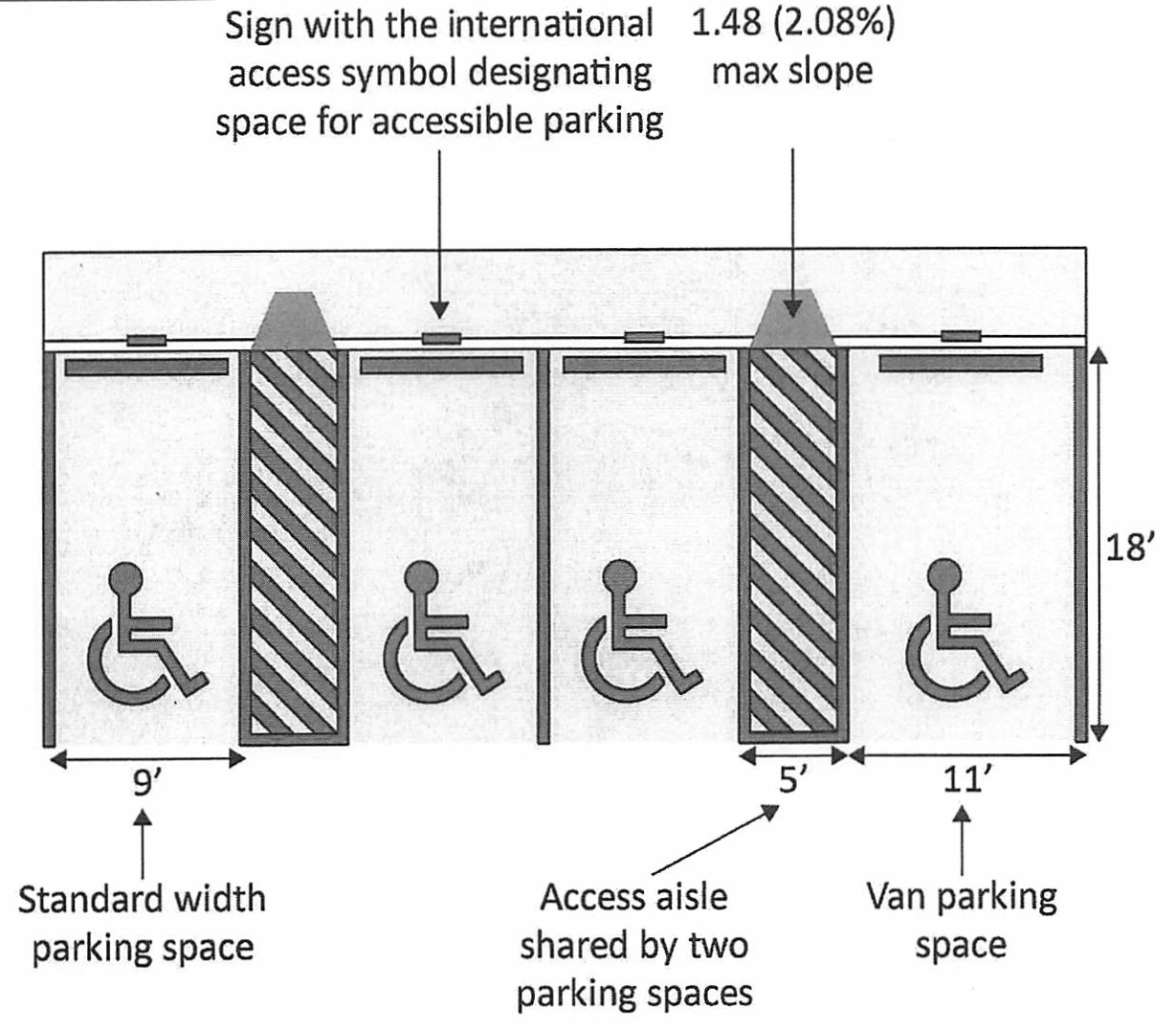
Such spaces shall comply with the design standards presented in the State Accessibility Code, provided that in no instance shall the width of any one space be less than 16 feet, nor the length less than 18 feet. Such spaces shall have no more than 1.48 (2.08 percent) slope in all directions. Such spaces shall be identified by a sign with the international symbol of accessibility on it and mounted at least 60 inches above the ground, as well as pavement markings indicating parking for persons with disabilities only. Such spaces shall be those closest to the entrance of the building or structure, and shall be connected by a paved surface designed to be firm, stable, and slip-resistant to provide safe and easy access. Such spaces shall otherwise be in accordance with the Illinois Vehicle Code.
An access aisle shall be provided in between each of two accessible parking spaces (except in angled parking) to assist people who use wheelchairs or other mobility devices to embark or disembark from vehicles. Access aisles shall be marked with diagonal stripes in bright colors, be created in the same length as the accessible parking space, and level with the accessible parking space.
The number of accessible parking spaces shall be calculated based on the total number of parking spaces provided on a site. The chart below shows the number of accessible spaces required by the 2010 ADA Standards for Accessible Design.
(Ord. No. 4647, § 5, 10-21-2024)
Editor's note— Ord. No. 4647, § 5, adopted October 21, 2024, set out provisions intended for use as § 48-1511. For purposes of clarity, and at the editor's discretion, these provisions have been included as § 48-1510.
Sec. 48-1530. - General provision.
There shall be provided off-street loading spaces not less than the minimum requirements specified in this section in connection with any building, structure or use which is to be erected or substantially altered, and which requires the receipt or distribution of materials or merchandise by trucks or similar vehicles in accordance with the regulations set forth in this division.
(Ord. No. 4647, § 5, 10-21-2024)
Sec. 48-1531. - Location.
Accessory off-street loading spaces shall be located on the same lot as the principal use. Open off-street loading spaces which abut a residence district boundary line shall be completely screened therefrom by a solid fence, wall, or door, or any combination thereof, of an architectural design approved by the building and zoning officer, not less than six feet nor more than eight feet in height or a densely planted tree or shrub hedge maintained to not less than six feet in height. No permitted or required loading space shall be located within 40 feet of the nearest point of intersection of any two streets. No loading space shall be in a required front or side yard, and any loading space located in a required rear yard shall be open to the sky.
(Ord. No. 4647, § 5, 10-21-2024)
Sec. 48-1532. - Size of space.
Unless otherwise specified in this article, a required off-street loading space shall be at least 12 feet in width and at least 55 feet in length, exclusive of access drives, aisles, ramps, maneuvering space, columns, and work areas, and shall have a vertical clearance of not less than 15 feet.
(Ord. No. 4647, § 5, 10-21-2024)
Sec. 48-1533. - Access.
Each required off-street loading space shall be designed with appropriate means of vehicular access to a street or alley in a manner which will least interfere with traffic movements. Access drives and intersection of driveways with streets shall be in accordance with regulations set forth in this article.
(Ord. No. 4647, § 5, 10-21-2024)
Sec. 48-1534. - Surfacing.
All open off-street loading spaces, access drives, aisles and maneuvering spaces shall be improved with a compacted base and a permanent wearing surface, such as asphalt, concrete or pavers, as approved by the city engineer.
(Ord. No. 4647, § 5, 10-21-2024)
Sec. 48-1535. - Repair and service.
No storage of any kind nor motor vehicle repair work or service of any kind shall be permitted within any required loading space.
(Ord. No. 4647, § 5, 10-21-2024)
Sec. 48-1536. - Utilization.
Space allocated to any off-street loading spaces shall not be used to satisfy the space requirements for any off-street parking facilities or portions thereof.
(Ord. No. 4647, § 5, 10-21-2024)
Sec. 48-1537. - Space requirements.
The minimum of off-street loading spaces accessory to buildings, structures and uses hereafter erected, structurally altered, or enlarged in all business and manufacturing districts shall be in accordance with the following schedule:
(Ord. No. 4647, § 5, 10-21-2024)
Sec. 48-1563. - Appendix I. Minimum standards of parking spaces, aisles and parking bays.
Sec. 48-1564. - Appendix II. Access driveway from streets to off-street parking and loading spaces.
(a)
Width of driveways (measured at the lot lines adjoining a street) shall be as follows:
(1)
Residential uses. Not less than nine feet wide or more than 22 feet wide.
(2)
Nonresidential uses.
a.
Not less than 14 feet wide or more than 20 feet wide for a one-way driveway;
b.
Not less than 24 feet wide or more than 35 feet wide for a two-way driveway serving 20 or fewer parking spaces or one or more loading space;
(b)
Radius connecting street pavement edge and driveway edge shall be as follows:
(1)
In residence districts. Not less than five feet, except driveways more than 20 feet in width, not less than eight feet.
(2)
In business and manufacturing districts.
a.
Not less than 15 feet at the intersection of a driveway and street pavement in a street having a right-of-way more than 66 feet wide;
b.
Not less than eight feet at the intersection of a driveway and a street pavement in a street having a right-of-way of 66 feet or less in width.
(c)
Angle at intersection of a driveway and street. The acute angle formed at the intersection of driveway and street pavement edges shall be not less than 60 degrees.
(d)
Spacing between separate driveway entrances on a lot (measured at the lot line adjoining a street) shall be as follows:
(1)
Not less than 20 feet on streets having rights-of-way more than 66 feet in width;
(2)
Not less than ten feet on streets having rights-of-way 66 feet or less in width.
(e)
On corner lots. Spacing between driveway entrance and right-of-way line of an adjacent intersecting street (measured from the nearest edge of the driveway pavement at its intersection with the street right-of-way line to the nearest right-of-way line of an adjacent intersecting street) shall be as follows:
(1)
Not less than 15 feet to an adjacent intersecting street having a right-of-way more than 66 feet in width.
(2)
Not less than eight feet to an adjacent intersecting street having a right-of-way 66 feet or less in width.
(Ord. No. 4647, § 5, 10-21-2024)

