
Muscatine City Zoning Code
CHAPTER 10
20 GARAGE, ACCESSORY BUILDING, AND ACCESSORY USE REGULATIONS
10-20-1 General Provisions
- No accessory building shall be constructed upon a lot until the construction of the main building has commenced.
- No accessory building shall be used unless the main building on the lot is also being used.
- The use of a temporary construction shed or road wagon for the storage of tools, material, and equipment by a contractor during building construction is permitted.
- In residential districts, accessory buildings and uses are limited to the following:
- Garages;
- Tennis court, swimming pool, garden house, ornamental gate, barbecue oven, fireplace, and similar uses customarily accessory to residential uses;
- Home occupation that is allowed by this chapter; and
- A noncommercial greenhouse that does not exceed in floor area twenty-five percent (25%) of the ground floor area of the main building.
- In commercial districts, accessory buildings and uses are limited to the following:
- Parking lots and garages conforming with the requirements of Title 10, Chapter 27.
- Use of not more than forty percent (40%) of the floor area of a building for incidental storage or allowed light industrial activity.
- In the AG District, accessory buildings and uses are limited to dwellings for persons employed on the premises, including mobile homes, provided such mobile homes are occupied by persons employed on the premises and do not exceed one per farm tract.
- In all other zoning districts, accessory buildings may be used for any use allowed by the zoning district in which they are located.
10-20-2 Size Regulations
- For parcels that are less than 20,000 square feet in size the maximum cumulative size for garages (attached or detached) and/or any other accessory building in all residential zoning districts is 1,440 square feet.
- For parcels of at least 20,000 square feet in size the maximum cumulative size for garages (attached or detached) and/or any other accessory building in all residential zoning districts is the lesser of the following:
- 2,500 square feet, or;
- 7.2% of the total parcel size.
- No accessory building placed in the rear yard may exceed 40% of the size of the rear yard.
- In residential zoning districts the cumulative size of any accessory buildings, not including attached garages, located in the rear yard may not exceed 40% of the size of the rear yard.
10-20-3 Placement And Setback Regulations
- Except for as enumerated in this Section accessory buildings must conform to the setbacks established for the zoning district in which they are located.
- No accessory building may be erected in front of a main building, unless the accessory building or garage is attached to the main building by a continuous structural wall.
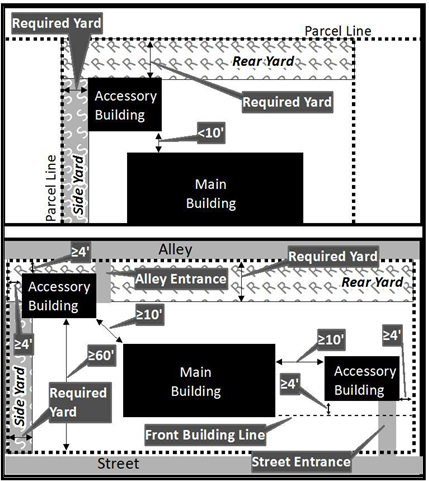
- Any accessory building or use closer than 10 feet to a main building and which must be in the side or rear yard, shall be considered as part of the main building and shall be provided with the side and rear yards required for the main building.
- An accessory building or use more than 10 feet from a main building may be erected within 4 feet of a side or rear lot line, but must be located at least 60 feet from the front lot line when entry is from an alley or street at the rear, and 4 feet behind the front building line of the main building when entry is from the street at the front.
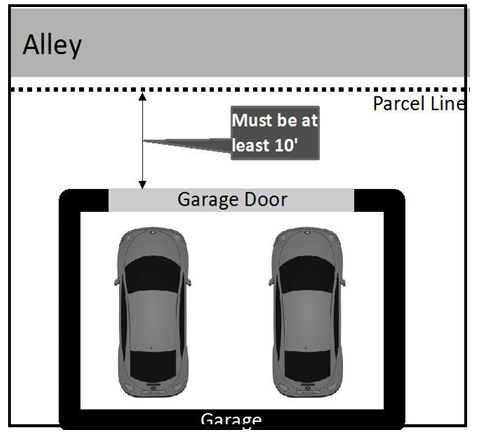
- Where a garage door is parallel to the alley and is entered from an alley, it must be 10 feet from the alley line, except for any exception enumerated in this Section.
- For every 25 square feet that an accessory building exceeds 1,440 square feet in size an additional 1 foot of setback of the accessory building is required in addition to what is required by the zoning district in which the accessory building is located.
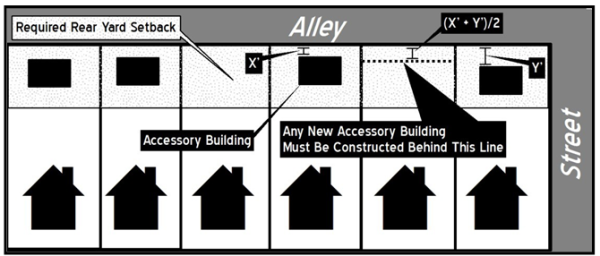
- An accessory building may be constructed within a required rear yard if all of the following conditions are met:
- The rear yard abuts an alley.
- 50% of parcels on the block and located on the same side of the alley as the subject parcel, contain an existing accessory building within the required rear yard setback.
- Any new accessory building that is constructed within the required rear yard shall not be located nearer to the alley right-of-way than the average distance to alley right-of-way of the nearest two accessory buildings located on the same side of the alley as the subject parcel.
10-20-4 Home Occupations
- Intent. This Section allows for home-based business activity, not otherwise permitted by Title 10 in residential districts, that is clearly subordinate and compatible with residential land uses, and will not negatively impact the character of the residential area. vii
- Operating Standards.
- Accessory Use Only.
- Home occupations shall be clearly incidental and accessory to the use of the residence as a dwelling.
- Interior alterations are allowed as long as the alterations do not result in elimination of either the kitchen, dining area, bathrooms, living room, or all of the bedrooms in the unit.
- Prohibited Activities, Equipment, and Materials. The following uses and activities are prohibited as part of any home occupation:
- Use of equipment or machinery that is not customarily incidental to domestic use (e.g., cement mixers, tractors, and paint booths).
- Equipment, machinery, or processes that create noise, smoke, glare, fumes, odor or vibration (e.g., assembly requiring power tools, carpentry) offensive to a reasonable person at the property line.
- Uses that involve activities or use of equipment or materials on more than an intermittent basis so as to change the fire safety or occupancy classification of the premises (e.g., welding).
- Activities that create visual or audible electrical interference in any radio or television off the subject property or cause fluctuation in line voltage off the subject property.
- Use or storage of chemicals or processes that are not customarily associated with domestic use. This includes any chemicals and pharmaceuticals of a type or in volumes not normally found in a domestic residence without a home occupation.
- The home occupation shall not exceed the limitations imposed by the provisions of all applicable building, fire, health, safety, and housing codes and shall conform with all applicable requirements for business and occupational licensing.
- The electrical service for the home occupation shall not exceed 200 amps
- Automobile repair or auto body shops. More than 2 vehicles per year which are not registered at the residence and are rebuilt, repaired, or reconstructed shall constitute an automobile repair or auto body shop.
- Escort services, meaning a person who, for a fee, commission, hire, reward or profit, accompanies other persons to or about social affairs, entertainments or places of amusement or consorts with others about any place of public resort or within any private quarters.
- Exterior Evidence of Use Prohibited. To ensure that dwellings in which a home occupation is occurring remain compatible with surrounding residential use, the following regulations shall apply:
- Incidental storage in a garage or any activities associated with the home occupation shall not displace any required parking in currently usable garage
- The home shall not require any alteration not customarily associated with residential use.
- Home occupation activities shall not be visible from the public rights-of-way or neighboring properties.
- Outdoor storage is prohibited.
- The residence shall not be used as a storage facility for a business conducted elsewhere.
- No home occupation shall produce quantities or types of refuse not customarily associated with a residential use.
- Any signage shall be in compliance Chapter 21 of Title 10.
- There shall be no exterior lighting which would indicate that the dwelling is being utilized in whole or in part of any purpose other than residential.
- Vehicles, Parking, and Traffic. The home occupation shall not generate excessive vehicular traffic or parking in the area of the principal structure. Parking shall be restricted to existing on-street and on-site parking associated with the principal structure.
- Accessory Use Only.
Amended by Ord. 2023-0390 on 9/7/2023
10-20-5 Cargo Containers
- Definition and Scope.
“Cargo containers” include standardized reusable vessels that were:- Originally designed for or used in the packing, shipping, movement or transportation of freight, articles, goods or commodities; and/or
- Originally designed for or capable of being mounted or moved by rail, truck or ship by means of being mounted on a chassis or similar transport device; and/or
- Containers that are designed to be used for storage and appear to be cargo containers, yet do not meet the specifications for commercial shipping, packing, or transportation of freight, shall comply with the requirements of this section.
- Does not include containers incorporated, in a manner that is fully compliant with adopted building code, as habitable space in dwelling units.
- Permitted Locations.
- The placement of cargo containers is limited to the following zoning districts:
- AG Agricultural District.
- C-1 Neighborhood and General Commercial District.
- C-2 Central Commercial District.
- C-3 Planned Commercial District.
- M-1 Light Industrial District.
- M-2 General Industrial District.
- S-1 Special Development District, if the allowed use for a given parcel in the approved development plan is non-residential.
- S-3 Large Scale Mixed Use Development District, if the allowed use for a given in the approved development plan is non-residential.
- A cargo container may be temporarily placed within a zoning district not listed in Section 10-20-5(B)(1) if;
- A cargo container is being used for the storage of tools, material, and equipment by a contractor during building construction of a project for which there is a currently valid construction permit.
- A cargo container is actively involved in making a pickup or delivery as part of a household move.
- Setbacks. Cargo containers placed for accessory storage use shall maintain setbacks equivalent to the required setbacks for accessory structures in the zoning district in which a cargo container is placed.
- The placement of cargo containers is limited to the following zoning districts:
- Compliance.
- All cargo containers placed after the effective date of the ordinance codified in Section 10-20-5, shall fully comply with all applicable provisions of Section 10-20-5, at the time of their placement.
- Cargo containers, regardless of their date of placement and which are not located within a zoning district not listed in Section 10-20-5(B)(1), shall comply with the following provisions by November 15, 2022.
- No more than two cargo containers shall be placed on a parcel.
- Cargo containers shall be placed on a surface and/or foundation capable of bearing the weight of the cargo container in a level manner.
- The placement of a cargo container shall comply with the following setback requirements:
- Property line: 25’
- Dwelling unit on a different parcel: 50’
- Cargo containers shall not be used for any advertising purpose and shall be kept clean of all alpha-numeric signage and writing.
- Cargo containers shall be painted a single color that match the color of the main structure on the parcel upon which the cargo container is located.
Adopted by Ord. 2022-0162 on 5/19/2022
10-20-6 Accessory Dwelling Units
One accessory dwelling unit on the same lot as a single-family residence, shall be allowed, in accordance with the following conditions:
A. An accessory dwelling unit shall not exceed one thousand square feet or fifty percent of the size of the single-family residence.
B. An accessory dwelling unit shall conform to the established setback requirements for its zoning district. However, the lesser setback requirements for accessory buildings, as established in Section 10-20-3, may be applied to detached accessory dwelling units under the following conditions:
1. The cumulative size of the accessory dwelling unit, all garages (attached to any structure on the parcel or detached), and any other accessory buildings present on the lot does not exceed the size restrictions for accessory buildings established in Section 10-20-2.
2. The placement and setbacks of the detached accessory dwelling unit conform to those established for accessory buildings in Section 10-20-3.
C. An accessory dwelling unit shall comply with all applicable building regulations as defined in Title 8, or if it a manufactured home have been constructed under the authority of 42 U.S.C. Section 5403 and which displays a seal from the U.S. Department of Housing and Urban Development certifying that it is in compliance with 42 U.S.C. Section 5403.
D. If a manufactured home is used as an accessory dwelling unit, it shall be converted to real property by being placed on a permanent foundation and assessed for real estate taxes.
E. Mobile homes, recreational vehicles, campers, or tents, shall not be used an accessory dwelling unit.
F. New or separate utility lines between the accessory dwelling unit and public utility service connections shall not be required. However, if full utility access that includes a separate metering system for billing purposes cannot be provided to the accessory dwelling unit, then new or separate utility lines may be required.
Adopted by Ord. 2025-0527 on 1/20/2026

