
Muscatine City Zoning Code
CHAPTER 10
21 SIGN REGULATIONS
1-18-2018 Ordinance 94140-0118 Adopted Amending Title 10, Chapter 21
10-21-1 Purpose
The purpose of this chapter is to promote public health, safety, and welfare through a comprehensive system of reasonable, effective, consistent, content-neutral, and nondiscriminatory sign standards and requirements, including the following specific purposes:
- To balance public and private objectives by allowing adequate avenues for both commercial and non-commercial messages.
- To promote the free flow of traffic and protect pedestrians and motorists from injury and property damage caused by, or which may be fully or partially attributable to, cluttered, distracting, and/or illegible signage.
- To protect the aesthetic beauty of the City’s natural and built environment.
- To prevent property damage, personal injury, and litter from signs which are improperly constructed, poorly maintained, or of flimsy materials.
- To protect property values, the local economy, and the quality of life by preserving and enhancing the appearance of the streetscape.
- To provide consistent sign design standards.
- To provide an improved visual environment for the citizens of and visitors to the City.
- To enable the fair and consistent enforcement of these sign regulations.
10-21-2 Applicability
- Applicability. This Chapter applies to all signs, of whatever nature and wherever located, within the City.
- Interpretations. Any classification of signs in this Chapter that permits speech by reason of the type of sign, identity of the sign user, or otherwise, shall also be interpreted to allow non-commercial speech on the sign. No part of this Chapter shall be construed to favor commercial speech over non-commercial speech. To the extent any provision of this Chapter is ambiguous, the term shall be interpreted not to regulate on the basis of the content of the message.
- Exemption. The following types of signs are exempt from the provisions of this Chapter, except for those contained in Section 10-21-4, Section 10-21-5, and Section 10-21-7(A).
- Street and Residence Identification Signs. Street identification and residence identification signs.
- Governmental Signs. Signs installed by the City, County, or a Federal or State governmental agency for the protection of public health, safety, and general welfare, including, but not limited to, the following:
- Emergency and warning signs necessary for public safety or civil defense;
- Traffic signs erected and maintained by an authorized public agency;
- Signs showing the location of public facilities.
- Traffic control devices on private property that are erected and maintained in compliance with the Manual on Uniform Traffic Control Devices adopted in this state and if not adopted by this state with the Manual on Uniform Traffic Control Devices adopted by the Federal Highway Administration.
- Where a federal, state or local law requires a property owner to post a sign on the owner’s property to warn of a danger or to prohibit access to the property either generally or specifically, the owner must comply with the federal, state or local law to exercise that authority by posting a sign on the property.
- Gravestones or cemetery markers.
- Internal Signs. Signs not visible beyond the boundaries of the lot or parcel upon which they are located, or from any public right-of-way, including signs within an enclosed mall or shopping center.
10-21-3 Permit Required For Permanent Signs
It shall be unlawful for any person to erect, or cause to be erected or constructed within the City, any permanent sign or awning without having first secured a permit therefor from the Community Development Department. A permit fee, as designated in the City Code for each sign or awning shall be charged to the applicant securing the required permit. Said fees may be subject to change from time to time by resolution of the City Council.
10-21-4 General Restrictions Applying To All Signs
- Location Restrictions. Except where specifically authorized in this Chapter, signs are prohibited in the following locations:
- Any sign, not owned by the City of Muscatine, located within a City right-of-way, except as may otherwise be permitted by in this Chapter.
- Any sign located within, on, or projecting over a property line which borders a public or private street, highway, alley, lane, avenue, road, sidewalk, or other right-of-way, except as may otherwise be permitted by this Chapter.
- Any sign attached to any public utility pole, structure or street light, tree, fence, fire hydrant, bridge, curb, sidewalk, park bench, statue, memorial, or other location on public property, except those signs approved as part of a special event permit on City property or banner signs permitted by the City on light poles in certain zones within the City.
- Nothing in this Section shall be construed to prohibit a person from holding a sign while located on City property so long as the person holding the sign is located on public property determined to be a traditional public forum and does not block ingress and egress from buildings or create a safety hazard by impeding travel on sidewalks, bike and vehicle lanes, and/or trails. Such signs must be held at all times and shall not be self supporting.
- Any sign, which by reason of its location, will obstruct the view of any authorized traffic sign, signal, or other traffic control device or which by reason of shape, color, or position interferes with or could be confused with any such authorized traffic signal or device.
- Any sign, which by reason of its location, will obstruct the view of any street or railroad track to the extent it makes it dangerous to use the street or railroad track or otherwise presents a safety hazard.
- Any sign which is placed so as to prevent or inhibit free ingress to or egress from any door, window, or any exit way required by the Building Code.
- Feature Restrictions. The following sign features are prohibited:
- No sign may be lighted so as to impair the vision of any motor vehicle driver.
- Any sign which emits sound, odor, smoke, laser or hologram lights, or other visible matter, including any sign that uses motion picture projection.
- No sign may imitate or resemble an official traffic control sign, signal or device.
- Vehicle Signs. Vehicle signs are prohibited. Vehicle signs are defined as a commercial sign of more than 4 square feet that is attached or applied to a vehicle or trailer, which is parked in location visible from the public right of way, and by means of any of the following which proves a violation:
- There is no current, lawful license plate affixed to the vehicle on which the sign is displayed; or
- The vehicle qualified as a junk or obsolete motor vehicle as defined in Section 7-12-1(B) of the City Code; or
- The vehicle on which the sign is displayed is not parked in a lawful or authorized location; or
- The vehicle is on blocks or other supports, or
- The vehicle is parked in a manner that is distinct or different from the pre-determined parking area design.
10-21-5 General Criteria And Regulations Applying To All Signs
- Sign Message. Any permitted sign may contain, in lieu of any other message or copy, any lawful non-commercial message, a message that does not advertise, identify or otherwise direct attention to a product or business but instead conveys an opinion, idea, concept or similar message, so long as the sign complies with the size, height, area, location, and other requirements of this Chapter.
- Sign Measurement Criteria.
- Sign Area Measurement. Sign area is measured as follows:
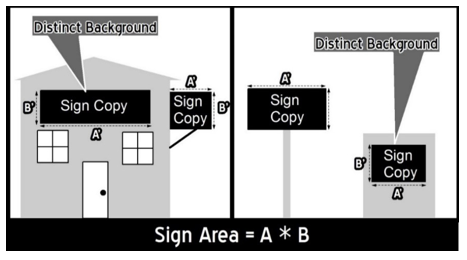
Figure 1: Sign Area Measurement- Sign copy mounted, affixed, or painted on a background panel or surface distinctively painted, textured, or constructed as a background for the sign copy, is measured as that area contained within the sum of the smallest rectangle(s) that will enclose both the sign copy and the background.
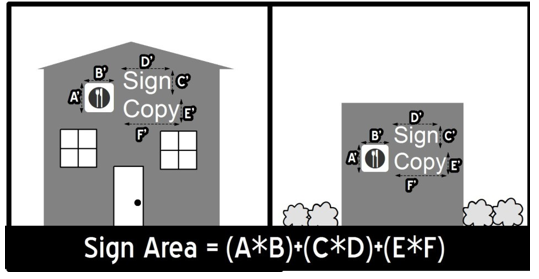
Figure 2: Sign Area Measurement - Sign copy mounted as individual letters or graphics against a wall, fascia, mansard, or parapet of a building or surface of another structure, that has not been painted, textured or otherwise altered to provide a distinctive background for the sign copy, is measured as a sum of the smallest rectangle(s) that will enclose each word and each graphic in the total sign.
- Two-face signs, are measured as follows if the interior angle between the two sign faces is 45 degrees or less, the sign area is of one sign face only. If the angle between the two sign faces is greater than 45 degrees, the sign area is the sum of the areas of the two sign faces.
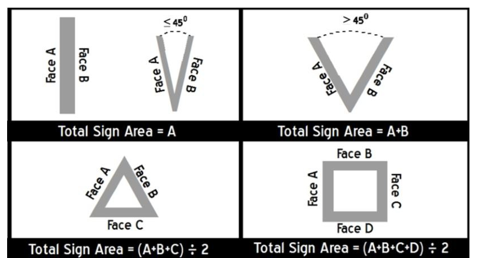
Figure 3: Sign Area Measurement - Multi-face signs, signs with three or more faces are measured as follows, the sum of the area of all the faces, divided by two.
- Spherical, free-form, sculptural or other non-planar sign area is measured as 50 percent of the sum of the areas using only the four vertical sides of the smallest four-sided polyhedron that will encompass the sign structure.
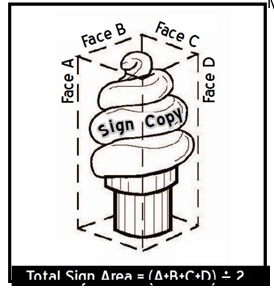
Figure 4: Non-Planar Sign Area
- Sign copy mounted, affixed, or painted on a background panel or surface distinctively painted, textured, or constructed as a background for the sign copy, is measured as that area contained within the sum of the smallest rectangle(s) that will enclose both the sign copy and the background.
- Sign Height Measurement. Sign height is measured as follows:
- Freestanding Signs. Sign height is measured as the vertical distance from the average elevation of the finished grade within an eight-foot radius from all sides of the sign at the base of a sign to the top of the sign, exclusive of any filling, berming, mounding or landscaping solely for the purpose of locating the sign.
- If natural grade at the base of a sign is higher than the grade of the adjacent road, sign height shall be measured from the base of the sign.
- If natural grade at the base of a sign is lower than the grade of an adjacent road, the height of the sign shall be measured from the top of curb elevation.
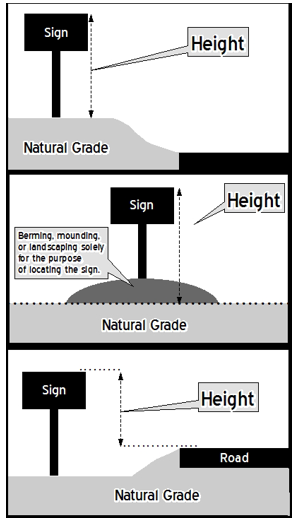
Figure 5: Sign Face Height Measurement
- Building Mounted Signs. The height of wall, fascia, mansard, parapet, or other building mounted signs is the vertical distance measured from the base of the wall on which the sign is located to the top of the sign or sign structure.
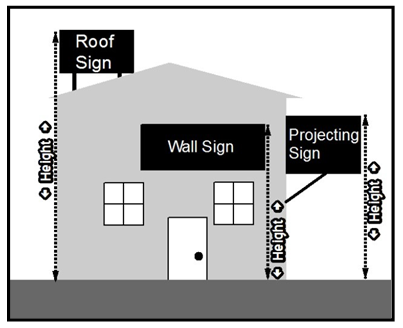
Figure 6: Height Measurement
- Freestanding Signs. Sign height is measured as the vertical distance from the average elevation of the finished grade within an eight-foot radius from all sides of the sign at the base of a sign to the top of the sign, exclusive of any filling, berming, mounding or landscaping solely for the purpose of locating the sign.
- Sign Area Measurement. Sign area is measured as follows:
- Structure and Installation.
- Raceway Cabinets. Raceway cabinets, where used as an element of building mounted signs, shall match the building color at the location of the building where the sign is located. Where a raceway cabinet provides a contrast background to sign copy, the colored area is counted in the aggregate sign area permitted for the site or business.
- Electrical Service. When electrical service is provided to freestanding signs or a landscape wall sign, all such electrical service is required to be underground and concealed. Electrical service to building mounted signs, including conduit, housings, and wire, shall be concealed or, when necessary, painted to match the surface of the structure upon which they are mounted. A building permit (electrical) shall be issued prior to installation of any new signs requiring electrical service.
- Durable Materials. All permanent signs permitted by this Chapter shall be constructed of durable materials capable of withstanding continuous exposure to the elements and the conditions of an urban environment.
- Maintenance. All signs, whether or not in existence prior to adoption of this Chapter, shall be maintained. Maintenance of a sign shall include periodic cleaning; replacement of flickering, burned out or broken light bulbs or fixtures, repair or replacement of any faded, peeled, cracked, or; otherwise damaged or broken parts of a sign; and any other activity necessary to restore the sign so that it continues to comply with the requirements and contents of the sign permit issued for its installation and provisions of this Chapter.
- Obsolete Signs. Sign structures permitted as on-premises commercial signs may remain in place after the business vacates the premises, provided the sign is left non-illuminated and sign copy is removed by covering the sign face or replacing the sign face with a blank sign face, within 30 days after the business vacates the premises, and provided that the sign remains in compliance with the maintenance provision of Section 10-21-5(D). After 30 days such signs shall be classified as off-premises commercial signs (billboards) and subject to all restrictions and regulations applicable to off-premises commercial signs.
- Unused Sign Support Structures. Any vacant and/or unused sign support structures, angle irons, sign poles, or other remnants of old signs which are not currently in use, do not meet the criteria for a permitted obsolete sign as set forth in Section 10-21-5(E), or proposed for immediate reuse evidenced by a Sign Permit application for a permitted sign, shall be removed.
- Nonconforming Uses. All nonconforming uses at the effective date of the passage of this Chapter are entitled to maintain sign(s) until said sign(s) are changed, altered, or replaced at which time they shall be brought into conformance with all regulations set out herein.
- Violation. It shall be unlawful for any owner of record, lessor, lessee, manager, agent, or other person having lawful possession or control over a building, structure, or parcel of land to fail to maintain the property and all signs in compliance with this Chapter. Any person who violates any of the provisions contained herein shall be guilty of a municipal infraction, and each day that the violation is permitted to exist shall be considered a separate and distinct offense.
10-21-6 Regulations And Criteria Applying To Permanent Signs
| Type of Sign (Regulated by Section) | Zoning District | |||||||||||||||||
| R-1 | R-2 | R-3 | R-4 | R-5 | R-6 | R-L | C-1 | C-2 | C-3 | M-1 | M-2 | S-1* | S-1** (Non-Res) | S-2 | S-3* (Res) | S-3** (Non-Res) | AG | |
| Wall Sign (D) | Y1 | Y1 | Y1 | Y1 | Y1 | Y1 | Y | Y | Y | Y | Y | Y | Y1 | Y2 | Y | Y1 | Y2 | Y3 |
| Ground Sign (E) | Y1 | Y1 | Y1 | Y1 | Y1 | Y1 | Y | Y | Y | Y | Y | Y | Y1 | Y2 | Y | Y1 | Y2 | Y3 |
| Post Sign (F) | N | N | N | N | N | N | N | Y | Y | Y | Y | Y | N | Y2 | Y | N | Y2 | Y3 |
| Roof Sign (G) | N | N | N | N | N | N | N | Y | Y | Y | Y | Y | N | Y2 | Y | N | Y2 | Y3 |
| Projecting Sign (H) | N | N | N | N | N | N | N | Y | Y | Y | Y | Y | N | Y2 | Y | N | Y2 | Y3 |
| Awning Canopy Sign (I) | N | N | N | N | N | N | N | Y | Y | Y | Y | Y | N | Y2 | Y | N | Y2 | Y3 |
| Marquee Sign (J) | N | N | N | N | N | N | N | Y | Y | Y | Y | Y | N | Y2 | Y | N | Y2 | Y3 |
| Billboards (K) | N | N | N | N | N | N | N | N | N | N | N | Y | N | N | N | N | N | Y3 |
| Electronic Message Center (L) | Y4 | Y4 | Y2 | Y4 | Y5 | Y5 | Y5 | Y | Y | Y | Y | Y | Y2,4 | Y2,4 | Y5 | Y2,4 | Y2 | Y3 |
| * | The approved use the subject parcel is residential | |||||||||||||||||
| ** | The approved use the subject parcel is non-residential | |||||||||||||||||
| 1 | Subject to compliance with Section 10-21-6(C) | |||||||||||||||||
| 2 | In accordance with an approved site plan as per Section 10-21-6(A)(9) | |||||||||||||||||
| 3 | Subject to size restriction as per Section 10-21-6(A)(5) | |||||||||||||||||
| 4 | Subject to size restriction as per Section 10-21-6(L)(3)(i) | |||||||||||||||||
| 5 | Subject to size restriction as per Section 10-21-6(L)(3)(ii) | |||||||||||||||||
Table 1: Overview of allowed types of signs by zoning district (This table is illustrative only)
- Regulations Applying to All Permanent Signs.
- For parcels with less than 120 feet of frontage along a public street the sum total size of all permanent signs on single parcel shall not exceed 360 square feet.
- For parcels with more than 120 feet of frontage along a public street the sum total size of all permanent signs on a single parcel shall not exceed 360 square feet plus an additional 1 square foot for each additional 2 linear feet of frontage beyond 120 feet.
- No single sign shall exceed 400 square feet.
- Regardless of parcel size, a billboards may be up to, but cannot exceed, 400 square feet.
- In AG districts a total of 32 square feet of permanent signs are allowed.
- All signs which are affixed on building walls and/or canopies, shall not extend higher than 35 feet above curb level, the maximum structure height allowed in the zoning district in which it is located, or 5 feet above building height, whichever is lower.
- Billboards are only permitted in the M-2 Districts.
- Churches, schools, and other permitted non-residential uses in residential zoning districts, shall be permitted to erect one bulletin board sign in addition to other signage permitted in this chapter. The bulletin board sign may contain illuminated changeable letter or electronic message center not to exceed 18 square feet in area.
- Signs in the S-3 Mixed-Use Development District, and the S-1 Special Development District shall be permitted through the process of Site Plan Review approval. The existing sign regulations contained herein for the respective uses in the residential, commercial, and light industrial zoning districts shall be construed as the guide in reviewing proposed signs in the Site Plan Review process. Disputes as to sign size or location in the S-3 Mixed Use Development District, or the S-1 Special Development District, may be appealed to the Zoning Board of Adjustment.
- Signs, Awnings, or Canopies Projecting into Public Right-of-Way.
- Any new sign, canopy, or awning which will overhang public right of way shall require consent of City Council prior to installation.
- No signs shall be permitted to encroach on or hang over Iowa Department of Transportation right-of-way.
- Overhanging signs, canopies, and awnings which overhang public right-of-ways as of September 16, 1981, and which otherwise conform to all applicable provisions of this Ordinance may continue to be maintained, provided the owner(s) of said signs, awnings, or canopies shall agree in writing to indemnify the City of Muscatine from any and all claims or suits for damages caused by the signs, awnings, or canopies on forms provided by the City. Further, the owner(s) shall provide the City of Muscatine with proof of public liability insurance in the amount of one hundred thousand dollars ($100,000).
- Permanent Signs in Residential Districts. Permanent signs in residential zoning districts are allowed as follows:
- Signs identifying platted subdivisions of more than two parcels, or apartment complexes of more than five dwelling units are subject to all the following criteria:
- No single entrance to a subdivision shall have more than one identification sign.
- An apartment complex of more than five dwelling shall have more than one identification sign anywhere along each public street that adjoining the apartment complex.
- The sign(s) must be a ground sign.
- The sign(s) cannot exceed 8 feet in height.
- The sign(s) cannot exceed 24 square feet.
- The sign(s) shall not count towards the maximum allowed signage on an individual parcel.
- Parcels of at least 20,000 square feet may have signs meeting the following criteria:
- No more than 12 square feet of signage for parcels that are being used for residential purpose, and no more than 24 square feet parcels that contain an allowed non-residential use, such as a school, place of worship, etc.
- Only wall or ground signs are permitted.
- Ground signs shall not exceed 5 feet in height.
- Ground signs are only permitted on parcels that contain an allowed non-residential use.
- Parcel of less than 20,000 square feet may have signs meeting the following criteria:
- No more than 12 square feet of signage for parcels that are being used for residential purpose, and no more than 24 square feet parcels that contain an allowed non-residential use, such as a school, place of worship, etc.
- Only wall signs are permitted.
- Signs identifying platted subdivisions of more than two parcels, or apartment complexes of more than five dwelling units are subject to all the following criteria:
- Wall Signs.
- Definition. A wall sign is a sign securely affixed to or painted on a wall the front, side, or rear wall of any building.
- Size and Height Regulations. No single wall sign shall exceed 20% of the total square foot area of the face of the building upon which it is placed.
- Placement. No wall sign shall extend more than 12 inches beyond the building.
- Ground Signs.
- Definition. A free-standing sign, generally having a low profile where the base of the sign structure is on the ground and a maximum of 12 inches above the lowest point of the ground adjacent to the sign such that the sign has the appearance of a solid base.
- Size and Height Regulations.
- No ground sign shall be at any point over 11 feet above the ground level.
- The maximum width shall be 14 feet.
- Placement.
- No ground sign shall be located within 10 feet of any parcel line.
- No ground sign, when erected on a lot fronting on intersecting streets, shall be erected within 50 feet of the intersection of the streets.
- Post Signs.
- Definition. Any permanent sign supported by one or more upright(s) or brace in or upon the ground and not attached to any building or wall, but not including a ground sign or billboard.
- Size and Height Regulations.
- The maximum square foot area for each face of a post sign shall not exceed 2 square feet for each lineal foot of the longest dimension of the parcel upon which it is located.
- No post sign shall exceed 35 feet in height.
- Regulations Relating to the Area Beneath the Bottom of Post Signs.
- No post sign may be extended downward nearer than 5 feet to the ground or pavement.
- Post signs constructed within 10 feet of any property line must maintain at least 10 feet of vertical clearance from the ground or pavement to the lowest edge of the sign.
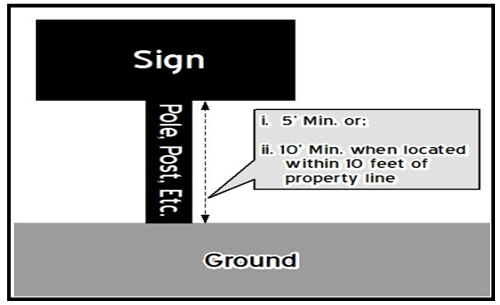 Figure 7: Post Sign Requirements
 - The area beneath a post sign shall not be used for storage, nor shall any sign (permanent or temporary) or structure be located there.
- Landscaping is permitted beneath the bottom of post signs, provided it does not exceed a height of 3 feet and at least 5 feet of vertical clearance is maintained between the bottom of the post sign and the top of any landscaping.
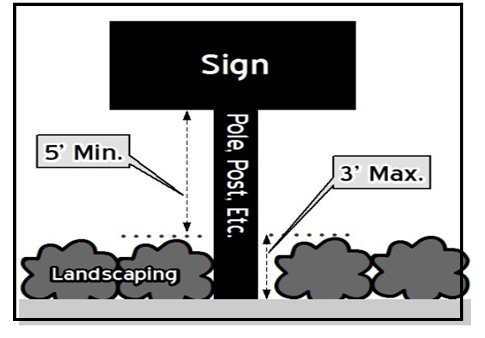 Figure 7a: Post Sign Requirements
- Roof Signs.
- Definition. Any sign erected, constructed, or maintained upon the roof of any building.
- Size and Height Regulations. No single roof sign shall, in size, exceed 20% of the total square foot area of the face of the building upon which it is placed.
- Projecting Signs.
- Definition. Any sign affixed to a building in such a manner that which is not substantially parallel to the surface or plane of the supporting wall and its leading edge extends more than 12 inches beyond the surface of such building. Awnings and canopies are not considered projecting signs.
- Size and Height Regulations.
- Projecting signs may extend from the building into a yard, provided that if the projecting sign is within 10 feet of any property line at its closest point, a minimum of 10 feet of vertical clearance must be maintained from ground level to the lowest edge of the sign.
- No single projecting sign shall, in size, exceed 20% of the total square foot area of the face of the building upon which it is placed.
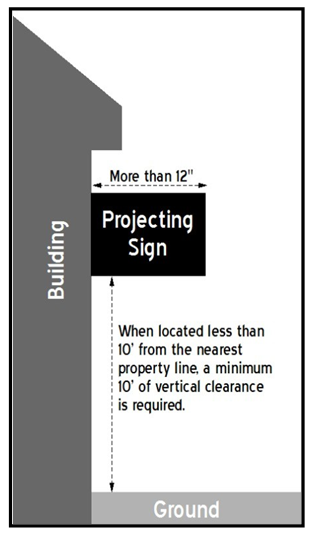 Figure 8: Projecting Signs
- Awning/Canopy Signs.
- Definition. A sign incorporated into or attached to an awning or canopy.
- Size and Height Regulations. No single awning/canopy sign shall exceed 20% of the total square foot area of the face of the building on which it is placed.
- Placement of Signs below Canopy or Awning. Signs may be constructed below a canopy or awning, provided that;
- The sign does not extend further than the outer edge of the canopy or awning,
- The sign does not exceed 18 inches in height,
- A vertical clearance of 7 feet is maintained from the lowest point of the sign to the ground or pavement.
- Canopy and Awning Regulations.
- All canopies and awnings shall be constructed on private property only and may be cantilevered over public rights-of-way, with approval by City Council in accordance with Section 10-21-6(B).
- All canopies and awnings shall be made of stoutly constructed materials capable of withstanding imposed loads.
- All canopies and awnings shall provide a minimum of 7 feet of vertical clearance from the bottom edge of the canopy or awning to grade.
- Marquee Signs.
- Definition. Any sign which forms part of, or is integrated into, a marquee and which does not extend horizontally beyond the limits of such marquee. A marquee is defined as a permanent canopy structure constructed of rigid materials that are attached to and supported by the building and that projects over the entrance to a building.
- Size and Height Regulations.
- A sign installed on or as part of a marquee shall not extend more than 3 feet above nor 1 foot below such marquee.
- No single marque sign shall, in size, exceed 20% of the total square foot area of the face of the building on which it is placed.
- Marquee Regulations.
- Marquees shall not extend more than 8 feet into a front yard.
- Marquees shall be a minimum of 10 feet above the ground at its lowest level.
- Billboards.
- Definition. A sign that meets any one or more of the following criteria:
- a permanent structure sign that is used for the display of off-site commercial messages; or
- an outdoor sign on which display space is made available to parties, other than the owner or operator of the sign or occupant of the parcel, in exchange for a rent, fee or other consideration;
- Size and Height Regulations.
- No billboard shall exceed 400 square feet in area.
- No billboard shall exceed 25 feet in height above grade.
- Placement.
- Allowed only in the M-2 zoning district.
- No billboard shall be located within 400 feet of another billboard also located on that same parcel.
- No billboard, when erected on a lot fronting on intersecting streets shall be erected within 50 feet of the intersection of the streets.
- Billboards Located in Vicinity of State Highway. State law requires that any billboard placed in a location that is visible from a primary state highway and that is within 660 feet of Iowa Department of Transportation right-of-way obtain a permit from the Iowa Department of Transportation prior to erection of the billboard; additionally, the following regulations apply:
- When a permit is required from the Iowa Department of Transportation it must be obtained prior to the issuance of a sign permit by the City of Muscatine.
- When City of Muscatine and Iowa Department of Transportation regulations or rules regarding billboards conflict, the more restrictive regulation or rule shall apply.
- Definition. A sign that meets any one or more of the following criteria:
- Electronic Message Centers.
- Definition. A variable-message sign that utilizes computer generated messages or some other electronic means of changing copy. These signs include displays using incandescent lamps, LEDs, LCDs, or similar technology.
- Applicability. Electronic Message Centers (“EMCs”) are all a component of a defined type of sign, such as wall signs, ground signs, pole signs, roof signs, or projecting signs. An EMC must comply with both the regulations that are specific to EMCs contained in this section and also with the regulations applicable to the specific type of sign form that it takes. Where regulations conflict, the most restrictive regulation shall apply.
- Size Regulations.
- In the R-1, R-2, R-3, and R-4 Zoning Districts, and the portions of the S-1 and S-3 that are designated by their adopted development plans for single or two family home, no EMC display area shall exceed 18 square feet in area.
- In the R-5, R-6, S-2, and C-2 Zoning Districts, and the portions of the S-1 and S-3 that are designated by their adopted development plans for multi-family home, no EMC display area shall exceed 25 square feet in area.
- Message Change Regulations.
- In all residential districts, S-1 and S-2 Districts, and C-2 Districts message changes shall not occur more frequently than once every 4 seconds.
- In all other zoning districts changes shall not occur more frequently than once every 2 seconds.
- Each change of message shall be accomplished in one second or less.
- Traveling messages (e.g., moving messages, animated messages, full-motion video, scrolling text messages) are prohibited.
- Illumination Standard. EMCs shall not operate at an intensity level of more than 0.3 foot-candles over ambient light as measured at a distance of one hundred fifty (150) feet.
- Additional Regulations.
- The use of EMCs shall be restricted to non-commercial messages, on-premises advertising, and/or the promotion of not-for-profit community-wide events or activities.
- In residential districts or, parcels where the front yard is adjacent to or across the street from a residential district, EMCs shall:
- Be turned off between the hours of 11 p.m. and 7 a.m.
- Set back from all property lines a minimum of 25 feet, or the same distance as the principal structure; whichever is less.
- Shall be restricted to red or amber alpha numeric displays on a dark background.
- Large Scale Commercial Developments. In Large Scale Commercial Developments, the following sign regulations apply:
- “Large Scale Commercial Development” is defined as: A property of 20 acres or more including the main lot and subdivided lot(s), which is used primarily for allowed commercial uses. The Large Scale Commercial Development can include one or multiple owners for the entire property or any individual subdivided lot.
- The total surface area in square feet of any sign(s) on a building shall not be more than three times the number of lineal feet in the length of the longest elevation of the building, measured from exterior face of building wall to exterior face of building wall directly across the plane of the building elevation, not including building setbacks, nor protrusions, nor canopies, nor the like appurtenances of the building. Signs may be erected on each wall of the building and shall not exceed one-fifth (1/5) of the total square foot area of the face of the building upon which they are placed, but in no event shall the total square footage of all such signs on a building exceed the total sign surface area as defined above.
- All signs shall be affixed on the building walls and/or canopies and shall not extend outward therefrom more than twelve (12) inches nor project higher than thirty-five (35) feet above curb level or five feet above building height, whichever is lower.
- One post sign for each public road frontage adjacent to the property, each of which may identify the name of the Large Scale Commercial Development (and may also identify the name and services or merchandise of each or any of the retail stores, offices, cinemas and restaurants located in the development), may be erected in addition to the signs affixed to the building walls as permitted elsewhere in this chapter. Such signs shall:
- Have a total surface area of not more than 500 square feet on each side;
- Not project higher than 35 feet above grade at the sign; may be erected so that the sign begins directly at grade level;
- Ground Signs for Large Scale Commercial Developments shall comply with all requirements of this chapter with the exception that not more than one ground sign is allowed per street frontage as otherwise permitted in this chapter. Additional ground signs may be allowed at public access points into Large Scale Commercial Developments, subject to the approval of the Site Plan Review Committee.
10-21-7 Temporary Signs
- Definition. “Temporary sign” shall mean any sign or sign structure which is not permanently affixed or installed, and is intended to be displayed for a limited period only. Examples of such signs include, but are not limited to, the following: banners, flags, pennants, propellers, valances, balloons, and sandwich boards.
- General Temporary Sign Regulations. The following shall apply to all temporary signs:
- Temporary signs are allowed only in compliance with the provisions of this Chapter.
- The City may remove or cause to be removed any temporary or portable sign erected or displayed upon, or projecting into public property.
- Temporary signs shall not be placed within public rights-of-way, including but limited to, roadways, bicycle lanes, street shoulders, curbs, sidewalks, and trails.
- Temporary signs shall not be attached to utility poles or trees.
- All temporary signs and related supports, including decorative covers, must be maintained in a graffiti-free and clean like-new condition. Temporary signs shall be repaired or replaced if they become damaged, defaced, torn, frayed, or faded.
- No off-premise advertising is permitted.
- Duration of Display.
- Generally. The purpose of temporary signs is to display messages for a temporary duration. Temporary signs shall not be used as subterfuge to circumvent the regulations that apply to permanent signs or to add permanent signage to a parcel in addition that which is permitted elsewhere in this chapter.
- Duration of Display. Temporary signs shall be removed when any of the following criteria is met:
- A commercial message is obsolete, misleading, or constitutes off-premises advertising, (e.g. a “for rent” or “for sale” sign in front of a building which is not for rent or for sale, or a sign that advertise a business, product, or service that is no long available on the parcel upon which the temporary sign is located.)
- The sign falls into disrepair.
- The number days for which a particular sign is allowed has lapsed, as set forth in the following schedule:
- Yard/Site Signs.
- Definition. For purposes of this section, Yard/Site signs shall mean a temporary sign constructed of paper, vinyl, plastic, wood, metal or other comparable material, and designed or intended to be displayed for a short period of time and which is not attached to a building or other permanent structure.
- Paper or Cardboard Faced Sign. Sign must be removed within 2 days of placement.
- Cloth, Fabric, Canvas, Vinyl Sign Face or Comparable Material. Sign must be removed with 45 days of placement.
- Laminated Paper, Plastic Lined Polyethylene Bags, and Comparable Material. Sign must be removed within 3 months of placement.
- Corrugated Plastic Sign Face. Sign must be removed within 4 months of placement.
- Wood or Metal Signs. Sign must be removed within 9 months of placement.
- Banners.
- Definition. For purposes of this section, Banners are defined as any sign of lightweight fabric or similar material that is attached to a building or other structure erected for a purpose other than holding or displaying the banner.
- Cloth, Fabric, Canvas, Vinyl Sign Face or Comparable Material. Sign must be removed with 45 days of placement.
- Window Signs.
- Signs placed on the inside of windows: not limited.
- Signs placed on the outside of windows: Sign must be removed with 30 days of placement.
- Yard/Site Signs.
- Frequency of Display. A temporary sign shall not be placed upon a parcel, if within the previous 27 days, a temporary sign was placed on the subject parcel.
- Registration.
- All temporary signs, not located within a residential zoning district, shall be registered with the Community Development Department.
- The following information shall be provided with the registration of any temporary sign:
- Parcel number;
- Name and contact information the party responsible for placing the temporary sign;
- Size of temporary sign;
- Date of the most recent prior placement, if any, of a temporary sign on the property.
- Size Regulations.
- In all residential zoning districts no temporary sign shall exceed 12 square feet.
- In all non-residential zoning districts no temporary sign shall exceed 32 square feet.
- Height Regulations.
- Temporary signs exceeding six feet in height shall be set back at least ten feet from the nearest property line.
- The highest point of temporary signs attached to the building shall not exceed the height of the lowest portion of the roofline on the wall face upon which it is attached.
- Number of Temporary Signs Permitted.
- One per street frontage.
- Situations Which Allow for Additional Temporary Signs.
- Elections. In addition to any temporary signs permitted elsewhere in this Chapter, four additional temporary signs per street frontage may be placed on a parcel for a period of 70 days prior to and five days after an election. Registration, as is required by Section 10-21-7(E), of signs allowed permitted by this section is not required. Any additional signs must comply with all other applicable regulations contained within this Chapter.
- Parcel is for Sale or Rent. In addition to any temporary signs permitted elsewhere in this Chapter, one additional temporary sign per street frontage may be placed when the owner of the parcel consents and that property is being offered for sale or rent and the sale or rental of the parcel is being marketed actively through demonstrable means other than signage on the property such as a listing on the multiple listing service; advertising in a local newspaper of general circulation; advertising on a website which is also advertising the sale or rental of other real estate in the Muscatine area and for a period of 15 days following the date on which a contract of sale has been executed by a person purchasing the property. Registration, as is required by Section 10-xxx-7(E), of signs allowed permitted by this section is not required. Any additional signs must comply with other all applicable regulations contained within this chapter, except that for as long as the parcel is actively for a sale or rent any metal or wood sign may remain displayed indefinitely.
- Interim Signs.
- Definition. Interim signs are temporary business advertising signs intended to provide interim signage while the permanent signage is being fabricated, repaired or prepared for installation.
- Size Regulations. The maximum size of interim signs shall be the same as the size of permanent signs permitted by this Chapter.
- Placement.
- The allowed location of interim signs shall be the same as for permanent signs permitted by this Chapter.
- The maximum number of signs shall be the same number of permanent signs permitted by this Chapter.
- Allowed Duration of Display. Interim signs shall be removed within 3 months or upon installation of new signs, whichever comes first.

