
Muscatine City Zoning Code
CHAPTER 10
32 DEFINITIONS
10-32-1 Definitions
For the purpose of this Ordinance, certain terms are hereby defined:
Words used in the present tense shall include the future; the singular number shall include the plural and the plural the singular; the word 'building" shall include the words "structure" and "premises"; the word "shall" is mandatory and not directory; the words "used" or "occupied" include the words "intended", "designed", or "arranged to be used or occupied"; the word "lot" includes the words "plot" or "parcel"; and the word "person" includes a firm, associations, organization, partnership, trust, company, or corporation, as well as an individual. Any word not herein defined shall be as defined in any recognized standard English dictionary.
"Accessory Building." A subordinate building, the use of which is incidental to and customary in connection with the principal building or use and which is located on the same lot with such principal building or use.
"Accessory Use." A subordinate use which is incidental to and customary in connection with the principal building or use and which is located on the same lot with such principal building or use.
"Accessory Dwelling Unit (ADU)". An additional residential dwelling unit located on the same lot as a single-family residence that is either attachd to or detached from the principle single-family residence.
"Agricultural Activity." Agricultural activity, including forests and forest products; harvest and management; dairy farming; livestock grazing and pasturage; truck gardening, the raising of crops, fruit, and nursery stock; fish farms; animal kennels and fur bearing animal farms; the harvesting, processing, packaging, packing, shipping, and selling of products produced on the premises, and incidental farm occupations and uses such as machinery, farm equipment, and domestic repair and construction; excluding commercial feed lots.
"Alley." A public or private thoroughfare which affords only a secondary means of access to abutting property.
"Ambient Noise." The all-encompassing noise associated with a given environment for a specified period of time, usually being a composite of sounds from many sources, near and far.
"Amortization." The established process of eliminating nonconforming uses over a period of time.
"Apartment." See Dwelling Unit.
"Assembling." Combining two (2) or more finished products into a single product.
"Automobile Service Station." Any land, building, structure, or premises used for the sale at retail of motor vehicle fuels, oils, or accessories, or for servicing or lubricating motor vehicles or installing or repairing parts and accessories; but not including the repairing or replacing of motors, bodies, or fenders of motor vehicles or painting motor vehicles, public garages, and the open storage of rental vehicles or trailers.
"Basement." A story having part, but not more than one-half (1/2) of its height below grade. A basement is counted as a story for the purposes of height regulation if subdivided and used for dwelling purposes other than by a janitor employed on the premises.
"Bed and Breakfast Home." Means a private residence which provides lodging and meals for guests, in which the owner resides and in which no more than two guest families are lodged at the same time and which, while it may advertise and accept reservations, does not hold itself out to the public to be a restaurant, hotel or motel, does not require reservations and serves food only to overnight guests.
"Billboard." Any structure or portion thereof upon which are signs or advertisements used on an outdoor display. (See also Sign Ordinance.)
"Board." Means Zoning Board of Adjustment established in Chapter 31.
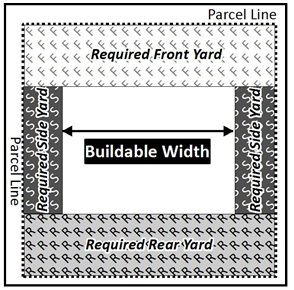
"Buildable Width." The width of the lot left to be built upon after the side yards are provided.
"Building." Any structure having a roof supported by columns of walls for the shelter or enclosure of persons or property. For the purposes of this definition "roof' shall include awning or other similar covering, whether permanent in nature or not.
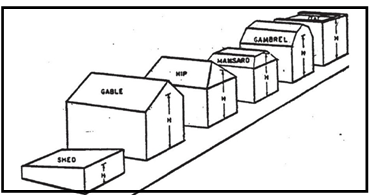
"Building Height." The vertical distance from the grade to (a) the highest point of a flat roof; (b) the deck line of a mansard roof; (c) the average height between eaves and ridge for gable, hip, and gambrel roofs; or (d) the average height between high and low points of a shed roof.
"Cellar." That part of a building having more than one-half (1/2) of its height below the average grade of the adjoining ground.
"Cemetery." Land used or intended (10 acre minimum) to be used for the burial of deceased humans. A marker or memorial is erected at each gravesite for permanent remembrance of the deceased. Other principal uses permitted on land used or intended for use as a cemetery include columbariums and mausoleums; incidental uses include business designed for the benefit, service, convenience or spiritual uplift of cemetery lot owners or persons visiting the cemetery. Accessory uses include utility buildings, maintenance storage areas, chapels and cemetery administration offices. Note. Interior columbariums are permitted ancillary uses within places of worship.
"Chapel." A structure intended for use as a place of worship or nondenominational assembly or visitation.
"City." The City of Muscatine, Iowa.
"Club." Buildings and facilities owned or operated by a corporation, association, person, or persons for a social, educational, or recreational purpose, but not primarily for profit and not primarily to render a service which is customarily carried on as a business.
"Columbarium." A building or structure designed with niches for the location of urns to hold the ashes of cremated persons.
"Commercial Feed Lot." An area of and devoted to raising and feeding of livestock where the operation is not a part of normal agricultural activity.
"Commission." The City Planning and Zoning Commission of Muscatine, Iowa.
"Common Land." Land held and/or used jointly by two (2) or more owners of other land in proximity to it. Usually established by subdivision regulations.
"Community Development Director." The individual designated to administer the Zoning Ordinance and who is responsible for the enforcement of the regulations imposed by said Ordinance.
"Conditional Use." The use allowed in a zoning district after a permit is granted by the Board of Adjustment according to the provisions of Section 10-31-1.
"Council." The City Council of Muscatine, Iowa.
"Condominium." A legal form of ownership of real property, usually individual ownership of a dwelling unit in a multi-unit development where some rights are held in common by the residents of that development.
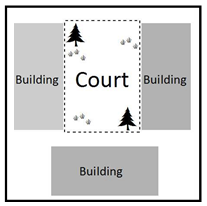
"Court." An open space more than one-half (1/2) surrounded by buildings.
"dBA." A unit of measure of sound intensity as measured on the "A" scale, such scale being that which is audible to the human ear.
"Decibel." A unit of measure in determining sound intensity.
"District." A part of the City wherein regulations of this Ordinance are uniform.
"Drive-In Use." Any establishment designed for the general public to make use from their vehicles of the sales or service provided on the premises.
"Duplex." A building or structure limited to two (2) individual residential units. (See Dwelling Two-Family.)
"Dwelling." Any building or portion thereof which is designated and used exclusively for residential purposes.
"Dwelling Single-Family." A building designed for or occupied exclusively by one (1) family.
"Dwelling Two-Family." A building or structure limited to two (2) individual residential units. (See Duplex.)
"Dwelling Multiple." A building designed for or occupied exclusively by three (3) or more families.
"Dwelling Unit." One (1) or more rooms in a dwelling occupied or intended to be occupied as separate living quarters by a single family as defined herein.
"Farm." See Agricultural Activity.
"Feedlot." A tract of land or structure wherein any type of fowl or livestock are maintained in close quarters for the purpose of fattening for final shipment to market.
"Fence." A structure for enclosing or screening.
"Flood Channel (Floodway)." The areas shown as “Floodway Areas in Zone AE” as shown on the Flood Insurance Rate Map (FIRM) for Muscatine County and Incorporated Areas, City of Muscatine Panels 19139C0185C, 192C, 225C, dated July 18, 2011; Panels 19139C0169D, 175D, 187D, 188D, 189D, 193D, 281D, 282D, 301D, dated April 16, 2014, and Panels 19139C0179E 183E, 184E, 191E, dated November 4, 2016, which were prepared as part of the Flood Insurance Study for Muscatine County.
"Flood Insurance Rate Map." The official map prepared as part of (but published separately from) the Flood Insurance Study, a study initiated, funded, and published by the Federal Emergency Management Agency for the purpose of evaluating in detail the existence and severity of flood hazards; providing the city with the necessary information for adopting a flood plain management program; and establishing actuarial flood insurance rates, which delineates both the flood hazard areas and the risk premium zones applicable to the community.
"Flood Plain." The areas classified as “Zone AE or Zone A” on the Flood Insurance Rate Map (FIRM) for Muscatine County and Incorporated Areas, City of Muscatine, Panels 19139C0185C, 192C, 225C, dated July 18, 2011; Panels 19139C0169D, 175D, 187D, 188D, 189D, 193D, 281D, 282D, 301D, dated April 16, 2014, and Panels 19139C0179E 183E, 184E, 191E, dated November 4, 2016 which were prepared as part of the Flood Insurance Study for Muscatine County.
"Floodproofing." Any combination of structural and nonstructural additions, changes, or adjustments to structures, including utility and sanitary facilities, which will reduce or eliminate flood damage to such structures.
"Floor Area." The square feet of floor space within the outside line of walls and includes the total of all space on all floors of a building. It does not include porches, garages, or space in a basement or cellar when said basement or cellar space is used for storage or incidental uses.
"Floor Area Ratio." The floor area of the building or buildings on any lot divided by the area of the lot.
"Garage, Private." A detached accessory or portion of a main building housing the motor driven vehicles of the occupants of the premises, but not commercial vehicles.
"Garage, Public." A building or portion thereof, other than a private or storage garage, designed or used for equipping, servicing, repairing, hiring, selling, storing, or parking motor-driven vehicles. The term repairing shall not include an automotive body repair shop nor the rebuilding, dismantling, or storage of wrecked or junked vehicles.
"Garage, Storage." Any building or premises used for housing only motor-driven vehicles, other than trucks and commercial vehicles.
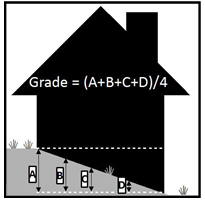
"Grade." The average level of the finished surface of the ground adjacent to the exterior walls of the building.
"Group Home." “Group Home”: A community-based residential home that meets one of the following criteria:
A. Family home meaning a residential care facility as defined under Chapter 135C.1(21) ofthe Iowa Code or a child foster care facility as defined by Iowa Code Chapter 237.1(6).
1. Residential care facility means any institution, place, building, or agency providing for a period exceeding twenty-four (24) hours accommodation, board, personal assistance, and other essential daily living activities to three (3 )individuals or more. Further, a care facility falling under the definition of Iowa Code 135C.1(21) must serve persons with an intellectual disability, chronic mental illness, a developmental disability, or brain injury as described by section 135.62 of the Code. A residential care facility is to have five (5) or fewer residences to remain in compliance with Iowa Code 135C.2.
2. Child foster care facility means the provision of parental nurturing, whichincludes but is not limited to the furnishing of food, lodging, training, education, supervision, treatment, or other care, to a child on a full-time basis. Child foster care exemptions are governed and fined by Iowa Code 237.1(6) as defined under Chapter 237.1(6) of the Iowa Code. This facility is limited to fewer than six (6) children and does not enumerate individual foster care family homes licensed under chapter 237 of the Iowa Code.
B. Elder group home meaning a single-family or multiple-family housing residence as required under Iowa Code 414.31 and is operated by a person who is providing room, board, and personal care and may provide health-related services to three (3) through five (5) elders, defined as those at least sixty (60) years of age or older, who are not related to the person providing the service within the third degree of consanguinity or affinity, and which is staffed by an on-site manager twenty-four (24) hours per day, seven (7) days per week as required under Iowa Code 231B.1.
C. Maternity group home should be interpreted liberally pursuant to Iowa Code section 414.27 but means a community-based residential home as defined by section 414.22 that provides room and board, personal care, supervision, training, support, and education in a family environment for women who are either pregnant or who have given birth within the preceding twenty-four (24) months and live with their children, and includes overnight room accommodations and administrative and office space for those persons who provide such services. A conditional use permit, special use permit, special exception, or variance is not required. However, the group homes shall not be located within contiguous city block areas as provided for in Iowa Code 414.27(3).
D. Any other occupancy of a dwelling unit that state or federal law mandates be treated the same as a single-family residence in zoning-related matters and pursuant to section 103A.7, 104A.2, and 104A.6 of the Iowa Code. Further, the City Ordinance shall not be interpreted as more restrictive than the rules adopted for the special classification by the director and state building code requirements for single or multiple-family housing. In the event this section of the Ordinance conflicts with State or Federal law, then the ordinance is preempted.
E. None of the above definitions include alternatives to incarceration, such as halfway houses, where residents are placed by court order and are under 24-hour supervision by employees or contractors of the Iowa Department of Corrections. This definition does not include alternatives to incarceration, such as halfway houses, where residents are placed by court order and are under 24-hour supervision by employees or contractors of the Iowa Department of Corrections.
"Historic Site." A site, building, or structure which has local, state, or national historical significance, as determined by the appropriate authority.
"Home Occupation." An occupation or business activity which results in a product or service and is conducted in whole or in part in a dwelling unit, and is subordinate to the residential use of the dwelling unit.
"Hospital." An establishment providing physical or mental health service, inpatient or overnight accommodations, and medical or surgical care of the sick or injured. Hospital includes sanitariums.
"Hotel." A building in which lodging is provided and offered to the public for compensation, and which is open to transient guests in contradistinction to a boarding house or lodging house as herein defined.
"Institution." A nonprofit establishment for public use.
"Junk." Any worn out, cast off, or discarded article or material which is ready for destruction or has been collected or stored for salvage or conversion to some use.
"Junk Yard." The use of land, whether inside or outside a structure, for the keeping or abandonment of junk. (Also see salvage.)
"Landscaped Area." An area that is permanently devoted and maintained to the growing of shrubbery, grass, and other plant material.
"Large Scale Retail Development." A property of twenty (20) acres or more including the main lot and subdivided lot(s), which is used primarily for purposes as defined in Section 10-11-1(A), (B), (F), and (G); and Section 10-11-2(A), (B), (F), (G), (H), and (I). The Large Scale Retail Development can be one or multiple owners for the entire property or any individual subdivided lot.
"Lot." A parcel of land occupied or intended for occupancy by a use permitted in this Ordinance, including one (1) main building together with its accessory buildings, open spaces, and parking spaces required by this Ordinance, and having its principal frontage upon an improved road or street.
"Lot Area." The total horizontal area within the lot lines of the lot.
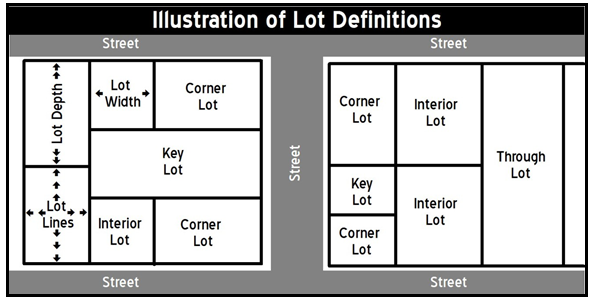
"Lot, Corner." A lot abutting upon two (2) or more streets at their intersections.
"Lot, Depth." The mean horizontal distance between the front and rear lot lines.
"Lot, Double Frontage." A lot having a frontage on two (2) nonintersecting roads, as distinguished from a corner lot, also known as a through lot.
"Lot, Interior." A lot other than a corner lot or double frontage lot.
"Lot, Through." A lot having a frontage on two (2) nonintersecting roads, as distinguished from a corner lot., also known as a Double Frontage Lot.
"Lot of Record." A lot or parcel of land the plat or deed of which has been recorded prior to the adoption of this Ordinance.
“Manufactured Home”: A factory-built structure built under the authority of 42 U.S.C.§5403, that is required by federal law to display a seal from the United States Department of Housing and Urban Development, and was constructed on or after June 15, 1976.
“Manufactured-Mobile Home Park”: A property under single ownership, upon which multiple mobile or manufactured homes are located, occupied as dwellings, and each home may or may not be under separate ownership from the land on which it sits.
“Manufactured-Mobile Home Park Lot”: Means a leaseable or rentable portion of land within a manufactured home park that has been reserved for the placement of a single manufactured or mobile home.
“Mobile Home”: Any vehicle without motive power used or so manufactured or constructed as to permit its being used as a conveyance upon the public streets and highways and so designed, constructed, or reconstructed as will permit the vehicle to be used as a place for human habitation by one or more persons; but shall also include any such vehicle with motive power not registered as a motor vehicle in Iowa. A “mobile home” is not built to a mandatory building code, contains no state or federal seals, and was built before June 15, 1976.
"Mausoleum." A building or structure designed with vaults to hold many caskets or crematory urns.
"Modular Building." A prefabricated transportable building manufactured in whole or in part off the site, designed to be used by itself or to be incorporated with similar units at a building site into a modular structure. The term is intended to apply to major assemblies and does not include prefabricated panels, trusses, or sub-elements which are to be incorporated into a structure at the site.
"Motel, Motor Court, Motor Lodge, or Tourist Court." Any building or group of buildings containing guest rooms or dwelling units, some or all of which have a separate entrance leading directly from the outside of the building with garage or parking space conveniently located on the lot, and designed, used, or intended wholly or in part for the accommodation of automobile transients.
"Nonconforming Use." The use of any building, structure, or land existing at the time of the enactment of this Ordinance, or any amendments thereto, which does not conform in whole or in part to the provisions of this Ordinance or its amendments.
"Noxious Fumes." Fumes which are in sufficient quantity to be harmful to health.
"Nursery School (Child Care)." Any land, building, structure, or premises used for educational instruction and/or supplemental parental care for four (4) or more children, either on an hourly or daily basis, with or without compensation.
"Nursing Home." A home for the aged or infirm in which three (3) or more persons not of the immediate family are received, kept, or provided with food and shelter or care for compensation, but not including hospitals, clinics, or similar institutions devoted primarily to the diagnosis and treatment of the sick and injured.
"Office." The building, room, or series of rooms in which the affairs of a business, profession, or branch of government are conducted.
"One Hundred (100 Year) Frequency Flood." A flood, the magnitude of which has a one percent chance of being equaled or exceeded in any given year or which, on the average, will be equaled or exceeded at least once every one hundred (100) years, as determined by the Flood Insurance Study for Muscatine County, prepared by the Federal Emergency Management Agency.
"Open Area." That part of a lot on which no part of a building or structure extends above the following elevations:
- Two feet (2') above the highest curb elevation of the street or streets that bound the lot;
- One foot (1') above the adjacent curb elevation for each one and one-fourth foot (1 1/4') the building or structure is set back from the street lot line, except that no portion of the structure shall exceed twelve feet (12') above the adjacent curb elevation. This provision shall apply to walls or structures that do not extend more than four feet (4') above the adjacent curb elevation.
"Parking Area (Lot)." An open area, other than the street, intended and used for the temporary parking of motor vehicles.
"Parking Space." A surfaced area, enclosed or unenclosed, sufficient in size to store one (1) automobile less than nine feet and six inches (9'6”) wide and eighteen feet (18') long, together with a driveway connecting the parking space with a street, road, or alley and permitting ingress and egress of that automobile without the necessity of moving any other automobile.
"Premises." A lot, together with all buildings and structures thereon.
"Processing." To prepare a product for sale by either a special treatment or to change it through a series of steps, but not the original manufacture of a component part.
"Salvage or Junk Yard." Any land, building, or other structure used for the storage, collection, processing, or conversion of any worn out, cast off, or discarded metal, paper, glass, or other material which is ready for destruction, or has been collected or stored for salvage or conversion to some use. This includes, but is not limited to, such things as automobiles, machinery, farm implements, household appliances, and construction materials. (Also see Junk Yard.)
"Satellite Receiving Dish." An apparatus that allows microwaves to reflect back to an antenna, also commonly referred to as an earth station.
"Setback." The distance between any street line and the nearest point to which any building or structure can be erected. All measurements shall be to the outside edge of the ground floor wall nearest the lot line or street line.
"Sign." A sign is any structure or part thereof or device attached thereto or painted or represented thereon, which shall be used to attract attention to any object, product, place, activity, person, institution, organization, or business; or which shall display or include any letter, word, model, banner, flag, pennant, insignia, device, or representation used as, or which is in the nature of, an announcement, direction, or advertisement. For the purpose of this Ordinance, the word “sign” does not include the flag, pennant, or insignia of any nation, state, city, or political unit, or other political, educational, charitable, philanthropic, civic, professional, religious, or like campaign, drive, moment, or event. (See Sign Ordinance.)
"Sign, Advertising." A sign which directs attention to a business or commodity, service, or entertainment conducted, sold, or offered elsewhere than on the premises. (See Sign Ordinance.).
"Sign, Area." Sign area is measured as follows: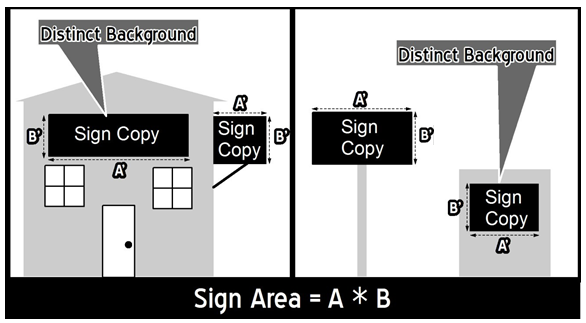
- Sign copy mounted, affixed, or painted on a background panel or surface distinctively painted, textured, or constructed as a background for the sign copy, is measured as that area contained within the sum of the smallest rectangle(s) that will enclose both the sign copy and the background.
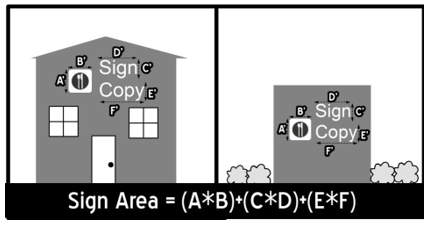
- Sign copy mounted as individual letters or graphics against a wall, fascia, mansard, or parapet of a building or surface of another structure, that has not been painted, textured or otherwise altered to provide a distinctive background for the sign copy, is measured as a sum of the smallest rectangle(s) that will enclose each word and each graphic in the total sign.
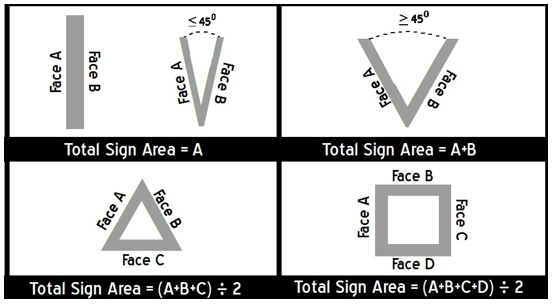
- Two-face signs, are measured as follows if the interior angle between the two sign faces is 45 degrees or less, the sign area is of one sign face only. If the angle between the any two sign faces is greater than 45 degrees, the sign area is the sum of the areas of the two sign faces.
- Multi-face signs, signs with three or more faces are measured as follows, the sum of the area of all the faces, divided by two.
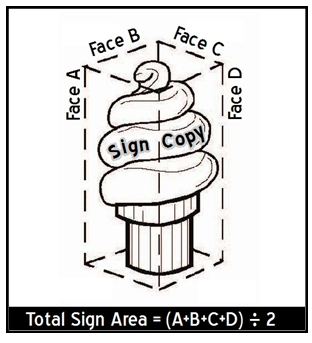
- Spherical, free-form, sculptural or other non-planar sign area is measured as 50 percent of the sum of the areas using only the four vertical sides of the smallest four-sided polyhedron that will encompass the sign structure.
"Sign, Electronic Message Center." A light emitting diode (LED) sign that is controlled via electronic communication. An electronic message center (EMC) sign has information created on a computer using a software program that allows the user to display static or moving messages consisting of text, graphics, video graphics, and animation, including the use of multiple colors on a contrasting background. Unless otherwise provided herein, EMC’s shall not be permitted to change pages or images more frequently than once every two (2) seconds. The use of EMC’s shall be restricted to on-site advertising and/or the promotion of not-for-profit communitywide events or activities. Historic Consideration: The use of Electronic Message Center Signs within any Historic District as approved for listing to the National Register of Historic Places by the National Park Service is prohibited.
"Sign, Ground." Any sign erected, constructed, or maintained for the purpose of displaying outdoor advertising by means of posters, pictures, pictorial, and reading matter when such sign is supported by two (2) or more uprights, posts, or braces placed upon or affixed in the ground and not attached to any part of a building.
"Sign, Marquee." Any sign affixed to a marquee over the entrance to a building and supported from the building.
"Sign, Portable." A sign, banner, sandwich board, mannequin, or advertising display constructed of cloth, canvas, plastic, blackboard, cardboard, wall board, metal, or other light material as well as any vehicle or trailer, one of the major uses of which is as a fixed or mobile advertising display. Such described signs shall be deemed portable if they are capable of being carried or moved and not affixed in a permanent manner to the ground, a structure, or other supporting device.
"Sign, Post." Any permanent sign supported by one or more uprights or braces in or upon the ground and not attached to any building or wall, but not including a ground sign or billboard.
"Sign, Pylon." A sign which may identify the name of a Large Scale Retail Development (and may also identify the name and services or merchandise of each or any of the retail stores, offices, cinemas and restaurants located in the development), which must be constructed in accordance with the requirements of Section 10-21-7(D).
"Sign, Roof." Any sign erected, constructed, or maintained upon the roof of any building.
"Sign, Wall." Any painted sign or poster on any surface or plane that may be affixed to the front, side, or rear wall of any building.
"Solid Waste Transfer Station." A site with a permanent enclosed structure for receiving solid waste for the purpose of reducing its volume for transport to other destinations. Activities include, but are not limited to, the sorting and compacting of materials, shredding, and the temporary storage of said materials while awaiting transport to a landfill or recycling destination. Ancillary site activities may include the composting of yard waste material.
"Standard Shrub." A standard shrub is any bush or small evergreen tree occupying a space of at least eighteen cubic feet.
"Standard Tree." A standard tree is a tree with a minimum caliber of three inches of a variety normally capable of attaining a 25 feet height when the tree is twenty years old.
"Street." A public way at least 60 feet in width which affords the principal means of access to abutting property.
"Street Center Line." The street center line is a line halfway between the street lines.
"Street Line." A dividing line between a lot and a contiguous street.
"Structural Alteration." Any change, except those required by law or ordinance, which would prolong the life of the supporting members of a building or structure, such as bearing walls, columns, beams, or girders, not including openings in bearing walls as permitted by other Ordinances.
"Structure." Anything constructed or installed or portable, the use of which requires a location on a parcel of land. It includes a movable structure while it is located on land which can be used for housing, business, commercial, agricultural, or office purposes, either temporarily or permanently. Structure also includes fences, billboards, swimming pools, poles, pipelines, transmission lines, tracks, and advertising signs, whether located on a rock, tree, separate structure, or part of another structure.
"Tourist Home." An establishment used for dwelling purpose in which rooms, with or without meals, are offered to transient guests for compensation.
"Townhouse." A building that has one-family dwelling units erected in a row as a single building on adjoining lots, each being separated from the adjoining unit or units by a masonry party wall or walls extending from the basement floor to the roof along the dividing lot line, and each such building being separated from any other building by space on all sides.
"Yard." An open space, other than a court on a lot, unoccupied and unobstructed from the ground upward, except as otherwise provided in this Ordinance.
"Yard, Front." A yard across the full width of the lot extending from the front line of the main building to the front line of the lot or to the designated street line in cases where the present property line extends to the center line of the abutting street. On corner lots, the front yard shall face the shortest street dimension of the lot, except that if the lot is square or almost square, i.e., has dimensions in a ratio of from 3:2 to 3:3, then the front yard may face either street.
"Yard, Rear." A yard extending the full width of the lot between a principal building and the rear lot line.
"Yard, Side." A yard between the main building and the side line of the lot, and extending from the front yard line to the rear yard line.
"Yard Width and Depth." The shortest horizontal distance from a lot line to the main building.
Amended by Ord. 2025-0527 on 1/20/2026

