
Muscatine City Zoning Code
CHAPTER 10
22 FENCE REGULATIONS
10-22-1 Regulations For Fences In Residential Districts
Fences in residential districts shall comply with the following regulations:
- Definitions. For the purposes of this section only, the following terms are defined:
- "Lot Lines." The property lines along the edge of a lot.
- "Street Lot Lines." A lot line, or segment of a lot line, that abuts a street. Street lot line does not include lot lines that abut an alley.
- "Corner Lot." A lot which has street lot lines that intersect.
- "Through Lot." A lot which has street lot lines that do not intersect. A lot with three street lot lines can be both a corner and through lot.
- "Building Line." A line running parallel to a lot line, that is the same distance from the lot line as the closest portion of the main building on the lot, extended the full width of the lot.
- "Front Lot Line."
- On a lot only abutting one street, the front lot line is the full length of a lot line that abuts a street.
- On a corner lot, the front lot line is the shortest of the lot lines that abut a street, regardless of the location of the building's architectural main entrance; if the lot is square then the front lot line shall face the building's architectural main entrance.
- On a through lot, the front lot line is the street lot line which faces the building's architectural main entrance.
- On a lot that is both a corner lot and through lot, the shortest street lot line shall be deemed to be the front lot line, if two street lot lines are the same length and shorter than any other street lot lines, the front lot line is the is the street lot line which faces the building's architectural main entrance.
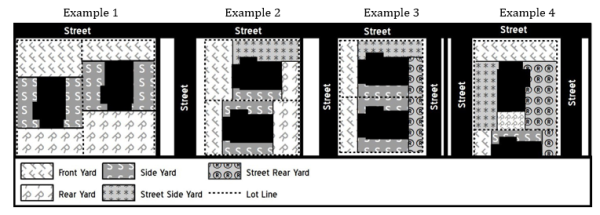
- "Front Yard." The area extending across the full width of the lot extending from the front building line of the main building to the front lot line.
- "Rear Lot Line." A lot line that is opposite a front lot line.
- "Rear Yard." The area extending the full width of the lot between the rear building line and the rear lot line, exclusive of any area that meets the definition of a street side yard or rear side yard.
- "Side Lot Line." A lot line that is neither a front, rear, or street lot line.
- "Side Yard." Areas between a side building lot line and the main building, and which are between the front and rear building lines.
- "Street Side Lot Line." A lot line that is neither a front or rear lot line, and is a street lot line.
- "Street Side Yard." The street side yard shall be any area behind the front building line, that is between any side street lot line and the main building, and which does not meet the definition of a street rear yard.
- "Street Rear Yard."
- When the rear lot line is also a street lot line, the street side rear yard shall be the area between the rear building line and the rear lot line, exclusive of any area located between a side building line and a side lot line that is a street lot line.
- When the rear lot line is not a street lot line, the street side rear yard shall be the area behind the front building line, that is between the side street lot line, on the street which the rear lot line of the adjoining lot is parallel to, the side building line.
- The maximum allowed height of fences are as follows:
- Any area of the lot that is between the main building and a side building line; and is also between the main building and either the front or rear building line: 6 feet.
- Rear Yards: 6 feet.
- Side Yards: 6 feet.
- Front Yards:
- All portions of a front yard that are more than 25 feet from the front lot line: 6 feet
- Portion of front yards that are less than 25 feet from the front lot line:
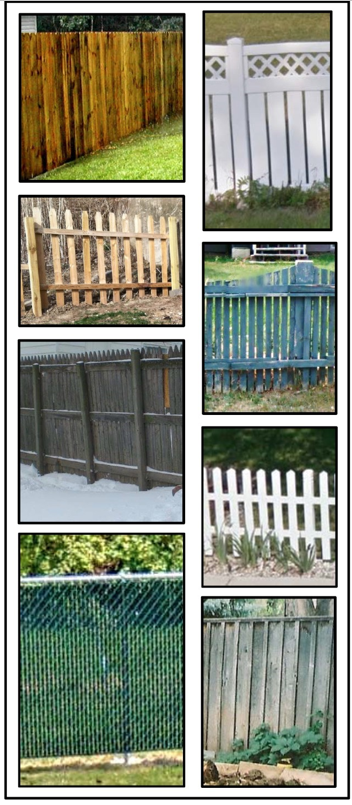
- Fences that are more than 25% opaque: 3 feet.
- Fences that are less than 25% opaque: 6 feet.
- Street Side Yards:
- All portions of a street side yard that are more than 25 feet from the street side lot line: 6 feet
- Portion of street side yards that are less than 6 feet from the street side lot line: x
- Fences that are more than 25% opaque: 3 feet.
- Fences that are less than 25% opaque: 6 feet.
- Portion of street side yards that are more than 6 feet, but less than 25 feet, from the street side lot line:
- Fences that are more than 25% opaque: 4.5 feet (54 inches).
- Fences that are less than 25% opaque: 6 feet.
All portions of a street side yard that are located between the main building and the side building line: 6 feet.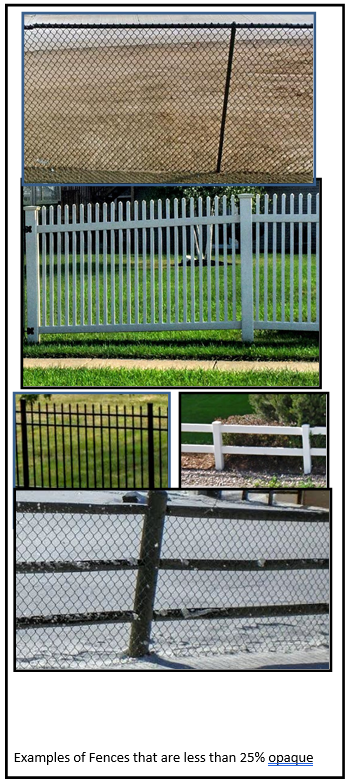
- Street Rear Yards: All portions of street rear yards that are more than 6 feet from the street rear lot line: 6 feet
- Portion of street rear yards that are less than 6 feet from the street rear lot line:
- Fences that are more than 25% opaque: 3 feet.
- Fences that are less than 25% opaque: 6 feet.
- All portions of a street rear yard that are located between the main building and the rear building line: 6 feet
- Portion of street rear yards that are less than 6 feet from the street rear lot line:
- All fencing must be at least 2 feet behind any improved portion of a public street, sidewalk, or alley.
- No fence shall contain barbed wire, razor wire, electrical current or charge of electricity, or similar hazardous materials or devices except in and those parcels in which the keeping of livestock is permitted.
Examples of Fences that are more than 25% opaque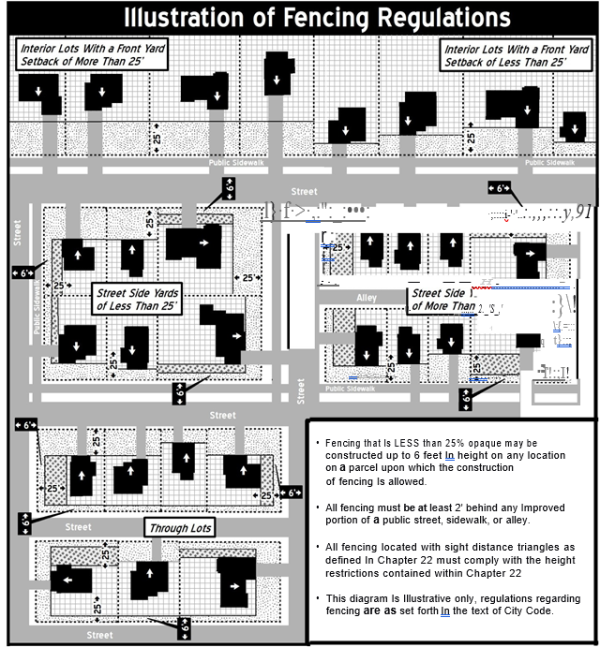
Legend1;:/:)'\j Maximum Height of Fences that are more than 25%opaque: 3 Feet l:::::::;:;:JMaximum Height of Fences that are more than 25%opaque: 4.5 Feet (54 Inches) []E] Maximum Height of Fences that are more than 25%opaque: 6 Feet1111 Building Footprint0 Direction in Which the Front of the Building Faces······ ·· Property Line
x 6-4-2020 Ordinance 2020-0201 adopted amending Title 10, Chapter 22, Section 1
10-22-2 Regulations For Fences In Non-Residential Districts
Fences in non-residential districts shall comply with the following regulations:
- Barbed wire or similar materials are allowed, if located on top of a fence or wall that is at least 6 feet in height.
- No fence shall contain razor wire, broken glass or similar hazardous materials or devices.
10-22-3 Sight Triangle
All fences located with sight distance triangles as defined in Title 10, Chapter 28 must comply with the height restrictions contained within Title 10 Chapter 28.
10-22-4 Fencing Required Around Outdoor Pools
A swimming pool, or other contained body of water of more than 24 inches or more in depth at any point and is intended for swimming, shall be enclosed by a fence or wall meeting the following criteria:
- Be entirely enclosed by at least a four-foot wall, fence or other barrier as measured on the exterior side of the wall, fence or barrier.
- Have no openings in the wall, fence or barrier through which a spherical object 4 inches in diameter can pass. Figure A.
- Have a vertical clearance between grade and the bottom of the wall, fence or barrier of less than 2 inches, as measured from the side of the wall, fence or barrier that faces away from the pool.
When a wall, fence or barrier is composed of vertical and horizontal members and the distance between the tops of the horizontal members is greater than or equal to 45 inches, spacing between vertical members shall not be greater than 4 inches. Figure B. - When a wall, fence or barrier is composed of vertical and horizontal members and the distance between the tops of the horizontal members is less than 45 inches, the horizontal members shall be located on the swimming pool side of the wall, fence or barrier. Spacing between the vertical members shall not be greater than 1 3/4 inches. Figure C.
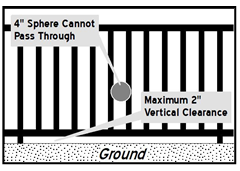 Figure A
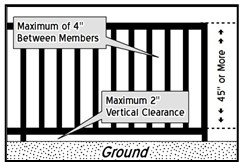 Figure B
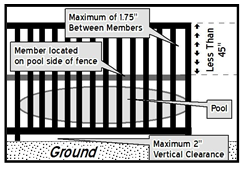 Figure C
- Where there are decorative cutouts on any vertical member, spacing within the cutouts shall not exceed 1 3/4 inches.
- When a wall, fence or barrier is composed of diagonal members, the openings formed by the diagonal members shall not be greater than 1 3/4 inches.
- Mesh size for chain link fences shall not be greater than a 2 1/4 inch square, unless the fence is provided with slats fastened at the top or bottom which reduce the size of the openings to 1 3/4 inches. Figure D.
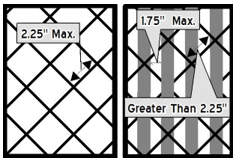 Figure D
- Gates for the enclosure shall:
- Be self-closing and self-latching.
- The latch shall be located:
- At least 54 inches above the underlying ground or;
- Be located on the pool side of the gate with a release mechanism at least 3 inches below the top of the gate and no opening greater than 1/2 inch within 24 inches of the release mechanism.
- Open outward from the pool.
- The wall, fence or barrier shall not contain openings, handholds or footholds accessible from the exterior side of the enclosure that can be used to climb the wall, fence or barrier.
- Solid barriers which do not have opening(s) shall not contain indentations or protrusions except for normal construction tolerances and tooled masonry joints.
- When an aboveground pool structure is used as barrier or where the barrier is mounted on top of the pool structure, and the means of access is a ladder or steps, then the ladder or steps shall be:
- Capable of being secured, locked, or removed to prevent access, without creating any openings that would allow the passage of a 4 inch sphere, or;
- Surrounded by a wall, fence or barrier that meets all requirements contained within this Chapter.

