
Muscatine City Zoning Code
CHAPTER 10
27 OFF-STREET PARKING AND LOADING REGULATIONS
10-27-1 Rules For Computing Required Off-Street Parking
In computing the number of required off-street parking spaces or loading spaces, the following rules shall apply:
- Floor area shall mean the gross floor area of the specific use, excluding any floor or portion thereof used for parking, as herein defined.
- Where fractional spaces result, the parking spaces required shall be the nearest whole number.
- In the case of mixed uses, the parking spaces required shall equal the sum of the requirements of the various uses computed separately or be the subject of a shared parking agreement under the provision of Section 10-27-6.
- Whenever an existing building or use is changed or enlarged in floor area, number of employees, number of dwelling units, seating capacity or otherwise, and parking spaces shall be provided on the basis of the enlargement of change.
10-27-2 Minimum Number Of Required Off-Street Parking Spaces
The minimum number of off-street parking spaces required is determined by the use of a parcel and are as follows:
- Single-Family Residential: 2 per dwelling unit
- Duplex: 2 per dwelling unit
- Multi-Family Residential:
- Efficiencies & One Bedroom: 1 per unit
- Two Bedroom Unit and all Dwelling Units in the Mixed Use – Downtown District with at least Two Bedrooms: 1 1/2 per unit
- Three Bedroom or More Units: 2 per unit
- All Multi-Family Residential Dwelling Units Located in Areas Zoned for Single- Family Dwelling Units: 2 per unit.
- Boarding House: 1 per 2 tenants
- Place of Worship: 1 per 4 fixed seats, 1 per 8 feet of bench length, or 1 per every 28 square feet in areas where no permanent seats are maintained in the main auditorium (sanctuary or place of worship)
- Elementary and Middle School: 2 per classroom, plus 1 per employee
- High School or College: 10 per classroom, plus 1 per employee
- Ballet, Martial Arts, Dance & Gymnastics School/Academy/Studio or Other like Establishment: 1 per 80 square feet of activity area
- Public Building: 1 per 330 square feet of gross floor area
- Office (Non-medical): 1 per 330 square feet of gross floor area
- Medical Office: 1 per 300 square feet of gross floor area
- Hospital: 2 per bed
- Nursing Home: 1 per 4 beds
- Industrial: 2 per each 3 employees on maximum shift, plus 1 per vehicle use in connection therewith
- Warehouse: 1 per 2,000 square feet of gross floor area
- Mini-Storage Warehousing: 3 plus 1 per 100 storage units
- Eating & Drinking Establishment: 1 per 66 square feet of seating floor plus 1 each for each 440 square feet of non-seating floor area
- Drive-Through Food Restaurant: 1 per 66 square feet of seating floor plus 1 each for each 440 square feet of non-seating floor area plus, 5 stacking spaces per drive-through, including service window and menu board areas
- Movie Theater: 1 per 4.5 seats
- Bowling Alley: 4 per lane, plus one per employee on the largest shift
- Recreation Center: 1 per 4 persons at maximum capacity
- Golf Course: 3 parking spaces per green, plus fifty percent (50%) of the spaces otherwise required for any accessory use (e.g., bars, restaurants).
- Furniture and/or Major Appliance Stores: 1 per 660 square feet of gross floor area
- Motor Vehicle (Including Boats) Sales, Display, and Rental: 1 space for every 330 square feet of floor used for indoor display and 1 parking space for each 660 square feet of for all indoor space not used for display. Parking spaces used for the display and storage of vehicles for sale or rent shall not be used to meet the requirements of this Section.
- Transportation or Trucking Yards: Parking for customers and employees shall be calculated by the individual component uses such as but not limited to offices for the dispatch areas, warehouses for transshipment or warehouse type areas.
- Beauty and Barber Shops: 1 per employee plus 1 per 1.5 hairdresser/barber station
- Funeral Homes, Chapels, Crematoriums, Mortuaries: 1 per 4 persons at maximum capacity
- Day Care/Child-Care Facilities: 1 per employee plus 1 off-street passenger drop off/pick up space per 10 students
- Hotel/Motel: 1 per guest room
- All Nonresidential Uses Within the Mixed Use - Downtown District: No off-street parking required
- All Other Nonresidential Uses: 1 per 330 square feet of gross floor area
10-27-3 Reduction In The Number Of Required Off-Street Parking Spaces
- The Site Plan Review Committee, in accordance with the site plan review process contained in Section 10-2-7(I), may authorize adjustments be made to the required number of off-street parking spaces as established by Section 10-27-2 based on the following criteria:
- The minimum number of off-street parking spaces may be reduced by up to 50% when the applicant for a development can demonstrate, to the satisfaction of the Site Plan Review Committee, that the use of alternative modes of transportation, including transit, bicycles, and walking, and/or special characteristics of the customer, client, user, employee or resident population will reduce expected vehicle use and parking space demand for this development, as compared to off-street parking space requirements contained in Section 10-27-2 and such a reduction in the number of required off street parking spaces will not adversely impact the surrounding area.
- Costs associated with providing the required off-street parking spaces shall not be used as a justification for a reduction in the number of required off-street parking spaces.
10-27-4 Accessible Parking Regulations
All parking facilities shall comply with 2010 ADA Standards for Accessible Design and all other applicable Federal or State code/regulations.
- Except as noted in Section 10-27-4(B), Section 10-27-4(C) and 10-27-4(D), the required number of accessible parking spaces is as indicated in the following table.
Total Parking Spaces in Lot Minimum Number of Accessible Spaces 1 to 25 1 26 to 50 2 51 to 75 3 76 to 100 4 101 to 150 5 151 to 200 6 201 to 300 7 301 to 400 8 401 to 500 9 501 to 1,000 2% of Total 1,001 & over 20, plus 1 each for each 100 over 1,000 - For outpatient, medical offices and treatment facilities, 10% of total parking spaces, not including those that are restricted for the use of employees, shall be handicap accessible.
- For facilities that specialize in treatment or services for persons with mobility impairments, 20% of total parking spaces, not including those that are restricted for the use of employees, shall be handicap accessible.
- For residential facilities:
- Where at least one parking space is provided for each residential dwelling unit, at least one accessible space shall be provided for each residential unit that are required by the American with Disabilities Act to provide mobility features complying with Sections 809.2 through 809.4 of the 2010 ADA Standards for Accessible Design.
- Where the total number of parking spaces provided for each unit exceed one per residential unit, 2% but no less than one accessible space shall be provided in addition to any space required by Section 10-27-4(D)(1).
- Where parking spaces are provided for persons other than residents, accessible spaces in a number that is in accordance with Section 10-27-4(A) shall be provided.
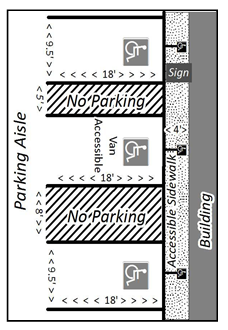
- Individual accessible parking spaces shall have an additional five-foot-wide, diagonally striped aisle abutting the passenger side of the space. If such spaces are provided in adjacent pairs, then one five-foot aisle may be shared between the two spaces.
- One in every six accessible parking spaces, but not less than one, shall be served by a van accessible space, which is an accessible parking space with a loading area of at least eight feet wide.
- Two accessible parking spaces may share a common access aisle.
- Parking access aisles shall be part of an accessible route to the building or facility entrance and shall comply with Americans with Disabilities Accessibility Guidelines accessible route requirements.
- Parked vehicle overhangs shall not reduce the clear width of an accessible route.
- Parking spaces and access aisles shall be level with surface slopes not exceeding 1:48 in all directions.
- Each accessible parking space must be accompanied by a sign with the international symbol of accessibility mounted at five feet above the ground. Signage for van accessible spaces shall include the written designation “van accessible”.
- Persons with disabilities parking spaces and access loading zones for persons with disabilities that serve a particular building shall be located on the shortest accessible route to the nearest accessible entrance with a minimum four-foot-wide sidewalk, said sidewalk shall comply with all relevant ADA standards. In parking facilities that do not serve a particular building, accessible parking spaces shall be located on the shortest route to an accessible pedestrian entrance to the parking facility. Where buildings have multiple accessible entrances with adjacent parking, accessible parking spaces shall be dispersed and located near the accessible entrances.
10-27-5 Off-Street Loading Requirements
- On the same premises with every building or part thereof, erected and occupied for commercial, industrial or other similar use involving the receipt or distribution of vehicles, material or merchandise, there shall be provided and maintained on the lot adequate space for standing, loading or unloading services in order to avoid undue interference with street or parking areas.
- All nonresidential uses within the C-2 Central Commercial District are exempt from the requirements of this Section.
- Off-street loading space areas shall not be construed, as, or counted towards, the supplying of area required as off-street parking space area.
- The loading and unloading space, unless completely and adequately provided for within a building, shall be a minimum area of 10 feet by 25 feet with 14 foot height clearance.
- The minimum number off-street loading spaces required are as indicated in the following table:
Gross Floor Area
(square feet)Number of Loading Spaces Required 0 to 2,000 None 2,000 to 20,000 1 20,000 to 100,000 1 space plus 1 space for each 20,000 sq. ft. of gross floor area in excess of 20,000 sq. ft. 100,000 to 500,000 5 spaces plus 1 space for each 40,000 sq. ft. of gross floor area in excess of 100,000 sq. ft. Over 500,000 15 spaces plus 1 space for each 80,000 sq. ft. of gross floor area in excess of 500,000 sq. ft. - In all cases where the off-street loading space is located in a manner that a truck must back directly from a major street into a loading space, a maneuvering space of not less than 50 feet shall be provided on the subject parcel.
- All off-street loading spaces shall be paved and shall be screened from any front yard area, unless the front yard is across the street from a parcel located in either the M-1 or M-2 District, either by the building existing on the lot or by a planting screen or fence.
- The minimum number of loading spaces may be reduced by up to 50% when the applicant for a development can demonstrate, to the satisfaction of the Site Plan Review Committee, that the special characteristics of the customer, client, user, employee or resident population will reduce expected loading space demand for this development, as compared to the off-street loading space requirements contained in Section 10-27-5.
10-27-6 Shared Use Of Required Parking Spaces
- One parking area may contain required spaces for several different uses but, except as otherwise provided in this section, the required space assigned to one use may not be credited to any other use.
- To the extent developments that wish to make joint use of the same parking spaces operate at different times, the same spaces may be credited to both uses. For example, if a parking lot is used in connection with an office building on Monday through Friday, but is 90% vacant on the weekends, another development that operates only on weekends could be credited with 90% of the spaces on that lot. Similarly, if a church parking lot is generally occupied only to 50% of capacity on days other than Sunday, another development could make use of 50% of the church's spaces on those other days.
- Joint use parking agreements between adjoining properties, or in planned developments on the same property, shall identify:
- The number of vehicle spaces provided for each land use activity(ies);
- The dates and times when said activities are conducted;
- Subsequently be recorded with the County Recorder’s Office prior to occupancy or use of said property or facilities.
10-27-7 Location Of Required Parking Spaces
All parking spaces required herein shall be located as follows:
- The parking spaces required for residential buildings or uses shall be located on the same lot with the building or use served and located behind the front building line.
- The parking spaces required for any other building or use may be located on an area within 300 feet of said building and two or more owners of buildings may join together in providing the required parking spaces. Where the required parking spaces are not located on the same lot with the building or use served, the usage of the lot or tract upon which said parking spaces are provided shall be restricted by an instrument of record describing the premises for which said parking is provided and assuring the retention of such parking so long as required by this Ordinance.
- In residential districts vehicles may be parked in the portion of any driveway located in front of the front line of the main building; however, parking in this area may not be used to satisfy requirements for a minimum number of off street parking spaces.
10-27-8 Standards For All Parking Lots, Garages, Drive Lanes, And Driveways
All areas intended for vehicular use, including but not limited to parking lots, garages, drive lanes, and driveways shall conform to the following improvement and maintenance standards:
- All parking areas, drives, lanes, aisles, loading spaces and any other outdoor spaces that accommodate vehicles shall be hard surfaced with materials such as Portland Concrete Cement or Asphaltic concrete (Asphalt), and shall be maintained so as to provide a durable pavement surface free of dust, weeds, and standing water.
- Portland Concrete Cement or Asphaltic concrete (Asphalt) hard surfacing shall meet all the following standards and shall be constructed to have the minimum pavement structural number as follows:
- Areas subjected to only automobile loading: 2.5
- Areas subjected to truck loading: 3.0.
- Gravel, crushed stone, dirt, chip seal, oil, sand or other such surfacing materials shall not be permitted.
- Other type of types of hard surfacing, that are not specifically prohibited, which create a durable pavement surface free of dust, weeds, and standing water, may be permitted if the material and specifications are approved in advance by the City of Muscatine.
- Adequate provision shall be made for the disposal of storm water so that water will not flow onto adjoining property or adjacent sidewalks in a quantity or manner that would be detrimental thereto, or inconvenient to persons using the sidewalk.
- A structurally sound wall or other abutment approved by the City Engineer to ensure safety shall be installed around each side of the parking lot wherever necessary to prevent the washing of soil to and from adjoining property, and a wall or screen of such height and character as are necessary for adequate screening of the parking lot from adjacent property shall also be provided to meet requirements of the City Engineer.
- The location and width of entrances and exits to and from the lot or garage shall be as determined by the City Engineer, but there shall not be more than one entrance and one exit, or one combined entrance or exit, along any one street, unless the same is deemed necessary by the City Council for the alleviation of traffic congestion and interference of traffic movement along such street.
- The location of each parking space and the location and direction of movement along the driveways providing access thereto shall be indicated by painting upon the surface, by raised directional signs, or by markers or other similar measures placed in the surfacing, where required by the City Engineer.
- Wherever the parking lots or garages are to be used during darkness, a system of lighting shall be installed to provide an adequate standard of illumination over the entire parking lot.
- Light fixtures provided for any off-street parking area adjacent to a residential use or residentially zoned lot shall shield the source of light from sight and prevent the spillover of direct light onto the residential use, while still providing security to motorists, pedestrians and bicyclists.
- A sign, the size and character of which shall be approved by the Site Plan Review Committee, shall be installed showing the ownership of the lot or garage and the permitted use thereof. If the lot or garage is so operated that a charge is made for the use of the parking facilities, the rates for parking shall be legibly shown upon the sign.
- A temporary shelter for the use of parking lot attendants may be maintained on the lot, provided the location, construction, and design of the same shall first be approved by the Site Plan Review Committee.
- The parking lot or garage shall be maintained in a manner to keep it as free as practicable from dust, paper, and other loose particles, and snow and ice shall be promptly removed by the operator. All adjacent sidewalks shall be kept free from dirt, ice, sleet, and snow and in a safe condition for use by pedestrians. All signs, markers, or any other methods used to indicate direction of traffic movement and location of parking spaces shall be maintained in a neat and legible condition. Likewise, any walls, trees, and shrubbery, as well as surfacing of the parking lot or garage, shall be maintained in good condition throughout its use for parking purposes and the City Engineer shall have the authority to prohibit the use of the area for parking purposes, unless and until proper maintenance, repair, or rehabilitation is completed.
10-27-9 Minimum Off-Street Parking Space Dimensions
- Width: 9.5 Feet
- Length: 18 Feet
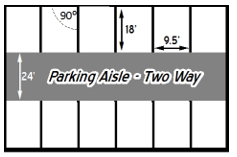
Figure A
10-27-10 Minimum Parking Aisle Width
The minimum width of drive aisles providing access to parking spaces shall be as follows:
- Two Way Traffic: 24’
- One-Way Traffic - 90⁰ Parking Angle: 24’
- One-Way Traffic - 75⁰ Parking Angle: 18’
- One-Way Traffic - 60⁰ Parking Angle: 14’ 6”
- One-Way Traffic - 45⁰ Parking Angle: 12’ 8”
- One-Way Traffic - 30⁰ Parking Angle: 11’
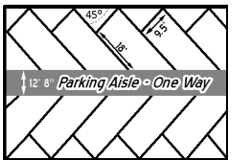 Figure A
10-27-11 Stormwater Management
Stormwater from parking lots shall drain to approved stormwater quality management practices. These practices are structural stormwater controls used to capture and treat a volume of stormwater runoff.
- These stormwater management practices shall be constructed in accordance with the most current version of the Iowa Stormwater Management Manual and must be reviewed and approved by the Public Works Department before construction.
- Stormwater management practices shall be designed and built to accommodate the runoff for the entire parking lot at an event rainfall depth of 1.25”.
- Stormwater management practices may be located in landscaped islands or landscaped buffers required by this Chapter.
- Stormwater management practices shall be maintained in good working order.
10-27-12 Landscaping Standards
The landscaping requirements in this section are intended to maximize the natural areas retained in any parking lot in order to optimize natural infiltration of rainwater, intercept and manage stormwater runoff, and provide an aesthetic setting for development. In order to accomplish these goals the following standards shall apply:
- Landscaped Islands.
- Landscaped islands meeting all the criteria set forth in this chapter shall be constructed in the portions of parking areas, containing 15 or more parking spaces, that are between any public street and a line drawn parallel the nearest face of the main building. Parking areas for large truck and semis do not require landscaped islands. If there is no structure on a parcel, landscaped islands shall be required in the entire parking lot.
- Such islands shall be located:
- At the ends of each parking aisle;
- As intermediate islands in long rows of spaces, in a manner so that no more than fifteen parking spaces are directly adjacent to one another;
- As separation between pedestrian walkways and parking spaces.
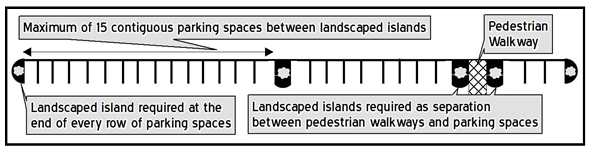
Figure C
- The minimum size for a landscaped island shall be 100 square feet. If two required landscaped in adjoining row of parking are combined the minimum size shall be 100 square feet.
- A minimum of one deciduous or evergreen tree shall be planted on each required parking lot island.
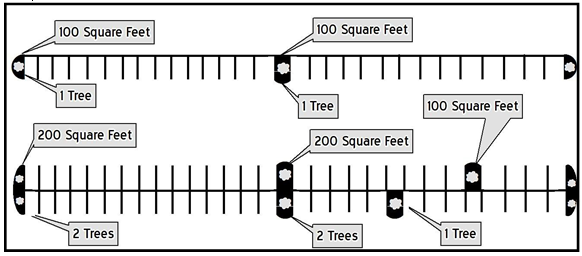
Figure D
- Screening Parking Lots from Residential Properties. To ensure that adjacent residents are not unreasonably disturbed, either by day or by night, by vehicle operations, parking areas adjacent to any residentially zoned property shall be screened from view by a solid wall or fence with a minimum height of 6 feet.
- Landscaped Buffers Along Streets.
- Parking lots shall be visually screened from all abutting streets by a landscaped buffer area at least 6 feet in width.
- A minimum of one tree and 6 shrubs shall be planted in the landscaped buffer per 25 linear feet of street frontage.
- All fractional amounts of required trees or shrubs shall be rounded up to the next whole number. For example, 2.15 trees rounds up to three trees.
- Where existing conditions or other provisions of this Ordinance make it impracticable to meet the requirements of Section 10-27-12(C), the Site Plan Review Committee may approve a modification to the width or location of the landscaped buffer area, or the spacing or number of trees in the landscaped buffer area, so long as there is no net loss of planted area or number of trees required if at all possible.
10-27-13 Standards For Required Trees And Shrubs
- Required Size. All trees and shrubs that are required by this chapter shall meet the following requirements.
- Deciduous trees shall be planted at 3 inches in caliper.
- Evergreen trees shall be coniferous species planted at six feet in height.
- Shrubs shall be either deciduous species planted at 2 1/2 feet in height or evergreen species planted at 2 1/2 feet in spread.
- Required Maintenance. All planting required by this Chapter shall be maintained to continue its effectiveness. If it deteriorates or dies, it shall be repaired or replaced no later than the next planting season.
- Permitted Tree Varieties. Any tree or shrub planted in a landscaped parking lot island or in landscaped buffer yard that is required by Section 10-27-12 shall be of one of the following approved varieties.
- Ornamental Pears: Cleveland Select or Red Spire
- Japanese Tree Lilac
- Maple, Sugar
- Maple, Black
- Maple, Red
- Hackberry
- Honey Locust, seedless thornless
- Gingko, male only
- London Plane Tree
- Oak, Swamp White
- Oak, Burr
- Oak, Red
- Oak, Scarlet
- Oak, English
- Linden, American
- Linden, Little Leaf
- Zelkova
- Beech
- Elm, Princeton
- Tulip Tree
- Iron Wood
- Narrow vase shaped Crab Apples: Adirondack and Marilee
- Any other variety not listed, but which has been approved for planting in the right-of-way by the City of Muscatine.
- A tree may be planted in lieu of any shrub required by this chapter. Trees planted in lieu of a required shrub need not be three inches in caliper.
10-27-14 Bicycle Parking
- Minimum Number of Required Bicycle Parking Spaces. For all nonresidential uses and multifamily residential developments containing more than 4 dwelling units, a minimum number of bicycle rack(s) are required as indicated in the following table.
Minimum Required Number Motor Vehicle Parking Spaces Minimum Number of Bicycle Racks 0-5 None 5-40 1 41-60 2 61-80 3 81-100 4 Over 100 5 or 5% of the minimum number of motor vehicle space, whichever is greater - Location.
- All required bicycle parking racks shall be located within a 100-foot diameter of the primary building entrance.
- All required bicycle racks shall be located in highly visible and well-lit areas to minimize theft and vandalism.
- A minimum of four feet from the required bicycle rack dimension shall be provided for pedestrian clearance when a bicycle rack is placed within a sidewalk or pedestrian right-of-way.
- Bicycle parking facilities shall not interfere with accessible paths of travel or accessible parking as required by the Americans with Disabilities Act of 1990, as amended.
- Layout and Design.
- Each bicycle rack shall be designed to accommodate two bike parking spaces using the allowed bike rack designs below.
- Bicycle racks shall be designed to accommodate U-shaped locking devices. The bicycle frame and one wheel can be locked to the rack with a high security, U-shaped shackle lock if both wheels are left on the bicycle.
- The bicycle racks shall be constructed of durable materials to withstand permanent exposure to the elements, such as powder-coated metal or stainless steel.
- All bicycle parking spaces must be hard-surfaced and dust free.
- All bicycle racks shall be securely anchored to the ground using a concrete footing and tamper-proof spike anchors.
- In cases where bicycle racks are not visible from the primary street, signage shall be used to direct cyclists safely to bicycle parking areas.

