
River Falls City Zoning Code
CHAPTER 17
08 - GENERAL REQUIREMENTS
Sections:
17.08.010 - Lot and building regulations.
A.
Lot Area and Population. No lot area shall be so reduced or diminished that the yards or other open spaces shall be smaller than prescribed by this title, nor shall the density of population be increased in any manner except in conformity with the area regulations as hereinafter provided, nor shall the area of any lots be reduced below the minimum requirement herein established.
B.
Building Access Requirements.
1.
Access Requirements. No principal building shall be erected or structurally altered unless there is direct access from a public street or highway. No building shall hereafter be erected or altered so as to close the present means of access to an existing principal building unless another access is provided.
2.
Number of Principal Buildings. There shall be no more than one single-family or duplex structure on any lot of record. There may be more than one multiple dwelling, commercial, industrial or university structure on a lot of record if all parking, open space and other district regulations are complied with for each structure. For the purpose of these regulations, townhouses and condominiums shall be defined as multiple dwelling structures.
C.
General Provisions. The following general provisions, in addition to the regulations prescribed for each district, shall apply to all districts:
1.
Yard Size. Yard size measurements shall be taken from the nearest point of the building which shall include any porch, eave, overhang or appurtenance that is attached thereto.
2.
Rear Yard Depth. In determining the depth of rear yards for any principal building where the rear yard opens into the alley, half the width of the alley, but not exceeding ten (10) feet, may be considered as a portion or the rear yard subject to the following:
a.
The depth of the rear yard shall not be reduced to less than ten (10) feet by the application of the exception.
b.
If the door of any building or improvement except a fence opens forward to an alley, it shall not be erected or established closer to the center line of an alley than a distance of fifteen (15) feet and not closer than five feet from the property line.
3.
Attached Dwellings. Attached dwellings shall be subject to the following provisions:
a.
Attached dwelling proposals shall be presented to the plan commission as certified surveys or subdivision plats as defined and outlined in Ordinance No. 13.06 and Ch. 236, Wis. Stats., et seq.
b.
Certified surveys shall be permitted where the division of any lot, parcel or tract of land creates four or less parcels.
c.
Proposals creating five or more parcels shall require the submittal of a subdivision plat in accordance with applicable regulations and statutes.
d.
The approval of attached dwelling development or conversion shall be by special use permit and occur only after the plan commission and the city council have accepted or approved any private easements, agreements, covenants or other provisions that may be required.
e.
Attached dwellings are permitted as a special use in the R1, R2 and R3 districts. This form of construction or conversion shall not create development that exceeds the density standards of a particular zoning district. Through the certified survey or subdivision plan, legal ownership of parcels smaller than those specified in the subdivision code may be allowed, while the special use permit prohibits nonconforming changes to an approved attached dwelling in the future.
4.
Attached Accessory Buildings. An attached accessory building or structure shall be subject to the setback and yard requirements of and as if it were a part of the principal building or use.
5.
Unattached Accessory. Unattached accessory buildings in any zone shall be subject to the following conditions:
a.
No detached accessory building or structure shall occupy more than thirty (30) percent of the area of a required yard.
b.
Except in the A district, no detached accessory building or structure shall exceed the height of the principal building structure. In the A district, detached accessory buildings may exceed the height of the principal building structure, but may not exceed fifty (50) feet in height.
c.
Except in the A district, detached accessory buildings shall have the same front yard setback requirements as the principal building or structure and shall not be allowed to encroach upon the front yard or beyond the front building line.
d.
No detached accessory building shall be closer than five feet from the rear lot line.
e.
No detached accessory building shall be closer than five feet from the side lot line.
f.
The minimum distance between the principal building and an unattached accessory building shall be five feet.
6.
[Decks.] For purposes of this chapter, a deck shall be subject to the following.
a.
No deck shall occupy more than thirty (30) percent of the area of a required yard.
b.
A deck shall have the same front yard setback requirements as the principal building and shall not be allowed to encroach upon the front yard setback.
c.
No deck shall be closer than fifteen (15) feet from the rear lot line.
d.
No deck shall be closer than five feet from the side lot line.
e.
No deck shall be closer than fifteen (15) feet from the side lot line on a corner lot.
f.
No deck shall encroach on a recorded easement.
A deck, gazebo or screen porch that is intended to be integrated into the principal structure by a roof extension, walls, or other improvements that partially or fully enclose it, shall be subject to the setback and yard requirements of the principal building.
(Prior code § 21.04)
(Ord. No. 2017-19, § 2, 11-14-2017; Ord. No. 2021-03, § 4, 5-11-2021)
17.08.020 - Driveway regulations.
All private driveways to or from public streets shall be subject to the following restrictions:
A.
Driveway Width. Driveway transitions exceeding those shown may be approved by the city engineer for drives entering arterial streets if necessary to accommodate anticipated truck turning movements.
B.
Driveway Spacing. Where it is not possible or practical to achieve the minimum required spacing as shown below, two driveways may be combined if the combined widths do not exceed the maximums prescribed by subsection A of this section.
C.
Driveway Angle to Street. The angle between the driveway and the street shall be between eighty (80) degrees and one hundred (100) degrees.
D.
Minimum Distance of Driveway from Street Intersection. (Measured from the near curb line extended of the intersecting street to the closest limit of curb cut.) See following table:
E.
Restrictions. The plan commission may prohibit the construction of a private driveway entering a minor arterial or principal arterial when the use of that driveway may create or aggravate a traffic hazard. Driveways entering a freeway or expressway shall be prohibited.
(Ord. 2008-13 § 1; prior code § 21.05)
17.08.030 - Vision obstructions.
A.
Vision Clearance Triangle. A vision clearance triangle shall be established at each corner of intersection streets in order to provide adequate sight distance.
1.
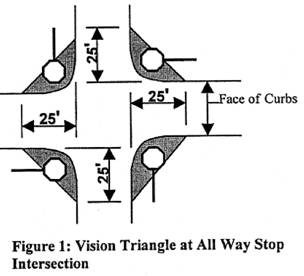
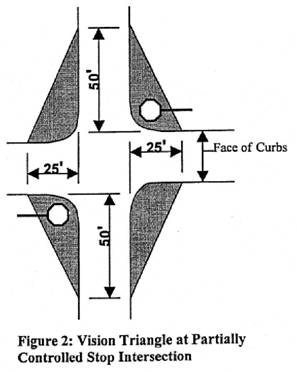
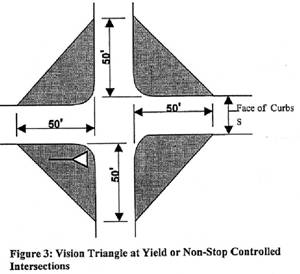
The vision triangle shall be formed by creating a third leg which connects the ends of two legs which are in line with the face of existing curbs and have lengths established as follows:
a.
On streets that a have a stop condition at the intersection, the leg of the vision triangle shall extend back twenty-five (25) feet from the nearest face of curb on the cross street being approached. See Figures 1 and 2.
b.
On streets that do not have a stop condition at the intersection, the leg of the vision triangle shall extend back fifty (50) feet from the nearest face of curb on the cross street being approached. See Figures 2 and 3.
2.
Vision clearance triangles shall apply at the intersection of public alleys with public streets. The leg of the vision clearance triangle along alleys shall extend back twenty-five (25) feet from the nearest face of the curb and the cross street being approached.
3.
Vision clearance triangles shall apply at the intersection of commercial driveways and alleys with public streets. The leg of the vision clearance triangle at commercial driveways shall extend back twenty-five feet from, and perpendicular to, the nearest face of curb on the cross street being approached.
4.
The vision clearance shall be considered three-dimensional beginning thirty (30) inches above the top of curbs and ending nine feet above the top of curbs.
5.
Where wording herein references horizontal measurement from face of curb and no curb exists, the edge of pavement shall be used instead.
6.
Where wording herein references vertical measurement from top of curb and no curb exists, the measurement shall begin at six inches above the edge of pavement.
7.
At any corner where the angle of intersection streets form an angle of less than seventy (70) degrees, the vision clearance triangle will be adjusted accordingly by the city engineer to provide sight distance consistent with that produced by application of this section at intersections of seventy (70) degrees or more.
B.
Character of Vision Clearance Triangle. A Vision Clearance Triangle shall contain no fence, structure, earth bank, hedge, planting, wall or other obstruction. The following are exempted from this provision:
1.
Public utility poles and fire hydrants;
2.
Trees trimmed to the trunk;
3.
Other plant species of open growth habit that are not planted in the form of a hedge and which are so planted and trimmed as to leave in all seasons a clear and unobstructed cross-view;
4.
Official warning signs or signals.
In addition, the city engineer may waive this provision where the natural contour of the ground is such that there can be no cross visibility at the intersection.
C.
Parking. There shall be no parking allowed along the curb adjacent to the vision clearance triangle.
D.
Buildings. Construction of new buildings or new additions to existing buildings that extend into the vision triangle shall not be permitted. Existing buildings shall not be considered an obstruction under the terms of this section.
E.
Obstructions in Corner Lots. The required front yard of a corner lot shall not contain any vehicle, trailer or other obstruction which may cause danger to traffic on a street or public road by obscuring the view.
(Ord. 2000-9; Ord. 1999-26: prior code § 21.06)
(Ord. No. 2017-13, §§ 1, 2, 6-27-2017; Ord. No. 2022-05, § 1, 8-23-2022)
Editor's note— Ord. No. 2017-13, § 1, adopted June 27, 2017, renamed § 17.08.030 from fences and obstructions as vision obstructions. See also Section 17.08.070, fences.
17.08.040 - Reserved.
Editor's note— Ord. No. 2022-05, § 2, adopted August 23, 2022, repealed § 17.08.040, which pertained to parking and loading and derived from prior code § 21.07. Similar provisions can be found in § 17.80.020
17.08.050 - Setback requirements.
A.
No structures shall be allowed any closer to streets, roads or traffic ways than as follow:
1.
Principal arterial, minimum setback: Forty-two (42) feet.
2.
Minor arterial, minimum setback: Twenty-five (25) feet.
3.
Collector street, minimum setback: Twenty-five (25) feet.
4.
Local street, minimum setback: Twenty-five (25) feet.
B.
Individual zoning district requirements, where different, shall prevail.
(Prior code § 21.08)
17.08.060 - Nonconforming building and uses.
A.
Purpose. In the districts established by this title or amendments that may later be adopted, there may exist lots of record and uses of land and structures which were lawful before this title was passed or amended, but which would be prohibited, regulated or restricted under the terms of this title or future amendments. The purpose of this section is to minimize the hardships that may unintentionally occur to citizens whose present lots or uses of land and structures do not conform wholly with the provisions of this title.
B.
Nonconforming Lots of Record.
1.
In any district created by this title or amendment thereto, any building, structure or accessory use or building may be erected on any single lot of record at the effective date of adoption or amendment of this title, except that all other provisions of this title shall apply. Such lot shall be in separate ownership and not of continuous frontage with other lots in the same ownership. This provision shall apply even though such lots fail to meet the requirements for area or width, or both, that are applicable in the district, provided that yard dimensions and requirements other than these previously stated shall conform to the regulations for the district in which such lot is located. Variance of yard requirements shall be obtained through action of the board of appeals.
2.
If two or more lots or combinations of lots and portions of lots with continuous frontage in single ownership are of record at the time of passage or amendment of this title and if all or part of the lots do not meet the requirements established for lot width and area, the lands involved shall be considered to be an undivided parcel for the purposes of this title and no portion of such parcel shall be used or sold in a manner which diminishes compliance with lot width and area requirements established by this title, nor shall any division of any parcel be made which creates a lot with width or area below the requirements of this title.
C.
Nonconforming Uses and Structures. The lawful use of a building or premises existing at the time of the adoption or amendment of this title may be continued although such use does not conform with the provisions of this title. Such nonconforming use shall not be extended. The total structural repairs or alterations in such a nonconforming building or premises shall not during its life exceed fifty (50) percent of the assessed value of the building unless changed to a conforming use. If such nonconforming use is discontinued for a period of twelve (12) months, any future use of the building or the premises shall conform to this title.
D.
Provisions for Columbaria and Mausoleums. Columbaria and mausoleums are regulated in state statutes under sections § 157.12 for mausoleums and non-exempt columbaria and § 157.123 for columbaria maintained by a religious association. The provisions under § 157.123 provide an exemption to the state's mausoleum requirements for columbaria maintained by a religious association.
1.
Requirements for all columbaria and mausoleums:
a.
Physical Requirements. Any outdoor columbarium or mausoleum shall be subject to the following requirements:
i.
Location. In addition to the land use requirements of the applicable zoning district, the following location requirements shall also apply:
(a)
Expect as permitted under subsection (b), mausoleums and columbaria shall be located inside a cemetery that has been in existence for 10 years or more. As is authorized by § 159.129, the City of River Falls waives the minimum 20-acre requirement for a cemetery (as found in § 157.12(2)(c)2) for which a mausoleum may be placed.
(b)
Columbaria maintained by a religious association may be located on property owned by the religious association and on which the religious association's church building or other place of worship is located. In the event that the religious association ceases to use or occupy the church building or other place of worship where the columbarium is located, the religious association shall relocate all of the urns or other receptacles in the columbarium containing cremated remains per the requirements of Wis. Stat. § 157.123(c).
ii.
Setback. Mausoleum and columbaria structures shall meet the setback and yard requirements of the zoning district in which it is located.
iii.
Signage. Signage shall be limited to inscriptions on the face of a mausoleum space or columbarium niche and commemorative plaque on the mausoleum or columbarium structure. Commemorative plaques may be no larger than twelve (12) inches by twelve (12) inches.
iv.
Left Objects. Left objects, such as flowers and mementos, are permitted but must be monitored by the religious association or cemetery or mausoleum operator and removed on a regular basis. The regularity of said removal can be defined in the plan of perpetual care and maintenance for the columbarium.
b.
Care and Maintenance Plan. A plan of perpetual care and maintenance shall be submitted to the plan commission for review and approval. Said plan shall be pursuant to § 157.123(2)(b) and (d) for columbaria maintained by a religious association or to § 157.12(3)(a) for mausoleums.
(Prior code § 21.09)
(Ord. No. 2017-10, § 2, 4-11-2017)
17.08.070 - Fences.
A.
Purpose and Intent. The city recognizes the health, safety, aesthetic and economic value of fences. The provisions of this section are intended to:
1.
Allow for areas on a site for privacy while maintaining the city's general open design along streets;
2.
Provide screening and enhance the overall aesthetic conditions within the city;
3.
Limit sight line obstructions;
4.
Reduce the potential for criminal and illegal activities; and
5.
Prevent conflicts with utilities and drainage flow.
B.
Definitions.
1.
"Fence" means a constructed barrier used to enclose, screen or separate areas.
2.
"Decorative fence" means a permanent or temporary structure not intended or designed to enclose, screen, or separate areas, but rather to decorate, accent, or frame a feature of the landscape.
C.
Permit Required. An application for a fence permit shall be made to the department of community development and shall provide the information itemized below. For each fence permit application, a fee will be paid in the amount listed in the city fee schedule. The requirements of this subsection C, and the location, height and materials requirements in subsections D, E, and F, below, shall not apply to fences constructed in the A district.
1.
Name, address, email, and telephone number of the applicant.
2.
Address of the property where the fence is to be located.
3.
Written consent of the owner of the property upon which the fence is to be erected (if different than the applicant).
4.
Site plan depicting all areas where the proposed fence will be installed, including setbacks from property lines and buildings, and the height proposed in each location.
5.
Photo or manufacturer specification sheet of the proposed fence to be installed (if commercially constructed) as well as the proposed fence material.
6.
Permits are not required for decorative fences.
D.
Location.
1.
Zoning District. Fences are allowed in any zoning district, subject to the provisions of this section.
2.
Fence Location on Lot. Unless otherwise required, fences are permitted up to, but not over, the property line, except for where a fence abuts a street, then it must be set back a minimum of three feet from the property line. Fences shall be set back as needed to maintain a vision clearance triangle setback as required in Section 17.08.030.
E.
Height. Except where otherwise required by this code, the following regulations apply to fence height. For the purposes of fence height requirements, alleys are not considered a street.
1.
Limitations. Except where otherwise required by this code or required by a condition of approval for a development application, the following limitations apply to fence height:
2.
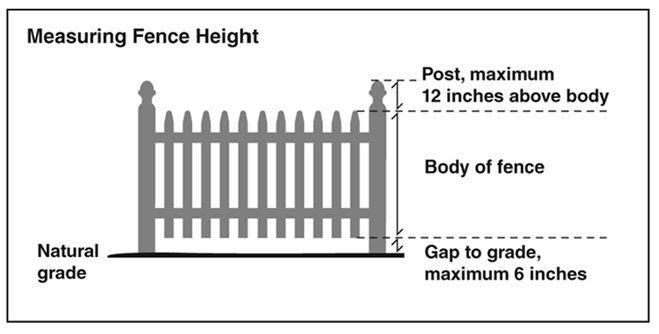
Measurement. Fence height is measured to include the body of the fence, plus allowing a maximum of six inches (on average between posts) above the natural grade (i.e., for drainage purposes). Fence posts are permitted to extend a maximum of twelve (12) inches above the body of the fence. In the event fence height has been elevated through the use of a retaining wall, the creation of a berm or other method for the primary purpose of increasing the elevation of the fence, the fence height is measured from the ground elevation prior to grade modification.
3.
Graphic Illustration: Measuring Fence Height.
4.
Exceptions.
a.
A residential fence in a side or rear yard abutting a nonresidential zone may rise up to the height of eight feet.
b.
Commercial fences in a side or rear yard abutting a residential zone must rise up to a minimum of eight feet in height.
c.
A residential fence in a rear or side yard that abuts a street may rise up to a height of six feet if the fence is set back a minimum of three feet from the property line and adequate landscaping is installed and maintained on the street side of the fence. Landscaping to be approved as part of the permit. Grasses, shrubs or small trees along with flowers will be acceptable with the intent to break up the visual solidness of the wall. Native plants are always encouraged. These requirements apply to all such fences greater than three feet up to six feet.
F.
Materials.
1.
Permitted Materials. Fences must be constructed [of] materials designed for permanent outdoor fencing such as wood, metal, brick, or vinyl. Wood fences must be constructed of cedar, redwood or other decay resistant wood.
2.
Prohibited Materials. The following fence materials are prohibited:
a.
Chain link fencing of any kind in a front yard.
b.
Snow fencing, plywood, or materials originally intended for other purposes.
c.
Above ground electric fencing.
3.
Exceptions. The following fences are exempt from material limitations:
a.
Temporary fences, such as chicken or mesh wire, are permitted for garden enclosures only.
b.
Temporary fence wrap made of material designed to withstand wind loads is permitted for temporary construction or excavation fences pursuant to subsection K, below.
c.
Barbed wire, razor wire, or concertina fencing is only permitted by special use permit and only if the proposed fence does not abut a residential zone.
G.
Restrictions. The following restrictions on fences apply to protect the public health, safety and welfare.
1.
Ownership. All fences, including fence footings, must be located entirely on the fence owner's property.
2.
Vision Clearance Triangle. No fence shall be placed in such a manner as to interfere with the vision clearance triangle requirements of Section 17.08.030.
3.
Fire hydrant and Utility Clear Zone. The area three feet in radius around all fire hydrants, fire hose connections and utility boxes must be kept free of any fencing that could impede access to or use of the hydrant, fire hose connection or utility box.
4.
Fences in Floodways. Fences are not permitted in floodway areas as designated on FEMA's flood boundary and floodway map.
5.
Drainage. A fence must not adversely affect drainage or create debris build-up.
H.
Fence Installation, Posts and Supporting Members. All fence elements must be permanently installed and constructed in a professional manner to secure the fence in a vertically level position. Fences must be installed so that posts and lateral supports are not on the side of the fence facing an adjacent property or public right-of-way, unless exposed on both sides.
I.
Maintenance. All fences must be kept in good repair and appearance on both sides of the fence by its owner. Fences shall not be in a condition of disrepair or constitute a public or private nuisance. The property owner is responsible for maintaining the area between the property line and the owner's fence.
J.
Utilities. The property owner is responsible for verifying that no conflicts exist with utilities prior to installation of fencing.
K.
Temporary Fences. Temporary fences are prohibited in residential districts, except where required for construction or excavation purposes. Where temporary fencing is for construction or excavation purposes, a temporary fence wrap is permitted for the duration of the construction or excavation period.
L.
Swimming Pool Safety Fences.
1.
Access Requirements.
a.
All swimming pools to be constructed or which are already constructed shall be completely surrounded by a fence or wall not less than four feet in height, which shall be so constructed as not to have openings, holes or gaps larger than four inches in diameter, except for doors and gates. The fence shall be of a type not readily climbed by children. A dwelling or accessory building may be used as part of such enclosure. An above ground pool with a wall greater than four feet in height does not require a fence if the wall cannot be readily climbed by children.
b.
Above ground pools shall be protected in such a way that access ways, other than those afforded by the dwelling house or accessory buildings, shall be equipped with self-closing and self-latching gates or doors (including removal of ladders to pools when not in use) and are kept securely closed at all times when not in actual use.
2.
Construction Requirements. As part of the building permit requirements, an applicant shall conform to the following:
a.
Submit a scaled drawing site plan indicating the location of the building, pool, decking, fence and gates.
b.
Install safety fencing around pool site during construction and until a permanent fence and gate is in place. The permanent fence shall be in place within seven days of filling of the pool. For the purpose of this subdivision, seven days after filling shall be considered the end of the construction.
M.
Retaining Walls.
1.
Any wall retaining more than three feet of earth shall not be allowed unless certified computations prepared by a professional engineer are provided and approved by the city engineer.
2.
A terraced wall retaining no more than six feet of earth may be erected without providing engineering computations if the height of any individual wall does not exceed three feet and individual walls are spaced one and one-half the height of the highest individual wall.
3.
If a retaining wall exceeds three feet, a three-foot barrier fence shall be placed along the top of the wall, excluding low density residential.
(Ord. No. 2017-13, § 1, 6-27-2017; Ord. No. 2017-18, § 1, 11-14-2017; Ord. No. 2018-04, § 1, 5-22-2018; Ord. No. 2021-03, § 5, 5-11-2021)
17.08.080 - Residential rental uses.
A.
Minimum Space and Occupancy Requirements. No person shall let to another for occupancy any dwelling unit for the purpose of living therein which does not comply with the following requirements:
1.
Every dwelling unit shall contain a minimum gross floor area of not less than one hundred fifty (150) square feet for the first occupant, one hundred (100) square feet for the second occupant, and seventy-five (75) square feet for each additional occupant. The floor area shall be calculated on the basis of the total area of all habitable rooms.
2.
In every dwelling unit of two or more habitable rooms, every room occupied for sleeping purposes by one occupant shall contain at least eighty (80) square feet of floor space.
3.
Every room occupied for sleeping purposes by more than one occupant shall contain at least forty (40) square feet of additional floor space for each occupant over twelve (12) years and at least an additional thirty (30) square feet of additional floor space for each occupant under twelve (12) years.
4.
At least one-half of the floor area of every habitable room shall have a ceiling height of a least seven feet and the floor area of that part of any room where the ceiling height is less than five feet shall not be considered as part of the floor area in computing the total floor area of the room for the purpose of determining the maximum permissible occupancy thereof.
5.
No "dwelling unit," shall be occupied by more than one "family" as defined in the code Section 17.04.020 Definitions.
6.
All residential rental uses must comply with municipal code Chapter 15.16 Housing Code.
(Ord. No. 2022-08, § 2, 8-23-2022)

