
Rome City Zoning Code
ARTICLE XI
- DESIGN STANDARDS
Sec. 80-11.1. - Applicability.
(a)
These design standards are applicable to new development that is subject to site plan review, per section 80-19.4. and to planned developments, per article XVII, in all districts with the exception of development within the GB district, W district, and WR district.
(b)
These design standards are organized by development type. However, certain developments are also subject to the standards of designated main streets, in section 80-11.7.
(c)
Development in the GB district is subject to the design standards of article VIII.
(d)
Development in the W district and the WR district is subject to the design standards of article IX.
(Ord. No. 9301A, 9-26-18)
Sec. 80-11.2. - Single-family detached and two-family dwellings.
(a)
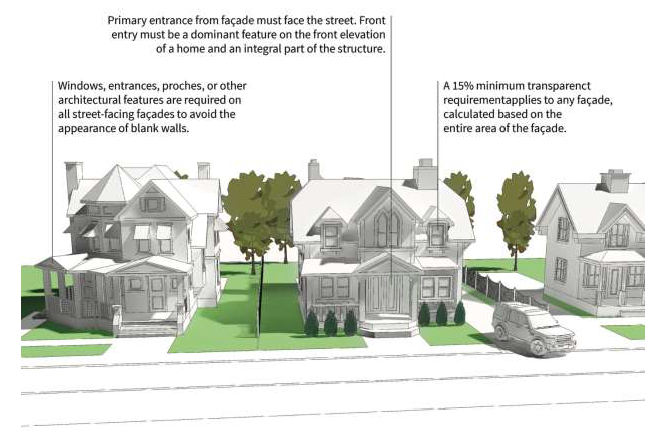
A dwelling must have a primary entrance from the façade facing the street. The front entry must be a dominant feature on the front elevation of a home and an integral part of the structure, using features such as porches, raised steps and stoops with roof overhangs, or decorative railings to articulate the front façade.
(b)
Windows, entrances, porches, or other architectural features are required on all street-facing facades to avoid the appearance of blank walls.
(c)
A 15 percent minimum transparency requirement applies to any façade and is calculated on the basis of the entire area of the façade.
(d)
New residential subdivisions of single-family and/or two-family residential developments must incorporate a diversity of housing types and styles through the use of building styles, architectural design elements, and building patterns to add variety to building designs. The following are examples of design techniques that may be used to meet this requirement:
i.
Constructing buildings with different numbers of stories.
ii.
Using reverse elevations.
iii.
Using a variety of front facade treatments, such as porches, decks, bay windows, trim details, and roof gables/dormers.
iv.
Providing differing garage orientations (i.e., front, side, rear alley).
v.
Using combined entryways, porches and decks.
vi.
Painting the buildings different colors and using different types of building materials.
Single-Family and Two-Family Dwellings
(Ord. No. 9301A, 9-26-18)
Sec. 80-11.3. - Multi-family and single-family attached dwellings.
(a)
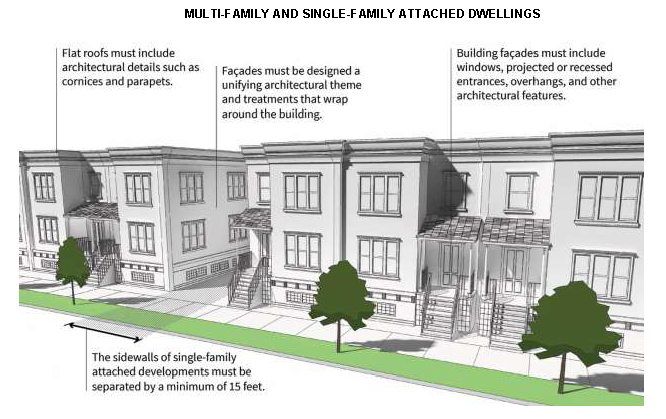
Façades must be designed with consistent materials and treatments that wrap around all street-facing façades. There must be a unifying architectural theme for the entire multi-family or single-family attached development, utilizing a common vocabulary of architectural forms, elements, materials, or colors in the entire structure.
(b)
Building facades must include windows, projected or recessed entrances, overhangs, and other architectural features. Three-dimensional elements, such as balconies and bay windows, are encouraged to provide dimensional elements on a façade.
(c)
The following minimum transparency requirements apply to any façade facing a street and are calculated on the basis of the entire area of the façade:
i.
Single-Family Attached Dwelling: 15 percent.
ii.
Multi-Family Dwelling: 25 percent
(d)
Flat roofs must include cornices, parapets, or similar architectural details to add variety and break up the roofline.
(e)
There must be a minimum separation of 15 feet between sidewalls of single-family attached developments. Where the front or rear wall faces the front or rear wall of another development, the minimum required separation between such buildings must be 30 feet. Driveways and parking areas may be located within this minimum separation area.
(f)
The following building materials are prohibited on any façade. However, such materials may be used as decorative or detail elements for up to 25 percent of the facade, or as part of the exterior construction that is not used as a surface finish material.
i.
Plain concrete block.
ii.
Corrugated metal.
iii.
Aluminum, steel, or other metal sidings.
iv.
Exposed aggregate (rough finish) concrete wall panels.
v.
Exterior insulating finish systems (EIFS).
vi.
T-111 composite plywood siding.
vii.
Plastic.
(Ord. No. 9301A, 9-26-18)
Sec. 80-11.4. - Commercial and mixed-use developments.
(a)
Façade design.
i.
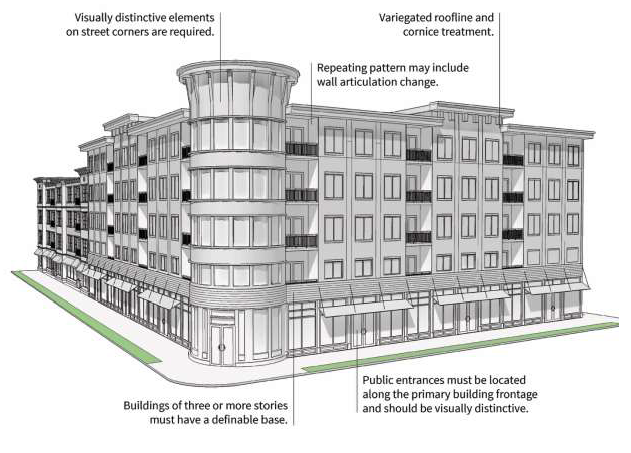
Building facades in excess of 100 feet that abut a public right-of-way, excluding alleys, must include a repeating pattern with no less than two of the following elements: color change, texture change, material module change, or a wall articulation change of no less than two feet in depth, such as a reveal, pilaster, or projecting rib. All elements must repeat at intervals of no more than 40 feet.
ii.
All buildings of three or more stories must be designed with a definable base (ground floor), through the use of architectural features such as cornice treatments, recesses, corbeling, brick courses, and window designs.
iii.
All buildings must have a public entrance from the sidewalk along the primary building frontage. Public entrances must be visually distinctive from the remaining portions of the façade along which they are located.
iv.
Visual distinction is required on street corners using distinctive building entryways in combination with landscape or artwork. The following are examples of design techniques that may be used to meet this requirement: architectural elements such as turrets, sculptures, and corner accentuating rooflines, landscape trellises, decorative tile, and artwork.
(b)
Fenestration design.
i.
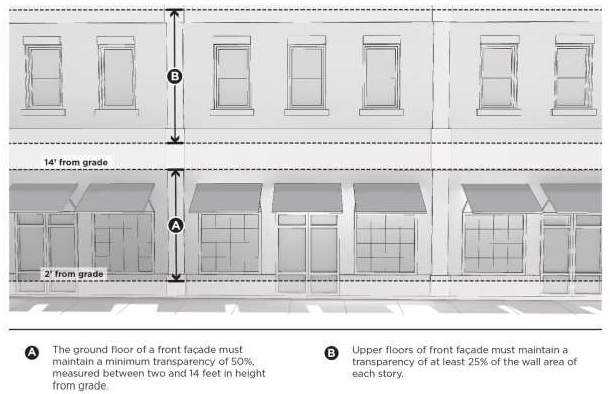
The ground floor of the front facade must maintain a transparency of 50 percent, measured between two and 14 feet in height from grade.
ii.
Upper floors of the front facade must maintain a transparency of 25 percent of the wall area of the story.
iii.
Mirrored and privacy tinted windows do not count towards transparency percentage.
(c)
Roof design.
i.
In the C-1 and C-3 districts, rooflines over 100 linear feet in building length must be variegated, and incorporate a major focal point feature, such as a dormer, gable, or projected wall feature. An element of variegation on the roofline must occur at intervals of no more than 75 feet.
ii.
If parapet walls are used, the parapet wall should extend around the entire perimeter of the structure, except where bordered by adjacent buildings to conceal the parapet ends. Parapet walls must feature three-dimensional cornice treatments or other shadow-creating details along their tops.
iii.
Green roof, blue roof, and white roof designs are encouraged.
iv.
Reflective roof surfaces that produce glare are prohibited, except for solar panels or white roofs intended to radiate absorbed or non-reflected solar energy and reduce heat transfer to the building.
(d)
Retail center site design.
i.
The site must be designed so that there is safe pedestrian access to the center from the public right-of-way and safe pedestrian circulation within the development.
ii.
A cohesive character is required through the use of coordinated hardscape treatment (special paving materials, lighting, street furniture, etc.) and landscaping.
iii.
If outlot buildings are part of a multi-tenant retail center, outlot buildings must define the street frontage by placement within zero feet to 25 feet of the lot line. Outlot buildings may be placed within a required setback to comply with this standard. Outlot buildings must include showcase windows and entrances oriented toward both the street and the interior parking lot.
iv.
A street presence for a mixed-use retail center must be created by locating part of the center or outlot buildings within zero feet to 25 percent of the lot line for at least 30 percent of the frontage. The center or outlot buildings may be placed within a required setback to comply with this standard.
v.
Rear parking areas with pedestrian access into the buildings are encouraged.
Commercial and Mixed-Use Developments
(Ord. No. 9301A, 9-26-18)
Sec. 80-11.5. - Office development.
(a)
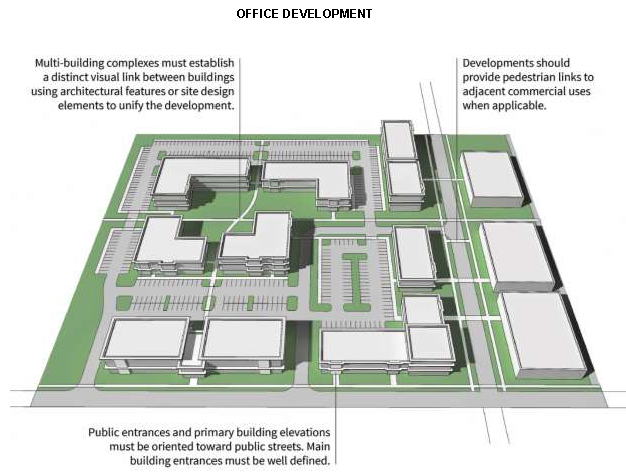
Public entrances and primary building elevations must be oriented toward public streets. Main entrances to the buildings must be well defined.
(b)
Entries to office or guest facilities must address the street, with direct access to office or guest facilities from street frontages and parking areas.
(c)
In multi-building complexes, a distinct visual link must be established between various buildings through the use of architectural features or site design elements such as courtyards, plazas, landscape, and walkways to unify the project.
(d)
When applicable, developments should provide a pedestrian link to adjacent commercial uses to provide safe pedestrian access between the site and commercial uses outside the development.
(Ord. No. 9301A, 9-26-18)
Sec. 80-11.6. - Industrial development.
(a)
Large expanses of highly reflective wall surface material and mirror glass on exterior walls are prohibited.
(b)
Green roof, blue roof, and white roof designs are encouraged.
(c)
Reflective roof surfaces that produce glare are prohibited, except for solar panels or white roofs intended to radiate absorbed or non-reflected solar energy and reduce heat transfer to the building.
(Ord. No. 9301A, 9-26-18)
Sec. 80-11.7. - Designated main streets.
Designated main streets have specific design standards to ensure a higher level of design quality, as well as context-sensitivity within the city's key "main street" corridors, consistent with the recommendations of the city's "Main Streets Program Design Guidelines" and "Storefront Design Manual." The goals are to improve the visual quality of the city's "main street" corridors, preserving and enhancing the city's unique urban character, improving walkability and pedestrian safety, encouraging economic development, and retaining the visual character and character-defining features of existing historic buildings within the district.
(a)
Commercial building façade standards.
i.
New construction must maintain consistency with existing development through designs that are of a similar scale and proportion to adjacent buildings.
ii.
New construction must acknowledge existing building widths by providing a division of the façade into visible building increments or modules no larger than the average width of existing buildings on the block.
iii.
Where a block is defined by a continuous street frontage, any proposed new building or infill construction must maintain such continuous street wall by building from side lot line to side lot line, unless access is required for rear yard parking.
iv.
Street abutting building facades must provide a building entrance no less than once every 50 feet.
(b)
Commercial building fenestration standards.
i.
If located in a C-1 or C-3 district, the ground floor of the front façade must maintain a transparency of 60 percent measured between two and 14 feet in height from grade.
ii.
If located in a C-2 district, the ground floor of the front façade must maintain a transparency of 40 percent measured between two and 14 feet in height from grade.
iii.
A bulkhead or knee-height wall a minimum of 18 inches and a maximum of 36 inches in height is required along any street abutting façade to provide a definable base and give visual weight to required ground floor glazing.
(c)
Site design.
i.
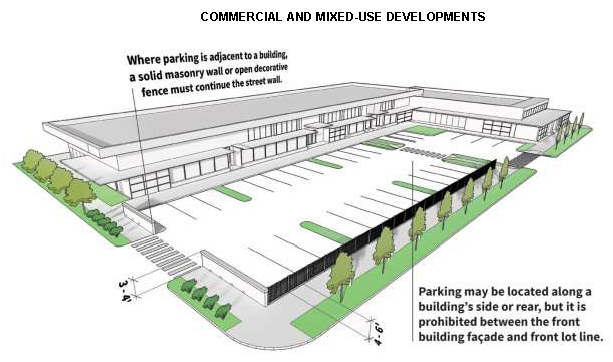
Parking may be located along the side or to the rear of the building. Parking is prohibited between the front building façade and front lot line.
ii.
When parking is located adjacent to a building, a continuation of the street wall must be created through the use of a solid masonry wall designed to complement the building, or combination of landscape and an open decorate fence as follows:
a.
A solid masonry wall must be between three and four feet in height. An open, decorative feature may be included in the design of such a wall, and may extend up to a maximum height of five feet. A masonry wall must employ the same quality materials required of the primary building.
b.
An open decorative fence must be between four and six feet in height, and must be constructed of high-quality durable material such as wrought iron.
c.
New construction within a designated main street district must be built at the lot line; a zero foot front build-to line is required to enhance the strong pedestrian-oriented sense of place. Corner lot buildings also require a zero foot build-to line at the corner lot line.
(d)
Residential design standards. New single-family detached, two-family, and single-family attached dwellings, and any additions to such structures, must be constructed to be generally compatible with other existing dwellings on the same block frontage within 200 feet. This requirement is satisfied by constructing the dwelling so that at least four of the following features are similar to the majority of other dwellings within 200 feet on the block frontage (both sides of the street):
i.
Roof style and overhang (e.g., gable, mansard, hip, A-frame, or flat).
ii.
Garage orientation and access (e.g., attached/front loaded, attached/side-loaded, or detached/alley-loaded)
iii.
Building massing (e.g., ranch with attached garage, two-story with attached garage, bungalow)
iv.
Floor area:
a.
Single-family dwelling. The floor area of the proposed dwelling unit shall be no less than 80 percent and not more than 145 percent of the average floor area of other single-family dwelling units, as indicated in the city tax assessor's records, within 200 feet of the subject lot, including single-family dwelling units along both sides of the street of the same block.
b.
Two-family dwelling. The floor area of the proposed dwelling unit shall be no less than 80 percent and not more than 145 percent of the average floor area of other two-family dwelling units, as indicated in the city tax assessor's records, within 200 feet of the subject lot, including two-family dwelling units along both sides of the street of the same block.
v.
Front porches (existence of).
vi.
Exterior building material.
vii.
Pattern of window and door openings (e.g., central door and four windows; offset door and three windows).
(Ord. No. 9301A, 9-26-18)

