
Rome City Zoning Code
ARTICLE XV
- LANDSCAPE
Sec. 80-15.1. - Purpose.
These landscape regulations are intended to establish minimum requirements and standards for landscaping for residential, nonresidential development, including mixed-use development, and manufactured home parks. The purpose of these landscape regulations is to:
(a)
Maintain and protect property values.
(b)
Enhance the general appearance of the city, integrate the native landscape into the urban environment, and provide the residents of the city with a sense of place.
(c)
Establish a natural environment within the city that provides a variety of services, including absorbing carbon dioxide and producing oxygen; intercepting stormwater, reducing surface runoff, curtailing erosion and improving water quality; providing critical wildlife habitat to promote urban biodiversity; buffering cold winter winds to aid in passive heating, and providing shade to aid in passive cooling and the reduction of urban heat island effect.
(d)
Reduce the effects of noise, glare, dust, heat, and other objectionable activities generated by some land uses.
(e)
Buffer and screen adjacent properties.
(f)
Promote the pleasant appearance and character of neighborhoods and the city, and promote the physical, mental, and emotional well-being of residents.
(Ord. No. 9301A, 9-26-18)
Sec. 80-15.2. - Landscape plan.
(a)
The following types of developments must prepare a landscape plan:
i.
New non-residential development, including mixed-use development.
ii.
New multi-family development.
iii.
New manufactured home parks.
iv.
New single-family, attached and detached, and two-family dwelling new construction for tree lawn trees.
(b)
Landscape plans must be drawn to scale and include existing and proposed pavement and structures, irrigation, vehicular use areas, significant trees, and/or landscape features and topographic elevations.
(c)
Natural vegetation or stands of trees existing prior to site development may be used toward meeting all or part of the landscape requirements. Incorporation of native species is encouraged.
(d)
Required landscape cannot incorporate trees which have the potential of interfering with overhead power lines.
(e)
The landscape plan must be prepared by a licensed New York landscape architect, New York certified nurseryman, or New York certified landscaper. The codes enforcement officer will review a proposed plan for compliance with the requirements of this article. The review is limited to compliance with standards. If the codes enforcement officer believes a proposed plan does not meet the requirements of this article, the applicant will be notified in writing of the codes enforcement officer's findings.
(f)
Landscape required pursuant to an approved site plan must be installed or bonded for under an agreement approved by corporation counsel prior to temporary occupancy, and installed before the issuance of final certificate of occupancy.
(Ord. No. 9301A, 9-26-18)
Sec. 80-15.3. - Maintenance.
(a)
All plant material used in landscape must be maintained in a healthy growing condition. The property owner is responsible for maintenance of required landscape. The codes enforcement officer will work with a property owner in establishing a realistic replanting plan when required landscape is lost due to situations beyond the control of the property owner, such as drought or other related circumstances.
(b)
The applicant must submit a maintenance agreement describing methods of compliance with the requirements of this article.
(c)
Failure, neglect, or refusal of owner to perform any required maintenance is subject to the enforcement provisions of this code.
(Ord. No. 9301A, 9-26-18)
Sec. 80-15.4. - Minimum planting requirements.
The following are the minimum planting sizes at the time of installation:
(a)
Deciduous trees must be at least two and one-half inches in diameter measured six inches above the top of the root flare.
(b)
Coniferous trees must be at least six feet in height.
(c)
Shrubs must be at least 18 inches in height at time of planting. Shrubs and groundcover should be planted so that they attain coverage of at least 75 percent of the planting area within four years.
(d)
Any planting of grass or sod must be established by using a turf grass developed for conditions of the northeast.
(Ord. No. 9301A, 9-26-18)
Sec. 80-15.5. - Species selection.
The applicant must install plants that are native or naturalized to the northeast, and are hardy to zones 5A, or a particular established microclimate where appropriate. The use of drought tolerant species is recommended to reduce or eliminate the need for irrigation. Invasive species are prohibited. Species listed in appendix A: plant list are approved. Other species or cultivated varieties may be used, as specifically approved by the city forester.
(Ord. No. 9301A, 9-26-18)
Sec. 80-15.6. - On-site landscaping.
(a)
All portions of a lot, including the areas of a demolished structure, not covered by structures or legal paved surfaces must be landscaped with trees, shrubs, grass, live groundcover, and other plantings. The landscape design may also include the use of stone, mulch beds, or other pervious landscaping materials (this excludes pervious pavers) for up to 15 percent of the total area.
(b)
All existing plantings that are maintained on a site may be counted toward any required on-site landscaping.
(c)
Rain gardens, bioswales, and similar stormwater management landscape elements also meet this requirement.
(d)
All on-site storage must be screened from public view. Visual screening must consist of a continuous fence, wall, evergreen hedge, landscape planting, or combination thereof so as to effectively screen the storage yard that it encloses, and must be maintained in good condition.
(e)
Mechanical equipment or other utility hardware whether on the ground or on a building must be screened from public view. Such screening must be harmonious with building design and materials.
(f)
Demolished structures must be infilled, compacted, and stabilized with a combination of the treatments for on-site landscaping.
(Ord. No. 9301A, 9-26-18)
Sec. 80-15.7. - Required parking lot landscape.
(a)
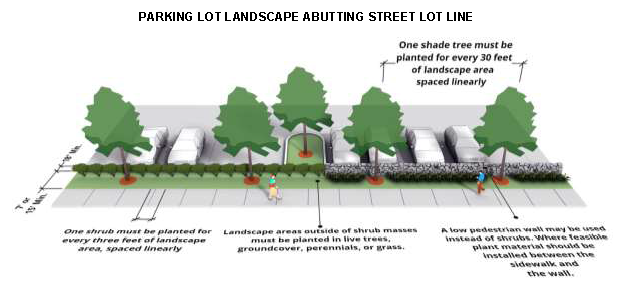
Required parking lot landscape abutting street lot line. Landscape is required along the edges of a parking lot that abuts a street lot line. The landscape treatment must run the full length of the street lot line. The landscaped area must be improved as follows:
i.
The landscape area in the I-G, S-S, and NPH districts must be a minimum of 15 feet in width. In all other districts, the landscape area must be a minimum of seven feet in width.
ii.
There must be a minimum linear distance of 18 inches between any wheels stops or curbs to accommodate vehicle bumper overhang. This area is not included in the minimum landscape area calculation.
iii.
One shade tree is required for every 30 linear feet of landscape area length, excluding driveways. As part of the landscape plan approval, trees may be spaced at various intervals based on specific site constraints and design considerations, but the total number of trees planted must be no less than one per 30 linear feet of landscape area length.
iv.
One shrub, reaching a minimum of three feet in height at maturity, is required for every three feet of landscape area length, excluding driveways. Shrub plantings must be spaced linearly to provide consistent buffering.
v.
Any one or more of the following alternatives to shrub plantings are also permitted:
a.
A low masonry or natural stone wall a minimum of three feet to a maximum of four feet in height may be used instead of shrubs. Where feasible, plant materials should be installed between the sidewalk and the wall to provide a softening effect.
b.
The landscape area may be planted with a mix of shrubs, perennials, native grasses, and other planting types that provide screening of a minimum of three feet in height.
c.
Stormwater management techniques, such as rain gardens and bioswales, planted with appropriate species to provide screening of a minimum of three feet in height, as measured from the established grade of the parking lot surface.
d.
An earthen berm a minimum of three feet to a maximum of four feet in height, as measured from the established grade of the parking lot surface. Berms must be constructed with no slope exceeding 33 percent, to prevent erosion and promote proper, safe maintenance. If an earthen berm is used, required plantings as specified in items (iii) and (iv) above may be reduced by 25 percent. The remainder of the berm must be planted in live groundcover, perennials, or grass.
vi.
In addition to the requirements above, the remainder of the required landscape area must be planted in live trees, groundcover, perennials, or grass.
(b)
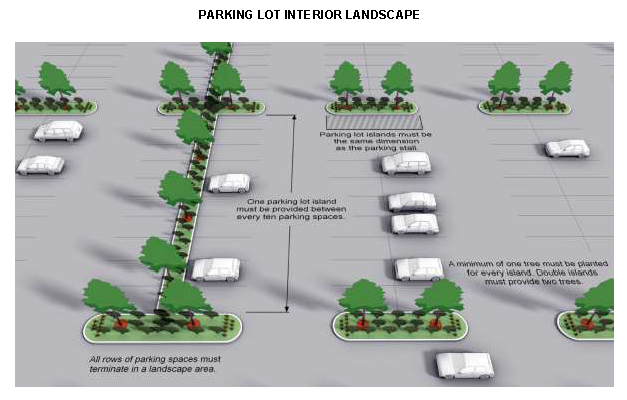
Required parking lot interior landscape. All parking lots of 20 or more spaces require interior parking lot landscape as described in this section. When the calculation of interior parking lot landscape requirements results in a fraction, said fraction is rounded up to the nearest whole number.
i.
One parking lot island must be provided between every ten parking spaces. As part of the landscape plan approval, parking lot island locations may be varied based on specific site requirements or design scheme, but the total number of islands must be no less than the amount required of one island for every ten spaces.
ii.
The minimum total landscape area of a parking lot, including parking lot islands, must be ten percent of the total parking lot area. Parking lot landscape along a street lot line, as required in item i., above, is excluded from the calculation of total parking lot area.
iii.
All rows of parking spaces must terminate in a landscape area.
iv.
Parking lot islands must be the same dimension as the parking stall. Double rows of parking must provide parking lot islands that are the same dimension as the double row.
v.
A minimum of one shade tree must be provided for every parking lot island or landscape area. Where a parking lot island or landscape area is the dimension of a double row, two shade trees are required. The remaining area of a parking lot island must be planted in ornamental trees, live groundcover, shrubs, perennials, or grass.
vi.
The use of stormwater management elements such as rain gardens and bioswales is encouraged in landscape areas. The inclusion of shade tree species that are tolerant to flooding or intermittent inundation is required.
(Ord. No. 9301A, 9-26-18)
Sec. 80-15.8. - Required buffer yard.
This section establishes standards for the dimensions and landscape for required buffer yards.
(a)
Buffer yards are located within rear and interior side yards, including the required rear or interior side setbacks, and must be reserved for the planting of material and installation of screening as required by this section. No parking spaces or accessory structures are permitted within the required buffer yard.
(b)
As of the effective date of this code, buffer yards are required for along interior side and rear yards in the following cases:
i.
Where a multi-family development abuts another residential district other than the R-3 district.
ii.
Where a non-residential use is located within a residential district, excluding parks.
iii.
Where a non-residential district or use abuts a residential district. This does not apply to the C-1 district or the natural resource districts or to any parks.
iv.
Where an I-G, S-S, or NPH district abuts a commercial district.
(c)
When the calculation of minimum buffer yard requirements results in a fraction, the fraction is rounded up to the nearest whole number. The minimum size and improvement of buffer yards is as follows:
i.
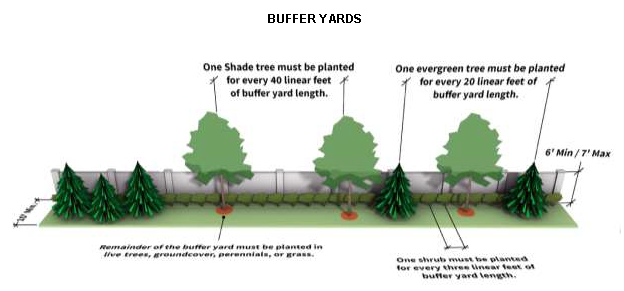
A buffer yard must be a minimum of ten feet in width.
ii.
One evergreen tree must be planted for every 20 linear feet of buffer yard length. As part of the landscape plan approval, trees may be spaced at various intervals based on specific site requirements, but the total number of evergreen trees planted must be no less than one per 20 linear feet of buffer yard length.
iii.
One shade tree must be planted for every 40 linear feet of buffer yard length. As part of the landscape plan approval, trees may be spaced at various intervals based on specific site requirements, but the total number of shade trees planted must be no less than one per 40 linear feet of buffer yard length.
iv.
One shrub, measuring a minimum of 18 inches in height at planting and reaching a minimum of three feet in height at maturity, must be planted for every three linear feet of buffer yard length, spaced linearly.
v.
A solid fence or wall a minimum of six feet and a maximum of seven feet in height must be erected along 100 percent of the yard length. At a minimum, the required plantings must be located on the exterior facing side of the fence.
vi.
The remainder of the buffer yard must be planted in live trees, groundcover, perennials, or grass.
(Ord. No. 9301A, 9-26-18)
Sec. 80-15.9. - Tree lawn trees.
The following tree planting requirements apply to tree lawns (i.e., those areas within the public right-of-way located between the curb and the sidewalk). Tree lawn trees must be planted as part of any new construction, including individual single-family and two-family development. Where a landscape plan is not required, tree lawn planting requirements will be verified as part of building permit approval.
(a)
Tree lawn trees must be planted at one tree for every 30 linear feet of tree lawn. Where appropriate, tree lawn trees may be clustered or spaced differently as determined appropriate or necessary by the city forester.
(b)
The selecting of tree species must be reviewed and approved by the city forester with particular regard for site-appropriate species.
(Ord. No. 9301A, 9-26-18)
Sec. 80-15.10. - Stormwater management.
Any new development that consists of 10,000 square feet or more of paved surface, including the building footprint and paved parking area must be designed to filter or store the first inch of rainwater during each rain event. A stormwater management plan must be submitted and approved as part of the landscape plan showing compliance with this standard and the standards of this section.
(a)
Stormwater management measures.
i.
Stormwater management measures must be implemented in the following order of preference:
a.
Infiltration, flow attenuation and pollutant removal of runoff on-site to existing areas with groundcover, trees, and similar vegetation, and through the use of open vegetated swales and natural depressions.
b.
Use of stormwater on-site to replace water used for industrial processes or irrigation. Stormwater detention structures for the temporary storage of runoff for these purposes must designed so as not to create a permanent pool of water.
c.
Stormwater retention structures for the permanent storage of runoff by means of a permanent pool of water.
d.
Retention and evaporation of stormwater on rooftops or in parking lots.
ii.
Infiltration practices must be utilized to reduce runoff volume increases. A combination of successive practices may be used to achieve the stormwater management standard of this section.
iii.
Best management practices (BMP) must be employed to minimize pollutants in stormwater runoff prior to discharge into a separate storm drainage system or water body.
iv.
All stormwater management facilities must be designed to provide an emergency overflow system, and incorporate measures to provide a non-erosive velocity of flow along its length and at any outfall.
v.
The designed release rate of any stormwater structure must be modified if any increase in flooding or stream channel erosion would result at a downstream dam, highway, structure or normal point of restricted stream flow.
(b)
Technical guides. The following documents serve as the official guides and specifications for stormwater management. Stormwater management practices that are designed and constructed per the most recent or successor versions of these technical documents are presumed to meet the standards of this article:
i.
The New York State Stormwater Management Design Manual (New York State Department of Environmental Conservation).
ii.
New York Standards and Specifications for Erosion and Sediment Control (Empire State Chapter of the Soil and Water Conservation Society).
(Ord. No. 9301A, 9-26-18)
Sec. 80-15.11. - Alternative landscaping plan.
Alternative landscaping plans may be proposed where strict application of the requirements in this article would prohibit reasonable development of a property. The planning board may consider the topography, shape, size or other natural features of the property or design features of the development when considering the suitability of a proposed alternative landscaping plan. Examples of situations where alternative landscaping plans are more likely to receive favorable consideration are mixed-use buildings and developments that qualify for reduced parking under this ordinance. Another technique that can be used in alternative landscaping plans is the enhancement of landscaping in a nearby area to soften the overall effect of the development, such as improvement of a nearby existing public right-of-way.
(Ord. No. 9301A, 9-26-18)

