
Rome City Zoning Code
ARTICLE XII
- USES
Sec. 80-12.1. - General use regulations.
(a)
No structure or land may be used or occupied unless allowed as a permitted or special use within the zoning district.
(b)
All uses must comply with any applicable federal and state requirements, and any additional city ordinances. For select uses, specific city ordinances may be cross-referenced but this is not intended to indicate that only those ordinances apply to such uses or that other uses within this code are not subject to additional ordinances not referenced.
(c)
Any use that is not included in the use matrix is prohibited in all districts.
(d)
A site may contain more than one principal use, so long as each principal use is allowed in the district. Each principal use is approved separately. In certain cases, uses are defined to include ancillary uses that provide necessary support and/or are functionally integrated into the principal use.
(e)
All uses must comply with the use standards of this article, as applicable, as well as all other regulations of this code. Use standards are referenced within table 80-12-1 and found in section 80-12.3.
(Ord. No. 9301A, 9-26-18)
Sec. 80-12.2. - Use matrix.
(a)
Table 80-12-1: Use Matrix identifies the principal and temporary uses allowed within each zoning district. P indicates that the use is permitted in the district. S indicates that the use is a special use in the district and requires special use approval. If a cell is blank, the use is not allowed in the district. In the case of temporary uses, a P indicates the temporary use is allowed in the district and may require approval of a temporary use permit. For accessory uses, see article XIII.
(b)
Allowed uses in the GB district are found in article VIII.
(c)
Allowed uses in the W waterfront district are found in article IX.
(d)
Allowed uses in the WR Woodhaven Redevelopment District are found in article IX.
(Ord. No. 9301A, 9-26-18; Ord. No. 9346A, 5-8-19; Ord. No. 9563A, 1-25-23)
Sec. 80-12.3. - Principal use standards.
Where applicable, principal uses are required to comply with all use standards of this section, whether a permitted or special use, in addition to all other regulations of this code.
(a)
Adult entertainment businesses.
i.
Purpose. It is recognized that there are some uses that, because of their very nature, have serious objectionable operational characteristics when several of them are concentrated under certain circumstances that produce a deleterious effect upon adjacent areas. Special regulation of these uses is necessary to ensure that adverse effects will not contribute to the blighting or downgrading of the surrounding neighborhood. The primary reason for regulation is to prevent a concentration of these uses in any one area that could create adverse neighborhood effects.
ii.
Location restrictions. Adult entertainment businesses are prohibited within:
a.
One thousand feet of any residential zoning district or any single-family, two-family, or multi-family dwelling at the time such adult entertainment business is established, including structures devoted to both residential and commercial or business purposes.
b.
One thousand feet of any preexisting public or private school.
c.
One thousand feet of any preexisting place of worship or other religious facility or institution.
d.
One thousand feet of any preexisting public park.
e.
The distance provided hereinabove shall be measured by following a straight line, without regard to intervening buildings, from the nearest point of the property parcel upon which the adult entertainment business is to be located to the nearest point of the parcel of property or the land use district boundary line from which the adult entertainment business is to be located.
iii.
Exceptions. These provisions do not apply to any theater, concert hall, or similar establishment that is primarily devoted to theatrical performances.
(b)
Airport.
i.
All facilities must comply with all Federal Aviation Administration requirements. All documentation must be submitted as part of a zoning application and prior to issuance of a building permit.
ii.
Any structures for such facilities must be set back a minimum of 100 feet from any residential district lot line.
(c)
Animal care facilities: Animal hospital, animal boarding, animal kennel, and animal shelter.
i.
All facilities must meet all applicable licensing requirements of the state.
ii.
Animal noises and odors must not be detectable on adjoining property for animal hospital, animal boarding, and animal kennel facilities. If an animal shelter is located within 250 feet of a residential district, animal noises and odors must not be detectable on adjoining property.
iii.
For animal shelters, any applicant desiring a crematorium must so state in the application.
iv.
All overnight boarding facilities must be located indoors.
v.
A fence a minimum of six feet and a maximum of seven feet in height is required for all exterior exercise areas.
(d)
Bed and breakfast.
i.
General standards. The following standards are applicable to bed and breakfasts:
a.
The owner of the bed and breakfast inn must reside in and continue to reside in the dwelling as a principal residence. The owner must provide a sworn statement certifying to such residency upon request of the codes enforcement officer.
b.
The number of guest rooms is limited to no more than four.
c.
Each bed and breakfast must be established, maintained and operated to preserve and complement the residential character and integrity of the surrounding area when the facility is established in a residential district. However, fire escapes, handicapped entrances, and other features of similar intent may be added to protect public safety.
d.
Breakfast must be served on the premises only for guests and employees of the inn. Guest rooms cannot be equipped with cooking facilities. No other meals may be provided on the premises.
e.
No parking spaces are allowed in the front yard of the site and must be located or screened from view so as to ensure no variation from the residential character of the site.
f.
No more than one person who is not a principal resident of the dwelling may be an employee at the dwelling site at any one time. The term employee does not apply to contractors providing short-term temporary services, such as repairs or landscaping.
g.
One permanent sign is allowed on the property of up to eight square feet per sign face, and may be attached to the exterior or placed in the window of the residence or an accessory structure, or placed within the front setback, mounted on an architectural post not to exceed four feet in height, or a monument sign not to exceed four feet above grade in the front setback. No sign may interfere with vision clearance on adjoining public rights-of-way.
ii.
Bed and breakfast use permits.
a.
Permits for bed and breakfasts must be obtained from the codes enforcement officer prior to their establishment, to ensure the following:
(1)
That the applicant is aware of the provisions of this code that govern bed and breakfasts.
(2)
That the city has all information necessary to evaluate whether the proposal initially meets and continues to meet code regulations.
(3)
That the city can document the distribution and location of bed and breakfasts.
b.
Bed and breakfast permits are valid as long as an active city business license is maintained, provided that there is compliance with the provisions of this article and with any conditions of approval attached to the permit.
c.
Bed and breakfast permits can be revoked for failure to comply with the regulations of this code. When a bed and breakfast permit has been revoked, a new permit cannot be issued to the applicant or other persons residing with the dwelling for 90 days.
(e)
Billboard.
i.
Billboards must be no closer to one another than 500 feet.
ii.
No billboard is permitted within 200 feet of any residential dwelling, school, cultural facility, place of worship, healthcare facility, or similar institutional use.
iii.
All billboards must conform to the setback requirements of the applicable zoning district.
iv.
No billboard may exceed 400 square feet in sign area.
(f)
Campground and recreational vehicle (RV) park.
i.
The minimum area for a campground or RV park is three acres.
ii.
Campgrounds and RV parks must comply with all applicable state and city regulations, including those governing the installation, construction, and/or operation of swimming pools, water supply, sewage disposal, food storage and services, plumbing, structures, electrical wiring, and fire prevention.
iii.
Management headquarters, recreational facilities, coin operated laundry facilities, cabins for counselors, overnight accommodations, living space, and other uses and structures customarily associated with the operation of a campground or RV park are allowed as part of the use.
iv.
Storage of all materials and/or equipment must be within enclosed structures.
v.
Year-round residency is prohibited at any campground or RV park. Camping units or recreational vehicles are prohibited from use as a principal residence.
vi.
A 50-foot setback from the perimeter property line of the campground or RV park is required. Any permanent or semi-permanent structures, such as offices, platforms, ramps, lean-to's, garages, and sheds, are prohibited within this setback. The perimeter setback must be landscaped. Preservation of existing vegetation is encouraged.
(g)
Car wash.
i.
Car wash facilities must be screened along interior side and rear lot lines with a solid fence or wall, a minimum of six feet and a maximum of seven feet in height. One shrub a minimum of three feet in height at time of planting must be planted linearly every three feet on-center along such fence or wall.
ii.
The site must be graded to drain away from adjoining properties.
(h)
Community garden.
i.
Community gardens are limited to the cultivation of herbs, fruits, flowers, or vegetables, including the cultivation and tillage of soil and the production, cultivation, growing, and harvesting of any agricultural, floricultural, or horticultural commodity. It may also include community-gathering spaces for active or passive recreation but playground equipment is prohibited.
ii.
Greenhouses, including high tunnels/hoop-houses, cold-frames, and similar structures, are permitted to extend the growing season. Accessory structures such as sheds, gazebos, and pergolas are also permitted.
iii.
Farmstands are permitted and are limited to sales of items grown at the site. Farmstands must be removed from the premises or stored inside a structure on the premises during that time of the year when the use is not open to the public. Only one farmstand is permitted per lot.
(i)
Day care center and day care home.
i.
Each day care must comply with all applicable state and federal regulations. The operator of a day care must be licensed by the state.
ii.
A day care home must maintain its original appearance as a residential dwelling.
iii.
A day care center must provide a pickup/drop off area. When a day care center is part of a multi-tenant retail center, the pickup/drop off area must not interfere with vehicle circulation in the parking lot, including blocking of the drive aisle.
(j)
Drive-through facility.
i.
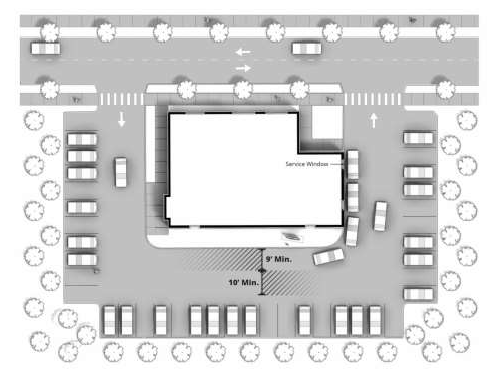
All drive-through facilities must provide a minimum of three stacking spaces per lane or bay, unless additional stacking spaces are specifically required by this code. Stacking spaces provided for drive-through uses must be:
a.
A minimum of nine feet in width, as measured from the outermost point of any service window or bay entrance, to the edge of the driveway, and 18 feet in length. In the case of a recessed service window, the measurement must be taken from the building wall.
b.
Stacking spaces must begin behind the vehicle parked at a final point of service exiting the drive through aisle, such as a service window or car wash bay (this does not include a menu board). Spaces must be placed in a single line behind each lane or bay.
ii.
All drive-through lanes must be located and designed to ensure that they do not adversely affect traffic circulation on adjoining streets. Drive-through lanes on corner lots must not route exiting traffic into adjacent residential neighborhoods.
iii.
Drive-through facilities must be screened along interior side and rear lot lines with a solid wall or fence, a minimum of six feet and a maximum of seven feet in height. One shrub a minimum of three feet in height at time of planting must be planted linearly every three feet on-center along such fence or wall. This standard does not apply to drive-through facilities within multi-tenant retail centers.
iv.
A drive through lane must have bail out capability for all vehicles that enter the drive through lane. The bail out lane must be a minimum width of ten feet in width and run parallel to the drive through lane. If a bail out lane is also an interior access drive providing access to parking spaces, the bail out lane is limited to a one-way traffic pattern following the direction of the drive through lane.
Drive-Through Facility
(k)
Dwelling, accessory dwelling unit.
i.
No more than one accessory dwelling unit is allowed per lot. Where allowed, the accessory dwelling unit does not count toward the maximum number of dwelling units on a lot, including when the accessory dwelling unit is located in a detached structure.
ii.
A detached accessory dwelling unit may not exceed the height of the principal dwelling.
iii.
An accessory dwelling unit may not exceed a gross floor area of 60 percent of the gross floor area of the principal dwelling or 1,800 square feet, whichever is less.
iv.
Detached accessory dwelling units may only be located in the rear yard. Detached accessory dwelling units must be located ten feet from any lot line and from any principal building.
(l)
Gas station.
i.
When adjacent to an existing residential dwelling or a residential district, gasoline storage and dispensing equipment, and automobile traffic areas, must be located and screened so that they are not visible from the first story window level of contiguous residential uses.
ii.
All structures and pump islands must be set back a minimum of 20 feet from interior side and rear lot lines. Structures are exempt from any build-to lines required by the district.
iii.
Minor motor vehicle repair is permitted as part of a gas station use if allowed within the district. All repair work must be conducted entirely within an enclosed structure. Storage of all merchandise, auto parts, and supplies must be within an enclosed structure.
iv.
The ancillary uses of a retail goods establishment and one car wash bay are permitted in connection with the principal gas station use.
(m)
Group home.
i.
The location, design, and operation of a group home must not alter the residential character of the structure. No structural or decorative alteration that alters the residential character of an existing residential structure used for a group home is permitted. Any new or remodeled structure must be designed to be compatible with the residential character of the surrounding neighborhood.
ii.
The facility must comply with all building, fire safety, health code and business licensing requirements.
iii.
Group homes must meet all city, state, and federal regulations.
(n)
General industrial. Certain uses within the general industrial use category must meet specified standards.
i.
Recycling drop-off centers.
a.
The facility must not cause or allow the emission or generation of any odor from any source that unreasonably interferes with another person's use and enjoyment of their property.
b.
To minimize windblown debris and dust, all areas where recyclable materials are loaded, unloaded, or transferred between containers must be in an enclosed building.
c.
To minimize contact with precipitation and the potential for contamination of runoff, all recyclable materials must be stored under a roofed area or in containers with lids that are kept closed.
(o)
Manufactured home park.
i.
Purpose.
a.
These standards provide location and development standards for development of manufactured and modular homes within the city. These standards are intended to provide a quality residential environment for residents of manufactured home developments.
b.
These standards are intended to supplement and implement federal and state statutes, rules, and regulations, and local ordinances governing manufactured homes and are not, in any way, to be construed as superseding or replacing said federal and state statutes, rules, and regulations. Manufactured home development within the city must comply with all applicable federal and state statutes, rules, and regulations and local ordinances. If local ordinances conflict with other applicable federal and state statutes, rules, and regulations, the stricter standards apply.
ii.
General standards. All manufactured home parks must conform to the following standards:
a.
Housing density for manufactured home parks cannot exceed the density allowed by the underlying zone.
b.
All manufactured homes must have been constructed after June 15, 1976, and must bear an "insignia of compliance" indicating compliance with the Federal Manufactured Home Construction and Safety Standards and bear a date of manufacture. However, manufactured homes relocated from another manufactured home park within the city and constructed prior to June 15, 1976, are not excluded from placement in a manufactured home park.
c.
All manufactured homes must have a minimum of 800 square feet of gross floor area.
iii.
Design standards. All manufactured home parks are subject to site plan review. In addition to the site plan review requirements, manufactured home parks are subject to the following requirements:
a.
All manufactured home parks must be designed by a design team, which must include an architect or landscape architect, and a civil engineer, all licensed by the state.
b.
The minimum site area for a manufactured home park is one acre and must have a minimum frontage of 100 feet on a public street.
c.
The maximum lot coverage of structures in the park is 50 percent of the gross site area.
d.
A minimum of five percent of the site area of the manufactured home park must be reserved for recreation facilities to be used in common by park residents.
e.
The minimum yard requirements for the perimeter of a manufactured home park are:
(1)
The minimum front yard is 30 feet. Each yard abutting a public street is considered a front yard.
(2)
All other yards must be a minimum of 20 feet.
f.
The minimum yard and separation requirements for individual manufactured home lots outside the perimeter yards of a manufactured home park are:
(1)
The minimum front yard for an individual manufactured home lot is ten feet from the edge of the curb or sidewalk closest to the manufactured home.
(2)
The minimum separation between structures is ten feet.
g.
Private street standards are as follows:
(1)
All private streets within a manufactured home park must meet the paving width standards for private streets (measured curb to curb) of Table 80-12-2: Manufactured Home Park Private Streets:
(2)
A cul-de-sac is limited to a maximum length of 500 feet. Each cul-de-sac must have a turn-around area at its terminus with a minimum radius of 30 feet.
(3)
All private streets must have a crowned profile and must be constructed of asphaltic concrete or Portland cement.
(4)
All private streets must be bordered by a continuous concrete curb with a minimum height of two inches above the street surface. Curbs must be a minimum of six inches wide.
(5)
All private streets must have a sidewalk on one side of the street, excepting streets 36 or more feet wide which must have a sidewalk on both sides of the street. All sidewalks must have a minimum width of three feet. Mailboxes, light poles, or other obstructions must be located in a manner that provides an unobstructed sidewalk of three feet.
h.
Utility standards are as follows:
(1)
All plans for water, sanitary sewer and storm drainage lines must be approved by the city engineer.
(2)
All stormwater must be collected on the site in a piped storm drainage system, unless otherwise approved by the city engineer. Underground service connection must be made from each manufactured home to the street gutter. Stormwater from the manufactured home park must be piped to a public storm drain line, if available. The developer may be required to construct an off-site storm drainage system acceptable to the city engineer.
(3)
All electrical, telephone and television cable lines must be located underground.
i.
Off-street parking spaces is required as follows:
(1)
One space per lot or unit, whichever is greater. In addition, one space must be provided for each vehicle used in connection with the facility.
(2)
If no parking is provided on private streets, the one space must be provided for each five dwelling units for guest parking. Allowable on-street parking as described below may be counted as guest parking.
(3)
All driveways for individual manufactured homes and off-street parking areas must be paved with asphaltic concrete or Portland cement.
(4)
No parking is allowed in a perimeter yard.
(5)
Parking is allowed on private streets only in accordance with table 80-12-3: parking on private streets:
j.
Storage areas for vehicles, including motor homes, recreation trailers, boats, boat trailers or other similar vehicles or equipment must not be located within 100 feet of the perimeter lot lines of a manufactured home park site. Recreation vehicle storage areas must have a ten-foot yard between the storage area and the nearest structure. The storage areas must be screened from the view of adjacent structures by a sight-obscuring fence and landscape.
k.
All land within a manufactured home park not paved or containing a structure must be landscaped with grass, trees, shrubs, or flowers in a manner that will enhance the residential character of the manufactured home park and surrounding neighborhood. All landscaping must be maintained, including regular irrigation, mowing, removal of weeds, and trimming and pruning as necessary.
l.
All yards, excepting the front yard, must have a continuous permanently maintained perimeter fence separating the manufactured home park from the adjacent property. The fence must have a minimum height of 42 inches and is limited to a maximum height of 72 inches.
m.
All manufactured homes within a manufactured home park must conform to the following standards:
(1)
All towing hitches, wheels, running lights, and other towing related equipment must be removed within 30 days after installation of the manufactured home.
(2)
All roof areas must have gutters with runoff draining through piped connections to the adjacent street gutter or to the manufactured home park storm drainage system. Manufactured homes and manufactured home decks must be skirted to blend with the color and texture of the manufactured home exterior. Skirting must be installed within 30 days of setup.
(3)
One storage shed is allowed for each manufactured home. Storage sheds must not exceed 200 square feet of gross floor area and must be located adjacent to and designed as an integral part of the manufactured home, deck, or carport.
(4)
Satellite signal receiving antennas greater than three feet in diameter are not allowed unless such antenna is used to serve a centralized television signal distribution system in the manufactured home park. Home television antennas and any satellite receiving antennas less than three feet in diameter must be installed at the rear of the manufactured home to a height not to exceed five feet above the roof peak. No antennas may be located in a perimeter yard.
(p)
Neighborhood non-residential reuse standards. Neighborhood non-residential reuse requires zoning board of appeals approval of a special use permit. Once such approval is granted, the structure may be reused for the uses in item ii., below. A use may be changed to any use allowed within item ii without requiring a new special use approval.
i.
A neighborhood non-residential reuse is only allowed within existing structures that are non-residential in their construction as of the effective date of this code.
ii.
The following uses are allowed within a neighborhood non-residential reuse:
a.
Art gallery.
b.
Arts studio.
c.
Multi-family dwelling, per item vii., below.
d.
Office.
e.
Personal service establishment.
f.
Restaurant.
g.
Retail goods establishment (retail sales of alcohol prohibited).
h.
Schools (primary/secondary, college/university, trade/vocational).
iii.
No off-street parking is required. However, any off-street parking currently provided must be maintained.
iv.
Drive-through facilities are prohibited.
v.
Outside storage or display is prohibited. All business, servicing, processing, and storage uses must be located within the structure.
vi.
Signs for non-residential uses are limited to those allowed in the C-1 district.
vii.
Non-residential structures may be reused for multi-family residential dwellings in accordance with the following standards:
a.
Construction drawings and plans that describe the proposed conversion are required as part of the special use permit application.
b.
Upon conversion, the unit mix must meet or exceed the gross floor area as calculated by the unit types below:
(1)
Efficiency unit: 500 square feet.
(2)
One bedroom: 800 square feet.
(3)
Two bedroom: 1,000 square feet.
(4)
Three or more bedroom: 1,250 square feet.
c.
No residential conversion may violate any occupancy regulations.
d.
Parking spaces must be provided as required in table 80-14-1.
(q)
Outdoor dining. These standards address outdoor dining areas on private property only.
i.
Outdoor dining is considered a separate principal use. Outdoor dining may only be established when allowed as a use within a zoning district and in conjunction with another principal use, such as a tavern or restaurant.
ii.
Outdoor dining must not interfere with any pedestrian access or parking spaces and aisles.
iii.
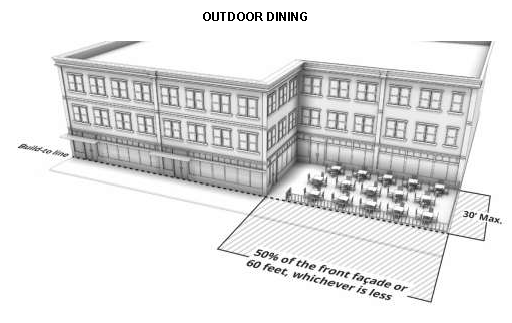
When a structure is required to be constructed at a build-to line, the structure may have up to 50 percent or 60 linear feet of the façade, whichever is less, designated as outdoor dining within a maximum setback of 30 feet from the required build-to line.
(r)
Outdoor storage and salvage yard.
i.
All parking, storage, dismantling, or maneuvering areas must be paved with an impervious material such as asphalt or concrete.
ii.
A salvage yard must comply with all applicable federal, state, and county regulations concerning the handling, storage, or disposal of hazardous waste and/or materials.
iii.
The storage area must be completely enclosed along all lot lines by a solid fence or wall a minimum of six feet and a maximum of eight feet in height, including ingress and egress. Fences or walls along the front or corner side lot line must be set back a minimum of ten feet. Within that setback, one shrub a minimum of three feet in height must be planted linearly every three feet on-center along such fence or wall.
iv.
Storage of any kind is prohibited outside the fence or wall. No items stored within 50 feet of the fence may exceed the height of the fence or wall.
v.
Any vehicles stored on-site must be stored so that no fluids will drain into the storm sewer system.
(s)
Parking lot and parking structure (principal use). All parking structures and parking lots are subject to the parking design standards of this code and the following standards:
i.
Parking structure.
a.
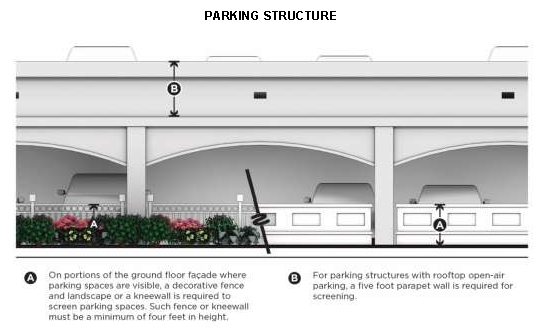
On portions of the ground floor façade along public streets where parking spaces are visible, a decorative fence and landscape or a kneewall is required to screen parking spaces. Such fence or kneewall must be a minimum of four feet in height.
b.
For parking structures with rooftop open-air parking, a five-foot parapet wall is required for screening of parked vehicles.
c.
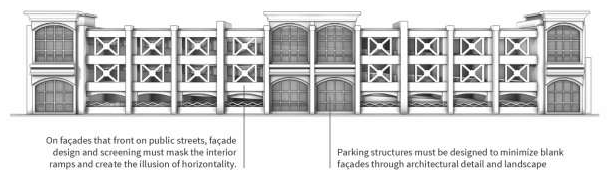
Where parking structures front on public streets, façade design and screening must mask the interior circulation ramps and create the illusion of horizontality along the street.
d.
Parking structures must be designed to minimize blank facades through architectural detailing and landscape.
ii.
Parking lot.
a.
A parking lot must be used solely for the temporary parking of motor vehicles and cannot be used as an off-street loading area.
b.
Only structures for the shelter of attendants or for payment kiosks are permitted in a parking lot. Shelters or kiosks must not exceed ten feet in height and 50 square feet in area.
c.
The parking lots must be screened and landscaped in accordance with the requirements of this code.
(t)
Private club or lodge.
i.
No more than 30 percent of the gross floor area may be used as office space.
ii.
Private clubs and lodges are permitted to serve meals and alcohol on the premises for members and their guests only.
iii.
Sleeping facilities are prohibited.
iv.
Private clubs and lodges leased or used as reception halls must comply with the requirements for reception halls.
(u)
Reception facility.
i.
A general admission fee or any other monetary donations (payment at the door to the general public) for entrance is prohibited, with the exception of fundraisers or events for bona fide non-profit organizations, places of worship, or schools.
ii.
All main activities, such as dining and entertainment, must be held within a completely enclosed building.
iii.
Outdoor seating areas are permitted for the use of guests. If a reception facility conducts main activities outdoors, special use approval is required for the outdoor component of the facility.
(v)
Residential care facility.
i.
Residential care facilities are subject to all local and federal regulations.
ii.
When located in a non-residential district, the structure must be designed with a lobby entrance along the primary frontage and meet the design standards of the district. When located in a residential district, residential care facilities must meet the design standards of the residential districts.
(w)
Reserved.
(x)
Vehicle dealership.
i.
Vehicle dealerships must have a minimum lot area of one acre.
ii.
Any ancillary repair operations must be performed within a fully enclosed building. All equipment and parts must be stored indoors. Any vehicles awaiting repair must be stored so that no fluids will drain into the storm sewer system, such as the use of drip pans and other coverings.
iii.
Vehicle dealerships with outdoor sales and display lots must include screening along 60 percent of outdoor display area that abuts a street. Such screening must consist of one or more of the following:
a.
Small shrubs a minimum of 18 inches in height spaced a minimum of every three linear feet.
b.
A fence or wall a minimum of two feet in height.
c.
Planters and/or planter boxes spaced a minimum of every five linear feet.
(y)
Vehicle repair—Major or minor.
i.
Vehicle repair establishments may not store the same vehicles outdoors on the site for longer than 15 days once repair is complete. Only vehicles that have been or are being serviced may be stored outdoors.
ii.
All repair operations must be performed within a fully enclosed building. All equipment and parts must be stored indoors. Any vehicles awaiting repair must be stored so that no fluids will drain into the storm sewer system, such as the use of drip pans and other coverings.
iii.
Vehicle repair establishments that abut a residential district must be screened along interior side and rear lot lines with a solid wall or fence, a minimum of six feet and a maximum of seven feet in height.
iv.
No partially dismantled, wrecked, junked, or discarded vehicles, or vehicles that sit on one or more flat tires or are inoperable in any manner may be stored outdoors on the premises. This standard does not apply to vehicles under repair.
v.
The sale of used or new vehicles is prohibited.
vi.
No motor vehicles may be stored and no repair work may be conducted in the public right-of-way.
(z)
Wind energy system.
i.
The design of the wind energy system must conform to applicable industry standards as such standards exist as of the date construction is commenced. The facility owner or operator must submit certificates of design compliance obtained by the equipment manufacturers from Underwriters Laboratories, Det Norske Veritas, Germanishcer Lloyd Wind Energies, or similar certifying organizations.
ii.
All wind turbines must be newly manufactured as of the date of installation. Experimental/prototype wind turbines may be approved as a special use.
iii.
All wind energy system must be equipped with a redundant braking system. This includes both aerodynamic over speed controls (including variable pitch, tip, and other similar systems) and mechanical brakes. Mechanical brakes must be operated in a fail-safe mode. Stall regulation is not considered a sufficient braking system for over speed protection.
iv.
All electrical components of the wind energy system must conform to applicable local, state, and national codes, and applicable international standards.
v.
An engineer's certificate must be completed by a structural engineer, licensed in the State of New York, certifying that the tower and foundation of the wind turbines are compatible with, and are appropriate for, the particular model of wind turbine used, and that the specific soils at the site can support the wind turbine.
vi.
Wind turbines must comply with the following design standards:
a.
Wind turbines must be a non-obtrusive and non-reflective color. The facility owner or operator must maintain the paint on wind turbines at all times in good repair.
b.
Wind turbines must not display advertising, except for reasonable identification of the turbine manufacturer, or the facility owner and operator.
c.
Within the wind energy system, wind turbines must be of a generally consistent size, design, and color, of similar height and rotor diameter, and rotate in the same direction.
d.
Wind turbines must not be artificially lit, except to the extent required by the Federal Aviation Administration or other applicable regulatory authorities.
e.
On-site transmission and power lines between wind turbines must, to the maximum extent practicable, be placed underground, reach the property line, and be located and constructed in such a way as to minimize disruption to the property's primary purpose as well as to facilitate the interconnection of other commercial wind power generating facilities.
f.
Non-essential appurtenances are prohibited to be affixed to any wind turbine, including, but not limited to, cellular or radio antennae.
g.
A clearly visible warning sign advising persons of the presence of high voltage levels must be placed at the base of all pad-mounted transformers and substations.
vii.
The applicant must commission and submit at the time of permit application a wildlife assessment (impact study), conducted by a qualified wildlife expert having no less than ten years of experience conducting wildlife assessments, indicating possible risks to local wildlife, habitat, and migratory birds. Additionally, the applicant's wildlife expert must also develop a mitigation plan, if applicable, that addresses/mitigates any risk to wildlife, migratory birds, and affiliated habitat. All wind turbines at time of application must be located out of bird and bat migration pathways/corridors where wind turbine construction would pose a substantial risk.
viii.
Wind turbines must not be climbable up to a height of at least 15 feet above ground surface. All access doors to wind turbines and electrical equipment must be locked or fenced, as appropriate, to prevent entry by non-authorized persons.
ix.
Wind turbines must be set back from all structures on a participating property owner's property a distance of no less than the turbine height. The setback distance is measured from the nearest point on the outside edge of a tower to the nearest point on the foundation of the occupied building.
x.
All wind turbines must be set back from the nearest property line a distance of not less than the normal setback requirements for that zoning district or 110 percent of the turbine height, whichever is greater. The setback distance is measured from the property line to the nearest point on the outside edge of a tower. Operation and maintenance building(s) and substations must be located in accordance with zoning district yard requirements. All wind farm structures, except for wind turbines, must comply with the regulations of the zoning district.
xi.
All wind turbines must be set back from the nearest public right-of-way a distance of 110 percent of the turbine height, as measured from the right-of-way line to the nearest point on the outside edge of a tower.
xii.
The facility owner or operator must comply with all applicable codes and codes regulating sound generation. In the event that any sound levels from a wind turbine are found to be in excess of permissible levels, the facility owner or operator must take necessary measures to bring sound levels down to a level acceptable.
xiii.
A wind turbine's shadow flicker must not fall on any window of an existing structure or within the buildable area of an adjacent lot, as defined by current setback requirements.
xiv.
The facility owner and operator must, at their sole expense, complete decommissioning of the wind energy system, or individual wind turbines, within one year after the end of the useful life of the wind energy system or individual wind turbines. The wind energy system or turbine must be deemed to be at the end of its useful life if it is abandoned for a period of time in excess of 180 days. Decommissioning includes removal of wind turbines, structures, roads and foundations to a depth of 48 inches, and any other element constructed by facility owner or operator for the purpose of maintaining or operating the wind energy system.
xv.
All facilities for a solar energy system must be screened. Screening is required on all sides of the structure except access openings to the structure. Screening must be a masonry wall, solid fence, or hedge, and must be the height of the structure or eight feet, whichever is less.
(aa)
Wireless telecommunications.
i.
Purpose. The city recognizes the increased need and demand for wireless communications transmitting facilities. Often these facilities require the construction of a communications tower. The intent of these provisions is to protect the city's interest in siting telecommunications facilities in a manner consistent with sound land use planning by:
a.
Minimizing visual effects of facilities through careful design, siting, and vegetative screening.
b.
Avoiding potential damage to adjacent properties from tower failure through engineering and careful siting of tower structures.
c.
Maximizing use of any existing towers, buildings, and structures.
d.
Allowing wireless service providers to meet their technological and service objectives for the benefit of the public.
ii.
Required approvals.
a.
Lease approval. On municipal or government owned property, a telecommunications facility is permitted upon execution of a lease with the municipality or the government entity and upon the issuance of a building permit. For any property owned by the city, all leases must be approved by a majority vote of the common council and must address relevant issues of safety, height, aesthetics, setbacks, future expansions of the facility, and colocation. A telecommunications facility on municipal or government-owned property does not require review or approval from the planning board.
b.
Site plan approval—Standard site plan. In the I-G and WR districts, installation of telecommunications antennas and supporting facilities that do not include the construction of a new tower is permitted upon standard site plan approval from the planning board, per section 80-19.4, and upon the issuance of a building permit.
c.
Expanded site plan approval. Installation of a new telecommunications tower in the I-G and WR districts, and installation of telecommunications towers, antennas, and supporting facilities of any kind in all other zoning districts requires expanded site plan approval from the planning board, per section 80-19.4, and upon the issuance of a building permit.
iii.
Development standards.
a.
Setbacks. All telecommunications towers must be set back from all adjacent property lines a sufficient distance to safeguard the general public and/or adjacent property. In the absence of any evidence supporting a greater or lesser setback distance, a setback of the tower from any adjacent residential property line equal to the tower height and a setback of at least 50 feet from any other adjacent property line is deemed adequate. The required setbacks may be decreased in those instances when the applicant has submitted plans for a tower designed to minimize damage to adjacent property in the event of a structural failure. Supporting facilities and guy anchors must comply with the minimum setback requirements of the underlying district.
b.
Safety.
(1)
A road turnaround and two parking spaces must be provided to assure adequate emergency and service access.
(2)
All towers and guy anchors, if applicable, must be enclosed by a fence not less than six feet in height or otherwise sufficiently secured to protect them from trespassing or vandalism.
(3)
The applicant must comply with all applicable state and federal regulations including, but not limited to, FAA and FCC regulations.
c.
Height.
(1)
Towers. The height regulations otherwise applicable in the underlying district do not apply to towers, provided that the applicant submits sufficient information to justify the proposed height as the minimum necessary to achieve its coverage objectives.
(2)
Building-mounted antennas. Telecommunications antennas mounted on buildings or structures may be no higher than 60 feet from the ground or the building height, whichever is less, unless the applicant submits sufficient information to justify a greater height as the minimum necessary to achieve its coverage objectives.
d.
Design and siting.
(1)
The planning board may require that the tower be designed and sited so as to avoid, if possible, application of Federal Aviation Administration (FAA) lighting and painting requirements, it being generally understood that tower should not be artificially lighted, except as required by the FAA.
(2)
Telecommunications towers, antennas, and supporting facilities must be situated in a manner that minimizes their proximity and visibility to residential structures.
(3)
Every effort is made to conceal telecommunications towers, antennas, and supporting facilities within or behind architectural features to limit its visibility from public ways and residential uses while still allowing it to perform its designated function.
(4)
Telecommunications antennas mounted on a roof must be stepped back from the front facade in order to limit their impact on the building's silhouette.
(5)
The telecommunications antennas mounted on a building must blend in with the existing building's architecture and, if over five square feet, must be painted or shielded with material that is consistent with the design and materials of the building.
(6)
Antenna and supporting electrical and mechanical equipment must be of a neutral color that is identical to or closely compatible with the colors of the supporting structure so as to make the antenna and related equipment as visually unobtrusive as possible.
(7)
A tower must be either blue/gray in color, have a galvanized finish or be colored appropriately to the extent that the tower is as unobtrusive as possible, unless otherwise required by the FAA. Accessory facilities should maximize use of building materials, colors, and textures designed to blend with the natural surroundings.
(8)
No tower must contain any signs except signs displaying contact information and safety instructions. Such signs must not exceed five square feet in surface area.
e.
Landscape and screening. The planning board may require reasonable landscaping consisting of trees or shrubs to screen the base of the tower and accessory structures to the extent possible from adjacent residential property. Existing trees and vegetation must be preserved to the maximum extent possible.
iv.
Preference for municipal or government-owned sites. All telecommunications towers, antennas, and supporting facilities erected, constructed or located within the city must comply with the following requirements. A proposal for the facility will not be approved unless the planning board finds that the antenna planned for the proposed facility cannot be accommodated on an existing structure located on municipal or government owned property within a one-mile radius of the proposed facility due to one or more of the following:
a.
The antenna would exceed the structural capacity of the existing structure, as documented by a qualified professional engineer, and the municipality or government entity has refused to reinforce, modify, or replace the structure to accommodate the planned or equivalent antenna.
b.
The antenna would cause interference materially impacting the usability of other existing antennae at the structure as documented by a qualified professional engineer and the interference cannot be prevented at a reasonable cost.
c.
Existing structures within the search radius cannot accommodate the antenna at a height necessary to function reasonably as documented by a qualified professional engineer.
d.
Other reasons that make it infeasible to locate the antenna upon an existing structure.
v.
Colocation requirements. A proposal for a tower will not be approved unless the planning board finds that the antenna planned for the proposed tower cannot be accommodated on an existing tower or structure within a one-mile radius of the proposed tower due to one or more of the following:
a.
The antenna would exceed the structural capacity of the existing or tower or structure, as documented by a qualified professional engineer, and the existing tower or structure cannot be reinforced, modified, or replaced to accommodate the planned or equivalent antenna at a reasonable cost.
b.
The antenna would cause interference materially impacting the usability of other existing antenna at the tower or structure as documented by a qualified professional engineer and the interference cannot be prevented at a reasonable cost.
c.
Existing towers or structures within the search radius cannot accommodate the antenna at a height necessary to function reasonably as documented by a qualified professional engineer.
d.
Other reasons that make it infeasible to locate the antenna upon an existing tower or structure.
e.
Any proposed tower must be designed structurally and electrically and in all respects to accommodate both the applicant's antennas and comparable antennas for at least two additional users if the tower is 100 feet in height or more, or for at least one additional user if the tower is 60 feet in height up to 100 feet in height. Towers must be designed to allow for future rearrangement of antennas upon the tower and to accept antennas mounted at varying heights.
vi.
Exemptions. The following are not subject to these provisions:
a.
Antenna used solely for residential household television and radio reception.
b.
Satellite antennas measuring two meters or less in diameter and located in commercial districts and satellite antennas one meter or less in diameter, regardless of location.
vii.
Existing facilities. Telecommunications towers, antennas, and supporting facilities in existence that do not conform to or comply with these regulations are subject to the following provisions:
a.
Telecommunications towers, antennas, and supporting facilities may continue in use for the purpose now used and as now existing but may not be replaced or structurally altered without complying in all respects with these regulations.
b.
If telecommunications towers, antennas, and supporting facilities are damaged or destroyed due to any reason or cause whatsoever, the facility may be replaced or restored to its former use, location, and physical dimensions without complying with these regulations, provided, however, if the cost of repair would be ten percent or more of the cost of a new facility of like kind and quality, then the facility may not be repaired or restored except in full compliance with these regulations.
(Ord. No. 9301A, 9-26-18; Ord. No. 9346A, 5-8-19; Ord. No. 9563A, 1-25-23)
Sec. 80-12.4. - Temporary use standards.
Temporary uses are required to comply with the use standards of this section, in addition to all other regulations of this code. These regulations are for temporary uses located on private property. Unless otherwise indicated, all temporary uses require a temporary use permit per section 80-16.8, which must be applied for by and issued to the property owner.
(a)
Farmers market.
i.
The timeframe of a farmers market, including number of days per week and overall duration of the event, will be determined and approved as part of the temporary use permit. A temporary use permit for a farmers market can be issued on a yearly basis, which allows for a schedule of days per week and number of weeks per year.
ii.
A management plan is required for a farmers market, to be submitted as part of the temporary use permit application, that demonstrates the following:
a.
The on-site presence of a manager during hours of operation who directs the operations of vendors participating in the market.
b.
An established set of operating rules addressing the governance structure of the market, hours of operation, and maintenance when open to the public.
c.
A general site plan of vendor stalls, visitor facilities, such as any seating areas and restrooms, and all ingress and egress points to the site.
d.
Provision for waste removal.
e.
The days and hours of internal operation, including vendor set-up and take-down times.
(b)
Temporary camping.
i.
The maximum time limit for temporary camping cannot exceed 60 days in any six-month period.
ii.
No more than three tents or recreational vehicles may be on a site at any one time.
iii.
Tents or recreational vehicles cannot be blocked up or placed upon any permanent foundation and cannot be connected to any utility such as water, gas, or electricity.
iv.
All tents or recreational vehicles not in use must be removed from the site.
(c)
Temporary contractor's office.
i.
A temporary contractor's office is allowed incidental to any construction project.
ii.
The temporary use permit is valid for the duration of the building permit, including any extensions.
iii.
The temporary contractor's office must be removed within 30 days of completion of the construction project.
(d)
Temporary mobile food sales.
i.
A temporary mobile food sales use is permitted for a maximum of 30 days per temporary use permit. There is no restriction on renewal of a temporary use permit, however no single permit may exceed 30 days validity.
ii.
The temporary use permit will be evaluated on the basis of the adequacy of the parcel size, parking provisions, traffic access, and the absence of undue adverse impact, including noise, on other properties.
iii.
All mobile food establishments must be properly licensed by the health department.
iv.
If the mobile food establishment operator is not the owner of the site where the truck or trailer will be located, written permission from the property owner must be submitted as part of the temporary use permit application.
v.
Sale of alcohol is prohibited.
vi.
During business hours, the permit holder must provide a trash receptacle for customer use and must keep the area clear of litter and debris at all times.
vii.
Outdoor seating may be provided on the site, but no seating may be permanently installed.
viii.
A permanent water or wastewater connection is prohibited.
ix.
Electrical service may be provided only by temporary service or other connection provided by an electric utility, or an on-board generator.
x.
Drive-through service is prohibited.
(e)
Temporary outdoor entertainment. A temporary use permit is not required for outdoor entertainment events within public parks and when organized by a public agency.
i.
A management plan is required as part of the temporary use permit application that demonstrates the following:
a.
The on-site presence of a manager during the event.
b.
A general site plan of performance areas, visitor facilities, such as any seating areas and restrooms, and all ingress and egress points to the site.
c.
Provision for recycling and waste removal.
d.
The days and hours of operation, including set-up and take-down times.
e.
A description of crowd control and security measures.
ii.
Any temporary structures must be removed within seven days of conclusion of the event.
iii.
Temporary outdoor entertainment events are limited to three events per calendar year on the same lot and a maximum duration of four days per event, with a minimum of 15 days between events, with the following exceptions:
a.
A temporary use permit for a carnival or circus is valid for a period of three events per calendar year on the same lot no more than 15 days in duration, with a minimum of 30 days between events.
(f)
Temporary outdoor sales. A temporary use permit is not required for outdoor sales within public parks and when organized by a public agency.
i.
A management plan is required as part of the temporary use permit application that demonstrates the following:
a.
The on-site presence of a manager during hours of operation who directs the operations of all participating vendors.
b.
An established set of operating rules addressing the governance structure of the sales event, hours of operation, and maintenance.
c.
A general site plan of vendor stalls, visitor facilities, such as any seating areas and restrooms, and all ingress and egress points to the site.
d.
Provision for recycling and waste removal.
e.
The days and hours of operation, including vendor set-up and take-down times.
ii.
Any temporary structures must be removed within seven days of conclusion of the event.
iii.
Temporary outdoor sales events are limited to three events per calendar year and a maximum duration of seven days per event, with a minimum of 30 days between events, with the following exceptions:
a.
A temporary use permit for a seasonal sale, such as Christmas tree lots or pumpkin patches, are limited to three events per calendar year and a maximum duration of 45 days. There is no minimum time between events.
(Ord. No. 9301A, 9-26-18)
Sec. 80-12.5. - Use definitions.
All uses within table 80-12-1 are defined in this section. Certain uses are defined to be inclusive of many uses. When a use meets a specific definition, it is regulated as such and is not regulated as part of a more inclusive use category.
Adult entertainment businesses. Adult entertainment businesses are defined as the following:
i.
Adult arcades where, for any form of consideration, one or more motion picture projectors, slide projectors or similar machines, for viewing by five or fewer persons each are used to show films, motion pictures, videocassettes, slides, or other photographic reproductions, which are characterized by emphasis upon the depiction or description of "specified sexual activities" or "specified anatomical areas."
ii.
Adult bookstores which have 50 percent or more of its stock in trade and offers for sale, for any consideration, any one or more of the following:
a.
Books, magazines, periodicals, or other printed matter or photographs, films, motion pictures, videocassettes, slides or other visual representations which are characterized by an emphasis upon the depiction or description of "specified sexual activities" or "specified anatomical areas."
b.
Instruments, devices, or paraphernalia that are designed for use in connection with "specified sexual activities."
iii.
Adult cabarets meaning any nightclub, bar, restaurant, or similar establishment, which regularly features live performances characterized by exposure of "specified anatomical areas" or by "specified sexual activities" or films, motion pictures, videocassettes, slides, or other photographic reproductions characterized by an emphasis upon the depiction or description of "specified sexual activities" or "specified anatomical areas."
iv.
Adult motion picture theater where, for any form of consideration, films, motion pictures, videocassettes, slides, or other photographic reproductions are shown, and in which a substantial portion of the total presentation time is devoted to the showing of material characterized by an emphasis upon the depiction or description of "specified sexual activities" or "specified anatomical areas."
v.
Adult theater, meaning a theater, concert hall, auditorium or similar establishment which, for any form of consideration, regularly features live performances characterized by the exposure of "specified sexual activities" or "specified anatomical areas."
vi.
Massage parlor where, for any form of consideration, massage, alcohol rub fomentation, electric, or magnetic treatment or manipulation of the human body is administered, unless by a medical practitioner, chiropractor, acupuncturist, physical therapist or similar professional person licensed by the state. This definition does not include an athletic club, health club, school, gymnasium, reducing salon, spa or similar establishment where massage or similar manipulation of the human body is offered as an incidental accessory service.
vii.
Specified sexual activities is defined as any of the following:
a.
Human genitals in a state of sexual stimulation or arousal.
b.
Acts of human masturbation, sexual intercourse, or sodomy.
c.
Fondling or other erotic touching of human genitals, pubic region, buttocks, or female breast.
viii.
Specified anatomical areas are defined as any of the following:
a.
Less than completely and opaquely covered human genitals, pubic region, buttock and female breast below a point immediately above the top of the areola.
b.
Human male genitals in a discernibly turgid state even if completely and opaquely covered.
Agricultural implement sales. A business primarily engaged in the sale or rental of farm tools, machinery and implements, tack, animal care products and farm supplies, and includes farm machinery repair services. Sale of feed, grain and seed are also allowed.
Agriculture. Land and associated structures used to grow crops and/or raise livestock for sale, commercial use, personal food production, donation, and/or educational purposes. The agriculture use includes single-family dwellings and any accessory dwellings that are ancillary to the principal activity of agriculture.
Airport. Land and/or structures used for the landing and takeoff of aircraft, including airport buildings, hangars, and maintenance equipment. An airport includes passenger terminals for that airport and any ancillary uses within the passenger terminal, such as restaurants and retail sales.
Amusement facility—Indoor. A facility for spectator and participatory uses conducted within an enclosed building, such as movie theaters, gymnasiums (excluding those within public parks), sports arenas, bowling alleys, tumbling centers, skating centers, roller rinks, and pool halls. An indoor amusement facility may include ancillary uses such as, but not limited to, concession stands, restaurants, and retail sales.
Amusement facility—Outdoor. A facility for spectator and participatory uses conducted outdoors or within partially enclosed structures, such as outdoor stadiums, fairgrounds, batting cages, miniature golf courses, and amusement parks. An outdoor amusement facility may include ancillary uses such as, but not limited to, concession stands, restaurants, and retail sales.
Animal boarding. An establishment where animals are boarded during the day and/or for short-term stays, and may include ancillary services such as pet grooming.
Animal hospital. An establishment that provides medical care for domestic animals, where animals may be boarded during their convalescence.
Animal kennel: Commercial. An establishment where dogs over six months of age are boarded, bred, raised, and trained for commercial gain. A commercial animal kennel does not include animal shelters or shelter and training facilities for canine units of public safety agencies.
Animal shelter. An establishment that houses and provides care for homeless, lost, or abandoned dogs, cats, and/or other animals until such animals are reclaimed by their owner, placed in a new home, placed with another organization for adoption, and/or euthanized.
Art gallery. An establishment that sells, loans and/or displays paintings, sculpture, photographs, video art, or other works of art. Art gallery does not include a cultural facility, such as a library or museum, which may also display paintings, sculpture, photographs, video art, or other works.
Arts studio. An establishment where an art, type of art or activity is taught, studied, or practiced such as dance, martial arts, photography, music, painting, gymnastics, pilates, or yoga. An arts studio also includes private exercise studios for private sessions with trainers and/or private classes.
Bank/financial institution. An institution licensed as a receiver of deposits, a savings and loan, credit union, or mortgage office.
Bed and breakfast. A single-family detached dwelling where a resident/owner, who lives on the premises, provides lodging for a daily fee in guest rooms with no in-room cooking facilities and prepares meals for guests.
Billboard. A sign advertising products, goods, services, facilities, events or attractions not made, sold, used, served or available on the lot displaying such sign or a sign owned by a person, corporation, or other entity that engages in the business of selling the advertising space on that sign.
Boat launch. A ramp on the shore by which ships or boats can be moved to and from the water.
Boat and marine rental. An establishment that offers boats for rental.
Boat and marine repair and service. A facility for boat repair or boat storage, where boats are repaired and stored until repairs are completed.
Boat and marine sales. A retail sales establishment where boats are sold as well as marine equipment, such as navigational instruments, marine hardware and paints, nautical publications, nautical clothing such as foul-weather gear, and marine engines. Fuel sale is prohibited.
Body modification establishment. An establishment that offers tattooing services, body piercing, and/or non-medical body modification. Body modification establishment does not include an establishment that offers only ear piercing as an ancillary service.
Broadcasting facility—TV/radio. A facility engaged in broadcasting and information relay services for radio and television signals, including studio facilities. A broadcasting facility may or may not include antennas to broadcast the signal.
Brew pub. An eating and drinking establishment where beer is brewed on premises exclusively for on-site consumption. The brewing of such beer is ancillary to the eating and drinking establishment.
Campground. An area to be used for transient occupancy by camping in tents, camp trailers, travel trailers, motor homes, or similar movable or temporary sleeping quarters.
Car wash. An establishment for the washing and cleaning of vehicles or other light duty equipment, whether automatic, by hand, or self-service. The car wash facility may be within an enclosed structure, an open bay structure, or similar configurations.
Cemetery. Land and structures reserved for the interring of human remains or the interring of animal remains. Cemeteries may include structures for performing religious ceremonies related to the entombment of the deceased, mortuaries, including the sales of items related to the internment of remains, and related accessory structures, such as sheds for the storage of maintenance equipment.
Community center. A facility used as a place of meeting, recreation, or social activity, that is open to the public and is not operated for profit, and offers a variety of social, educational, community service activities.
Community garden. The cultivation of fruits, flowers, vegetables, or ornamental plants by more than one person or family. Community gardens do not include the raising of livestock or the use of heavy machinery.
Contractor office. Offices for businesses in the conduct of any building trade or building craft, together with land and/or structures used for the storage of equipment, vehicles, machinery, or building materials related to and used by the building trade or craft.
Conservation area. Designated open space that preserves and protects natural features, wildlife, and critical environmental features. A conservation area may include opportunities for passive recreation, such as hiking trails and lookout structures, and environmental education.
Convention center. A facility designed and used for conventions, conferences, seminars, product displays, recreation activities, and entertainment functions, along with ancillary functions including temporary outdoor displays and food and beverage preparation and service for on-premise consumption.
Cultural facility. A facility open to the public that provides access to cultural exhibits and activities including, but not limited to, museums, cultural centers, non-commercial galleries, historical societies, and libraries. A cultural facility may include uses such as, but not limited to, retail sales of related items and restaurants as ancillary uses.
Day care center. A facility where, for a portion of a 24-hour day, care and supervision is provided for:
1)
Children not related to the owner or operator of the facility; or
2)
Elderly and/or functionally-impaired adults in a protective setting that are not related to the owner or operator.
Day care home. A residential dwelling where care and supervision is provided by a permanent occupant of the dwelling for:
1)
Care children not related to the owner or operator of the facility; or
2)
Elderly and/or functionally-impaired adults in a protective setting that are not related to the owner or operator of the facility.
A child day care home does not include a dwelling that receives children from a single household. For the purposes of applying district dimensional standards, day care homes are subject to the standards for the dwelling type.
Drive-through facility. That portion of a business where business is transacted directly with customers via a service window that allows customers to remain in their vehicle. A drive through facility is approved separately as a principal use in conjunction with other principal uses such as restaurants and financial institutions.
Drug treatment clinic. A facility authorized by the state to use the drugs including but not limited to methadone in the treatment, maintenance, or detoxification of persons.
Drug/alcohol treatment facility, residential. A licensed care facility that provides 24-hour medical and/or non-medical/therapeutic care of persons seeking rehabilitation from a drug and/or alcohol addiction. Such facilities include medical detoxification. This includes institutions that are located in one or more buildings on contiguous property with one administrative body.
Dwelling, accessory dwelling unit. An additional dwelling unit associated with and incidental to a principal dwelling on the same lot. An accessory dwelling unit must include separate cooking and sanitary facilities, with its own legal means of ingress and egress, and is a complete, separate dwelling unit. The accessory dwelling unit must be within or attached to the principal dwelling unit structure or within an existing structure, such as a garage or carriage house, and designed so that the appearance of the principal structure remains that of a single-family residence.
Dwelling, caretakers unit. A residence for persons employed on a site for purposes of care and protection of persons, property, plants, animals, equipment, or other circumstances on site or on contiguous lots under the same ownership.
Dwelling, multi-family. A structure containing three or more attached dwelling units used for residential occupancy on a single lot. A multi-family dwelling does not include a single-family-attached dwelling.
Dwelling, single-family—Attached. A structure that that contains two or more dwelling units attached by a party wall on separate lots or separate tax parcels.
Dwelling, single-family—Detached. A structure containing only one dwelling unit on a single lot.
Dwelling, two-family. A structure containing two dwelling units on a single lot.
Farmer's market. Temporary use of structures and/or land for the sale of a variety of fresh fruits, flowers, vegetables, or ornamental plants, and other locally produced farm and food products, including value-added products, directly to consumers from two or more famers or from vendors that have taken such items on consignment for retail sale.
Farmstand. A temporary structure where agricultural products produced on the premises are sold.
Freight terminal. A facility for freight pick-up or distribution by rail, air, truck, or shipping transport.
Funeral home. An establishment where the dead are prepared for burial display and for rituals before burial or cremation, including chapels for the display of the deceased and the conducting of rituals before burial. A funeral home may or may not perform cremation and have crematoriums.
Gas station. An establishment where fuel for vehicles is stored and dispersed from fixed equipment into the fuel tanks of motor vehicles. A gas station may also include ancillary retail uses, an ancillary car wash bay, ancillary minor vehicle repair facilities, and solar and/or electric charging stations.
Golf course/driving range. A tract of land design with at least nine holes for playing a game of golf and improved with tees, greens, fairways, and hazards. A golf course may include a clubhouse, restrooms and shelters, and country club facilities. A driving range may be designed as a standalone facility or included as part of a larger golf course.
Government office. Offices owned, operated, or occupied by a governmental agency to provide a governmental service to the public. Government offices do not include public safety or public works facilities.
Group home. A group care facility in a residential dwelling for:
1)
Care of persons in need of personal services or assistance essential for activities of daily living;
2)
Care of persons in transition or in need of supervision; or
3)
The protection of the individual.
Group homes include facilities for drug and alcohol rehabilitation and those transitioning from homeless status. Group home does not include facilities for adults or minors who have been institutionalized for criminal conduct and require a group setting to facilitate transition into society.
Healthcare facility. Facilities for primary health services and medical or surgical care to people, primarily in-patient, and including, as an integral part of the institution, related facilities such as laboratories, outpatient facilities, dormitories, or educational facilities, and ancillary uses such as, but not limited to, cafeterias, restaurants, retail sales, and similar uses.
Heavy retail, rental, and service. Retail, rental, and/or service establishments of a heavier and larger-scale commercial character typically requiring permanent outdoor service or storage areas and/or partially enclosed structures. Examples of heavy retail, rental, and service establishments include large-scale home improvement centers with outdoor storage, display, and rental components, lumberyards, truck rental establishments, and sales, rental, and repair of heavy equipment. Wholesale establishments that sell to the general public, including those establishments where membership is required, are considered heavy retail, rental, and service establishments.
Hotel. A facility that provides sleeping accommodations for a fee and customary lodging services. Related ancillary uses include, but are not be limited to, meeting facilities, restaurants, bars, and recreational facilities for the use of guests.
Hydroelectric power generation. Electricity produced from generators driven by turbines that convert the potential energy of falling or fast-flowing water into mechanical energy.
Industrial design. An establishment where the design, marketing, brand development and sales of various products are researched and developed. An industrial design establishment may create prototypes of products, but may not manufacture products for direct sale and distribution from the premises.
Industrial—Artisan. A manufacturing establishment for artisan-related crafts that are more intensive uses, such as small-scale metalworking, glassblowing, furniture making, pottery, leathercraft, hand-woven articles, and related items.
Industrial—General. The manufacturing of products from processed or unprocessed raw materials, including processing, fabrication, assembly, treatment, and packaging of such products, and incidental storage, sales, and distribution of such products. This manufacturing may produce noise, vibrations, illumination, or particulate that is perceptible to adjacent land users. These industrial uses typically have ancillary outdoor storage areas.
Live entertainment. A venue that stages live performances, performed live by one or more persons including, but not limited to, musical acts including disc jockeys (DJs), theatrical plays, performance art, stand-up comedy, and magic, and may be included as part of the operation of a bar, restaurant, amusement facility, or similar use.
Living history museum or living museum. Land that recreates historical settings to simulate a past time period, to provide visitors with an experiential interpretation and education of the documented history of the underlying land on which the living museum exists. It may incorporate historical tools, activities, and costume into an interactive presentation and may incorporate historical reenactment to educate the public and to convey a sense of everyday life during the historical period. The Living History Museum may only include livestock that supports the educational and interpretive mission of the museum. The facility may include retail sales of related historical items in a gift shop and a snack bar/café that serves onsite museum visitors as ancillary uses.
Manufactured home park. A parcel of land with single control or unified ownership that has been planned and improved for the placement of manufactured homes for residential use.
Marina and dock. Waterfront establishments whose business is offering the sale or rental of boats and marine sporting equipment and the servicing, repair, or storage of the same. They may also provide travelift services, slip rental, gasoline, sanitary pumpout service, and food and drink.
Meat processing plant. A facility for slaughtering, processing, packaging, and distribution of animals such as cattle, pigs, sheep and other livestock.
Medical/dental office. A facility operated by one or more physicians, dentists, chiropractors, psychiatrists, physiotherapists, or other licensed practitioners of the healing arts for the examination and treatment of persons solely on an outpatient basis. Medical/dental offices also include alternative medicine clinics, such as acupuncture and holistic therapies, and physical therapy offices for physical rehabilitation.
Medical marijuana dispensary. An entity registered pursuant to New York State Public Health Law that acquires, possesses, processes (including development of related products such as edible MIPs, tinctures, aerosols, oils or ointments), transfers, transports, sells, distributes, dispenses or administers marijuana, products containing marijuana, related supplies or educational materials to registered, qualifying patients or their personal caregivers. Unless otherwise specified, medical marijuana dispensary refers to the site(s) of dispensing and preparation of marijuana.
Micro-brewery. A facility for the production and packaging of malt beverages of alcoholic content for wholesale distribution, with a capacity of less than 15,000 barrels per year and may include a tasting room. A tasting room allows customers to taste samples of products manufactured on site and purchase related sales items. Brewery facilities that exceed this capacity are considered general industrial uses.
Micro-distillery. A facility for the production and packaging of alcoholic beverages in quantities not to exceed 12,000 gallons per year and may include a tasting room. A tasting room allows customers to taste samples of products manufactured on site and purchase related sales items. Distillery facilities that exceed this capacity are considered general industrial uses.
Micro-winery. A facility for the production and packaging of any alcoholic beverages obtained by the fermentation of the natural contents of fruits or vegetables, containing sugar, including such beverages when fortified by the addition of alcohol or spirits, in quantities not to exceed 25,000 gallons per year and may include a tasting room. A tasting room allows customers to taste samples of products manufactured on site and purchase related sales items. Wineries that exceed this capacity are considered general industrial uses.
Neighborhood non-residential reuse. The reuse of a non-residential structure within a primarily residential neighborhood that is non-residential in its original construction.
Nursery/greenhouse—Retail. An establishment where flowers, shrubbery, vegetables, trees, and other horticultural and floricultural products are propagated and sold, and may include gardening and landscape supplies and products, such as hardware, garden tools and utensils, paving stones and bricks, and other related items for sale.
Office. An establishment that engages in the processing, manipulation, or application of business information or professional expertise. Such an office may or may not offer services to the public. An office is not materially involved in fabricating, assembling, or warehousing of physical products for the retail or wholesale market, nor engaged in the repair of products or retail services. An office does not include bank or financial institution, government office, or industrial design.
Outdoor dining. A seating area that is located outdoors and contiguous to a restaurant or bar, typically in addition to an indoor seating area. Outdoor dining is approved separately as a principal use. Outdoor dining areas may be roofed or covered with an awning.
Outdoor storage. The storage of material outdoors as a principal use of land for more than 24 hours.
Park. A facility that serves the recreational needs of residents and visitors. Park includes, but is not limited to, playgrounds, ballfields, football fields, soccer fields, basketball courts, tennis courts, dog parks, skateboard parks, passive recreation areas, and gymnasiums. Public parks may also include non-commercial indoor or outdoor amusement facilities, including zoos and amphitheaters, ancillary uses such as, but not limited to, restaurant and retail establishments, and temporary outdoor uses such as festivals and performances.
Parking lot. An open, hard-surfaced area, other than a street or public way, used for the storage of operable vehicles, whether for compensation or at no charge. This includes park-and-ride lots, where commuters and others park their vehicles and transfer to a bus, rail system (rapid transit, light rail, or commuter rail), or carpool, and the vehicle is left in the lot during the day and retrieved when the owner returns.
Parking structure. A structure of one or more levels or floors used for the parking or storage of operable vehicles, whether for compensation or at no charge.
Passenger terminal. A facility for the handling, receiving, and transferring of passengers.
Personal services. An establishment that provides frequent or recurrent needed services of a personal nature. Typical uses include, but are not limited to, beauty shops, barbershops, tanning salons, electronics repair shops, nail salons, laundromats, pet grooming (no boarding), health clubs, dry cleaners, and tailors.
Pet food manufacturing. The manufacturing of a specialty food for domesticated animals that is formulated according to their nutritional needs, and generally consists of meat, meat byproducts, cereals, grain, vitamins, and minerals.
Places of worship. A facility where persons regularly assemble for religious purposes and related social events, and may include group housing for persons under religious vows or orders. Places of worship may also include ancillary day care facilities and/or classrooms for weekly religious instruction.
Private clubs or lodge. A facility operated by an organization or association for a common purpose, such as, but not limited to, a meeting hall for a fraternal or social organization or a union hall, but not including clubs organized primarily for-profit or to render a service which is customarily carried on as a business.
Public safety facility. A facility operated by and for the use of public safety agencies, such as the fire department and the police department, including the dispatch, storage, and maintenance of police and fire vehicles. Public safety facilities include shelter and training facilities for canine units of public safety agencies.
Public works facility. A facility operated by the municipal or parish public works departments to provide municipal and parish services, including dispatch, storage, and maintenance of municipal vehicles.
Reception facility. A facility that provides hosting and rental services of a banquet hall or similar facilities for private events including, but not limited to, wedding receptions, holiday parties, and fundraisers, with food and beverages that are prepared and served on-site or by a caterer to invited guests during intermittent dates and hours of operation. Live entertainment may be provided as an ancillary use as part of an event. A reception facility is not operated as a restaurant with regular hours of operation.
Recreational vehicle (RV) park. Land used for the accommodation of two or more recreational vehicles for transient dwelling purposes.
Research and development. A facility where research and development is conducted in industries that include, but are not limited to, biotechnology, pharmaceuticals, medical instrumentation or supplies, communication, and information technology, electronics and instrumentation, and computer hardware and software. A research and development establishment may create prototypes of products, but may not manufacture products for direct sale and distribution from the premises.
Residential care facility. A licensed group care facility that provides 24-hour medical or non-medical care of persons in need of personal services, supervision, or assistance essential for sustaining the activities of daily living, or for the protection of the individual. A residential care facility includes nursing homes, assisted living, hospice care, and continuum of care facilities.
Restaurant. An establishment where food and drinks are provided to the public, primarily for on-premises consumption by seated patrons. If the establishment also serves alcoholic beverages, a full menu of food and drinks must also be prepared on premises and a minimum of 60 percent of gross sales must come from food sales in accordance with chapter 10 of the Code of Ordinances.
Retail goods establishment. An establishment that provides physical goods, products, or merchandise directly to the consumer, where such goods are typically available for immediate purchase and removal from the premises by the purchaser.
Salvage yard. Land where vehicles or other machinery are collected, accumulated, or stored, and broken up, where parts may be saved and processed for resale. This includes any land where two or more wrecked, junked, burned, salvaged, disassembled, or inoperative motor vehicles are collected, accumulated, or stored not within a completely enclosed structure.
School—Primary or secondary. A public, private, or parochial facility that offers instruction at the elementary, junior high, and/or high school levels.
School—College or university. A facility for post-secondary higher learning that grants associate or bachelor degrees. The institution may also have research facilities and/or professional schools that grant master and doctoral degrees. School—University or college include ancillary uses such as dormitories, cafeterias, restaurants, retail sales, indoor or outdoor recreational facilities, and similar uses.
School—Trade or vocational. A facility that offers instruction in industrial, clerical, computer, managerial, automotive, repair (electrical, plumbing, carpentry, etc.), or commercial skills, or a business conducted as a commercial enterprise, such as a school for general educational development or driving school. School—Trade or vocational also applies to privately operated schools that do not offer a complete educational curriculum.
Self-storage. A facility for the storage of personal property where individual renters control and access individual storage spaces. Ancillary retail sales of related items, such as moving supplies, and facility offices may also be included.
Solar energy system. The components and subsystems required to convert solar energy into electric energy suitable for use. The term includes, but is not limited to, solar panels and solar energy equipment. A solar energy system is classified as either tier 1, tier 2 or tier 3 as defined in section 80-19.11.
Specialized food production. A business that specializes in the sale of certain food products, such as a coffee roaster, bakery, candy maker, meat market, catering business, cheesemonger, or fishmonger, and may offer areas for ancillary retail sales or restaurants that serve the products processed on-site. Specialty food service also includes preparation, processing, canning, or packaging of food products where all processing is completely enclosed and there are no outside impacts.
Stable. A facility where equines are kept, fed, and cared for.
Tavern. An establishment for the sale of alcoholic beverages for consumption on the premises. Snack foods or other prepared food may be available for consumption on the premises as an ancillary use.
Temporary camping (private property). The use of private property by the owner or non-paying guests (no commercial use of the lot) for temporary camping with tents and/or RVs.
Temporary contractor's office. A temporary structure utilized as a watchman's quarters, construction office, equipment shed, or sales center during the construction of a new development.
Temporary mobile food sales. A mobile food establishment where food preparation and service is housed in a truck or trailer or a non-motorized mobile food cart.
Temporary outdoor entertainment. A temporary live entertainment event, such as the performance of live music, revue, or play within an outdoor space. Temporary outdoor entertainment event includes fireworks shows, horse shows, carnivals/circuses, temporary worship services, and others.
Temporary outdoor sales. Temporary uses, which may include temporary structures, where goods are sold, such as consignment auctions, arts and crafts fairs, flea markets, rummage sales, temporary vehicle sales, and holiday sales, such as Christmas tree lots and pumpkin sales lots. This temporary use category does not include outdoor sales related to a retail goods establishment where such goods are part of the establishment's regular items offered for purchase.
Utilities. Facilities that produce and/or transmit basic services, such as gas, sewer, water, cable, or communications, including large-scale developments such as electrical substations, high voltage transmission lines, and water towers and tanks. Utilities do not include public works facilities, wireless telecommunications, wind energy systems, or solar farms.
Vehicle dealership. An establishment that sells or leases new or used automobiles, vans, motorcycles, and/or all-terrain vehicles (ATV) vehicles, or other similar motorized transportation vehicles. A motor vehicle dealership may maintain an inventory of the vehicles for sale or lease either on-site or at a nearby location, and may provide on-site facilities for the repair and service of the vehicles sold or leased by the dealership. Vehicle dealerships do not include truck, trailer, boat, or heavy equipment sales, which are considered heavy retail, rental, and service.
Vehicle operations facility. A facility for the dispatch, storage, and maintenance of emergency medical care vehicles, taxicabs and similar vehicles for hire, school buses, utility vehicles, and similar vehicles. Vehicle operations facility does not include a public works or public safety facility.
Vehicle rental agency. An establishment that rents automobiles and vans, including incidental parking and servicing of rental vehicles. A motor vehicle rental establishment may maintain an inventory of the vehicles for sale or lease either on-site or at a nearby location, and may provide on-site facilities for the repair and service of the vehicles sold or leased by the dealership. Vehicle rental does not include truck rental establishments or rental of heavy equipment, which is considered part of heavy retail, rental, and service.
Vehicle repair—Major. A business that provides services in engine rebuilding, major reconditioning of worn or damaged motor vehicles, motorcycles, all-terrain vehicles (ATV), recreational vehicles and trailers, towing and collision service, including body, frame or fender straightening or repair, and painting of motor vehicles, and may include minor vehicle repair services.
Vehicle repair—Minor. A business the provides services in minor repairs to motor vehicles, motorcycles, and all-terrain vehicles (ATV) vehicles, including repair or replacement of cooling, electrical, fuel and exhaust systems, brake adjustments, relining and repairs, wheel servicing, alignment and balancing, repair and replacement of shock absorbers, and replacement or adjustment of mufflers and tail pipes, hoses, belts, light bulbs, fuses, windshield wipers/wiper blades, grease retainers, wheel bearings, and the like.
Vehicle parts and accessories sales. An establishment where new or used parts for automobiles, panel trucks or vans, trailers, or recreation vehicles are displayed and sold.
Warehouse. An enclosed facility for the storage and distribution of manufactured products, supplies, and/or equipment.
Wholesale. A business where goods are sold to either retailers, or to industrial, commercial, institutional, or other professional business users, or to other wholesalers and related subordinated services.
Wind energy system. An energy system operated by a public, private, or cooperative company for the generation, transmission, distribution, or processing of wind energy.
Wireless telecommunication. Towers, antennas, and facilities used to transmit and receive signals that facilitate wireless telecommunications.
i.
Wireless accessory structures are any building or structure serving or being used in conjunction with a telecommunications facility, antenna, or tower and located on the same lot as the telecommunications facility, antenna, or tower. Examples of such structures include base stations, utility, or transmission equipment or storage sheds.
ii.
Wireless antenna is a system of electrical conductors that transmit or receive radio frequency signals or electromagnetic waves. Such signals include but are not limited to radio, television, cellular, paging, PCS, and microwave communications.
iii.
Telecommunications facilities are towers and/or antennas and accessory structures used in connection with the transmission and/or reception of wireless telecommunications services as defined in the Telecommunications Act of 1996.
iv.
Telecommunications tower is any ground or roof mounted pole, spire, structure or combination thereof designed to support antennas, including but not limited to freestanding towers, guyed towers, monopoles, and similar structures.
(Ord. No. 9301A, 9-26-18; Ord. No. 9468A, 11-10-21; Ord. No. 9563A, 1-25-23)

