
Rome City Zoning Code
ARTICLE XVI
- SIGNS
Sec. 80-16.1. - Purpose.
The sign regulations are intended to:
(a)
Encourage the effective use of signs as a means of communication in the city.
(b)
Maintain and enhance the aesthetic environment and the city's ability to attract sources of economic development and growth.
(c)
Improve pedestrian and traffic safety.
(d)
Minimize possible adverse effects of signs on nearby public and private property.
(e)
Enable the fair and consistent enforcement of these sign restrictions.
(Ord. No. 9301A, 9-26-18)
Sec. 80-16.2. - General standards.
The following regulations apply to all signs:
(a)
All signs must be constructed in accordance with state uniform fire prevention and building code, shall be maintained in good condition, shall be kept free of defects or hazards and shall not be allowed to become dilapidated or deteriorated.
(b)
No sign may obstruct any ingress or egress, including fire escapes, or windows. No sign may be attached to a fire escape.
(c)
All signs must be plainly marked with the name and address of the applicant and/or proxy owner relative to said sign.
(Ord. No. 9301A, 9-26-18)
Sec. 80-16.3. - Illumination standards.
(a)
Any sign illumination, including gooseneck reflectors, external illumination, and internal illumination, must be designed, located, shielded, and directed to prevent the casting of glare or direct light upon roadways and surrounding properties, and the distraction of motor vehicle operators or pedestrians in the public right-of-way.
(b)
The maximum allowable footcandle at the lot line for any illuminated sign is one footcandle. For signs that project over the public right-of-way, the maximum allowable footcandle at the curb line is one footcandle.
(c)
The sign face of internally illuminated signs must function as a filter to diffuse illumination. The sign face must cover all internal illumination components so that no exposed bulbs are visible.
(d)
All external illumination of a sign must concentrate the illumination upon the printed area of the sign face.
(e)
For electronic message signs, the maximum brightness is limited to 5,000 nits during daylight hours, and 500 nits between dusk to dawn. The sign must have an automatic dimmer control that produces a distinct illumination change from a higher allowed illumination level to a lower allowed level for the time period between one-half hour before sunset and one-half hour after sunrise.
(f)
No sign illumination may be combined with reflective materials, such as mirrors, polished metal, or highly-glazed tiles, which would increase glare.
(g)
The use of neon or LED lighting as a sign material or sign accent is permitted only in the commercial and industrial districts, and the NR, W, and GB districts. When lit, lighting must be continuously illuminated. Flashing neon or LED lighting is prohibited.
(h)
Neon or LED lighting to outline doors and windows is prohibited.
(Ord. No. 9301A, 9-26-18)
Sec. 80-16.4. - Maintenance and enforcement.
(a)
Maintenance.
i.
The painted parts of signs and any supports of the sign, unless such parts are galvanized or otherwise treated to prevent rust, must be painted at least once every three years.
ii.
Any sign found to be broken, damaged, or unsafe upon inspection by the codes enforcement officer must be repaired or made secure by the applicant, sign owner, or property owner. The codes enforcement officer will give notice by registered or certified mail, return receipt requested, to any of the above-named persons to repair or remove the unsafe sign within five days of receipt of said notice. If the sign is not repaired, made secure, or removed within 30 days, or within any additional time the codes enforcement officer allows, the codes enforcement officer will revoke the sign permit and remove the sign.
iii.
In the case of a sign that advertises a defunct business or product, the sign must be removed by the applicant, sign owner, or property owner within 60 days of receipt of written notification by the codes enforcement officer by registered or certified mail, returned receipt requested, or within such additional time as the codes enforcement officer may allow.
iv.
If a sign is found to be a source of imminent peril to persons or property, the codes enforcement officer will remove the sign or otherwise secure the sign without notice to the applicant, sign owner, or property owner.
(b)
Enforcement. In addition to the enforcement provisions of this code, the following apply:
i.
Whenever the codes enforcement officer determines that there has been a violation of this article, written notice will be served upon the applicant, sign owner, or property owner by registered or certified mail, return receipt requested, at his last known address. The notice will specify the alleged violation, provide a reasonable time within which the violation is to be corrected, state what legal remedies will be imposed upon failure to correct the violation, and inform the individuals of their right to appeal to the zoning board of appeals. The notice of violation will automatically become a final order if the violation is not corrected within the time allowed or if an application for appeal is not submitted to the codes enforcement officer within seven days from receipt of the notice.
ii.
Upon failure of the applicant, sign owner, or property owner to correct the cited violation within the time allowed by the codes enforcement officer, or failure to apply for an appeal, the codes enforcement officer by written instruction to the commissioner of public works will direct that the violating sign be removed. Such sign will be stored for a 30-day period during which the sign may be claimed upon proof of ownership and upon payment for the reasonable cost of removal and storage as determined by the commissioner. If the sign is not claimed, the codes enforcement officer is authorized to sell the stored sign at the public auction to the highest bidder or to otherwise dispose of said sign at his/her discretion and to apply the proceeds, if any, to the removal and storage costs.
(Ord. No. 9301A, 9-26-18)
Sec. 80-16.5. - Signs in historic district.
Any sign application for a sign in a historic district is subject to the regulations of article XVIII and must be accompanied by a written statement from the chairman of the historic and scenic preservation commission that the sign application has been reviewed and approved by the planning board.
(Ord. No. 9301A, 9-26-18)
Sec. 80-16.6. - Prohibited signs.
All signs not expressly allowed by this code are prohibited. In addition, the following sign types are specifically prohibited:
(a)
Abandoned signs. Any signs that advertise an activity, business, product, or service no longer conducted or available on the premises on which the sign is located is prohibited.
(b)
Flashing signs.
(c)
Moving signs, including signs designed to be moved by wind or other natural elements. This excludes clocks and barber poles.
(d)
Parked advertising vehicles and vehicle signs. This prohibition does not include signs painted on vehicles, trucks, or buses that are being operated and stored in the normal course of business, such as signs located on delivery trucks, promotional vehicles, moving vans, and rental trucks, provided that the primary purpose of such vehicles is not the display of signs, and that they are parked or stored in areas related to their use as vehicles and all vehicles are in operable condition. Vehicle for-sale signs are also exempt from this provision.
(e)
Roof signs.
(f)
Snipe signs.
(g)
Temporary off-premise signs.
(h)
Traffic hazard signs. Signs that constitute a traffic hazard include those that:
i.
Interfere with, obstruct the view of, or may be confused with any authorized traffic sign, signal, or device because of its position, shape, or color, including signs illuminated in red, green, or amber color to resemble a traffic signal.
ii.
Make use of the words STOP, LOOK, DETOUR, DANGER, CAUTION, WARNING, or any other word, phrase, symbol, or character in a manner that misleads, interferes with, or confuses traffic.
(i)
Tri-vision signs.
(Ord. No. 9301A, 9-26-18)
Sec. 80-16.7. - Exempt signs (permanent and temporary).
(a)
Exemption of alteration and maintenance operations. The following activities are exempt from a sign permit:
i.
Painting, repainting, cleaning, changing permitted items of information, or other normal maintenance and repair of a sign, not involving structural changes or changes in the electrical components of the sign. Any activity that increases the sign area, sign height, or any sign dimension is not exempt from a sign permit.
ii.
Changing of the message of a changeable message sign or electronic message sign.
(b)
Exempt ancillary signs.
i.
Logos and labels located on mechanical equipment, recycling bins, trash containers, or similar, which are part of the equipment as manufactured and/or installed, are exempt.
ii.
Signs installed by the sponsors of public transit stations, bike-sharing stations, or car-share facilities are exempt.
iii.
Signs installed on gas station pumps to advertise products or services available on the premises are exempt. Such signs are limited to two square feet in sign area and a maximum of one per pump station.
(c)
Permitted exempt signs. The following signs are allowed without a sign permit. None of these signs may be illuminated. All exempt signs must comply with all the regulations of this section and this code.
i.
Building entryway sign. Townhouse, multi-family dwellings, and non-residential developments with multiple tenants are permitted a sign at the entryway.
a.
Building entryway signs may be constructed as either freestanding or wall signs, subject to the following:
(1)
Signs are limited to six square feet in area.
(2)
Freestanding signs are limited to five feet in height, and must be located within ten feet of the building entry and five feet from any lot line.
(3)
Signs may only be internally illuminated.
b.
Building entryway signs are limited to one per building entry.
ii.
Construction activity sign. On a site where active construction is taking place, a temporary sign is permitted, subject to the following:
a.
Construction activity signs are permitted in all districts on all sites with active construction projects. Construction activity signs may be installed only after approval of building permit and must be removed once construction is complete or the building permit expires.
b.
Construction activity signs may be constructed as either freestanding or wall signs, subject to the following:
(1)
Signs are limited to 16 square feet in area for construction sites for individual single-family or two-family dwellings, and for any site of less than one acre in lot area. Signs are limited to 32 square feet in area for all other construction sites.
(2)
Freestanding signs are limited to seven feet in height and must be located five feet from any lot line.
(3)
Wall signs may be installed on a fence.
(4)
Signs may not be illuminated.
c.
Construction activity signs are limited to one per street frontage.
iii.
Flags. Flags of any nation, state, municipality, or political subdivision, flags officially designated as a national, state, or local symbol, or flags of fraternal, religious, and civic organizations are permitted in any district.
a.
Flags may be freestanding or wall-mounted.
b.
Poles for freestanding flags are limited to the maximum height of the district or 35 feet, whichever is less.
c.
Poles for freestanding flags must be setback a minimum of ten feet from any lot line.
d.
Wall-mounted flags may not extend over the public right-of-way.
e.
There is no limit on the number of such flags per lot.
f.
External illumination of flags is permitted but must be focused on the flagpole and flag.
iv.
Garage or yard sale activity sign. When a garage or yard sale occurs at a residential dwelling, such lot is permitted a temporary sign as follows:
a.
Garage or yard sale activity signs are permitted for any dwelling conducting such activity. Garage or yard sale activity signs must be located on the site of the activity.
b.
Garage or yard sale activity signs are limited to one per street frontage.
c.
Garage or yard sale activity signs may be constructed as either freestanding, wall, or window signs.
d.
Garage or yard sale activity signs are limited to six square feet in size.
e.
Freestanding signs are limited to five feet in height and must be located within five feet from any lot line.
f.
Garage or yard sale activity signs may not be illuminated.
g.
Garage or yard sale activity signs may be installed 48 hours prior to and must be removed within 24 hours of the end of sales activity.
v.
Government sign. Federal, state, or local governments or taxing bodies may install signs in the public interest in any number, configuration, or size in any district. Such signs may be illuminated as required by the agency.
vi.
Light pole banner. Light pole banners on private property are allowed as follows:
a.
Light pole banners are permitted for light poles in private parking lots and must be mounted so that they are held taut between support posts.
b.
Light pole banners are limited to a maximum area of ten square feet.
c.
Light pole banners must be mounted to project perpendicular from light poles.
d.
Light pole banners must not be used as a temporary off-premise sign.
vii.
Memorial signs. A location that memorializes a historic person, event, structure, or site is permitted a sign as follows:
a.
Signs are permitted in any district.
b.
Signs may be constructed as either freestanding or wall signs, subject to the following:
(1)
Signs are limited to six square feet.
(2)
Freestanding signs are limited to four feet in height and must be located five feet from any lot line.
(3)
Signs may be internally or externally illuminated.
c.
Signs are limited to one per street frontage.
viii.
Noncommercial message sign. Signs used for the expression of noncommercial ideas and messages, which include signs advocating a public issue, recommending a candidate for public office, alerts, or warnings, are permitted in all districts.
a.
Noncommercial message signs may be constructed as either freestanding, wall, or window signs. There is no limit on the number of signs permitted.
b.
Freestanding and wall-mounted noncommercial message signs in residential districts are limited to 16 square feet in area. Noncommercial message signs in all other districts are limited to 32 square feet in area.
c.
Window-mounted noncommercial message signs must meet the coverage limitations of window signs. If no coverage is specified, the limitation is 30 percent of the window area.
d.
Freestanding noncommercial message signs must be located five feet from any lot line.
e.
Noncommercial message signs posted on private property must have the permission of the property owner.
f.
Noncommercial message signs may not be illuminated.
g.
Noncommercial message signs cannot be used as a temporary off-premise sign.
ix.
Parking lot signs.
a.
Parking lot circulation sign.
(1)
Parking lot circulation signs are permitted at each entrance/exit, driveway intersection, drive-through lane, and other circulation points.
(2)
Parking lot circulation signs are limited to four square feet in area.
(3)
A freestanding parking lot circulation sign is limited to four feet in height and must be two feet from any lot line.
(4)
Parking lot circulation signs may be internally or externally illuminated.
b.
Parking lot information sign.
(1)
Parking lot information signs are permitted as needed for any parking lot, whether a principal or ancillary use.
(2)
Parking lot information signs are limited to ten square feet in area and may be wall-mounted or freestanding.
(3)
Freestanding signs are limited to six feet in height and must be five feet from any lot line that abuts a street.
x.
Real estate activity sign. When a structure or lot is offered for sale, lease, or rent, such lot is permitted a temporary sign as follows:
a.
Real estate activity signs are permitted in all districts. Real estate signs must be located on the site of the property for sale, lease, or rent.
b.
Real estate signs are limited to one per street frontage.
c.
Real estate activity signs may be constructed as either freestanding, wall, or window signs.
d.
Real estate activity signs are limited to 16 square feet in residential districts and 32 square feet in all other districts.
e.
Freestanding signs are limited to five feet in height and must be located within five feet from any lot line.
f.
Real estate activity signs may not be illuminated.
g.
Real estate activity signs must be removed within three days of final closing, lease, or rental. If such real estate signs are used in conjunction with a promotional event related to the sale, lease or rent, such signs may be installed 48 hours prior to event and must be removed within 24 hours of the end of the event
xi.
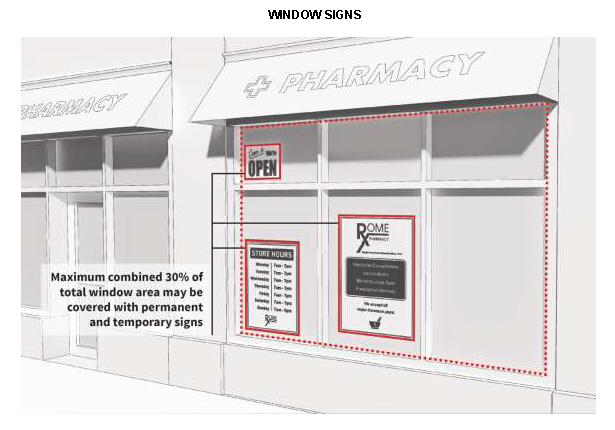
Window sign.
a.
Window signs are permitted for all non-residential uses in all districts.
b.
All window signs, whether temporary or permanent, are limited to no more than 30 percent of the surface of each window area. Window area is counted as a continuous surface until divided by an architectural or structural element. Mullions are not considered an element that divides window area.
c.
Window signs may be internally or externally illuminated.
(Ord. No. 9301A, 9-26-18)
Sec. 80-16.8. - Temporary signs requiring permit.
(a)
All temporary signs that are not considered exempt require a sign permit. A security deposit must accompany permits for temporary signs in accordance with the fee schedule. The permit will expire five days after a related event has concluded or 90 days after issuance, whichever is less. In the event that a temporary sign has not been removed upon expiration of the permit, the codes enforcement officer will cause that sign to be removed, the cost of which is to be charged to the applicant by deducting the cost from the deposit.
(b)
A temporary sign cannot be attached to fences, trees, or utility poles, and cannot be placed in a position that obstructs or impairs vision of traffic or creates a hazard or nuisance.
(c)
Maximum temporary signs size limits are 16 square feet in sign area in residential districts and 32 square feet in sign area in all other districts.
(d)
Temporary signs are limited to a maximum height of six feet, as measured from the ground to the top of the sign.
(e)
Permits for temporary signs cannot authorize more than one temporary sign per establishment. This does not include temporary inflatable signs, which are authorized separately.
(Ord. No. 9301A, 9-26-18)
Sec. 80-16.9. - Temporary inflatable signs.
(a)
Only cold-air inflatable signs are permitted.
(b)
A temporary inflatable sign permit is required for any inflatable sign.
(c)
A temporary inflatable sign is permitted only in the C-2 district or for special events sponsored or co-sponsored by the city.
(d)
The sign cannot extend into the required setbacks or into the public right-of-way.
(e)
Only one temporary inflatable sign permit may be granted for a single location at one time. A temporary inflatable sign permit may be granted up to three times in any calendar year.
(f)
Each temporary inflatable sign permit may be granted for a period of no more than 30 consecutive days.
(g)
Lettering or advertising on the inflatable sign cannot exceed an aggregate of 150 square feet. The width and height of the inflatable cannot exceed 25 feet.
(Ord. No. 9301A, 9-26-18)
Sec. 80-16.10. - Signs: permit required.
(a)
A-frame sign.
i.
A-frame signs are permitted for non-residential uses in the commercial districts and the WR, W, and GB districts.
ii.
Sign permits for A-frame signs are valid from January 1 through December 31, unless otherwise restricted as part of the sign permit approval. A new sign permit application must be applied for on or after January 1 of each year. In addition to the sign permit application submittal requirements, a placement plan must be submitted that shows the general location of the A-frame sign.
iii.
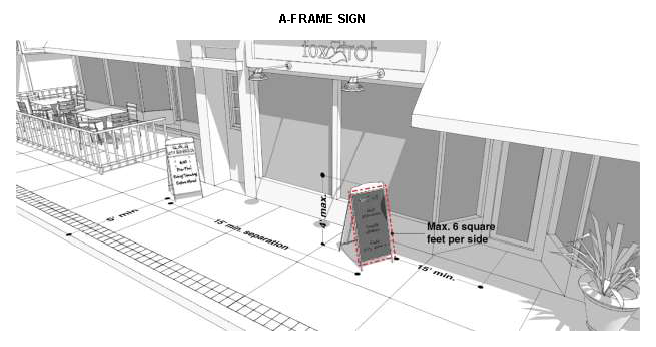
One A-frame sign is permitted per establishment, including for multi-tenant establishments. A minimum 15-foot separation is required between all A-frame signs.
iv.
An A-frame sign must be placed within 15 feet of the primary entrance of the business, and must not interfere with pedestrian traffic or violate standards of accessibility as required by the ADA or other accessibility codes. A-frame signs may be placed in the public right-of-way but must maintain a five foot sidewalk clearance at all times.
v.
A-frame signs are limited to six square feet in area per side and four feet in height.
vi.
The use of A-frame signs is limited to business hours only. Signs must be stored indoors at all other times.
vii.
A-frame signs must not be used outdoors when high winds or heavy rain conditions exist.
viii.
Illumination of A-frame signs is prohibited. No A-frame sign may have an electronic component.
(b)
Awning sign.
i.
Awning signs are permitted for multi-family dwellings and non-residential uses in all districts.
ii.
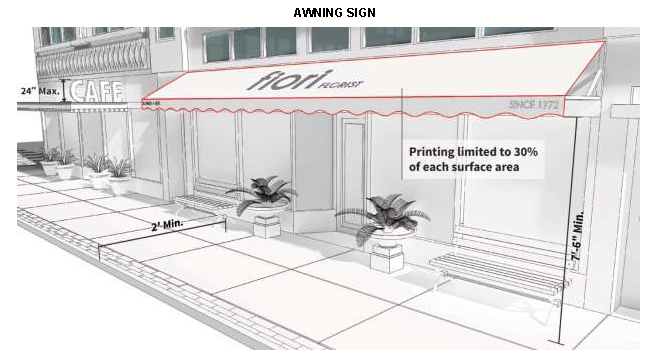
Awning signs must maintain a minimum vertical clearance of seven feet six inches.
iii.
Awning signs may encroach into the public right-of-way but must be located at least two feet from the curb line.
iv.
Awning signs must be made of a durable, weather-resistant material such as canvas, canvas-like material, nylon, vinyl-coated fabric, or metal.
v.
Printing on any awning sign is limited to 30 percent of each surface area.
vi.
Awning signs are permitted lettering attached to and located above the top of a solid flat awning mounted perpendicular to a façade to a maximum height of 24 inches.
vii.
Awning signs may be externally illuminated and must be focused on the printed area.
viii.
Back-lit awnings are prohibited.
ix.
Under-awning signs are permitted subject to the following standards. These standards also apply to signs mounted under galleries or arcades.
a.
Under-awning signs must be attached to the underside of an awning. Under-awning signs must not project beyond the edge of the awning.
b.
Under-awning signs must maintain a minimum vertical clearance of seven feet.
c.
A maximum of one under-awning sign is permitted per business establishment with frontage where the awning is mounted.
d.
Under-awning signs are limited to a maximum of six square feet.
e.
Under-awning signs must be securely fixed to the awning with metal supports.
f.
Under-awning signs must be made of wood or simulated wood, metal, or plastic.
(c)
Canopy sign.
i.
Canopy signs are divided into two types: non-structural and structural. Canopy signs are permitted for multi-family dwellings and non-residential uses in all districts.
ii.
Non-structural canopy signs are subject to the following:
a.
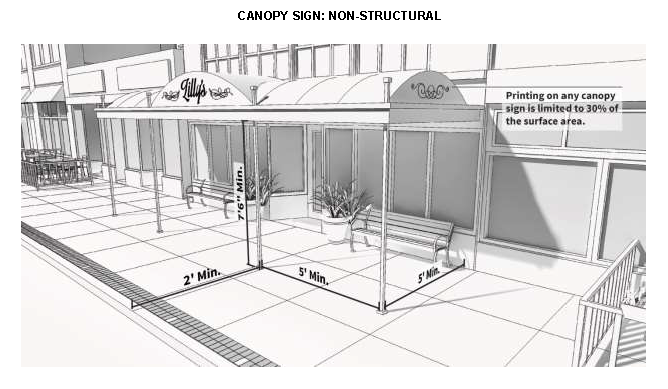
Non-structural canopy signs must maintain a minimum vertical clearance of seven feet six inches.
b.
Non-structural canopy signs may encroach into the public right-of-way but must be located at least two feet from the curb line. Support posts must maintain a minimum separation of five feet between posts and between the posts and any building wall.
c.
Non-structural canopy signs must be made of a durable, weather-resistant material such as canvas, canvas-like material, nylon, or vinyl-coated fabric.
d.
Printing on any non-structural canopy sign is limited to 30 percent of the surface area.
e.
Non-structural canopy signs may be externally illuminated and lighting must be focused on the printed area.
f.
Back-lit canopies are prohibited.
iii.
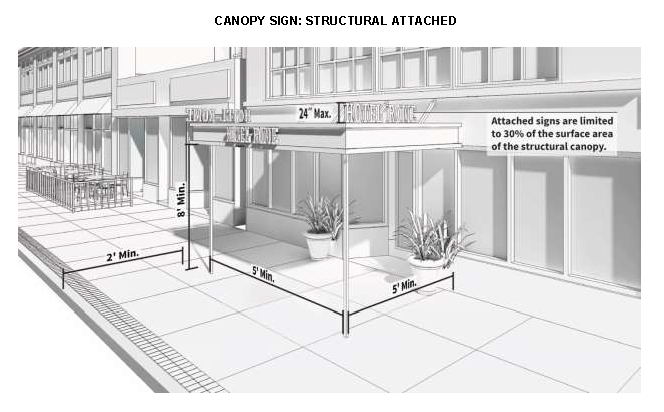
Structural canopy signs are subject to the following:
a.
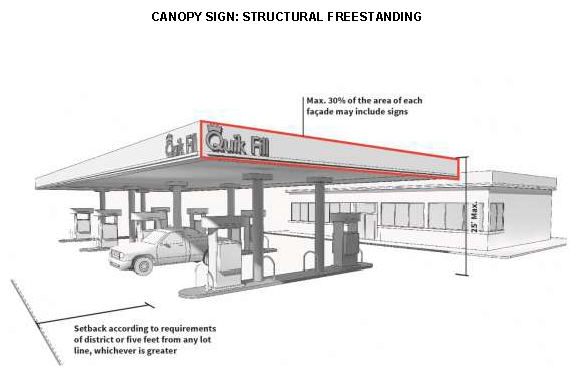
Structural canopy signs must be attached to the principal structure, with the exception for gas station canopies which may be either attached to the principal structure or may be a freestanding structure.
b.
Structural canopy signs attached to the principal structure may encroach into the public right-of-way but must be located at least two feet from the curb line. Support posts must maintain a minimum separation of five feet between posts and between the posts and any building wall.
c.
Freestanding structural canopy signs are subject to the setback requirements of the district in which they are located or five feet from any lot line, whichever is greater.
d.
All structural canopy signs must maintain a minimum vertical clearance of eight feet.
e.
For structural canopies attached to a building, signs are limited to 30 percent of the surface area. Such signs are permitted lettering attached to and located above the top of a structural canopy to a maximum height of 24 inches.
f.
For freestanding structural canopies, a maximum of 30 percent of the area of each façade may include signs. No sign may be mounted above the top of the roof of the structural canopy; however, a sign mounted on the structural canopy façade may extend a maximum of 12 inches above the roofline.
g.
Freestanding structural canopies are limited to a maximum height of 25 feet.
h.
Structural canopy signs must be made of metal, brick, stucco, concrete, or other permanent building material.
i.
Structural canopy signs may be internally or externally illuminated. If externally illuminated, the lighting must be focused on the sign. In addition, structural canopies for gas stations are permitted an illuminated band along the facades of the canopy. The illuminated band is limited to 15 percent of the overall height of the facade of the canopy and is not counted as a sign unless there is a commercial message integrated into the band, whereby, the commercial message portion would be calculated as a sign.
(d)
Electronic message sign. When electronic message signs are allowed, the following standards apply to freestanding, wall, or marquee signs with an electronic message sign component.
i.
Electronic message signs are permitted for any school, government office, park, or cultural facility in any district. Electronic message signs are permitted in the C-2, GB, and I districts for non-residential uses.
ii.
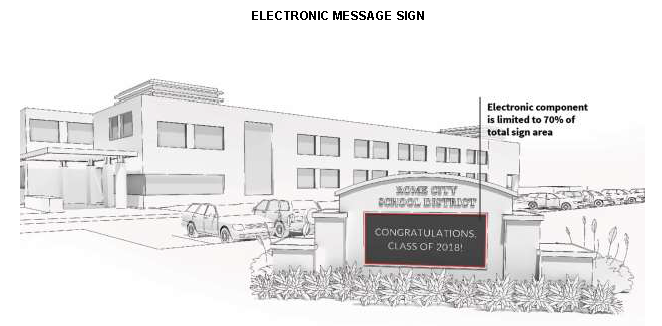
Electronic message signs are permitted as a freestanding sign, marquee sign, or wall sign and are subject to the requirements for those sign types within that district, including that they are counted within the number of signs permitted and the total sign area. Electronic message signs must be integrated into the larger sign structure and the electronic component is limited to a maximum of 70 percent of the total sign area of a freestanding sign or wall sign.
iii.
Only one electronic message sign per lot is permitted, whether freestanding sign or wall sign.
iv.
Each message or image displayed on an electronic message sign must be static for a minimum of four seconds. Multi-color messages and static images are permitted.
v.
Electronic message signs cannot display any off-premises commercial advertising.
vi.
Any scrolling, flashing, animation, or movement of the message or any component of the sign is prohibited.
(e)
Freestanding sign. Freestanding signs are permitted for: non-residential uses, multi-family dwellings, and residential subdivision developments. Freestanding signs are subject to the following regulations.
i.
General regulations. Freestanding signs may be either pole or monument construction. In certain districts or for certain uses, freestanding signs may be limited to only one type of construction.
a.
A freestanding pole sign that is affixed, attached, or erected on one or more poles, where such poles are not an integral part of the sign. Freestanding pole signs include any freestanding sign that does not meet the design and construction standards of a freestanding monument sign as described in this section.
b.
A freestanding monument sign is designed with the base of the sign installed on the ground. The monument base must be designed as an integral part of the sign structure. The width of the top of the sign face must be a minimum of 75 percent and a maximum of 130 percent of the width of the base.
c.
In order to create flexibility for freestanding monument signs installed where the ground is not level, structural (non-decorative) posts may extend out of the ground but are limited to a maximum of six inches above the adjacent ground where they are installed. When the freestanding monument sign is designed with decorative posts that are part of the overall sign structure and sign design, such decorative posts may extend out of the ground for a maximum of two and one-half feet above the adjacent ground where they are installed.
d.
Freestanding signs must be set back five feet from any lot line. No freestanding sign may project into, over, or otherwise encroach on a public right-of-way.
e.
Freestanding signs may be internally or externally illuminated. If externally illuminated, all light must be directed onto the sign face.
ii.
Non-residential uses (excluding multi-tenant retail centers). Freestanding signs for all non-residential uses except multi-tenant retail centers are subject to the following limitations on sign area, sign height, and sign number.
a.
One freestanding sign is permitted per street frontage of a lot and where such street frontage is a minimum of 50 feet. When a lot has over 200 feet of street frontage, an additional ground monument sign is permitted for each additional access point to the lot. A minimum separation of 50 feet is required between ground monument signs.
b.
Freestanding signs are limited to a maximum height of 20 feet.
c.
Freestanding signs are limited to a maximum area of 50 square feet.
d.
Where a nonresidential development has 200 feet of street frontage and a lot area of two acres or more, such development is permitted an increased sign area and height of 200 square feet of area and 30 feet in height.
e.
Freestanding signs may be either pole or monument construction.
iii.
Multi-tenant retail centers. Freestanding signs for multi-tenant retail centers are subject to the following limitations on sign area, sign height, and sign number.
a.
One freestanding sign is permitted per street frontage of a lot. An additional freestanding sign is permitted for each additional access point to the lot. A minimum separation of 50 feet is required between freestanding signs. For the purposes of this regulation, a multi-tenant development where the development as a whole may be comprised of separate lots of record, the entire development including outlot parcels and inline development is considered one lot.
b.
Such freestanding sign may be either pole or monument construction,
c.
Freestanding signs are permitted a maximum sign area of 200 square feet and a maximum sign height of 25 feet.
iv.
Multi-family dwellings. Freestanding signs for multi-family dwellings are subject to the following limitations on sign area, sign height, and sign number.
a.
Such freestanding sign must be monument construction.
a.
One freestanding sign is permitted per street frontage of a lot.
c.
Freestanding monument signs are permitted a maximum sign area of 32 square feet and a maximum sign height of six feet.
v.
Residential subdivisions. Freestanding signs for residential subdivisions are subject to the following limitations on sign area, sign height, and sign number.
a.
Such freestanding sign must be monument construction.
b.
One freestanding sign is permitted per each access point to the residential subdivision. A minimum separation of 50 feet is required between freestanding signs.
c.
Freestanding monument signs are permitted a maximum sign area of 100 square feet and a maximum sign height of six feet.
(f)
Marquee.
i.
Marquees are permitted for non-residential uses in the C-2, C-3, W, and GB districts.
ii.
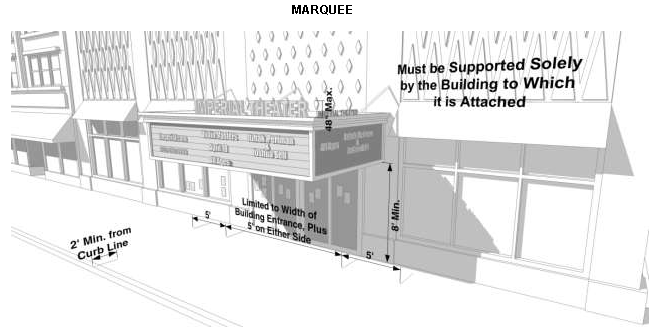
Marquees must be supported solely by the building to which they are attached. No exterior columns or posts are permitted as supports.
iii.
The roof of a marquee may not be used for any purpose other than to form and constitute a roof and must be constructed of noncombustible material.
iv.
Water from the roofs of a marquee may not drain, drip, or flow onto the surface of a public right-of-way. Sufficient downspouts, drains, and gutters must be installed as part of each marquee to prevent water from the roof of the marquee from flowing onto the surface of a public right-of-way.
v.
Marquees must be erected over a building entrance and are limited to the width of the building entrance with an additional five feet on each side of the entrance doors.
vi.
All marquees must maintain a minimum vertical clearance of eight feet, and the roof of the marquee structure must be erected below the second floor windowsill.
vii.
Marquees may encroach into the public right-of-way but must be located at least two feet from the curb line.
viii.
Marquees are permitted lettering attached to and located above the roof of a marquee to a maximum height of 48 inches.
ix.
Marquees may be internally illuminated.
(g)
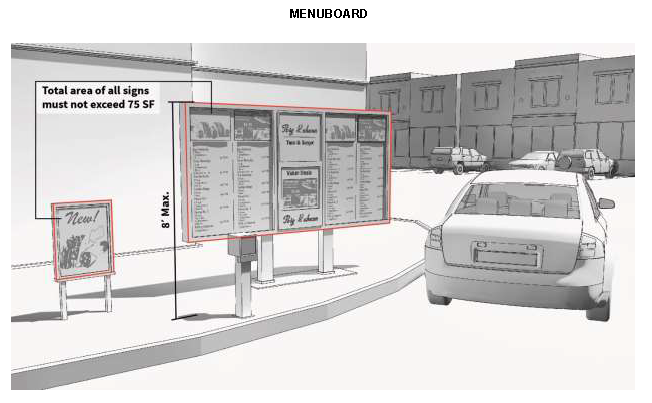
Menuboard.
i.
Menuboards are permitted for all drive-through facilities.
ii.
Menuboards are limited to a maximum of one per drive-through lane.
iii.
Menuboards are limited to 75 square feet in sign area and eight feet in height. The menuboard may be designed as separate freestanding signs grouped together and may include the use of preview boards designed as separate freestanding signs installed a distance earlier in the drive-through lane, however the total area of all signs must not exceed 75 square feet.
iv.
Menuboards are permitted an additional ten square feet of sign area for temporary signs attached to the top or sides of the menuboard.
v.
Menuboards must be located a minimum of 15 feet from any residential district lot line.
vi.
Menuboards may be internally illuminated. Menuboards may also contain an electronic screen that displays order information for each customer.
(h)
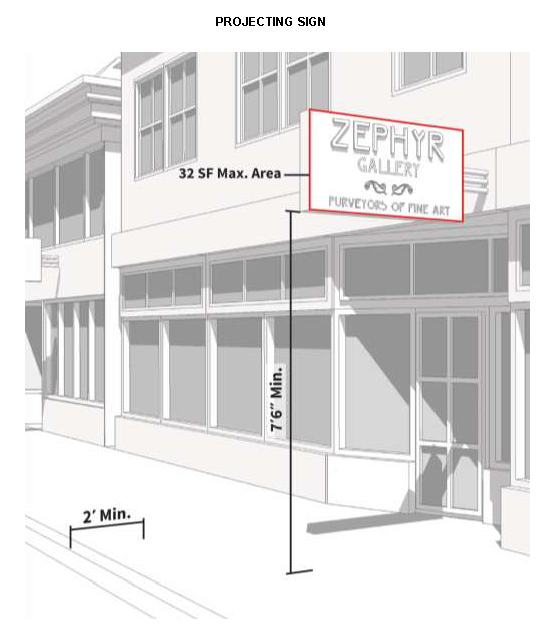
Projecting sign.
i.
Projecting signs are permitted for non-residential uses in all non-residential districts.
ii.
One projecting sign is permitted per establishment with frontage on a street. For a corner lot, one projecting sign is permitted for each street frontage.
iii.
Projecting signs may encroach into the public right-of-way but must be located at least two feet from the curb line.
iv.
Projecting signs must maintain a minimum vertical clearance of seven feet, six inches feet. No projecting sign affixed to a building may project higher than the building height, including the sign support structure.
v.
Projecting sign area is limited to a maximum sign area of 32 square feet.
vi.
Projecting signs must be constructed of wood or simulated wood, metal, durable, weather-resistant material like canvas, canvas-like material, nylon or vinyl-coated fabric, plastic, or high-density urethane (HDU) foam board or similar durable foam construction. Projecting signs constructed of canvas or similar material must be mounted so that they are held taut between support posts.
vii.
Projecting signs may be internally or externally illuminated. If externally illuminated, all lighting must be directed onto the sign face from above.
(i)
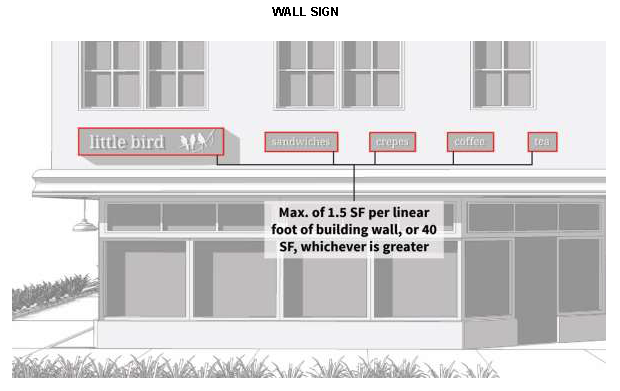
Wall sign.
i.
Wall signs are permitted for all non-residential uses.
ii.
For a single tenant structure, the maximum total wall sign area is one square foot per linear foot of building wall where the wall sign(s) will be mounted or 40 square feet, whichever is greater. The square footage from different facades cannot be combined to create a larger sign on any one facade.
iii.
For a structure that contains multiple tenants, each tenant that has exterior business frontage is permitted a total wall sign area of one square foot per linear foot of business frontage or 40 square feet, whichever is greater, along their individual frontage(s).
iv.
The number of individual wall signs on a facade is not limited, however the cumulative sign area of all signs on a facade cannot exceed the maximum allowable total wall sign area per facade.
v.
Wall signs may be internally or externally illuminated. If externally illuminated, all light must be directed onto the sign face.
vi.
Wall signs must be safely and securely attached to the building wall. Wall signs must be affixed flat against the wall and must project 12 inches or less from the building wall. Wall signs may encroach into the public right-of-way for no more than 12 inches.
vii.
No wall sign affixed to a building, including sign support structure, may project beyond the ends or top of the wall or higher than the roofline of the structure to which it is attached.
viii.
Wall signs must be constructed of wood or simulated wood, metal, durable, weather-resistant material like canvas, canvas-like material, nylon or vinyl-coated fabric, plastic, or high-density urethane (HDU) foam board or similar durable foam construction. Wall signs constructed of material must be mounted so that they are held taut against the wall.
ix.
Wall signs are permitted on architectural appurtenances, such as chimneys or penthouses, which are part of the structure. Wall signs must not cover any window, windowsill, transom sill, or significant architectural feature.
x.
Ghost signs are considered wall signs. Existing ghost signs are exempt from these requirements and deemed conforming. Ghost signs may be maintained and repainted but no new information or images may be added to the existing sign. No new wall signs may be painted on structures.
(Ord. No. 9301A, 9-26-18)

