
Rome City Zoning Code
ARTICLE XIV
- OFF-STREET PARKING AND LOADING
Sec. 80-14.1. - General application.
(a)
Existing facilities.
i.
The existing number of off-street vehicle, bicycle, and loading spaces may not be reduced below the minimum requirements of this code. If the number of existing spaces is already less than the requirements of this article, it may not be further reduced.
ii.
If a building permit was lawfully issued prior to the effective date of this code, and if substantial construction has begun within 90 days of the issuance of a permit, the number of off-street vehicle, bicycle, and loading spaces is that required by building permit and supersedes the requirements of this code.
(b)
New construction. The construction of a new principal building must provide all required parking unless the site is eligible for a parking exemption or other parking flexibility allowed by this article.
(c)
Change in use. When the existing use of a structure or land is changed to a new use, parking and bicycle spaces must be provided as required for the new use, except as described below:
i.
No additional vehicle and bicycle parking spaces are required if the change in use would result in an increase of spaces of less than ten percent. This also applies to a simultaneous change in use of a group of uses on the same lot which together result in a need for an increase in vehicle and bicycle parking spaces of ten percent or more. The ten percent increase is calculated by dividing the number of additional spaces required by the number of spaces required before the increase.
ii.
The change in use is eligible for a parking exemption per section 80-14.10.
iii.
Shared parking is provided per section 80-14.12.
(d)
Change in intensity of use. Whenever the intensity of a use is increased based on an increase in the number of dwelling units, floor area, seating capacity, or other unit of measurement used to calculate the number of required number of vehicle and bicycle parking spaces, additional spaces must be provided for that increase, except as described below:
i.
Whenever there is an increase in the intensity of a use that creates a need for additional vehicle and bicycle parking spaces of ten percent or more, the additional spaces are required. No additional vehicle and bicycle parking spaces are required if the increase in intensity would result in an increase of spaces of less than ten percent. This also applies to a simultaneous increase in intensity of a group of uses on the same lot which together result in a need for an increase in vehicle and bicycle parking spaces of ten percent or more. The ten percent increase is calculated by dividing the number of additional spaces required by the number of spaces required before the increase.
ii.
An increase in the intensity of a use is eligible for a parking exemption per section 80-14.10.
iii.
Shared parking is provided per section 80-14.12.
(e)
Provision of additional spaces and parking maximums. The establishment of additional off-street parking, bicycle, or loading facilities above the minimum required by this code is not prohibited unless specifically limited by parking maximums.
(f)
Use of parking facilities.
i.
The sale, repair, or dismantling or servicing of any vehicles, equipment, materials, or supplies, or the display of goods in off-street parking areas is prohibited, unless otherwise permitted by this code.
ii.
The property owner is responsible for ensuring that parking and loading facilities are only used by tenants, employees, visitors, or other authorized persons.
iii.
Space allocated to any off-street loading space may not be used to satisfy the requirement for any off-street vehicle or bicycle parking space or access aisle or portion thereof. Conversely, the area allocated to any off-street vehicle or bicycle parking space may not be used to satisfy the replacement for any off-street loading space or portion thereof.
(g)
Required plans. Building permits will not be issued until there is an approved plan identifying required vehicle and bicycle parking and loading facilities in accordance with this article.
(h)
Unlawful removal. It is unlawful to discontinue prior approved required vehicle and bicycle parking and loading facilities without establishing alternate facilities that meet the requirements of this article. Vehicle and bicycle parking and loading facilities meeting the requirements of this article must be maintained as long as the use they serve is in existence.
(Ord. No. 9301A, 9-26-18)
Sec. 80-14.2. - Computation of requirements.
This section describes how the number of vehicle, bicycle, and loading spaces are calculated based upon the requirements of this article. The total number of required vehicle and bicycle parking and loading spaces is based upon the requirements for the principal use or uses located on the lot.
(a)
Where multiple uses with different parking requirements occupy the same structure or lot, the required vehicle and bicycle parking and loading spaces is the sum of the requirements for each use computed separately, unless otherwise permitted by this code.
(b)
A fraction of less than one-half is disregarded, and a fraction of one-half or more is counted as one parking or loading space.
(c)
For uses where patrons or spectators occupy benches, pews or open floor areas used for service, each 48 linear inches of benches, pews, or permanent seating areas, or five square feet of open floor areas used for seating is counted as one seat for the purpose of determining the requirement for the required number of spaces.
(Ord. No. 9301A, 9-26-18)
Sec. 80-14.3. - Required off-street vehicle and bicycle parking spaces.
(a)
General requirements.
i.
Except as otherwise provided in this code, the minimum and maximum number of off-street vehicle and bicycle parking spaces to be provided for each use is listed in table 80-14-1: off-street vehicle and bicycle parking requirements. If a space is blank, that indicates that there is no minimum required and/or no maximum limitation.
ii.
Table 80-14-1 lists parking requirements for each use. In some cases, uses that are considered part of a generic use category are listed with specific vehicle parking requirements. These specific uses are listed only for the purposes of this section and do not indicate whether such uses are permitted or special uses within any district. Certain uses listed within the districts are not listed in table 80-14-1 and therefore do not have vehicle parking requirements.
iii.
Certain uses listed within table 80-14-1 are required to provide bicycle parking spaces. Of those uses required to provide bicycle spaces, some are also required to provide long-term spaces, where bicycles will be left for longer periods of time and require a safe and weatherproof storage area. The required number of long-term spaces is shown as a percentage of the required total bicycle spaces. All other required bicycle spaces must be designed as short-term spaces, which are areas where bicycles will be left for short stops, requiring a high degree of convenience.
iv.
In all cases where bicycle parking is required, a minimum of two bicycle spaces must be provided. After the first 25 required bicycle parking spaces are provided, additional bicycle parking spaces may be provided at a 50 percent reduction. There is no maximum number of bicycle spaces required.
v.
Where bicycle parking space requirements indicate "Over 10,000 sf GFA" or other number threshold, this means that bicycle spaces are required only for structures over a certain gross floor area. When this threshold applies, bicycle parking space requirements are calculated on the basis of the entire gross floor area.
vi.
Motorcycle and scooter parking may be substituted for up to four automobile spaces or five percent of the required parking spaces, whichever is less.
(b)
Provision of car- and bike-share facilities.
i.
Spaces within parking lots and structures may include designated parking spaces for car-share facilities. A car-share facility is a membership-based car-sharing service that provides automobile rental to members, billable by the hour or day, and is not considered a vehicle rental establishment. Spaces reserved for car-share facilities may count toward minimum parking requirements of this code.
ii.
Spaces within parking lots and structures may include designated areas for bike-share facilities. A bike-share facility provides bicycle rentals to the public and it is not considered a vehicle rental establishment. When a minimum of 15 bicycles are provided for rental, such bike-share facilities may substituted for up to four automobile spaces or five percent of the required parking spaces, whichever is less.
(c)
Provision of electric vehicle charging stations. Spaces within parking lots and structures may include designated parking spaces for electric vehicle charging. Spaces reserved for electric vehicle charging count toward minimum parking requirements of this code but do not count toward any parking maximums.
(d)
Multi-tenant retail center parking calculation. A multi-tenant retail center is defined as a group of three or more separate commercial establishments, primarily retail, but also including personal service, restaurant, office, and similar non-residential uses, that is planned, owned, and/or managed as a single property. The two main configurations of multi-tenant retail centers are large shopping centers and strip centers.
i.
Multi-tenant retail centers under 20,000 square feet in gross floor area require a minimum of one parking space per 500 square feet of gross floor area, rather than calculation by the individual uses.
ii.
Multi-tenant retail centers of 20,000 square feet or more in gross floor area are subject to a parking maximum of one parking space per 250 square feet of gross floor area, rather than calculation by the individual uses. In addition, multi-tenant retail centers of 20,000 square feet or more in gross floor area require one bicycle space per 2,500 square feet of gross floor area.
iii.
Multi-tenant retail centers are subject to a maximum parking limitation of 125 percent of the required minimum parking.
(Ord. No. 9301A, 9-26-18)
Sec. 80-14.4. - Required off-street loading spaces.
(a)
Off-street loading spaces must be provided for any use that distributes or receives materials or merchandise by trucks or other commercial vehicles in accordance with table 80-14-2: off-street loading requirements. In the case of multi-tenant developments, required loading spaces are calculated on the basis of each individual tenant. For example, if only one commercial tenant of a multi-tenant development is over 10,000 square feet, only one loading space is required; if all tenants are under 10,000 square feet, no loading is required.
(b)
Structures that are 50 years of age or older as of the effective date of this code and do not currently have any loading areas are exempt from off-street loading requirements.
(c)
No structure is required to provide more than five loading spaces.
(Ord. No. 9301A, 9-26-18)
Sec. 80-14.5. - Location of vehicle parking spaces.
(a)
Residential uses.
i.
All required off-street vehicle parking spaces for residential uses and the residential component of mixed-use developments must be located on the same lot as the structure.
ii.
For single-family (detached and attached) and two-family dwellings, required vehicle parking spaces are permitted in private driveways, but must not encroach onto the public right-of-way.
iii.
Tandem vehicle parking is permitted for residential uses. All tandem spaces must be assigned to the same dwelling unit.
iv.
Single-family (attached and detached) and two-family dwellings are permitted one paved parking pad, subject to the following:
a.
Parking pads are limited to a maximum of 400 square feet in aggregate.
b.
The maximum impervious surface requirement for the lot may not be exceeded to accommodate a parking pad. Parking pads may be constructed of a permeable surface.
c.
Parking pads must be accessed by the driveway.
d.
Parking pads are permitted in any yard. Parking pads must be located a minimum of three feet from any interior side or rear lot line. When located in the front yard and corner side yard they must be directly attached to the main driveway; however, they are not permitted to encroach into the required front or corner side setback.
(b)
Non-residential uses.
i.
Vehicle parking for a non-residential use may be located on the same lot or within 500 feet of the use served. The maximum 500-foot distance restriction does not apply to valet parking services. However, valet parking services must provide evidence of a lot reserved for vehicle parking.
ii.
In the I district, required parking is fulfilled by all parking areas on the campus, including non-contiguous areas. In these districts, the 500-foot distance restriction does not apply on the campus.
(Ord. No. 9301A, 9-26-18)
Sec. 80-14.6. - Design of parking facilities.
(a)
Dimensions of vehicle parking spaces.
i.
Off-street vehicle parking space dimensions must meet the standards of figure 14-1. All vehicle parking spaces must have a minimum vertical clearance of seven feet six inches.
ii.
Motorcycle and scooter parking spaces must measure at least four feet in width by eight feet in length and must be identified or designated through the use of signs or pavement markings.
Figure 80-14-1: Parking Lot Dimensions
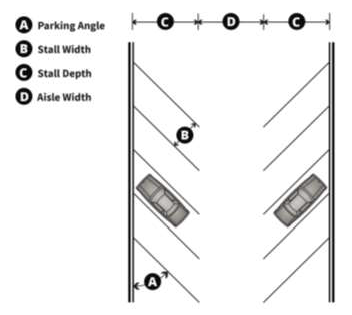
1 Two-way traffic.
(b)
Circulation requirements for off-street vehicle parking areas.
i.
Each off-street vehicle space must open directly upon an aisle or driveway of adequate width to provide access to a vehicle parking space. All off-street parking facilities must provide access in a manner that least interferes with traffic movement. For all uses except single-family detached and two-family dwellings, the parking area must be designed so that the driver of the vehicle proceeds forward into traffic rather than backs out.
ii.
All required off-street parking facilities must have vehicular access from a street, alley, driveway, or cross-access easement.
iii.
Parking areas should be designed to utilize 90 degree parking if possible and orient parking rows perpendicular to the building to enhance pedestrian safety.
iv.
Clearly delineated crosswalks of paving, brick paver, bituminous brick pattern stamping, or painted striping must connect landscaped areas and parking lot islands to building entrances to improve safe passageway for pedestrians. Curb cuts must be included on landscaped areas or islands where such crosswalks are located.
v.
All parking lots must comply with the "ADA Accessibility Guidelines for Buildings and Facilities" regulations issued by federal agencies under the Americans with Disabilities Act (ADA) and section 1106 of the Building Code of New York State for the amount and design of accessible vehicle parking spaces required in parking lots and structures.
(c)
Striping. Off-street parking areas must be marked by painted lines a minimum of four inches in width and maintained in clearly visible condition. Signs or markers should be used as necessary to ensure efficient and safe circulation within the lot. Vehicle parking spaces for handicapped persons must be identified with the appropriate sign and visible at all times of the year, regardless of plant growth or similar conditions.
(d)
Curbing and wheel stops. Wheel stops or curbing are required when a parking space abuts a pedestrian walkway, landscape area, or fences. Breaks in curbing may be provided to allow for drainage into landscape areas to absorb stormwater.
(e)
Surfacing. All parking lots must be surfaced with a durable all-weather material, such as asphalt, concrete, turfstone, or other product, as approved by the codes enforcement officer or, if site-plan review is required, by the planning board. Pervious paving may be allowed, subject to permission by the codes enforcement officer or, if site-plan review is required, by the planning board.
(f)
Drainage. Off-street parking facilities must be drained to eliminate standing water and prevent damage to abutting property and/or public streets and alleys. All drainage must comply with the requirements of this code for stormwater management.
(g)
Maintenance. Off-street parking areas must be maintained in a clean, orderly, and dust-free condition at the expense of the owner or lessee.
(h)
Lighting. Parking lot lighting not exceeding 24 feet in height is required to provide safe access for pedestrians. Outdoor lighting and aerial-mounted floodlighting must be shielded from above in such a manner that the bottom edge of the shield is below the light source. Said lighting must be shielded so that the direct illumination is confined to the property boundaries of the light source. Ground-mounted floodlighting or light projection above the horizontal plane is prohibited between midnight and sunrise. A plan for proposed lighting must be submitted to the codes enforcement officer for review and approval prior to final site plan approval.
(i)
Landscape and screening. All parking lots must be landscaped and screened in accordance with article XV.
(j)
Hydraulic lifts. All hydraulic lifts must be located within a parking structure.
(k)
Turnaround space. Dead end parking lots are prohibited. A turnaround space is required and the minimum depth and width of such turnaround space must be nine feet and designated with signs stating "No Parking."
(Ord. No. 9301A, 9-26-18)
Sec. 80-14.7. - Driveway design.
(a)
Single-family detached and two-family dwelling driveways.
i.
A residential driveway that provides access to a detached or attached garage is limited to a maximum width of 12 feet. A driveway apron, the width of the garage, as measured from the garage walls, is permitted to extend for a distance (depth) of 25 feet as measured perpendicular from the garage doors before tapering back at an angle of no more than 45 degrees to the required driveway width for access to the additional spaces. If the distance from the additional depth to the lot line is 15 feet or less, tapering is not required.
ii.
A residential driveway may be located three feet from any interior side or corner side lot line, unless a shared driveway is established per item iii., below.
iii.
A residential driveway may be shared by adjacent lots. This shared driveway location is only allowed if agreed to by the owners of each lot, and the agreement is recorded as a shared driveway servitude on each plat of survey.
iv.
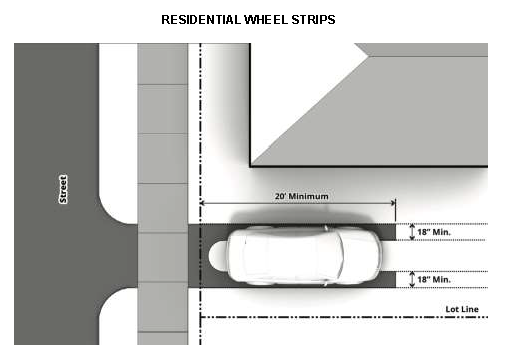
Single-family detached and two-family dwellings are permitted to construct driveways that consist of two concrete wheel strips, each of which is at least 18 inches wide and at least 20 feet long. Space between wheel strips must be planted with turf or groundcover; gravel is prohibited.
v.
Residential driveways must be surfaced with a durable all-weather material, such as asphalt, concrete, turfstone, or other product. Pervious paving may be allowed, subject to permission by the codes enforcement officer or, if site-plan review is required, by the planning board. Gravel is prohibited.
(b)
Single-family attached and multi-family dwellings, and non-residential driveways.
i.
All parking lots must be surfaced with a durable all-weather material, such as asphalt, concrete, turfstone, or other product. Pervious paving may be allowed, subject to permission by the codes enforcement officer or, if site-plan review is required, by the planning board. Gravel is prohibited.
ii.
With the exception of loading berths, driveways are limited to a maximum width of 12 feet for one-way drives, and a maximum of 24 feet for two-way drives.
(c)
Driveways in the outside district. The driveways providing ingress and egress to lots in the outside district served by gravel roadways may be surfaced with gravel. However, any driveway providing ingress/egress to a residential property in the outside district served by a hard surface roadway must consist of a hard surface for, a minimum, from the roadway and of the first 15 feet from the lot line into the property.
(d)
Cross-access easements.
i.
Adjacent non-residential uses, including mixed-use development, with dedicated parking areas are encouraged to provide a cross-access drive to allow circulation between sites. Property owners are encouraged to pursue cross-access with adjacent property owners at the time of development. If cross-access is provided, the codes enforcement officer may require that the property owner provide proof that adjacent property owners have been contacted in writing regarding the provision of cross-access.
ii.
Joint use driveways and cross-access easements must incorporate site design features to make it visually obvious that the abutting properties are tied together.
iii.
Pursuant to this section, property owners who establish cross-access easements must:
a.
Record an easement allowing cross-access to and from properties served by the joint use driveways and cross-access easement.
b.
Any pre-existing driveways must be closed and eliminated after construction of the joint-use driveway.
c.
Record a joint maintenance agreement defining the maintenance responsibilities of each property owner.
(Ord. No. 9301A, 9-26-18)
Sec. 80-14.8. - Design of bicycle parking spaces.
(a)
Location.
i.
The bicycle parking area must be convenient to building entrances and street access, but may not interfere with normal pedestrian and vehicle traffic. Bicyclists must not be required to travel over stairs to access parking.
ii.
When required to provide bicycle spaces, certain uses are also required to provide long-term spaces, where bicycles will be left for longer periods of time and require a safe and weatherproof storage area. The required number of long-term spaces is shown as a percentage of the required total bicycle spaces in table 80-14-1. All other required bicycle spaces must be designed as short-term spaces, which are areas where bicycles will be left for short stops, requiring a high degree of convenience. Nothing in this code prevents the provision of additional bicycle spaces in excess of that required; long-term spaces are required only in the amount calculated by the minimum number of spaces in table 80-14-1, not of the total number of short-term spaces, which may exceed that required by the table.
iii.
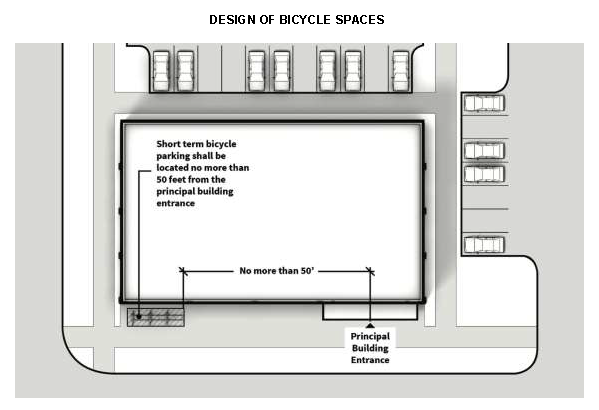
Short-term bicycle parking spaces must be located no more than 50 feet from the principal building entrance and at the same grade as the sidewalk or an accessible route. The property owner may make arrangement with the codes enforcement officer to place required bicycle parking spaces in the public right-of-way so long as a minimum of five feet of clearance is maintained in the pedestrian way and the bicycle spaces are located within 50 feet of the lot. Required bicycle parking spaces may be located in the public right-of-way, with approval from the codes enforcement officer, if one or more of the following conditions are met:
a.
The use does not provide vehicle parking on-site.
b.
The addition of bicycle parking on the site would reduce the number of parking spaces below that required by this code.
c.
Bicycle parking spaces in the right-of-way are shared by uses located on the same blockface. In such cases, the number of bicycle spaces required is cumulative of that required by all uses sharing such spaces.
iv.
Long-term bicycle parking spaces must be located in a covered area that is easily accessible from the public-right-of-way and building entrances.
v.
Required bicycle parking for residential uses may be provided in garages, storage rooms, and other resident-accessible, secure areas. Spaces within dwelling units or on balconies do not count toward satisfying bicycle parking requirements.
(b)
Design.
i.
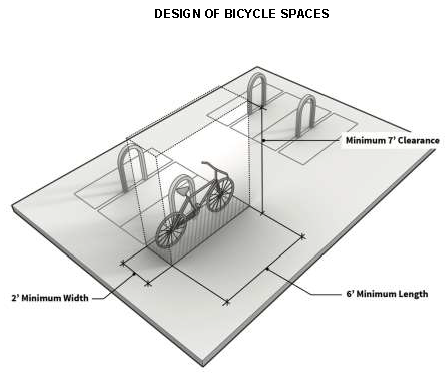
Required bicycle spaces must provide each bike space within a row of bicycle parking a minimum of two feet in width by six feet in length, with a minimum vertical clearance of seven feet. Each required bicycle parking space must be accessible without moving another bicycle. There must be an aisle at least five feet wide between each row of bicycle parking to allow room for bicycle maneuvering.
ii.
The area devoted to bicycle parking must be surfaced as required for vehicle parking areas.
iii.
All long-term bicycle parking spaces must be located indoors or fully covered, such as by the use of an overhang or covered walkway, weatherproof outdoor bicycle lockers, or an indoor storage area. Where bicycle parking is not located within a building or locker, the cover design must be of permanent construction, designed to protect bicycles from rainfall, snow, and inclement weather, and with a minimum vertical clearance of seven feet.
iv.
Bicycle parking racks must permit the bicycle frame and one wheel to be locked to the rack and support the bicycle in a stable position. Structures that require a user-supplied locking device must be designed to accommodate U-shaped locking devices. All lockers and racks must be securely anchored to the ground or a structure to prevent the racks and lockers from being removed from the location.
v.
If required bicycle parking facilities are not visible from the street or principal building entrance, signs must be posted indicating their location.
(Ord. No. 9301A, 9-26-18)
Sec. 80-14.9. - Design of off-street loading spaces.
(a)
Location. All off-street loading spaces must be located on the same lot as the use served. No off-street loading spaces may project into a public right-of-way. No off-street loading space is permitted in a front yard.
(b)
Dimensions.
i.
All required off-street loading spaces must be a minimum of 12 feet in width, a minimum of 35 feet in length, exclusive of aisle and maneuvering space, and have a minimum vertical clearance of 15 feet.
ii.
Structures that are 50 years of age or older and maintain loading spaces that do not comply with the dimensions of this section are deemed legally conforming in terms of loading space dimensions. If new loading spaces are constructed, such spaces may be designed to match the dimensions of existing spaces rather than the requirements of this section.
(c)
Surfacing. All off-street loading spaces must be paved with a durable, all-weather material or pervious paving that can support anticipated loads.
(d)
Drainage and maintenance.
i.
Off-street loading facilities must be drained to eliminate standing water and prevent damage to abutting property and/or public streets and alleys. All drainage must comply with the requirements of this code for stormwater management.
ii.
Off-street loading areas must be maintained in a clean, orderly, and dust-free condition at the expense of the owner or lessee.
(e)
Access. Each required off-street loading space must be designed with adequate means of vehicular access to a street or alley and in a manner that will minimize interference with traffic movement.
(f)
Lighting. Parking lot lighting must meet the exterior lighting standards of section 80-14.6(h).
(g)
Landscape and screening. All parking lots must be landscaped and screened in accordance with article XII.
(Ord. No. 9301A, 9-26-18)
Sec. 80-14.10. - Parking exemptions.
(a)
Applicability. When a use is exempt from vehicle parking requirements by this article, bicycle parking is exempted as well. If a use that is exempt from vehicle parking voluntarily provides parking, bicycle parking, as required by this article, is required.
(b)
Exemptions from parking requirements.
i.
Non-residential uses of 2,500 square feet or less of gross floor area in the commercial districts are exempt from all off-street vehicle parking requirements. Non-residential uses of 2,500 square feet of gross floor area or less located within a multi-tenant retail center are not eligible for this exemption and must provide the required parking.
ii.
Existing structures as of the effective date of this code that currently do not provide any parking due to lack of sufficient space on the lot to accommodate parking are exempt from all off-street vehicle parking requirements regardless of any change in use or intensity or use. Once the principal building is demolished, this exemption is no longer valid. In addition, if the lot area is expanded (e.g., the adjoining lot is purchased), this exemption is no longer valid.
iii.
In the C-3 district no off-street vehicle parking is required, but bicycle parking is necessary.
(Ord. No. 9301A, 9-26-18)
Sec. 80-14.11. - On-street parking credit permission.
(a)
In the commercial districts, on-street parking spaces located along the front or corner side property line may be counted toward required off-street parking spaces for commercial uses. New on-street parking spaces may also be created to count toward required off-street parking but must be located along the corner side or front lot line, and must be accessible 24 hours a day.
(b)
Where on-street parking spaces are unmarked, the number of parking spaces is calculated by dividing the length of the on-street parking area located parallel to property line of the property under consideration divided by 18, where a fraction of less than one-half is disregarded, and a fraction of one-half or more is counted as one space.
(c)
Where on-street parking spaces are marked, each marked space counts as one required parking space, including any space where at least 50 percent of the width is located along the lot line of the property under consideration.
(d)
Any subsequent change in the availability of on-street parking used to meet off-street parking requirements requires proof that the minimum parking requirements, per this section, have been met. When on-street parking is made unavailable, the use has 90 days from that date to accommodate all required off-street parking.
(Ord. No. 9301A, 9-26-18)
Sec. 80-14.12. - Shared parking.
(a)
Off-street parking spaces for separate uses may be provided collectively if the aggregate number of spaces provided is not less than the sum of the spaces required in table 80-14-3: shared parking calculation. Multi-tenant retail centers are not eligible for shared parking. Mixed-use developments, multi-use office parks, and similar types of development, and property owners that establish cross-access easements are all eligible for shared parking.
(b)
Table 80-14-3 is applied in the following manner:
i.
The required number of spaces for each use is calculated according table 80-14-1.
ii.
The required number of spaces for each use is then applied to the percentages for each timeframe according to the appropriate land use category in table 80-14-3 to determine the number of required spaces. This is done for each timeframe category.
iii.
The numbers are summed for within each timeframe and the highest sum total in a timeframe is the required number of spaces.
iv.
Shared parking may be located off-site so long as it complies with the location requirements of this article.
v.
The following is a sample calculation of how this provision is applied:
Sample Calculation
Example: multi-use office park with the following uses within the development; based on current parking requirements, the number of required spaces is:
Using the shared parking calculation, these numbers are plugged into the table and using the percentages allotted to each land use for each time of day, are calculated as total spaces required per timeframe.
With a straight parking calculation, 190 spaces are required. However, the shared parking provision allows this example multi-use office park to be constructed by-right with 154 spaces (the highest number of spaces within the various timeframes—The 7:00 a.m. to 6:00 p.m. timeframe). This is because these timeframe calculations take into account the times of day the various uses utilize the most parking.
(Ord. No. 9301A, 9-26-18)
Sec. 80-14.13. - Storage of commercial vehicles.
(a)
No commercial vehicle may be parked outdoors on a lot in a residential district, with the exception of vehicles engaged in loading or unloading or current work being done to the adjacent premises. This does not include standard size passenger motor vehicles including, but not limited to, vans, sports utility vehicles (SUVs), standard passenger size livery vehicles, and pick-up trucks, which are permitted to be stored or parked outdoors overnight on lots in residential districts. This includes vehicles owned and used for commercial purposes by the occupant of a dwelling or guest, provided that the vehicle is stored or parked in a permitted parking area. Permitted commercial vehicles may include the logo of the commercial business painted on or applied to the vehicle.
(b)
All other commercial vehicles including, but not limited to, semi-truck tractor units, with or without attached trailers, commercial trailers, box vans and box trucks, buses, tow trucks, construction vehicles, livery vehicles that exceed standard passenger vehicle size, such as limousines, or other large commercial vehicles are not permitted to be stored or parked outside overnight on a lot in a residential district.
(c)
For non-residential uses in the non-residential districts, commercial vehicles with the logo of the commercial business painted on or applied to the vehicle that are being operated and stored in the normal course of business, such as signs located on delivery trucks, promotional vehicles, moving vans, and rental trucks, are permitted to be stored on the lot in areas related to their use as vehicles, provided that the primary purpose of such vehicles is not the display of signs. All such vehicles must be in operable condition. Signs placed or painted on parked vehicles where the only purpose is to advertise a product or service, or to direct the public to a business or activity located on or off the premises, are prohibited.
(Ord. No. 9301A, 9-26-18)
Sec. 80-14.14. - Off-season storage of recreational vehicles.
(a)
In the inside district, the off-season storage of recreational vehicles, recreational craft, or recreational vessels is permitted in the rear yard only and is limited to one vehicle, craft, or vessel.
(b)
In the outside district, where the minimum lot size is met or exceeded, off-season storage of recreational vehicles, recreational craft or recreational vessels is permitted in the rear yard only and is limited to two vehicles, craft, or vessels per parcel. If the lot does not meet or exceed the minimum lot size, off-season storage of recreational vehicles, recreational craft or recreational vessels are permitted in the rear yard only and are limited to one vehicle, craft, or vessel.
(c)
No more than one unregistered vehicle or trailer is allowed on any residentially zoned lot, other than in a completely enclosed structure. The unregistered vehicle must be stored in the rear yard and must be fully covered with a tarp or fully enclosed with a six-foot high fence. An unregistered vehicle is allowed in the front yard of a residentially zoned lot for the purpose of advertisement of sale for a period of no more than 30 days. This vehicle must be owned by the owner of the property on which the car is displayed and in good condition, defined as having fully inflated tires, all doors, including the hood and truck, intact, and no broken or missing windows.
(d)
There is no limit on the number of recreational vehicles that may be stored in a lot when all are stored within a fully enclosed structure. Temporary storage tents for recreational vehicles are prohibited.
(Ord. No. 9301A, 9-26-18)

